

Navigating the Path to CyberPeace: Insights and Strategies
Featured #factCheck Blogs

Executive Summary
Social media users are claiming that Indian Army Chief General Dhiraj Seth dances with soldiers’ wives and attended a dance competition organised by the Border Security Force Wives Welfare Association (BWWA). CyberPeace Research found no credible sources to substantiate the viral claim. Our research revealed that the viral image is related to his visit to Nepal. According to reports, he travelled to Nepal on his first foreign visit after taking charge of the Indian Army, where he was welcomed by senior Nepal Army officials. During the visit, he was also scheduled to receive the honorary rank of General of the Nepal Army. However, his photograph is being linked to a dance video from an event organised by the Central Armed Police Forces (CAPF), accompanied by objectionable claims about him. Our research found no credible evidence confirming that General Dhiraj Seth attended the event or was associated with the activities shown in the video. Therefore, linking his photograph from the Nepal visit to the dance video is misleading.
Claim:
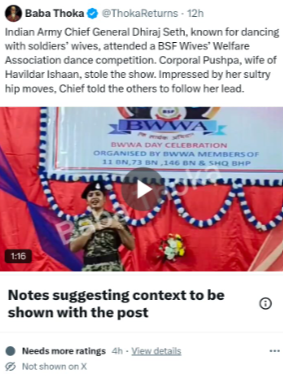
It is being claimed on social media that Indian Army Chief General Dhiraj Seth attended a dance competition organised by the BSF Wives Welfare Association (BWWA), where he was impressed by a woman’s dance performance and asked other participants to follow her lead.
https://x.com/ThokaReturns/status/2110854323760693485
Fact Check
To verify the viral claim, we conducted a reverse image search using keyframes from the video. During this process, we found the video on Instagram. The text “BSF Wives Welfare Association” was visible on the backdrop behind the stage. However, there was no mention of Army Chief General Dhiraj Seth anywhere in the video.
https://www.instagram.com/reels/Ddl7oTEgnf7/
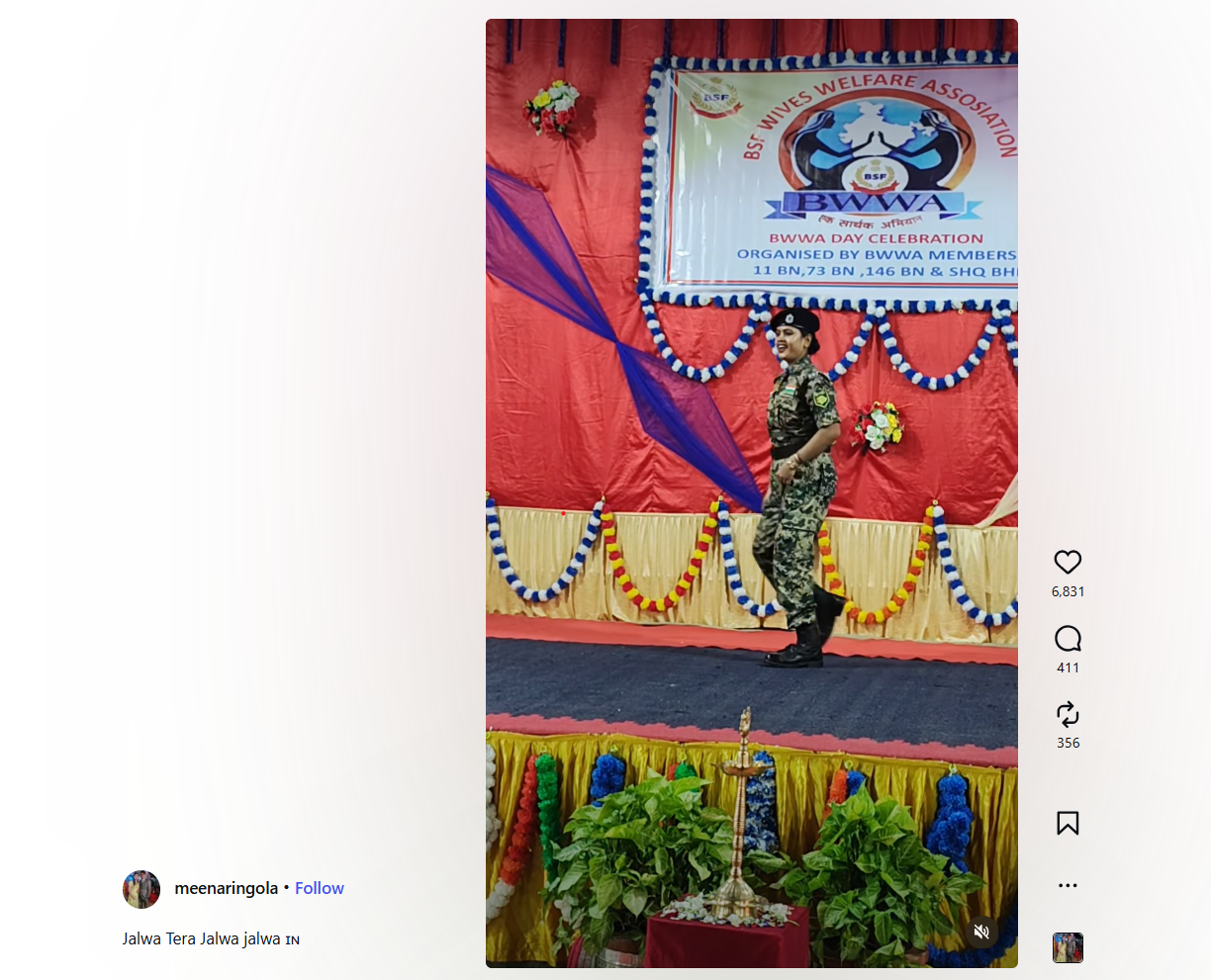
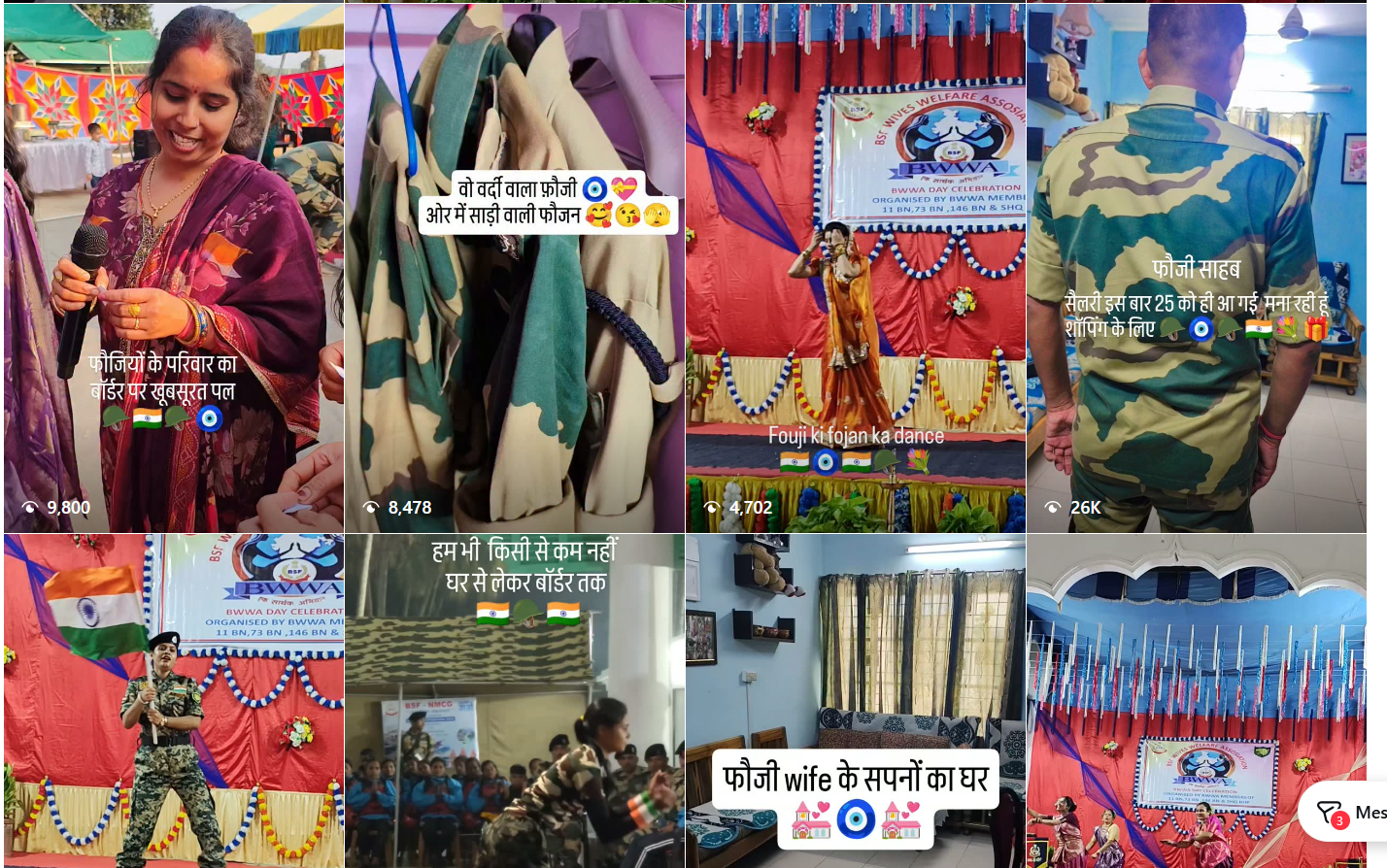
After reviewing these videos, our research found no evidence to substantiate the claim that General Dhiraj Seth attended an event organised by the BSF Wives Welfare Association or danced at the event. His photograph is being linked to the dance video, but no credible evidence supporting this claim was found.
During our research, we found the original video of Army Chief General Dhiraj Seth shared by ANI. According to the report, General Dhiraj Seth arrived in Nepal on a three-day official visit aimed at strengthening defence ties between the two countries.
https://www.instagram.com/reels/DcGxzLPExR5/

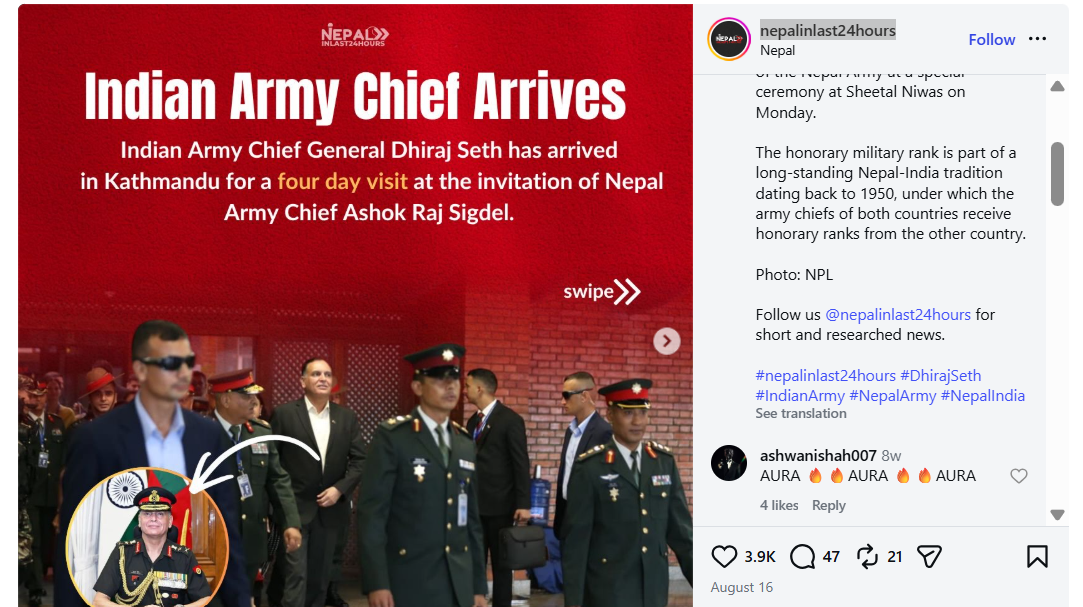
In the final stage of our research, we found a report on an Instagram account named ‘nepalinlast24hours’. According to the report, Indian Army Chief General Dhiraj Seth arrived in Kathmandu on his first foreign visit after taking command of the Indian Army on June 30, 2026. He was welcomed by senior Nepal Army officials at Tribhuvan International Airport.
The report stated that during his four-day visit, General Seth was scheduled to meet Nepal’s Prime Minister Balendra Shah and Nepal Army Chief Ashok Raj Sigdel. Additionally, he was scheduled to be conferred with the honorary rank of General of the Nepal Army at a special ceremony at Sheetal Niwas on Monday.This tradition between India and Nepal dates back to 1950. Under the arrangement, the army chiefs of both countries are conferred with honorary military ranks in each other’s armies.
https://www.instagram.com/p/DcGbgm0jUBH/?dlrf=MXFndzM5dGp4ZTh5OA%3D%3D
Conclusion
Our research found that the viral photograph of Indian Army Chief General Dhiraj Seth is related to his visit to Nepal. According to reports, he travelled to Nepal on his first foreign visit after taking command of the Indian Army, where he was welcomed by senior Nepal Army officials. During the visit, he was also scheduled to be conferred with the honorary rank of General of the Nepal Army.However, his photograph is being linked on social media to a dance video from an event organised by the Central Armed Police Forces (CAPF), accompanied by objectionable claims about him. Our research found no credible evidence confirming General Dhiraj Seth’s presence at the event or his association with the activities shown in the video. Therefore, linking his photograph from his Nepal visit to the dance video is misleading.

Executive Summary
A video is being shared on social media with the claim that a Bharatiya Janata Party (BJP) leader is doing sit-ups in front of the public. Some users are sharing the video as a recent incident, claiming that a BJP MLA performed sit-ups in front of the public. CyberPeace Research found the claim to be misleading. Our research revealed that the viral video is not recent but dates back to February 2022, when Bhupesh Chaubey, the BJP MLA from the Robertsganj Assembly constituency in Sonbhadra, apologised to disgruntled party workers during a party workers' convention.
Claim:
A user on Facebook shared the viral image on October 11, 2026, with the caption: “This is the bond submitted by coward Abhijeet Dipke in court for his release, and he says he will take to the streets again.” The link to the post, its archive link, and a screenshot are provided below.
https://www.facebook.com/reel/1806020163922780
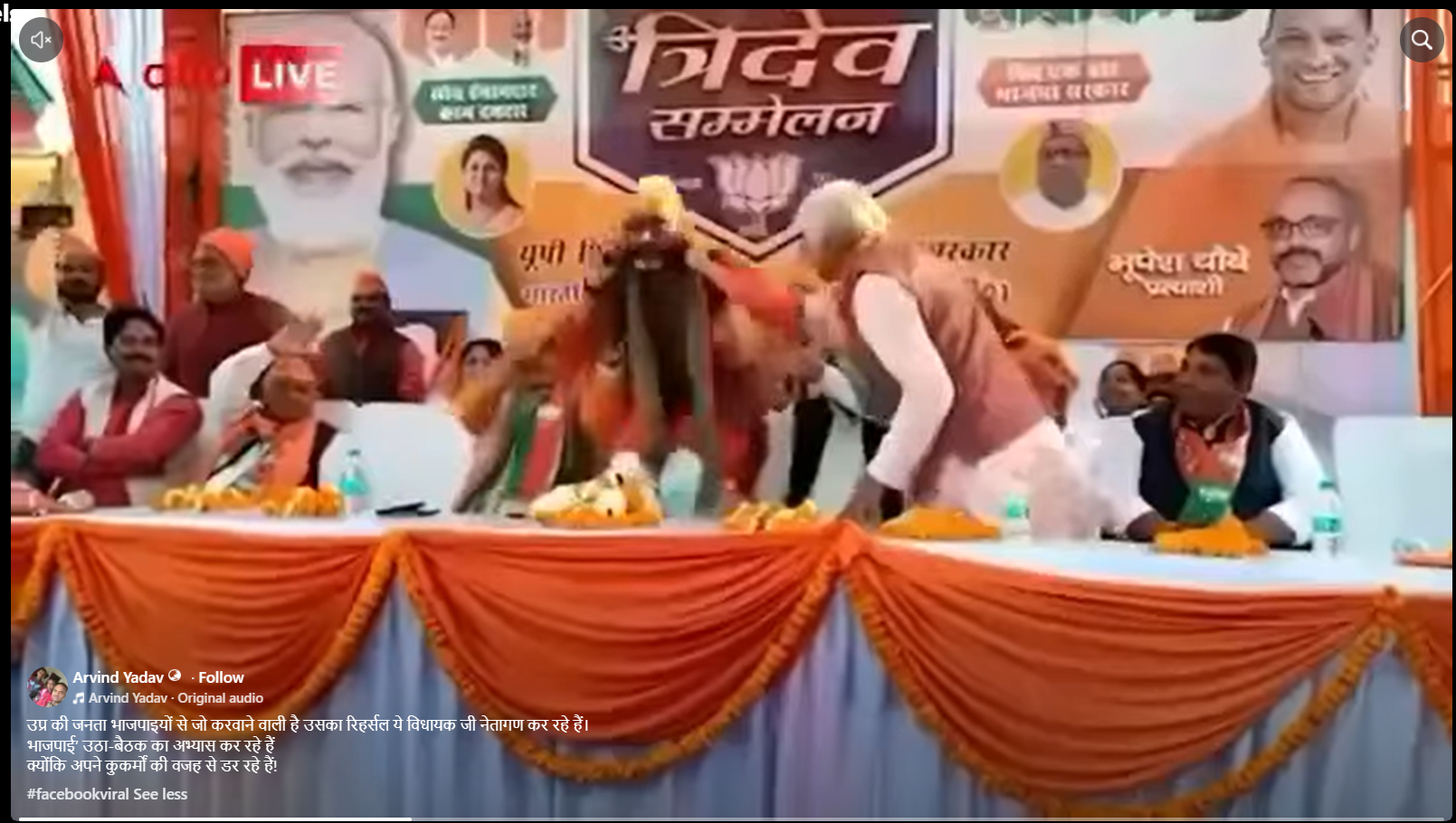
Fact Check
We conducted a reverse image search using keyframes from the viral video. During the search, we found a report published on the Dainik Bhaskar website on February 23, 2022, which featured the same video. According to the report, polling in Sonbhadra was scheduled for March 7 as part of the seventh phase of the Assembly elections. During the election campaign, Bhupesh Chaubey, the BJP MLA and candidate from the Robertsganj Assembly constituency, was seen adopting an unusual approach. He stood on a chair, held his ears and performed sit-ups on the chair, apologising to the public for the mistakes he had made over the previous five years.The link to the report and a screenshot are provided below.
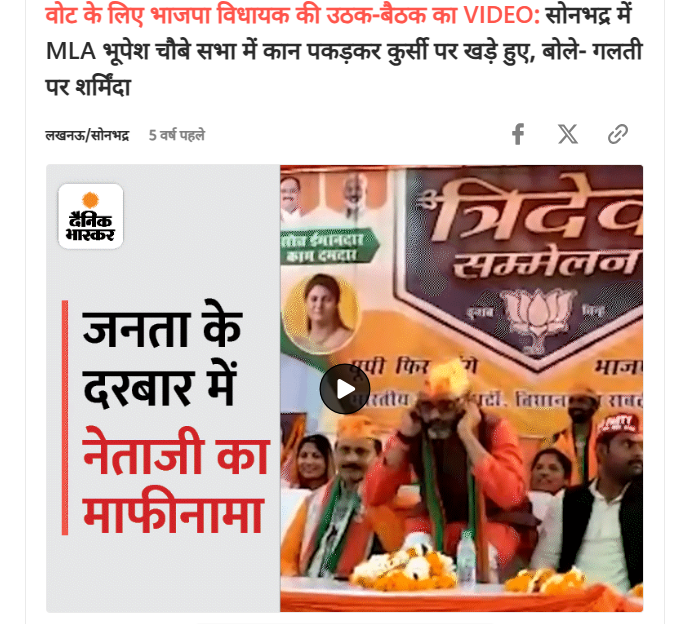
In the next stage of our research, we found a report published on ABP News’ Hindi website on February 25, 2022, which featured the viral video in a general context. We found the same video in this report as well. The link to the report and a screenshot are provided below.
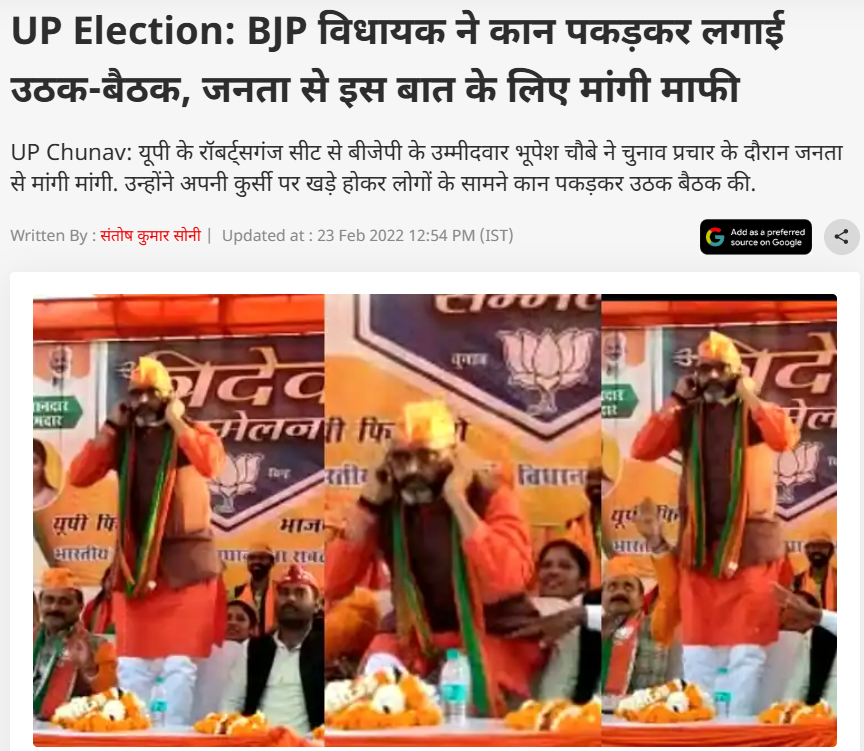
Conclusion
Our research found that the viral video is not recent but dates back to February 2022, when Bhupesh Chaubey, the BJP MLA from the Robertsganj Assembly constituency in Sonbhadra, apologised to disgruntled party workers during a party workers' convention.
Executive Summary:
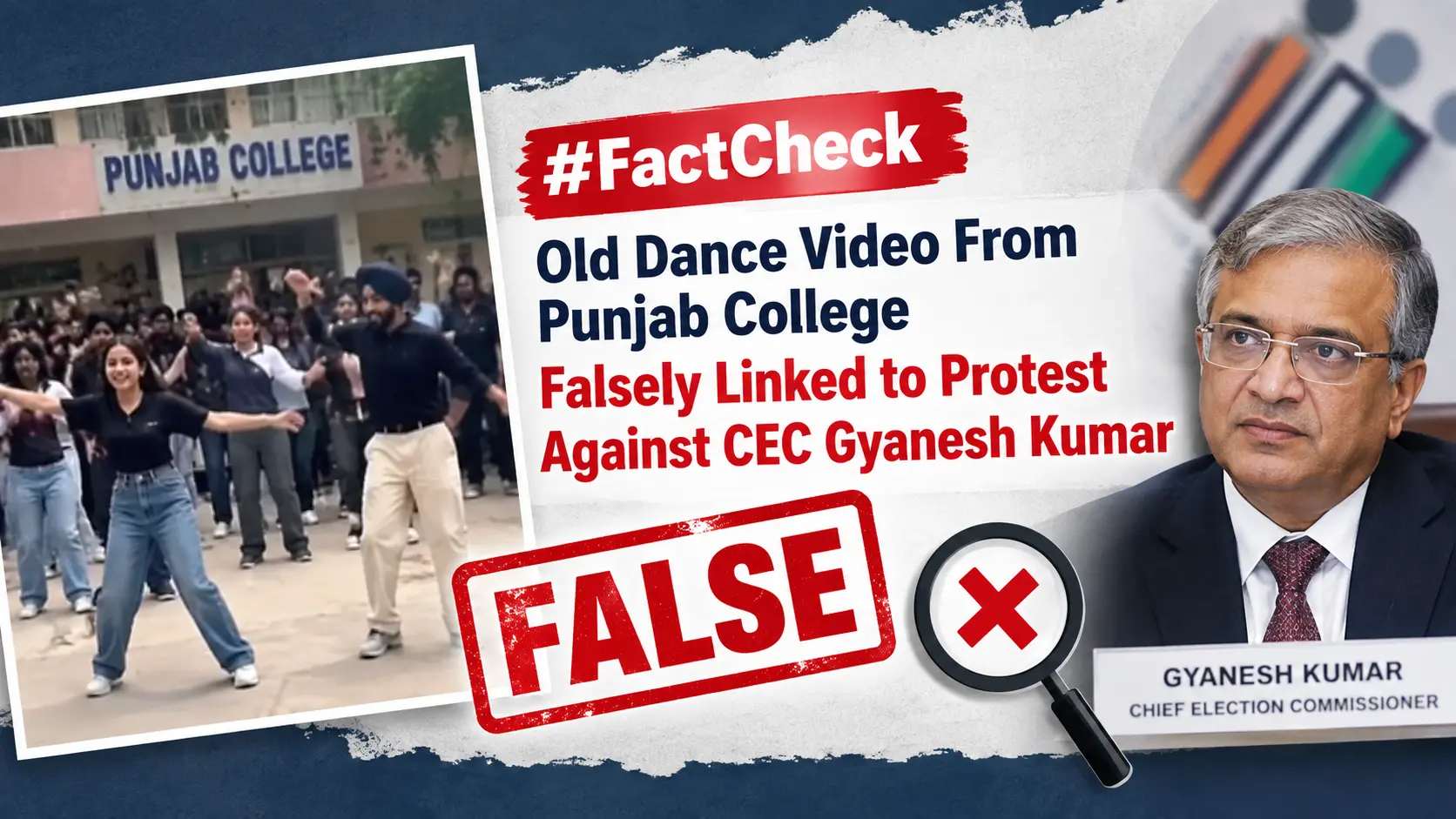
A video of girls dancing is being shared on social media. The video is being circulated with the claim that it shows a recent protest against Chief Election Commissioner Gyanesh Kumar. Social media users are sharing the video as footage from the protest and attempting to link it to the ongoing developments. However, CyberPeace Research found the viral claim to be false. Our research found that the video is not recent. The viral video is from an event organised at a college under Panjab University and has no connection with the ongoing protests against Chief Election Commissioner Gyanesh Kumar.
Claim:
A user on the social media platform X (formerly Twitter) shared the viral video on October 5, 2026, with the caption: “Looking at this mujra, it seems they are not demanding Gyanesh Kumar’s resignation, but rather performing a mujra in his honour.” The post link, archive link, and screenshot are provided below.
https://x.com/janardanmis/status/2107092458731614355
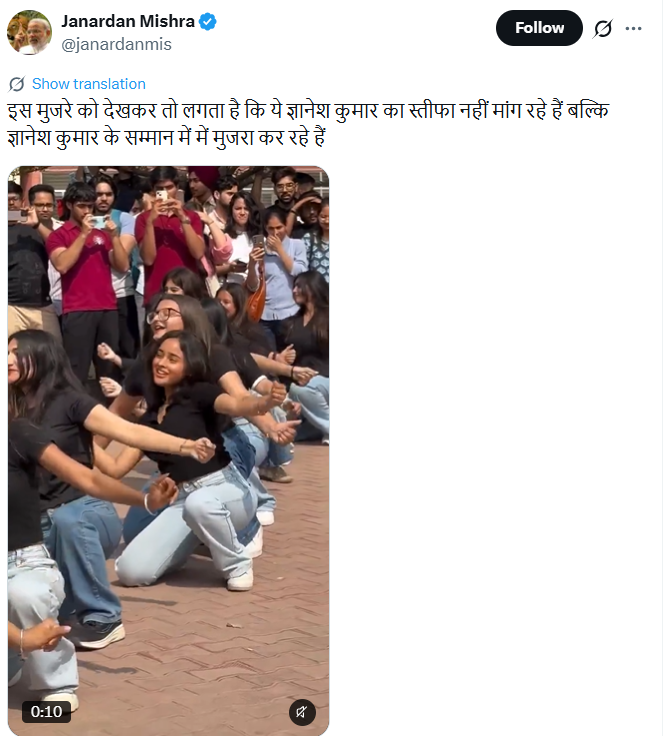
Fact Check
To verify the authenticity of the viral claim, we conducted a reverse image search using keyframes from the video. During the search, we found the same video uploaded on the Instagram account named “SD Flash Zoom” on March 7, 2026. Upon examining the Instagram account, we found that the page posts videos related to dance programmes organised at Goswami Ganesh Dutta Sanatan Dharma College (GGDSD College), affiliated with Panjab University. The post link and screenshot are provided below.
https://www.instagram.com/p/DVkLftuCW_G/
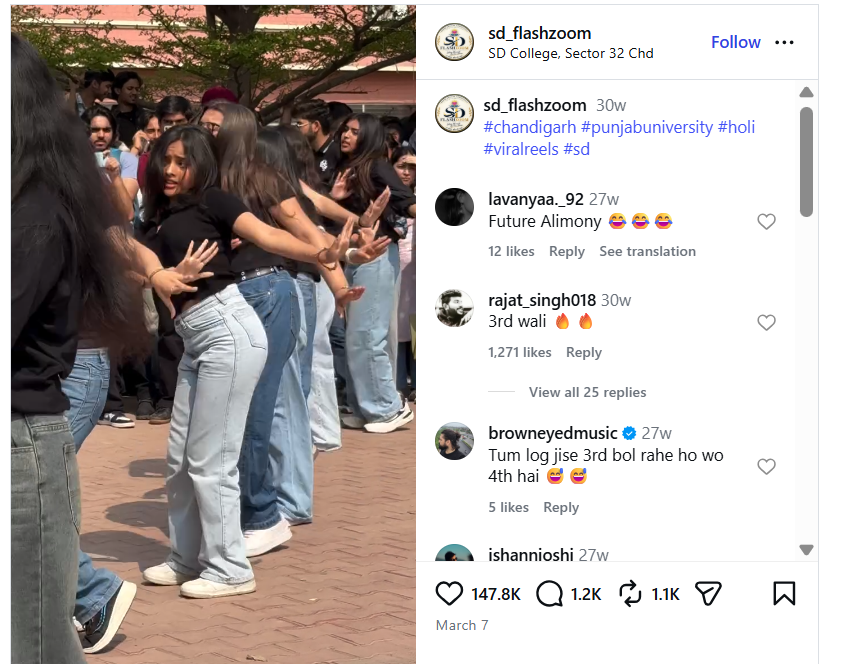
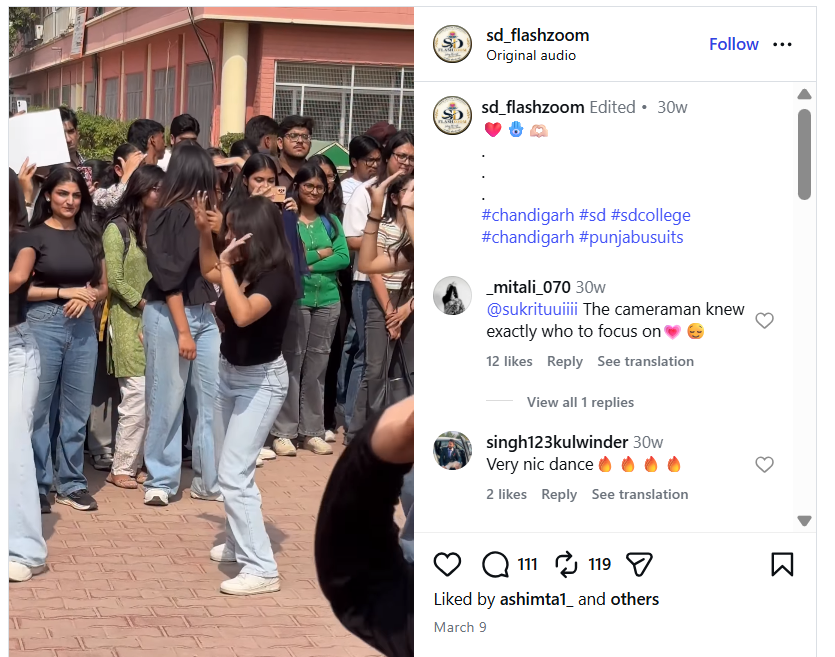
During our research, we found another video uploaded on the same account on March 9, 2026. Watch the video. The visuals seen in this video match those in the viral video, confirming that both videos are from the same event. The post link and screenshot are provided below.
https://www.instagram.com/p/DVqRuIdiQ7t/
Conclusion
The evidence gathered during our research makes it clear that the video being shared on social media as footage of a protest against Chief Election Commissioner Gyanesh Kumar is not recent. The viral video is actually from an event held at SD College in Punjab in March 2026. Therefore, the claim that the video shows a protest against Chief Election Commissioner Gyanesh Kumar is misleading.

Executive Summary
A video is being shared on social media showing violent clashes between protesters and police. The video is being circulated with the claim that it is from recent protests in France and shows clashes between protesters and police during the ongoing demonstrations. However, CyberPeace Research found the viral claim to be misleading. Our research found that the viral video is not recent; it dates back to a violent protest held in Paris on November 28, 2020.
Claim:
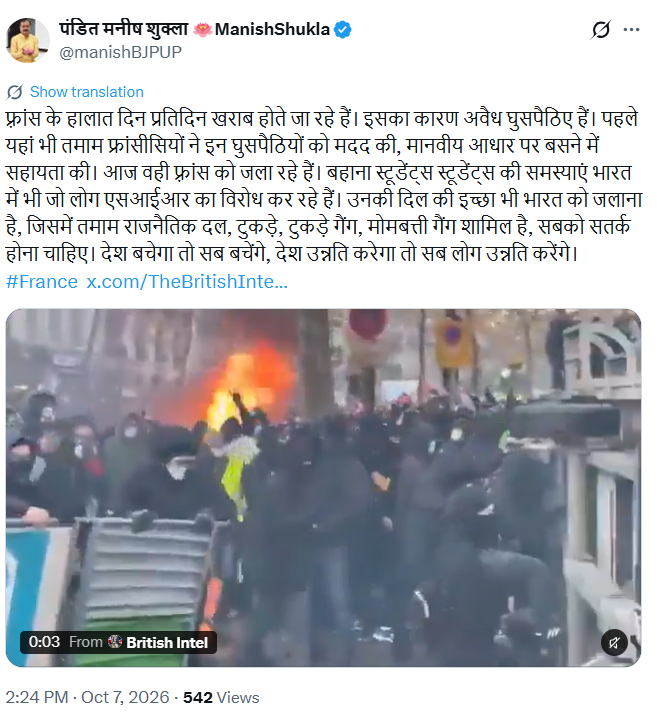
A user on the social media platform X (formerly Twitter) shared the viral video on October 7, 2026, with the caption: “The situation in France is worsening day by day. The reason for this is illegal immigrants. Initially, many French people helped these infiltrators settle there on humanitarian grounds. Today, the same people are burning France. They are using students’ issues as an excuse. Those opposing SIR in India also have the same intention of setting India on fire. Several political parties, the ‘tukde-tukde gang’ and the ‘candlelight gang’ are involved. Everyone should remain vigilant. If the country survives, everyone will survive; if the country progresses, everyone will progress.”The post link, archive link, and screenshot are provided below.
https://x.com/manishBJPUP/status/2107756379372990575?s=20
Fact Check
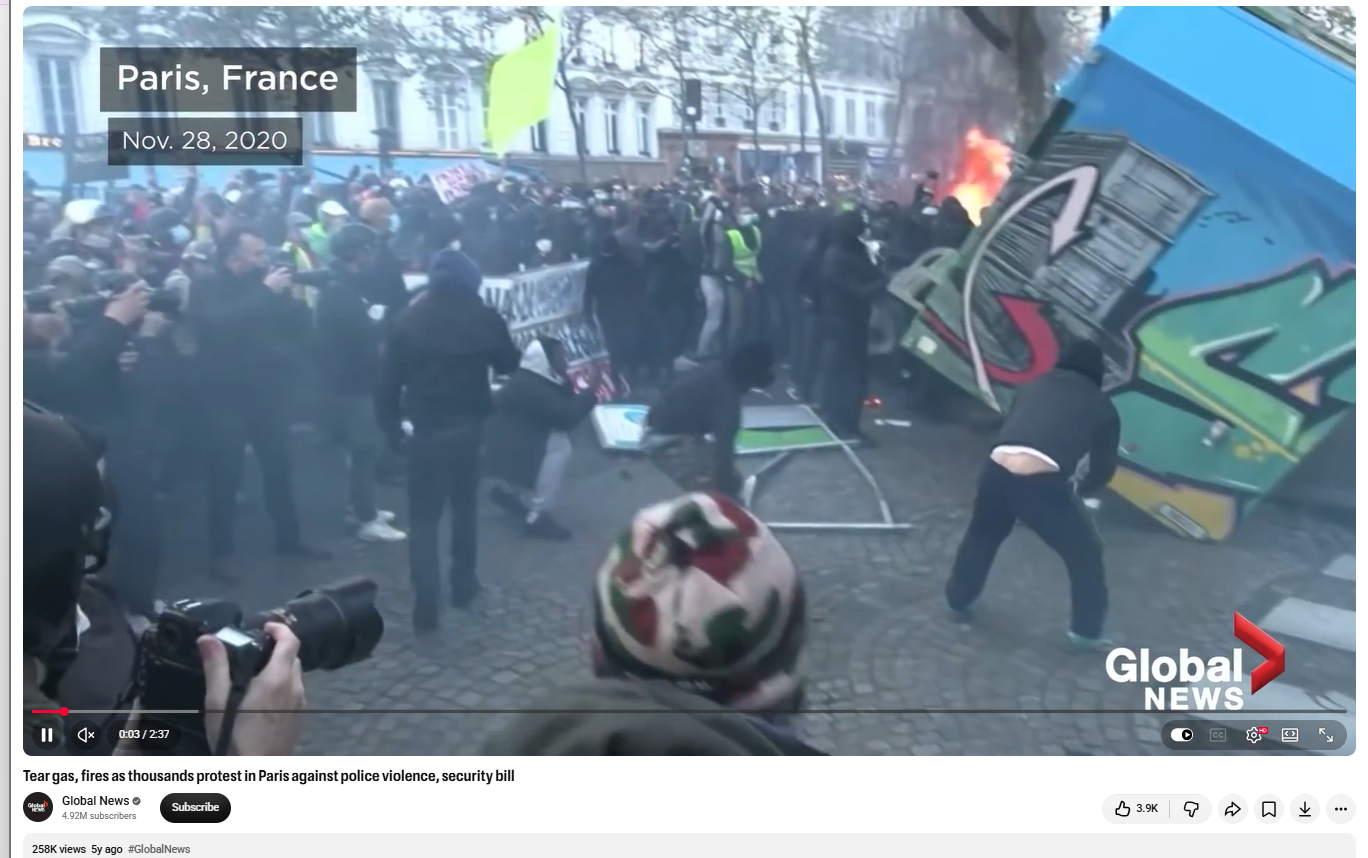
In the next step of our research, we extracted keyframes from the video and conducted a reverse image search. During the search, we found a video uploaded on the Global Times YouTube account on November 28, 2020. The title and description of the video identified it as footage from protests in Paris, France, against police violence and the security bill. The report link and screenshot are provided below.
https://www.youtube.com/watch?v=hCMA8Vqqsr8
In the next step of our research, we found a report published on the China Daily website on November 30, 2020. The report also contained the visuals seen in the viral video. The report link and screenshot are provided below.
https://www.chinadailyhk.com/hk/article/150932
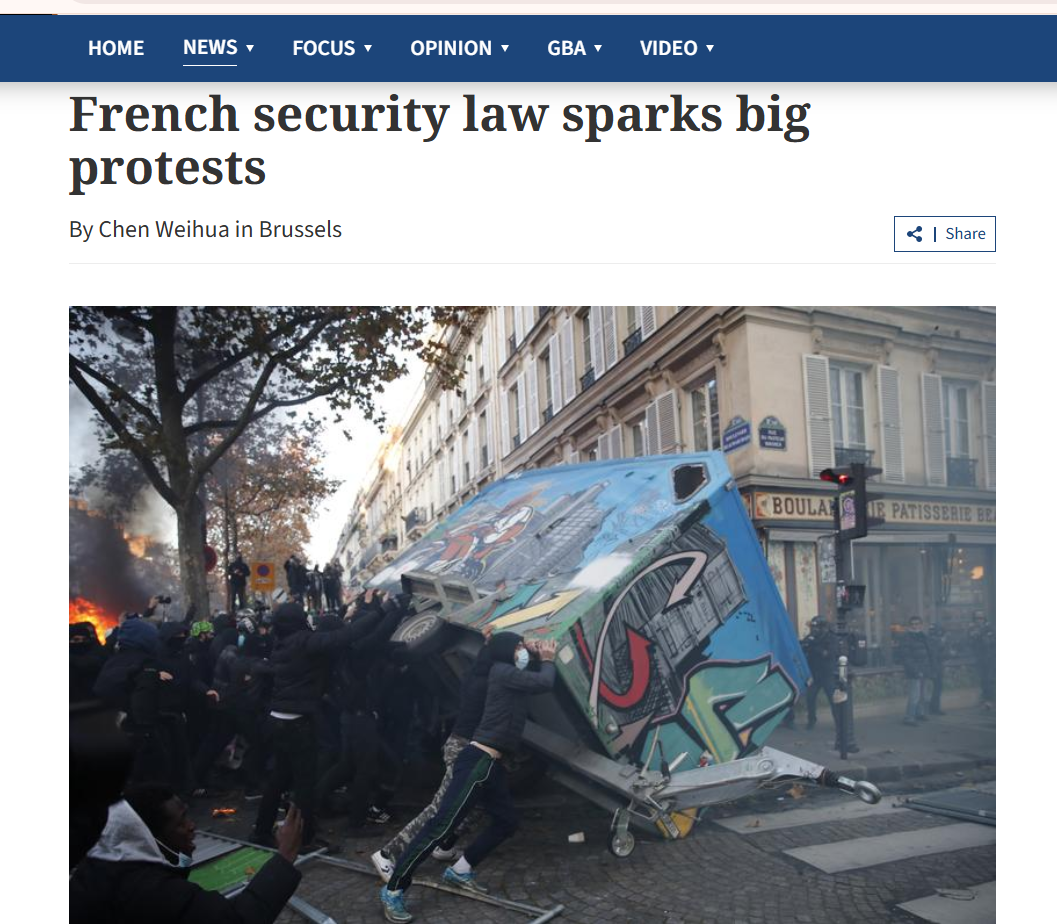
According to a report published by China Daily, hundreds of thousands of people took to the streets across France on Saturday to protest against a proposed law that included provisions restricting the filming of police officers and addressing racial discrimination. The protests followed the alleged brutal beating of a Black man by police in Paris. A controversial provision, particularly Article 24 of the National Security Law, criminalised the dissemination of photos or videos of police officers carrying out their duties if done with malicious intent. The provision carried a penalty of up to 45,000 euros (US$53,800) and one year in prison. In Paris, police used tear gas and stun grenades after clashes broke out between protesters and police. Some people in the crowd threw stones and fireworks at police. Several cars and a newspaper kiosk were set on fire, while dozens of people were arrested.
Conclusion
Our research found that the viral video is not recent but dates back to a violent protest held in Paris on November 28, 2020.

Executive Summary
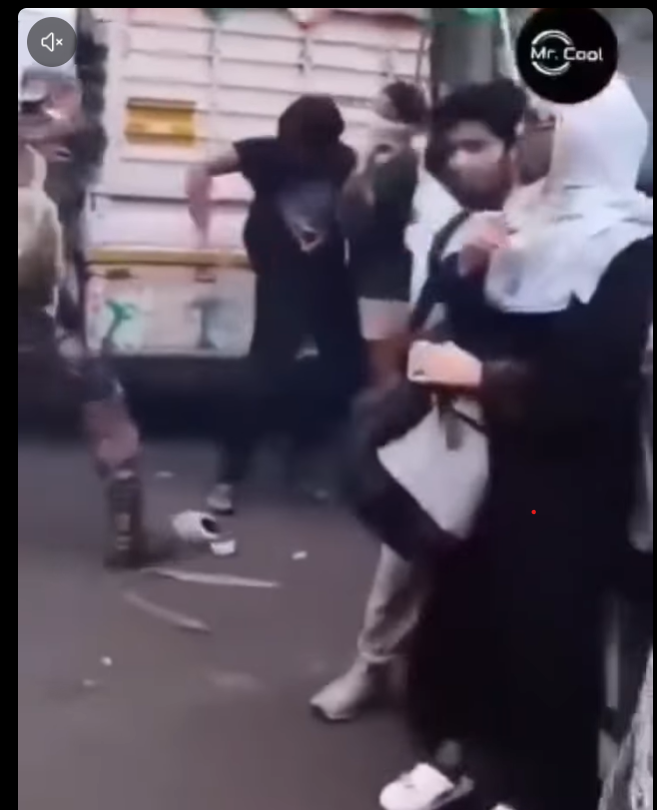
Reports of differences between the Chief Election Commissioner and the two Election Commissioners over the functioning of the Election Commission have emerged, following which protests were held across the country. Protesters demanding the resignation of Chief Election Commissioner Gyanesh Kumar took out a ‘Citizens March’ to Jantar Mantar on October 4, 2026. Against this backdrop, a video is being widely shared on social media. The video purportedly shows a CRPF personnel lathi-charging protesters. It is being shared with the claim that the footage is from the protest against Chief Election Commissioner Gyanesh Kumar at Jantar Mantar in Delhi. However, CyberPeace Research found the viral claim to be false. The viral video is not recent; it dates back to July 2026. At that time, students in Delhi were protesting over the alleged NEET paper leak and demanding the resignation of then Union Education Minister Dharmendra Pradhan.
Claim:
A Facebook user, ‘Kuldeep Pandit’, shared the viral video on October 4, 2026, with the caption: “The only thing left was the last ball, when Modi ji hit a six at the Jantar Mantar stadium and broke the backsides of traitors... Jantar Mantar is now under the control of the Indian Army, and the Army is giving freedom by the trolley load... Jai Shri Ram.”The archive link to the post can be viewed here.
https://www.facebook.com/reel/1807020453964507
https://perma.cc/RN8J-XV4K?type=standard
Fact Check
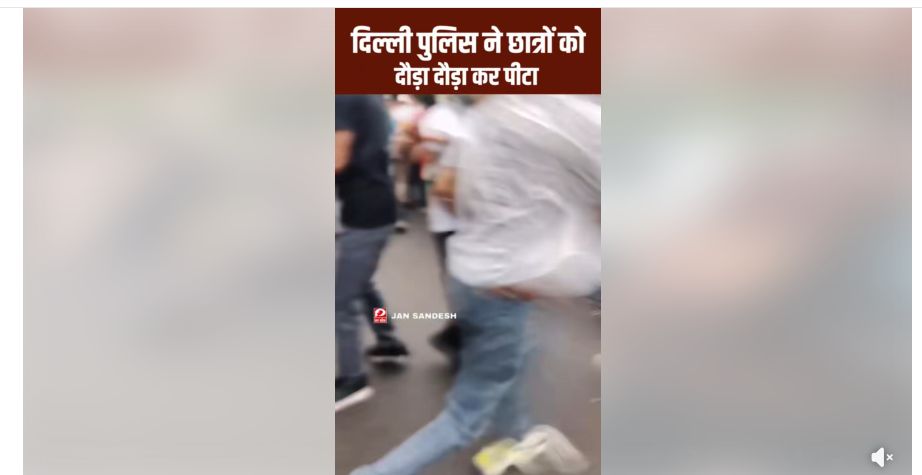
To verify the authenticity of the viral video, we extracted several keyframes using the InVID tool and conducted a reverse image search on Google. During the search, we found the viral video shared on a Facebook account named ‘Jansandesh News’ on July 21, 2026. According to the information provided with the post, the video shows a protest held at Jantar Mantar over the alleged NEET paper leak.
https://www.facebook.com/watch/?v=1786356329397999
Based on the information obtained, we conducted a Google search using relevant keywords. We also found the viral video on an Instagram account named ‘datiabulletinofficial’. The video was shared on July 21, 2026, and was identified as footage from a protest held at Jantar Mantar. According to the caption, students were protesting over the alleged NEET paper leak and demanding the resignation of then Union Education Minister Dharmendra Pradhan.
https://www.instagram.com/reels/DbFXpGHzmwB/
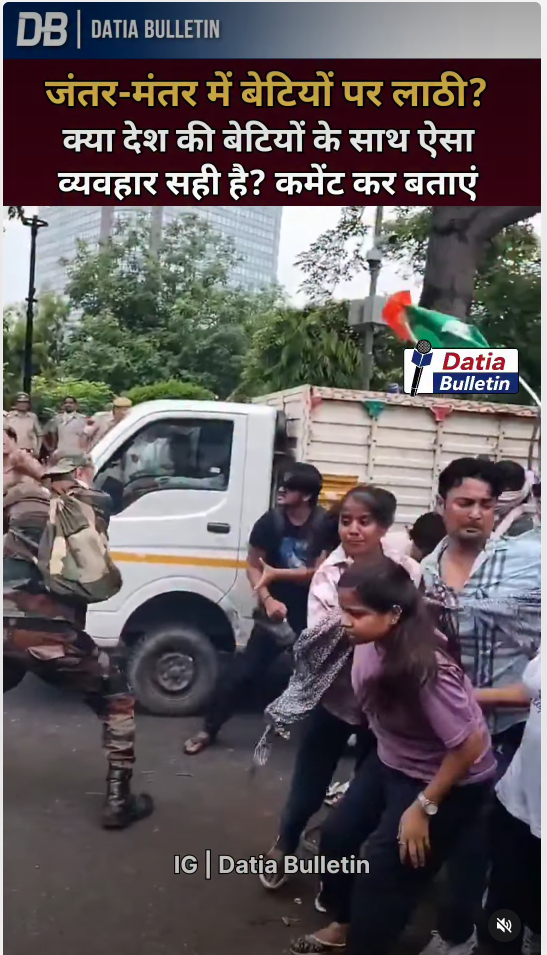
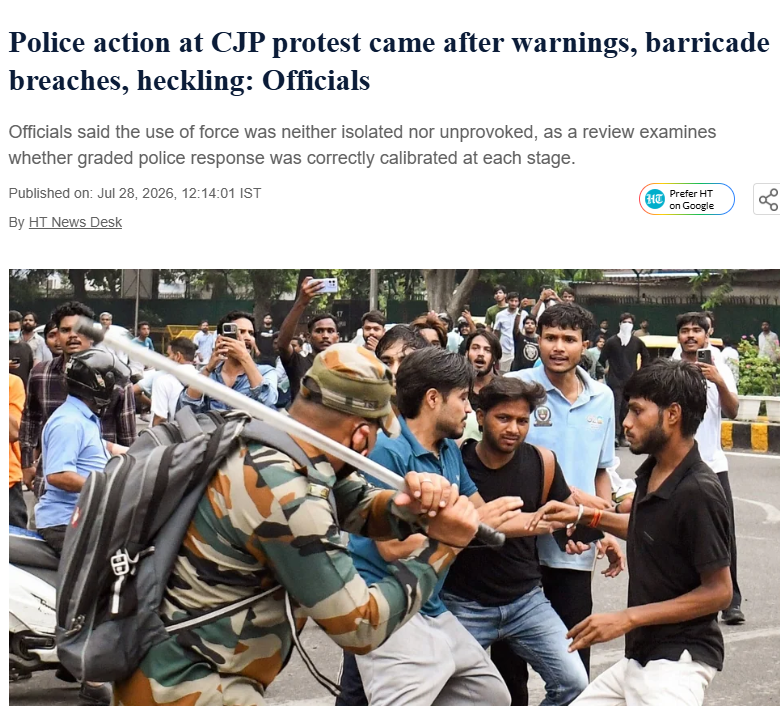
During our research, we found a news report related to the claim on the Hindustan Times website. The report was published on July 28, 2026. According to the report, “On July 20, students led by the ‘Cockroach Janta Party’ (CJP) marched towards Parliament. During the protest, police and Rapid Action Force (RAF) personnel lathi-charged the students, drawing considerable criticism. The Delhi Police later clarified that it would review the lathi-charge on the students and the action taken by the police.”The report also contains keyframes that closely resemble the visuals seen in the viral video.
Conclusion:
Our research found that the claim being made about the viral video of protesters being lathi-charged is false. The video dates back to July 2026, when students in Delhi held protests over the alleged NEET paper leak and demanded the resignation of then Union Education Minister Dharmendra Pradhan.

Executive Summary
Employees’ organisations of public sector banks had recently announced a nationwide strike, with one of their key demands being a five-day work week, including holidays on all Saturdays. Against this backdrop, a claim is being circulated on social media that the bank unions’ demand has been accepted and that all public sector banks will now remain closed every Saturday.
However, CyberPeace Research found that the claim that banks will observe holidays on all Saturdays is false. Neither the government nor bank employees’ unions have made any official announcement regarding the implementation of a five-day work week or holidays on all Saturdays.
Claim:
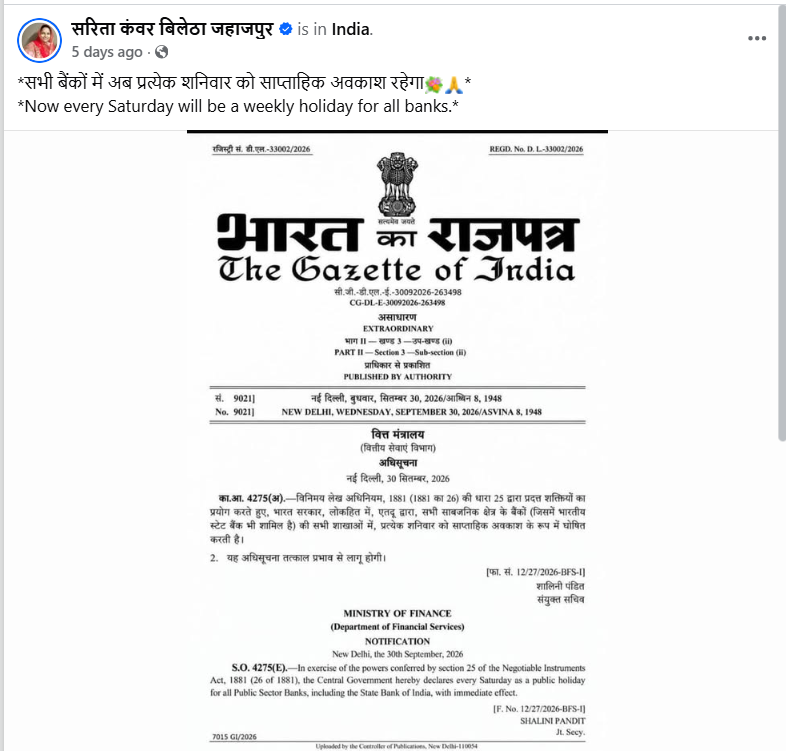
A user on the social media platform Facebook shared what was purportedly an Indian Gazette document, claiming that all banks will now observe a weekly holiday on every Saturday.
https://www.facebook.com/photo/?fbid=122234792282534138&set=a.122114627672534138
Fact Check
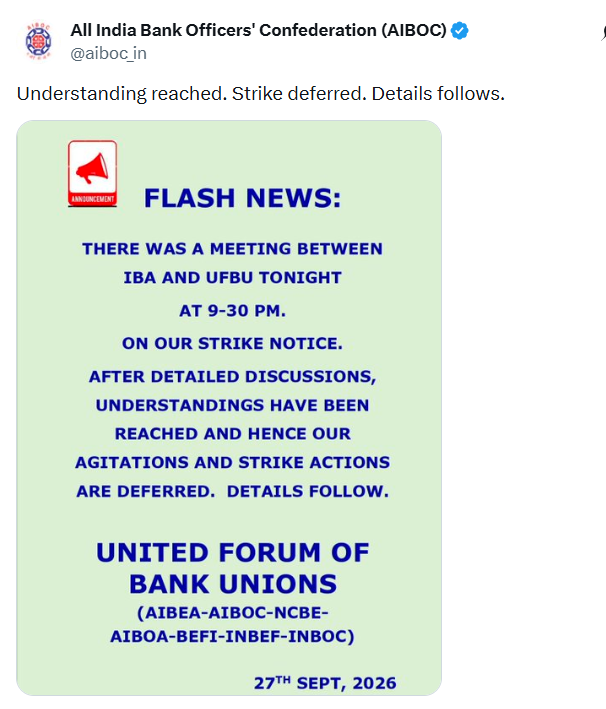
We reviewed all the announcements issued by the organisations that had called for the bank strike. None of these organisations issued any statement confirming that their demands had been accepted. We found a statement from the All India Bank Officers’ Confederation (AIBOC), in which the organisation stated in an X post that the strike scheduled for September 28–30, 2026, had been postponed following discussions. However, the organisation did not state anywhere that the demand for holidays on all Saturdays had been accepted.
https://x.com/aiboc_in/status/2104262645507612777?s=20
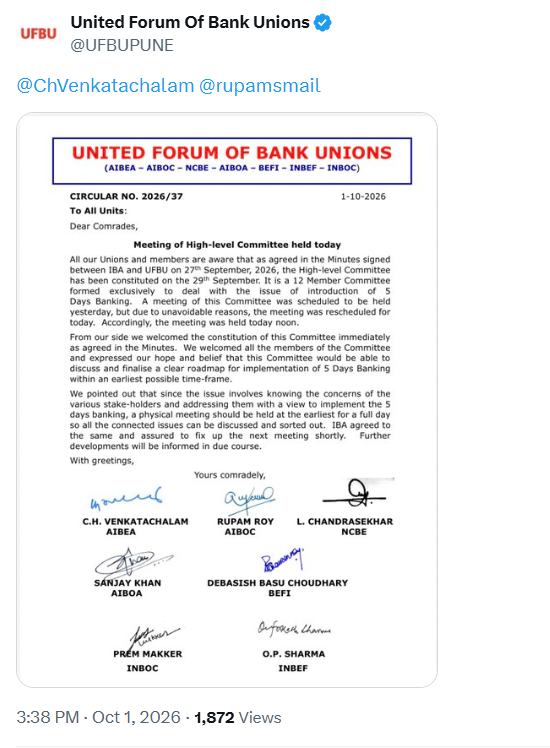
The United Forum of Bank Unions (UFBU), a joint platform of seven bank employees’ unions, issued a statement on October 1, making it clear that there has been no confirmation so far that the unions’ demands have been accepted. The statement said that a five-member committee has been constituted to consider the demand for holidays on all Saturdays, and the committee will soon prepare a roadmap for taking the matter forward.
https://x.com/UFBUPUNE/status/2105600756795707456
Conclusion:
The claim circulating on social media that all public sector banks will remain closed every Saturday from now on is false. CyberPeace Research found that neither the government nor bank employees’ unions have made any official announcement regarding the declaration of holidays on all Saturdays. Therefore, the claim being circulated on social media is misleading.

Executive Summary
A video is being shared on social media, purportedly showing a tiger approaching Neem Karoli Baba. In the video, Baba appears to place his hand on the tiger before walking away. Users are sharing the video on social media, believing it to depict a real incident. However, CyberPeace Research found the viral claim to be false. Our research found that the viral video is not authentic but AI-generated.
Claim:
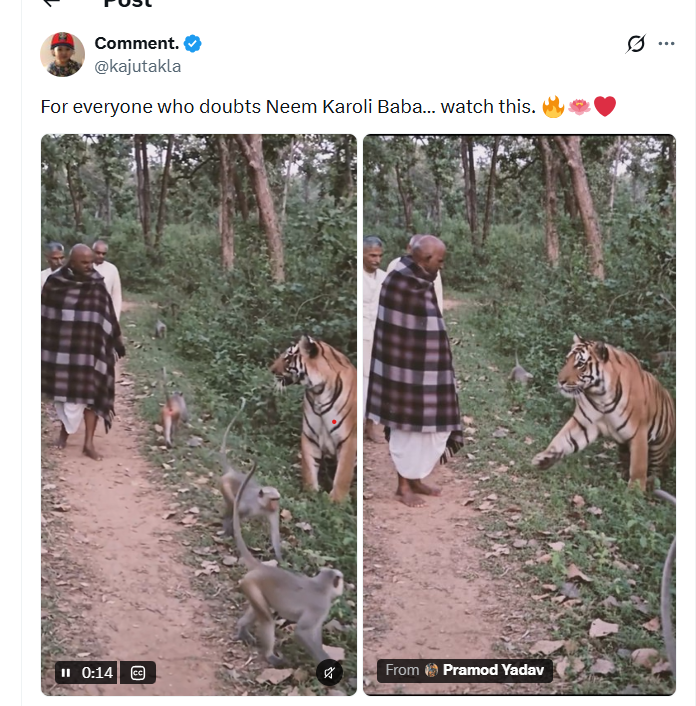
A user on the social media platform X (formerly Twitter) shared the viral video on October 5, purportedly showing a tiger approaching Neem Karoli Baba. In the video, Baba appears to place his hand on the tiger before walking away. The post link, archive link, and screenshot are provided below.
https://x.com/kajutakla/status/2106961156674031795?s=20
Fact Check
To verify the authenticity of the viral claim, we conducted a Google search using relevant keywords. During the search, we did not find any credible media reports confirming the claim. We then analysed the video using the AI detection tool DetectVideo AI. According to the tool’s results, the video has a 90 per cent probability of being AI-generated.

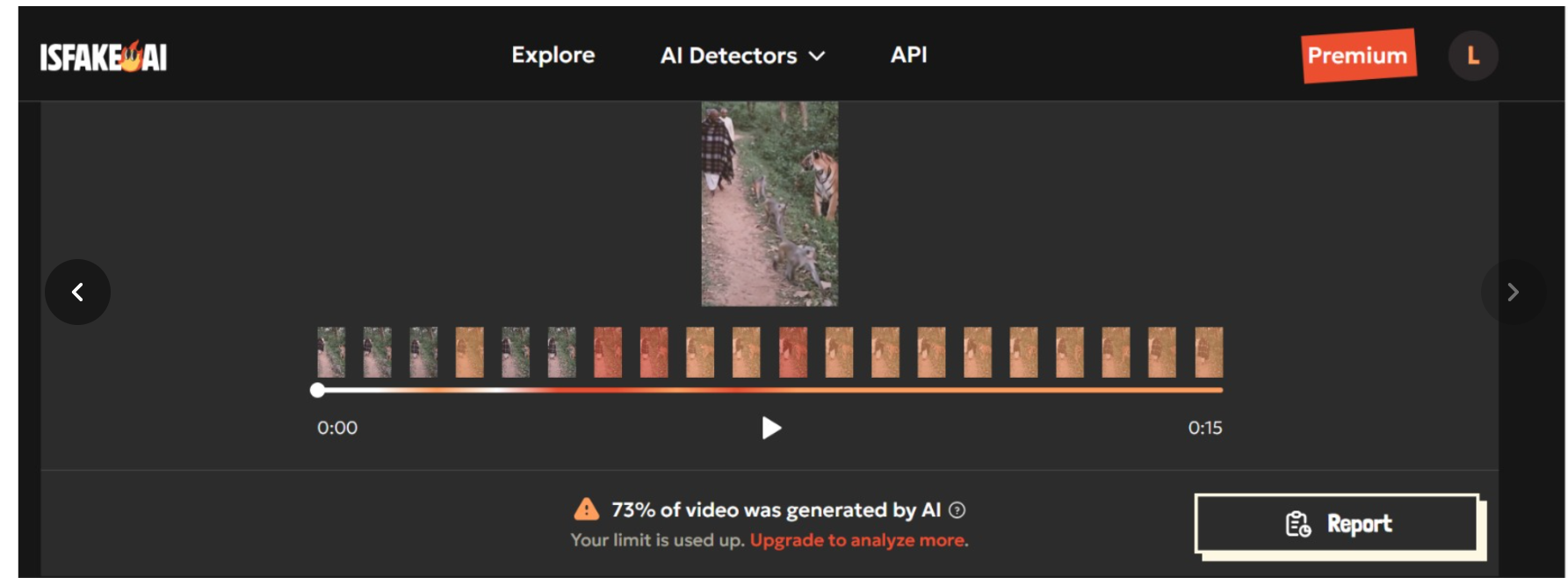
To further verify the authenticity of the viral video, we scanned it using another AI detection tool, ISFAKE AI. According to the results, the viral video is AI-generated.
Conclusion
Our research found that the viral video is not authentic but AI-generated. We did not find any credible media reports or other reliable sources confirming that the video shows a real incident involving Neem Karoli Baba and a tiger. The findings of AI detection tools further indicate that the visuals have been artificially generated. Therefore, the viral video is being circulated on social media with a misleading claim, presenting AI-generated visuals as a real incident.

Executive Summary
A video showing a car caught in a web of electrical wires beneath a flyover is being widely shared on social media. In the viral video, the car appears to be suspended in mid-air, while a large number of people can be seen gathered below, watching the astonishing scene. People standing on the flyover also appear shocked as they look at the scene below. However, CyberPeace Research found that the video is not authentic but AI-generated and is being circulated with a misleading claim.
Claim:
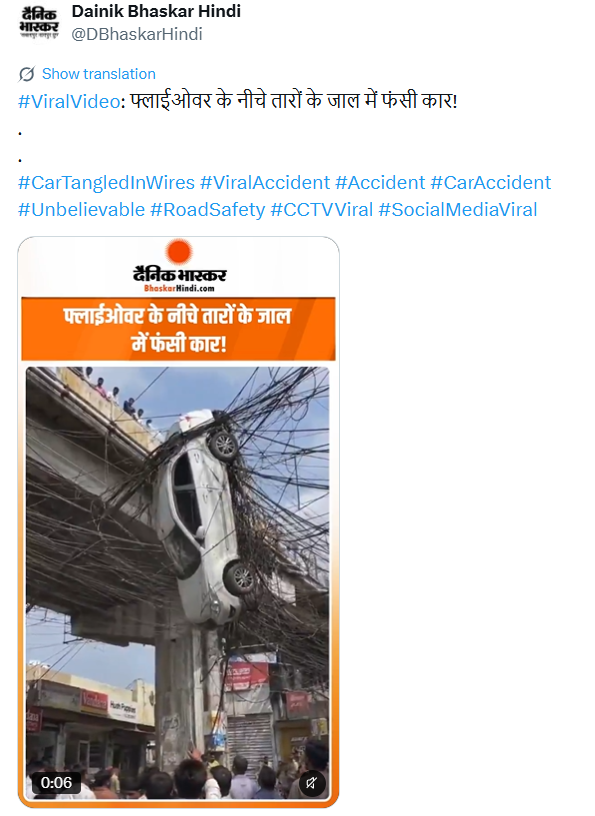
An X user shared the viral video with the caption: “#ViralVideo: Car caught in a web of wires beneath a flyover!”
https://x.com/DBhaskarHindi/status/2107022982258553245
.
Fact Check
To verify the authenticity of the viral video showing a car caught in electrical wires beneath a flyover, we conducted a reverse image search of its keyframes using Google Lens. During the search, we found the same video uploaded on August 28, 2026, on the Instagram account of an AI content creator, @bhau_mitra_mandal_parbhani. The caption accompanying the video read: “Everyone is shocked to see this sight of a car caught in a web of electrical wires beneath a flyover! The car is dangerously stuck in the wires, drawing the attention of everyone gathered below. How did the car get here? The reason is yet to be revealed.” The caption also clearly mentioned that the visuals were AI-generated. In addition, the words “AI News” and “AI Generated Visuals” were displayed on the video itself, further indicating that the footage was artificially generated.
https://www.instagram.com/reels/DclpJHfgqXr/
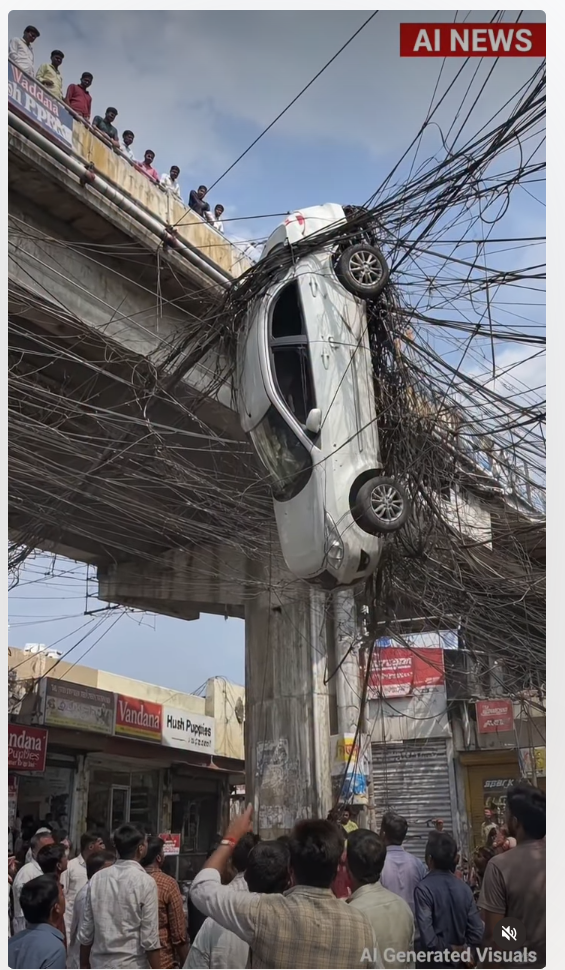
To further verify the authenticity of the viral video, we analysed it using the AI detection tool Hive Detect. The tool’s analysis identified the video as AI-generated with a 99.9 per cent probability.

Another AI detection platform, WasitAI, also identified the visuals in the video as highly likely to be AI-generated.

Conclusion
The evidence gathered during our research makes it clear that the viral video showing a car caught in electrical wires beneath a flyover is not authentic but AI-generated. Our research found that the same video was originally uploaded by an AI content creator, where it was clearly labelled as AI-generated. The findings were further supported by AI detection tools, including Hive Detect and WasitAI, which also identified the visuals as highly likely to be AI-generated. Therefore, the viral video is being circulated on social media with a misleading claim, presenting AI-generated visuals as a real incident.

Executive Summary
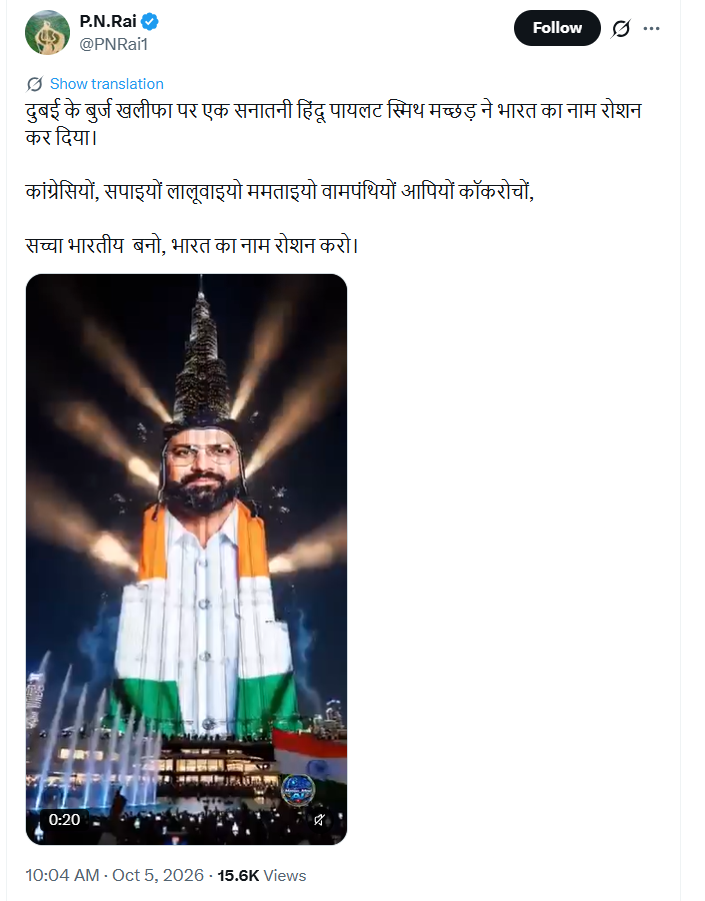
On September 30, 2026, reports emerged that Captain Smith Machhar, the Indian pilot of flydubai flight FZ1073 travelling from Dubai to Tel Aviv, was attacked by his co-pilot in the cockpit. Despite sustaining serious injuries, Captain Machhar reportedly managed to land the aircraft safely, saving the lives of all 174 passengers. Following the incident, a video is going viral on social media with the claim that a picture of Captain Smith Machhar was displayed on Dubai’s Burj Khalifa in his honour.
However, CyberPeace Research found the claim to be false. Our research found that the viral video is AI-generated and is being circulated on social media with a misleading claim.
Claim:
A user on the social media platform X (formerly Twitter) shared the viral video on October 5, 2026, with the caption: “A Sanatani Hindu pilot, Smith Machhar, has made India proud on Dubai’s Burj Khalifa. Congressis, Samajwadis, Lalu supporters, Mamata supporters, Leftists, AAP supporters and cockroaches, become true Indians and make India proud.” The post link, archive link and screenshot are provided below.
https://x.com/PNRai1/status/2106966191386611900
https://ghostarchive.org/archive/3RroW
Fact Check
To verify the viral claim, we conducted a Google search using relevant keywords. During the search, we did not find any credible media report confirming the claim.In the next stage of our research, we closely examined the video.
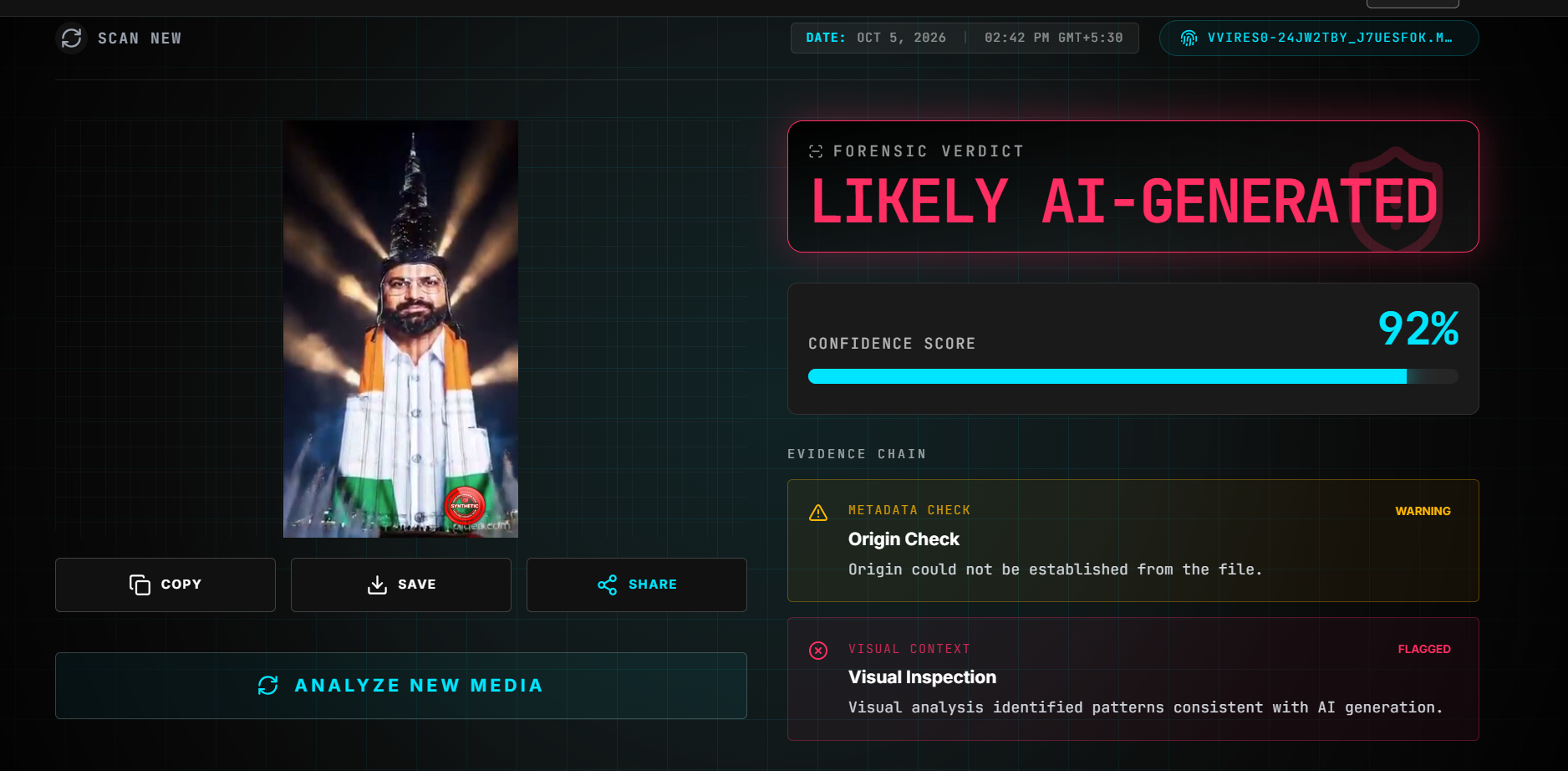
We noticed several inconsistencies that raised suspicions that it was AI-generated. In the video, the building’s texture appears to blend and shift strangely into a person’s clothing. Such changes do not appear natural or consistent with a genuine video. We then analysed the viral video using the AI detection tool ISFAKEAI. According to the results, the viral video is 99 per cent AI-generated.
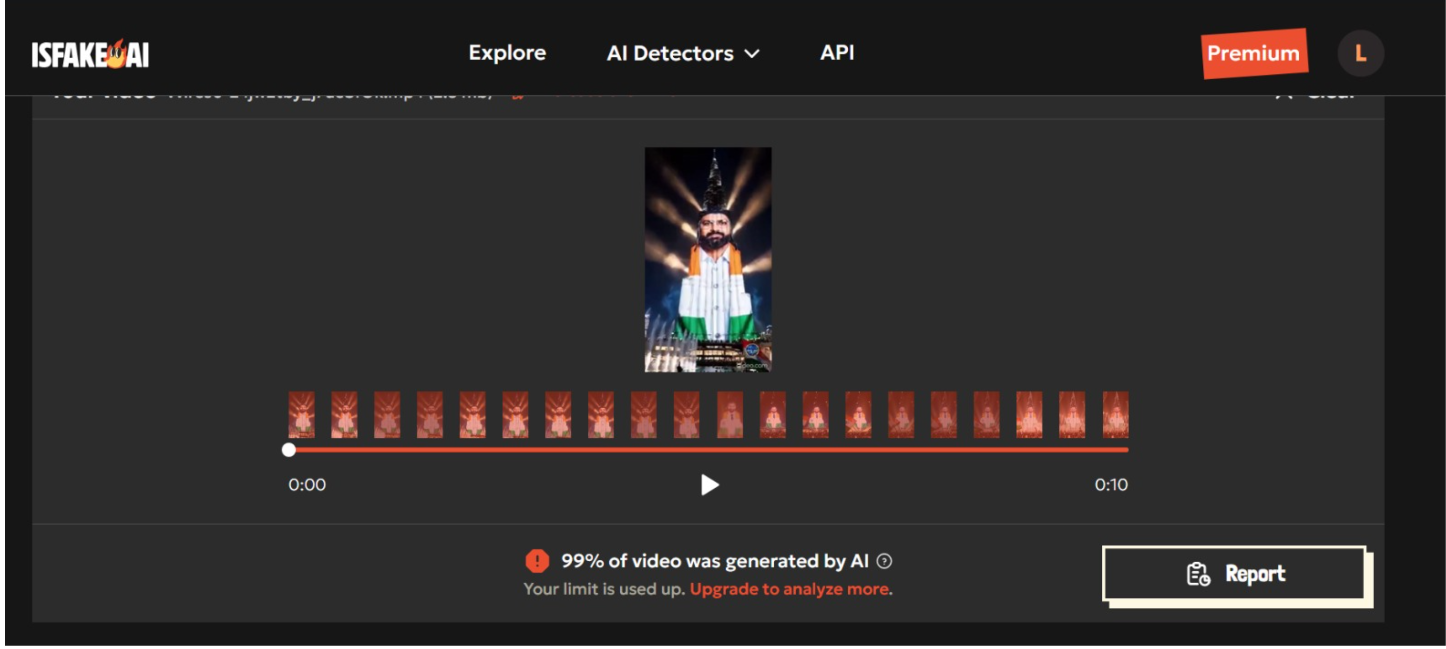
In the next stage of our research, we analysed the viral video using the AI detection tool FauxLens. According to the results, the viral video is 92 per cent AI-generated.
At the end of our research, we analysed the viral video using the AI detection tool Undetectable AI. According to the tool’s results, the viral video is 93 per cent AI-generated.

Conclusion
Our research found that the viral video is AI-generated and is being circulated on social media with a misleading claim. The video does not provide authentic evidence that a picture of Captain Smith Machhar was displayed on the Burj Khalifa. The visual inconsistencies observed in the video, along with the results of multiple AI detection tools, further indicate that the video has been digitally created or manipulated using AI.

Executive Summary
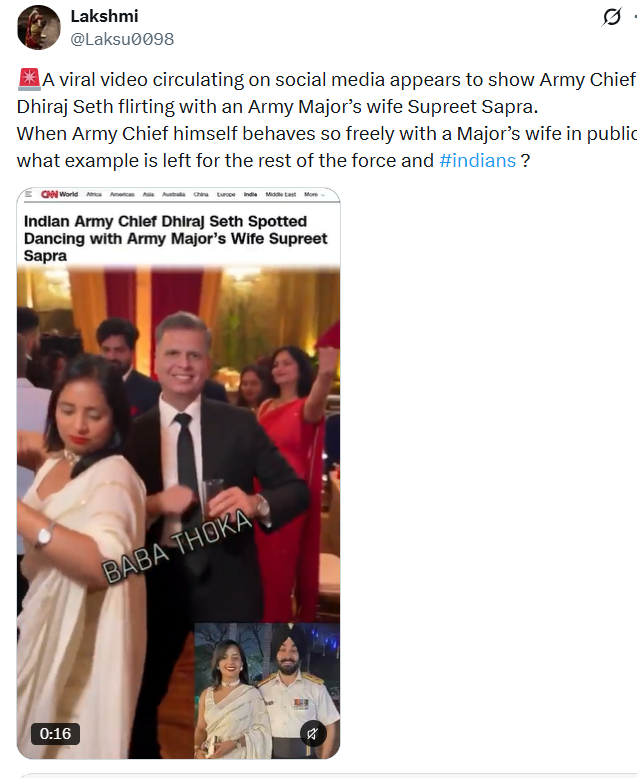
A video is going viral on social media, purportedly showing Indian Army Chief General Dhiraj Seth dancing with a woman. The video is being shared with the claim that Army Chief General Dhiraj Seth was seen dancing with Supreet Sapra, the wife of an Army Major. The video also uses a format resembling the CNN website, and several social media users are sharing it as genuine. However, CyberPeace Research found the video to be completely fake. In reality, an original video was manipulated using AI technology and circulated as part of a disinformation campaign targeting the Army Chief. The Indian Army has also denied the claim.
Claim
An X handle, ‘@Laksu0098’, shared a purported CNN report on September 29. It featured a video allegedly showing Army Chief General Dhiraj Seth dancing with an Army Major’s wife, Supreet Sapra, while holding a glass of alcohol. The bottom portion of the video also displayed a photograph of a woman with an Army officer, implying that the woman in the photograph was the same person seen dancing with the Army Chief. The claim shared along with the video read: “A viral video circulating on social media appears to show Army Chief Dhiraj Seth flirting with an Army Major’s wife, Supreet Sapra. When the Army Chief himself behaves so freely with a Major’s wife in public, what example is left for the rest of the force and Indians?”
https://x.com/Laksu0098/status/2104830327059566641?s=20
Fact Check
We began our research into the viral video by conducting a keyword search. Since the video uses the name and format of CNN, we first searched CNN for any news report related to the video. However, we did not find any such report.
In the next stage of our research, we closely examined the video to assess its authenticity. The movements of the people shown in the viral video, as well as the alcohol in the glasses they were holding, appeared unnatural. Normally, when a person dances while holding a glass filled with liquid, the liquid would show some movement. However, no such movement can be seen in the viral video. This raised suspicions that the video may have been generated or manipulated using AI.
As part of the next step in our research, we used AI detection tools to analyse the video. We first analysed the video using ZeroGPT, which indicated that the viral video was likely AI-generated.

Taking our research forward, we analysed the viral video using Meta AI’s detection tool. The tool’s results indicated that the video had been altered using AI on August 23, 2026.

Conclusion
Our research found that the video being circulated in the name of Army Chief General Dhiraj Seth is fake. The Indian Army has also denied the claim. In reality, the viral video was created and circulated using AI technology.

Executive Summary
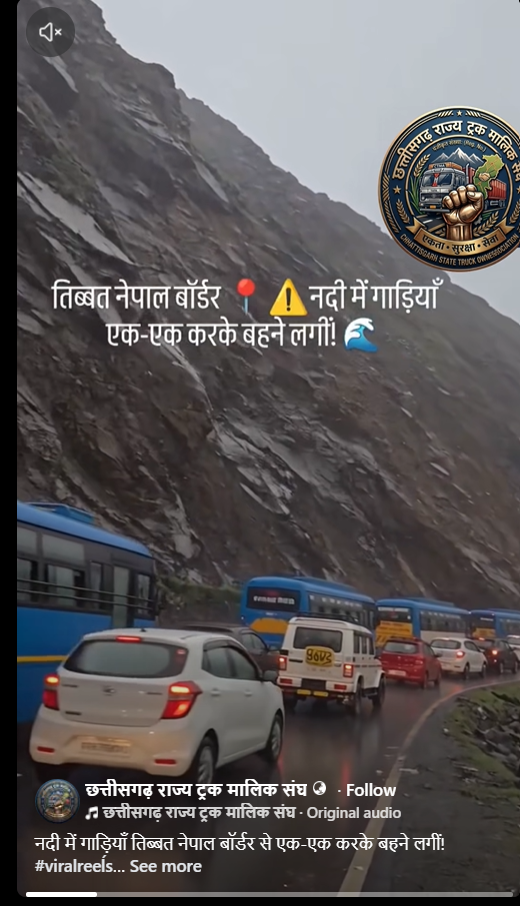
A video showing vehicles being swept away by floodwaters is going viral on social media. It is being claimed that the video shows flooding along the Nepal-Tibet border.However, CyberPeace Research found that the video is AI-generated.
Claim
The video shows debris suddenly falling from a mountain while vehicles are moving along a road. During the incident, vehicles seen on the road near a fast-flowing river are swept away into the water one after another. The archive of the post can be viewed here.
https://www.facebook.com/reel/1796949138009288
Fact Check
To verify the viral video claiming to show vehicles being swept away by floods along the Tibet-Nepal border, we conducted a reverse image search of its keyframes. However, during our research, we did not find the video in any credible media report or authentic source that identified it as genuine footage of flooding along the Nepal-Tibet border. During our research, we closely examined the video and noticed several inconsistencies that raised questions about its authenticity. In cases where heavy vehicles are caught in or swept away by fast-flowing water, the force of the current, the vehicles losing balance and being submerged are generally visible. In contrast, the vehicles in the viral video appear to float almost in a straight direction through the water without any visible resistance, raising doubts about the authenticity of the footage.
The video also shows several blue buses travelling on the road. On closer examination, the design and appearance of these buses appear to be almost identical. In addition, the letters and numbers visible on some vehicle number plates appear unusual, blurred and distorted. Such visual inconsistencies are commonly observed in AI-generated content. To further verify these findings, we scanned the viral video using the AI detection tool Hive Detect. The tool’s analysis identified the video as potentially AI-generated, with a score of 84.5 per cent.

We also analysed the video using another AI detection platform, DetectVideo AI. The tool likewise identified the video as potentially AI-generated, with a score of 89 per cent.

Conclusion
The evidence gathered during our research makes it clear that the video being circulated with the claim that vehicles were swept away by floodwaters along the Tibet-Nepal border is AI-generated.

Executive Summary
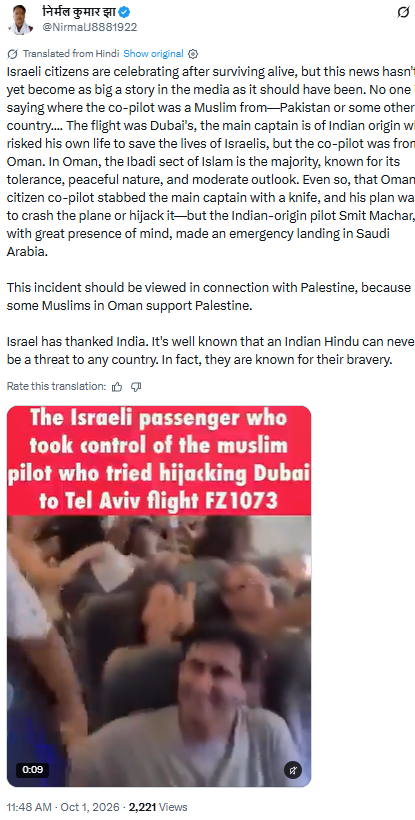
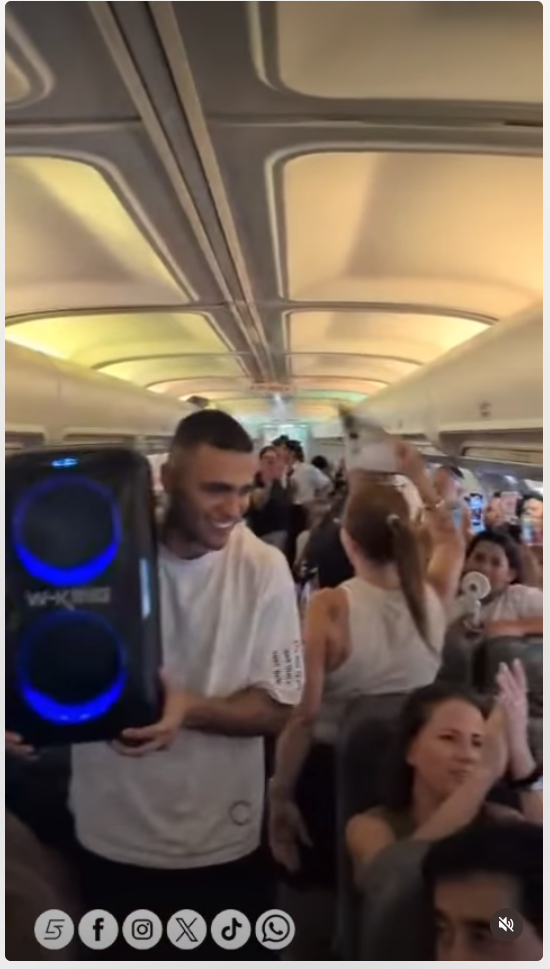
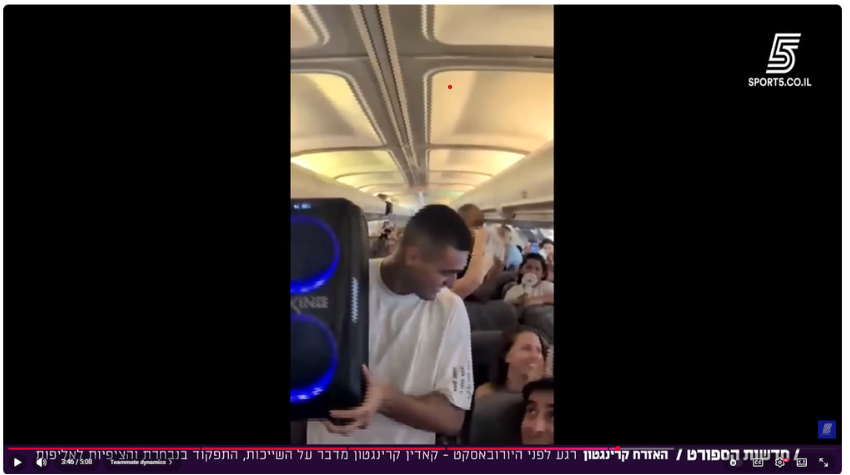
A video showing people dancing inside an aircraft with a speaker playing music is being shared on social media with the claim that they were celebrating after surviving an accident involving a flydubai flight travelling from Dubai to Tel Aviv. However, CyberPeace Research found that the video was actually shared by an Israeli sports media outlet in August 2025, and shows Israeli basketball player Yam Madar playing music through a speaker inside a flight.
Claim
A video is going viral on social media showing a person playing music through a speaker inside an aircraft, while other passengers can be seen dancing to the song being played.
https://x.com/NirmalJ8881922/status/2105542863278973186
Fact Check:
We began our research into the viral video using the InVID tool and extracted several keyframes from it. During this process, we found the same video on the Instagram account of Israeli sports media channel Sports 5, where it was uploaded on August 18, 2025. The video was accompanied by a caption in Hebrew, which translates into Hindi as: “Don’t take a sleeping pill: This is what it’s like to be on a flight with Yam Madar.”
https://www.instagram.com/reels/DNgQrgLsW11/
During our research, we also found an interview with another player from the Israeli basketball team, Khadeen Carrington, uploaded on Sports 5’s YouTube channel on August 26, 2025. During the interview, when Carrington was asked about his relationship with the other members of the team, he referred to the aforementioned video featuring Yam Madar.
https://www.youtube.com/watch?v=k_0AzSWlvJw
Conclusion
The evidence gathered during our research makes it clear that the video being linked to the flydubai flight accident is old. The person seen in the video is Yam Madar, a member of the Israeli basketball team.

Executive Summary
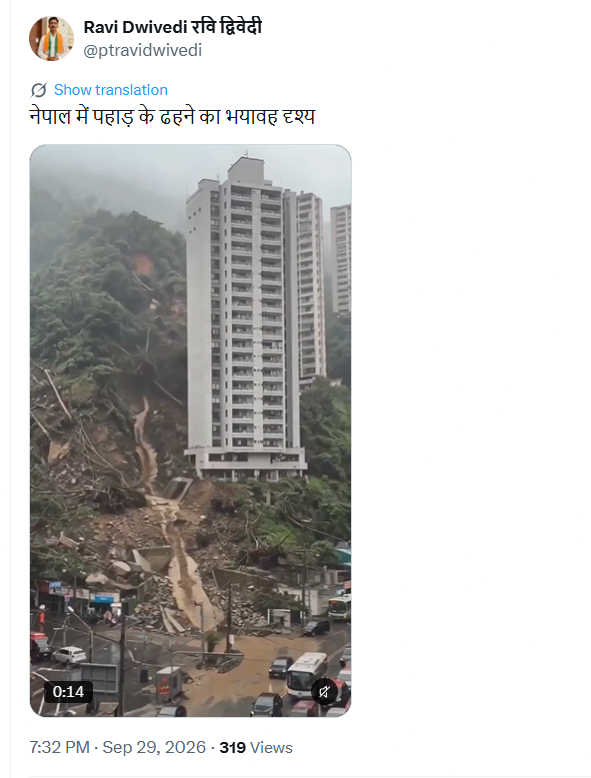
A video is being shared on social media showing a large amount of debris cascading down a mountain amid multi-storey buildings. The video is being shared with the claim that it shows a landslide incident in Nepal. CyberPeace Research found the viral claim to be false. Our research found that the viral video is AI-generated and is being shared with a misleading claim.
Claim:
A Facebook user shared the viral video on September 29, 2026, with the caption, “A horrifying scene of a mountain collapsing in Nepal.” The post link, archive link and screenshot are provided below.
https://x.com/ptravidwivedi/status/2104934750595219494
Fact Check
To verify the authenticity of the viral claim, we conducted a reverse image search using keyframes from the video. However, we did not find any credible media reports or other reliable sources related to the video during the search. Upon closely examining the viral video, we noticed several inconsistencies that raised suspicions that the video may be AI-generated.
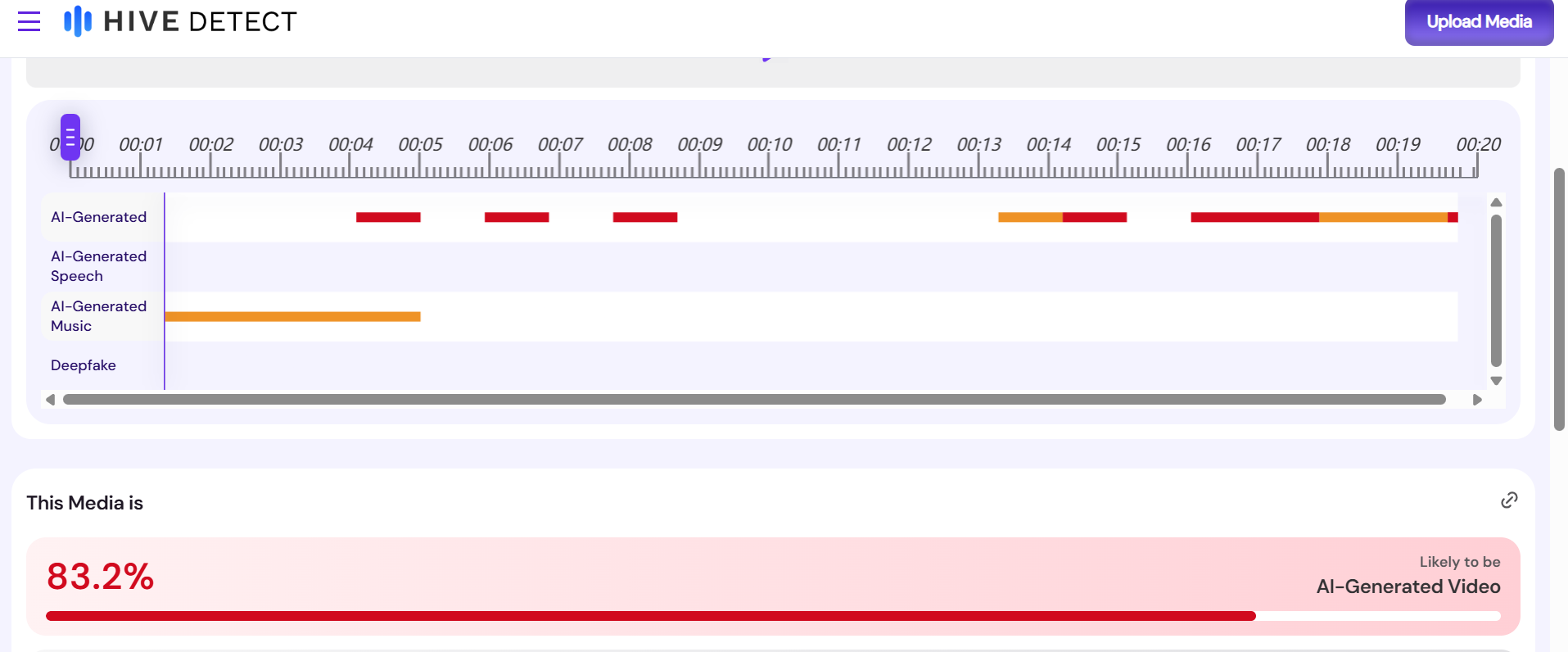
As part of the next step in our research, we scanned the video using the AI detection tool Hive Detect. According to the results, the viral video has an 83 per cent likelihood of being AI-generated.

At the end of our research, we scanned the viral video using the AI detection tool WasIt AI. According to the results, the viral video was found to be AI-generated.


Conclusion
Our research found that the viral video is AI-generated and is being shared with a misleading claim.

Executive Summary
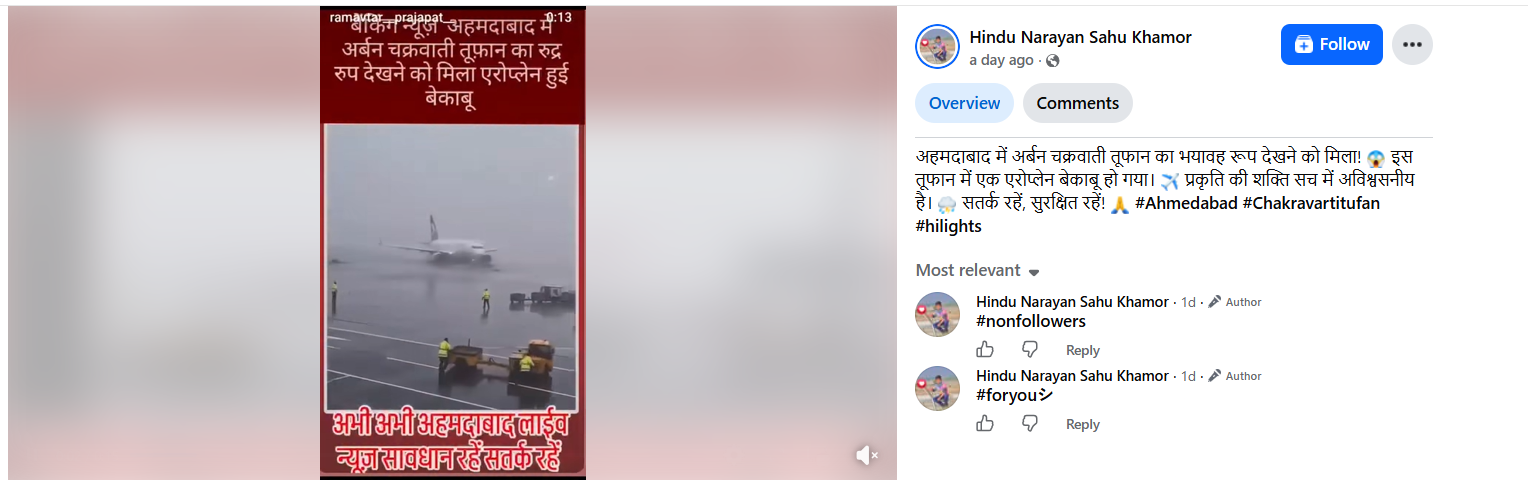
A video is being shared on social media showing an aircraft seemingly losing control amid strong winds. The video is being claimed to be from Ahmedabad, with users alleging that it shows the aircraft being affected by Cyclone Arnab. CyberPeace Research found the viral claim to be false. Our research found that the video is AI-generated. Gujarat is not among the states affected by Cyclone Arnab.
Claim:
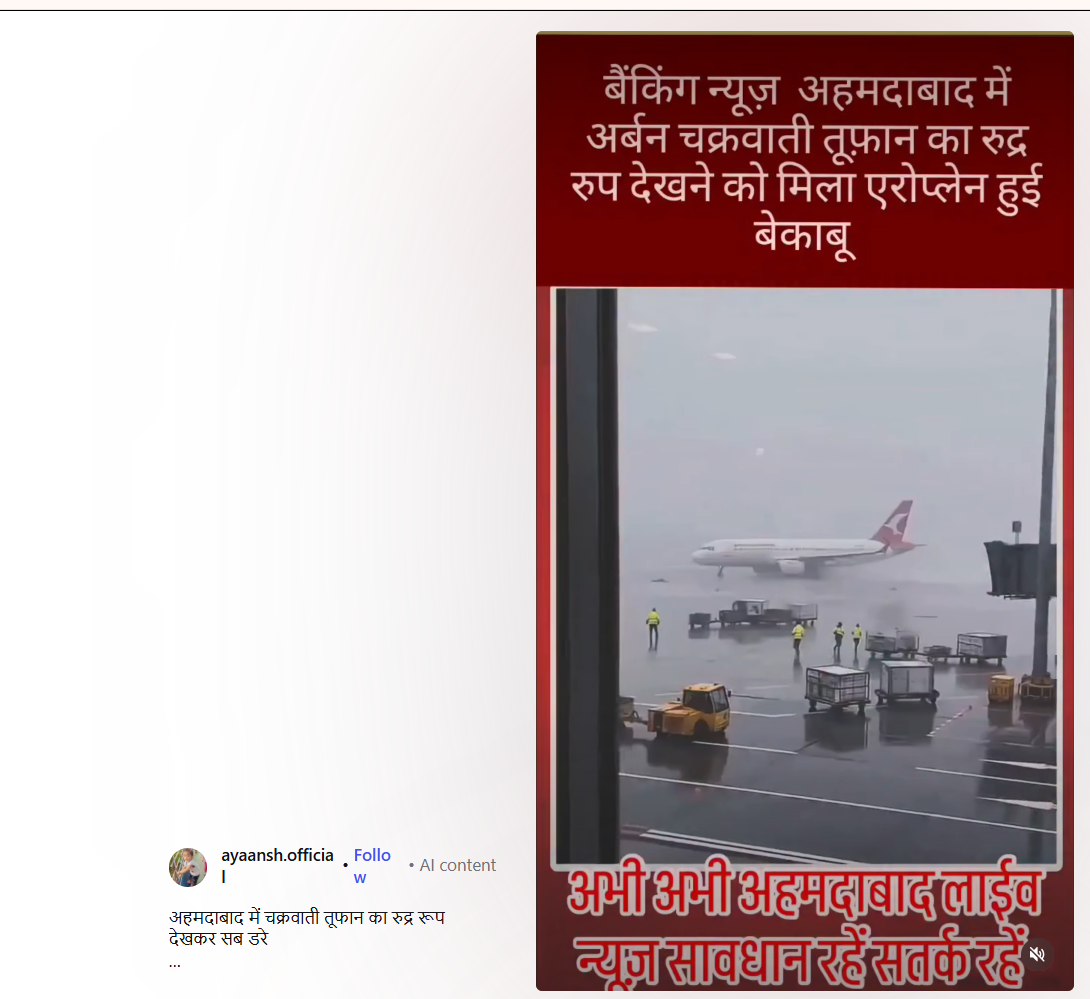
A Facebook user shared the viral video on September 28 with the caption: “The terrifying form of Cyclone Arnab was witnessed in Ahmedabad! An airplane lost control during the storm. The power of nature is truly incredible. Stay alert, stay safe.” The post link, archive link and screenshot are provided below.
https://www.facebook.com/watch/?v=1076505855146958
Fact Check
To verify the authenticity of the viral claim, we conducted a Google search using relevant keywords. During the search, we found a report published on the DD News website on September 25, 2026. According to the report, Cyclone Arnab, which formed over the Bay of Bengal, weakened after making landfall along the coastal areas of Odisha and Andhra Pradesh. The cyclone made landfall along the coast of north Andhra Pradesh and south Odisha between around 11 pm and 1 am, bringing heavy rainfall and strong winds to both states.The report, citing the India Meteorological Department (IMD), stated that rainfall was forecast across 22 states and Union Territories in the country. A heavy rainfall alert was issued for Odisha, Chhattisgarh, Madhya Pradesh, Maharashtra, West Bengal, Sikkim, Uttarakhand, Uttar Pradesh, Bihar, Jharkhand, Andhra Pradesh and Telangana. Meanwhile, light rainfall was expected in Delhi-NCR and Karnataka. Rain accompanied by strong winds was also forecast in the northeastern states, the Andaman and Nicobar Islands, and Kerala.The post link and screenshot are provided below.
https://ddnews.gov.in/cyclone-arnab-weakens-rain-forecast-for-22-states-today/
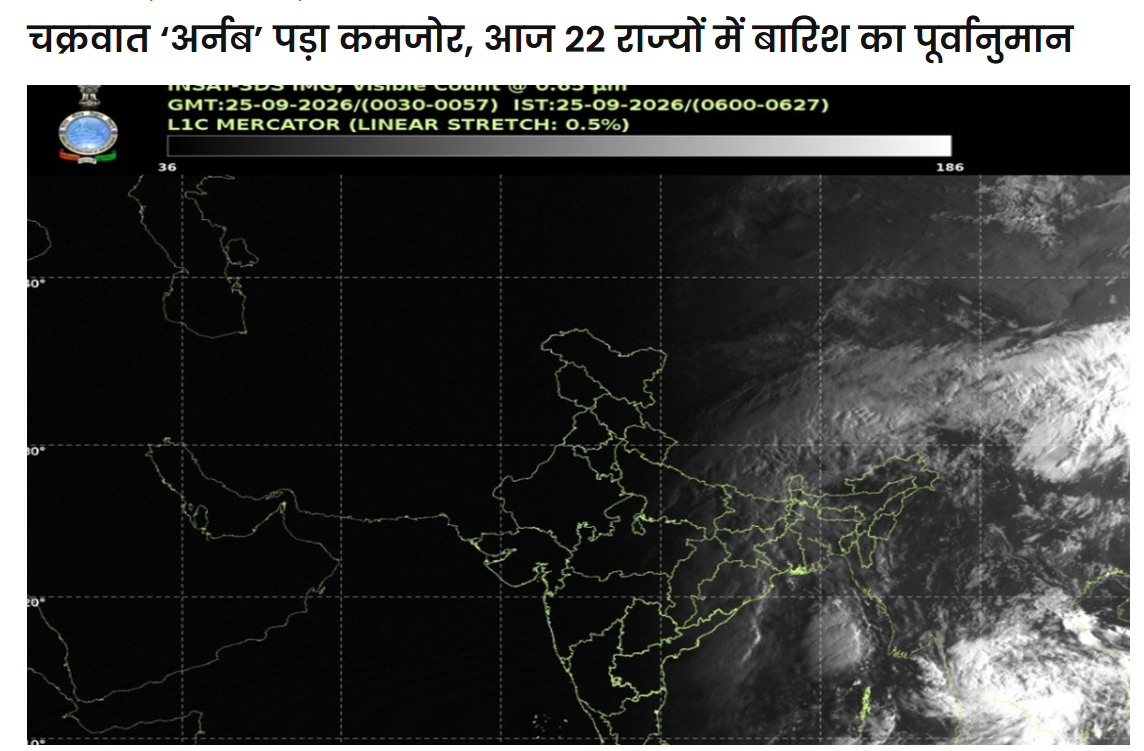
The report made no mention of Gujarat. This raised doubts about the authenticity of the viral video. As part of the next step in our research, we conducted a reverse image search on Google using keyframes from the video. During the search, we found the same video on an Instagram channel that posts AI-generated content. The link and screenshot of the relevant post are provided below.
https://www.instagram.com/reels/Ddya_O1O1rP/
Taking the research forward, we scanned the viral video using the AI detection tool IsFakeAI. According to the results generated by the tool, the viral video was found to be AI-generated.
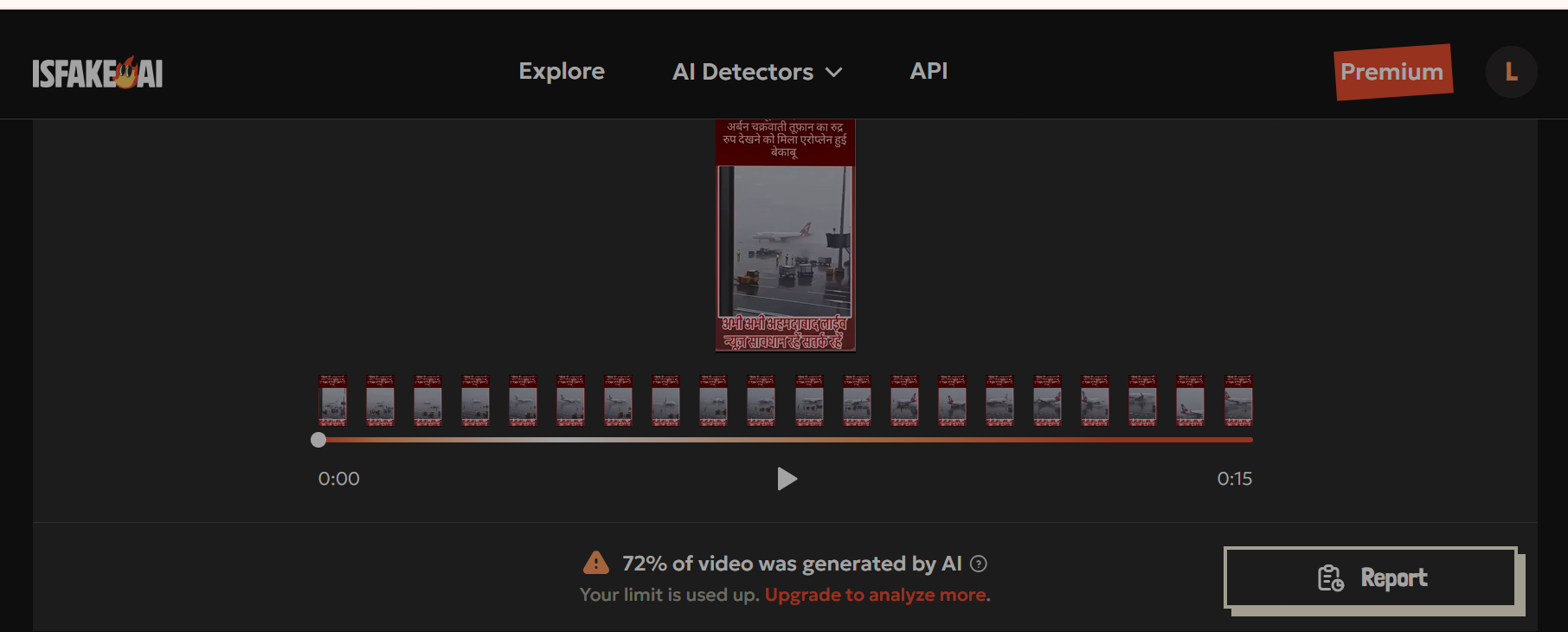
As part of the next step in our research, we scanned the viral video using another AI detection tool, WasIt AI. According to the results, the viral video has a 73 per cent likelihood of being AI-generated.

Conclusion
Our research found the viral claim to be false. We found that the video is AI-generated. Gujarat is not among the states affected by Cyclone Arnab.
