
#FactCheck - Fake Graphic Falsely Claims Amit Shah Urged People to Skip Meals Amid Crisis Rumours
Executive Summary
A graphic widely circulating on social media claims that Union Home Minister Amit Shah has warned, “A major crisis is coming; if possible, skip one meal a day.” The claim has been found to be false in a fact-check conducted by CyberPeace Research Wing. The research revealed that Amit Shah has not made any such statement.
Claim
A Facebook user shared the viral graphic on May 17, 2026, claiming that BJP leader and Home Minister Amit Shah issued a “warning” to the public, allegedly saying people should be prepared for a major crisis and consider skipping one meal a day. The post has been widely circulated on social media, drawing significant attention and discussion.
- https://www.facebook.com/photo.php?fbid=1509406197622070&set=pb.100056581115590.-2207520000&type=3
- https://archive.ph/Z9Tle

Factcheck
A keyword-based search on Google did not return any credible news reports supporting the claim. Further scrutiny of the official account of the Ministry of Home Affairs on X also found no mention or statement matching the viral claim.

A separate review of the official X account of Home Minister Amit Shah also did not show any such statement or post confirming the viral claim.

Conclusion
The viral claim is false. Union Home Minister Amit Shah has not made any such statement.

Related Blogs
Introduction
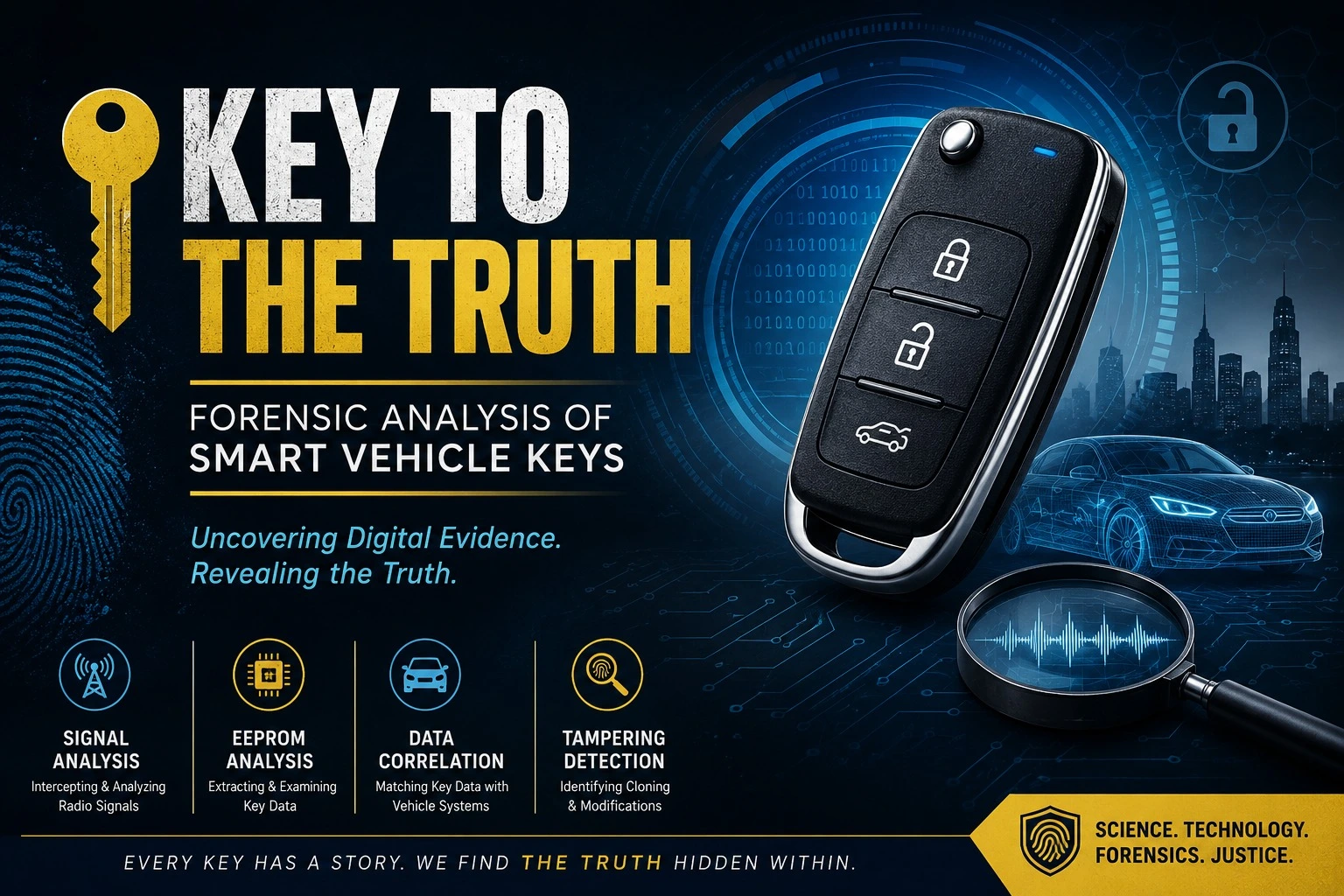
With the modernization of automobiles, so have the methods employed by criminals who seek to commit thefts. The old method of smashing a car window or bypassing an engine lock is no longer prevalent. Modern car thieves employ cloning techniques for keys and digital signals, and sophisticated methods to commit crimes without any traces left behind. In an era where intelligence is crucial, the forensic examination of car keys has become an indispensable tool for investigations, providing clues buried within ordinary car keys.
The Need for Car Key Forensics Today
Daily, thousands of cars worth millions are being hacked or stolen around the globe. The shocking thing is that most of these hacks do not have any sign of breakage or forced entry. It is because the thieves use vulnerabilities in the wireless key systems to unlock the vehicles without leaving any trace behind. Therefore, car-key forensics has now become more important than ever before.
Forensic Value of Smart Key
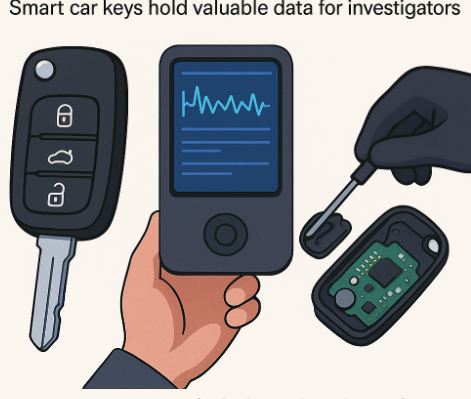
The smart key is not just comprised of locking and unlocking features for vehicles. Actually, it operates as a miniature computer within the key itself. Information such as pairing records, frequency of use, or the last instance that the key was used to unlock something could be contained in smart keys, thus offering evidence of any criminal activity conducted using these items.
Patterns of Vehicle Theft
Through the examination of the chip in a key, one will be able to establish whether the key was legally programmed or had been tampered with by some other means. Such forensics become more important when trying to detect and monitor any car theft rings, which employ cloning machines or software.
Confirming Ownership and Authenticity
In cases involving insurance claims or fraud, smart key data can help confirm whether the person making a claim actually owned or used the car during the incident. It’s digital proof that goes beyond what paperwork or statements can show.
Strengthening Legal Cases
When brought to court, data doesn’t lie. A properly handled forensic examination of a car key can provide hard evidence — the kind that holds up under questioning and supports or disproves claims with complete accuracy. In many cases, this small device becomes the most reliable witness in the investigation.
A Real-Life Example
Consider the following scenario: An expensive SUV is stolen from a parking lot secured with security surveillance. No one is captured on camera and there is no sign of forced entry. After days of investigation, the police end up arresting a suspect with a smart key.
During forensic analysis of the smart key, it is revealed that:
- The transponder has an ID number which can be matched against the immobilizer installed in the vehicle.
- The rolling code counter has been incremented in such a way that the date corresponds with the report of theft of the vehicle.
- The extracted information helps match the pair timestamp of the key with the particular make and model of the vehicle.
All this from a single piece of evidence – the smart key.
Inside a Smart Key: Where the Data Lives
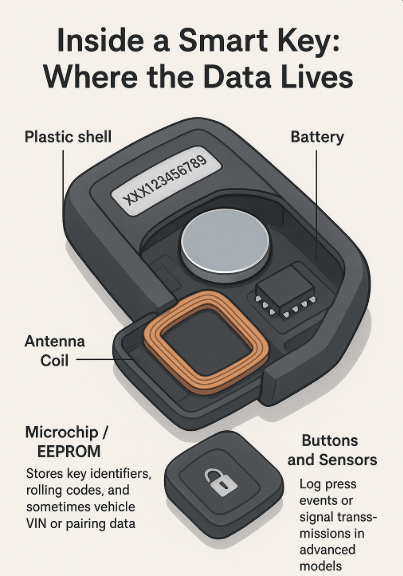
An average smart key is not only a remote but also a multi-level set of data carriers:
- Plastic Shell– could include serial numbers and information on the manufacture.
- Battery – helps calculate the time of using the key or detect any modifications.
- Antenna Coil – sends encrypted information to the immobilizer of a car. Draw the picture of this element.
- Microchip / EEPROM – holds key identification code, rolling code, VIN number, and/or other information of the vehicle.
- Buttons / sensors – could record any pressing or transmission actions in some cases.
All the little devices above, once properly studied via forensics software, provide valuable information.
How the Investigator Uncovers the Truth
In relation to investigating the true story about a vehicle, it is no different than handling other forms of digital evidence, as forensic analysts treat the car key in the same way. It is nothing more than an encrypted device in your hands, and using special techniques, they are able to reveal the information contained within the device.
Some of the methods used by modern forensic laboratories include:
1. Intercepting Radio Signals
Any intelligent key transmits radio signals to communicate with a car. Specialists employ advanced antennas and radio frequency (RF) analysers to catch and analyse them. This way, it is possible to understand the interaction between the key and the car – how often was it used, what kind of authentication procedure takes place, and if the signal matches the car’s one or has been forged somehow.
2. Checking Out the Key’s Brain (Analysis of EEPROM)
There is always a special chip on the key that is responsible for its activity. The chip contains an important memory module (EEPROM – Electrically Erasable Programmable Read-Only Memory), which holds various data, including key IDs and rolling codes. It can be carefully retrieved via advanced tools. Thus, it is possible to determine whether somebody tried to tamper with the key.
3. The Correlation between the Key and Car’s Information
The information stored inside the key will not be used separately since investigators will correlate the key's data with that of the vehicle itself (ECU and immobilizer). If the two kinds of information coincide, the investigation may conclude that the key belongs to the vehicle. Otherwise, this may mean either cloning or tampering.
4. Identifying the Tampering and Cloning Evidence
As was mentioned above, thieves sometimes resort to using unlawful programming devices for duplicating smart car keys. In order to detect possible cloning, experts examine the key using various diagnostic devices to find out whether the keys were modified by changing the encryption code, frequencies, and hardware itself.
At the end of the process, some kind of miracle occurs because of the following: all actions committed with this particular key become documented, recorded inside the device itself. Even if someone tries to hide anything or remove any information concerning this particular incident, there will always remain some data.
Car Key Forensics in the Future
The evolution of cars to connect with other devices and adopt self-driving technologies requires new investigative methods to be used for vehicle-related crimes. Advanced car keys or smartphone apps that replace physical keys will likely incorporate biometric authentication, cloud integration, or blockchain records of key activity in the near future.
Such improvements will pose several threats and offer many benefits:
- Artificial intelligence tools can determine if the car key is cloned based on its behaviour pattern.
- Blockchain validation ensures all key-related activities are recorded and cannot be altered.
- Cyber-forensic protocols will become increasingly necessary for investigating criminal activity related to vehicles.
Car key forensics technology will not only allow solving crimes but may become instrumental in crime prevention.
Conclusion
A car key in this era is more than just an unlocking mechanism; it is a miniature data storage facility, which can yield information about the user, intentions, and access rights. The more cars become technologically advanced, the more the examination of smart keys becomes necessary as part of correlating physical evidence with digital investigation. It clearly indicates how small objects such as keys can play pivotal roles in cracking cases.
Introduction
Somewhere right now, a model is reading a library. It does not read like you or I, savouring a good line or skipping to the end. It does not copy, clean and convert text into numbers at the scale that a human reader could. The copyright questions these models raise are not new, but they are new in scale, and they implicate a legal order that prizes borders. A book written in Lagos can be replicated on a server in Virginia, used to train a model sold in Berlin. Whose laws apply? The honest answer is: we don't know.
A Treaty Written Before Computers
The Berne Convention is one of the most important international agreements on copyright, with over 180 countries being party to it. According to Article 9(1) of the Berne Convention, authors have the exclusive right to allow or prohibit the reproduction of their works in any form or way. Article 9(2) provides that certain countries may implement exceptions to the rights granted by the convention, as long as they are consistent with the three-step test. More specifically, a national law exception should be confined to a certain category of works, not prejudice the work’s normal use, and not unreasonably prejudice the rights of the author.
This explains how the Berne Convention could apply to copyright protection for AI. Developers of such technology often argue that since the output of a given model rarely resembles anything learned from the examples provided, there is no copying occurring. However, the Agreed Statements of the WIPO Copyright Treaty provide that the reproduction of a protected item in digital format also constitutes a reproduction. Therefore, if a work is used to train a model, this can be considered a reproduction, and the question then emerges whether a national exception applies.
Three Jurisdictions, Three Answers
Countries have responded in different ways to that question. The United States draws on its fair use doctrine, a flexible, four-factor test that was never intended for machine learning but dominates AI-related disputes anyway. Japan’s Article 30-4 permits uses of works for the purpose of data analysis where the use is not for the enjoyment of the work’s expression, which captures a lot of what training entails. And the European Union’s approach falls somewhere in the middle: its text and data mining rules allow mining of lawfully accessible works, but rightsholders can specify in a machine-readable manner that they do not want their works mined, and developers are required to seek permission.
A recent roundtable from the Columbia Undergraduate Law Review argues that the EU model fits the three-step test best because the opt-out keeps a licensing market alive and gives authors control before their work is used rather than after. It argues that broad US fair use and Japan's provision both struggle at the second and third steps, since they can undercut a foreseeable licensing market. That is one scholarly view and not settled law. The EU system also has its own weak spot: an opt-out only protects authors who know it exists and have the technical means to use it.
Bartz v. Anthropic in Brief
Bartz v. Anthropic is the case that puts these debates in front of a judge. Three authors, including Andrea Bartz, Charles Graeber and Kirk Wallace Johnson, filed a lawsuit against the Anthropic company for using part of their works to create the central library used by Claude and to train the models used in its creation. In addition, in June 2025, Judge William Alsup approved the separation of the case, considering each instance of use separately.
On training, he granted summary judgement for Anthropic, holding the use was fair and describing it as exceedingly transformative. He compared it to a reader who studies great writing in order to produce something new. It mattered that the authors did not allege Claude's outputs reproduced their books, so the case turned on inputs alone. He also held that buying print books and scanning them into digital copies was fair use, since it only changed the format of copies Anthropic already owned. But he refused to excuse the more than seven million pirated books Anthropic downloaded to build a permanent library. Building that library from pirated copies, he found, was its own use and not a transformative one, and that part was set for trial.
Two observations are worth making in relation to those thinking across borders. First, the court's assumption that there might be a market for training licences, but its observation that this is not a market which the Copyright Act entitles authors to control, is quite inconsistent with Berne's concern for normal exploitation. Moreover, the order makes no reference to Berne at all, bearing out the observation that the US courts apply the domestic statute and not the treaty.
The story did not end there. Anthropic agreed to a $1.5 billion class settlement covering roughly 482,000 works, and the court granted final approval on 20 July 2026. It resolves claims about past acquisition and copying, so the training ruling remains a trial court's view rather than binding precedent.
Where Borders Break the System
The deeper trouble is that none of this travels well. Berne is not self-executing in the United States, so judges apply the domestic statute, and nobody is required to ask whether a fair use ruling passes the three-step test. Meanwhile, training can happen in one country, on work from dozens of others, for a product used everywhere. The same book might be freely usable in Tokyo, subject to an opt-out in Paris and defended as fair use in San Francisco.
The roundtable suggests one way forward: a new WIPO special agreement, along the lines of the WIPO Copyright Treaty, in response to the internet. It would provide guidance on the application of the three-step test to training, regard licensing markets as an ordinary part of exploitation, and require minimum standards for reservations of rights and compensation. There is one major potential obstacle: many of the most influential AI companies are based in the US, which has a record of opposing international obligations that impinge on fair use. A deal would apply only to the extent that it is not controlled by the US, where most of the training takes place. Market forces, in the form of the so-called Brussels effect, may prove more influential than negotiations at WIPO.
Conclusion
Bartz’s analysis illustrates the importance of characterising a specific use at the level of a particular court. While the former had been viewed as an activity and the latter as an acquisition, the distinction between the use of a work and its acquisition appears more likely to transcend borders than the concept of fair use. Berne was designed to create a common ground for authors. Whether this convention would be able to fulfil its function in the era of generative AI depends on the willingness of nations to adopt a joint understanding of what constitutes its foundations for machines.

Executive Summary
Several social media posts are claiming that Chinese troops have entered nearly 60 kilometres inside Arunachal Pradesh. Amid these claims, a video showing security personnel managing a large crowd is being widely circulated as footage from Arunachal Pradesh. Users are sharing the clip claiming it captures the situation following the alleged Chinese intrusion. CyberPeace Research Wing found the claim to be false. The viral video is not from Arunachal Pradesh. It actually shows Baltal Base Camp during the Amarnath Yatra in Jammu and Kashmir. The Government of India has also categorically denied reports of any recent Chinese intrusion into Indian territory.
Claim
A Facebook user, "Komal Vanshi," shared the video on July 8, 2026, claiming that Chinese People's Liberation Army (PLA) soldiers had entered deep inside Arunachal Pradesh and referring to alleged incidents along the Line of Actual Control (LAC). The post was accompanied by the viral video, suggesting it was related to the alleged intrusion.
https://www.facebook.com/reel/1585091393251089

Fact Check
We first carefully examined the viral video. During the analysis, we noticed barricades bearing the words "Jammu & Kashmir Police." This clearly indicated that the footage could not have been recorded in Arunachal Pradesh.

In the next step, we extracted multiple keyframes from the video and conducted a reverse image search using Google Lens. Although the video was widely shared with the Arunachal Pradesh claim, our search led us to a YouTube Shorts video uploaded on July 7, 2026, identifying the location as Baltal, one of the main base camps for the annual Amarnath Yatra in Jammu and Kashmir.
https://www.youtube.com/watch?v=EEfP2RckyJM

The visual details in the YouTube video matched the viral footage, confirming that it was filmed at Baltal Base Camp and had no connection with Arunachal Pradesh or any alleged Chinese military movement
Conclusion
CyberPeace Research Wing found that the viral claim is false. The video being circulated as evidence of a Chinese military incursion into Arunachal Pradesh actually shows crowd management arrangements at Baltal Base Camp during the Amarnath Yatra in Jammu and Kashmir. The footage has been falsely linked to an unrelated claim about Chinese troops entering Indian territory. There is no evidence that the video depicts any incident related to the India-China border.
