
#FactCheck -Old Video of Former CEC Rajiv Kumar Misleadingly Linked to Recent West Bengal Election Results
Executive Summary
Following the results of the recent West Bengal elections, a video of former Chief Election Commissioner Rajiv Kumar has gone viral on social media. In the clip, Kumar is seen questioning television news channels over their election-result coverage and alleged early “trends” before the actual counting process begins. In the viral video, Rajiv Kumar can be heard saying, “When counting begins, channels start showing trends from 8:05 AM itself, which is nonsense. The first round of counting starts only at 8:30 AM. We have evidence that leads were being shown before that. Is it possible that these early trends are shown just to justify exit polls?”The video is being widely shared with the claim that Kumar made these remarks after the recently concluded West Bengal Assembly elections Research conducted by CyberPeace Research Wing found that a 2024 video of former Chief Election Commissioner Rajiv Kumar is being misleadingly shared as a recent statement made after the West Bengal election results.
Claim
An Instagram user shared the viral clip suggesting that the former Election Commissioner made these comments in the context of the latest West Bengal poll results.

Fact Check
Using relevant keyword searches, we traced the original source of the clip to an official post shared by the Election Commission of Indiaon Facebook on October 15, 2024. The video was part of a press conference announcing the Assembly election schedule for Maharashtra and Jharkhand.

We also found the complete live-streamed press conference on the official YouTube channel of the Election Commission.

During the press conference, around the 26:45-minute mark, an ANI journalist referred to discrepancies between exit polls and actual Lok Sabha election results and asked whether such situations fuel doubts over EVMs among the public. Responding to the question at around 30:27 minutes, Rajiv Kumar spoke about the need for self-regulation in electronic media and concerns over premature “trends” shown during counting day. He said that exit polls often create public expectations despite lacking a clear scientific basis and questioned why TV channels begin displaying leads even before the first official counting round starts.
Conclusion
The viral claim is misleading. The video of former Chief Election Commissioner Rajiv Kumar is not related to the recent West Bengal election results. The clip is from an October 15, 2024 press conference held to announce the Maharashtra and Jharkhand Assembly election schedule and is now being falsely shared in a misleading context after the West Bengal polls.

Related Blogs

Introduction
Cyber-attacks are another threat in this digital world, not exclusive to a single country, that could significantly disrupt global movements, commerce, and international relations all of which experienced first-hand when a cyber-attack occurred at Heathrow, the busiest airport in Europe, which threw their electronic check-in and baggage systems into a state of chaos. Not only were there chaos and delays at Heathrow, airports across Europe including Brussels, Berlin, and Dublin experienced delay and had to conduct manual check-ins for some flights further indicating just how interconnected the world of aviation is in today's world. Though Heathrow assured passengers that the "vast majority of flights" would operate, hundreds were delayed or postponed for hours as those passengers stood in a queue while nearly every European airport's flying schedule was also negatively impacted.
The Anatomy of the Attack
The attack specifically targeted Muse software by Collins Aerospace, a software built to allow various airlines to share check-in desks and boarding gates. The disruption initially perceived to be technical issues soon turned into a logistical nightmare, with airlines relying on Muse having to engage in horror-movie-worthy manual steps hand-tagging luggage, verifying boarding passes over the phone, and manually boarding passengers. While British Airways managed to revert to a backup system, most other carriers across Heathrow and partner airports elsewhere in Europe had to resort to improvised manual solutions.
The trauma was largely borne by the passengers. Stories emerged about travelers stranded on the tarmac, old folks left barely able to walk without assistance, and even families missing important connections. It served to remind everyone that the aviation world, with its schedules interlocked tightly across borders, can see even a localized system failure snowball into a continental-level crisis.
Cybersecurity Meets Aviation Infrastructure
In the last two decades, aviation has become one of the more digitally dependent industries in the world. From booking systems and baggage handling issues to navigation and air traffic control, digital systems are the invisible scaffold on which flight operations are supported. Though this digitalization has increased the scale of operations and enhanced efficiency, it must have also created many avenues for cyber threats. Cyber attackers increasingly realize that to target aviation is not just about money but about leverage. Just interfering with the check-in system of a major hub like Heathrow is more than just financial disruption; it causes panic and hits the headlines, making it much more attractive for criminal gangs and state-sponsored threat actors.
The Heathrow incident is like the worldwide IT crash in July 2024-thwarting activities of flights caused by a botched Crowdstrike update. Both prove the brittleness of digital dependencies in aviation, where one failure point triggering uncontrollable ripple effects spanning multiple countries. Unlike conventional cyber incidents contained within corporate networks, cyber-attacks in aviation spill on to the public sphere in real time, disturbing millions of lives.
Response and Coordination
Heathrow Airport first added extra employees to assist with manual check-in and told passengers to check flight statuses before traveling. The UK's National Cyber Security Centre (NCSC) collaborated with Collins Aerospace, the Department for Transport, and law enforcement agencies to investigate the extent and source of the breach. Meanwhile, the European Commission published a statement that they are "closely following the development" of the cyber incident while assuring passengers that no evidence of a "widespread or serious" breach has been observed.
According to passengers, the reality was quite different. Massive passenger queues, bewildering announcements, and departure time confirmations cultivated an atmosphere of chaos. The wrenching dissonance between the reassurances from official channel and Kirby needs to be resolved about what really happens in passenger experiences. During such incidents, technical restoration and communication flow are strategies for retaining public trust in incidents.
Attribution and the Shadow of Ransomware
As with many cyber-attacks, questions on its attribution arose quite promptly. Rumours of hackers allegedly working for the Kremlin escaped into the air quite possibly inside seconds of the realization, Cybersecurity experts justifiably advise against making conclusions hastily. Extortion ransomware gangs stand the last chance to hold the culprits, whereas state actors cannot be ruled out, especially considering Russian military activity under European airspace. Meanwhile, Collins Aerospace has refused to comment on the attack, its precise nature, or where it originated, emphasizing an inherent difficulty in cyberattribution.
What is clear is the way these attacks bestow criminal leverage and dollars. In previous ransomware attacks against critical infrastructure, cybercriminal gangs have extorted millions of dollars from their victims. In aviation terms, the stakes grow exponentially, not only in terms of money but national security and diplomatic relations as well as human safety.
Broader Implications for Aviation Cybersecurity
This incident brings to consideration several core resilience issues within aviation systems. Traditionally, the airports and airlines had placed premium on physical security, but today, the equally important concept of digital resilience has come into being. Systems such as Muse, which bind multiple airlines into shared infrastructure, offer efficiency but, at the same time, also concentrate that risk. A cyber disruption in one place will cascade across dozens of carriers and multiple airports, thereby amplifying the scale of that disruption.
The case also brings forth redundancy and contingency planning as an urgent concern. While BA systems were able to stand on backups, most other airlines could not claim that advantage. It is about time that digital redundancies, be it in the form of parallel systems or isolated backups or even AI-driven incident response frameworks, are built into aviation as standard practice and soon.
On the policy plane, this incident draws attention to the necessity for international collaboration. Aviation is therefore transnational, and cyber incidents standing on this domain cannot possibly be handled by national agencies only. Eurocontrol, the European Commission, and cross-border cybersecurity task forces must spearhead this initiative to ensure aviation-wide resilience.
Human Stories Amid a Digital Crisis
Beyond technical jargon and policy response, the human stories had perhaps the greatest impact coming from Heathrow. Passengers spoke of hours spent queuing, heading to funerals, and being hungry and exhausted as they waited for their flights. For many, the cyber-attack was no mere headline; instead, it was ¬ a living reality of disruption.
These stories reflect the fact that cybersecurity is no hunger strike; it touches people's lives. In critical sectors such as aviation, one hour of disruption means missed connections for passengers, lost revenue for airlines, and inculcates immense emotional stress. Crisis management must therefore entail technical recovery and passenger care, communication, and support on the ground.
Conclusion
The cybersecurity crisis of Heathrow and other European airports emphasizes the threat of cyber disruption on the modern legitimacy of aviation. The use of increased connectivity for airport processes means that any cyber disruption present, no matter how small, can affect scheduling issues regionally or on other continents, even threatening lives. The occurrences confirm a few things: a resilient solution should provide redundancy not efficiency; international networking and collaboration is paramount; and communicating with the traveling public is just as important (if not more) as the technical recovery process.
As governments, airlines, and technology providers analyse the disruption, the question is longer if aviation can withstand cyber threats, but to what extent it will be prepared to defend itself against those attacks. The Heathrow crisis is a reminder that the stake of cybersecurity is not just about a data breach or outright stealing of money but also about stealing the very systems that keep global mobility in motion. Now, the aviation industry is tested to make this disruption an opportunity to fortify the digital defences and start preparing for the next inevitable production.
References
- https://www.bbc.com/news/articles/c3drpgv33pxo
- https://www.theguardian.com/business/2025/sep/21/delays-continue-at-heathrow-brussels-and-berlin-airports-after-alleged-cyber-attack
- https://www.reuters.com/business/aerospace-defense/eu-agency-says-third-party-ransomware-behind-airport-disruptions-2025-09-22/

Assembly elections are due to be held in Assam later this year, with polling likely in April or May. Ahead of the elections, a video claiming to be an Aaj Tak news bulletin is being widely circulated on social media.
In the viral video, Aaj Tak anchor Rajiv Dhoundiyal is allegedly seen stating that a leaked intelligence report has issued a warning for the ruling Bharatiya Janata Party (BJP) in Assam. The clip claims that according to this purported report, the BJP may suffer significant losses in the upcoming Assembly elections. Several social media users sharing the video have also claimed that the alleged intelligence report signals the possible removal of Assam Chief Minister Himanta Biswa Sarma from office.
However, an investigation by the Cyber Peace Foundation found the viral claim to be false. Our probe clearly established that no leaked intelligence report related to the Assam Assembly elections exists.
Further, Aaj Tak has neither published nor broadcast any such report on its official television channel, website, or social media platforms. The investigation also revealed that the viral video itself is not authentic and has been created using deepfake technology.
Claim
On social media platform Facebook, a user shared the viral video claiming that the BJP has been pushed on the back foot following organisational changes in the Congress—appointing Priyanka Gandhi Vadra as chairperson of the election screening committee and Gaurav Gogoi as the Assam Pradesh Congress Committee president. The post further claims that an Intelligence Bureau report predicts that the current Assam government will not return to power.
(Link to the post, archive link, and screenshots are available.)
FactCheck:
To verify the claim, we first searched for reports related to any alleged leaked intelligence assessment concerning the Assam Assembly elections using relevant keywords. However, no credible or reliable reports supporting the claim were found. We then reviewed Aaj Tak’s official website, social media pages, and YouTube channel. Our examination confirmed that no such news bulletin has been published or broadcast by the network on any of its official platforms.
- https://www.facebook.com/aajtak/?locale=hi_IN
- https://www.instagram.com/aajtak/
- https://x.com/aajtak
- https://www.youtube.com/channel/UCt4t-jeY85JegMlZ-E5UWtA
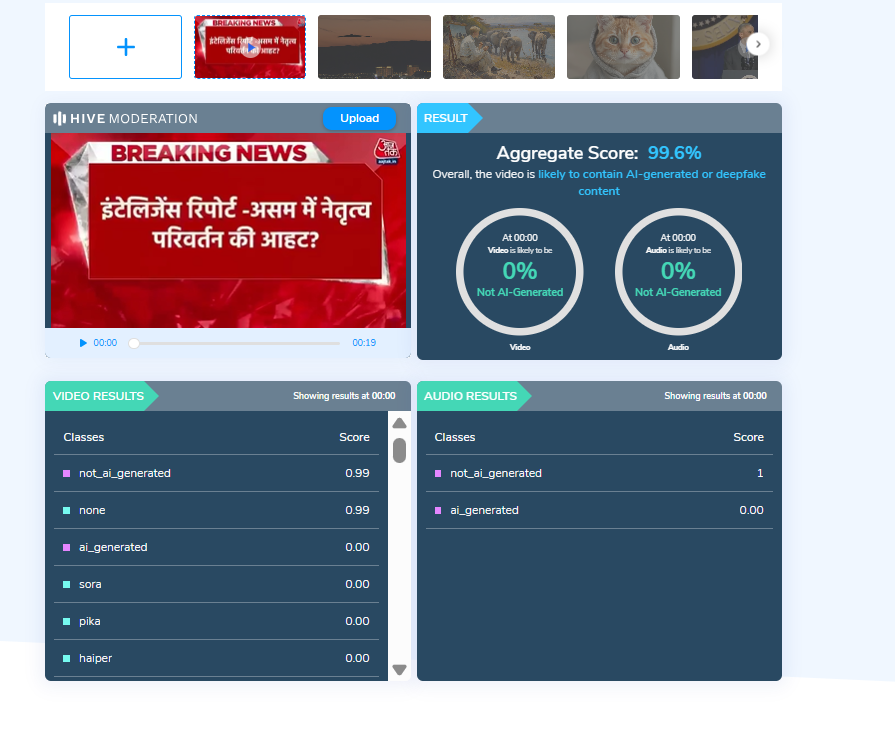
To further verify the authenticity of the video, its audio was scanned using the deepfake voice detection tool HIVE Moderation.
The analysis revealed that the voice heard in the video is 99 per cent AI-generated, clearly indicating that the audio is not genuine and has been artificially created using artificial intelligence.
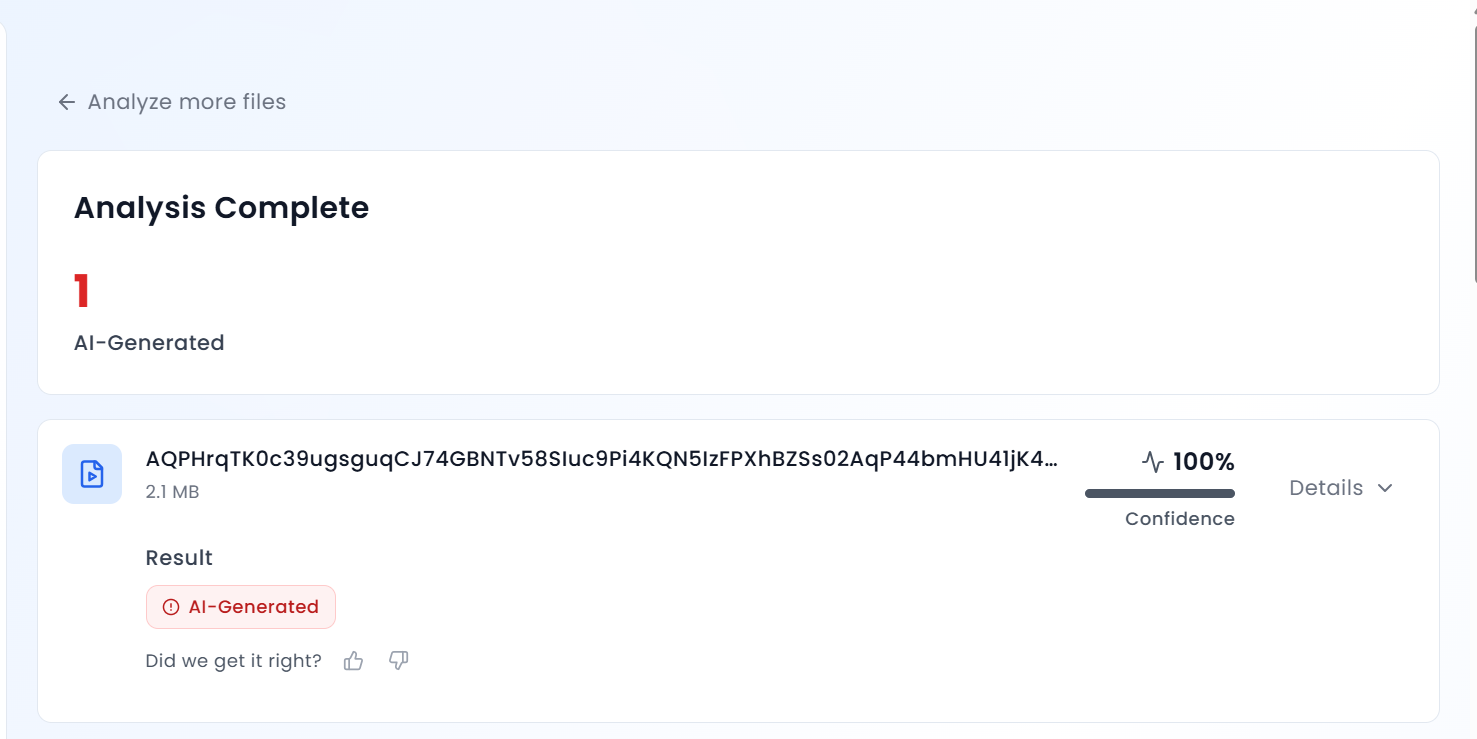
Additionally, the video was analysed using another AI detection tool, Aurigin AI, which also identified the viral clip as AI-generated.
Conclusion:
The investigation clearly establishes that there is no leaked intelligence report predicting BJP’s defeat in the Assam Assembly elections. Aaj Tak has not published or broadcast any such content on its official platforms. The video circulating on social media is not authentic and has been created using deepfake technology to mislead viewers.

Introduction
Intricate and winding are the passageways of the modern digital age, a place where the reverberations of truth effortlessly blend, yet hauntingly contrast, with the echoes of falsehood. Within this complex realm, the World Economic Forum (WEF) has illuminated the darkened corners with its powerful spotlight, revealing the festering, insidious network of misinformation and disinformation that snakes through the virtual and physical worlds alike. Gravely identified by the “WEF's Global Risks Report 2024” as the most formidable and immediate threats to our collective well-being, this malignant duo—misinformation and disinformation.
The report published with the solemn tone suitable for the prelude to such a grand international gathering as the Annual Summit in Davos, the report presents a vivid tableau of our shared global landscape—one that is dominated by the treacherous pitfalls of deceits and unverified claims. These perils, if unrecognised and unchecked by societal checks and balances, possess the force to rip apart the intricate tapestry of our liberal institutions, shaking the pillars of democracies and endangering the vulnerable fabric of social cohesion.
Election Mania
As we find ourselves perched on the edge of a future, one where the voices of nearly three billion human beings make their mark on the annals of history—within the varied electoral processes of nations such as Bangladesh, India, Indonesia, Mexico, Pakistan, the United Kingdom, and the United States. However, the spectre of misinformation can potentially corrode the integrity of the governing entities that will emerge from these democratic processes. The warning issued by the WEF is unambiguous: we are flirting with the possibility of disorder and turmoil, where the unchecked dispersion of fabrications and lies could kindle flames of unrest, manifesting in violent protests, hate-driven crimes, civil unrest, and the scourge of terrorism.
Derived from the collective wisdom of over 1,400 experts in global risk, esteemed policymakers, and industry leaders, the report crafts a sobering depiction of our world's journey. It paints an ominous future that increasingly endows governments with formidable power—to brandish the weapon of censorship, to unilaterally declare what is deemed 'true' and what ought to be obscured or eliminated in the virtual world of sharing information. This trend signals a looming potential for wider and more comprehensive repression, hindering the freedoms traditionally associated with the Internet, journalism, and unhindered access to a panoply of information sources—vital fora for the exchange of ideas and knowledge in a myriad of countries across the globe.
Prominence of AI
When the gaze of the report extends further over a decade-long horizon, the prominence of environmental challenges such as the erosion of biodiversity and alarming shifts in the Earth's life-support systems ascend to the pinnacle of concern. Yet, trailing closely, the digital risks continue to pulsate—perpetuated by the distortions of misinformation, the echoing falsities of disinformation, and the unpredictable repercussions stemming from the utilization and, at times, the malevolent deployment of artificial intelligence (AI). These ethereal digital entities, far from being illusory shades, are the precursors of a disintegrating world order, a stage on which regional powers move to assert and maintain their influence, instituting their own unique standards and norms.
The prophecies set forth by the WEF should not be dismissed as mere academic conjecture; they are instead a trumpet's urgent call to mobilize. With a startling 30 percent of surveyed global experts bracing for the prospect of international calamities within the mere span of the coming two years, and an even more significant portion—nearly two-thirds—envisaging such crises within the forthcoming decade, it is unmistakable that the time to confront and tackle these looming risks is now. The clarion is sounding, and the message is clear: inaction is no longer an available luxury.
Maldives and India Row
To pluck precise examples from the boundless field of misinformation, we might observe the Lakshadweep-Malé incident wherein an ordinary boat accident off the coast of Kerala was grotesquely transformed into a vessel for the far-reaching tendrils of fabricated narratives, erroneously implicating Lakshadweep in the spectacle. Similarly, the tension-laden India-Maldives diplomatic exchange becomes a harrowing testament to how strained international relations may become fertile ground for the rampant spread of misleading content. The suspension of Maldivian deputy ministers following offensive remarks, the immediate tumult that followed on social media, and the explosive proliferation of counterfeit news targeting both nations paint a stark and intricate picture of how intertwined are the threads of politics, the digital platforms of social media, and the virulent propagation of falsehoods.
Yet, these are mere fragments within the extensive and elaborate weave of misinformation that threatens to enmesh our globe. As we venture forth into this dangerous and murky topography, it becomes our collective responsibility to maintain a sense of heightened vigilance, to consistently question and verify the sources and content of the information that assails us from all directions, and to cultivate an enduring culture anchored in critical thinking and discernment. The stakes are colossal—for it is not merely truth itself that we defend, but rather the underlying tenets of our societies and the sanctity of our cherished democratic institutions.
Conclusion
In this fraught era, marked indelibly by uncertainty and perched precariously on the cusp of numerous pivotal electoral ventures, let us refuse the role of passive bystanders to unraveling our collective reality. We must embrace our role as active participants in the relentless pursuit of truth, fortified with the stark awareness that our entwined futures rest precariously on our willingness and ability to distinguish the veritable from the spurious within the perilous lattice of falsehoods of misinformation. We must continually remind ourselves that, in the quest for a stable and just global order, the unerring discernment of fact from fiction becomes not only an act of intellectual integrity but a deed of civic and moral imperative.
References
- https://www.businessinsider.in/politics/world/election-fuelled-misinformation-is-serious-global-risk-in-2024-says-wef/articleshow/106727033.cms
- https://www.deccanchronicle.com/nation/current-affairs/100124/misinformation-tops-global-risks-2024.html
- https://www.msn.com/en-in/news/India/fact-check-in-lakshadweep-male-row-kerala-boat-accident-becomes-vessel-for-fake-news/ar-AA1mOJqY
- https://www.boomlive.in/news/india-maldives-muizzu-pm-modi-lakshadweep-fact-check-24085
- https://www.weforum.org/press/2024/01/global-risks-report-2024-press-release/
