
#FactCheck -Prayagraj Celebration Video Falsely Shared as BJP Victory Celebration in West Bengal
Executive Summary
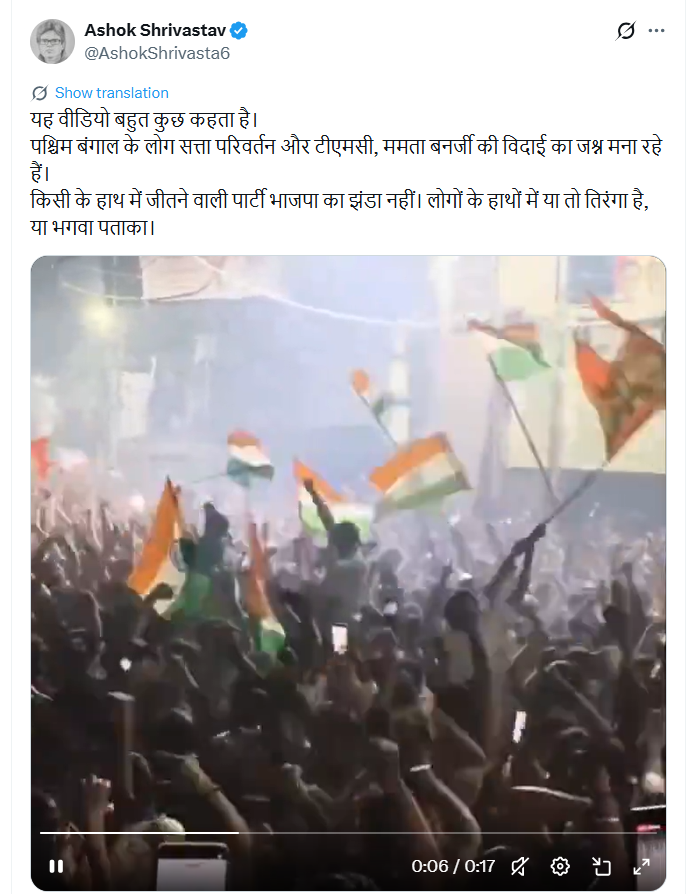
Assembly election results for West Bengal, Assam, Kerala, Tamil Nadu and the Union Territory of Puducherry have been declared, with the Bharatiya Janata Party (BJP) set to form the government in West Bengal after defeating the Trinamool Congress (TMC). Amid celebrations and reports of violence in the state, several misleading videos and images are also circulating on social media. One such viral clip shows people waving the Indian tricolour and saffron flags during a street celebration. Social media users are claiming that the video captures people celebrating a political change and BJP’s victory in West Bengal. Research by CyberPeace Research Wing found that the claim is false. The viral video is not from West Bengal but from Prayagraj and actually shows celebrations after India’s victory in the ICC Men's T20 World Cup 2026.
Claim
An X user named “Ashok Shrivastav” shared the video on May 6, 2026, claiming that people in West Bengal were celebrating the departure of Mamata Banerjee and the TMC government. The user further claimed that people were waving only the national flag and saffron flags, not BJP flags.
Fact Check
To verify the claim, we extracted several keyframes from the viral video and conducted a reverse image search using Google Lens. The clip was found on multiple social media handles falsely linked to West Bengal.

However, the oldest version of the video was uploaded on March 8, 2026, by an Instagram page named “Streets of Sangam.” The caption identified the location as Prayagraj and included hashtags related to the World Cup and Loknath. During the comparison of the viral and original videos, we noticed a shop sign reading “Suman Ornaments.” Using Google Street View, we traced the location to Baba Loknath area in Prayagraj, where the same shop could be identified near Loknath Gate.

Conclusion
Our research confirms that the viral claim is fake. The video being shared as BJP victory celebrations in West Bengal is actually from Prayagraj, Uttar Pradesh, and dates back to March 2026, when locals celebrated Team India’s T20 World Cup victory. The old clip is now being misleadingly circulated with a false political narrative.

Related Blogs

Introduction
In the wake of the Spy Loan scandal, more than a dozen malicious loan apps were downloaded on Android phones from the Google Play Store, However, the number is significantly higher because they are also available on third-party marketplaces and questionable websites.
Unmasking the Scam
When a user borrows money, these predatory lending applications capture large quantities of information from their smartphone, which is then used to blackmail and force them into returning the total with hefty interest levels. While the loan amount is disbursed to users, these predatory loan apps request sensitive information by granting access to the camera, contacts, messages, logs, images, Wi-Fi network details, calendar information, and other personal information. These are then sent to loan shark servers.
The researchers have disclosed facts about the applications used by loan sharks to mislead consumers, as well as the numerous techniques used to circumvent some of the limitations imposed on the Play Store. Malware is often created with appealing user interfaces and promotes simple and rapid access to cash with high-interest payback conditions. The revelation of the Spy Loan scandal has triggered an immediate response from law enforcement agencies worldwide. There is an urgency to protect millions of users from becoming victims of malicious loan apps, it has become extremely important for law enforcement to unmask the culprits and dismantle the cyber-criminal network.
Aap’s banned: here is the list of the apps banned by Google Play Store :
- AA Kredit: इंस्टेंट लोन ऐप (com.aa.kredit.android)
- Amor Cash: Préstamos Sin Buró (com.amorcash.credito.prestamo)
- Oro Préstamo – Efectivo rápido (com.app.lo.go)
- Cashwow (com.cashwow.cow.eg)
- CrediBus Préstamos de crédito (com.dinero.profin.prestamo.credito.credit.credibus.loan.efectivo.cash)
- ยืมด้วยความมั่นใจ – ยืมด่วน (com.flashloan.wsft)
- PréstamosCrédito – GuayabaCash (com.guayaba.cash.okredito.mx.tala)
- Préstamos De Crédito-YumiCash (com.loan.cash.credit.tala.prestmo.fast.branch.mextamo)
- Go Crédito – de confianza (com.mlo.xango)
- Instantáneo Préstamo (com.mmp.optima)
- Cartera grande (com.mxolp.postloan)
- Rápido Crédito (com.okey.prestamo)
- Finupp Lending (com.shuiyiwenhua.gl)
- 4S Cash (com.swefjjghs.weejteop)
- TrueNaira – Online Loan (com.truenaira.cashloan.moneycredit)
- EasyCash (king.credit.ng)
- สินเชื่อปลอดภัย – สะดวก (com.sc.safe.credit)
Risks with several dimensions
SpyLoan's loan application violates Google's Financial Services policy by unilaterally shortening the repayment period for personal loans to a few days or any other arbitrary time frame. Additionally, the company threatens users with public embarrassment and exposure if they do not comply with such unreasonable demands.
Furthermore, the privacy rules presented by SpyLoan are misleading. While ostensibly reasonable justifications are provided for obtaining certain permissions, they are very intrusive practices. For instance, camera permission is ostensibly required for picture data uploads for Know Your Customer (KYC) purposes, and access to the user's calendar is ostensibly required to plan payment dates and reminders. However, both of these permissions are dangerous and can potentially infringe on users' privacy.
Prosecution Strategies and Legal Framework
The law enforcement agencies and legal authorities initiated prosecution strategies against the individuals who are involved in the Spy Loan Scandal, this multifaced approach involves international agreements and the exploration of innovative legal avenues. Agencies need to collaborate with International agencies to work on specific cyber-crime, leveraging the legal frameworks against digital fraud furthermore, the cross-border nature of the spy loan operation requires a strong legal framework to exchange information, extradition requests, and the pursuit of legal actions across multiple jurisdictions.
Legal Protections for Victims: Seeking Compensation and Restitution
As the legal battle unfolds in the aftermath of the Spy loan scam the focus shifts towards the victims, who suffer financial loss from such fraudulent apps. Beyond prosecuting culprits, the pursuit of justice should involve legal safeguards for victims. Existing consumer protection laws serve as a crucial shield for Spy Loan victims. These laws are designed to safeguard the rights of individuals against unfair practices.
Challenges in legal representation
As the legal hunt for justice in the Spy Loan scam progresses, it encounters challenges that demand careful navigation and strategic solutions. One of the primary obstacles in the legal pursuit of the Spy loan app lies in the jurisdictional complexities. Within the national borders, it’s quite challenging to define the jurisdiction that holds the authority, and a unified approach in prosecuting the offenders in various regions with the efforts of various government agencies.
Concealing the digital identities
One of the major challenges faced is the anonymity afforded by the digital realm poses a challenge in identifying and catching the perpetrators of the scam, the scammers conceal their identity and make it difficult for law enforcement agencies to attribute to actions against the individuals, this challenge can be overcome by joint effort by international agencies and using the advance digital forensics and use of edge cutting technology to unmask these scammers.
Technological challenges
The nature of cyber threats and crime patterns are changing day by day as technology advances this has become a challenge for legal authorities, the scammers explore vulnerabilities, making it essential, for law enforcement agencies to be a step ahead, which requires continuous training of cybercrime and cyber security.
Shaping the policies to prevent future fraud
As the scam unfolds, it has become really important to empower users by creating more and more awareness campaigns. The developers of the apps need to have a transparent approach to users.
Conclusion
It is really important to shape the policies to prevent future cyber frauds with a multifaced approach. Proposals for legislative amendments, international collaboration, accountability measures, technology protections, and public awareness programs all contribute to the creation of a legal framework that is proactive, flexible, and robust to cybercriminals' shifting techniques. The legal system is at the forefront of this effort, playing a critical role in developing regulations that will protect the digital landscape for years to come.
Safeguarding against spyware threats like SpyLoan requires vigilance and adherence to best practices. Users should exclusively download apps from official sources, meticulously verify the authenticity of offerings, scrutinize reviews, and carefully assess permissions before installation.
References

Executive Summary
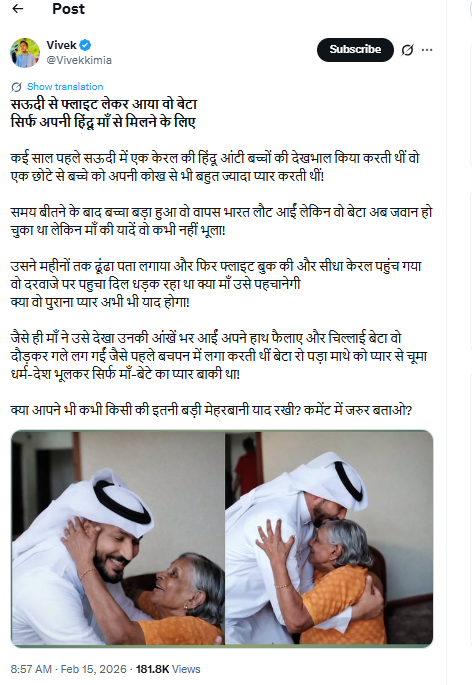
A photo is going viral on social media showing a young man dressed in traditional Arab attire warmly embracing an elderly woman. The post claims that the man flew in from Saudi Arabia to Kerala just to meet his “Hindu mother,” portraying the image as a heartwarming example of communal harmony. However, research by the CyberPeace found that the claim being shared with the image is misleading.
Claim
The viral post narrates an emotional story, alleging that years ago a Hindu woman from Kerala worked in Saudi Arabia caring for children and loved a young boy like her own son. After she returned to India, the boy—now grown up—reportedly searched for her for months, booked a flight, and finally reached Kerala to reunite with her. The post describes an emotional reunion filled with tears, affection, and a bond beyond religion and nationality.
Fact Check
A reverse image search of the viral picture led us to a video uploaded on August 18, 2023, on the YouTube channel of social media influencer Hashim Abbas. In the video, he is seen meeting and hugging the elderly woman while extending Onam greetings.
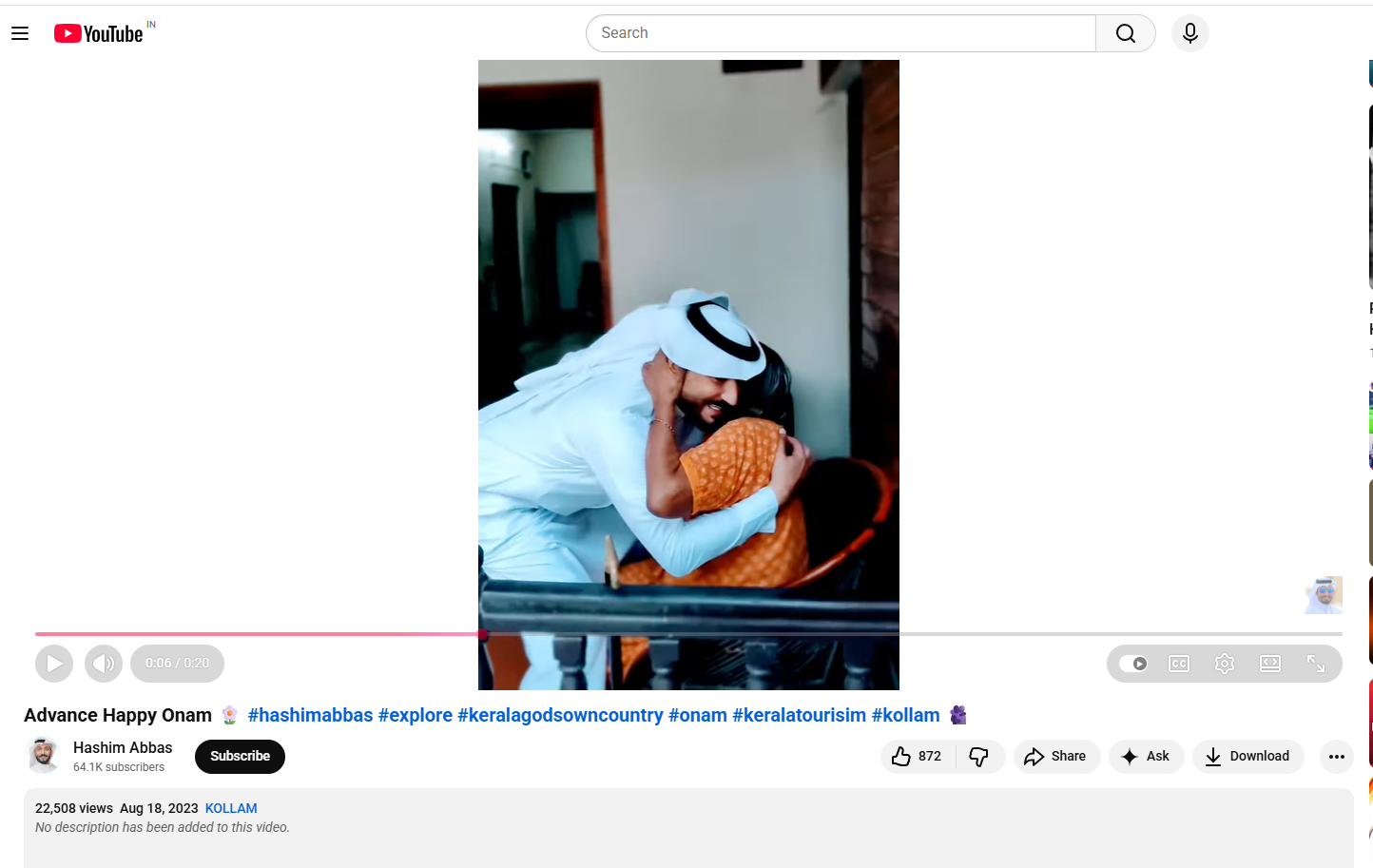
Further examination of Hashim Abbas’ social media accounts revealed several other videos from his Kerala visit. Our research also found that Abbas played a significant role in the Malayalam film Kondotty Pooram.

Additionally, we found a video posted on August 13, 2023, by actress and theatre artist Sandhya Rajendran, daughter of veteran Malayalam actress Vijayakumari. The video shows Vijayakumari teaching Onam songs to Hashim Abbas.

Conclusion
The evidence clearly establishes that the viral claim is misleading. The man seen in the image is Hashim Abbas, who was meeting senior Malayalam actress Vijayakumari to extend Onam greetings. The emotional story about a son flying from Saudi Arabia to reunite with his Hindu mother is fictional and not connected to the viral image.

Executive Summary:
A viral online video claims Billionaire and Founder of Tesla & SpaceX Elon Musk of promoting Cryptocurrency. The CyberPeace Research Team has confirmed that the video is a deepfake, created using AI technology to manipulate Elon’s facial expressions and voice through the use of relevant, reputed and well verified AI tools and applications to arrive at the above conclusion for the same. The original footage had no connections to any cryptocurrency, BTC or ETH apportion to the ardent followers of crypto-trading. The claim that Mr. Musk endorses the same and is therefore concluded to be false and misleading.

Claims:
A viral video falsely claims that Billionaire and founder of Tesla Elon Musk is endorsing a Crypto giveaway project for the crypto enthusiasts which are also his followers by consigning a portion of his valuable Bitcoin and Ethereum stock.


Fact Check:
Upon receiving the viral posts, we conducted a Google Lens search on the keyframes of the video. The search led us to various legitimate sources featuring Mr. Elon Musk but none of them included any promotion of any cryptocurrency giveaway. The viral video exhibited signs of digital manipulation, prompting a deeper investigation.
We used AI detection tools, such as TrueMedia.org, to analyze the video. The analysis confirmed with 99.0% confidence that the video was a deepfake. The tools identified "substantial evidence of manipulation," particularly in the facial movements and voice, which were found to be artificially generated.


Additionally, an extensive review of official statements and interviews with Mr. Musk revealed no mention of any such giveaway. No credible reports were found linking Elon Musk to this promotion, further confirming the video’s inauthenticity.
Conclusion:
The viral video claiming that Elon Musk promotes a crypto giveaway is a deep fake. The research using various tools such as Google Lens, AI detection tool confirms that the video is manipulated using AI technology. Additionally, there is no information in any official sources. Thus, the CyberPeace Research Team confirms that the video was manipulated using AI technology, making the claim false and misleading.
- Claim: Elon Musk conducting giving away Cryptocurrency viral on social media.
- Claimed on: X(Formerly Twitter)
- Fact Check: False & Misleading
