
#FactCheck -Edited Newspaper Clipping Falsely Linked to Indira Gandhi’s Appeal Against Buying Gold
Executive Summary
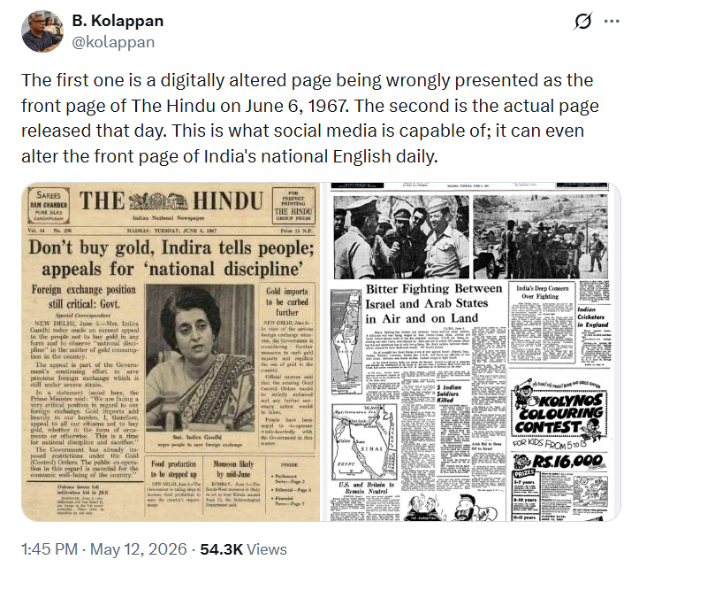
A purported front page of The Hindu dated June 6, 1967, is being widely circulated on social media with the claim that then Prime Minister Indira Gandhi had urged Indians not to buy gold in any form and to follow “national discipline” by restricting gold consumption. The viral claim suggests that the appeal was part of the government’s efforts to conserve foreign exchange reserves, which were allegedly under severe pressure at the time. However, research conducted by CyberPeace Research Wing found the claim to be false. Our research revealed that the front page being circulated online is not authentic and has been digitally edited.
Claim
An X (formerly Twitter) user shared the viral newspaper clipping on May 12, 2026, and wrote:“In 1967, during a severe foreign exchange crisis, Indira Gandhi appealed to Indians not to buy gold.From ‘skip one meal’ to ‘don’t buy gold,’ Congress-era governance normalized shortages, restrictions, and sacrifice, while ordinary citizens paid the price for failed economic policies.”

Research
To verify the claim, we examined the official social media accounts of The Hindu. During the research, we found a post published on the publication’s official X account on May 12, 2026, clarifying that the viral image claiming to be the June 6, 1967 front page of The Hindu was digitally altered and not part of its official archives. The newspaper also urged readers to verify information carefully before sharing it online.

We also found an X post by B Kolappan, a journalist with The Hindu, who shared the original front page of the newspaper dated June 6, 1967, further exposing the viral image as fake.
For context, Prime Minister Narendra Modi, while addressing a public gathering on May 10, 2026, spoke about the possible economic impact of the ongoing conflict in the Middle East and advised people to avoid buying gold for a year, even during weddings or family functions. The viral claim appears to have resurfaced in this backdrop.

Conclusion
Our research found that the alleged 1967 front page of The Hindu circulating on social media is digitally edited and fake. There is no evidence that the viral newspaper page is authentic or part of The Hindu’s archival records.

Related Blogs
Introduction
In today’s digital era, warfare is being redefined. Defence Minister Rajnath Singh recently stated that “we are in the age of Grey Zone and hybrid warfare where cyber-attacks, disinformation campaigns and economic warfare have become tools to achieve politico-military aims without a single shot being fired.” The crippling cyberattacks on Estonia in 2007, Russia’s interference in the 2016 US elections, and the ransomware strike on the Colonial Pipeline in the United States in 2021 all demonstrate how states are now using cyberspace to achieve strategic goals while carefully circumventing the threshold of open war.
Legal Complexities: Attribution, Response, and Accountability
Grey zone warfare challenges the traditional notions of security and international conventions on peace due to inherent challenges such as :
- Attribution
The first challenge in cyber warfare is determining who is responsible. Threat actors hide behind rented botnets, fake IP addresses, and servers scattered across the globe. Investigators can follow digital trails, but those trails often point to machines, not people. That makes attribution more of an educated guess than a certainty. A wrong guess could lead to misattribution of blame, which could beget a diplomatic crisis, or worse, a military one. - Proportional Response
Even if attribution is clear, designing a response can be a challenge. International law does give room for countermeasures if they are both ‘necessary’ and ‘proportionate’. But defining these qualifiers can be a long-drawn, contested process. Effectively, governments employ softer measures such as protests or sanctions, tighten their cyber defences or, in extreme cases, strike back digitally. - Accountability
States can be held responsible for waging cyber attacks under the UN’s Draft Articles on State Responsibility. But these are non-binding and enforcement depends on collective pressure, which can be slow and inconsistent. In cyberspace, accountability often ends up being more symbolic than real, leaving plenty of room for repeat offences.
International and Indian Legal Frameworks
Cyber law is a step behind cyber warfare since existing international frameworks are often inadequate. For example, the Tallinn Manual 2.0, the closest thing we have to a rulebook for cyber conflict, is just a set of guidelines. It says that if a cyber operation can be tied to a state, even through hired hackers or proxies, then that state can be held responsible. But attribution is a major challenge. Similarly, the United Nations has tried to build order through its Group of Governmental Experts (GGE) that promotes norms like “don’t attack. However, these norms are not binding, effectively leaving practice to diplomacy and trust.
India is susceptible to routine attacks from hostile actors, but does not yet have a dedicated cyber warfare law. While Section 66F of the IT ACT, 2000, talks about cyber terrorism, and Section 75 lets Indian courts examine crimes committed abroad if they impact India, grey-zone tactics like fake news campaigns, election meddling, and influence operations fall into a legal vacuum.
Way Forward
- Strengthen International Cooperation
Frameworks like the Tallinn Manual 2.0 can form the basis for future treaties. Bilateral and multilateral agreements between countries are essential to ensure accountability and cooperation in tackling grey zone activities. - Develop Grey Zone Legislation
India currently relies on the IT Act, 2000, but this law needs expansion to specifically cover grey zone tactics such as election interference, propaganda, and large-scale disinformation campaigns. - Establish Active Monitoring Systems
India must create robust early detection systems to identify grey zone operations in cyberspace. Agencies can coordinate with social media platforms like Instagram, Facebook, X (Twitter), and YouTube, which are often exploited for propaganda and disinformation, to improve monitoring frameworks. - Dedicated Theatre Commands for Cyber Operations
Along with the existing Defence Cyber Agency, India should consider specialised theatre commands for grey zone and cyber warfare. This would optimise resources, enhance coordination, and ensure unified command in dealing with hybrid threats.
Conclusion
Grey zone warfare in cyberspace is no longer an optional tactic used by threat actors but a routine activity. India lacks the early detection systems, robust infrastructure, and strong cyber laws to counter grey-zone warfare. To counter this, India needs sharper attribution tools for early detection and must actively push for stronger international rules in this global landscape. More importantly, instead of merely blaming without clear plans, India should focus on preparing for solid retaliation strategies. By doing so, India can also learn to use cyberspace strategically to achieve politico-military aims without firing a single shot.
References
- Tallinn Manual 2.0 on the International Law Applicable to Cyber Operations (Michael N. Schmitt)
- UN Document on International Law in Cyberspace (UN Digital Library)
- NATO Cyber Defence Policy
- Texas Law Review: State Responsibility and Attribution of Cyber Intrusions
- Deccan Herald: Defence Minister on Grey Zone Warfare
- VisionIAS: Grey Zone Warfare
- Sachin Tiwari, The Reality of Cyber Operations in the Grey Zone

Amid the popularity of OpenAI’s ChatGPT and Google’s announcement of introducing its own Artificial Intelligence chatbot called Bard, there has been much discussion over how such tools can impact India at a time when the country is aiming for an AI revolution.
During the Budget Session, Finance Minister Nirmala Sitharaman talked about AI, while her colleague, Minister of State (MoS) for Electronics and Information Technology Rajeev Chandrasekhar discussed it at the India Stack Developer Conference.
While Sitharaman stated that the government will establish three centres of excellence in AI in the country, Chandrashekhar at the event mentioned that India Stack, which includes digital solutions like Aadhaar, Digilocker and others, will become more sophisticated over time with the inclusion of AI.
As AI chatbots become the buzzword, News18 discusses with experts how such tech tools will impact India.
AI IN INDIA
Many experts believe that in a country like India, which is extremely diverse in nature and has a sizeable population, the introduction of technologies and their right adoption can bring a massive digital revolution.
For example, Manoj Gupta, Cofounder of Plotch.ai, a full-stack AI-enabled SaaS product, told News18 that Bard is still experimental and not open to everyone to use while ChatGPT is available and can be used to build applications on top of it.
He said: “Conversational chatbots are interesting since they have the potential to automate customer support and assisted buying in e-commerce. Even simple banking applications can be built that can use ChatGPT AI models to answer queries like bank balance, service requests etc.”
According to him, such tools could be extremely useful for people who are currently excluded from the digital economy due to language barriers.
Ashwini Vaishnaw, Union Minister for Communications, Electronics & IT, has also talked about using such tools to reduce communication issues. At World Economic Forum in Davos, he said: “We integrated our Bhashini language AI tool, which translates from one Indian language to another Indian language in real-time, spoken and text everything. We integrated that with ChatGPT and are seeing very good results.”
‘DOUBLE-EDGED SWORD’
Sundar Balasubramanian, Managing Director, India & SAARC, at Check Point Software, told News18 that generative AI like ChatGPT is a “double-edged sword”.
According to him, used in the right way, it can help developers write and fix code quicker, enable better chat services for companies, or even be a replacement for search engines, revolutionising the way people search for information.
“On the flip side, hackers are also leveraging ChatGPT to accelerate their bad acts and we have already seen examples of such exploitations. ChatGPT has lowered the bar for novice hackers to enter the field as they are able to learn quicker and hack better through asking the AI tool for answers,” he added.
Balasubramanian also stated that CPR has seen the quality of phishing emails improve tremendously over the past 3 months, making it increasingly difficult to discern between legitimate sources and a targeted phishing scam.
“Despite the emergence of the use of generative AI impacting cybercrime, Check Point is continually reminding organisations and individuals of the significance of being vigilant as ChatGPT and Codex become more mature, it can affect the threat landscape, for both good and bad,” he added.
While the real-life applications of ChatGPT include several things ranging from language translation to explaining tricky math problems, Balasubramanian said it can also be used for making the work of cyber researchers and developers more efficient.
“Generative AI or tools like ChatGPT can be used to detect potential threats by analysing large amounts of data and identifying patterns that may indicate malicious activity. This can help enterprises quickly identify and respond to a potential threat before it escalates to something more,” he added.
POSITIVE FACTORS
Major Vineet Kumar, Founder and Global President of CyberPeace Foundation, believes that the deployment of AI chatbots has proven to be highly beneficial in India, where a booming economy and increasing demand for efficient customer service have led to a surge in their use. According to him, both ChatGPT and Bard have the potential to bring significant positive change to various industries and individuals in India.
“ChatGPT has already made an impact by revolutionising customer service, providing instant and accurate support, and reducing wait time. It has automated tedious and complicated tasks for businesses and educational institutions, freeing up valuable time for more significant activities. In the education sector, ChatGPT has also improved learning experiences by providing quick and reliable information to students and educators,” he added.
He also said there are several possible positive impacts that the AI chatbots, ChatGPT and Bard, could have in India and these include improved customer experience, increased productivity, better access to information, improved healthcare, improved access to education and better financial services.
Reference Link : https://www.news18.com/news/explainers/confused-about-chatgpt-bard-experts-tell-news18-how-openai-googles-ai-chatbots-may-impact-india-7026277.html

Introduction
The pervasive issue of misinformation in India is a multifaceted challenge with profound implications for democratic processes, public awareness, and social harmony. The Election Commission of India (ECI) has taken measures to counter misinformation during the 2024 elections. ECI has launched campaigns to educate people and urge them to verify election-related content and share responsibly on social media. In response to the proliferation of fake news and misinformation online, the ECI has introduced initiatives such as ‘Myth vs. Reality’ and 'VerifyBeforeYouAmplify' to clear the air around fake news being spread on social media. EC measures aim to ensure that the spread of misinformation is curbed, especially during election time, when voters consume a lot of information from social media. It is of the utmost importance that voters take in facts and reliable information and avoid any manipulative or fake information that can negatively impact the election process.
EC Collaboration with Tech Platforms
In this new age of technology, the Internet and social media continue to witness a surge in the spread of misinformation, disinformation, synthetic media content, and deepfake videos. This has rightly raised serious concerns. The responsible use of social media is instrumental in maintaining the accuracy of information and curbing misinformation incidents.
The ECI has collaborated with Google to empower the citizenry by making it easy to find critical voting information on Google Search and YouTube. In this way, Google supports the 2024 Indian General Election by providing high-quality information to voters, safeguarding platforms from abuse, and helping people navigate AI-generated content. The company connects voters to helpful information through product features that show data from trusted organisations across its portfolio. YouTube showcases election information panels, including how to register to vote, how to vote, and candidate information. YouTube's recommendation system prominently features content from authority sources on the homepage, in search results, and in the "Up Next" panel. YouTube highlights high-quality content from authoritative news sources during key moments through its Top News and Breaking News shelves, as well as the news watch page.
Google has also implemented strict policies and restrictions regarding who can run election-related advertising campaigns on its platforms. They require all advertisers who wish to run election ads to undergo an identity verification process, provide a pre-certificate issued by the ECI or anyone authorised by the ECI for each election ad they want to run where necessary, and have in-ad disclosures that clearly show who paid for the ad. Additionally, they have long-standing ad policies that prohibit ads from promoting demonstrably false claims that could undermine trust or participation in elections.
CyberPeace Countering Misinformation
CyberPeace Foundation, a leading organisation in the field of cybersecurity works to promote digital peace for all. CyberPeace is working on the wider ecosystem to counter misinformation and develop a safer and more responsible Internet. CyberPeace has collaborated with Google.org to run a pan-India awareness-building program and comprehensive multilingual digital resource hub with content available in up to 15 Indian languages to empower over 40 million netizens in building resilience against misinformation and practising responsible online behaviour. This step is crucial in creating a strong foundation for a trustworthy Internet and secure digital landscape.
Myth vs Reality Register by ECI
The Election Commission of India (ECI) has launched the 'Myth vs Reality Register' to combat misinformation and ensure the integrity of the electoral process during the general elections 2024. The 'Myth vs Reality Register' can be accessed through the Election Commission's official website (https://mythvsreality.eci.gov.in/). All stakeholders are urged to verify and corroborate any dubious information they receive through any channel with the information provided in the register. The register provides a one-stop platform for credible and authenticated election-related information, with the factual matrix regularly updated to include the latest busted fakes and fresh FAQs. The ECI has identified misinformation as one of the challenges, along with money, muscle, and Model Code of Conduct violations, for electoral integrity. The platform can be used to verify information, prevent the spread of misinformation, debunk myths, and stay informed about key issues during the General Elections 2024.
The ECI has taken proactive steps to combat the challenge of misinformation which could cripple the democratic process. EC has issued directives urging vigilance and responsibility from all stakeholders, including political parties, to verify information before amplifying it. The EC has also urged responsible behaviour on social media platforms and discourse that inspires unity rather than division. The commission has stated that originators of false information will face severe consequences, and nodal officers across states will remove unlawful content. Parties are encouraged to engage in issue-based campaigning and refrain from disseminating unverified or misleading advertisements.
Conclusion
The steps taken by the ECI have been designed to empower citizens and help them affirm the accuracy and authenticity of content before amplifying it. All citizens must be well-educated about the entire election process in India. This includes information on how the electoral rolls are made, how candidates are monitored, a complete database of candidates and candidate backgrounds, party manifestos, etc. For informed decision-making, active reading and seeking information from authentic sources is imperative. The partnership between government agencies, tech platforms and civil societies helps develop strategies to counter the widespread misinformation and promote online safety in general, and electoral integrity in particular.
References
- https://pib.gov.in/PressReleaseIframePage.aspx?PRID=2016941#:~:text=To%20combat%20the%20spread%20of,the%20ongoing%20General%20Elections%202024
- https://www.business-standard.com/elections/lok-sabha-election/ls-elections-2024-ec-uses-social-media-to-nudge-electors-to-vote-124040700429_1.html
- https://blog.google/intl/en-in/company-news/outreach-initiatives/supporting-the-2024-indian-general-election/
- https://blog.google/intl/en-in/partnering-indias-success-in-a-new-digital-paradigm/
