
#FactCheck-Old Maharashtra Video of Dancing Policemen Falsely Linked to West Bengal Election Results
Executive Summary
A video showing police personnel dancing on the streets along with civilians is going viral on social media. The clip is being shared with the claim that policemen in West Bengal were celebrating the defeat of Mamata Banerjee and the victory of the BJP.
Research by CyberPeace Research Wing found that the claim is misleading. The viral video is old and unrelated to the West Bengal elections.
Claim
An X user shared the video on April 26, 2026, alleging that police personnel were celebrating BJP’s victory. The post questioned those raising concerns over EVMs, suggesting that even police were openly rejoicing over the election outcome.
- https://x.com/Minakshishriyan/status/2051490074957930510
- https://archive.is/d81OT
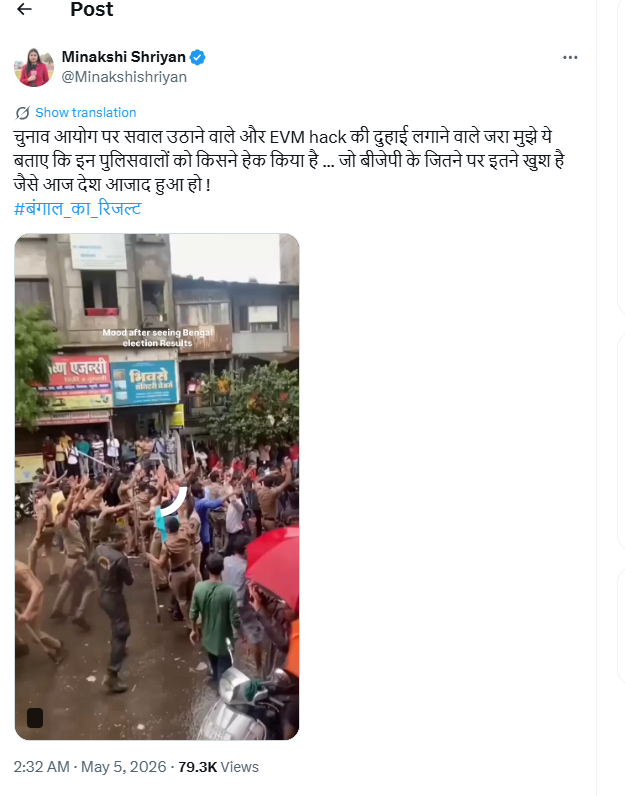
Fact Check
To verify the claim, we extracted keyframes from the viral video and conducted a reverse image search. This led us to a Reddit post dated September 13, 2022, where the same video was shared. The post described it as footage from Ganesh Visarjan celebrations in India, and several users in the comments identified the location as Maharashtra.

Further research led us to a YouTube channel “Yash Arate Vlogs,” which uploaded the same video on September 10, 2022. The description stated that the clip was recorded during Ganpati immersion celebrations in Kolhapur.
https://www.youtube.com/shorts/0_w5t-4rmTY

We also found media reports from September 2022 indicating that during Ganesh Visarjan in Kolhapur, loud music and festive atmosphere led even on-duty police personnel to briefly join the celebrations.

Conclusion
Our research confirms that the viral video does not show any post-election celebration in West Bengal. It is an old clip from Maharashtra, recorded during Ganesh Visarjan festivities, and is being falsely shared with a misleading political claim.

Related Blogs

What Is a VPN and its Significance
A Virtual Private Network (VPN) creates a secure and reliable network connection between a device and the internet. It hides your IP address by rerouting it through the VPN’s host servers. For example, if you connect to a US server, you appear to be browsing from the US, even if you’re in India. It also encrypts the data being transferred in real-time so that it is not decipherable by third parties such as ad companies, the government, cyber criminals, or others.
All online activity leaves a digital footprint that is tracked for data collection, and surveillance, increasingly jeopardizing user privacy. VPNs are thus a powerful tool for enhancing the privacy and security of users, businesses, governments and critical sectors. They also help protect users on public Wi-Fi networks ( for example, at airports and hotels), journalists, activists and whistleblowers, remote workers and businesses, citizens in high-surveillance states, and researchers by affording them a degree of anonymity.
What VPNs Do and Don’t
- What VPNs Can Do:
- Mask your IP address to enhance privacy.
- Encrypt data to protect against hackers, especially on public Wi-Fi.
- Bypass geo-restrictions (e.g., access streaming content blocked in India).
- What VPNs Cannot Do:
- Make you completely anonymous and protect your identity (websites can still track you via cookies, browser fingerprinting, etc.).
- Protect against malware or phishing.
- Prevent law enforcement from tracing you if they have access to VPN logs.
- Free VPNs usually even share logs with third parties.
VPNs in the Context of India’s Privacy Policy Landscape
In April 2022, CERT-In (Computer Emergency Response Team- India) released Directions under Section 70B (6) of the Information Technology (“IT”) Act, 2000, mandating VPN service providers to store customer data such as “validated names of subscribers/customers hiring the services, period of hire including dates, IPs allotted to / being used by the members, email address and IP address and time stamp used at the time of registration/onboarding, the purpose for hiring services, validated address and contact numbers, and the ownership pattern of the subscribers/customers hiring services” collected as part of their KYC (Know Your Customer) requirements, for a period of five years, even after the subscription has been cancelled. While this directive was issued to aid with cybersecurity investigations, it undermines the core purpose of VPNs- anonymity and privacy. It also gave operators very little time to carry out compliance measures.
Following this, operators such as NordVPN, ExpressVPN, ProtonVPN, and others pulled their physical servers out of India, and now use virtual servers hosted abroad (e.g., Singapore) with Indian IP addresses. While the CERT-In Directions have extra-territorial applicability, virtual servers are able to bypass them since they physically operate from a foreign jurisdiction. This means that they are effectively not liable to provide user information to Indian investigative agencies, beating the whole purpose of the directive. To counter this, the Indian government could potentially block non-compliant VPN services in the future. Further, there are concerns about overreach since the Directions are unclear about how long CERT-In can retain the data it acquires from VPN operators, how it will be used and safeguarded, and the procedure of holding VPN operators responsible for compliance.
Conclusion: The Need for a Privacy-Conscious Framework
The CERT-In Directions reflect a governance model which, by prioritizing security over privacy, compromises on safeguards like independent oversight or judicial review to balance the two. The policy design renders a lose-lose situation because virtual VPN services are still available, while the government loses oversight. If anything, this can make it harder for the government to track suspicious activity. It also violates the principle of proportionality established in the landmark privacy judgment, Puttaswamy v. Union of India (II) by giving government agencies the power to collect excessive VPN data on any user. These issues underscore the need for a national-level, privacy-conscious cybersecurity framework that informs other policies on data protection and cybercrime investigations. In the meantime, users who use VPNs are advised to choose reputable providers, ensure strong encryption, and follow best practices to maintain online privacy and security.
References
- https://www.kaspersky.com/resource-center/definitions/what-is-a-vpn
- https://internetfreedom.in/top-secret-one-year-on-cert-in-refuses-to-reveal-information-about-compliance-notices-issued-under-its-2022-directions-on-cybersecurity/#:~:text=tl;dr,under%20this%20new%20regulatory%20mandate.
- https://www.wired.com/story/vpn-firms-flee-india-data-collection-law/#:~:text=Starting%20today%2C%20the%20Indian%20Computer,years%2C%20even%20after%20they%20have

Introduction
The Kerala High Court banned the use of mobile phones during office hours on the 2nd of December 2024, and issued an Official Memorandum titled, ‘Indulgence In Online Gaming And Watching Social Media Content During Office Hours’. This memorandum, issued by the Registrar General, prohibits mobile phone usage for personal activities such as gaming and social media during working hours. This memorandum aims to curb the productivity woes and reinforce professional discipline and further ensure the smooth functioning of the office operations.
The memorandum reiterated its earlier notices from 2009 and 2013, where the High Court had emphasised that violations would be taken seriously. This reflects the High Court’s commitment to maintaining efficiency and professionalism in the workplace. According to the memorandum, controlling officers will monitor the staff for violations and strict actions will be taken if the rules are flouted.
Background
The circumstances that led to the Kerala HC’s decision are as follows: staff engaged in playing online games, browsing social media, watching videos or movies and even engaging in online shopping or trading during work hours, excluding the allocated lunch recess (as per the memorandum).
As mentioned earlier, this memorandum is not the first of its kind. There were similar directives that were issued in 2009 and 2013 to target the poor productivity standards, rooted in the staff members' behaviours. The present memorandum is unlike the previously mentioned ones as, it specifically addresses the rise in mobile-based distractions, like online gaming and trading. The present directive does not outline any exceptions to senior officials with designated responsibilities, and emphasises universal adherence for all levels of the workforce.
According to Cell Phones at Workplace Statistics, around 97% of workers use their smartphones during work hours, mixing personal and job-related activities. And more than 55% of managers say that cell phones are a major reason for lower productivity among employees.
Therefore, it can be safely concluded that even though smartphones have become indispensable tools for communication, their misuse has wider implications for overall organisational productivity.
CyberPeace Outlook
The Kerala High Court's decision to restrict personal mobile phone usage during work hours underscores the importance of fostering a disciplined and focused workplace environment. While smartphones are vital for communication, their misuse poses significant productivity challenges. Some proactive steps that employers can take are implementing clear policies, conducting regular training sessions and promoting a culture of accountability. Balancing digital freedom and professional responsibility is the key to ensuring that technological tools serve as enablers of efficiency rather than distractions in the workplace.
References
- https://www.thehindu.com/sci-tech/technology/kerala-high-court-issues-memo-banning-staff-from-gaming-and-social-media-during-work-hours/article68963949.ece
- https://timesofindia.indiatimes.com/technology/tech-news/kerala-high-court-bans-mobile-gaming-and-social-media-for-staff-during-work-hours/articleshow/116101149.cms
- https://images.assettype.com/barandbench/2024-12-05/1hiq8ffv/Kerala_High_Court_OM.pdf
- https://www.coolest-gadgets.com/cell-phones-at-workplace-statistics/

Executive Summary
A 22-second video is circulating on social media platform X (formerly Twitter) with a claim that a shooting incident took place at Patna High School in Bihar. The video shows several masked men running around with weapons in their hands, accompanied by the sound of gunfire. A text overlay on the video reads "Patna High School." However, an research by the CyberPeace Research Wing has revealed that this claim is entirely fake and misleading. The video does not depict a real shooting; it captures an authorized movie/web series shooting on the school premises.
The Claim
Social media users are sharing the video claiming that a real firing incident occurred at Patna High School in Patna, Bihar. https://x.com/IraRuhi/status/2070334893830357499
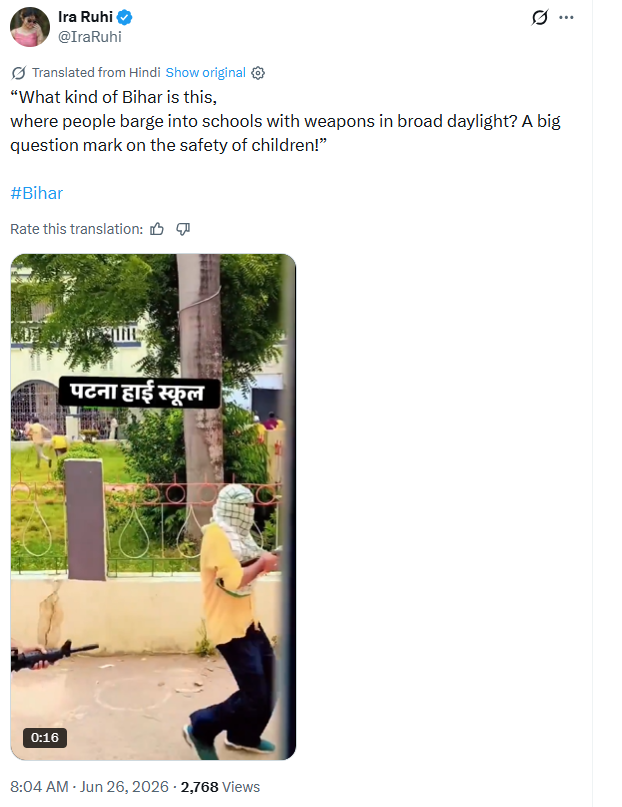
Fact Check
Keyframes from the viral video were analyzed using reverse image search. This led to identical videos uploaded on Facebook and Instagram on June 25, 2026. The captions on both uploads explicitly stated that the footage was from a movie and web series shoot. Furthermore, a closer inspection of the videos revealed professional filmmaking equipment, such as a black flag and a skimmer, visible on the set. https://www.facebook.com/reel/2160248068089642

https://www.instagram.com/p/DaBE0gQglUF/
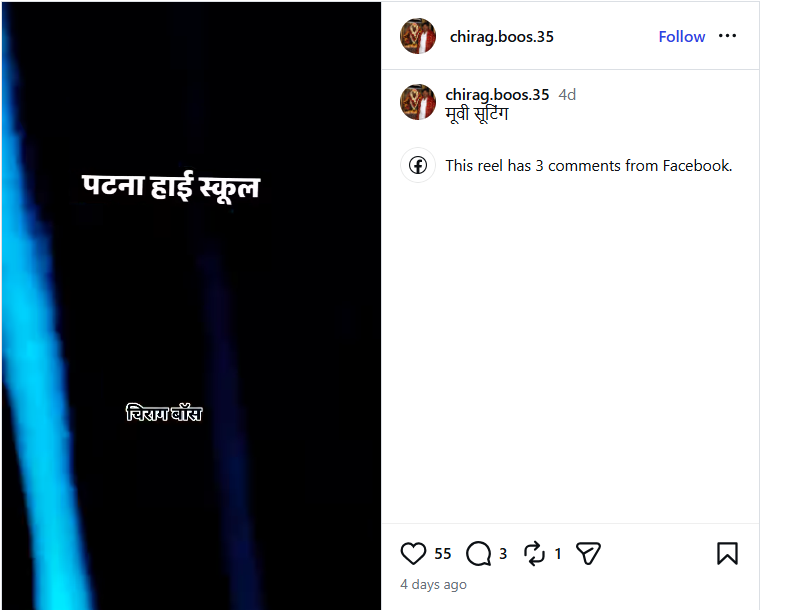
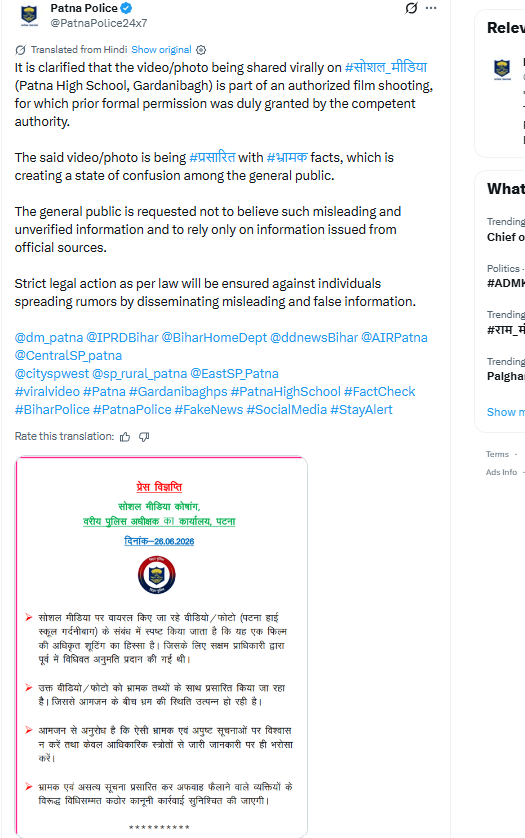
A targeted keyword search led to a YouTube video uploaded on June 20, 2026. The visuals in this video perfectly matched the viral footage, and the individuals seen in the viral clip could be spotted wearing the exact same clothes. "Regarding the video/photo being circulated on social media (Patna High School, Gardanibagh), it is clarified that this is part of an authorized film shooting, for which due permission was previously granted by the competent authority."
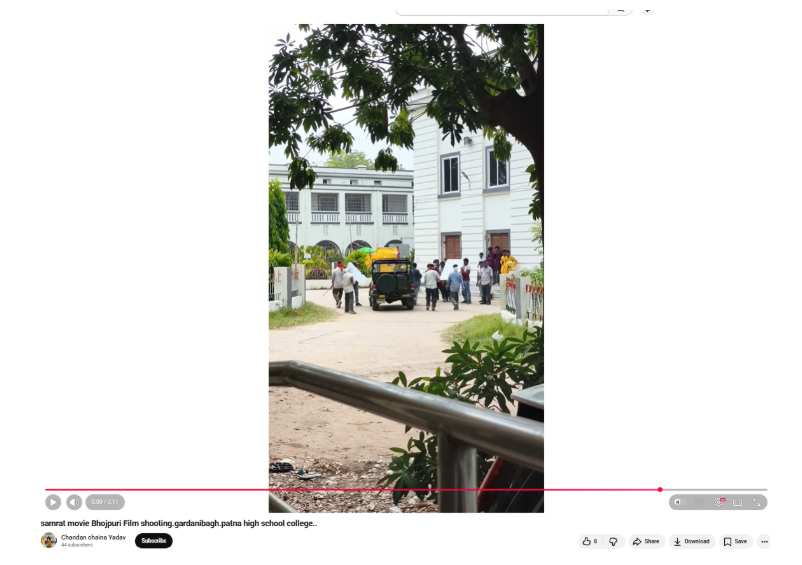
To verify further, official statements were checked. The Patna Police issued a formal press release on June 26, 2026, completely dismissing the viral rumors. https://x.com/PatnaPolice24x7/status/2070501501529960581
Conclusion
The evidence gathered confirms that there was no shooting incident at Patna High School. The viral video is behind-the-scenes footage from a pre-approved film production.
