#FactCheck -AI-Generated Image Falsely Claims Mohan Bhagwat Laid Foundation of ‘52nd Shakti Peeth’
Executive Summary
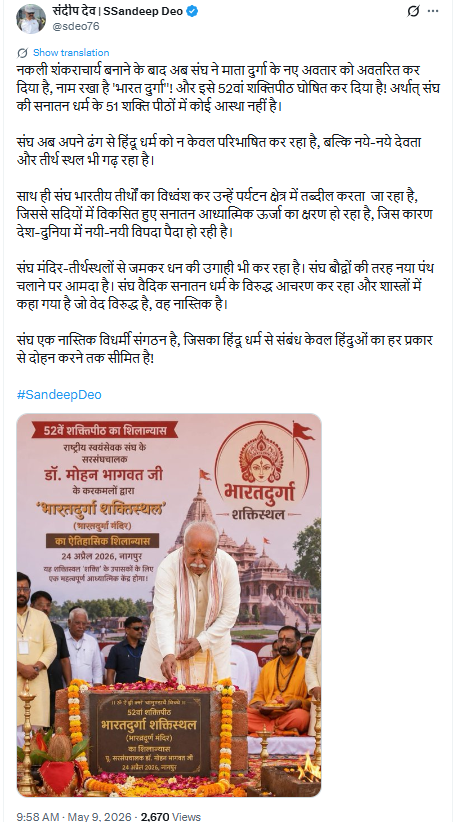
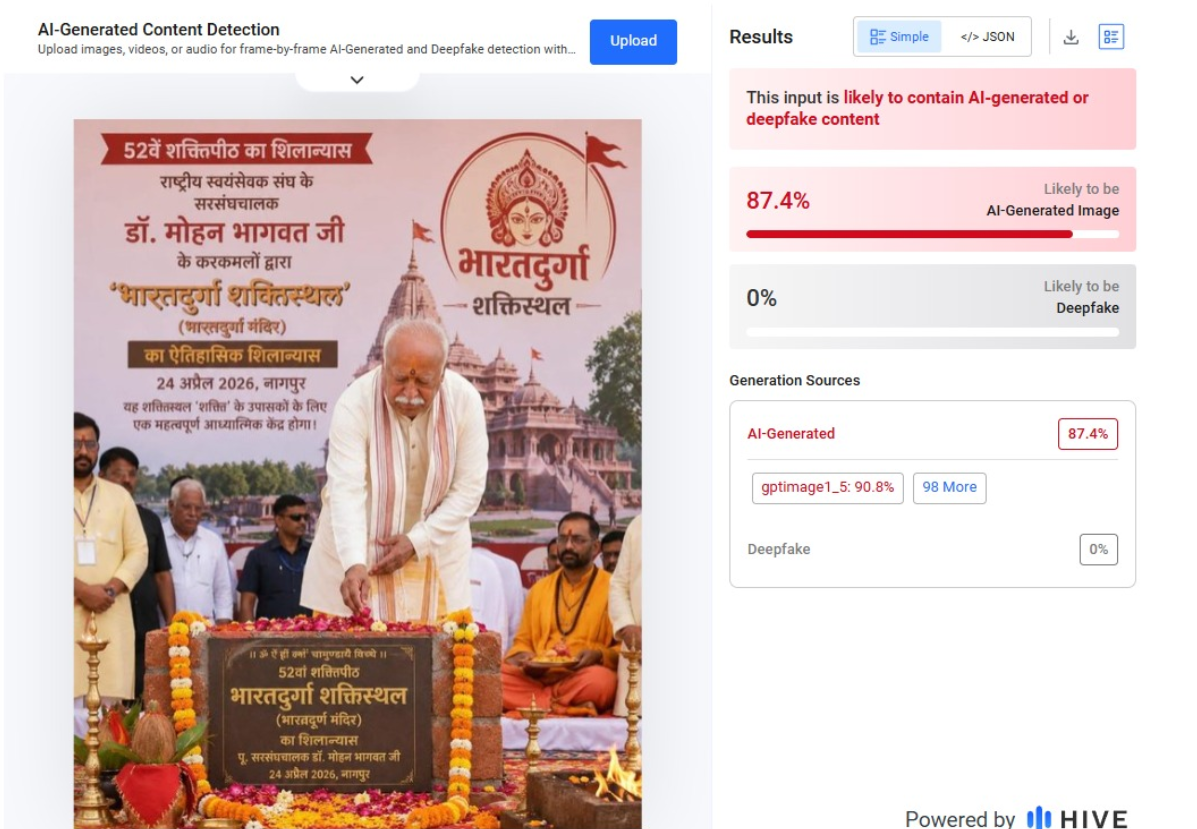
A picture of Mohan Bhagwat is going viral on social media, showing him allegedly laying the foundation stone of a so-called “52nd Shakti Peeth” named Bharatdurga. Users are claiming that the RSS chief insulted Sanatan Dharma by creating a new Shakti Peeth in Nagpur. Research by CyberPeace Research Wing found that the claim is false. The viral image is AI-generated, and Mohan Bhagwat did not inaugurate any “52nd Shakti Peeth.” In reality, he laid the foundation stone of the Bharatdurga Temple.
Claim
An X user named Sandeep Dev shared the viral image and alleged that after creating “fake Shankaracharyas,” the RSS had now introduced a new form of Goddess Durga called “Bharat Durga” and declared it the 52nd Shakti Peeth. The post further claimed that the RSS was redefining Hinduism and creating new religious sites.
Fact Check
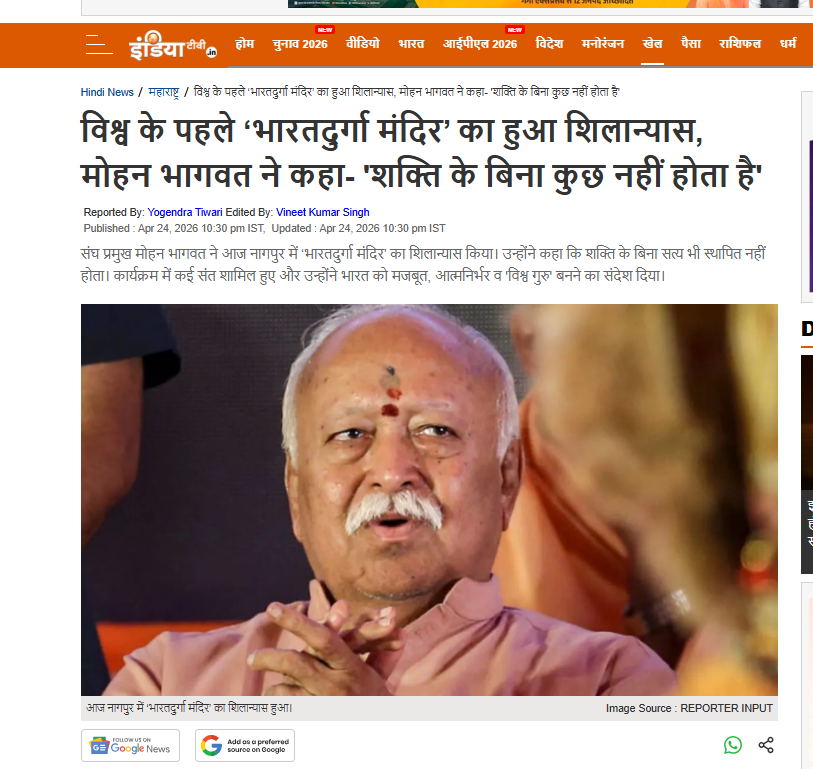
To verify the claim, we searched relevant keywords and found reports published on April 24, 2026, by India TV and Navbharat Times. According to these reports, Mohan Bhagwat laid the foundation stone of the world’s first Bharatdurga Temple in Nagpur during a ceremony organized at the Jamtha campus of Dr. Abaji Thatte Seva and Research Institute. Several prominent saints and religious leaders attended the event. Importantly, none of the reports described the temple as the “52nd Shakti Peeth.”
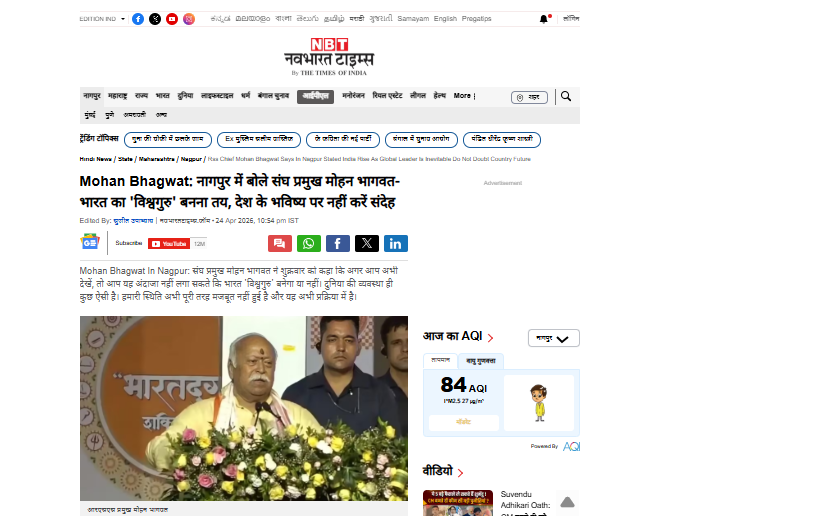
Further research led us to the full video of the foundation ceremony uploaded on the YouTube channel of Devendra Fadnavis. The stage backdrop and video thumbnail clearly mention “Bharatdurga Temple Foundation Ceremony.” However, the viral image frame was not visible anywhere in the authentic footage.

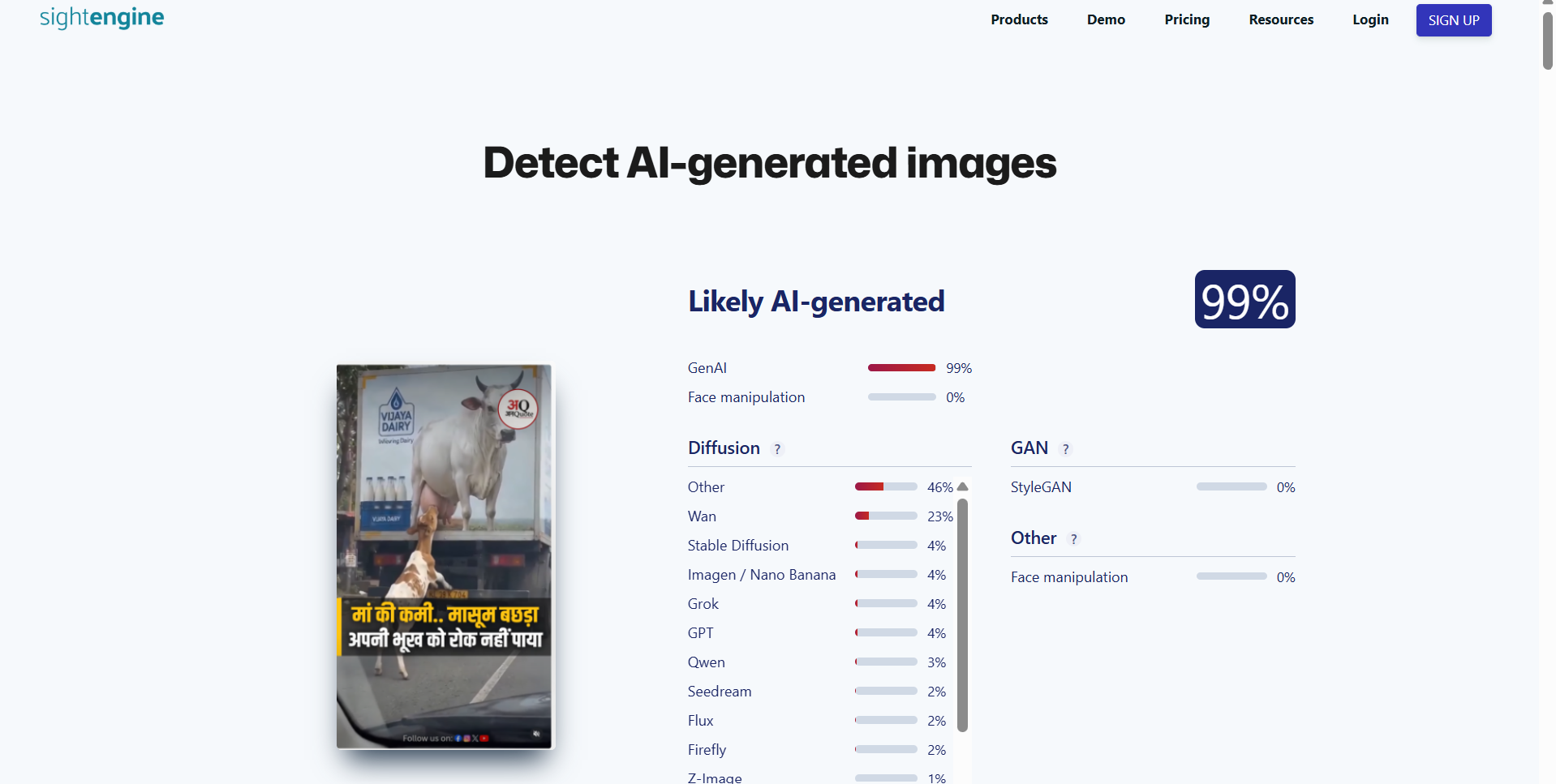
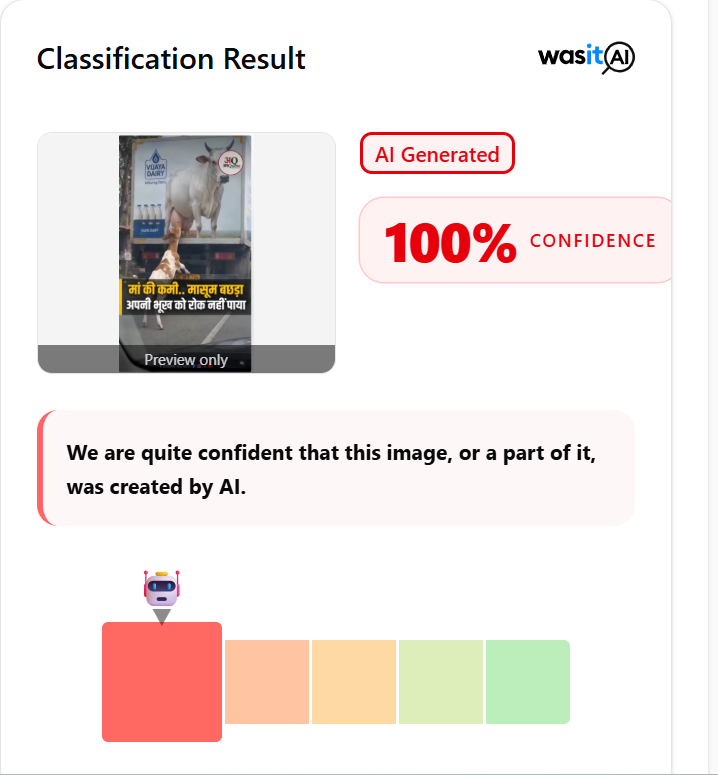
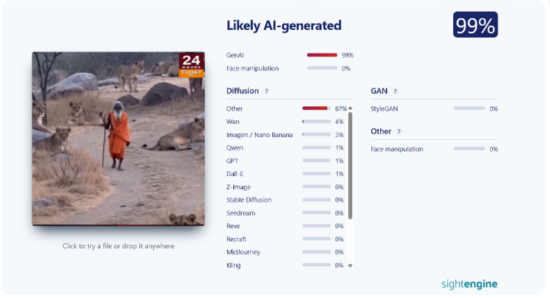
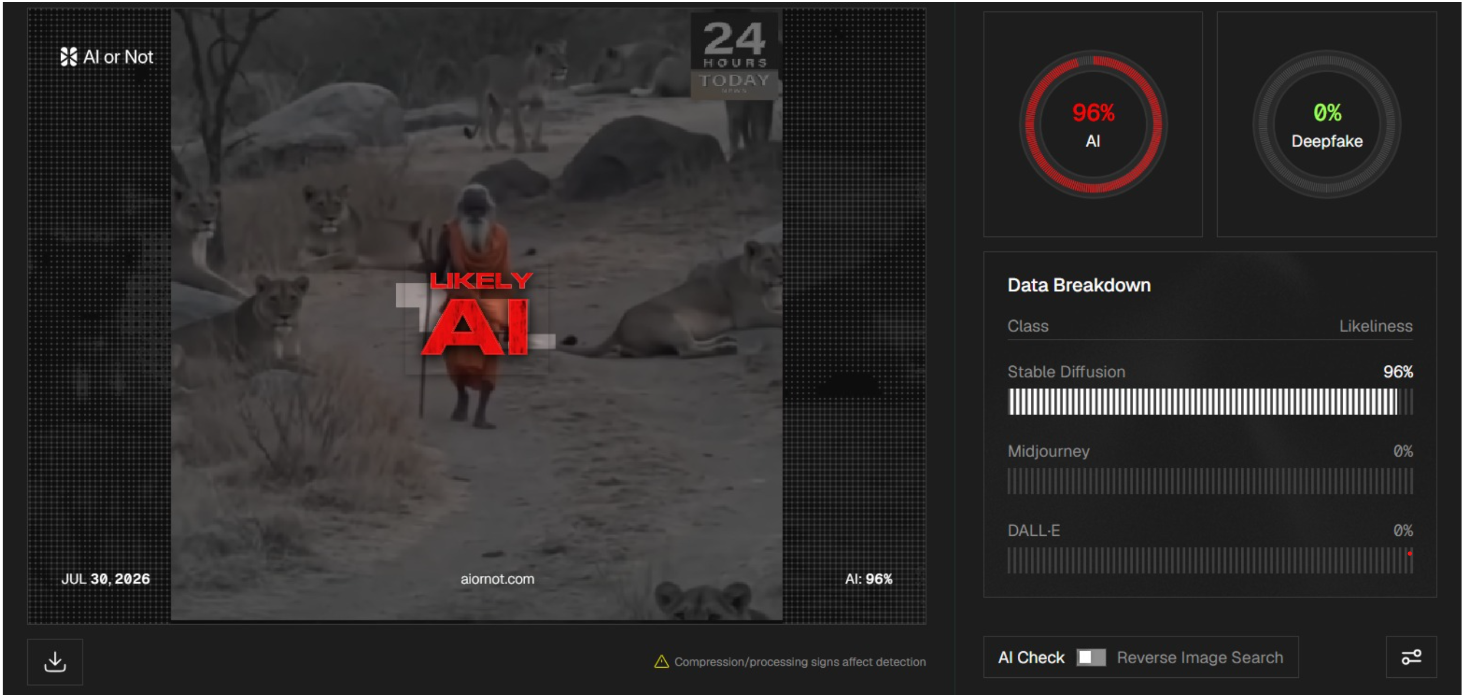
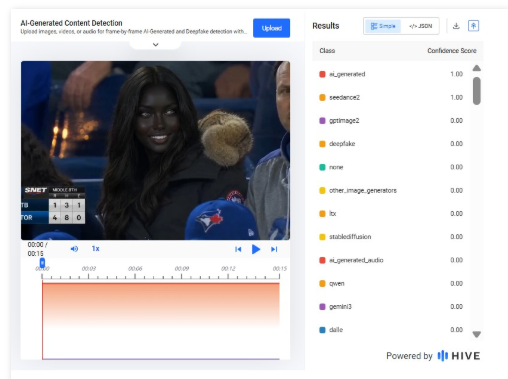
We also analyzed the viral image using AI detection tools, which indicated that the image was AI-generated.
Conclusion
Our research confirms that the claim about Mohan Bhagwat laying the foundation of a “52nd Shakti Peeth” is false. The viral image is AI-generated. In reality, he participated in the foundation ceremony of the Bharatdurga Temple in Nagpur.
Related Blogs

Introduction
In a landmark move for India’s growing artificial intelligence (AI) ecosystem, ten cutting-edge Indian startups have been selected to participate in the prestigious Global AI Accelerator Programme in Paris. This initiative, jointly facilitated by the Ministry of Electronics and Information Technology (MeitY) under the IndiaAI mission, aims to project India’s AI innovation on the global stage, empower startups to scale impactful solutions while fostering cross-border collaboration.
Launched in alignment with the vision of India as a global AI powerhouse, the IndiaAI initiative has been working on strengthening domestic AI capabilities. Participation in the Paris Accelerator Programme is a direct extension of this mission, offering Indian startups access to world-class mentorship, investor networks, and a thriving innovation ecosystem in France, one of Europe’s AI capitals.
Global Acceleration for Local Impact
The ten selected startups represent diverse verticals, from conversational AI to cybersecurity, edtech and surveillance intelligence. This selection was made after a rigorous evaluation of innovation potential, scalability, and societal impact. Each of these ventures represents India's technological ambition and capacity to solve real-world problems through AI.
The significance of this opportunity goes beyond business growth. It sets the foundation for collaborative policy dialogues, ethical AI development, and bilateral innovation frameworks. With rising global scrutiny on issues such as AI safety, bias, and misinformation, the need for making efforts for a more responsible innovation takes centre stage.
CyberPeace Outlook
India’s participation opens up a pivotal chapter in India's AI diplomacy. Through such initiatives, the importance of AI is not confined just to commercial tools but also as a cornerstone of national security, citizen safety, and digital sovereignty can be explored. As AI systems increasingly integrate with critical infrastructure from health to law enforcement, the role of cyber resilience becomes significant. With the increasing engagement of AI in several sensitive sectors like audio-video surveillance and digital edtech, there is an urgent need for secure-by-design innovation. Including parameters such as security, ethics, and accountability into the development lifecycle becomes important, aligning with its broader goal of harmonising with digital progress.
Conclusion
India’s participation in the Paris Accelerator Programme signifies its commitment to shaping global AI norms and innovation diplomacy. As Indian startups interact with European regulators, investors, and technologists, they carry the responsibility of representing not just business acumen but the values of an open, inclusive, and secure digital future.
This global exposure also feeds directly into India’s domestic AI strategies, a global platform informing policy evolution, enhancing research and development networks, and building a robust talent pipeline. Programmes like these act as bridges, ensuring India remains adaptive in the ever-evolving AI landscape. Encouraging such global engagements while actively working with stakeholders to build frameworks safeguarding national interests, protecting civil liberties, and fostering innovation becomes paramount. As India takes this global leap, the journey ahead must be shaped by innovation, collaboration, and vigilance.
References
- https://egov.eletsonline.com/2025/05/indiaai-selects-10-innovative-startups-for-prestigious-ai-accelerator-programme-in-paris/#:~:text=The%2010%20startups%20selected%20for,audio%2Dvideo%20analytics%20for%20surveillance.
- https://www.pib.gov.in/PressReleasePage.aspx?PRID=2132377
- https://inc42.com/buzz/meet-the-10-indian-ai-startups-selected-for-global-acceleration-programme/
- https://www.businessworld.in/article/govt-to-send-10-ai-startups-to-paris-accelerator-in-push-for-global-reach-558251

Introduction
In 2022, Oxfam’s India Inequality report revealed the worsening digital divide, highlighting that only 38% of households in the country are digitally literate. Further, only 31% of the rural population uses the internet, as compared to 67% of the urban population. Over time, with the increasing awareness about the importance of digital privacy globally, the definition of digital divide has translated into a digital privacy divide, whereby different levels of privacy are afforded to different sections of society. This further promotes social inequalities and impedes access to fundamental rights.
Digital Privacy Divide: A by-product of the digital divide
The digital divide has evolved into a multi-level issue from its earlier interpretations; level I implies the lack of physical access to technologies, level II refers to the lack of digital literacy and skills and recently, level III relates to the impacts of digital access. Digital Privacy Divide (DPD) refers to the various gaps in digital privacy protection provided to users based on their socio-demographic patterns. It forms a subset of the digital divide, which involves uneven distribution, access and usage of information and communication technology (ICTs). Typically, DPD exists when ICT users receive distinct levels of digital privacy protection. As such, it forms a part of the conversation on digital inequality.
Contrary to popular perceptions, DPD, which is based on notions of privacy, is not always based on ideas of individualism and collectivism and may constitute internal and external factors at the national level. A study on the impacts of DPD conducted in the U.S., India, Bangladesh and Germany highlighted that respondents in Germany and Bangladesh expressed more concerns about their privacy compared to respondents in the U.S. and India. This suggests that despite the U.S. having a strong tradition of individualistic rights, that is reflected in internal regulatory frameworks such as the Fourth Amendment, the topic of data privacy has not garnered enough interest from the population. Most individuals consider forgoing the right to privacy as a necessary evil to access many services, and schemes and to stay abreast with technological advances. Research shows that 62%- 63% of Americans believe that companies and the government collecting data have become an inescapable necessary evil in modern life. Additionally, 81% believe that they have very little control over what data companies collect and about 81% of Americans believe that the risk of data collection outweighs the benefits. Similarly, in Japan, data privacy is thought to be an adopted concept emerging from international pressure to regulate, rather than as an ascribed right, since collectivism and collective decision-making are more valued in Japan, positioning the concept of privacy as subjective, timeserving and an idea imported from the West.
Regardless, inequality in privacy preservation often reinforces social inequality. Practices like surveillance that are geared towards a specific group highlight that marginalised communities are more likely to have less data privacy. As an example, migrants, labourers, persons with a conviction history and marginalised racial groups are often subject to extremely invasive surveillance under suspicions of posing threats and are thus forced to flee their place of birth or residence. This also highlights the fact that focus on DPD is not limited to those who lack data privacy but also to those who have (either by design or by force) excess privacy. While on one end, excessive surveillance, carried out by both governments and private entities, forces immigrants to wait in deportation centres during the pendency of their case, the other end of the privacy extreme hosts a vast number of undocumented individuals who avoid government contact for fear of deportation, despite noting high rates of crime victimization.
DPD is also noted among groups with differential knowledge and skills in cyber security. For example, in India, data privacy laws mandate that information be provided on order of a court or any enforcement agency. However, individuals with knowledge of advanced encryption are adopting communication channels that have encryption protocols that the provider cannot control (and resultantly able to exercise their right to privacy more effectively), in contrast with individuals who have little knowledge of encryption, implying a security as well as an intellectual divide. While several options for secure communication exist, like Pretty Good Privacy, which enables encrypted emailing, they are complex and not easy to use in addition to having negative reputations, like the Tor Browser. Cost considerations also are a major factor in propelling DPD since users who cannot afford devices like those by Apple, which have privacy by default, are forced to opt for devices that have relatively poor in-built encryption.
Children remain the most vulnerable group. During the pandemic, it was noted that only 24% of Indian households had internet facilities to access e-education and several reported needing to access free internet outside of their homes. These public networks are known for their lack of security and privacy, as traffic can be monitored by the hotspot operator or others on the network if proper encryption measures are not in place. Elsewhere, students without access to devices for remote learning have limited alternatives and are often forced to rely on Chromebooks and associated Google services. In response to this issue, Google provided free Chromebooks and mobile hotspots to students in need during the pandemic, aiming to address the digital divide. However, in 2024, New Mexico was reported to be suing Google for allegedly collecting children’s data through its educational products provided to the state's schools, claiming that it tracks students' activities on their personal devices outside of the classroom. It signified the problems in ensuring the privacy of lower-income students while accessing basic education.
Policy Recommendations
Digital literacy is one of the critical components in bridging the DPD. It enables individuals to gain skills, which in turn effectively addresses privacy violations. Studies show that low-income users remain less confident in their ability to manage their privacy settings as compared to high-income individuals. Thus, emphasis should be placed not only on educating on technology usage but also on privacy practices since it aims to improve people’s Internet skills and take informed control of their digital identities.
In the U.S., scholars have noted the role of libraries and librarians in safeguarding intellectual privacy. The Library Freedom Project, for example, has sought to ensure that the skills and knowledge required to ensure internet freedoms are available to all. The Project channelled one of the core values of the library profession i.e. intellectual freedom, literacy, equity of access to recorded knowledge and information, privacy and democracy. As a result, the Project successfully conducted workshops on internet privacy for the public and also openly objected to the Department of Homeland Security’s attempts to shut down the use of encryption technologies in libraries. The International Federation of Library Association adopted a Statement of Privacy in the Library Environment in 2015 that specified “when libraries and information services provide access to resources, services or technologies that may compromise users’ privacy, libraries should encourage users to be aware of the implications and provide guidance in data protection and privacy.” The above should be used as an indicative case study for setting up similar protocols in inclusive public institutions like Anganwadis, local libraries, skill development centres and non-government/non-profit organisations in India, where free education is disseminated. The workshops conducted must inculcate two critical aspects; firstly, enhancing the know-how of using public digital infrastructure and popular technologies (thereby de-alienating technology) and secondly, shifting the viewpoint of privacy as a right an individual has and not something that they own.
However, digital literacy should not be wholly relied on, since it shifts the responsibility of privacy protection to the individual, who may not either be aware or cannot be controlled. Data literacy also does not address the larger issue of data brokers, consumer profiling, surveillance etc. Resultantly, an obligation on companies to provide simplified privacy summaries, in addition to creating accessible, easy-to-use technical products and privacy tools, should be necessitated. Most notable legislations address this problem by mandating notices and consent for collecting personal data of users, despite slow enforcement. However, the Digital Personal Data Protection Act 2023 in India aims to address DPD by not only mandating valid consent but also ensuring that privacy policies remain accessible in local languages, given the diversity of the population.
References
- https://idronline.org/article/inequality/indias-digital-divide-from-bad-to-worse/
- https://arxiv.org/pdf/2110.02669
- https://arxiv.org/pdf/2201.07936#:~:text=The%20DPD%20index%20is%20a,(33%20years%20and%20over).
- https://www.pewresearch.org/internet/2019/11/15/americans-and-privacy-concerned-confused-and-feeling-lack-of-control-over-their-personal-information/
- https://eprints.lse.ac.uk/67203/1/Internet%20freedom%20for%20all%20Public%20libraries%20have%20to%20get%20serious%20about%20tackling%20the%20digital%20privacy%20divi.pdf
- /https://openscholarship.wustl.edu/cgi/viewcontent.cgi?article=6265&context=law_lawreview
- https://eprints.lse.ac.uk/67203/1/Internet%20freedom%20for%20all%20Public%20libraries%20have%20to%20get%20serious%20about%20tackling%20the%20digital%20privacy%20divi.pdf
- https://bosniaca.nub.ba/index.php/bosniaca/article/view/488/pdf
- https://www.hindustantimes.com/education/just-24-of-indian-households-have-internet-facility-to-access-e-education-unicef/story-a1g7DqjP6lJRSh6D6yLJjL.html
- https://www.forbes.com/councils/forbestechcouncil/2021/05/05/the-pandemic-has-unmasked-the-digital-privacy-divide/
- https://www.meity.gov.in/writereaddata/files/Digital%20Personal%20Data%20Protection%20Act%202023.pdf
- https://www.isc.meiji.ac.jp/~ethicj/Privacy%20protection%20in%20Japan.pdf
- https://socialchangenyu.com/review/the-surveillance-gap-the-harms-of-extreme-privacy-and-data-marginalization/

Introduction
After the tragic bomb blast at RedFort on November 10, 2025, there is a trail of misinformation and false narratives spread rapidly across social media platforms, messaging and news channels. It can not only unfold into a public misunderstanding but can also incite panic, communal tensions and endanger lives. To prevent all of these from happening, we, as responsible citizens, can play a critical role by verifying information before sharing it with friends, family, or colleagues. This article provides guidance on practical, evidence-based strategies to navigate the information landscape and protect yourself and your community from the harm caused by misinformation and disinformation.
Digital Scams in the Aftermath of the Blast
Cybercriminals increased their activity in the hours after the Red Fort explosion, using the country’s sorrow as a chance to take advantage of fear.
Numerous allegations surfaced of residents receiving threatening calls that falsely claimed they were “digitally arrested” or that their phones, bank accounts, or Aadhaar were being “seized for investigation”, accusing them of being involved in the explosion. These fictitious intimidation calls sent innocent people into worry, anxiety, and doubt spirals.
The pattern is common after major national crises:
- Fear rises.
- People seek urgent answers.
- Cybercriminals exploit the confusion.
Knowing this makes it easier for us to remain watchful. No law enforcement organisation uses phone conversations, WhatsApp communications, or threats of “digital detention” to make arrests or conduct investigations.
Verify breaking news from trusted official channels
Whenever a crisis like bomb blasts occurs, people look for information on social media, news channels, and YouTube channels to stay fully informed about the situation. This is a very chaotic moment, and due to the lack of government verification of the initial information, false news spread rapidly.
Where to seek verified information:
a. Press Information Bureau (PIB): The official government news agency that, from time to time, clarifies viral news.
b. Delhi Police Official Channels: Check social media handles of Delhi Police.
c. Ministry of Home Affairs (MHA): MHA is responsible for internal security, and gives information about this information through official press releases and notifications.
d. Major Credible news outlets: Some news channels can be trusted with news, as they typically verify information before publishing, like The Hindu, Indian Express.
What to do:
Cross-check every unverified social media post and news that you come across from credible news channels and official government press releases.
Verify Images and videos using reverse search tools
Recently, many social media handles have been sharing old photos of different bomb blasts from Ukraine, Israel, and Palestine in the name of the Red Fort blasts. While it can create a false narrative, the same should be verified before sharing.
Reliable fact-checking resources and how to use them.
Every country has dedicated fact-checking organisations that systematically verify viral claims.
Fact-checking organisations based in India:
a. PIB Fact Check (https://factcheck.pib.gov.in/ )
· It is the official fact-checking unit of the PIB, which focuses on demystifying government-related misinformation.
· email: socialmedia@pib.gov.in
· Telegram: http://t.me/PIB_FactCheck
· Follow it on: Twitter (@PIBFactCheck), Facebook, Instagram, Telegram and WhatsApp.
How to use these resources:
· Whenever you come across any viral post, use exact keywords or quotes to find those on these resources.
· Look for the verdict (true, false, misleading), then share the verified fact-checks with your network to debunk false narratives.
Practice Digital Hygiene and Be Cautious When Sharing
Digital hygiene refers to the practices and habits individuals adopt to maintain a healthy and secure digital lifestyle. Simple digital practices can restrict the spread of misinformation. A vigilant individual can reduce the spread of misinformation. It can be done by below steps
i. Check URLs and Links: We can verify the URLs and links of any news and websites using different tools to check the credibility of any news
ii. How to Evaluate the Trustworthiness of Sources:
· Verify if the account sharing the information has a blue checkmark on most platforms.
· Examine the account's background, whether it is a recognised media source, an official government profile, or a newly created anonymous account?
· Approach posts featuring intense emotional language ("URGENT!", "SHOCKING!", "MUST SHARE!") with scepticism.
· Refrain from posting screenshots of tweets or posts while providing a link to the source, allowing others to confirm its validity.
iii. Before You Distribute:
· Question yourself: "Am I certain this is accurate based on a reliable source?"
· Avoid the temptation to share breaking news immediately; hold off until it has been confirmed by government sources.
· If you're uncertain, include a comment such as "I haven't confirmed this yet; please consult reliable sources" instead of sharing unverified information.
· Reflect on the consequences, as it might lead to panic, provoke communal violence, or damage an individual's reputation
6. How to report misinformation to platforms and authorities?
While it is important to verify news before sharing it to prevent fake news, it is also important to report it to reduce misinformation and the violence caused due to it. On social media like Facebook, Instagram, Twitter/X, WhatsApp, and Telegram, anyone can report the same on the platform.
Reporting to the Government Authorities:
a. PIB Fact Check WhatsApp (+91 8799711259):
Send Screenshots or texts of suspected government-related misinformation for verification, and then an automated acknowledgement is generated.
b. Delhi Police Cyber Crime Unit
Cyber Crimes such as Email Frauds, Social Media Crimes, Mobile App-related crimes, Business Email Compromise, Data Theft, Ransomware, Net Banking/ ATM Frauds and fake calls frauds, insurance frauds, lottery scam, bitcoin, cheating scams, online transactions frauds can be reported to the Delhi Police Cyber Crime Unit.
7. Quick checklist: What to do When You See Breaking News
· Wait before sharing any breaking news.
· Go through official channels like PIB and other official channels like MHA.
· If not available there, then cross-reference it from 2-3 credible news sources for the same information.
· Check timestamps and metadata, and compare metadata dates with claims about when events occurred.
· In case you find any information, news or any social media posts as misleading, then report the same.
CyberPeace Resolves: Pause. Reflect. Then Respond
Misinformation becomes the infection that spreads the fastest when people are confused and afraid. Every citizen is urged by CyberPeace to remain composed, stand tall, and not panic, particularly in times of national emergency.
Prior to experiencing an emotional response to any concerning call, message, or widely shared news:
Pause. Reflect. Acknowledge.
- Pause before sharing or responding.
- Reflect on whether the information is from a credible source.
- Acknowledge what you know—and what is just rumour.
CyberPeace is still dedicated to helping people and communities deal with online dangers, safeguard mental health, and dispel false information with clarity and truth.