

#FactCheck

Executive Summary
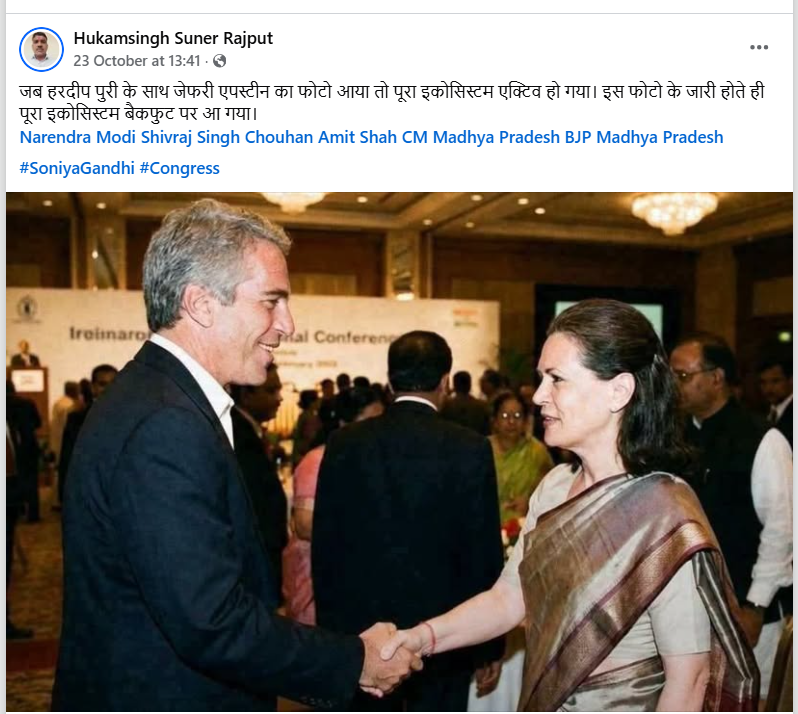
A photograph is currently going viral on social media showing former Congress president Sonia Gandhi shaking hands with American sex offender Jeffrey Epstein. Several social media users are sharing the image as authentic. Some posts also use objectionable language against Sonia Gandhi in their captions. CyberPeace Research found the viral claim to be false. Our research found that the viral image is not authentic but AI-generated.
Claim
On October 23, 2026, Facebook user ‘Hukamsingh Suner Rajput’ uploaded the image with the caption: “When Jeffrey Epstein’s photo with Hardeep Puri came out, the entire ecosystem became active. As soon as this photo was released, the entire ecosystem went on the back foot.”
https://www.facebook.com/photo/?fbid=4839481413005242&set=a.1849023385384408
FactCheck
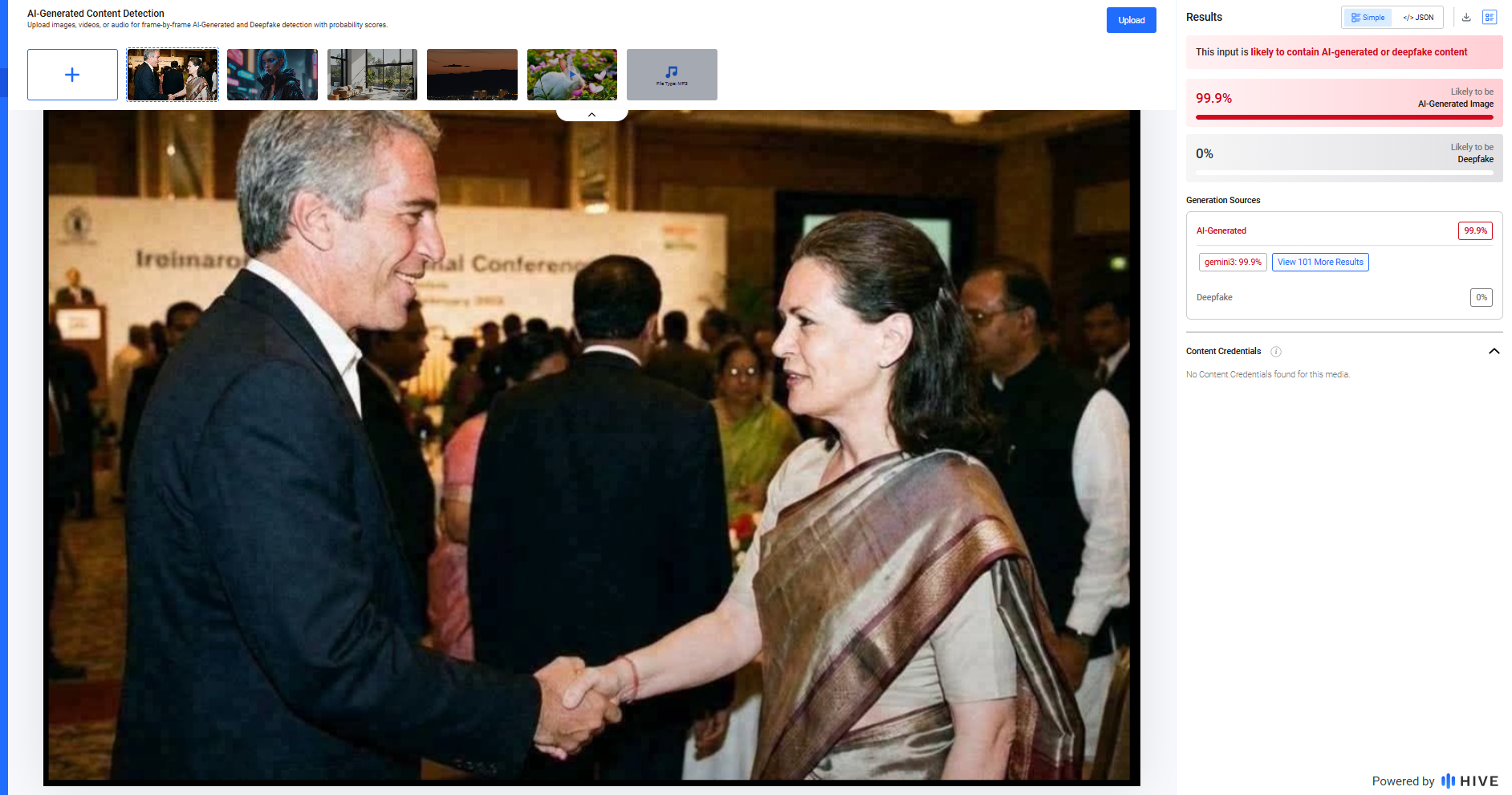
As part of our research, we first used Google’s open search tool. A search using relevant keywords did not yield any news report that could verify the authenticity of the viral image. This indicated that the viral image was fake. Based on this, we used AI detection tools to further verify the image. We first used the ‘Hive Moderation’ tool, which indicated a 99 per cent probability that the viral image was generated using AI.
We also scanned the image using another AI detection tool, Sightengine. According to the results, the viral image is 99 per cent likely to be AI-generated.

Conclusion:
Our research found that the viral image is not authentic but AI-generated.

Executive Summary
Following a public altercation on stage between Uttarakhand Cabinet Minister Subodh Uniyal and singer Daler Mehndi on October 18, a video has gone viral on social media showing a woman arguing loudly with Uniyal. Sharing the video, several users claim that Uniyal has faced the consequences of his actions.
CyberPeace Research found that the video dates back to June 2026, when some people accused Uniyal of illegally entering a polling booth during municipal elections.
Claim
Text overlaid on the video reads, “The BJP minister who insulted Daler Mehndi has finally faced the consequences of his actions!” The caption states, “Whether it is nature's justice or the reckoning for one's deeds, everyone's time comes! BJP minister Subodh Uniyal, who reprimanded Daler Mehndi on stage in front of everyone, clashed with women at a polling booth. The minister who insulted an artist has now had to face opposition from women!”
https://www.facebook.com/reel/1095658483207750

Fact Check
To verify the viral claim, we searched Google using relevant keywords. However, we did not find any credible media reports confirming the claim.
As the next step in our research, we conducted a reverse image search of the video's keyframes. During this search, we found a news report on the India TV website that featured the viral video. The report was published on January 10, 2026.
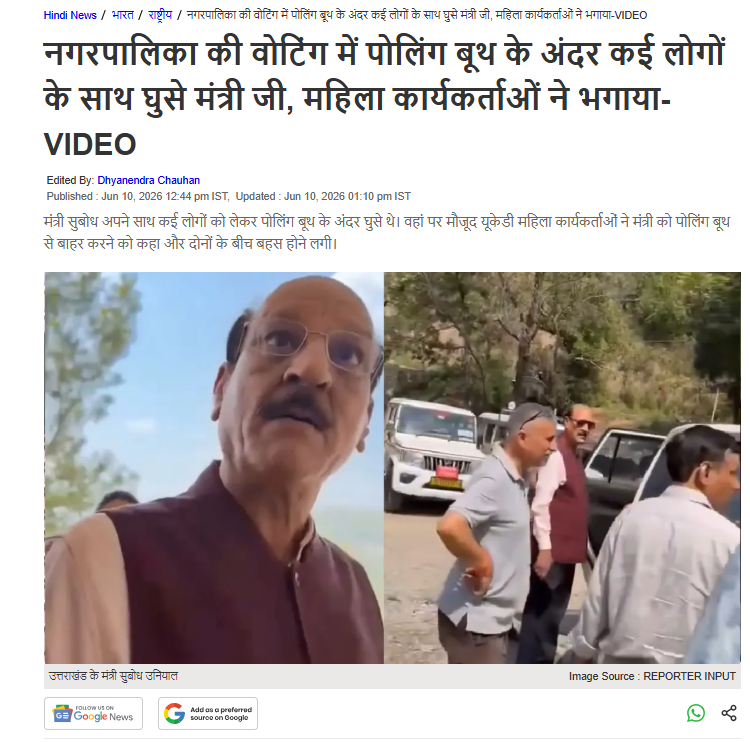
According to the India TV report, a controversy erupted over Cabinet Minister and local MLA Subodh Uniyal's entry into a polling booth during the Narendra Nagar municipal elections in Uttarakhand. It was alleged that Uniyal entered the polling booth in violation of the Model Code of Conduct. UKD leader Pramila Rawat and senior leader Dinesh Master opposed his entry. A heated argument also broke out between the minister and local residents during the protest, and a video of the incident went viral on social media.This establishes that the viral video is not recent but dates back to an earlier incident.
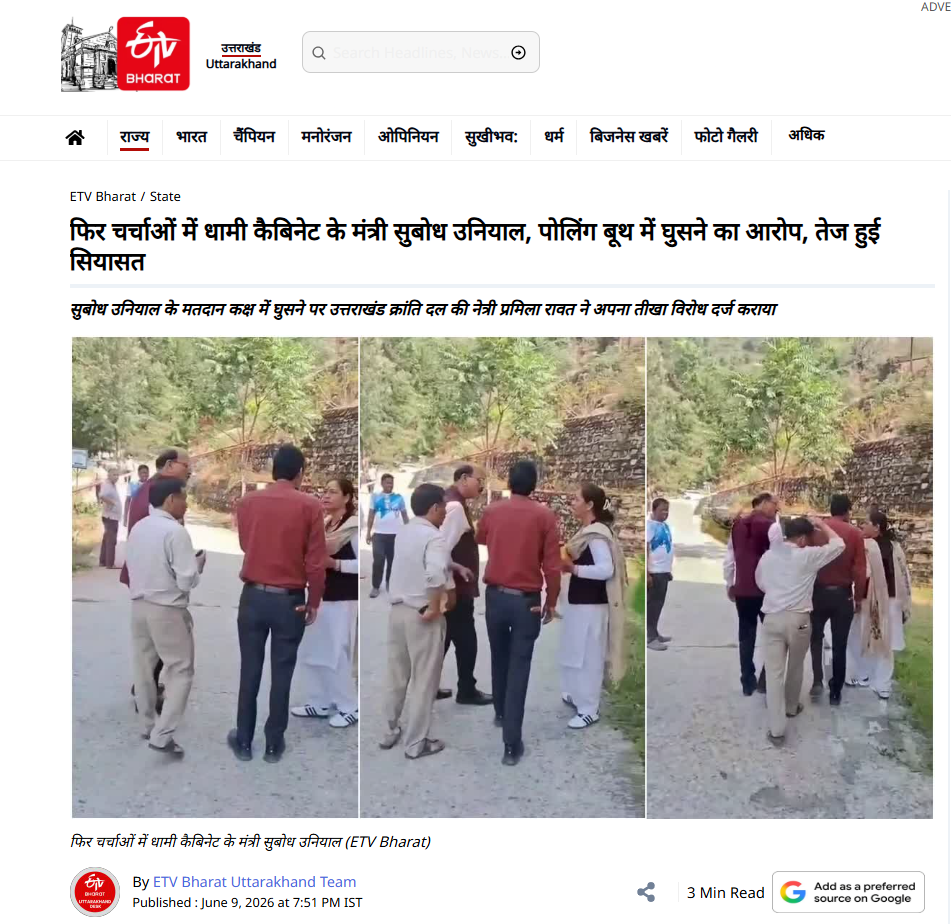
As the next step in our research, we also found a report published by ETV Bharat on June 9, 2026, which covered the incident in its original context.
https://www.etvbharat.com/hi/state/narendra-nagar-municipal-council-election-cabinet-minister-subodh-uniyal-polling-booth-uts26060906445
Conclusion
Our research found that the video dates back to June 2026, when some people accused Uniyal of illegally entering a polling booth during the municipal elections.

Executive Summary
Large-scale protests have been taking place in France over the past few weeks. The protests initially began against rising inflation and increasing fuel prices. They later turned violent, with incidents of vandalism reported in several places. Amid this, a video is being shared on social media with the claim that several police officers can be seen pointing guns at a woman. Moments later, the officers shoot the woman. It is being claimed that the woman was participating in the protests in France and was shot by the police. CyberPeace Research found that the incident actually took place in Brazil, where police officers shot a woman who was approaching them with a knife.
Claim
Sharing the video on X, a user wrote: “A leftist was protesting in France. She also wanted a regime change. The police administration carried out a coup against this woman herself, but Modi is the dictator.”
https://x.com/PoojaHindu50/status/2111970585626497490
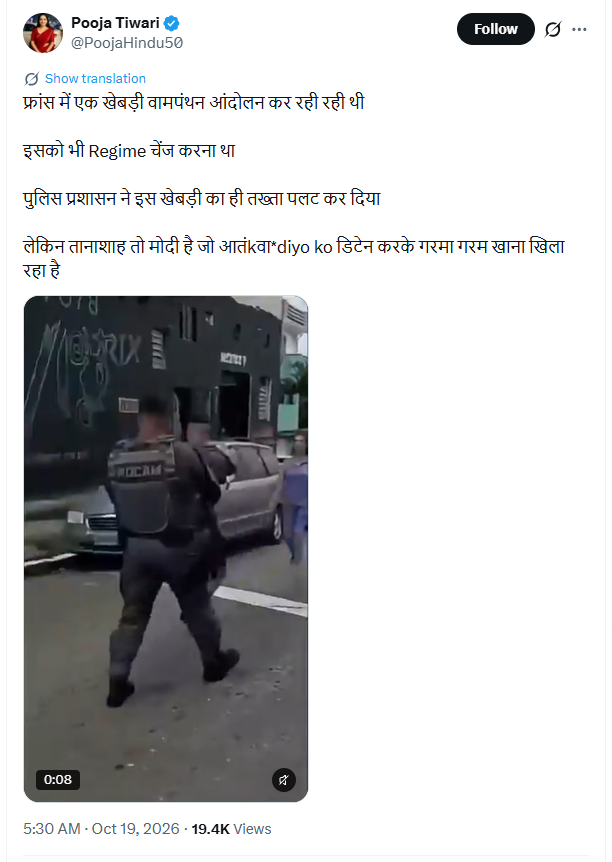
Fact Check
A reverse image search of the keyframes from the video led us to a video report published by Brazilian media outlet Cidade Alerta. Published on October 16, the report features the viral video as well as CCTV footage of the incident.
https://www.youtube.com/watch?v=GNVMTw_ECbo&t=61s

According to the report, the incident took place in São Paulo, Brazil. The woman seen in the video was identified as Camila Pereira. She was reportedly approaching the police officers while carrying a sharp knife. The police repeatedly asked her to put the weapon down, but she continued moving towards them. One of the police officers then shot her. The woman died in the incident. As the next step in our research, we found the same video on a YouTube channel named g1. The video also identified the incident as having taken place in São Paulo, Brazil, and stated that the woman was mentally unwell.
At the end of our research, we found a report by the New York Post stating that a police officer was arrested in connection with the incident. However, he was later released on bail.
https://www.youtube.com/watch?v=OnGn75ipR0Y


Conclusion
Our research found that the incident took place in Brazil, where police officers shot a woman who was approaching them with a knife.

Executive Summary
A video is being shared on social media with the claim that it shows a Bangladeshi couple sentenced to death in Saudi Arabia. In the video, a woman is seen telling her husband that she is pregnant. The claim states that the woman's only “crime” was that she was about to become a mother, and that Saudi Arabia sentenced not two, but three people to death. CyberPeace Research found that the couple shown in the video are husband and wife and have no connection to the Bangladeshi nationals sentenced to death in Saudi Arabia.
Claim
An X user shared the viral video with the following caption: “This is the Bangladeshi couple. Her only crime was that she was about to become a mother. She told her husband, ‘You are going to be a father.’ Hearing this, tears welled up in his eyes, and he kissed his wife's forehead out of joy. Saudi Arabia has sentenced not two, but three people to death.”
View the archived post here. Similar posts can be found here and here.
https://x.com/imarpit96/status/2113128510848172287
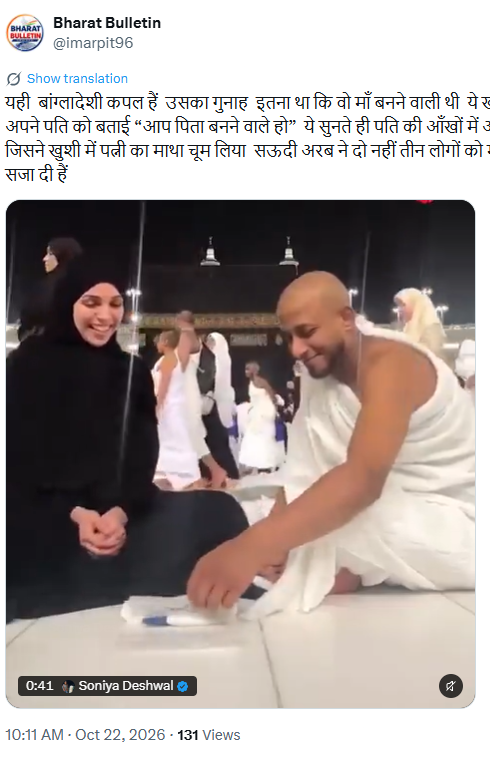
Fact Check
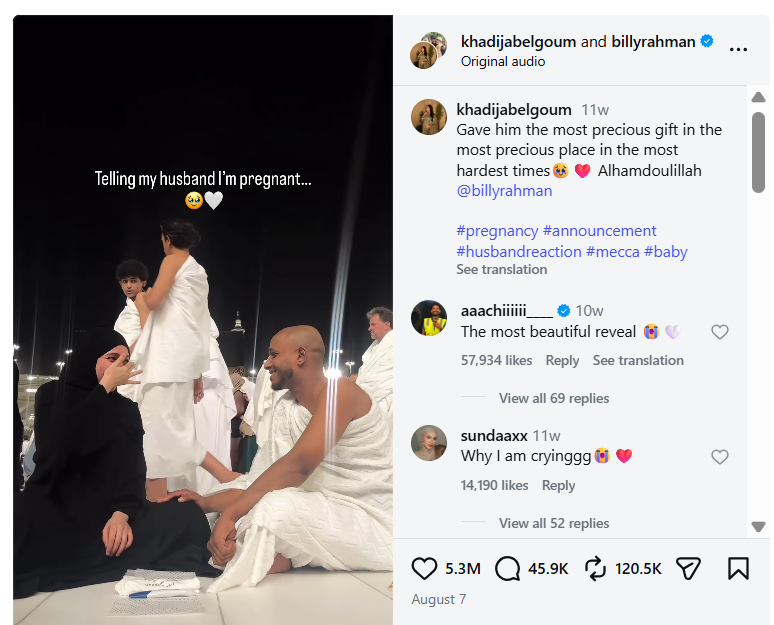
To verify the viral video being shared as showing a Bangladeshi couple sentenced to death in Saudi Arabia, we conducted a reverse image search of its keyframes. During the search, we found the same video uploaded on August 7, 2026, on the Instagram account of Khadija Belghoum (@khadijabelgoum).
Text overlaid on the video reads, “I told my husband that I am pregnant.” In the caption, the woman also wrote that she gave her husband the most precious gift at the holiest place during the most difficult time. The post also tags her husband, Billy Rahman, on Instagram. Additionally, the hashtag Mecca was included in the post.
https://www.instagram.com/p/DbtdSc
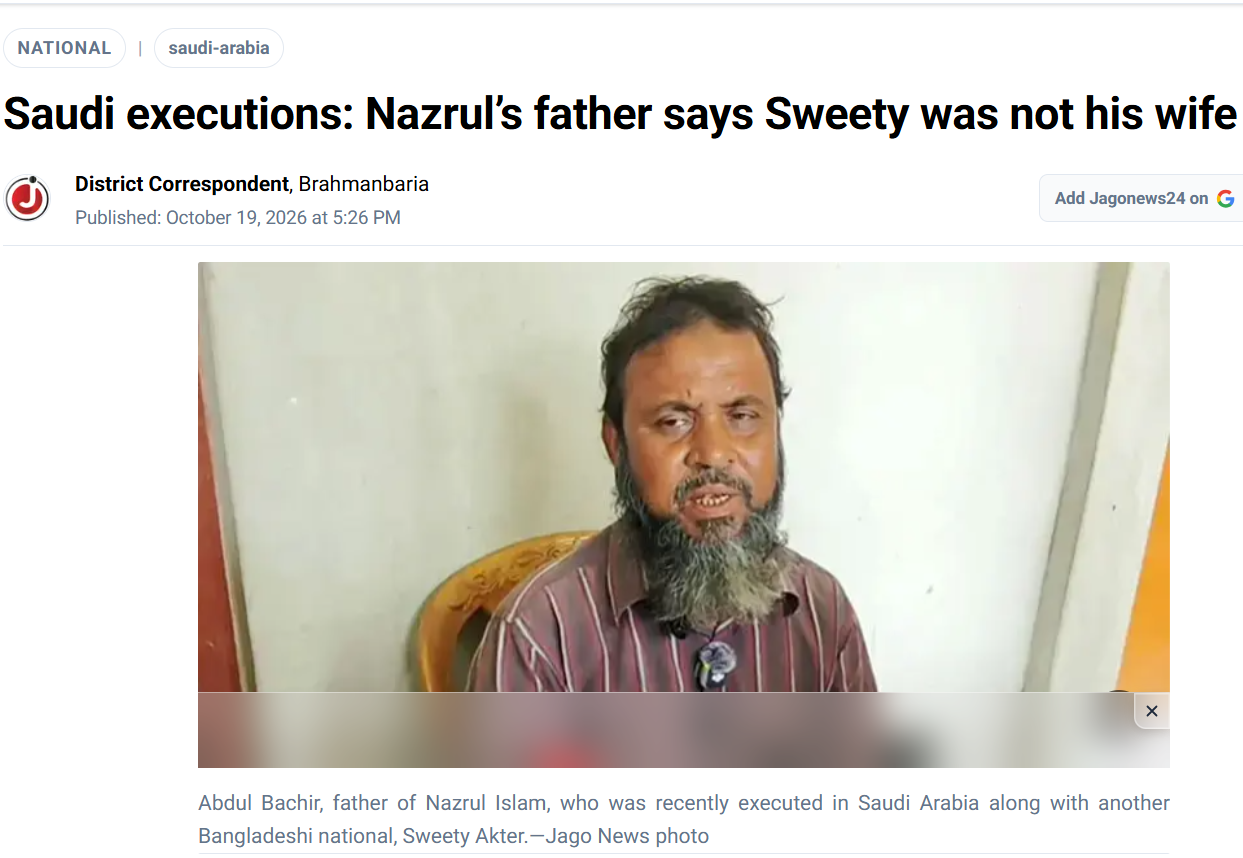
During our research into the claim, we found a report published on October 19, 2026, by Bangladeshi news website Jago News. According to the report, Nazrul Islam and Sweety Akhtar, who were sentenced to death in Saudi Arabia, were being described as husband and wife in social media posts. However, Nazrul's father, Abdul Bashir, refuted this claim. Speaking to Jago News, he said that Sweety was not Nazrul's wife and that his family did not even know her. According to the report, he also said that Nazrul had worked for only six months after arriving in Saudi Arabia, following which he spent three years and three months in prison. The family was still unaware of the reason for his arrest.
https://www.jagonews24.com/en/national/news/97248
Conclusion
The evidence gathered during our research clearly establishes that the claim accompanying the viral video is false. The couple shown in the video are Khadija Belghoum and Billy Rahman, who are husband and wife. They have no connection to the Bangladeshi nationals who were executed in Saudi Arabia.

Executive Summary
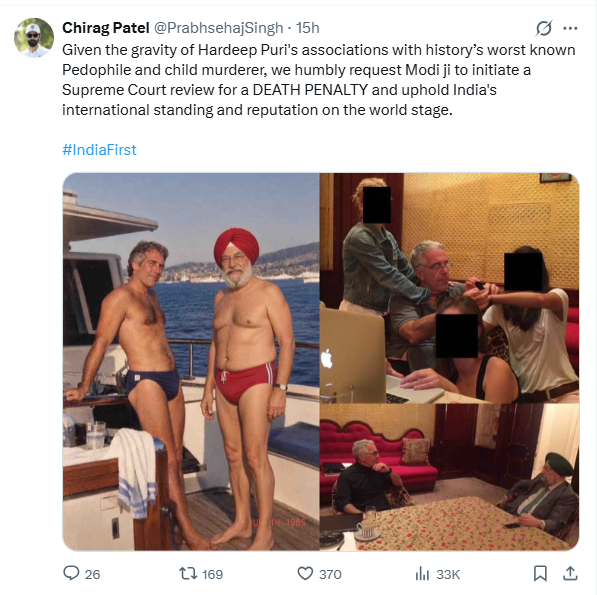
A photo is being shared on social media with the claim that it shows Union Minister Hardeep Puri alongside convicted sex offender Jeffrey Epstein. The post also claims that the image establishes an association between the two. CyberPeace Research found that the viral image is not authentic but AI-generated and is being shared with a misleading claim.
Claim
An X user shared the viral image with the following caption: “Given the gravity of Hardeep Puri's associations with history’s worst known pedophile and child murderer, we humbly request Modi ji to initiate a Supreme Court review for a DEATH PENALTY and uphold India's international standing and reputation on the world stage.”
https://x.com/PrabhsehajSingh/status/2113284787452657974?s=20
Fact Check
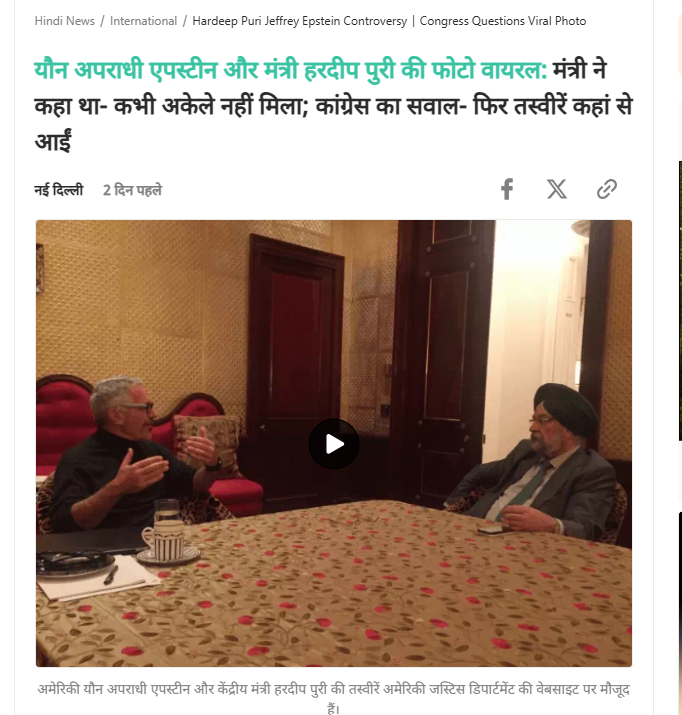
To verify the viral claim, we searched Google using relevant keywords. During the search, we found a report published by Dainik Bhaskar that featured photographs of convicted American sex offender Jeffrey Epstein and Union Minister Hardeep Puri. However, the photographs included in the report were completely different from the viral image.
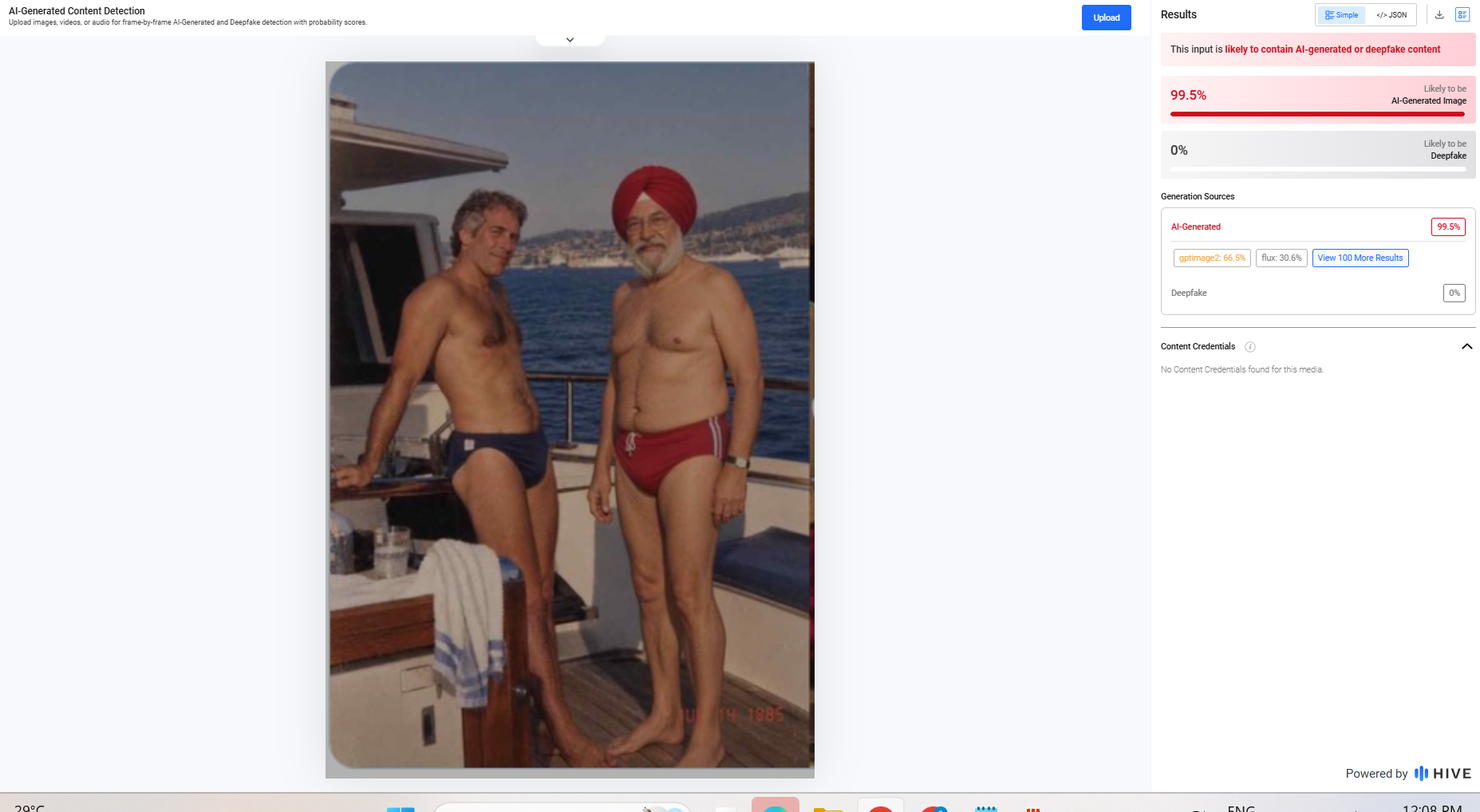
As the next step in our research, we examined the viral image closely and suspected that it was AI-generated. We then scanned the image using the AI detection tool Hive Moderation. According to the results, the viral image is 99 per cent likely to be AI-generated.
We also scanned the image using another AI detection tool, Wasit AI, which indicated that the viral image is AI-generated.

Conclusion
Our research found that the viral image is not authentic but AI-generated and is being shared with a misleading claim.

Executive Summary
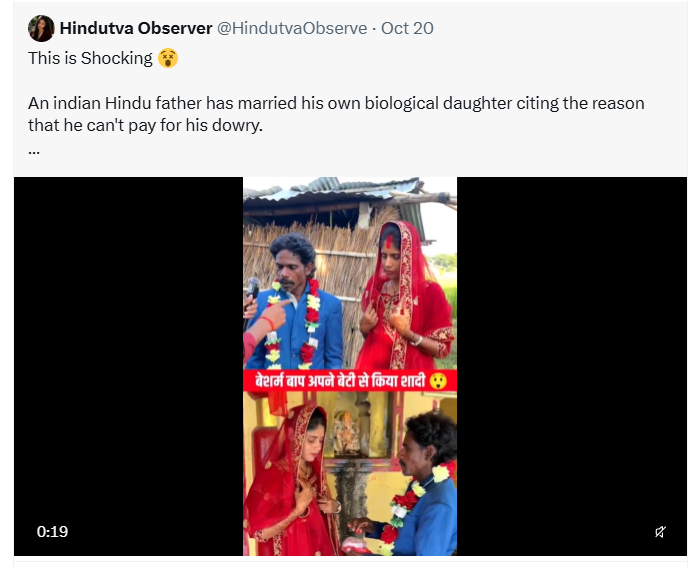
A video is going viral on social media, claiming that an Indian Hindu father married his own biological daughter because he could not afford to pay her dowry. CyberPeace Research found that the video features scripted content being presented as a real-life incident, making the claim misleading. The claim that the man married his own biological daughter is false.
Claim:
A video is being shared on social media with the claim that an Indian Hindu father married his own biological daughter because he was unable to afford her dowry.
https://x.com/i/birdwatch/t/2112470461011599390?source=6
Fact Check
To verify the viral video, we conducted a reverse image search of its keyframes. However, we did not find any credible media reports about the incident. As the next step in our research, we found the video on a Facebook account named Kundan Kumar Mukhiya, where the creator had identified the video as scripted content.
https://www.facebook.com/reel/1170873325369168

As the next step in our research, we found another video on the same page, which was also identified as scripted content.

We examined the user's Facebook account and found that he is a content creator who makes scripted videos.

Conclusion
Our research found that the video features scripted content being shared with a misleading claim, presenting it as a real-life incident. The claim that the man married his own biological daughter is false.

Executive Summary
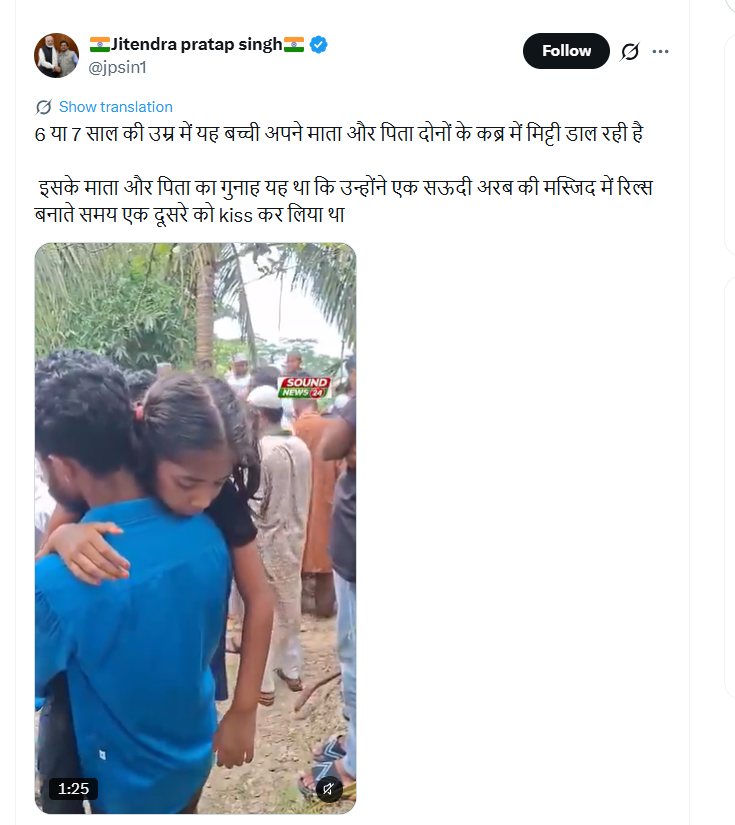
A disturbing video showing a girl placing soil on a grave is going viral on social media. In the video, a young girl can be seen crying as she places soil on a grave in the presence of several people. The video is being shared in connection with Bangladeshi nationals allegedly killed in Saudi Arabia. It is claimed that her parents were killed while making a reel inside a mosque in Saudi Arabia and that she is placing soil on their grave.
CyberPeace Research found that the video of the girl placing soil on a grave dates back to May 2026. In reality, a Bangladeshi national named Sajal died in Saudi Arabia after a tree fell on him while he was eating. The girl seen in the video is Sajal’s daughter. The video is now being shared with a false claim linking it to a man and a woman who were recently sentenced to death in Saudi Arabia.
Claim:
A user on X shared the video with the caption: “At the age of 6 or 7, this little girl is placing soil on the graves of both her mother and father. Their crime was that they kissed each other while making reels inside a mosque in Saudi Arabia.”
https://x.com/jpsin1/status/2112109435393024287
Fact Check
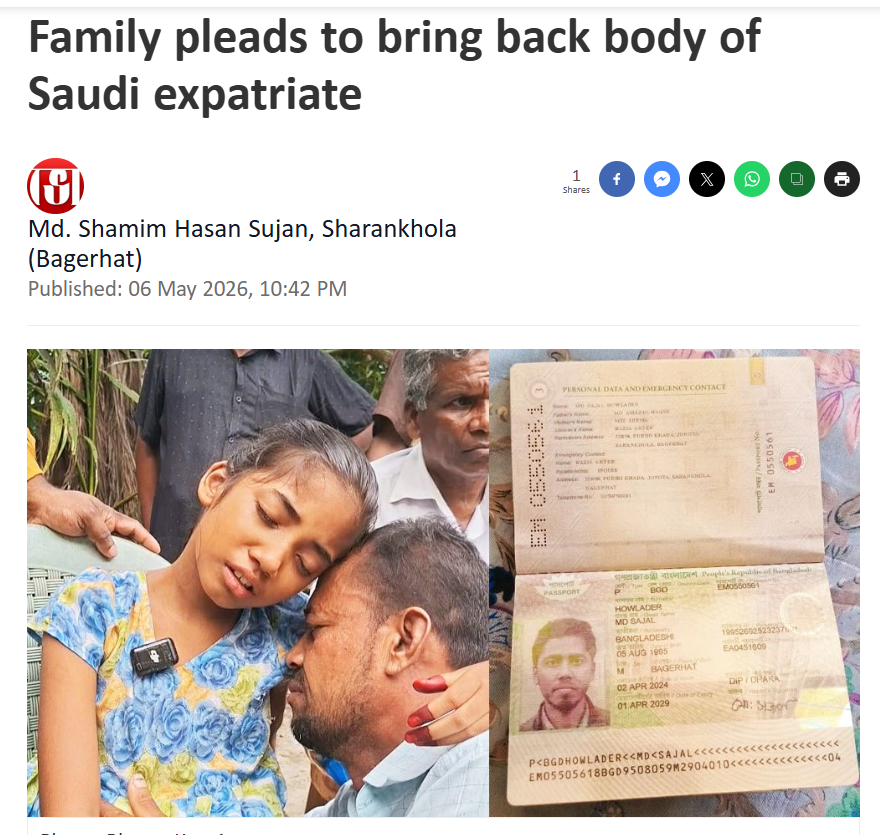
During our research, we found a photograph of the girl seen in the viral video in a report published on May 6, 2026, by another Bangladeshi news website, Bhorer Kagoj (bhorerkagoj.net). The report stated that Sajal Howlader, 31, son of Imadul Howlader, a resident of Ward No. 4 of Khanda village under Rayenda Union No. 3 in Sharankhola Upazila, died after being crushed by a tree in Saudi Arabia.
According to the report, Sajal’s father, Imadul, said that on May 2, at around 4:30 p.m. Saudi Arabia time, Sajal and five other people were sitting under a tree and eating rice when a large she-oak tree fell on them. The five other people sitting under the tree survived, but Sajal died after being crushed by it.
The report also stated that Sajal’s daughter had appealed to Bangladesh Prime Minister Tarique Rahman to bring her father’s body back from Saudi Arabia.
https://www.bhorerkagoj.net/country/786354
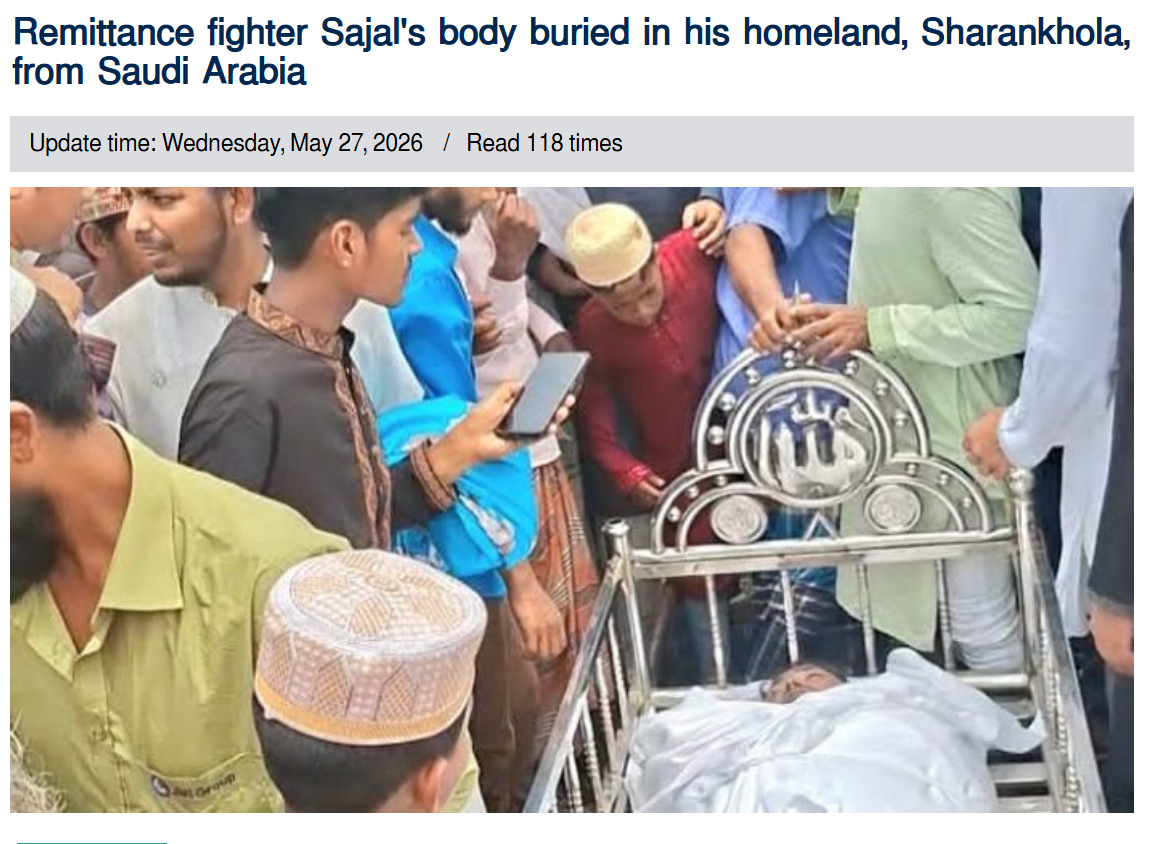
Upon further research, we found a detailed report about the incident published by the Bangladeshi news website Daily Ajker Songram (dailyajkersongram.com). The report stated that 31-year-old Mohammad Sajal died in Saudi Arabia after a tree fell on him.
His body arrived at Hazrat Shahjalal International Airport at around 11 a.m. on May 25, 2026. After the completion of the legal formalities, Sajal’s body reached his hometown of Sharankhola on May 26, 2026.
https://www.dailyajkersongram.com/2026/05/27/
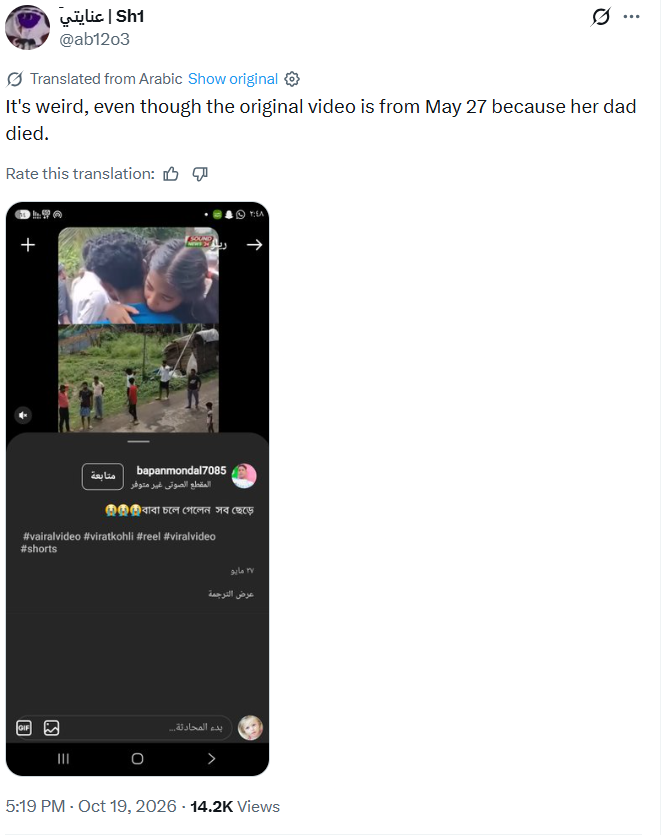
An X account also shared the video, claiming that the original video dates back to May 27, when the girl’s father had died.
https://x.com/ab12o3/status/2112149070764482702
Conclusion
Our research found that the video showing a girl placing soil on a grave dates back to May 2026. In reality, a Bangladeshi national named Sajal died in Saudi Arabia after a tree fell on him while he was eating. The girl seen in the video is Sajal’s daughter. The video is now being shared with a false claim linking it to a man and a woman who were recently sentenced to death in Saudi Arabia.

Executive Summary
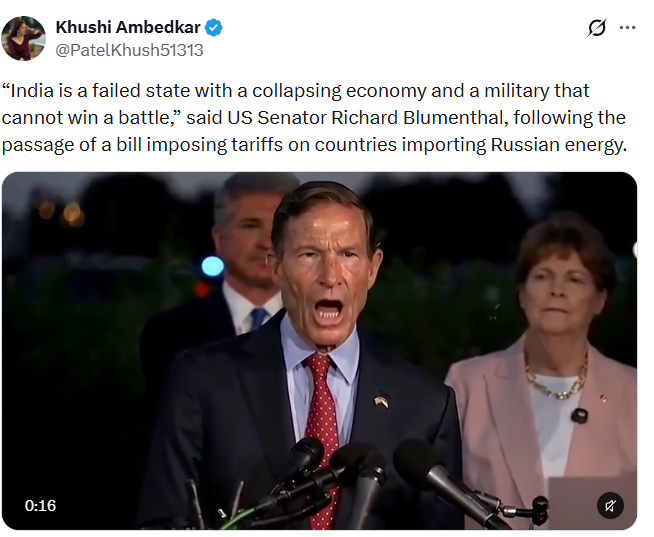
A statement attributed to US Senator Richard Blumenthal is going viral on social media, claiming that he described India as a “failed state” with a collapsing economy and a military that cannot win any battle. The statement is being linked to the passage of a bill imposing tariffs on countries importing Russian energy.
CyberPeace Research found that US Senator Richard Blumenthal did not make the viral statement describing India as a “failed state.” Blumenthal had expressed concerns over India and China purchasing Russian oil and gas, but the remarks attributed to him in the viral post do not match his actual statements. Therefore, the viral claim is misleading.
Claim
A social media user shared a statement attributed to US Senator Richard Blumenthal on X, claiming that he said, “India is a failed state with a collapsing economy and a military that cannot win a battle.” The statement is being portrayed as a remark made following the passage of a bill imposing tariffs on countries importing Russian energy.
https://x.com/PatelKhush51313/status/2112099213802869021?s=20
Fact Check
To verify the viral claim, we searched for relevant keywords but did not find any credible media reports supporting it.
As the next step in our research, we found the original video published on Business Today's YouTube channel on September 17, 2026. In the video, US Senator Richard Blumenthal can be heard commenting on India and China purchasing Russian oil and gas. However, he did not make the statement about India's economy and military that is being attributed to him in the viral post. Therefore, the viral claim is misleading.
https://www.youtube.com/watch?v=L2W30xSSYHc

As the next step in our research, we scanned the viral video using the AI detection tool DETECT VIDEO AI. According to the results, the video is 64% AI-generated.

We scanned the viral video using another AI detection tool, HUMAN METER. According to the results, the video is 75% AI-generated.

Conclusion
Our research found that US Senator Richard Blumenthal did not make the viral statement describing India as a “failed state.” Blumenthal had expressed concerns over India and China purchasing Russian oil and gas, but the remarks attributed to him in the viral post do not match his actual statements. Therefore, the viral claim is misleading.

Executive Summary
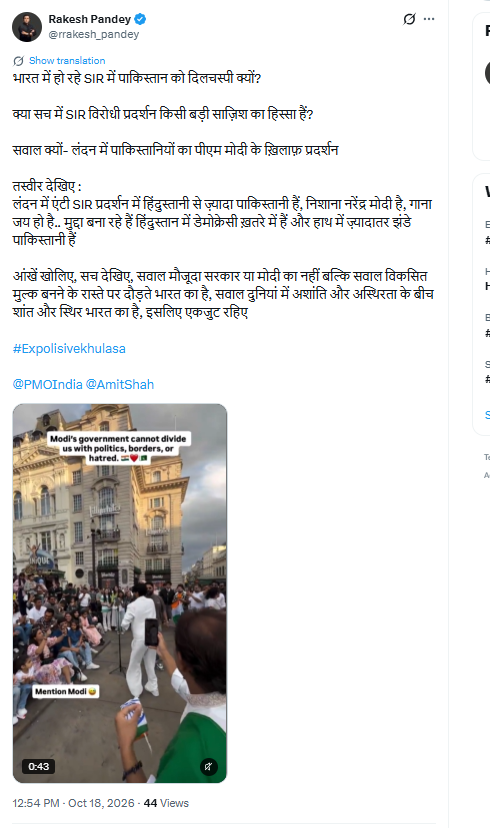
A video is being shared on social media with the claim that Pakistani flags were waved during a protest against Chief Election Commissioner Gyanesh Kumar in London. CyberPeace Research found that the video is not from a protest against the SIR in London. Instead, it shows a joint event held in London on August 15 to mark the Independence Days of India and Pakistan.
Claim:
Social media users are claiming that more Pakistanis than Indians participated in a protest against the SIR in London, with several Pakistani flags visible during the demonstration. The post links the alleged presence of Pakistanis to Pakistan’s purported interest in the protests against the SIR in India and suggests that the demonstration was part of a larger conspiracy against Prime Minister Narendra Modi.
https://x.com/rrakesh_pandey/status/2111720154795233494?s=20
Fact Check
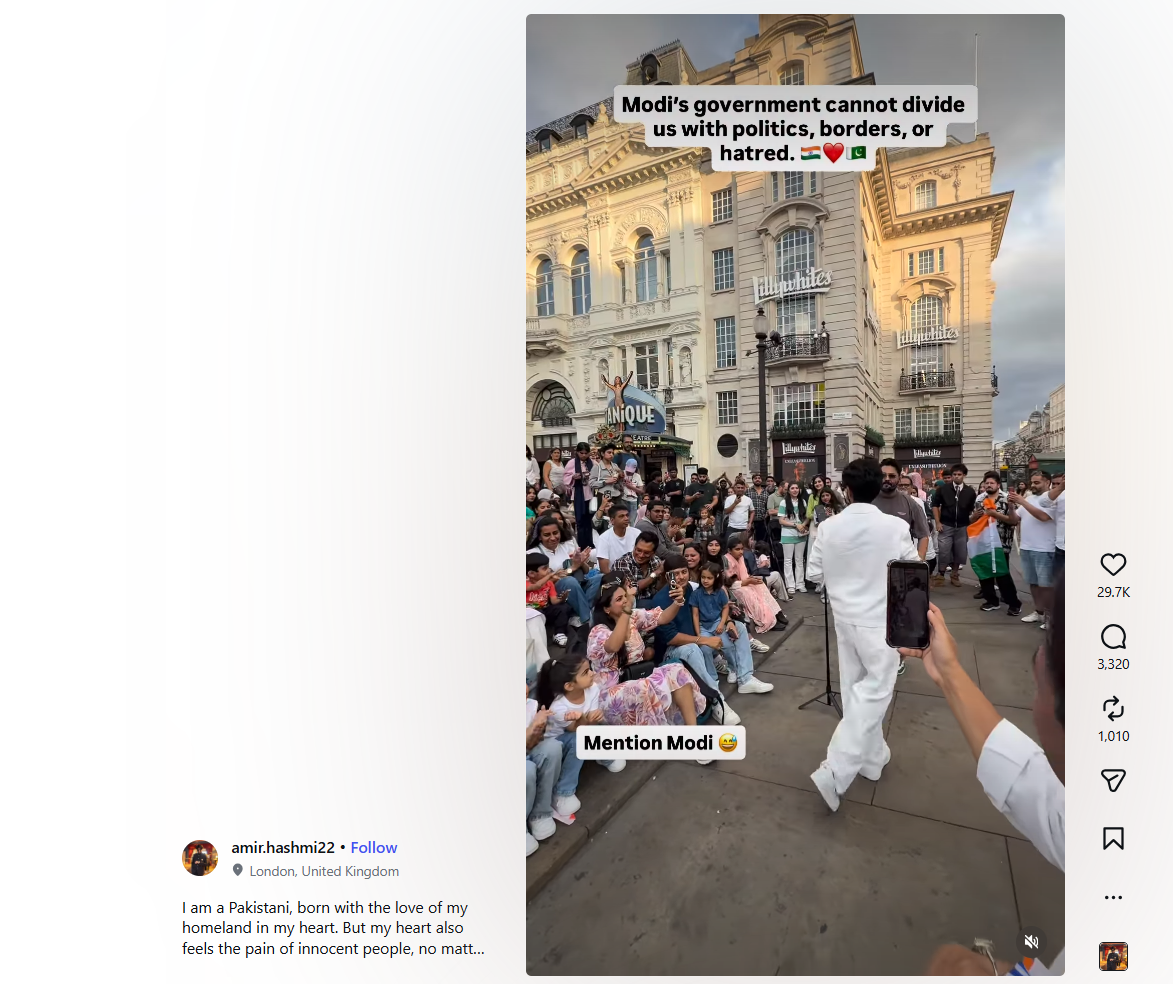
During our research into the viral video claiming that Pakistani flags were waved during a protest against Chief Election Commissioner Gyanesh Kumar in London, a keyword search led us to the same video uploaded on the Instagram account of a Pakistani man, Amir Hashmi, on October 17. Notably, the video was uploaded on the same day that protests against Gyanesh Kumar were held in London.
https://www.instagram.com/reels/DemgSnHNRot/
During our research, we also found a video uploaded on August 16, 2026, to the Instagram account of the same individual, Pakistani singer Amir Hashmi, who is based in London. The video contained visuals matching those seen in the viral clip. The accompanying caption stated that the footage showed celebrations marking the Independence Days of Pakistan and India jointly at Piccadilly Circus in London.
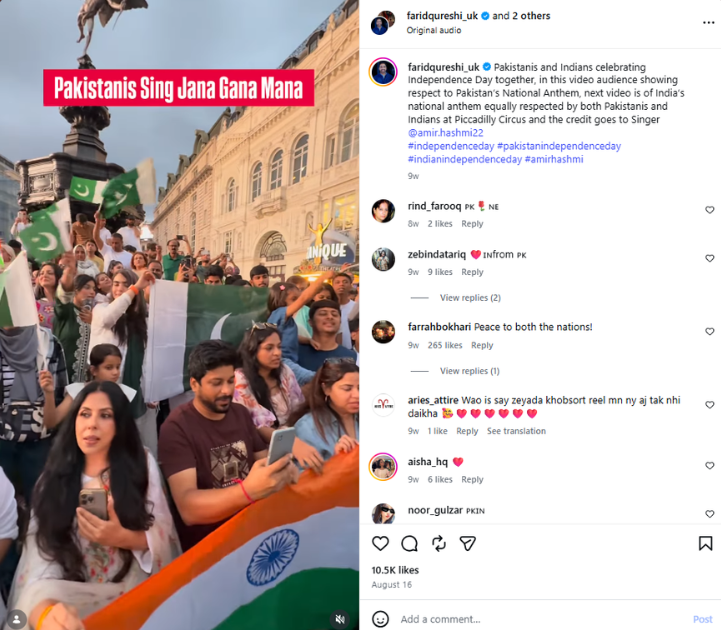
According to another post on Amir Hashmi’s Instagram account, the event was held at Piccadilly Circus on August 15, 2026, local time in England.
https://www.instagram.com/reels/Db9A0paoIvh/

Conclusion
The evidence gathered during our research confirms that the video being shared with the claim that Pakistani flags were waved during a protest against Chief Election Commissioner Gyanesh Kumar in London actually shows an event held on August 15. However, the Pakistani singer shared the video on October 17, the same day protests against Gyanesh Kumar took place in London.

Executive Summary
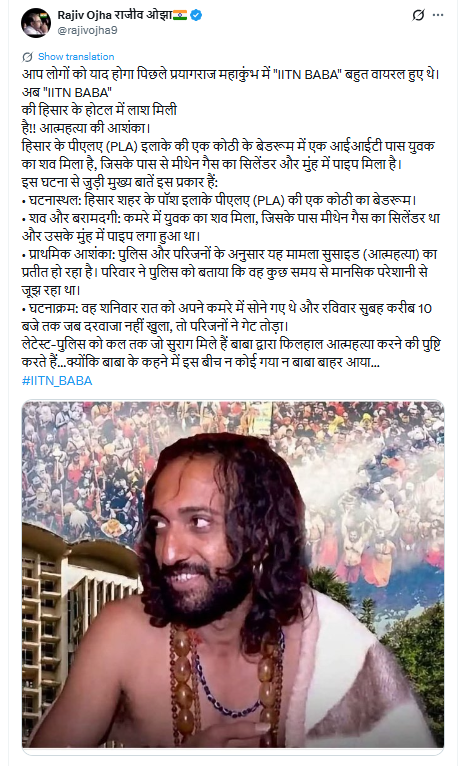
A social media post is being shared claiming that the body of IIT Baba Abhay Singh has been found in Hisar. The viral post also features a photograph of Abhay Singh, popularly known as IIT Baba. The caption accompanying the post reads, “The body of #IITian Baba was found in a bedroom in Hisar, along with a methane gas cylinder and a pipe in his mouth; suicide is suspected… Further details will emerge as the investigation progresses.”
CyberPeace Research found that the claim about IIT Baba Abhay Singh’s death is false.
Claim:
Social media users are claiming that ‘IITian Baba’, who came into the limelight during the Prayagraj Maha Kumbh, died by suicide in Hisar. The post alleges that his body was found in a room at a house in the PLA area of Hisar, with preliminary information suggesting that the police suspect suicide.
https://x.com/rajivojha9/status/2110238805177585752
https://archive.ph/submit/?url
Fact Check
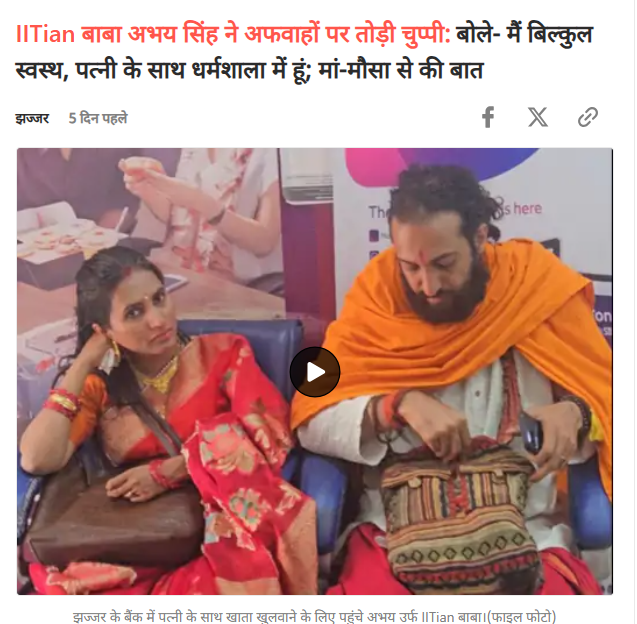
To verify the claim that IIT Baba Abhay Singh’s body was found in Hisar, we first conducted a Google search using relevant keywords. However, we did not find any credible media reports confirming his death. During the search, we came across a report published on the Dainik Bhaskar website on October 15, 2026, which stated that Abhay Singh, popularly known as IIT Baba, is alive and currently in Dharamshala, Himachal Pradesh, with his wife.
According to the Dainik Bhaskar report, IIT Baba Abhay Singh denied the rumours of his death during a conversation. The report also stated that he had spoken to his family members amid the circulation of these rumours.
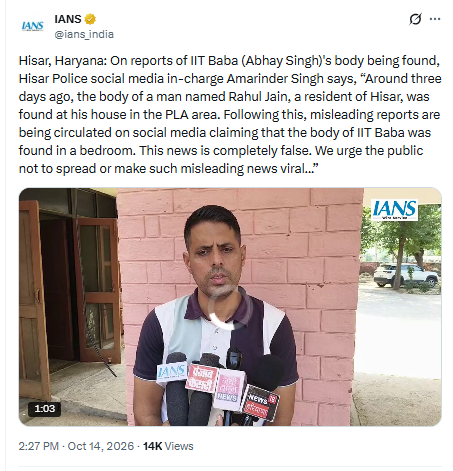
During our research, we found a video posted on the official X account of news agency IANS on October 14, 2026. In the video, Hisar Police social media in-charge Amarinder Singh clarified while speaking to the media that the claim circulating on social media about IIT Baba Abhay Singh’s death was
false.He explained that three days earlier, the body of a local resident named Rahul Jain had been found at his residence in the PLA area of Hisar, following which rumours about IIT Baba Abhay Singh’s death began circulating on social media. Amarinder Singh also appealed to people not to share misleading information.
https://x.com/ians_india/status/2110293986904768641?s=20
Conclusion
The evidence gathered during our research confirms that the claim that IIT Baba Abhay Singh’s body was found in Hisar is false. Hisar Police also refuted the claim after reports of his death went viral on social media.

Executive Summary
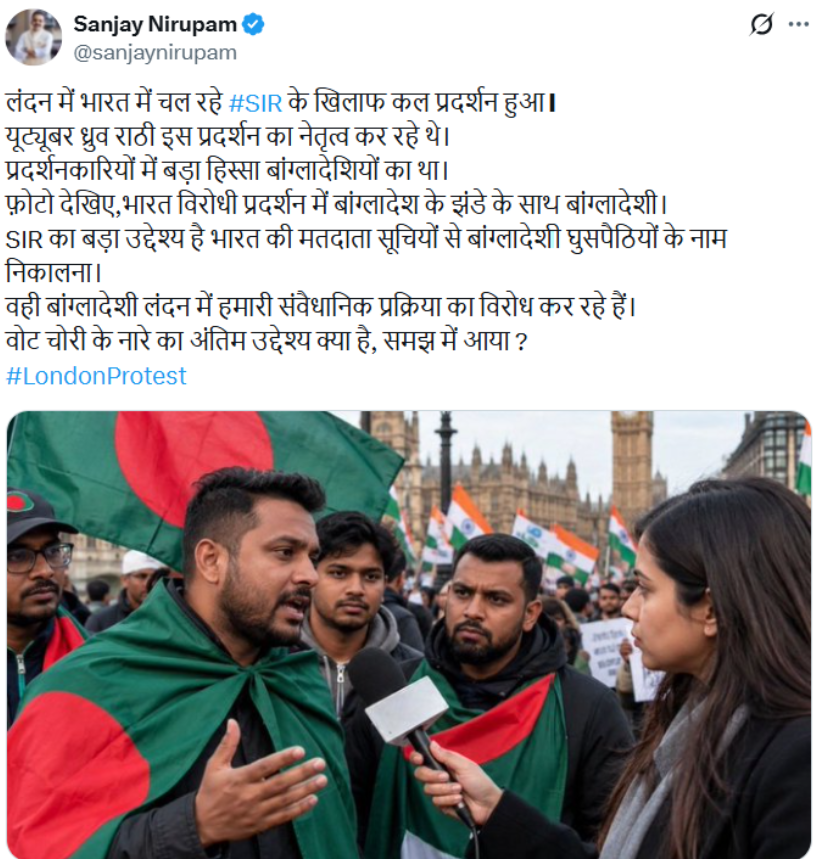
A photo of a Bangladeshi national holding the Bangladesh flag during a protest against Chief Election Commissioner Gyanesh Kumar in London is going viral on social media. The image is being shared with the claim that it was taken during the protest. CyberPeace Research found the viral claim to be false. The image is not authentic and is AI-generated.
Claim:
A photo of a Bangladeshi national holding the Bangladesh flag during a protest against Chief Election Commissioner Gyanesh Kumar in London.
Fact Check
To verify the authenticity of the viral image claiming to show a Bangladeshi man holding the Bangladesh flag during a protest against Chief Election Commissioner Gyanesh Kumar in London, we conducted a reverse image search using Google Lens. However, we could not find the image in any credible media reports.
Upon closely examining the image, we noticed several inconsistencies. For instance, the text on the posters held by people in the image is not clearly legible, and the reporter's microphone does not bear the logo of any media organisation. Such inconsistencies are commonly observed in AI-generated images.
To further examine the image, we analysed it using the AI detection tool Sightengine. The tool indicated a 99.2 per cent probability that the image was AI-generated.

Another AI detection platform, AI or Not, also identified the image as highly likely to be AI-generated.

Conclusion
The evidence gathered during CyberPeace Research confirms that the image circulating with the claim that it shows a Bangladeshi national holding the Bangladesh flag during a protest against Chief Election Commissioner Gyanesh Kumar in London is AI-generated.
.webp)
Executive Summary
A social media post is going viral, claiming that a large number of people took to the streets in Kolkata in support of CJP. The post targets Chief Election Commissioner Gyanesh Kumar, stating, “Gyanesh Kumar, your game is over now!”
CyberPeace Research found that the viral video is not related to any protest against Chief Election Commissioner Gyanesh Kumar. The video shows a public Durga Puja celebration at Chorbagan in Kolkata, where a large number of people had gathered.
Claim:
A large number of people took to the streets in Kolkata in support of CJP. The protesters targeted Chief Election Commissioner Gyanesh Kumar, saying, “Gyanu, your game is over now!”
https://x.com/pokershash/status/2111337300848415032
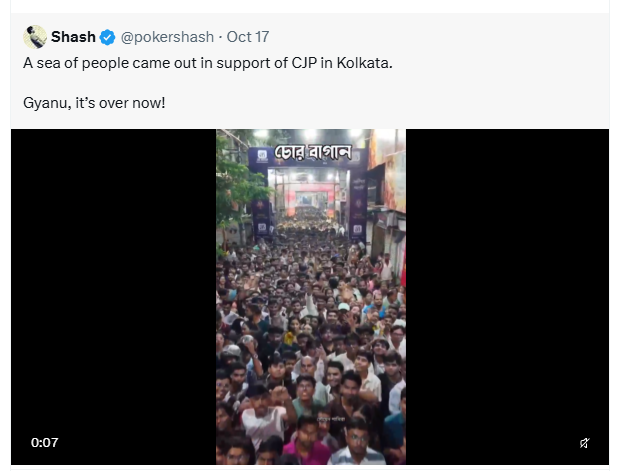
Fact Check
We conducted a reverse image search using keyframes from the viral video. During our research, we found the video on Facebook, where it was identified as footage from a public Durga Puja celebration organised at Chorbagan in Kolkata, which saw a large gathering of people.
https://www.facebook.com/watch/?v=29115417811386049
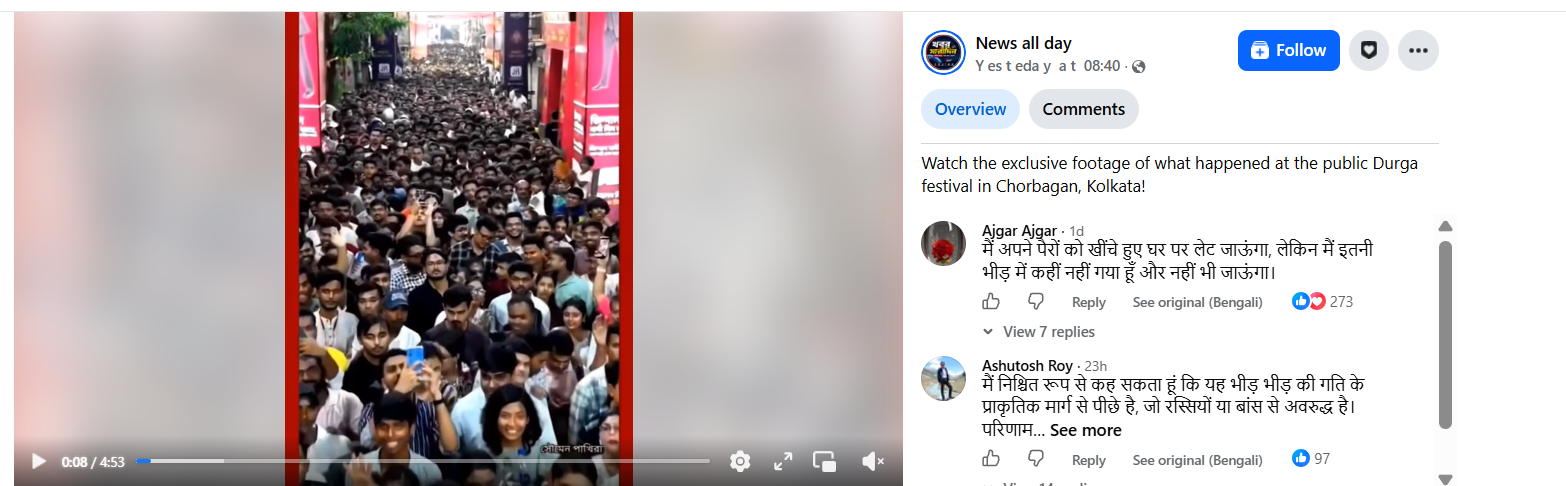
During our research, we found a video published by Times Now Bharat on October 17, 2026. According to the report, the footage shows a large crowd gathered at the Chorbagan Sarbojanin Durga Puja pandal in Kolkata. A near-stampede occurred at the venue, leaving 25 people injured, five of whom were reported to be in critical condition. This confirms that the video is unrelated to any gathering in support of CJP.

Conclusion
Our research found that the viral video is not related to any protest against Chief Election Commissioner Gyanesh Kumar. The video shows a public Durga Puja celebration at Chorbagan in Kolkata, where a large number of people had gathered.
