
#FactCheck - AI-Generated Image Falsely Shared as Bees Attacking Shankaracharya Swami Avimukteshwaranand Saraswati
Executive Summary
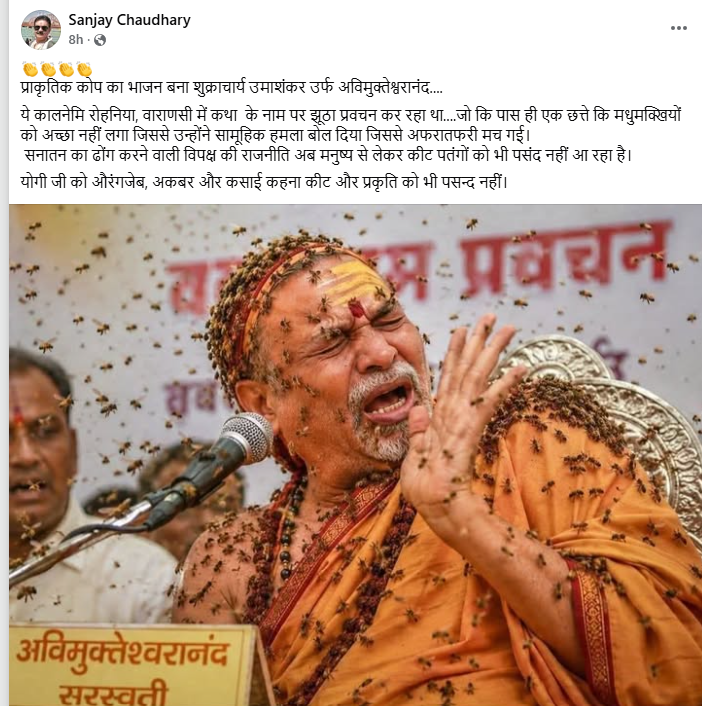
During the Gau Raksha Yatra of Shankaracharya Swami Avimukteshwaranand Saraswati, bees reportedly attacked a discourse event in Rohania area of Varanasi, Uttar Pradesh. Following the incident, a picture has gone viral on social media showing bees attacking Swami Avimukteshwaranand Saraswati. Several users are sharing the image as genuine while targeting the Shankaracharya online. CyberPeace Research Wing investigated the viral image and found it to be fake. Our research revealed that the picture was created using Artificial Intelligence (AI). While it is true that a bee attack occurred during Swami Avimukteshwaranand Saraswati’s discourse program, the viral image itself is fabricated.
Claim
A Facebook user named “Sanjay Chaudhary” shared the viral image on May 15, 2026, with the caption: “Prakritik kop ka bhajan bana Shukracharya Umashankar alias Avimukteshwaranand… This Kaalnemi was delivering false sermons in Rohania, Varanasi in the name of religion… The bees from a nearby hive did not like it and collectively attacked, creating chaos. Even insects and nature no longer like the opposition’s politics disguised as Sanatan Dharma. Calling Yogi Ji Aurangzeb, Akbar and butcher is not acceptable even to nature and insects.”
Post link and archive link are given below:
- https://www.facebook.com/sanjaychaudhary073/posts/pfbid02kgts8igKDwgctz3MamECMGoGfQR5aWPTdsDgLeux3pD9jwP7ADfgNpoPfHvMb9Zul
- https://perma.cc/E6SE-BAXZ
Fact-Check
To verify the viral claim, we used Google Open Search tools and found reports related to the incident on the YouTube channel of News18 UP Uttarakhand. A report published on May 13, 2026 stated that bees attacked the discourse event during Swami Avimukteshwaranand’s Gau Raksha Yatra in Rohania, Varanasi. The incident created panic at the venue, forcing the Swami to end his discourse midway. The channel also uploaded a YouTube Shorts video related to the incident.

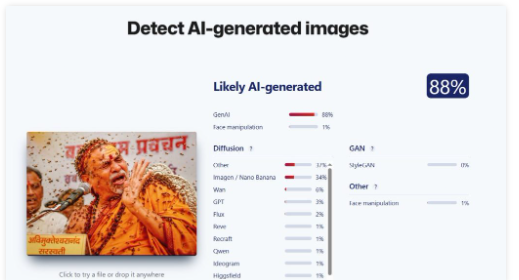
As part of the research, we further analyzed the viral image using AI detection tools. First, we used the tool “Sight Engine,” which indicated an 88 percent probability that the image was AI-generated.
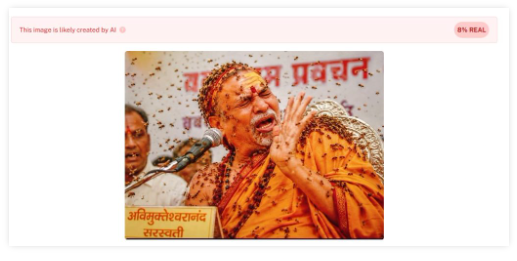
We then examined the image using another AI detection tool called “Undetectable,” which also suggested that the photo was likely created using AI.
Conclusion
Our research found that the viral image is AI-generated. The picture was created using artificial intelligence tools. While bees did attack during Swami Avimukteshwaranand Saraswati’s Gau Raksha Yatra on May 13, 2026, the viral image circulating on social media is fictional and not real.

Related Blogs
Introduction
The banking and finance sector worldwide is among the most vulnerable to cybersecurity attacks. Moreover, traditional threats such as DDoS attacks, ransomware, supply chain attacks, phishing, and Advanced Persistent Threats (APTs) are becoming increasingly potent with the growing adoption of AI. It is crucial for banking and financial institutions to stay ahead of the curve when it comes to their cybersecurity posture, something that is possible only through a systematic approach to security. In this context, the Reserve Bank of India’s latest Financial Stability Report (June 2025) acknowledges that cybersecurity risks are systemic to the sector, particularly the securities market, and have to be treated as such.
What the Financial Stability Report June 2025 Says
The report notes that the increasing scale of digital financial services, cloud-based architecture, and interconnected systems has expanded the cyberattack surface across sectors. It calls for building cybersecurity resilience by improving Security Operations Center (SOC) efficacy, undertaking “risk-based supervision”, implementing “zero-trust approaches”, and “AI-aware defense strategies”. It also recommends the implementation of graded monitoring systems, employing behavioral analytics for threat detection, building adequate skill through hands-on training, engaging in continuous learning and simulation-based exercises like Continuous Assessment-Based Red Teaming (CART), conducting scenario-based resilience drills, and establishing consistent incident reporting frameworks. In addition, it suggests that organizations need to adopt quantifiable benchmarks like SOC Efficacy and Cyber Capability Index to guarantee efficient governance and readiness.
Implications
Firstly, even though the report doesn’t break new ground in identifying cyber risk, it does sharpen its urgency and lays the groundwork for giving more weight to cybersecurity in macroprudential supervision. In the face of emerging threats, it positions cyberattacks as a systemic financial risk that can affect India’s financial stability with the same seriousness as traditional threats like NPAs and capital inadequacy.
Secondly, by calling to “ensure cyber resilience”, it reflects the RBI’s dedication to values-based compliance to cybersecurity policies where effectiveness and adaptability matter more than box-ticking. This approach caters to an organisation’s/ sector’s unique nature, governance requirements, and updates to rising risks. It checks not only if certain measures were used, but also if they were effective, through constant self-assessment, scenario-based training, cyber drills, dynamic risk management, and value-driven audits. In the face of a rapidly expanding digital transactions ecosystem with integration of new technologies such as AI, this approach is imperative to building cyber resilience. The RBI’s report suggests exactly this need for banks and NBFCs to update its parameters for resilience.
Conclusion
While the RBI’s 2016 guidelines focus on core cybersecurity concerns and has issued guidelines on IT governance, outsourcing, and digital payment security, none explicitly codify “AI-aware,” “zero-trust,” or a full “risk-based supervision” mechanism. The more recent emphasis on these concepts comes from the 2025 Financial Stability Report, which uses them as forward-looking policy orientations. How the RBI chooses to operationalize these frameworks is yet to be seen. Further, RBI’s vision cannot operate in a silo. Cross-sector regulators like SEBI, IRDAI, and DoT must align on cyber standards and incident reporting protocols.
In the meanwhile, highly vulnerable sectors like education and healthcare, which have weaker cybersecurity capabilities, can take a leaf from RBI’s book by ensuring that cybersecurity is treated as a continuously evolving issue . Many institutions in these sectors are known to perform goals-based compliance through a simple checklist approach. Institutions that take the lead in implementing zero-trust, diversifying vendor dependencies, and investing in cyber resilience will not only meet regulatory expectations but build long-term competitive advantage.
References
- https://economictimes.indiatimes.com/news/economy/policy/adopt-risk-based-supervision-zero-trust-approach-to-curb-cyberfrauds-rbi/articleshow/122164631.cms?from=mdr-%20500
- https://paramountassure.com/blog/value-driven-cybersecurity/
- https://www.rbi.org.in/commonman/english/Scripts/Notification.aspx?Id=1721
- https://rbidocs.rbi.org.in/rdocs//PublicationReport/Pdfs/0FSRJUNE20253006258AE798B4484642AD861CC35BC2CB3D8E.PDF
Introduction
The use of AI in content production, especially images and videos, is changing the foundations of evidence. AI-generated videos and images can mirror a person’s facial features, voice, or actions with a level of fidelity to which the average individual may not be able to distinguish real from fake. The ability to provide creative solutions is indeed a beneficial aspect of this technology. However, its misuse has been rapidly escalating over recent years. This creates threats to privacy and dignity, and facilitates the creation of dis/misinformation. Its real-world consequences are the manipulation of elections, national security threats, and the erosion of trust in society.
Why India Needs Deepfake Regulation
Deepfake regulation is urgently needed in India, evidenced by the recent Rashmika Mandanna incident, where a hoax deepfake of an actress created a scandal throughout the country. This was the first time that an individual's image was superimposed on the body of another woman in a viral deepfake video that fooled many viewers and created outrage among those who were deceived by the video. The incident even led to law enforcement agencies issuing warnings to the public about the dangers of manipulated media.
This was not an isolated incident; many influencers, actors, leaders and common people have fallen victim to deepfake pornography, deepfake speech scams, defraudations, and other malicious uses of deepfake technology. The rapid proliferation of deepfake technology is outpacing any efforts by lawmakers to regulate its widespread use. In this regard, a Private Member’s Bill was introduced in the Lok Sabha in its Winter Session. This proposal was presented to the Lok Sabha as an individual MP's Private Member's Bill. Even though these have had a low rate of success in being passed into law historically, they do provide an opportunity for the government to take notice of and respond to emerging issues. In fact, Private Member's Bills have been the catalyst for government action on many important matters and have also provided an avenue for parliamentary discussion and future policy creation. The introduction of this Bill demonstrates the importance of addressing the public concern surrounding digital impersonation and demonstrates that the Parliament acknowledges digital deepfakes to be a significant concern and, therefore, in need of a legislative framework to combat them.
Key Features Proposed by the New Deepfake Regulation Bill
The proposed legislation aims to create a strong legal structure around the creation, distribution and use of deepfake content in India. Its five core proposals are:
1. Prior Consent Requirement: individuals must give their written approval before producing or distributing deepfake media, including digital representations of themselves, as well as their faces, images, likenesses and voices. This aims to protect women, celebrities, minors, and everyday citizens against the use of their identities with the intent to harm them or their reputations or to harass them through the production of deepfakes.
2. Penalties for Malicious Deepfakes: Serious criminal consequences should be placed for creating or sharing deepfake media, particularly when it is intended to cause harm (defame, harass, impersonate, deceive or manipulate another person). The Bill also addresses financially fraudulent use of deepfakes, political misinformation, interfering with elections and other types of explicit AI-generated media.
3. Establishment of a Deepfake Task Force: To look at the potential impact of deepfakes on national security, elections and public order, as well as on public safety and privacy. This group will work with academic institutions, AI research labs and technology companies to create advanced tools for the detection of deepfakes and establish best practices for the safe and responsible use of generative AI.
4. Creation of a Deepfake Detection and Awareness Fund: To assist with the development of tools for detecting deepfakes, increasing the capacity of law enforcement agencies to investigate cybercrime, promoting public awareness of deepfakes through national campaigns, and funding research on artificial intelligence safety and misinformation.
How Other Countries Are Handling Deepfakes
1. United States
Many States in the United States, including California and Texas, have enacted laws to prohibit the use of politically deceptive deepfakes during elections. Additionally, the Federal Government is currently developing regulations requiring that AI-generated content be clearly labelled. Social Media Platforms are also being encouraged to implement a requirement for users to disclose deepfakes.
2. United Kingdom
In the United Kingdom, it is illegal to create or distribute intimate deepfake images without consent; violators face jail time. The Online Safety Act emphasises the accountability of digital media providers by requiring them to identify, eliminate, and avert harmful synthetic content, which makes their role in curating safe environments all the more important.
3. European Union:
The EU has enacted the EU AI Act, which governs the use of deepfakes by requiring an explicit label to be affixed to any AI-generated content. The absence of a label would subject an offending party to potentially severe regulatory consequences; therefore, any platform wishing to do business in the EU should evaluate the risks associated with deepfakes and adhere strictly to the EU's guidelines for transparency regarding manipulated media.
4. China:
China has among the most rigorous regulations regarding deepfakes anywhere on the planet. All AI-manipulated media will have to be marked with a visible watermark, users will have to authenticate their identities prior to being allowed to use advanced AI tools, and online platforms have a legal requirement to take proactive measures to identify and remove synthetic materials from circulation.
Conclusion
Deepfake technology has the potential to be one of the greatest (and most dangerous) innovations of AI technology. There is much to learn from incidents such as that involving Rashmika Mandanna, as well as the proliferation of deepfake technology that abuses globally, demonstrating how easily truth can be altered in the digital realm. The new Private Member's Bill created by India seeks to provide for a comprehensive framework to address these abuses based on prior consent, penalties that actually work, technical preparedness, and public education/awareness. With other nations of the world moving towards increased regulation of AI technology, proposals such as this provide a direction for India to become a leader in the field of responsible digital governance.
References
- https://www.ndtv.com/india-news/lok-sabha-introduces-bill-to-regulate-deepfake-content-with-consent-rules-9761943
- https://m.economictimes.com/news/india/shiv-sena-mp-introduces-private-members-bill-to-regulate-deepfakes/articleshow/125802794.cms
- https://www.bbc.com/news/world-asia-india-67305557
- https://www.akingump.com/en/insights/blogs/ag-data-dive/california-deepfake-laws-first-in-country-to-take-effect
- https://codes.findlaw.com/tx/penal-code/penal-sect-21-165/
- https://www.mishcon.com/news/when-ai-impersonates-taking-action-against-deepfakes-in-the-uk#:~:text=As%20of%2031%20January%202024,of%20intimate%20deepfakes%20without%20consent.
- https://www.politico.eu/article/eu-tech-ai-deepfakes-labeling-rules-images-elections-iti-c2pa/
- https://www.reuters.com/article/technology/china-seeks-to-root-out-fake-news-and-deepfakes-with-new-online-content-rules-idUSKBN1Y30VT/

Executive Summary
A video of an elderly woman performing a pole vault is being widely shared on social media. The video is being shared with the claim that the woman, who can be seen performing the astonishing feat, is 95 years old. Several people can also be seen around her in the video. She runs at full speed while carrying a pole and then leaps over a bar placed at a height. People present at the venue can be seen applauding her remarkable performance. A research done by the Research Wing of CyberPeace found that the video is not real but AI-generated.
Claim
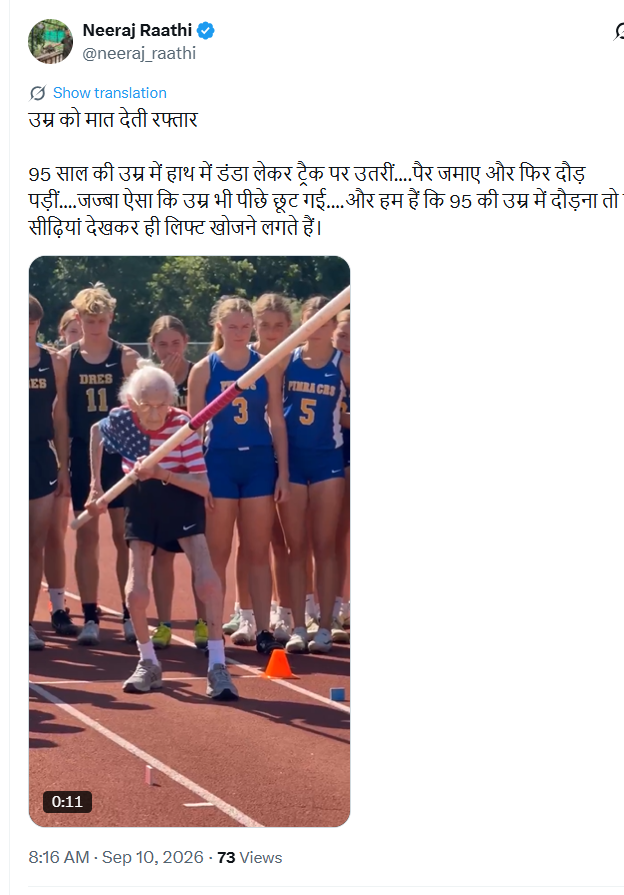
An X user shared the video with the caption: “Defying age with speed. At the age of 95, she stepped onto the track with a stick in her hand… planted her feet and started running… such determination that even age was left behind… and here we are, at 95, forget running, we start looking for a lift the moment we see the stairs.”
https://x.com/neeraj_raathi/status/2097879324573798613
https://archive.ph/8Invi
Fact Check
To verify the authenticity of the viral video showing the elderly woman performing a pole vault, we first conducted a Google search using relevant keywords. However, we did not find any credible media reports or other reliable sources identifying the video as footage of a real pole vault competition.
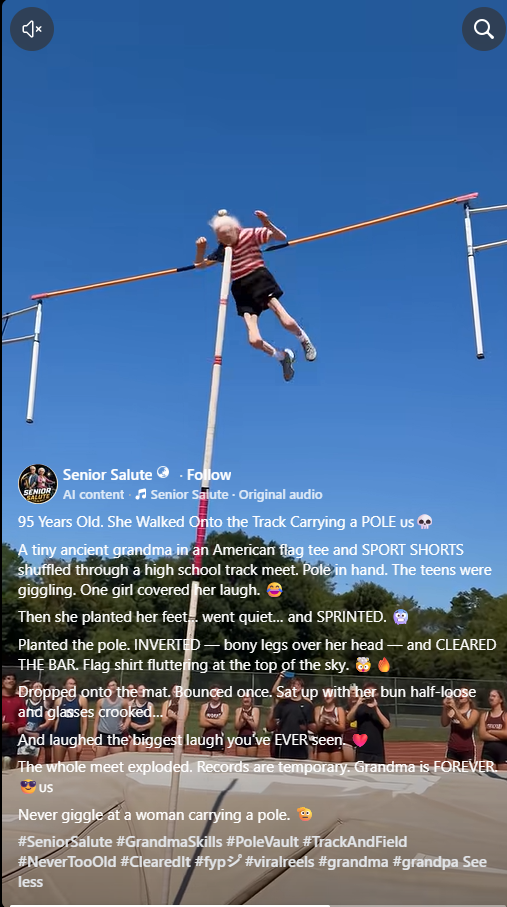
We then conducted a keyframe search and found the same video uploaded on September 8, 2026, on a Facebook page called ‘Senior Salute’, an AI content creator. The post also carries an AI-generated content label.
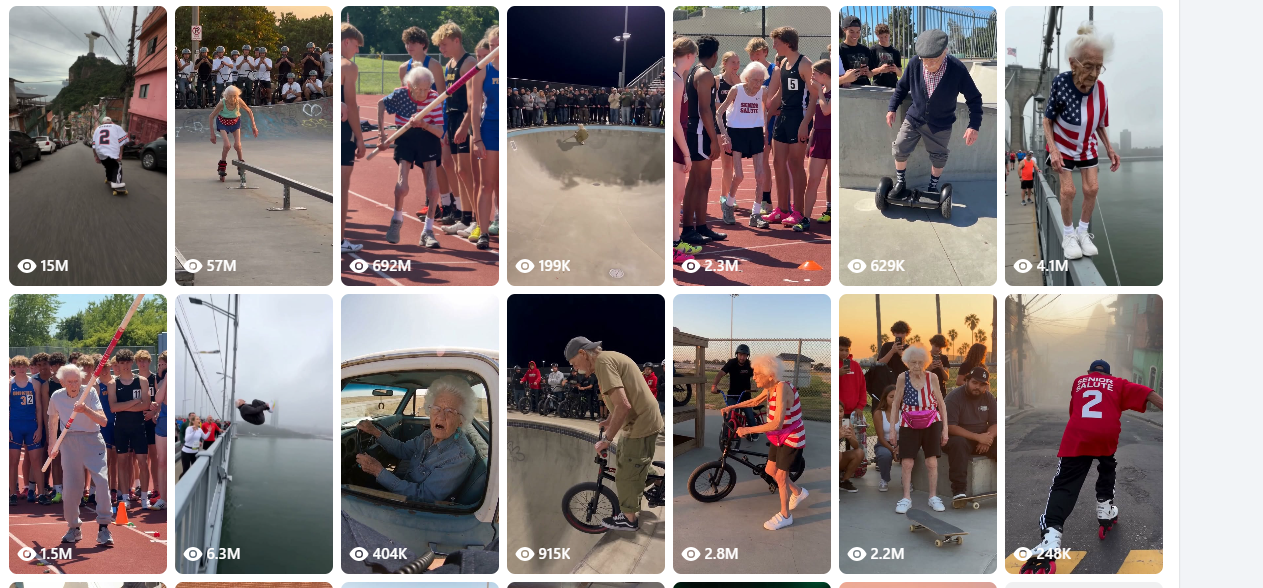
Upon reviewing the Facebook account, we found several similar videos showing elderly people performing various stunts. The account appears to exclusively create and share AI-generated videos.
We also checked the video using another AI detection tool, Truth Scan. In its analysis, the tool gave the viral video a 90 percent score, indicating that it was likely AI-generated.

In addition, we checked the visuals in the viral video using another AI detection platform, AIorNOT. In its analysis, the tool also indicated a high likelihood that the visuals in the video were AI-generated.

Conclusion
The evidence gathered during our research makes it clear that the viral video showing an elderly woman performing a pole vault is not genuine but AI-generated. The same video was found on a Facebook page that primarily shares AI-generated content and was posted with an AI-generated content label. Further, multiple AI detection tools also indicated a high likelihood that the video was created using AI. Therefore, the claim that the video shows a 95-year-old woman performing a real pole vault is false.
