
#FactCheck -AI-Generated Clip Misleads Users as Monkey ‘Saves’ Child Under Falling Tree Branch
Executive Summary
A video showing a monkey allegedly saving the life of a sleeping child is rapidly going viral on social media. In the clip, a monkey can be seen picking up a child sleeping on a mat under a tree and moving the child away moments before a heavy tree branch falls at the same spot. Social media users are sharing the video as a “miracle of nature” and praising the emotional sensitivity and instincts of animals. However, research conducted by CyberPeace Research Wing found that the viral video is not real and was created using artificial intelligence tools.
Claim
The caption accompanying the viral post states:“In a shocking incident, a monkey was seen stepping in to save an innocent child sleeping under a tree from imminent danger. People nearby were stunned by the scene. It is being claimed that the monkey sensed the danger around the child and tried to protect him. The unusual incident has now gone viral on social media, with many saying that emotions and compassion are not limited to humans, animals can also understand feelings.”
The video has been widely shared across social media platforms
- https://www.instagram.com/reels/DYMvhRPTcCA/
- https://archive.ph/https://www.instagram.com/reels/DYMvhRPTcCA/

Fact Check
To verify the authenticity of the video, we extracted keyframes from the clip and conducted a reverse image search. During the research, we found the same video uploaded on May 8, 2026, on an Instagram page named Instagram user “mojilo_vandro.” The caption of the original upload did not provide any factual context and presented the video in a dramatic, miracle-like manner.

We further examined the Instagram account and found that it regularly posts several AI-generated videos featuring monkeys performing heroic or emotional acts. Importantly, the account owner has also identified themselves as an “AI video creator” in the bio section.
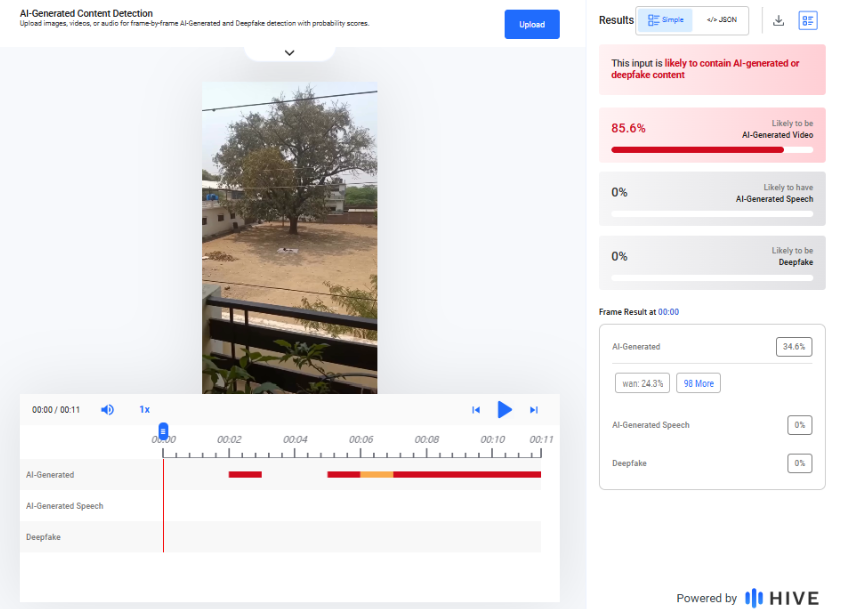
To further analyze the clip, we tested it using the AI detection tool Hive Moderation. The tool’s analysis classified the viral video as 85.6% likely to be AI-generated. We also checked the clip using another AI detection platform, Deepfake-o-meter. Its AVSRDD (2025) detection model flagged the video as potentially AI-generated with a 100% confidence score.

Conclusion
The evidence gathered during our research clearly shows that the viral video claiming to show a monkey saving a sleeping child from a falling tree branch is not authentic. The clip was created using AI-generated visual techniques and does not depict a real incident.

Related Blogs

Introduction
In the age of digital advancement, where technology continually grows, so does the method of crime. The rise of cybercrime has created various threats to individuals and organizations, businesses, and government agencies. To combat such crimes law enforcement agencies are looking out for innovative solutions against these challenges. One such innovative solution is taken by the Surat Police in Gujarat, who have embraced the power of Artificial Intelligence (AI) to bolster their efforts in reducing cybercrimes.
Key Highlights
Surat, India, has launched an AI-based WhatsApp chatbot called "Surat Police Cyber Mitra Chatbot" to tackle growing cybercrime. The chatbot provides quick assistance to individuals dealing with various cyber issues, ranging from reporting cyber crimes to receiving safety tips. The initiative is the first of its kind in the country, showcasing Surat Police's dedication to using advanced technology for public safety. Surat Police Commissioner-in-Charge commended the use of AI in crime control as a positive step forward, while also stressing the need for continuous improvements in various areas, including technological advancements, data acquisition related to cybercrime, and training for police personnel.
The Surat Cyber Mitra Chatbot, available on WhatsApp number 9328523417, offers round-the-clock assistance to citizens, allowing them to access crucial information on cyber fraud and legal matters.
Surat Police's AI Chatbot: Cyber Mitra
- Surat Police in Gujarat, India, has launched an AI-based WhatsApp chatbot, "Surat Police Cyber Mitra Chatbot," to combat growing cybercrime.
- The chatbot provides assistance to individuals dealing with various cyber issues, from reporting cyber crimes to receiving safety tips.
- The initiative is the first of its kind in the country, showcasing Surat Police's dedication to using advanced technology for public safety.
- The Surat Cyber Mitra Chatbot, available on WhatsApp number 9328523417, offers round-the-clock assistance to citizens, providing crucial information on cyber fraud.
The Growing Cybercrime Threat
With the advancement of technology, cybercrime has become more complex due to the interconnectivity of digital devices and the internet. The criminals exploit vulnerabilities in software, networks, and human behavior to perpetrate a wide range of malicious activities to fulfill their illicit gains. Individuals and organizations face a wide range of cyber risks that can cause significant financial, reputational, and emotional harm.
Surat Police’s Strategic Initiative
Surat Police Cyber Mitra Chatbot is an AI-powered tool for instant problem resolution. This innovative approach allows citizens to address any issue or query at their doorstep, providing immediate and accurate responses to concerns. The chatbot is accessible 24/7, 24 hours a day, and serves as a reliable resource for obtaining legal information related to cyber fraud.
The use of AI in police initiatives has been a topic of discussion for some time, and the Surat City Police has taken this step to leverage technology for the betterment of society. The chatbot promises to boost public trust towards law enforcement and improve the legal system by addressing citizen issues within seconds, ranging from financial disputes to cyber fraud incidents.
This accessibility extends to inquiries such as how to report financial crimes or cyber-fraud incidents and understand legal procedures. The availability of accurate information will not only enhance citizens' trust in the police but also contribute to the efficiency of law enforcement operations. The availability of accurate information will lead to more informed interactions between citizens and the police, fostering a stronger sense of community security and collaboration.
The utilisation of this chatbot will facilitate access to information and empower citizens to engage more actively with the legal system. As trust in the police grows and legal processes become more transparent and accessible, the overall integrity and effectiveness of the legal system are expected to improve significantly.
Conclusion
The Surat Police Cyber Mitra Chatbot is an AI-powered tool that provides round-the-clock assistance to citizens, enhancing public trust in law enforcement and streamlining access to legal information. This initiative bridges the gap between law enforcement and the community, fostering a stronger sense of security and collaboration, and driving improvements in the efficiency and integrity of the legal process.
References:
- https://www.ahmedabadmirror.com/surat-first-city-in-india-to-launch-ai-chatbot-to-tackle-cybercrime/81861788.html
- https://government.economictimes.indiatimes.com/news/secure-india/gujarat-surat-police-adopts-ai-to-check-cyber-crimes/107410981
- https://www.timesnownews.com/india/chatbot-and-advanced-analytics-surat-police-utilising-ai-technology-to-reduce-cybercrime-article-107397157
- https://www.grownxtdigital.in/technology/surat-police-ai-cyber-mitra-chatbot-gujarat/

A video circulating widely on social media claims that Indian cricketer Virat Kohli made a sarcastic remark about fast bowler Prasidh Krishna ahead of the New Zealand series. In the clip, Kohli is allegedly heard saying that he expected to be the top scorer of the series, but lost all hope after seeing Prasidh Krishna’s name in the squad.
Users sharing the video claim that Kohli publicly commented on Prasidh Krishna in this manner.
Research by the CyberPeace Foundation has found the viral claim to be false. Our probe revealed that the viral clip has been digitally manipulated. The video is originally from a 2024 advertisement featuring Virat Kohli, in which his voice has been altered using deepfake (AI-generated) technology and falsely presented with a misleading narrative.
Claim
The video was shared on Instagram on January 6, 2025, with users claiming that Kohli made the remark after the New Zealand squad was announced. The post included the altered audio suggesting Kohli’s disappointment over Prasidh Krishna’s selection. Link, archive link

Fact Check:
To verify the claim, we extracted key frames from the viral video and conducted a Google Reverse Image Search. This led us to the original video posted by Virat Kohli himself on X (formerly Twitter) on April 15, 2024. The original clip was part of a brand advertisement, and no such statement about the New Zealand series or Prasidh Krishna was made in it. Link and Screenshot

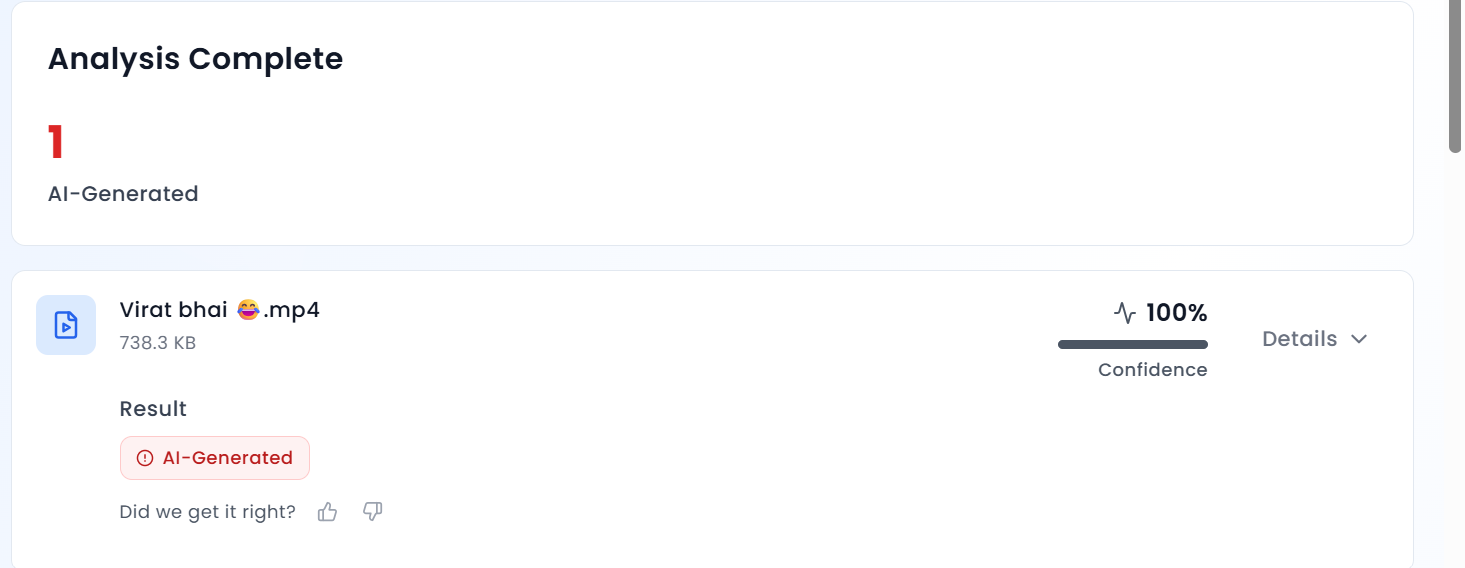
A close review of the viral clip raised suspicions due to the unnatural tone and inconsistencies in Kohli’s voice. To confirm this, we analysed the video using the AI detection tool Aurigin AI. The tool’s results showed that the audio in the viral clip is 100 percent AI-generated, confirming that Kohli’s voice was artificially manipulated.
Conclusion
The CyberPeace Foundation’s research confirms that the viral video claiming Virat Kohli mocked Prasidh Krishna is fake and misleading. The clip is taken from an old advertisement and has been doctored using deepfake technology to alter Kohli’s voice. The video is being circulated on social media with a false claim, and Virat Kohli has made no such statement regarding the New Zealand series or Prasidh Krishna.

Introduction
In today's era of digitalised community and connections, social media has become an integral part of our lives. we use social media to connect with our friends and family, and social media is also used for business purposes. Social media offers us numerous opportunities and ease to connect and communicate with larger communities. While it also poses some challenges, while we use social media, we come across issues such as inappropriate content, online harassment, online stalking, account hacking, misuse of personal information or data, privacy issues, fake accounts, Intellectual property violation issues, abusive and dishearted content, content against the terms and condition policy of the platform and more. To deal with such issues, social media entities have proper reporting mechanisms and set terms and conditions guidelines to effectively prevent such issues and by addressing them in the best possible way by platform help centre or reporting mechanism.
The Role of Help Centers in Resolving User Complaints:
The help centres are established on platforms to address user complaints and provide satisfactory assistance or resolution. Addressing user complaints is a key component of maintaining a safe and secure digital environment for users. Platform-centric help centres play a vital role in providing users with a resource to seek assistance and report their issues.
Some common issues reported on social media:
- Reporting abusive content: Users can report content that they find abusive, offensive, or in violation of platform policies. These reports are reviewed by the help centre.
- Reporting CSAM (Child Sexual Abuse Material): CSAM content can be reported to platform help centre. Social media platforms have stringent policies in place to address such concerns and ensure a safe digital environment for everyone, including children.
- Reporting Misinformation or Fake News: With the proliferation of misinformation online, users can report content that they find or suspect misleading or false information and Fact-checking bodies are employed to assess the accuracy of reported content.
- Content violating intellectual property rights: If there is a violation or infringement of any intellectual property work, it can be reported on the platform.
- Violence of commercial policies: Products listed on social media platforms are also needed to comply with the platform’s Commercial Policies.
Submitting a Complaint to the Indian Grievance Officer for Facebook:
A user can report his issue through the below-mentioned websites:
The user can go to the Facebook Help Center, where go to the "Reporting a Problem” section, then by clicking on Reporting a Problem, Choose the Appropriate Issue that best describes your complaint. For example, if you have encountered inappropriate or abusive content, select the ‘I found inappropriate or abusive content’ option.
Here is a list of issues which you can report on Facebook:
- My account has been hacked.
- I've lost access to a page or a group I used to manage.
- I've found a fake profile or a profile that's pretending to be me.
- I am being bullied or harassed.
- I found inappropriate or abusive content.
- I want to report content showing me in nudity/partial nudity or in a sexual act.
- I (or someone I am legally responsible for) appear in content that I do not want to be displayed.
- I am a law enforcement official seeking to access user data.
- I am a government official or a court officer seeking to submit an order, notice or direction.
- I want to download my personal data or report an issue with how Facebook is processing my data.
- I want to report an Intellectual Property infringement.
- I want to report another issue.
Then, describe your issues and attach supporting evidence such as screenshots, then submit your report. After submitting a report, you will receive a confirmation that your report has been submitted to the platform. The platform will review the complaint within the stipulated time period, and users can also check the status of their filed complaint. Appropriate action will be taken by platforms after reviewing such complaints. If it violates any standard policy, terms & conditions, or privacy policies of the platform, the platform will take down that content or will take any other appropriate action.
Conclusion:
It is important to be aware of your rights in a digital landscape and report such issues to the platform. It is essential to understand how to report your issues or grievances on social media platforms effectively. By using the help centre or reporting mechanism of the platform, users can effectively file their complaints on the platform and contribute to a safer and more responsible online environment. Social media platforms have their compliance framework and privacy and policy guidelines in place to ensure the compliance framework for community standards and legal requirements. So, whenever you encounter an issue on social media, report it on the platform and contribute to a safer digital environment on social media platforms.
References:
- https://www.cyberyodha.org/2023/09/how-to-submit-complaint-to-indian.html
- https://transparency.fb.com/en-gb/enforcement/taking-action/complaints-handling-process/
- https://www.facebook.com/help/contact/278770247037228
- https://www.facebook.com/help/263149623790594
