
#FactCheck - AI-Generated Image Falsely Shows Tamil Nadu CM Vijay Touching Rahul Gandhi’s Feet
Executive Summary
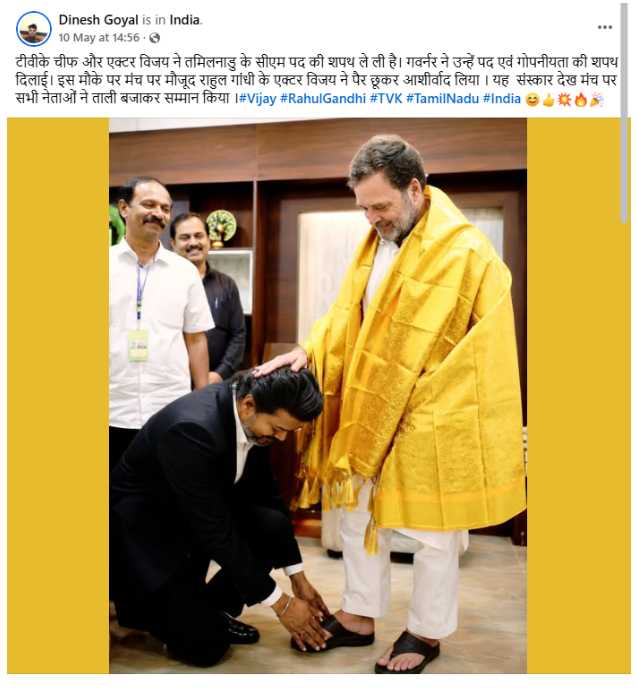
A viral image circulating on social media claims that Tamil Nadu Chief Minister C. Joseph Vijay touched the feet of Congress leader Rahul Gandhi during his swearing-in ceremony, while Congress and several other parties extended support to his government. The image is being widely shared with captions suggesting it captures a real political moment. However, CyberPeace Research Wing research has found the claim to be false. The image is AI-generated and does not depict any real event.
Claim
A Facebook user shared the viral image on May 10, 2026, claiming that TVK chief and actor Vijay had taken oath as the Chief Minister of Tamil Nadu. The post further claimed that during the ceremony, Vijay touched Rahul Gandhi’s feet to seek blessings, and the gesture was applauded by leaders present on stage. The post, along with archived links and screenshots, is being circulated as authentic evidence of the alleged incident.
- https://www.facebook.com/100057774695228/posts/1389222123013598/?rdid=FEzRYpVvSIieeUbj#
- https://archive.ph/kv4e1
Fact Check
A keyword-based search on Google did not return any credible news reports supporting the claim or confirming such an event. A closer visual examination of the image raised strong suspicions of AI manipulation, prompting verification through AI detection tools. When the image was analyzed using the SIGHTENGINE detection tool, the results indicated that the image is 99% likely to be AI-generated.

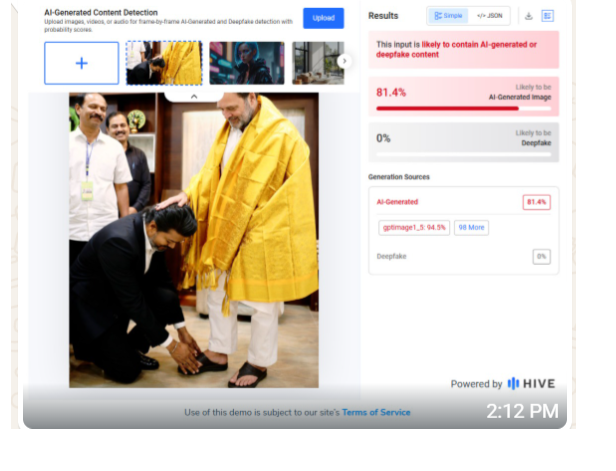
Further verification using another AI detection platform, HIVE MODERATION, also flagged the image as synthetic, showing an 81% probability of being AI-generated.
Conclusion
The research clearly shows that the viral image is not real. It has been generated using artificial intelligence and is being falsely shared as a real political event.

Related Blogs

Executive Summary:
The picture that went viral with the false story that Dhoni was supporting the Congress party, actually shows his joy over Chennai Super Kings' victory in the achievement of 6 million followers on X (formerly known as Twitter) in 2020. Dhoni's gesture was misinterpreted by many, which resulted in the spread of false information. The Research team of CyberPeace did an in-depth investigation of the photo's roots and confirmed its authenticity through a reverse image search, highlighting how news outlets and CSK's official social media channels shared it. The case illustrates the value of fact verification and the role of real information in preventing the fake news epidemic.

Claims:
An image of former Indian Cricket captain Mahendra Singh Dhoni, showed him urging people to vote for the Congress party, wearing the Chennai Super Kings (CSK) jersey and showing his right palm visible and gesturing the number 'one' with his left index finger. In reality he is celebrating Chennai Super Kings' milestone achievement on X (formerly Twitter) in 2020. Many people are sharing the misinterpretation knowingly or unknowingly over social media platforms.


Fact Check:
After receiving the post, we ran a reverse image search of the image and found a news article published by NDTV. According to the news outlet, Dhoni and his teammates were celebrating CSK's milestone of reaching six million followers on X (formerly known as Twitter) in the photos.

In the image it is written as a tweet of @chennaiipl, to get an idea we dig into the official account of Chennai Super Kings on X (formerly known as Twitter). And Voila! we found the exact post which surfaced on the X (formerly known as Twitter) on 5th October 2020.

Additionally, we found a video posted on the X (formerly known as Twitter) handle of CSK, featuring other cricketers celebrating the Six Million Followers milestone for which they are thanking the audience for their support. Again, it was posted on Oct 05, 2020. The caption of the video is written as “Chennai Super #SixerOnTwitter! A big thanks to all the super fans for each and every bouquet and brickbat throughout the last decade. All the #yellove to you. #WhistlePodu”

Therefore it is easy to conclude that the viral image of MS Dhoni supporting Congress is wrong and misleading.
Conclusion:
The information that circulated online media regarding a picture of Mahendra Singh Dhoni supporting the Congress Party has been proven to be untrue. The actual photograph was of Dhoni congratulating the Chennai Super Kings for having six million followers on social media in the year 2020. This highlights the need for checking the facts of any news circulating online.
- Claim: A photo allegedly depicting former Indian cricket captain Mahendra Singh Dhoni encouraging people to support the Congress party in elections surfaced online.
- Claimed on: X (Formerly known as Twitter)
- Fact Check: Fake & Misleading

Introduction
On 1 July 2026, the United Nations published their first draft of the Development of Artificial Intelligence (AI) report. The scientists who authored this document are 40 individuals who comprise the Independent International Scientific Panel on Artificial Intelligence , which was formed by the UN General Assembly in 2025 and chaired by Bengio and Ressa.
The report’s key takeaway message relates to the importance of countries establishing frameworks for the appropriate use of AI technologies as a means of preventing the aggravation of social inequality. UN Secretary-General António Guterres pointed out that without such regulation, society will not be able to enjoy the benefits of these technologies. After all, their explosive development is already beginning to have negative consequences.
This report served as key for the UN Global Dialogue on AI Governance, which was held in Geneva on 6thJuly, 2026.
What Exactly Does the Report Say?
It is not a rulebook, it doesn't create laws. It is more of a survey to get countries on board before they start treaties regarding AI.
This is seen through how much AI has developed from previous technologies, such as electricity taking decades to be common everywhere while the internet took 15 years to get to a billion users, but chatGPT alone got to 100 million users within 2 months. Today, millions of people use AI chatbots, and AI has helped map out 200 million+ protein structures currently helping us get drugs to market much faster.
The report is also cautious. It talks about an "evidence dilemma" , we need evidence to make good AI rules, but by the time it's collected, it might be too late to control the technology. There are 45+ AI frameworks worldwide, but they're disconnected, and some safety checks are done by the same companies that build the AI, raising doubts about their trustworthiness.
The Big Inequality Problem
This is one of the most eye-opening parts of the report. It says the USA has about 75% of the world's most powerful supercomputers, while China has around 15%, together, 90% of the world's top computing power. Most AI models are also built in these two countries, meaning they stand to gain the most from AI's growth.
Here's the shocking part: nearly two-thirds of people in high-income countries will benefit from AI tools. But in low-income countries, only about 5% will see any real benefit. Just because AI tools exist doesn't mean everyone gets equal access — especially poorer countries that depend on other nations for AI tools, cloud services, and data.
The Language Problem
Another major issue is language. Most AI tools work well in English and a few major languages. But for other languages, these tools are far less reliable, which becomes dangerous in fields like healthcare.
The report provides shocking examples of how AI translation software has been mistakenly conflating smallpox with syphilis and gonorrhoea with diabetes. It also describes how an attempt by a nurse to reassure a patient speaking Tigrinya that she was about to be given "IV antibiotics", had in fact, been translated by the software into "IV insecticides".
Other Serious Concerns
The report also warns about darker uses of AI, like creating sexual abuse material and fake explicit videos (deepfakes), which mostly harm women and children. AI-generated disinformation is being used to manipulate elections, while cybercriminals use AI for fraud and other crimes.
In addition, AI could have negative impacts on individuals struggling with mental health issues and even driving vulnerable populations to commit suicide. Moreover, the global AI infrastructure is estimated to release huge amounts of CO2 that is contributing to environmental damage.
What the Report Recommends
Because most of the power over AI development will be controlled by major corporations and nations, the report charges that the system is likely to lead to "unjust hierarchical control over critical systems."
To fix this, the suggestions include:
- Independent groups, not AI companies themselves, should test AI systems.
- Countries should cooperate to regulate artificial intelligence technologies instead of imposing a policy on a particular state.
- The states should develop the technical and language expertise to participate in the global negotiations on AI governance.
- However, the global AI governance should address developing countries’ needs to upgrade their infrastructures, such as electricity and data, and strike a balance between sustainability and digitalization.
Conclusion
This UN report is an important first step, giving countries real scientific evidence as they move towards binding international agreements on AI. Its biggest takeaway is this: AI itself is neutral — neither good nor bad on its own. What makes it good or bad for the world are the choices made by governments, firms, and societies in regulating it. Without proper control, AI technologies may well make inequality even worse than it already is. The negotiations to come will be critical in determining the future of the technology.
References
- United Nations News, 'AI explained: Why the world needs to act now', 1 July 2026
- Euronews, 'Window to control AI is closing and it could widen inequality, UN experts warn', 2 July 2026
- Irish Examiner, 'Rapid spread of AI may worsen global inequality, UN warns', 1 July 2026
- Reuters, 'UN report sees enormous potential benefits, big risks in AI', 1 July 2026
- Preliminary Report of the Independent International Scientific Panel on Artificial Intelligence, United Nations, July 2026
Executive Summary
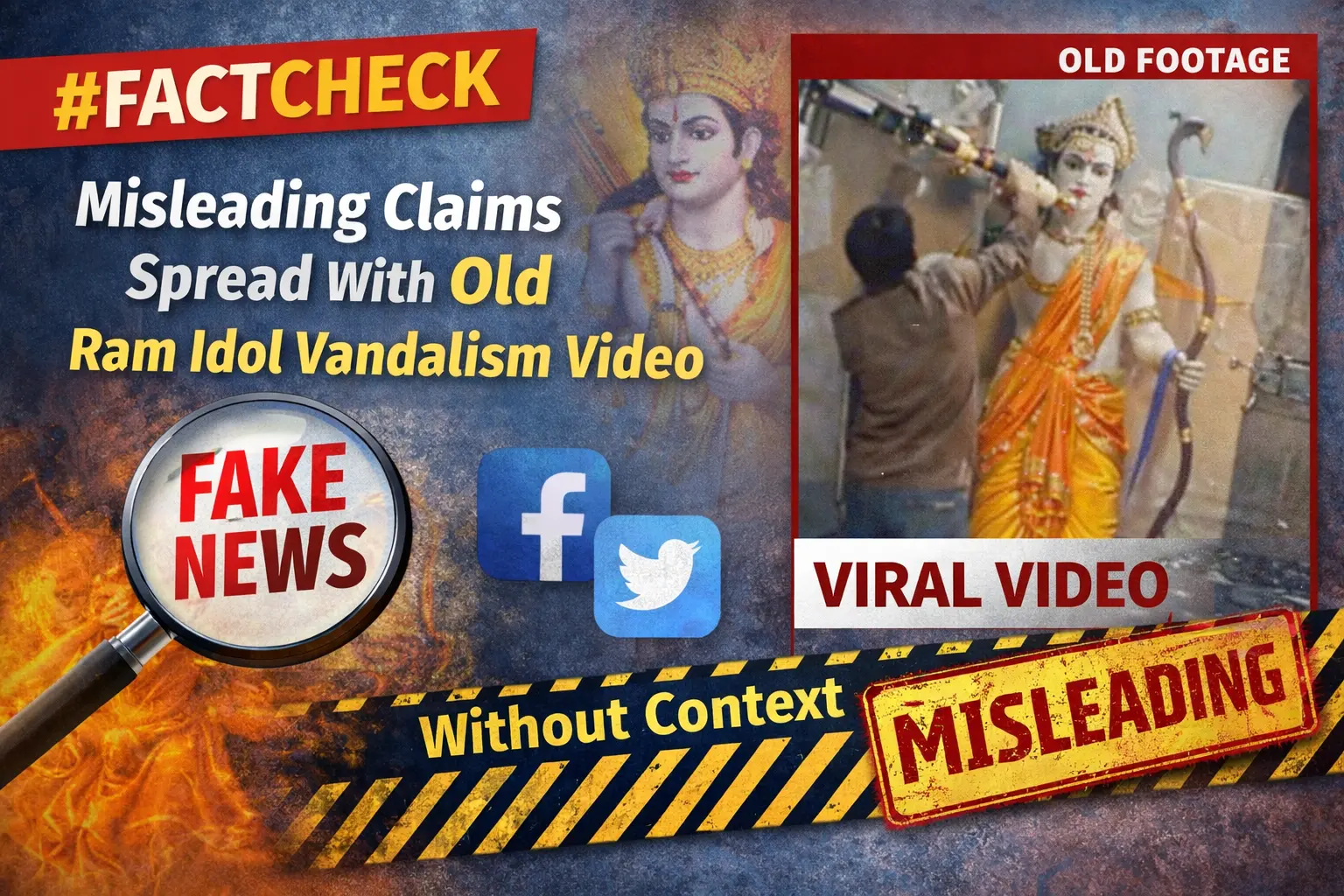
A video circulating on social media has sparked controversy, showing a man allegedly vandalising an idol of Lord Ram. Users sharing the clip claim that the incident recently took place in Ayodhya, Uttar Pradesh. The posts further allege that a Muslim individual climbed the idol and attempted to damage it. However, research by the CyberPeace found the viral claim to be misleading. The research revealed that the video is not recent but nearly three years old. At the time of the incident, the police had already arrested the accused. Social media users are now resharing the old video with false claims that it is a recent event.
Claim:
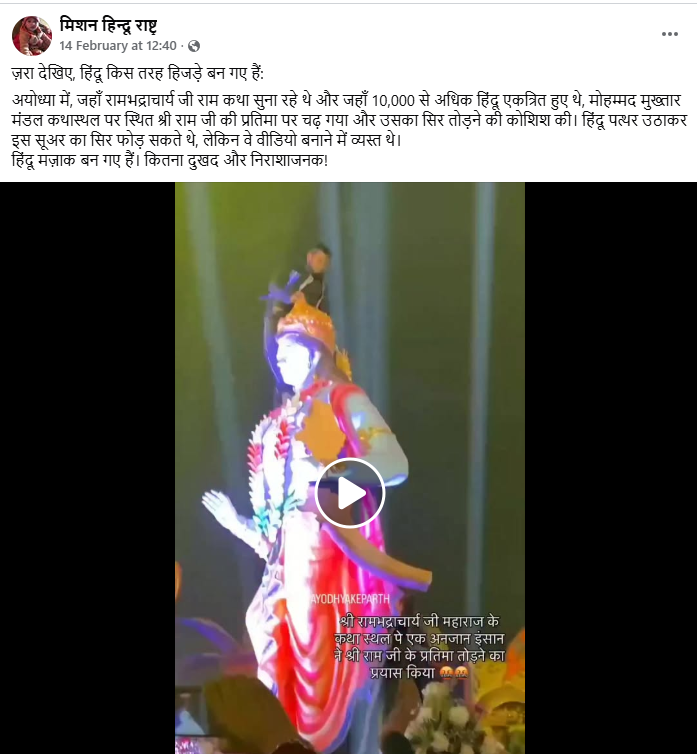
On February 14, 2026, a Facebook user shared the viral video claiming that the incident occurred in Ayodhya, where a large religious gathering was underway. The post alleged that a man identified as Mohammad Mukhtar Mandal climbed the idol of Lord Ram and attempted to break it. The post was widely circulated with inflammatory remarks. (Link and archived version of the post were provided along with a screenshot.)
Fact Check
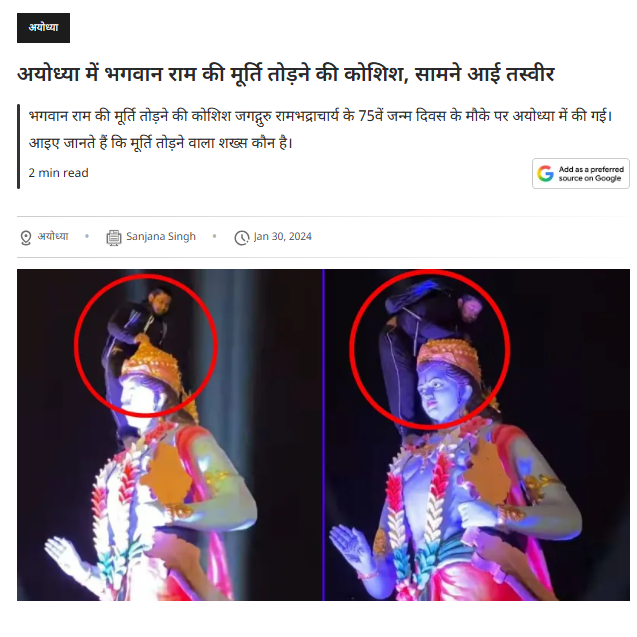
To verify the authenticity of the claim, we extracted key frames from the viral video and conducted a reverse image search using Google Lens. During the search, we found a report published on January 30, 2024, on the Hindi website of Patrika, which carried visuals matching the viral footage. According to the report, a video had surfaced showing a man climbing an idol of Lord Ram in Ayodhya and attempting to damage it. The video had gone viral at the time, following which police registered a case against the accused, Mukhtar Ali Mandal, and arrested him.
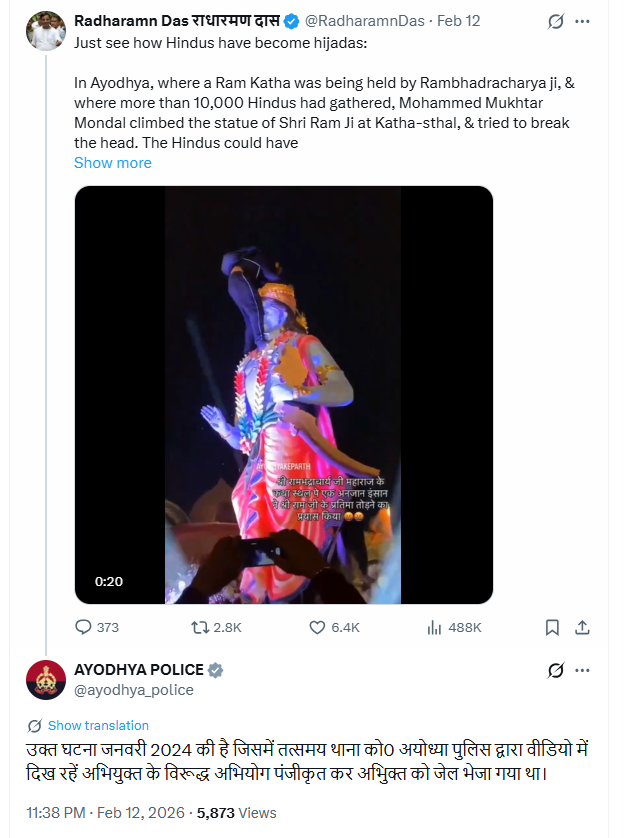
Further research led us to another Facebook post featuring the same video. In the comment section of that post, Uttar Pradesh Police clarified that the incident dated back to January 2024. The Ayodhya police had registered a case against the accused shown in the video and sent him to jail.
Conclusion:
The research confirms that the viral video is not recent but an old incident from January 2024. The accused was arrested at the time. The video is being reshared with misleading claims falsely presenting it as a recent event.
