
#FactCheck: War Thunder Game Footage Falsely Shared as Video of IAF MiG-29 Crash
Executive Summary
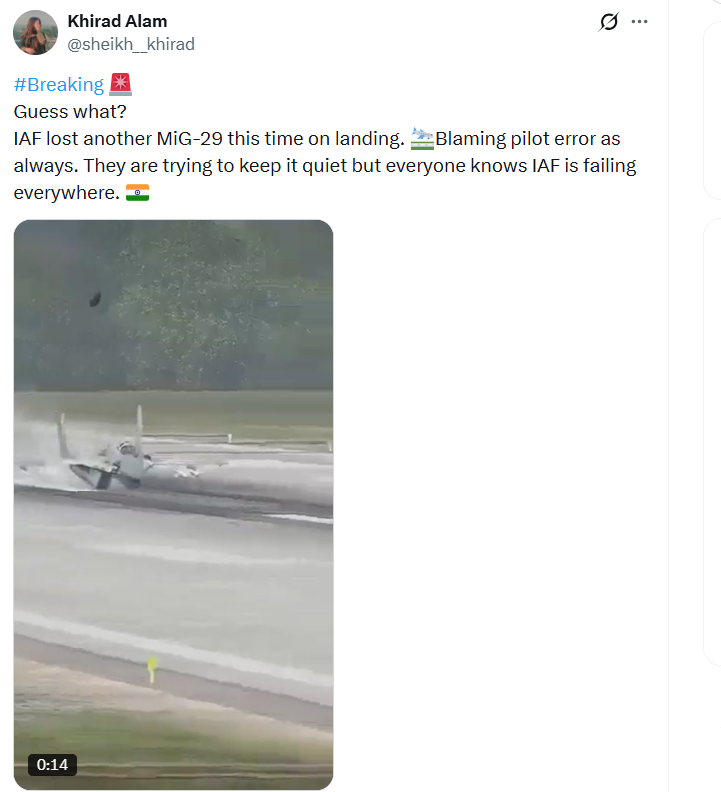
A video is being shared on social media with the claim that an Indian Air Force (IAF) MiG-29 fighter jet crashed while landing due to the pilot’s negligence. The claim further alleges that no casualties were reported in the incident and that the IAF is concealing the incident because it is losing fighter jets at a high rate. The video is being widely shared on social media.
CyberPeace Research found the claim to be false. Our Research revealed that the video is not footage of an actual IAF MiG-29 crash, but gameplay footage from the video game War Thunder, which is being shared with a false and misleading claim.
Claim:
An Indian Air Force MiG-29 fighter jet crashed while landing, with pilot error being blamed for the incident. The post further claims that the IAF is trying to conceal the incident.
https://x.com/sheikh__khirad/status/2100447634599342114?s=20
Fact Check
To verify the claim, we conducted a Google search using relevant keywords. However, we did not find any credible media report supporting the claim. We also checked the official X account of the Indian Army, but found no post confirming the claim.
https://x.com/adgpi

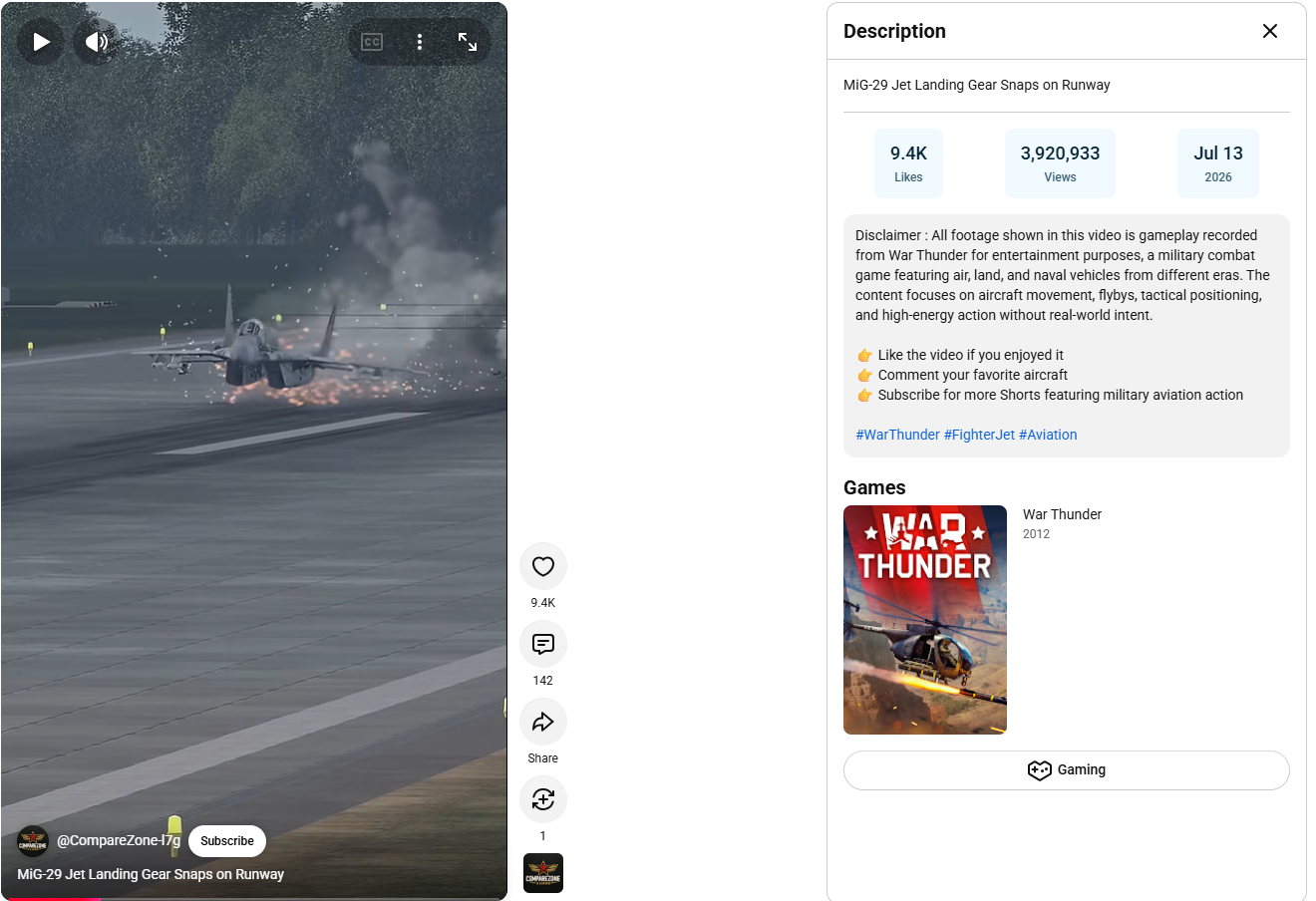
As part of our further research, we conducted a reverse image search of keyframes from the video. During the search, we found a YouTube channel where similar visuals had been uploaded.

We found that the channel regularly posts gaming-related content. At the end of our research, we found the original version of the viral video on the YouTube channel. It was published on July 13, 2026. The video description also clearly states that the footage is gaming content and not a real-life incident.
https://www.youtube.com/shorts/dVu0eMztePo
Conclusion
Our research found that the video being shared with the claim that an IAF MiG-29 fighter jet crashed during landing does not depict a real incident. The video is actually gameplay footage from the video game War Thunder.Therefore, gaming footage is being falsely presented on social media as footage of an Indian Air Force MiG-29 crashing during landing. The incident shown in the video is not real.

Related Blogs

Executive Summary:
A photo allegedly shows an Israeli Army dog attacking an elderly Palestinian woman has been circulating online on social media. However, the image is misleading as it was created using Artificial Intelligence (AI), as indicated by its graphical elements, watermark ("IN.VISUALART"), and basic anomalies. Although there are certain reports regarding the real incident in several news channels, the viral image was not taken during the actual event. This emphasizes the need to verify photos and information shared on social media carefully.

Claims:
A photo circulating in the media depicts an Israeli Army dog attacking an elderly Palestinian woman.


Fact Check:
Upon receiving the posts, we closely analyzed the image and found certain discrepancies that are commonly seen in AI-generated images. We can clearly see the watermark “IN.VISUALART” and also the hand of the old lady looks odd.

We then checked in AI-Image detection tools named, True Media and contentatscale AI detector. Both found potential AI Manipulation in the image.


Both tools found it to be AI Manipulated. We then keyword searched for relevant news regarding the viral photo. Though we found relevant news, we didn’t get any credible source for the image.

The photograph that was shared around the internet has no credible source. Hence the viral image is AI-generated and fake.
Conclusion:
The circulating photo of an Israeli Army dog attacking an elderly Palestinian woman is misleading. The incident did occur as per the several news channels, but the photo depicting the incident is AI-generated and not real.
- Claim: A photo being shared online shows an elderly Palestinian woman being attacked by an Israeli Army dog.
- Claimed on: X, Facebook, LinkedIn
- Fact Check: Fake & Misleading

Introduction
Words come easily, but not necessarily the consequences that follow. Imagine a 15-year-old child on the internet hoping that the world will be nice to him and help him gain confidence, but instead, someone chooses to be mean on the internet, or the child becomes the victim of a new kind of cyberbullying, i.e., online trolling. The consequences of trolling can have serious repercussions, including eating disorders, substance abuse, conduct issues, body dysmorphia, negative self-esteem, and, in tragic cases, self-harm and suicide attempts in vulnerable individuals. The effects of online trolling can include anxiety, depression, and social isolation. This is one example, and hate speech and online abuse can touch anyone, regardless of age, background, or status. The damage may take different forms, but its impact is far-reaching. In today’s digital age, hate speech spreads rapidly through online platforms, often amplified by AI algorithms.
As we celebrate today, i.e., 18th June, the International Day for Countering Hate Speech, if we have ever been mean to someone on the internet, we pledge never to repeat that kind of behaviour, and if we have been the victim, we will stand against the perpetrator and report it.
This year, the theme for the International Day for Countering Hate Speech is “Hate Speech and Artificial Intelligence Nexus: Building coalitions to reclaim inclusive and secure environments free of hatred. UN Secretary-General Antonio Guterres, in his statement, said, “Today, as this year’s theme reminds us, hate speech travels faster and farther than ever, amplified by Artificial Intelligence. Biased algorithms and digital platforms are spreading toxic content and creating new spaces for harassment and abuse."
Coded Convictions: How AI Reflects and Reinforces Ideologies
Algorithms have swiftly taken the place of feelings; they tamper with your taste, and they do so with a lighter foot, invisibly. They are becoming an important component of social media user interaction and content distribution. While these tools are designed to improve user experience, they frequently inadvertently spread divisive ideologies and push extremist propaganda. This amplification can strengthen the power of extremist organisations, spread misinformation, and deepen societal tensions. This phenomenon, known as “algorithmic radicalisation,” demonstrates how social media companies may utilise a discriminating content selection approach to entice people down ideological rabbit holes and shape their ideas. AI-driven algorithms often prioritise engagement over ethics, enabling divisive and toxic content to trend and placing vulnerable groups, especially youth and minorities, at risk. The UN’s Strategy and Plan of Action on Hate Speech, launched on June 18, 2019, recognises that while AI holds promise for early detection and prevention of harmful speech, it also demands stringent human rights safeguards. Without regulation, these tools can themselves become purveyors of bias and exclusion.
India’s Constitutional Resolve and Civilizational Ethos against Hate
India has always taken pride in being inclusive and united rather than divided. As far as hate speech is concerned, India's stand is no different. The United Nations, India believes in the same values as its international counterpart. Although India has won many battles against hate speech, the war is not over and is now more prominent than ever due to the advancement in communication technologies. In India, while the right to freedom of speech and expression is protected under Article 19(1)(a), its exercise is limited subject to reasonable restrictions under Article 19(2). Landmark rulings such as Ramji Lal Modi v. State of U.P. and Amish Devgan v. UOI have clarified that speech can be curbed if it incites violence or undermines public order. Section 69A of the IT Act, 2000, empowers the government to block content, and these principles are also reflected in Section 196 of the BNS, 2023 (153A IPC) and Section 299 of the BNS, 2023 (295A IPC). Platforms are also required to track down the creators of harmful content and remove it within a reasonable hour and fulfil their due diligence requirements under IT rules.
While there is no denying that India needs to be well-equipped and prepared normatively to tackle hate propaganda and divisive forces. India’s rich culture and history, rooted in philosophies of Vasudhaiva Kutumbakam (the world is one family) and pluralistic traditions, have long stood as a beacon of tolerance and coexistence. By revisiting these civilizational values, we can resist divisive forces and renew our collective journey toward harmony and peaceful living.
CyberPeace Message
The ultimate goal is to create internet and social media platforms that are better, safer and more harmonious for each individual, irrespective of his/her/their social and cultural background. CyberPeace stands resolute on promoting digital media literacy, cyber resilience, and consistently pushing for greater accountability for social media platforms.
References
- https://www.un.org/en/observances/countering-hate-speech
- https://www.artemishospitals.com/blog/the-impact-of-trolling-on-teen-mental-health
- https://www.orfonline.org/expert-speak/from-clicks-to-chaos-how-social-media-algorithms-amplify-extremism
- https://www.techpolicy.press/indias-courts-must-hold-social-media-platforms-accountable-for-hate-speech/
Executive Summary
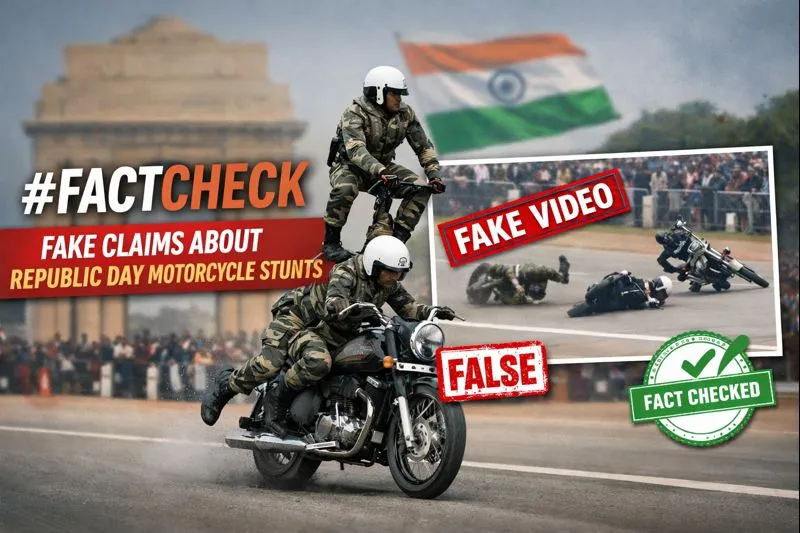
As India concluded its 77th Republic Day celebrations on January 26, 2026, with grandeur and patriotic enthusiasm along the iconic Kartavya Path, a video began circulating on social media claiming to show Indian security personnel failing to perform motorcycle stunts during the ceremonial parade. The short clip allegedly depicts soldiers attempting high-risk, synchronised motorcycle manoeuvres, only to lose balance and fall off their bikes. The visuals were widely shared online with mocking captions, suggesting incompetence during a nationally televised event. However, an research by the CyberPeace found that the video is not authentic and was digitally generated using artificial intelligence.
Claim
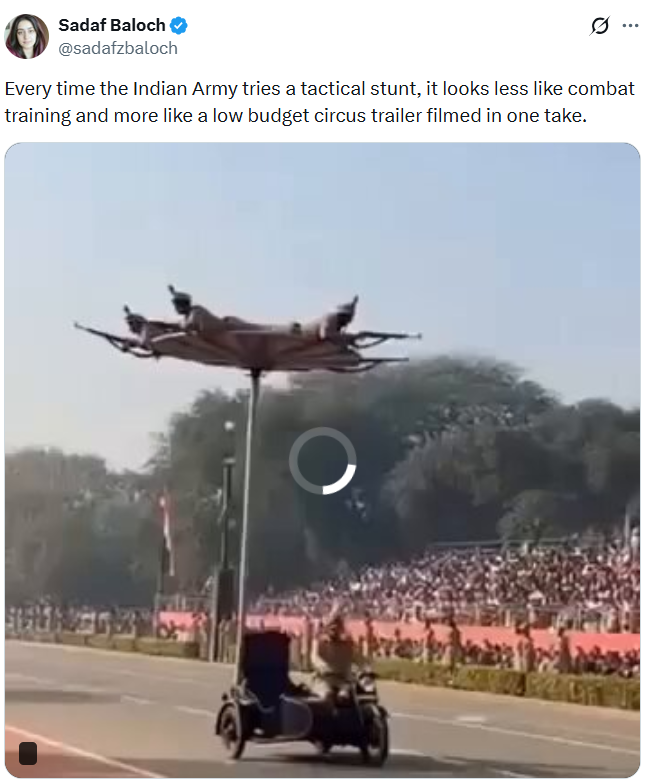
A Pakistan-based X user, Sadaf Baloch (@sadafzbaloch), shared the video on January 27, claiming it showed Indian security personnel failing to execute motorcycle stunts during the Republic Day parade held on January 26, 2026. While sharing the clip, the user wrote:“Every time the Indian Army tries a tactical stunt, it looks less like combat training and more like a low-budget circus trailer filmed in one take.”The post was widely circulated with similar narratives questioning the professionalism of Indian forces.
Here is the link and archive link to the post, along with a screenshot.
To verify the authenticity of the viral video, the Desk conducted a detailed frame-by-frame analysis. During the examination, a watermark linked to ‘Sora’—an AI text-to-video generation model was detected at the 00:05 timestamp. The presence of this watermark strongly indicated that the video was artificially generated and not recorded during a real-world event.
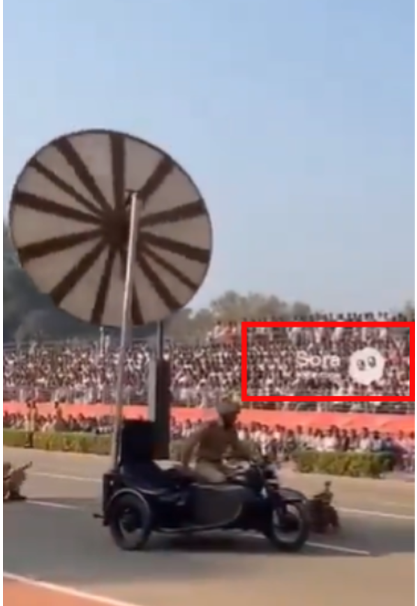
Fact Check:
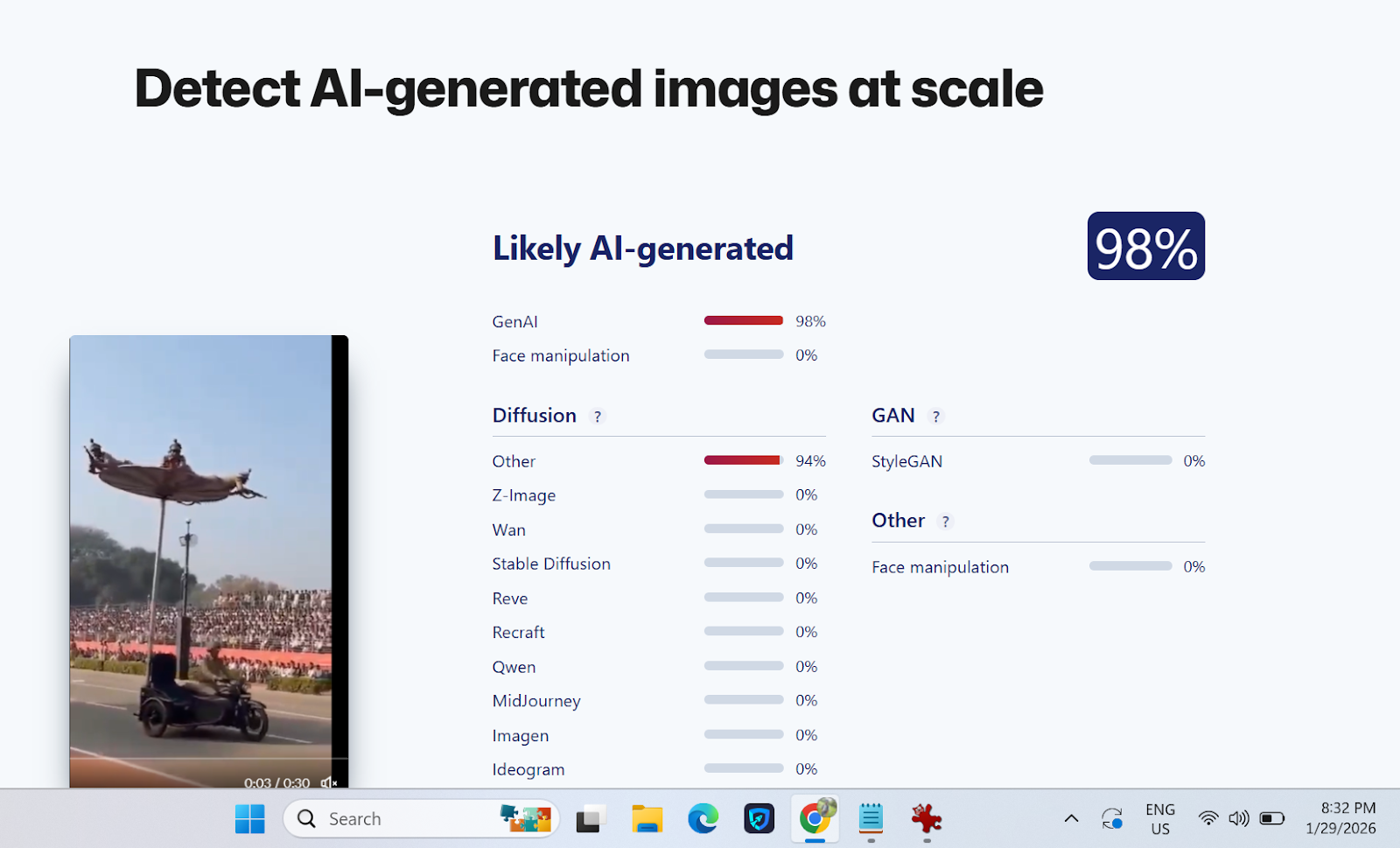
Further visual scrutiny revealed several inconsistencies commonly associated with AI-generated content. The background appeared unnatural and lacked realistic depth, while the movements and reactions of the security personnel looked mechanically exaggerated and inconsistent with real physics. Facial expressions and body motions during the alleged falls also appeared unrealistic. To strengthen the verification, the Desk analysed the clip using Sightengine, an AI-detection tool. The results showed a 98 per cent probability that the video contained AI-generated or deepfake elements.
Below is a screenshot of the result.
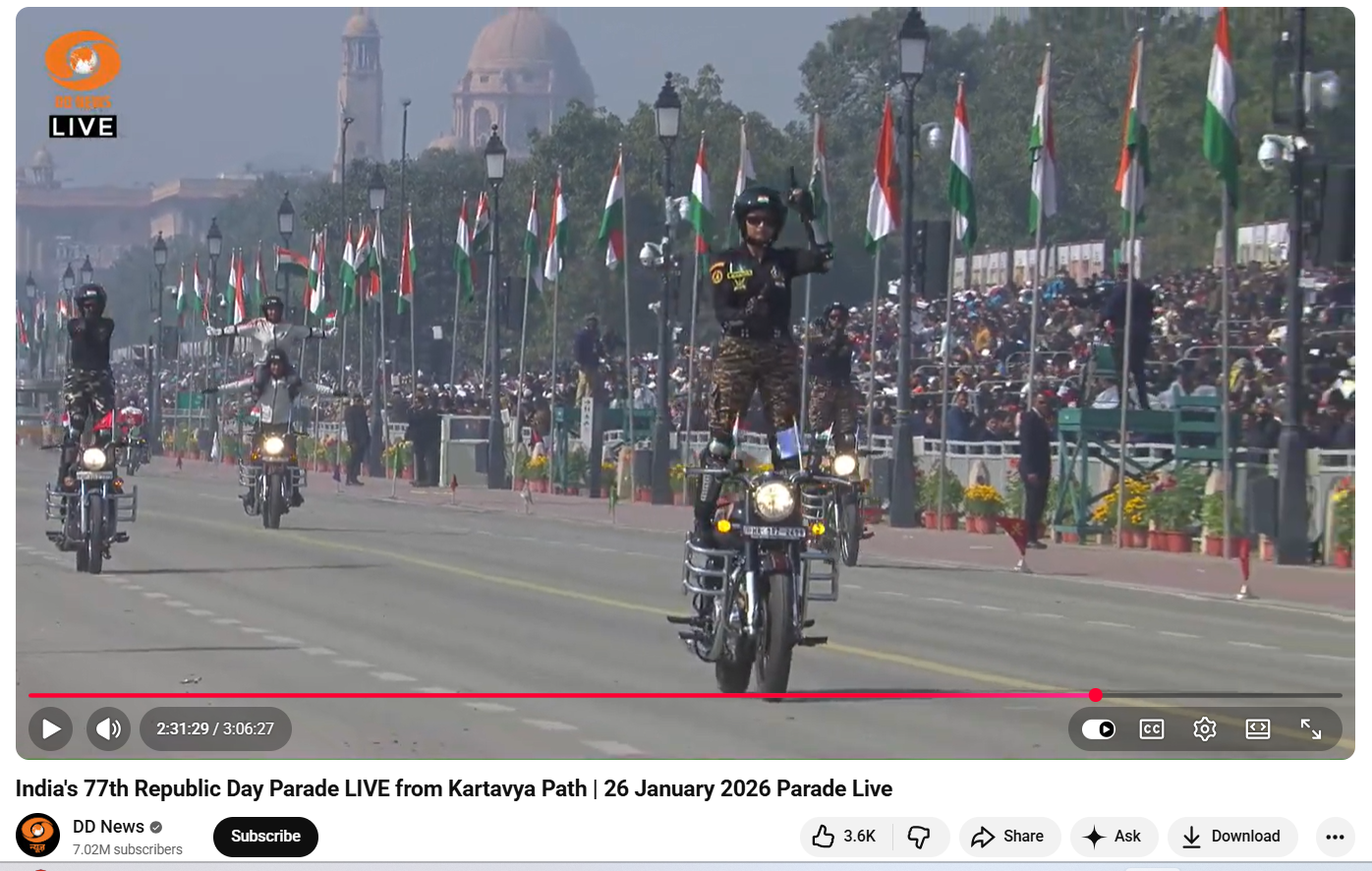
As part of the research , the Desk also conducted a customised keyword search and reviewed official coverage of the Republic Day parade. A full-length video broadcast by DD News on its official YouTube channel was examined. The footage showed joint CRPF and SSB motorcycle teams performing traditional daredevil stunts without any mishap. No incident resembling the viral claim was found in the official broadcast or in any credible media reports.
Here is the video link and a screenshot.
Conclusion
The CyberPeace research confirms that the viral video purportedly showing Indian security personnel failing to perform motorcycle stunts during the 77th Republic Day parade is AI-generated. The clip has been falsely circulated online as genuine content with the intent to mislead viewers and spread misinformation.

