
#FactCheck- AI-Generated Video of Alleged Iranian Attack on US Helicopter Goes Viral with False Claims
Executive Summary
A video is being widely shared on social media showing armed personnel attacking a helicopter. The video is being circulated with the claim that Iranian soldiers shot down a US military helicopter near the Strait of Hormuz amid rising tensions between the United States and Iran. CyberPeace Research Wing research found the claim to be false. The viral video is AI-generated and is being shared with misleading context.
Claim:
An X (formerly Twitter) user shared the video on June 10, 2026, with the caption: “This is great cinema. Breaking News: Iran used a $150 weapon to bring down a $1 billion US military aircraft. For the first time, America has met its real enemy.”
Post link and archive link can be seen below:
https://x.com/TheIncNews/status/2064758088012607544?s=20
https://archive.ph/LUDUz

Fact-Check
To verify the claim, we conducted a keyword search on Google. However, no credible media reports were found supporting this claim.
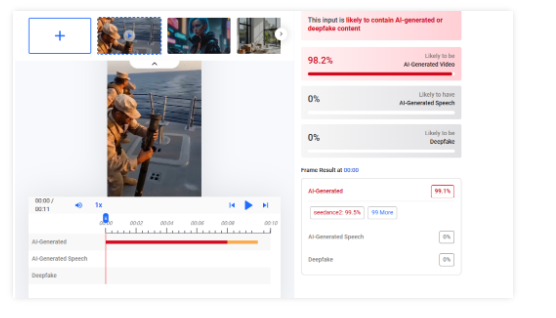
On closely examining the video, we suspected it to be AI-generated. We then analyzed it using the AI detection tool HIVE MODERATION. The results indicated that the video is 98% likely to be AI-generated.
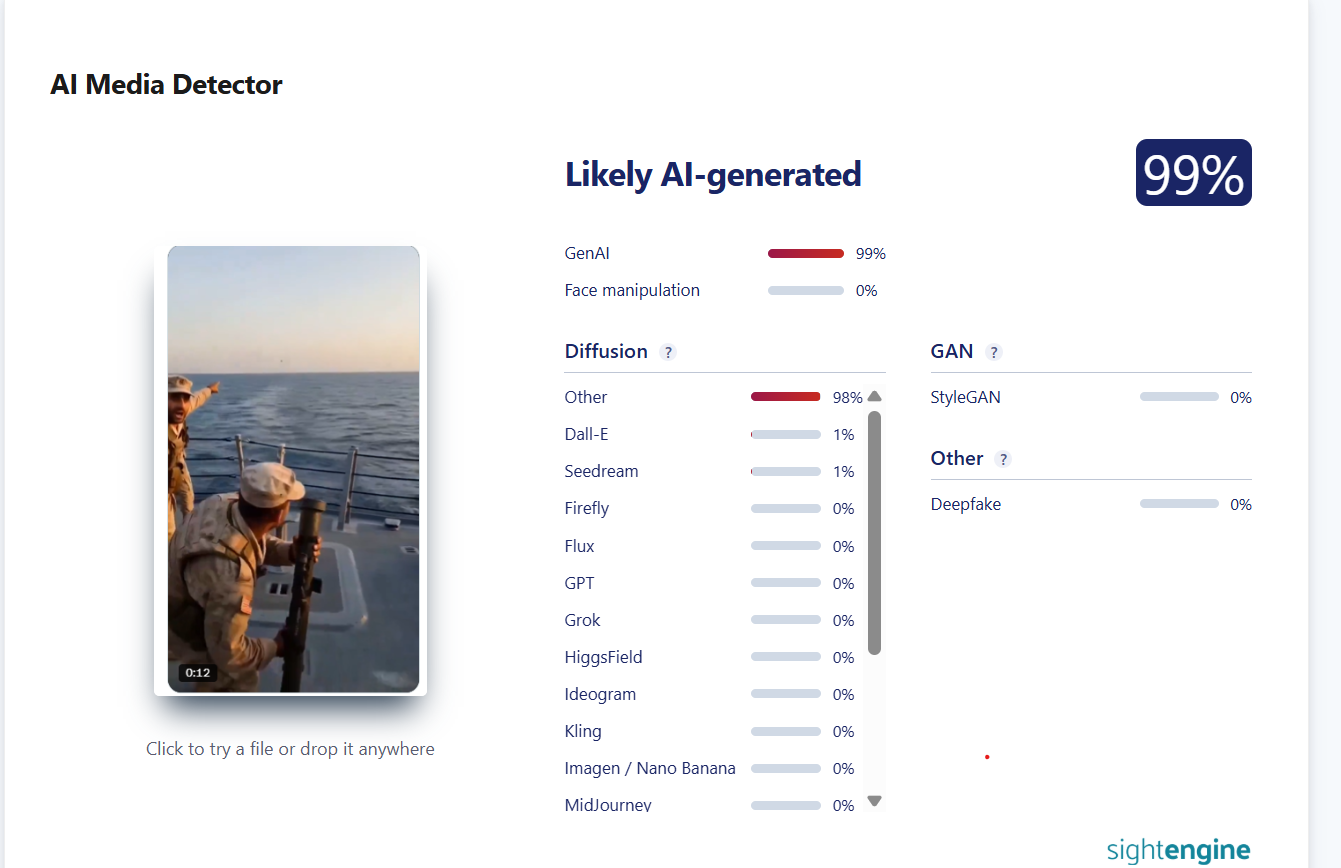
In the next step, we further analyzed the video using another AI detection tool, SIGHTENGINE. The results showed a 99% probability of the video being AI-generated.
Conclusion:
Our research confirms that the viral video is AI-generated and does not depict any real-world incident. The content is being circulated with a misleading and false narrative, falsely linking it to ongoing geopolitical tensions, despite there being no credible evidence or verified reports supporting such a claim.

Related Blogs
Executive Summary
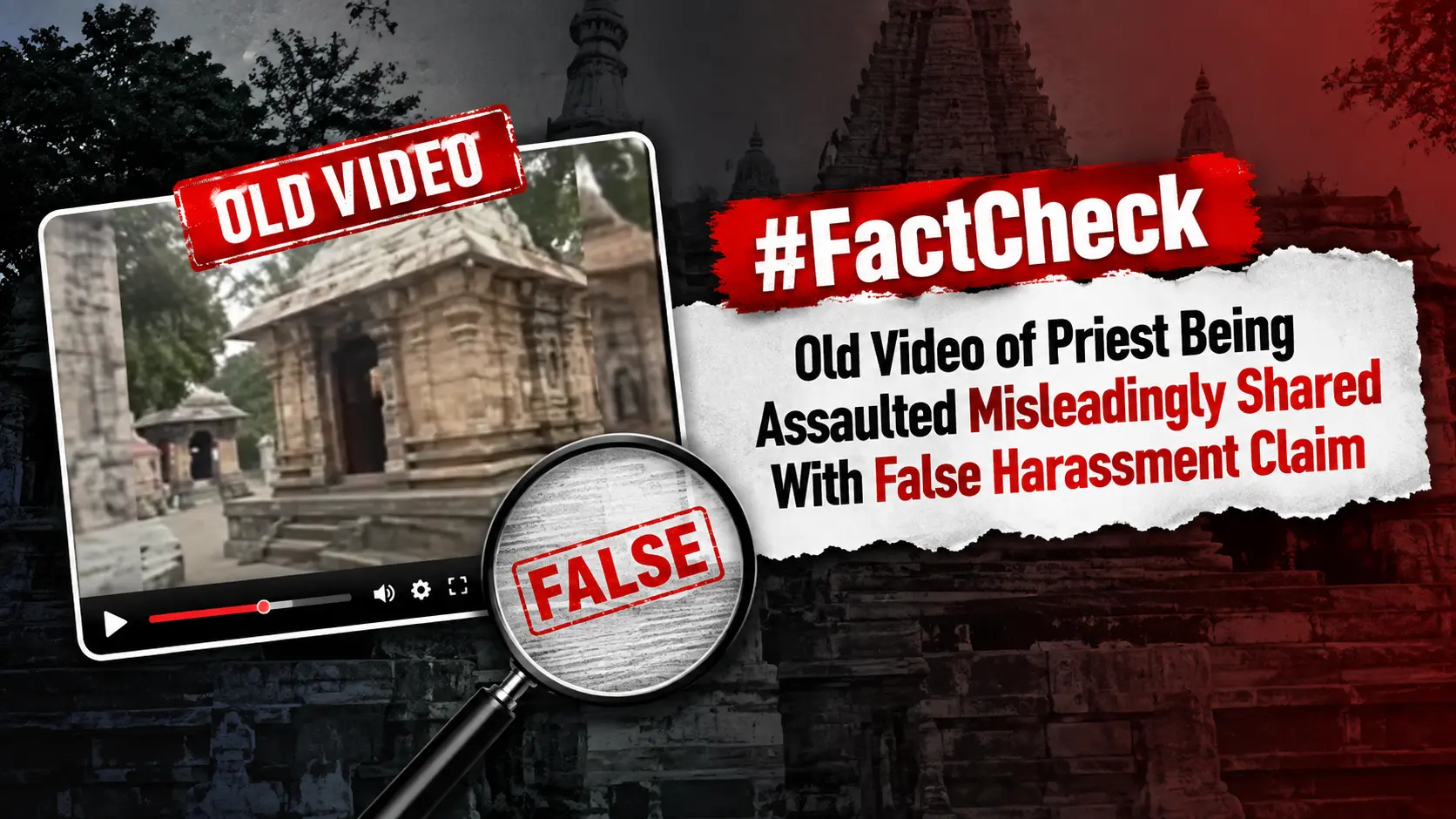
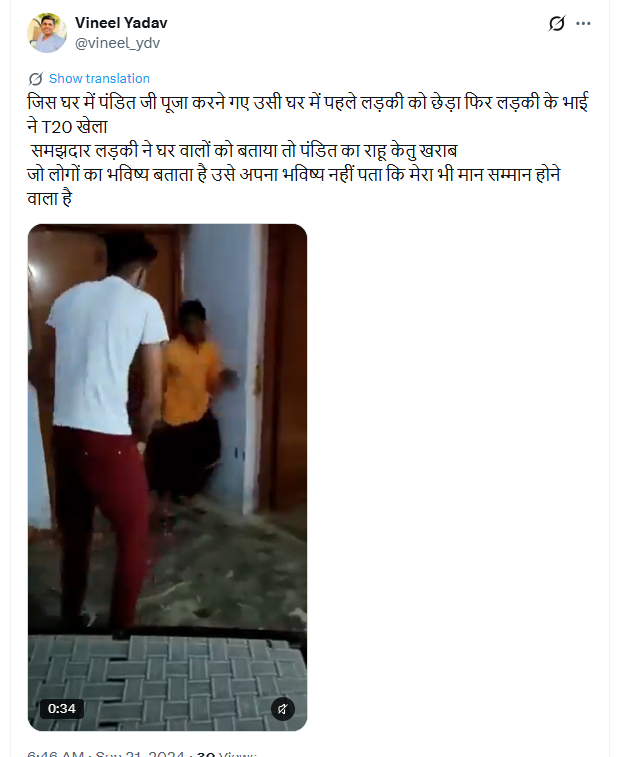
A video showing a man being beaten with a cricket bat is being widely shared on social media. It is being claimed that a priest had allegedly misbehaved with a girl at the same house where he had gone to perform a puja, following which the girl’s brother beat him up. However, our Research found the claim to be misleading. CyberPeace Research found that the video is around four years old. According to reports, the man was beaten after he allegedly objected to a cricket bat being kept inside a temple. Four youths were arrested by the police in connection with the incident.
Claim:
An X user shared the viral video with the caption: “The priest went to a house to perform a puja, where he first harassed a girl, and then the girl’s brother played T20. The sensible girl informed her family. The priest who predicts other people’s future could not predict his own—that his honour was also going to be at stake.”
https://x.com/vineel_ydv/status/1837299886921753054?s=20
https://ghostarchive.org/archive/b91vB
Fact Check
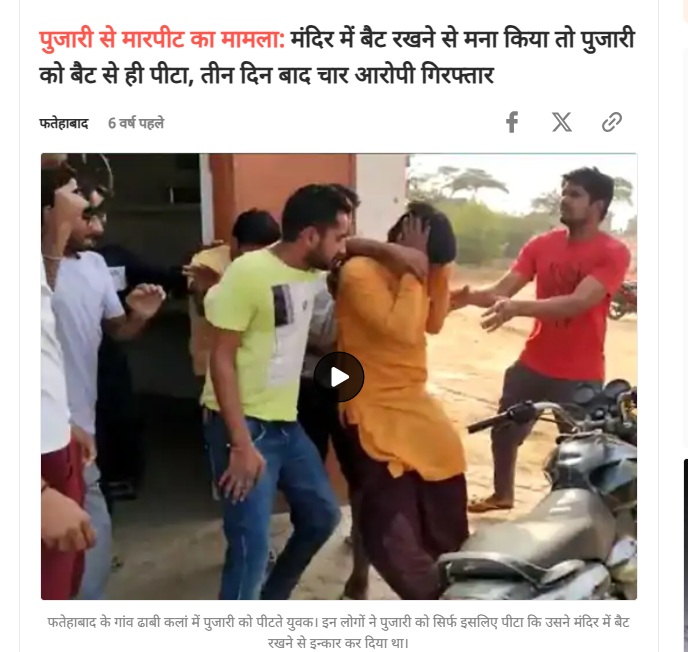
To verify the viral claim, we searched Google using relevant keywords. During the search, we did not find any credible media reports supporting the claim. To further verify the claim, we conducted a reverse image search of keyframes from the video. During the search, we found a report published by Dainik Bhaskar on November 5, 2020. According to the report, police arrested four youths in connection with the assault of a priest in Fatehabad, Haryana. The report stated that three days earlier, the youths had beaten the priest with a cricket bat after he objected to them keeping the bat inside the temple.
https://www.bhaskar.com/local/haryana/news/fatehabad-haryana-priest-beaten-with-cricket-bat-very-hardly-in-fatehabad-police-arrested-four-accused-127888122.html
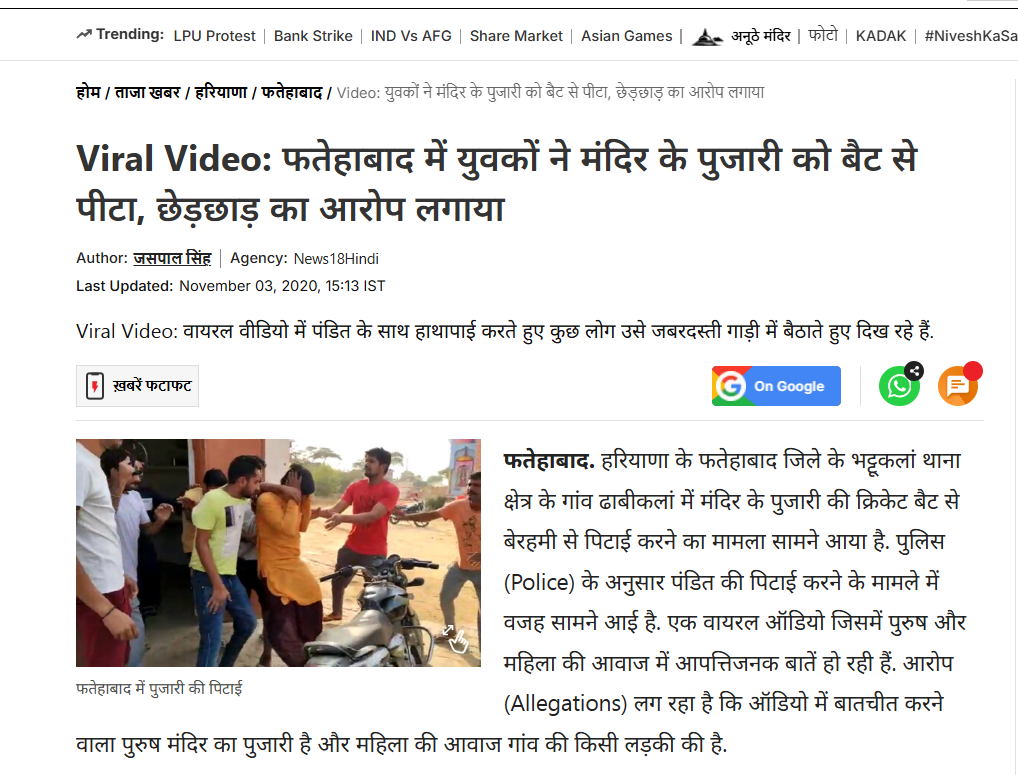
As part of the next step in our Research, we found a report published on the News18 website with a generic caption. The viral image was also included in the report.
Conclusion
Our Research found that the video is around four years old and is unrelated to the claim being circulated on social media. The incident took place after the priest objected to the youths keeping a cricket bat inside the temple, following which he was assaulted with the bat. Police subsequently arrested four youths in connection with the incident. Therefore, the claim that the priest was beaten after allegedly harassing a girl at the house where he had gone to perform a puja is misleading.
.webp)
Introduction
In July 2025, the Digital Defence Report prepared by Microsoft raised an alarm that India is part of the top target countries in AI-powered nation-state cyberattacks with malicious agents automating phishing, creating convincing deepfakes, and influencing opinion with the help of generative AI (Microsoft Digital Defence Report, 2025). Most of the attention in the world has continued to be on the United States and Europe, but Asia-Pacific and especially India have become a major target in terms of AI-based cyber activities. This blog discusses the role of AI in espionage, redefining the threat environment of India, the reaction of the government, and what India can learn by looking at the example of cyber giants worldwide.
Understanding AI-Powered Cyber Espionage
Conventional cyber-espionage intends to hack systems, steal information or bring down networks. With the emergence of generative AI, these strategies have changed completely. It is now possible to automate reconnaissance, create fake voices and videos of authorities and create highly advanced phishing campaigns which can pass off as genuine even to a trained expert. According to the report made by Microsoft, AI is being used by state-sponsored groups to expand their activities and increase accuracy in victims (Microsoft Digital Defence Report, 2025). Based on SQ Magazine, almost 42 percent of state-based cyber campaigns in 2025 had AIs like adaptive malware or intelligent vulnerability scanners (SQ Magazine, 2025).
AI is altering the power dynamic of cyberspace. The tools previously needing significant technical expertise or substantial investments have become ubiquitous, and smaller countries can conduct sophisticated cyber operations as well as non-state actors. The outcome is the speeding up of the arms race with AI serving as the weapon and the armour.
India’s Exposure and Response
The weakness of the threat landscape lies in the growing online infrastructure and geopolitical location. The attack surface has expanded the magnitude of hundreds of millions of citizens with the integration of platforms like DigiLocker and CoWIN. Financial institutions, government portals and defence networks are increasingly becoming targets of cyber attacks that are more sophisticated. Faking videos of prominent figures, phishing letters with the official templates, and manipulation of the social media are currently all being a part of disinformation campaigns (Microsoft Digital Defence Report, 2025).
According to the Data Security Council of India (DSCI), the India Cyber Threat Report 2025 reported that attacks using AI are growing exponentially, particularly in the shape of malicious behaviour and social engineering (DSCI, 2025). The nodal cyber-response agency of India, CERT-In, has made several warnings regarding scams related to AI and AI-generated fake content that is aimed at stealing personal information or deceiving the population. Meanwhile, enforcement and red-teaming actions have been intensified, but the communication between central agencies and state police and the private platforms is not even. There is also an acute shortage of cybersecurity talents in India, as less than 20 percent of cyber defence jobs are occupied by qualified specialists (DSCI, 2025).
Government and Policy Evolution
The government response to AI-enabled threats is taking three forms, namely regulation, institutional enhancing, and capacity building. The Digital Personal Data Protection Act 2023 saw a major move in defining digital responsibility (Government of India, 2023). Nonetheless, threats that involve AI-specific issues like data poisoning, model manipulation, or automated disinformation remain grey areas. The following National Cybersecurity Strategy will attempt to remedy them by establishing AI-government guidelines and responsibility standards to major sectors.
At the institutional level, the efforts of such organisations as the National Critical Information Infrastructure Protection Centre (NCIIPC) and the Defence Cyber Agency are also being incorporated into their processes with the help of AI-based monitoring. There is also an emerging public-private initiative. As an example, the CyberPeace Foundation and national universities have signed a memorandum of understanding that currently facilitates the specialised training in AI-driven threat analysis and digital forensics (Times of India, August 2025). Even after these positive indications, India does not have any cohesive system of reporting cases of AI. The publication on arXiv in September 2025 underlines the importance of the fact that legal approaches to AI-failure reporting need to be developed by countries to approach AI-initiated failures in such fields as national security with accountability (arXiv, 2025).
Global Implications and Lessons for India
Major economies all over the world are increasing rapidly to integrate AI innovation with cybersecurity preparedness. The United States and United Kingdom are spending big on AI-enhanced military systems, performing machine learning in security operations hubs and organising AI-based “red team” exercises (Microsoft Digital Defence Report, 2025). Japan is testing cross-ministry threat-sharing platforms that utilise AI analytics and real-time decision-making (Microsoft Digital Defence Report, 2025).
Four lessons can be distinguished as far as India is concerned.
- To begin with, the cyber defence should shift to proactive intelligence in place of reactive investigation. It is not only possible to detect the adversary behaviour after the attacks, but to simulate them in advance using AI.
- Second, teamwork is essential. The issue of cybersecurity cannot be entrusted to government enforcement. The private sector that maintains the majority of the digital infrastructure in India must be actively involved in providing information and knowledge.
- Third, there is the issue of AI sovereignty. Building or hosting its own defensive AI tools in India will diminish dependence on foreign vendors, and minimise the possible vulnerabilities of the supply-chain.
- Lastly, the initial defence is digital literacy. The citizens should be trained on how to detect deepfakes, phishing, and other manipulated information. The importance of creating human awareness cannot be underestimated as much as technical defences (SQ Magazine, 2025).
Conclusion
AI has altered the reasoning behind cyber warfare. There are quicker attacks, more difficult to trace and scalable as never before. In the case of India, it is no longer about developing better firewalls but rather the ability to develop anticipatory intelligence to counter AI-powered threats. This requires a national policy that incorporates technology, policy and education.
India can transform its vulnerability to strength with the sustained investment, ethical AI governance, and healthy cooperation between the government and the business sector. The following step in cybersecurity does not concern who possesses more firewalls than the other but aims to learn and adjust more quickly and successfully in a world where machines already belong to the battlefield (Microsoft Digital Defence Report, 2025).
References:
- Microsoft Digital Defense Report 2025
- India Cyber Threat Report 2025, DSCI
- Lucknow based organisations to help strengthen cybercrime research training policy ecosystem
- AI Cyber Attacks Statistics 2025: How Attacks, Deepfakes & Ransomware Have Escalated, SQ Magazine
- Incorporating AI Incident Reporting into Telecommunications Law and Policy: Insights from India.
- The Digital Personal Data Protection Act, 2023

Introduction
WhatsApp has become the new platform for scams, and the number of cases of WhatsApp scams is increasing daily. Just like that, a new WhatsApp scam has been started, and many WhatsApp users in India have reported receiving missed calls from unknown international numbers. Worse, one does not even have to answer the call to be scammed. A missed call is sufficient to be scammed.
Millions of populations switch from normal SMS to WhatsApp, usually, people used to get fake messages and marketing messages, but the trend of scamming has been evolving now. Most people get calls from different countries, and they are concerned about how these scammers got the numbers. WhatsApp works through VoIP networks, so no extra charges from any country exist. And about 500 million WhatsApp users are getting these scam calls, the calls are mainly on job-scams of promising part-time employment and opportunities. These types of job scam calls have been started reporting in 2023.
People reporting missed calls from countries like Ethiopia (+251), Malaysia (+60), Indonesia (+62), Vietnam (+84), etc.
The agenda of these calls are still unclear. Still, in some cases, the scammers ask for confidential information from WhatsApp users, like bank details, so the users must not reveal their personal information. Also, it is important to note that if you get any calls from a particular country, it necessarily does not mean it is from that country. Various agencies sell international numbers for WhatsApp calls.
Why has WhatsApp become a hub scam?
The generation has evolved and dumped the old SMS into WhatsApp. From school to college and offices, people use WhatsApp for their official work, as it is very easy and user-friendly, so people avoid safety measures. Generally, users need to understand the consequences of technology and use it with safeguards and awareness. Many people lose money and become victims of scams on WhatsApp as they share their confidential information. And the worse is that one does not even have to answer the call to be scammed. A missed call is sufficient to be scammed.
Before these international calls scam, the user received a call from the scam that they were from KBC, and the user won something. Then sought confidential information by the excuse that they would transfer the money to the user, and because of that user got scammed by the scammers. These scams have risen rapidly lately.
Safeguards users can use against these scam calls
WhatsApp responds to complaints regarding international calls to “block and report.”
If you have already received such calls, the best thing you can do is report and block them right away. As a result, the same number does not return to your phone, and numerous identical reports may persuade WhatsApp to delete the number entirely.
WhatsApp is also working on an update allowing users to block calls from unknown numbers on the service.

Users must modify their phone’s and app’s fundamental privacy settings to protect themselves from data breaches. The calls are directed toward app users who are actively using the app. However, by modifying the account’s appearance, a user can lessen the likelihood of being added to the scammers’ attack lists.
Limit Privacy
Begin by modifying WhatsApp’s ‘who can see’ settings. If your profile photo, last seen, and online status are visible to anybody, restrict them to persons on your contact list only. Change the About and Groups options as well.
Turn on two-factor authentication
Enabling two-factor authentication on WhatsApp adds more security to your data. In addition, the app also supports biometric protection in case of theft or loss.
Active Reporting
The users should report as soon as they see something odd or suspicious activity.
A typical question that users have is, ‘Where do the scammers acquire my phone number from?’
The answer is a little more complicated than we thought. Your data is retained on the company database from the time you sign up on a website or reveal your phone number at a store in order to take advantage of promotional offers and promotions. Due to a lack of technological infrastructure and legislation to protect personal data, a scammer can simply obtain your information.
According to Palo Alto research, India is the second most vulnerable country in the APAC region in terms of cyberattacks and data breaches. A data protection law is essential in the face of increasing calls and data breaches.
The Digital Personal Data Protection bill is set to be introduced in the parliament’s monsoon session. The bill has the potential to protect data, which will help to eliminate scams.
Conclusion
Several people had tweeted on tweeter about receiving fake calls on WhatsApp from international numbers more than once. WhatsApp encrypts calls and messages, making it difficult to track the person, and it appears that hackers are taking advantage of this to swindle customers. If you receive a WhatsApp call from any of the above ISD codes, we strongly advise you not to answer it and to block the number so the bad actors do not call you again. Report & block immediately that’s what WhatsApp has been responding to the complainants.
