
#FactCheck-Viral Video of Monkey Saving Child Hanging From Balcony Is AI-Generated
Executive Summary
A video showing a monkey dramatically rescuing a child hanging from a balcony is being widely shared on social media. In the clip, a small child appears to be on the verge of falling when a monkey suddenly arrives, grabs the child, and saves them from falling. Many users praised the monkey’s bravery, while some even described it as a miracle. Research by CyberPeace Research Wing found that the viral video is not real and was created using AI technology before being shared with misleading claims.
Claim
An X user shared the video claiming that a monkey saved a child from falling off a balcony just in time, astonishing onlookers with its intelligence and quick action. The post described the monkey’s act as heroic and compassionate.

Fact Check
To verify the claim, we extracted keyframes from the viral video and conducted a reverse image search using Google Lens. During this process, we found the same video uploaded on April 16, 2026 by an Instagram account named Instagram user mojilo_vandro. The caption described the scene as a “miracle of God.”

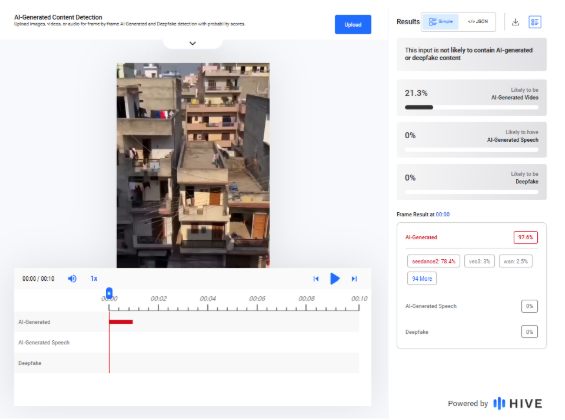
A closer review of the account revealed several similar monkey-themed videos. More importantly, the account bio clearly states that it creates AI-based fictional content. We also analyzed the clip using AI detection tool Hive Moderation, which assessed the video as having a 97.6% probability of being AI-generated
Conclusion
Our research confirms that the viral video of a monkey saving a child hanging from a balcony does not depict a real incident. It was digitally created using AI and shared online with misleading claims.

Related Blogs

Introduction
Misinformation is, to its basic meaning, incorrect or misleading information, it may or may not include specific malicious intent and includes inaccurate, incomplete, misleading, or false information and selective or half-truths. The main challenges in dealing with misinformation are defining and distinguishing misinformation from legitimate content. This complexity arises due to the rapid evolution and propagation which information undergoes on the digital platforms. Additionally, balancing the fundamental right of freedom of speech and expression with content regulation by state actors poses a significant challenge. It requires careful consideration to avoid censorship while effectively combating harmful misinformation.
Acknowledging the severe consequences of misinformation and the critical need to combat misinformation, Bharatiya Nyaya Sanhita (BNS), 2023 has implemented key measures to address misinformation in India. These new provisions introduced under the new criminal laws in India penalise the deliberate creation, distribution, or publication of inaccurate information. Previously missing from the IPC, these sections offer an additional legal resource to counter the proliferation of falsehoods, complementing existing laws targeting the same issue.
Section 353 of the BNS on Statements Conducing to Public Mischief criminalises making, publishing, or circulating statements, false information, rumours, or reports, including through electronic means, with the intent or likelihood of causing various harmful outcomes.
This section thus brings misinformation into its ambit, since misinformation has been traditionally used to induce public fear or alarm that may lead to offences against the State or public tranquillity or inciting one class or community to commit offences against another. The section also penalizes the promotion of enmity, hatred, or ill will among different religious, racial, linguistic, or regional groups.
BNS also prescribes punishment of imprisonment for up to three years, a fine, or both for offences under section 353. Interestingly, a longer imprisonment of up to 5 years along with a fine has been prescribed to curb such offences in places of worship or during religious ceremonies. The only exception that may be availed under this section is granted to unsuspecting individuals who, believing the misinformation to be true, spread misinformation without any ill intent. However, this exception may not be as effective in curbing misinformation, since at the outset, the offence is hard to trace and has multiple pockets for individuals to seek protection without any mechanism to verify their intent.
The BNS also aims to regulate misinformation through Section 197(1)(d) on Imputations, assertions prejudicial to national integration. Under this provision, anyone who makes or publishes false or misleading information, whether it is in the form of spoken words, written, by signs, in visible representations, or through electronic communication, therefore, results in jeopardising the sovereignty, unity, integrity, or security of India is liable to face punishment in the form of imprisonment for up to three years, a fine, or both and if it occurs in a place of worship or during religious ceremonies, the quantum of punishment is increased to imprisonment for up to five years and may include a fine. Additionally, Section 212 (a) & (b) provides against furnishing false information. If a person who is legally obligated to provide information to a public servant, knowingly or reasonably believes that the information is false, and still furnishes it, they now face a punishment of six months imprisonment or a fine up to five thousand rupees or both. However, if the false information pertains to the commission or prevention of an offence, or the apprehension of an offender, the punishment increases to imprisonment for up to two years, a fine, or both.
Enforcement Mechanisms: CyberPeace Policy Wing Outlook
To ensure the effective enforcement of these provisions, coordination between the key stakeholders, i.e., the law enforcement agencies, digital platforms, and judicial oversight is essential. Law enforcement agencies must utilize technology such as data analytics and digital forensics for tracking and identifying the origins of false information. This technological capability is crucial for pinpointing the sources and preventing the further spread of misinformation. Simultaneously, digital platforms associated with misinformation content are required to implement robust monitoring and reporting mechanisms to detect and address the generated misleading content proactively. A supporting oversight by judicial bodies plays a critical role in ensuring that enforcement actions are conducted fairly and in line with legal standards. It helps maintain a balance between addressing misinformation and upholding fundamental rights such as freedom of speech. The success of the BNS in addressing these challenges will depend on the effective integration of these mechanisms and ongoing adaptation to the evolving digital landscape.
Resources:
- Bharatiya Nyaya Sanhita, 2023 https://www.mha.gov.in/sites/default/files/250883_english_01042024.pdf
- https://www.foxmandal.in/changes-brought-forth-by-the-bharatiya-nyaya-sanhita-2023/
- https://economictimes.indiatimes.com/news/india/spreading-fake-news-could-land-people-in-jail-for-three-years-under-new-bharatiya-nyaya-sanhita-bill/articleshow/102669105.cms?from=mdr

Cyber attacks in India besides becoming common are also getting deadlier. Each strike has taken proportions to drive home the fact that no one is safe.
Hacker ‘John Wick’, hasn’t spared India’s PM or Paytm. Cyber intelligence firm Cyble which dredges the Dark Web has red-flagged hacking episodes at Truecaller, Dunzo, Unacademy, Naukri.com, Bharat Earth Movers Limited (BEML), LimeRoad and IndiaBulls.Picture this, Mumbai-based cybersecurity firm Sequretek, says in Covid-hit 2020, India has seen a 4000% spike in phishing emails and a 400% uptake in the number of policy violations that have grown over 400% as per the latest statistics.Besides the threat to crucial data, the cost suffered by companies is phenomenal. According to a report by IBM’s ‘Cost of a Data Breach Report 2020’ report, Indian companies witnessed an average $2 Mn total cost of data breach in 2020, this is an increase of 9.4% from 2019.
Another survey by Barracuda Networks revealed that 66% of Indian organisations have had at least one data breach or cybersecurity incident since shifting to a remote working model during the pandemic.
Indian Startups At Mercy Of Cyber Attacks
More recently personal data of 2.8 Lakh WhiteHat Jr students and teachers were exposed, where crucial details of minors have been made available on the dark web. Another major breach that took place this week and exclusively reported by Inc42 was when data of 1.4 Mn job seekers was leaked when jobs portal IIMjobs was hacked.
Vineet Kumar, the founder of Cyber Peace Foundation (CPF), a think tank of cybersecurity and policy experts, said that with the increased digitisation of companies and their processes, data has become the new oil.
“You get good money when you sell users data on the dark web. Hackers discovering vulnerabilities and using SQL injections to pull entire databases remains a common practice for hacking,” Kumar told Inc42.
The CyberPeace Foundation says from mid-April to the end of June it noticed 8,98,7841 attacks, July and August saw 64,52,898 attacks. Whereas September and October saw 1,37,37,516 attacks and 18,149,233 attacks respectively.
Speaking to Inc42, Pankit Desai, cofounder and CEO, Sequretek says, “Originally only a limited set of systems were being exposed, now with WFH all systems have to be exposed to the internet as all your processes are enabled remotely. WFH also creates an additional challenge where ‘personal assets are being used for professional purposes’ and ‘professional assets are being used for personal purposes.”
Malwares like SpyMax, Blackwater are being used as a combination of phishing mails and poorly secured home computers to harvest credentials. These credentials are then used for carrying out attacks. The number of attacks with harvested credentials is already up 30%, the company revealed.
Government data shows that in 2019 alone, India witnessed 3.94 lakh instances of cybersecurity breaches. In terms of hacking of state and central government websites, Indian Computer Emergency Response Team (CERT-In) data shows that a total of 336 websites belonging to central ministries, departments, and state governments were hacked between 2017 and 2019.
According to Nasscom’s Data Security Council of India (DSCI) report 2019, India witnessed the second-highest number of cyber attacks in the world between 2016 and 2018. This comes at a time when digitisation of the Indian economy is predicted to result in a $435 Bn opportunity by 2025.On September 22, the Ministry of Electronics and Information Technology (MeITY) told the Parliament that Indian citizens, commercial and legal entities faced almost 7 lakh cyberattacks till August this year.
The Indian Computer Emergency Response Team (CERT-In) has “reported 49,455, 50,362, 53,117, 208,456, 394,499 and 696,938 cybersecurity incidents during the year 2015, 2016, 2017, 2018, 2019 and 2020 (till August) respectively,” the MeITY said while responding to an unstarred question in the Lok Sabha regarding cyberattacks on Indian citizens and India-based commercial and legal entities.“
India also lacks a cohesive nation-wide cyber-strategy, policies, and procedures. Regulations around data privacy, protection, and penalty should be enacted and enforced as these measures will help businesses evaluate their cybersecurity posture and seek ways to improve. Currently, incident reporting is not mandatory. By making it compulsory, there will be a body of research data that can provide insights on threats to India and inform the government on strategies it can undertake to strengthen the nation’s cyber posture,” said Kumar Ritesh, founder and CEO, Cyfirma.The Internet Crime Report for 2019, released by the USA’s Internet Crime Complaint Centre of the Federal Bureau of Investigation (FBI), has revealed that India stands third in the world among top 20 countries that are victims of internet crimes.
Kumar attributes these numbers to Indian’s lack of basic cyber awareness. However, a poignant point is also the lack of a robust cybersecurity policy in India. Though the issue was touched upon by Prime Minister Narendra Modi during his Independence Day speech on Aug 15, 2020, not much movement has happened on that front.
“Cybersecurity is a very important aspect, which cannot be ignored. The government is alert on this and is working on a new, robust policy,” Modi said.The PM’s announcement was made in the backdrop of the government’s initiative to connect 1.5 lakh gram panchayats through an optical fiber network, thereby increasing the country’s internet connectivity.
With India pipped to take on the world with its IT prowess and increased digital integration the need for a robust policy is now more than ever.
Source: https://inc42.com/buzz/3-94-lakhs-and-counting-how-cyberattacks-are-a-worry-for-digital-india/
Executive Summary
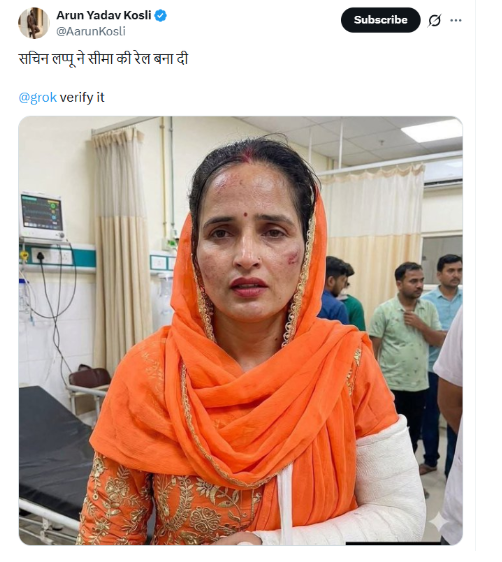
A photo allegedly showing injuries to Seema Haider has been widely circulated on social media. Users are claiming that her husband Sachin Meena assaulted her. However, a fact-check by CyberPeace Research Wing has found the claim to be false. The research reveals that the viral image is AI-generated and is being shared with a misleading narrative.
Claim
On X (formerly Twitter), a user shared the image on May 14, 2026, claiming that Sachin Meena assaulted Seema Haider.
Fact Check
A keyword-based search on Google did not return any credible media reports supporting the viral claim.
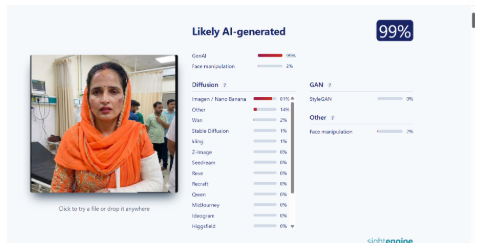
A closer visual examination of the image raised suspicions of AI generation. The image was first analysed using the AI detection tool Hive Moderation, which indicated a 99% probability that the image is AI-generated.
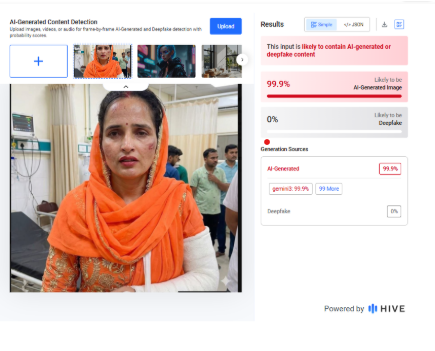
Further analysis using another AI detection tool, Sightengine, also produced similar results, confirming a 99% likelihood that the image was generated using AI tools.
Conclusion
The viral image is AI-generated and misleading. The claim that Sachin Meena assaulted Seema Haider is false and has no factual basis.
