
#FactCheck-Old Video of Ira Khan’s Wedding Falsely Linked to Aamir Khan’s Third Marriage
Executive Summary
A video featuring Bollywood actor Aamir Khan is being widely shared on social media. The video is being linked to his alleged third wedding with Gauri Spratt, with users claiming that both of his former wives, Reena Dutta and Kiran Rao, attended the ceremony. CyberPeace Research Wing research found the claim to be misleading. The viral video is not from Aamir Khan’s alleged third wedding. It is actually from the wedding celebrations of his daughter, Ira Khan, held two years ago. Furthermore, no credible media report confirms that Reena Dutta and Kiran Rao attended Aamir Khan’s alleged wedding with Gauri Spratt.
Claim
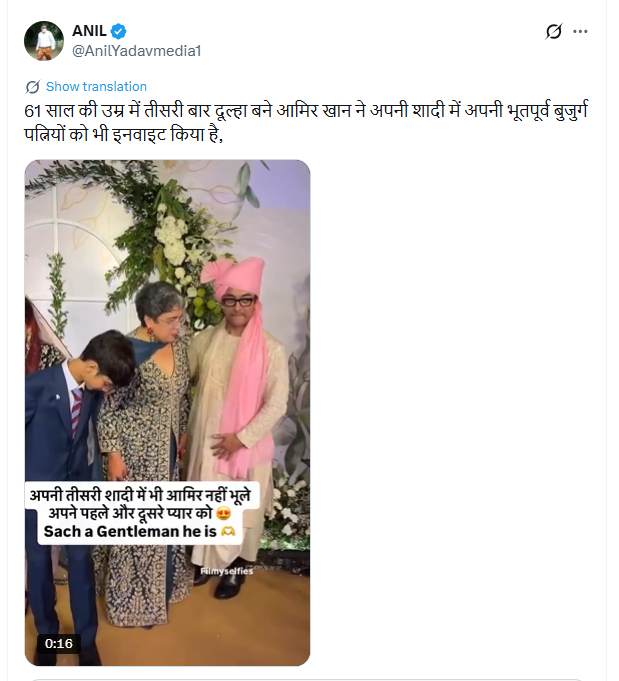
On July 5, 2026, an X (formerly Twitter) user shared the viral video with the caption: “At the age of 61, Aamir Khan got married for the third time and even invited his former wives to the wedding.” The post link, archive link, and screenshots are provided below.
https://x.com/anilyadavmedia1/status/2073728740048208226
Fact Check
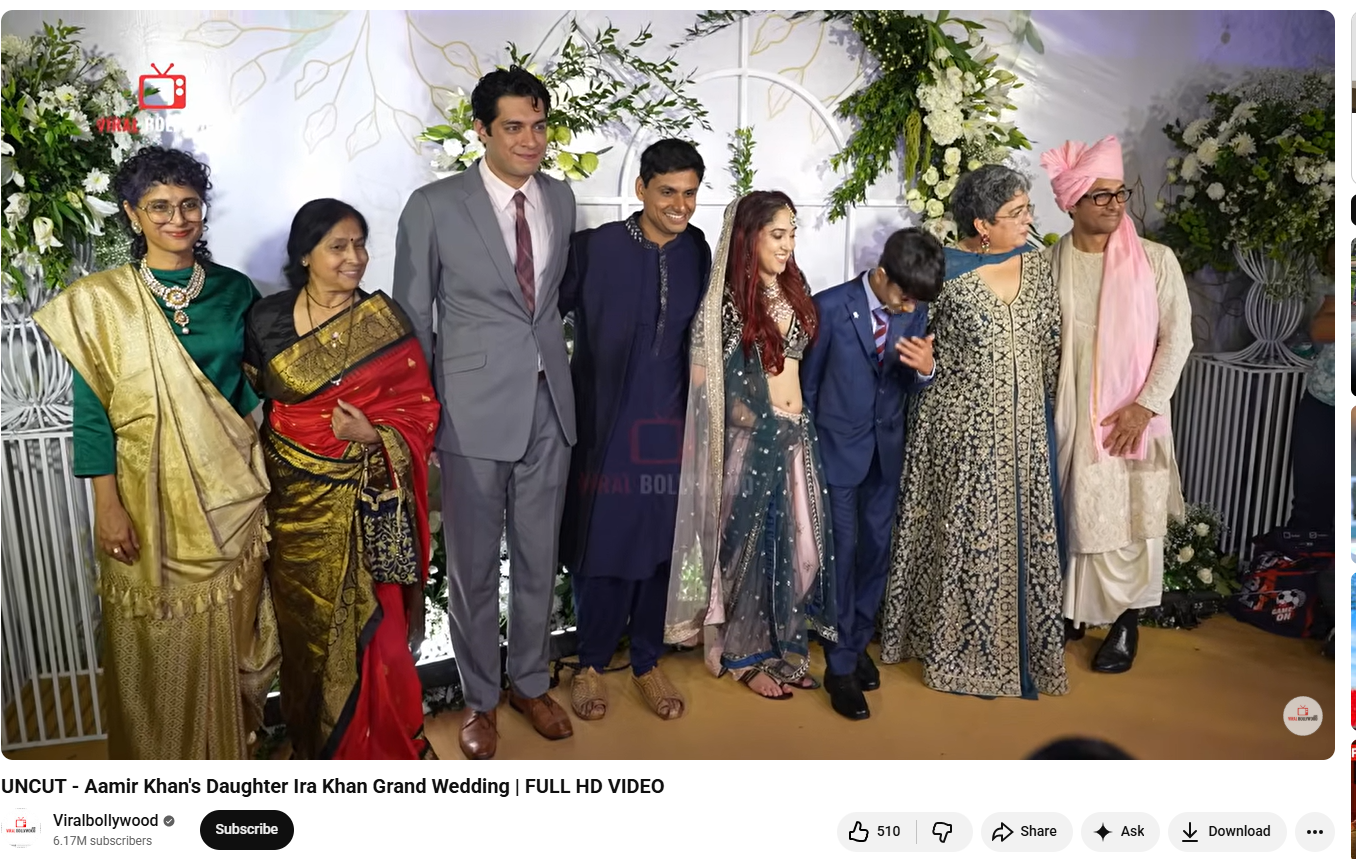
To verify the claim, we extracted several keyframes from the viral video and performed a reverse image search using Google Lens. During the research, we found the same video uploaded on the YouTube channel Viral Bollywood on January 4, 2024. The visuals in that video matched the viral clip exactly. The post link and screenshots are provided below.
https://www.youtube.com/watch?v=yV39oUh-_tU
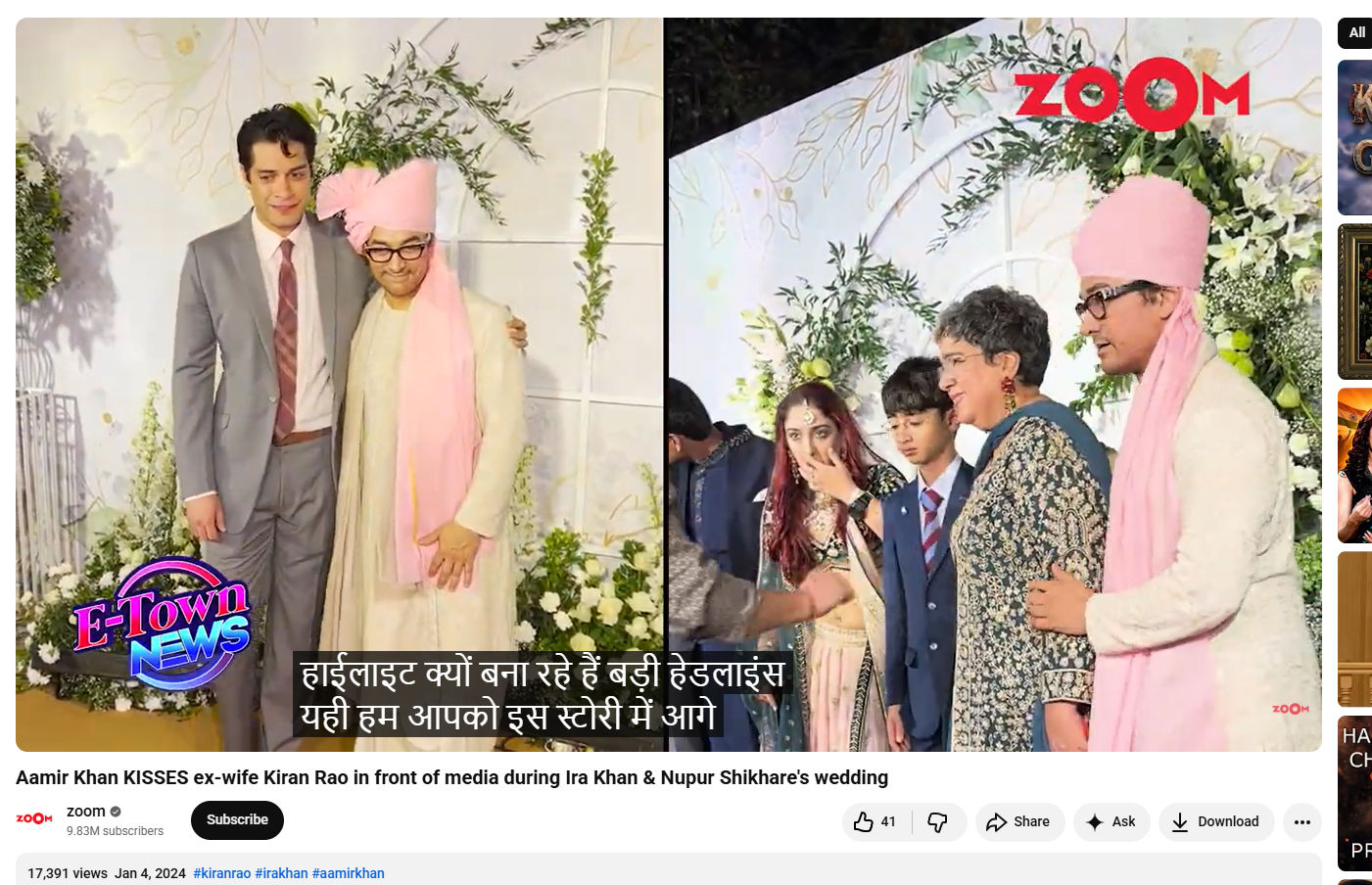
In the next stage of our research, we found another video published by Zoom on January 4, 2024. The visuals in this video also matched those seen in the viral clip. The post link and screenshots are provided below.
https://www.youtube.com/watch?v=c5Um5eB6kpM
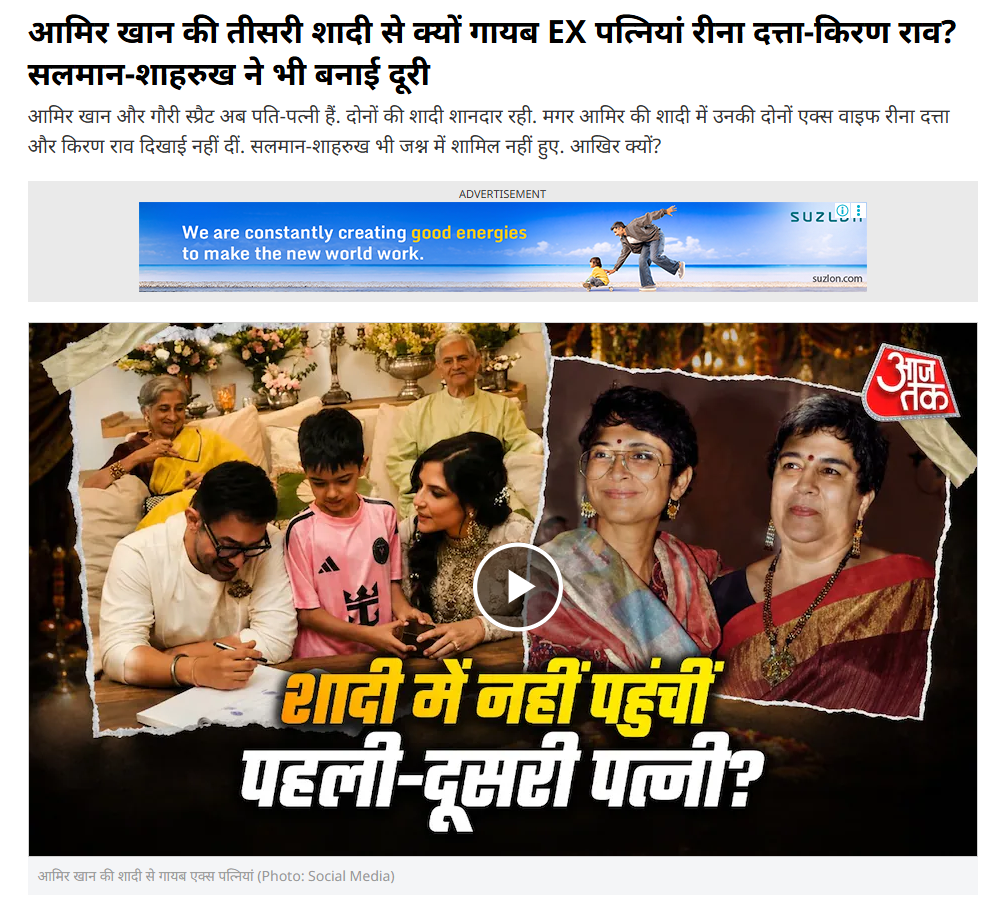
We also looked into whether Reena Dutta and Kiran Rao attended Aamir Khan’s alleged third wedding. During this process, we found a report published by Aaj Tak, which stated that both of Aamir Khan’s former wives did not attend the alleged wedding ceremony. The post link and screenshots are provided below.
Conclusion
Our research found that the viral video is not from Aamir Khan’s alleged third wedding. It is an old video from the wedding celebrations of his daughter, Ira Khan, held in 2024. Moreover, there is no credible evidence or media report confirming that Reena Dutta and Kiran Rao attended Aamir Khan’s alleged wedding with Gauri Spratt. Therefore, the viral claim is misleading.

Related Blogs
Artificial intelligence is revolutionizing industries such as healthcare to finance to influence the decisions that touch the lives of millions daily. However, there is a hidden danger associated with this power: unfair results of AI systems, reinforcement of social inequalities, and distrust of technology. One of the main causes of this issue is training data bias, which appears when the examples on which an AI model is trained are not representative or skewed. To deal with it successfully, this needs a combination of statistical methods, algorithmic design that is mindful of fairness, and robust governance over the AI lifecycle. This article discusses the origin of bias, the ways to reduce it, and the unique position of fairness-conscious algorithms.
Why Bias in Training Data Matters
The bias in AI occurs when the models mirror and reproduce the trends of inequality in the training data. When a dataset has a biased representation of a demographic group or includes historical biases, the model will be trained to make decisions in ways that will harm the group. This is a fact that has a practical implication: prejudiced AI may cause discrimination during the recruitment of employees, lending, and evaluation of criminal risks, as well as various other spheres of social life, thus compromising justice and equity. These problems are not only technical in nature but also require moral principles and a system of governance (E&ICTA).
Bias is not uniform. It may be based on the data itself, the algorithm design, or even the lack of diversity among developers. The bias in data occurs when data does not represent the real world. Algorithm bias may arise when design decisions inadvertently put one group at an unfair advantage over another. Both the interpretation of the model and data collection may be affected by human bias. (MDPI)
Statistical Principles for Reducing Training Data Bias
Statistical principles are at the core of bias mitigation and they redefine the data-model interaction. These approaches are focused on data preparation, training process adjustment, and model output corrections in such a way that the notion of fairness becomes a quantifiable goal.
Balancing Data Through Re-Sampling and Re-Weighting
Among the aforementioned methods, a fair representation of all the relevant groups in the dataset is one way. This can be achieved by oversampling underrepresented groups and undersampling overrepresented groups. Oversampling gives greater weight to minority examples, whereas re-weighting gives greater weight to under-represented data points in training. The methods minimize the tendency of models to fit to salient patterns and improve coverage among vulnerable groups. (GeeksforGeeks)
Feature Engineering and Data Transformation
The other statistical technique is to convert data characteristics in such a way that sensitive characteristics have a lesser impact on the results. In one example, fair representation learning adjusts the data representation to discourage bias during the untraining of the model. The disparate impact remover adjust technique performs the adjustment of features of the model in such a way that the impact of sensitive features is reduced during learning. (GeeksforGeeks)
Measuring Fairness With Metrics
Statistical fairness measures are used to measure the effectiveness of a model in groups.
Fairness-Aware Algorithms Explained
Fair algorithms do not simply detect bias. They incorporate fairness goals in model construction and run in three phases including pre-processing, in-processing, and post-processing.
Pre-Processing Techniques
Fairness-aware pre-processing deals with bias prior to the model consuming the information. This involves the following ways:
- Rebalancing training data through sampling and re-weighting training data to address sample imbalances.
- Data augmentation to generate examples of underrepresented groups.
- Feature transformation removes or downplays the impact of sensitive attributes prior to the commencement of training. (IJMRSET)
These methods can be used to guarantee that the model is trained on more balanced data and to reduce the chances of bias transfer between historical data.
In-Processing Techniques
The in-processing techniques alter the learning algorithm. These include:
- Fairness constraints that penalize the model for making biased predictions during training.
- Adversarial debiasing, where a second model is used to ensure that sensitive attributes are not predicted by the learned representations.
- Fair representation learning that modifies internal model representations in favor of
Post-Processing Techniques
Fairness may be enhanced after training by changing the model outputs. These strategies comprise:
- Threshold adjustments to various groups to meet conditions of fairness, like equalized odds.
- Calibration techniques such that the estimated probabilities are fair indicators of the actual probabilities in groups. (GeeksforGeeks)
Challenges
Mitigating bias is complex. The statistical bias minimization may at times come at the cost of the model accuracy, and there is a conflict between predictive performance and fairness. The definition of fairness itself is potentially a difficult task because various applications of fairness require various criteria, and various criteria can be conflicting. (MDPI)
Gaining varied and representative data is also a challenge that is experienced because of privacy issues, incomplete records, and a lack of resources. The auditing and reporting done on a continuous basis are needed so that mitigation processes are up to date, as models are continually updated. (E&ICTA)
Why Fairness-Aware Development Matters
The outcomes of the unfair treatment of some groups by AI systems are far-reaching. Discriminatory software in recruitment may support inequality in the workplace. Subjective credit rating may deprive deserving people of opportunities. Unbiased medical forecasts might result in the flawed allocation of medical resources. In both cases, prejudice contravenes the credibility and clouds the greater prospect of AI. (E&ICTA)
Algorithms that are fair and statistical mitigation plans provide a way to create not only powerful AI but also fair and trustworthy AI. They admit that the results of AI systems are social tools whose effects extend across society. Responsible development will necessitate sustained fairness quantification, model adjustment, and upholding human control.
Conclusion
AI bias is not a technical malfunction. It is a mirror of real-world disparities in data and exaggerated by models. Statistical rigor, wise algorithm design, and readiness to address the trade-offs between fairness and performance are required to reduce training data bias. Fairness-conscious algorithms (which can be implemented in pre-processing, in-processing, or post-processing) are useful in delivering more fair results. As AI is taking part in the most crucial decisions, it is necessary to consider fairness at the beginning to have a system that serves the population in a responsible and fair manner.
References
- Understanding Bias in Artificial Intelligence: Challenges, Impacts, and Mitigation Strategies: E&ICTA, IITK
- Bias and Fairness in Artificial Intelligence: Methods and Mitigation Strategies: JRPS Shodh Sagar
- Fairness and Bias in Artificial Intelligence: A Brief Survey of Sources, Impacts, and Mitigation Strategies: MDPI
- Ensuring Fairness in Machine Learning Algorithms: GeeksforGeeks
Bias and Fairness in Machine Learning Models: A Critical Examination of Ethical Implications: IJMRSET - Bias in AI Models: Origins, Impact, and Mitigation Strategies: Preprints
- Bias in Artificial Intelligence and Mitigation Strategies: TCS
- Survey on Machine Learning Biases and Mitigation Techniques: MDPI

A video claiming to show a Hatha yogi performing extreme penance on a snow-covered mountain amid strong icy winds is going viral on social media. In the clip, the ascetic is seen balancing on one hand in a yoga posture, while users portray the visuals as a rare example of extraordinary spiritual endurance in harsh climatic conditions.
However, an investigation by the CyberPeace Foundation has found the claim to be false. Our analysis confirms that the viral video is AI-generated and does not depict a real person or an actual event.
Claim:
A Instagram user shared the video with the caption:
“Hatha yogi, what kind of soil are these people made of?” The post suggests that the visuals show a real yogi performing intense meditation on a frozen mountain.
- https://www.instagram.com/reels/DTK32TvDGIJ/
- (Archive link as provided) https://perma.cc/H84M-MGXZ

Fact Check:
To verify the claim, the CyberPeace Foundation conducted a detailed examination of the viral video.No credible or verifiable news reports were found to support the claim that such an incident ever occurred.
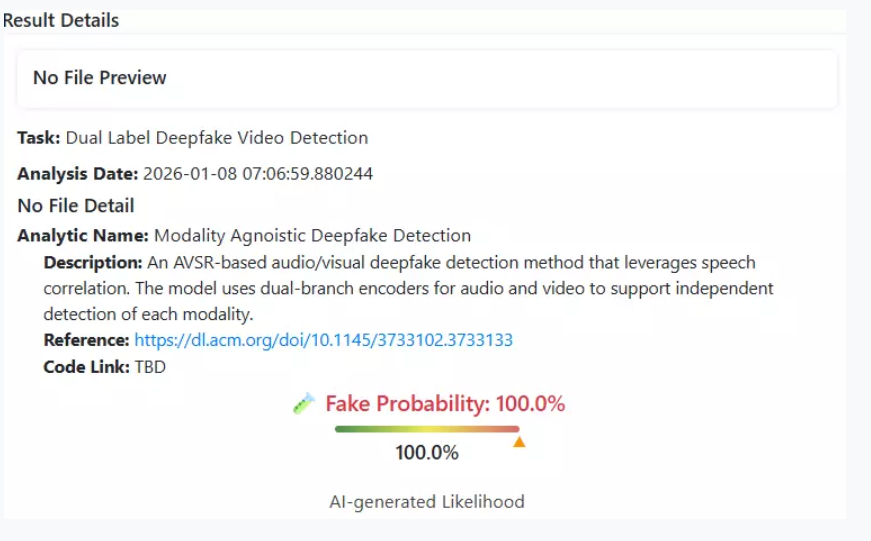
The viral video was analysed using the AI detection tool Deepfake-O-Meter.Its AVSRDD (2025) module flagged the video as AI-generated, confirming that the visuals were digitally created and not recorded in real life.
Multiple indicators within the footage,such as unnatural body balance, environmental inconsistencies, and visual artifacts are consistent with AI-generated content.
Conclusion
The viral video purportedly showing a yogi meditating on a frozen mountain is not real. It has been created using artificial intelligence and is being circulated on social media with a misleading narrative. Users are advised to exercise caution and verify content before sharing such sensational claims.

Executive Summary
A video is being shared on social media with the claim that Ministry of External Affairs spokesperson Randhir Jaiswal was seen eating nuts during the BRICS Summit. The post claims that a reporter questioned him about eating nuts during the event. The video is also being shared with the sarcastic caption, “The Nutty Spokesperson.” Through the post, an attempt is being made to suggest that a reporter questioned Randhir Jaiswal about eating nuts during a press briefing. CyberPeace Research found that in the original video, Ministry of External Affairs spokesperson Randhir Jaiswal was responding to a question about Pakistan’s announcement of a 7 million Pakistani rupee bounty on Jaish-e-Mohammed chief Masood Azhar. Jaiswal addressed the announcement during the regular media briefing held on September 15, 2026. In his response, Jaiswal said that such announcements by Pakistan were not new and that the country should take concrete action against terrorism. However, the video being circulated on social media has been digitally edited using the original footage to falsely suggest that a reporter had questioned Jaiswal about eating nuts.
Claim:
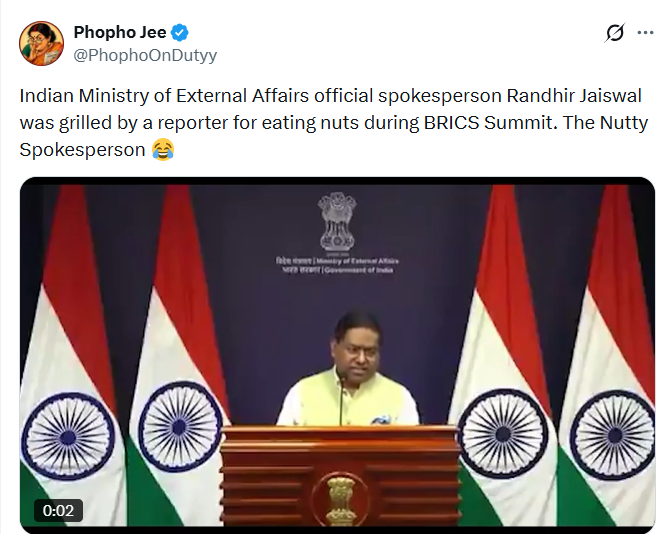
During the BRICS Summit, a reporter questioned Ministry of External Affairs spokesperson Randhir Jaiswal about eating nuts and confronted him over it.
https://x.com/PhophoOnDutyy/status/2099940769876640084?s=20
Fact Check
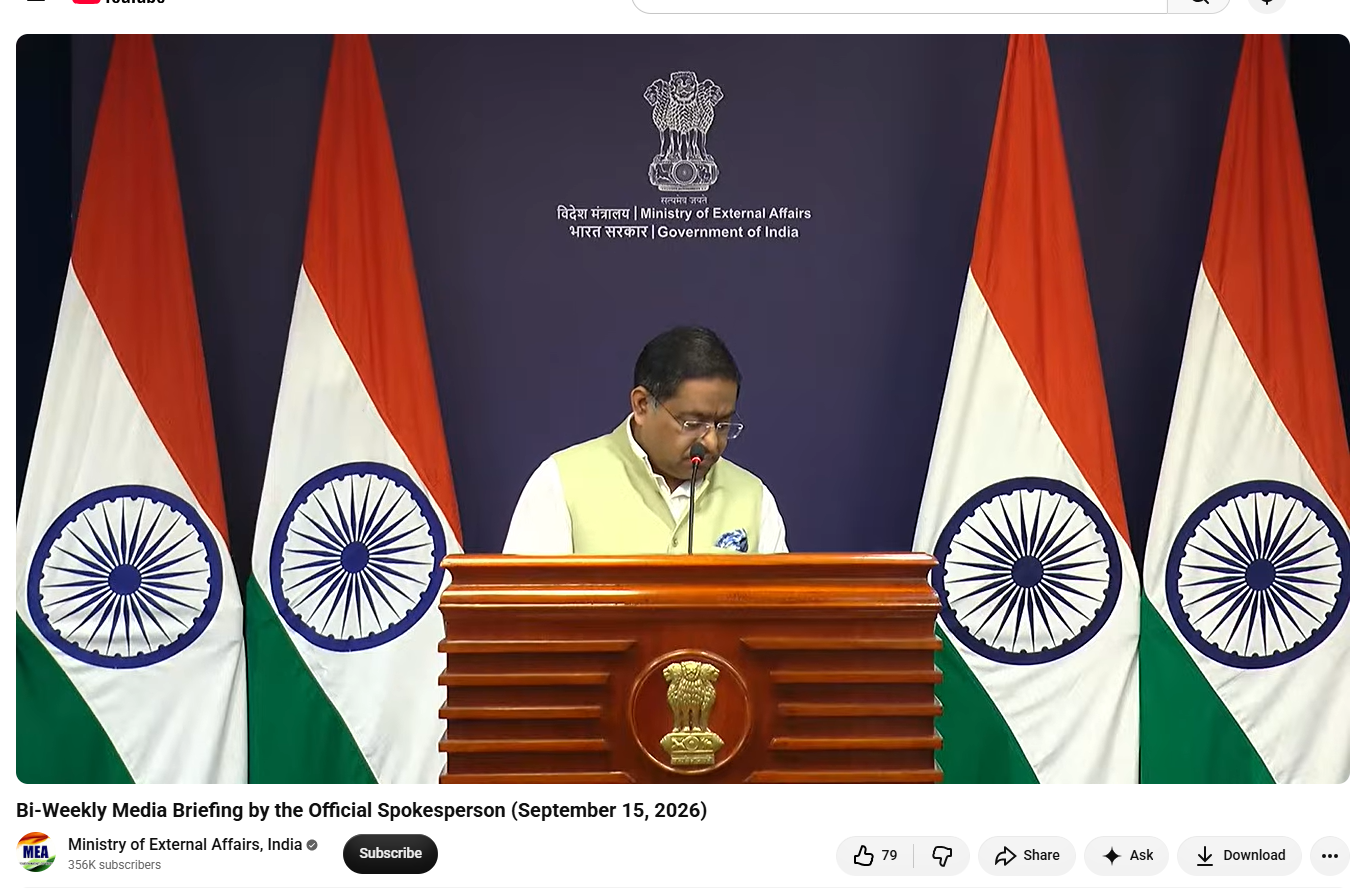
To verify the claim, we conducted a Google search using relevant keywords. During the search, we did not find any credible media report supporting the claim.As part of our research, we conducted a reverse image search of keyframes from the video. We found the original video on the YouTube channel of the Ministry of External Affairs, India. In the original video, Randhir Jaiswal was responding to a question about Pakistan’s announcement of a 7 million Pakistani rupee bounty on Masood Azhar.The reporter does not question Jaiswal about eating nuts anywhere in the original video. This establishes that the original footage has been edited and presented with a false context. Therefore, the claim being circulated on social media is false.
https://www.youtube.com/live/dw-qqLolRgc
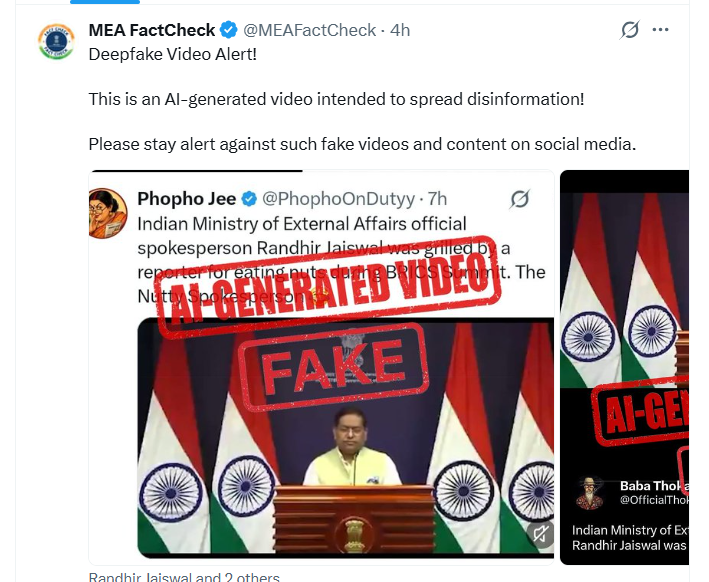
As part of our further research, we checked the official X account of MEA FactCheck. It also identified the video as AI-generated.
https://x.com/MEAFactCheck/status/2100076244805255501?s=20
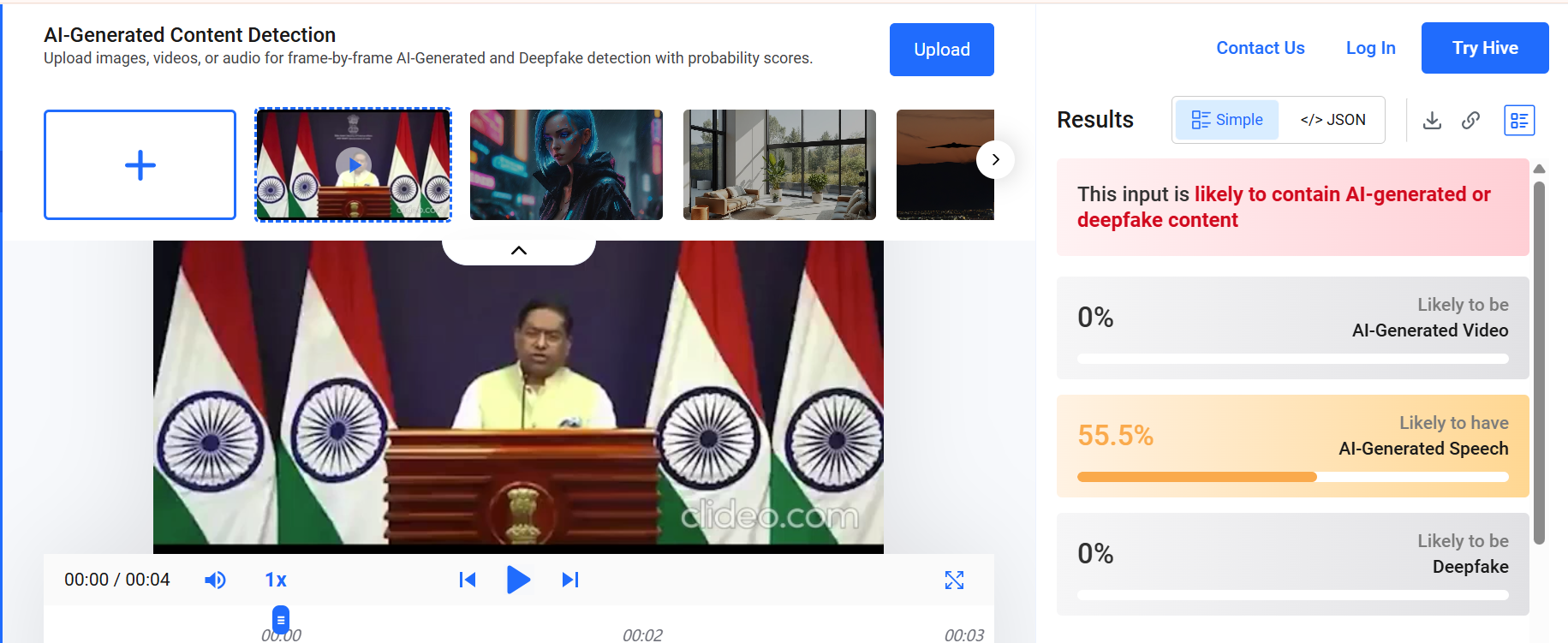
The video was scanned using the AI detection tool Hive Moderation. According to the results, the video has a 55% probability of being AI-generated.
Conclusion
Our research found that the video being shared on social media is fake and edited. In the original video, Ministry of External Affairs spokesperson Randhir Jaiswal was responding to a question about Pakistan’s announcement of a 7 million Pakistani rupee bounty on Masood Azhar.At no point in the original video does the reporter question Jaiswal about eating nuts.
The footage being circulated has been digitally manipulated and presented in a different context. The official X account of MEA FactCheck also identified the video as AI-generated. Therefore, the claim that Jaiswal was questioned by a reporter about eating nuts is false and misleading.
