
#FactCheck - Viral Claim About Nitish Kumar’s Resignation Over UGC Protests Is Misleading
Executive Summary
A news video is being widely circulated on social media with the claim that Bihar Chief Minister Nitish Kumar has resigned from his post in protest against the ongoing UGC-related controversy. Several users are sharing the clip while alleging that Kumar stepped down after opposing the issue. However, CyberPeace research has found the claim to be false. The researchrevealed that the video being shared is from 2022 and has no connection whatsoever with the UGC or any recent protests related to it. An old video has been misleadingly linked to a current issue to spread misinformation on social media.
Claim:
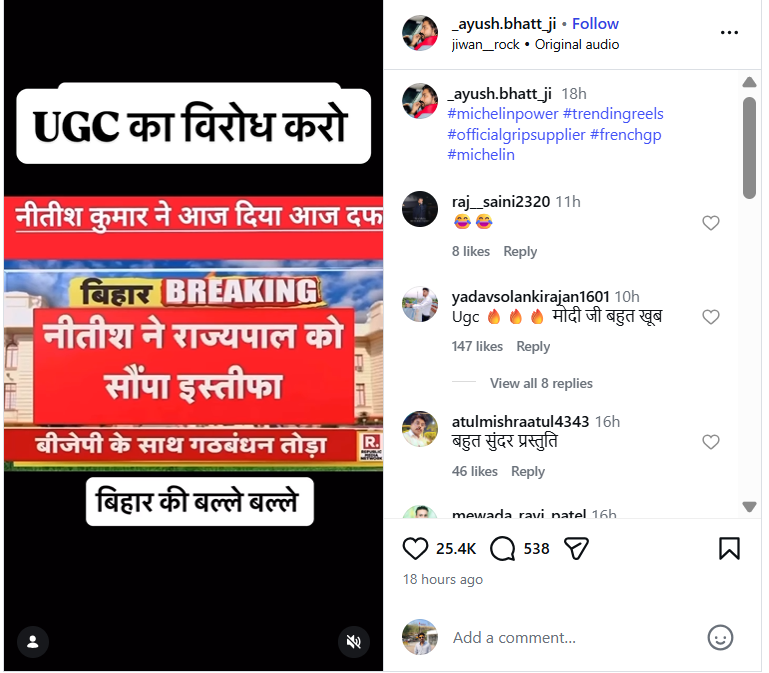
An Instagram user shared a video on January 26 claiming that Bihar Chief Minister Nitish Kumar had resigned. The post further alleged that the news was first aired on Republic channel and that Kumar had submitted his resignation to then-Governor Phagu Chauhan. The link to the post, its archived version, and screenshots can be seen below. (Links as provided)
Fact Check:
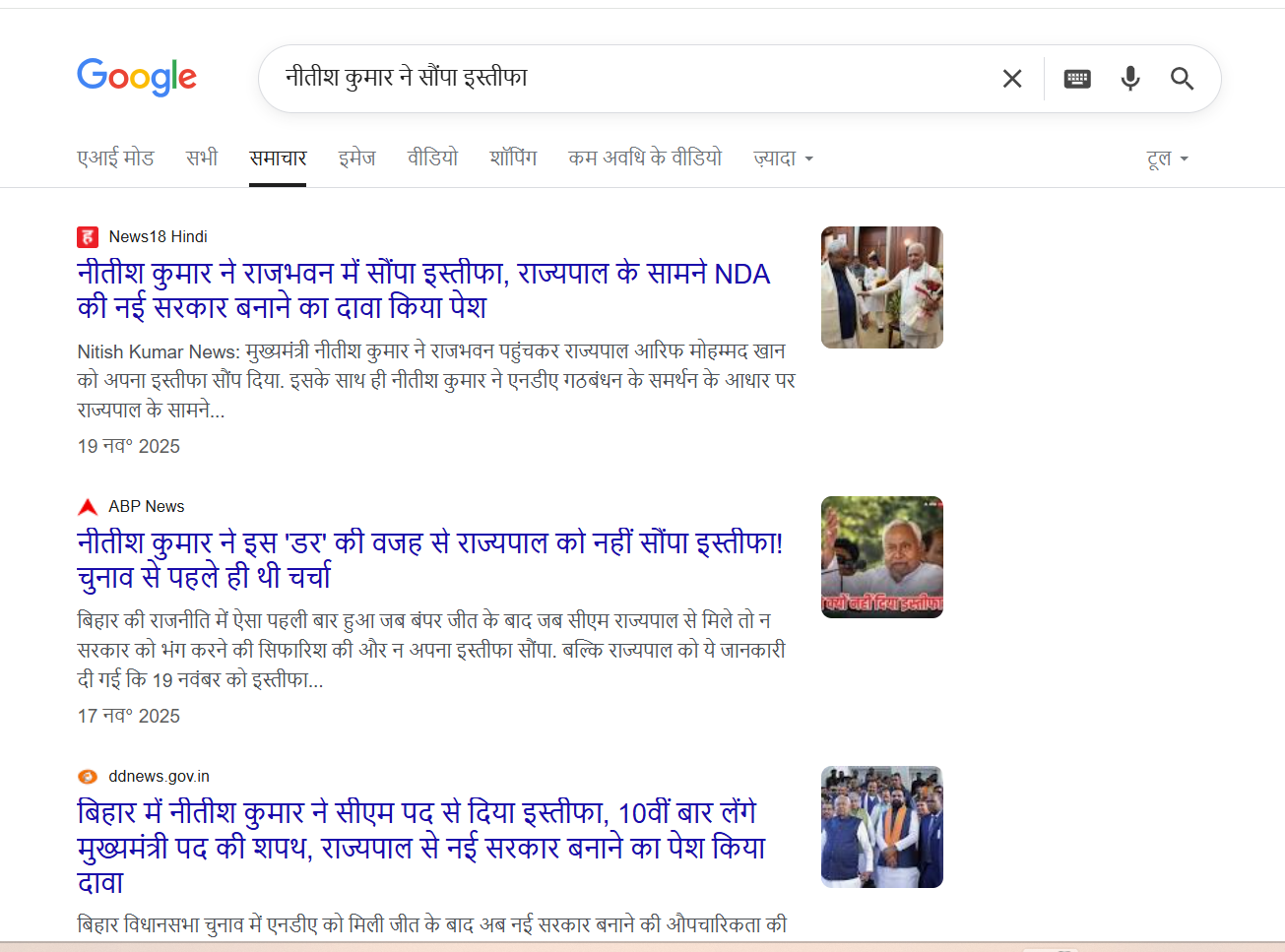
To verify the claim, CyberPeace first conducted a keyword-based search on Google. No credible or established media organisation reported any such resignation, clearly indicating that the viral claim lacked authenticity.
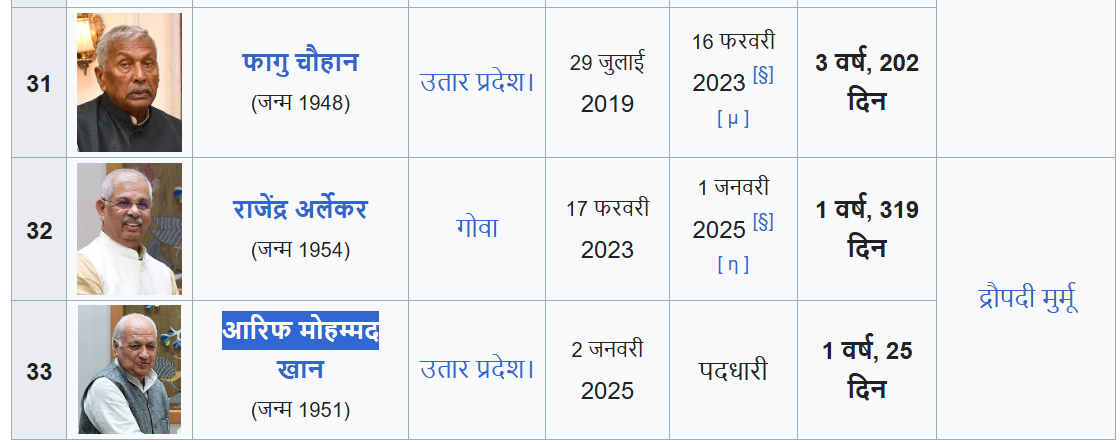
Further, the voiceover in the viral video states that Nitish Kumar handed over his resignation to Governor Phagu Chauhan. However, Phagu Chauhan ceased to be the Governor of Bihar in February 2023. The current Governor of Bihar is Arif Mohammad Khan, making the claim in the video factually incorrect and misleading.
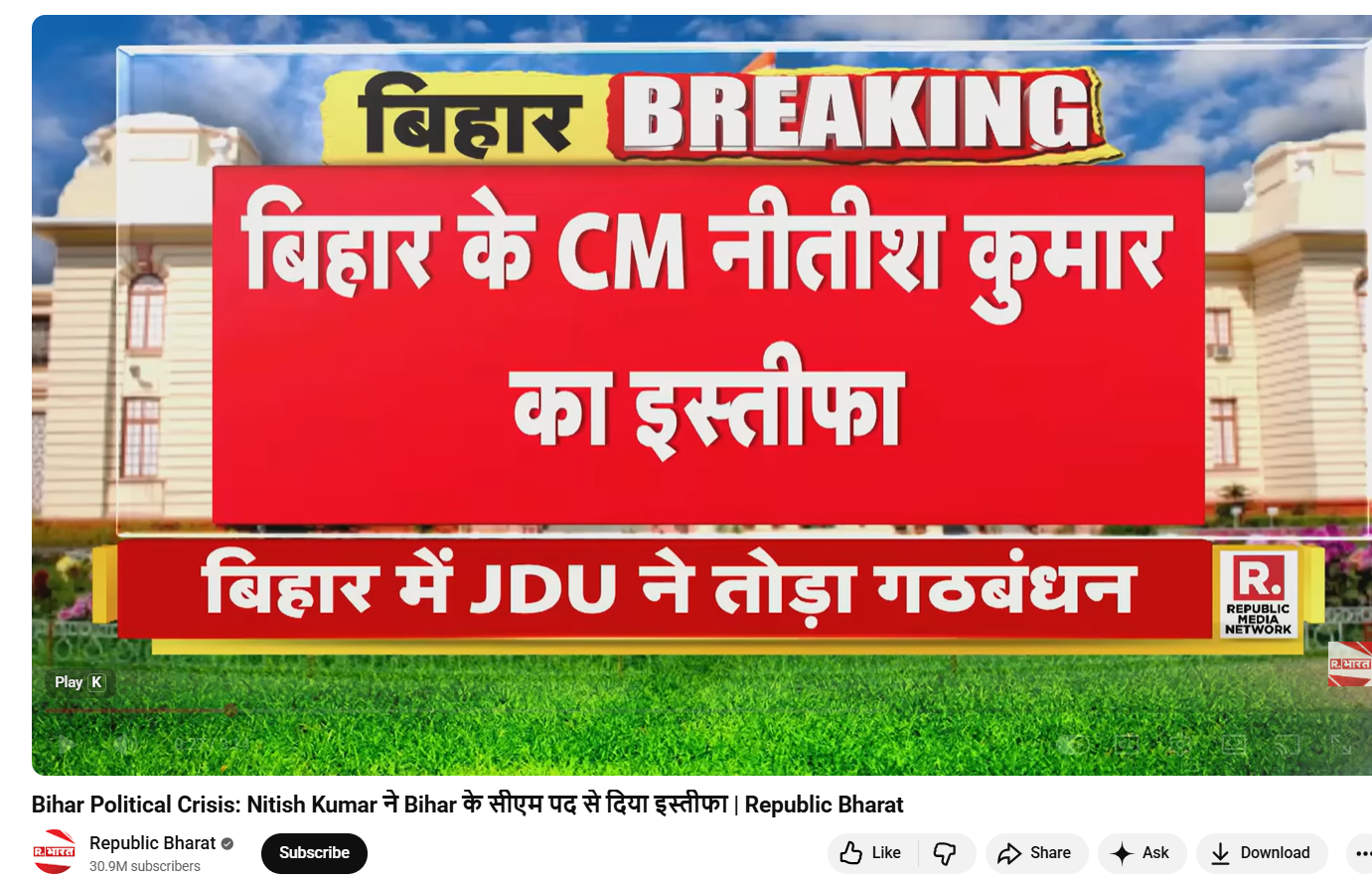
In the next step, keyframes from the viral video were extracted and reverse-searched using Google Lens. This led to the official YouTube channel of Republic Bharat, where the full version of the same video was found. The video was uploaded on August 9, 2022. This clearly establishes that the clip circulating on social media is not recent and is being shared out of context.
Conclusion
CyberPeace’s research confirms that the viral video claiming Nitish Kumar resigned over the UGC issue is false. The video dates back to 2022 and has no link to the current UGC controversy. An old political video has been deliberately circulated with a misleading narrative to create confusion on social media.

Related Blogs
.webp)
Introduction
If we look at the concept of scams, they have existed for as long as human societies have. A few decades ago, it was quite common to see scams being carried out in the form of fake landline calls, forged documents or persuasive salesmen. And ‘trust’, being the fundamental aspect of human interaction, has been at the forefront of such interactions. This ‘trust’ factor has been consistently exploited by nefarious individuals all over the world through various acts of deception and a plethora of fraudulent activities.
As the years have gone by, the very same scamming methods have simply shifted mediums. They have transitioned from the geographies of markets and doorsteps to the virtual world of smartphones and digital devices. The senior citizens of today are sitting at a juncture where they come equipped with the ‘habits’ and ‘understanding’ of the offline world. And this is why in today’s technologically driven and fast paced digital environment, they are being targeted via ‘unfamiliar’ digital mediums and tactics, making them highly susceptible to cyber frauds and online scams.
Back in the simpler days, it wasn’t too difficult to catch the whiff of a scammer. One could pick up on their practiced speech patterns, spot their overly polished and formal tone or their sheepish body language and even notice the minute inconsistencies in their statements. This back-and-forth communication would take place in real time, over phone calls and even face to face.
But the scenario today is worse. Since our reliance on digital devices has expanded at an unparalleled pace, it has become all the more difficult to distinguish between what’s fake and what’s genuine. All of a sudden, our entire essential daily activities have become encompassed in the realm of the digital world, ranging from banking, shopping, healthcare to everyday communication. And to further exacerbate the situation, today’s scammers have quietly adapted to this newfound circumstance, as they hide behind screens.
Fake messages or emails can be easily mistaken for being ‘real’ in the current modern digital age. Especially for senior citizens, this shift is presenting a serious challenge. They are being forced to evaluate authenticity and legitimacy through links, messages and apps that basically all look familiar. For example, the logo in an online correspondence might seem to be genuine or its language might look official and credible. At first glance, even the format or the layout of an email or a message may seem familiar enough to not raise any suspicion. This is the point where the danger lies. When there are no warning signs, no rude tones, no spelling errors and no weird behaviour. It becomes very difficult for people to tell what’s real and what’s a trap, especially for the seniors. And in that brief period of confusion, scammers manage to fool people into divulging personal information, clicking dangerous links or even parting with their hard-earned money.
What makes the senior population so vulnerable?
Trapped in the Convenience of Digital Dependence
As the senior population embraces the new and sophisticated digital tools of today, alongside they are also risking their exposure to the online world of cyber security risks and cyber criminals. New devices such as smartphones and tablets do offer unprecedented convenience but they also come with various underlying dangers. Modern technology has made everyday tasks quite easy. Smartphone based UPI applications, bank applications and even online healthcare platforms have simplified life not just for the elderly, but for everyone across society. But many senior citizens may not be as well versed with the usage of these technologies and the digital risks they carry. They may get influenced easily or they may not exercise the same level of caution as the younger generations (who have literally grown up being surrounded by the dynamics of technology). This ‘familiarity gap’ adds up to the vulnerability of seniors. Without any prior visible warning signs they can easily end up getting exposed to online scams, fraudulent transactions and data misuse.
Cybercriminals’ Goldmine: Cash-rich Seniors
Although a person’s vulnerability towards becoming a target or a victim of a cyber crime is mostly shaped by their circumstance and not by age alone. But still, from the point of view of a cyber criminal, senior citizens do seem to be the perfect victims. Most of them are retired and financially sound with lifetime savings, consistent pensions, accumulated assets and anticipated income streams. As they enjoy their solid financial footing, they may not keep a regular check on their online banking accounts and financial records. This ‘financial ease’ can inadvertently make them more prone to cyber crimes, especially when they are simultaneously getting increasingly dependent on digital tools. This lack of oversight may allow suspicious activities or fraudulent transactions to go unnoticed and sometimes even lead to huge losses of money. This is where digital literacy comes in. Keeping the seniors well informed on the safe usage of the internet can significantly lower their chance of getting intertwined in an online scam. It has therefore become crucial to promote and encourage regular account checks, setting up of alerts and foster awareness regarding common online threats that can help seniors safeguard their hard-earned resources.
India itself witnessed an increase of 86% from the years 2020 to 2022 in cyber crime cases related to senior citizens.
Targeting the Psychological Aspects: Panic, Overwhelm, Manipulation and Isolation
Senior citizens are often at an age and stage in life where their routines slow down and the general pace of life shifts towards a gentler rhythm. Thought processes may not be as swift as they used to be, some may even experience mild cognitive decline and many live alone or away from their children or immediate support systems. Research also shows that aging can lead to low memory function which in turn can increase an individual’s susceptibility to digital traps such as phishing emails and financial abuse. According to a comprehensive analysis of senior fraud victims, it has been noted that victimisation increases with advancing age. There are significant associations between fraud victimisation and human cognitive factors, such as: diminished executive functioning, reduced ability of the brain to process information and even impairments in comprehending complex everyday information.
Cybercriminals, who are aware of these soft spots, deliberately exploit the seniors’ psychological and mental space. They strategically deploy methods that create confusion and cognitive overload. They may create a fictitious scenario depicting some kind of ‘urgency’ and use the elderly’s ‘panic response’ to their advantage. They may create false warnings of a blocked bank account, a missed or delayed medical update or inform them of a sudden (but fake) legal issue. They aim at creating a situation of ‘overwhelm, anxiety and severe distress’. And it is common knowledge that when fear encapsulates an individual, the process of rational decision making deeply gets affected. In this scenario elderly victims often fall for the cyber criminals’ malicious antics and end up complying with them without actually verifying their intent and authenticity.
The senior population of the current times was raised in an era where they were rarely taught to question authoritative figures. This is where ‘manipulation’ steps in. The concept of manipulation thrives on the sense of ‘authority, power, position and trust’. Cyber fraudsters use this mechanism and convincingly impersonate government representatives, senior bank officials, healthcare providers, etc. They may project credibility and legitimacy by using authoritative sounding language, creating a sense of power over the victim and manipulating them.
Another important factor that scammers leverage to their advantage is ‘isolation’. A lot of seniors live alone or just with their spouse, with no immediate support systems nearby. They navigate and tread their daily routines on their own, trying hard to adapt to the dynamic digital world. This life of solitude or isolation leaves them in a vulnerable state. They may not even have someone to talk to, or get a second opinion, or even guidance regarding some suspicious online activity that they may be experiencing. This state of isolation combined with their limited digital competence creates the perfect stance for a cybercriminal to manipulate these individuals.
Understanding this psychological dimension has become critical to prevent cyber crimes amongst the elderly. Proper awareness campaigns, reassurance, encouragement of think-and-verify habits can reduce the occurrence of such scams and protect our senior citizens.
Clickbait Cures, Bogus Health Remedies and Expensive False Hopes
It is a known fact that for most senior citizens, their health ranks highest in the list of their priorities. They are always on the lookout for information regarding treatments, medications, dietary supplements and even wellness programs. In an effort to live a healthy and fuller life in this digital age, unknowingly, senior citizens can become easy targets for cybercriminals.
The internet is flooded with eye-catching headlines, ads and clickbaits that promise quick relief and miracle cures. Their wordings may appear like: ‘miracle joint and arthritis relief’, ‘reverse diabetes in seven days’, ‘secret anti-ageing formulas that doctors won’t divulge’, etc. These promises seem all flashy and shiny, but the reality is generally painful. Elderly people can easily get attracted to such ads. Scammers use reassuring language that instantly appeals to the seniors’ attention and their emotions. They create fake doctor profiles or publish fabricated patient reviews with overly dramatised testimonials and false research. In order to seem authentic, some scammers may even use the names and logos of respectable health institutions and organisations such as the ‘World Health Organisation’. They claim to sell products like miracle pills, teas, devices, virtual health services, etc., all at extremely high prices along with pressure inducing statements such as: ‘offer ends tonight’ or ‘only 20 spots left’.
When the elderly fall for this scam and end up paying the amount, either the promised product doesn’t turn up or it proves to be completely ineffective. In worst case scenarios, it may even harm the user’s health. These bogus health products are not regulated by any health association or authority. They may contain unsafe ingredients, incorrect dosages and other toxic substances that can severely impact the elderly’s health. An adverse reaction can take place or an existing medical condition may worsen. What begins as a hopeful step towards better health can eventually lead to loss of finances, physical harm and a deep sense of disappointment and hurt.
Sharing of card details, Adhaar numbers, insurance and medical reports on fake websites can further lead to identity theft and other dangerous cyber crimes.
Protection starts with simple habits. And here families have a big role to play. Making our senior citizens aware of this scenario is the first step. Education brings along ‘awareness’, and with awareness comes ‘caution and confidence’. Teaching the seniors to be wary of any warning signs, to not share any personal or financial details online and to make sure to consult a doctor first before starting any new treatments, are a few ways that can definitely help in reducing the risk of such scams.
Risky Digital Routines: Overexposure and Oversharing
The senior citizens of today are heavily invested in their daily digital routines. They stay virtually connected through various messaging apps (such as WhatsApp), they eagerly curate and maintain their digital identities on online platforms (such as Instagram and Facebook) and they regularly use emails to share messages, articles and forwards within their social circles. Many of us have seen it in our own family groups, that the seniors are the most enthusiastic lot. They are the first to send in their morning salutation messages, photos and other daily updates. This eagerness reflects both their genuine commitment towards staying in touch and also the pure joy that they derive from being active members of these online communities. It is important to understand that these platforms don’t just serve as mere communication tools for them. Beyond messaging and sharing of updates, these online spaces offer a sense of community, belongingness and self-expression to the elderly.
But these everyday digital routines can cause an overexposure to the virtual world which further creates opportunities for scammers. Clicking on unfamiliar links, downloading unknown softwares and giving quick responses to alerts and notifications (without first identifying the source), are a few examples of how seniors end up getting embroiled in risky situations. At the same time, online oversharing of personal details such as addresses, birthdays, travel plans, family updates, phone numbers, even investment plans, etc., can seem to be quite harmless on the face of it. But all of this information builds a goldmine for the scammers. They may be able to piece it together and use it to send highly convincing phishing emails, create fake online offers or even impersonate a loved one.
Senior citizens also tend to take online messages at face value. AI generated videos, images, false news, etc., are all generally shared under the garb of sensational claims or urgent warnings and are therefore easily assumed to be true, especially by the elderly. They may not even take a minute to factcheck the information and instead may forward it to ten other people in their circle.
The above risks can significantly be reduced by practicing safer digital habits. Seniors should be mindful in their digital usage. Pausing and thinking before clicking on a link, fact checking a piece of news, using strong privacy settings and trusted apps, etc., can help protect both their personal data as well as their digital wellbeing.
Silent Suffering: Shame, Underreporting and Systemic Gaps
Research suggests that senior citizens do not always report a cybercrime. This can be due to shame, self blame, ridicule, fear of being judged as incompetent and a general opinion that even if they report it, nothing will come out of it. They may feel embarrassed about getting deceived, believing that they should have known better. This may create an emotional burden which further amplifies underreporting. Informing their family members or just reaching out for some help can seem like a mammoth task for them.
Existing institutional gaps in our systems compounds this silent suffering. While there are law enforcement and consumer protection agencies in place, but the first step, which is the ‘reporting mechanism’, can seem to be inaccessible or too overbearing for the seniors. These systems may not have a very proactive outreach and can fail to tackle the distinct set of challenges faced by the seniors (such as clear guidance on scams or support for recovering lost funds).
This combination of ‘shame, underreporting and weak system support’ creates a dangerous cycle. Senior citizens are left as open prey, exploited and repeatedly targeted without sufficient help or any recognition for their plight.
The Way Forward
Society has to first acknowledge and identify the inimitable vulnerabilities of the seniors. This cycle can be broken by developing information drives that are specially tailored for the seniors. Moreover, along with family involvement, user friendly reporting channels and stronger protections from fraudulent online practices, seniors can see a ray of hope.
Targeted training programs, senior friendly cybersecurity workshops and courses can be a starting point. Teaching them about password creations, safe browsing tactics, phishing recognition and specific mentor-led sessions can empower them with the basic understanding of the online world.
Being able to navigate the digital world with adequate competence and confidence, and without the fear of exploitation, is ultimately what every senior citizen needs.
References
- https://www.staysafeonline.org/articles/why-do-scammers-target-older-adults
- https://pmc.ncbi.nlm.nih.gov/articles/PMC12074955/
- https://cybersecurityasia.net/rise-cyber-crime-targeting-older-adults/
- https://news.ufl.edu/2024/06/older-adults-vulnerable-to-scams/
- https://oklaw.org/resource/why-are-older-people-vulnerable-to-scams
- https://www.crimrxiv.com/pub/g7u4rb9v
- https://www.norc.org/research/library/majority-of-older-adults-experience-cyber-abuse-in-their-lifetim.html
- https://www.sbigeneral.in/blog/cyber-insurance/cyber-tips-and-tricks/how-senior-citizens-can-avoid-internet-scams

Artificial Intelligence (AI) provides a varied range of services and continues to catch intrigue and experimentation. It has altered how we create and consume content. Specific prompts can now be used to create desired images enhancing experiences of storytelling and even education. However, as this content can influence public perception, its potential to cause misinformation must be noted as well. The realistic nature of the images can make it hard to discern as artificially generated by the untrained eye. As AI operates by analysing the data it was trained on previously to deliver, the lack of contextual knowledge and human biases (while framing prompts) also come into play. The stakes are higher whilst dabbling with subjects such as history, as there is a fine line between the creation of content with the intent of mere entertainment and the spread of misinformation owing to biases and lack of veracity left unchecked. AI-generated images enhance storytelling but can also spread misinformation, especially in historical contexts. For instance, an AI-generated image of London during the Black Death might include inaccurate details, misleading viewers about the past.
The Rise of AI-Generated Historical Images as Entertainment
Recently, generated images and videos of various historical instances along with the point of view of the people present have been floating all over the internet. Some of them include the streets of London during the Black Death in the 1300s in England, the eruption of Mount Vesuvius at Pompeii etc. Hogne and Dan, two creators who operate accounts named POV Lab and Time Traveller POV on TikTok state that they create such videos as they feel that seeing the past through a first-person perspective is an interesting way to bring history back to life while highlighting the cool parts, helping the audience learn something new. Mostly sensationalised for visual impact and storytelling, such content has been called out by historians for inconsistencies with respect to details particular of the time. Presently, artists admit to their creations being inaccurate, reasoning them to be more of an artistic interpretation than fact-checked documentaries.
It is important to note that AI models may inaccurately depict objects (issues with lateral inversion), people(anatomical implausibilities), or scenes due to "present-ist" bias. As noted by Lauren Tilton, an associate professor of digital humanities at the University of Richmond, many AI models primarily rely on data from the last 15 years, making them prone to modern-day distortions especially when analysing and creating historical content. The idea is to spark interest rather than replace genuine historical facts while it is assumed that engagement with these images and videos is partly a product of the fascination with upcoming AI tools. Apart from this, there are also chatbots like Hello History and Charater.ai which enable simulations of interacting with historical figures that have piqued curiosity.
Although it makes for an interesting perspective, one cannot ignore that our inherent biases play a role in how we perceive the information presented. Dangerous consequences include feeding into conspiracy theories and the erasure of facts as information is geared particularly toward garnering attention and providing entertainment. Furthermore, exposure of such content to an impressionable audience with a lesser attention span increases the gravity of the matter. In such cases, information regarding the sources used for creation becomes an important factor.
Acknowledging the risks posed by AI-generated images and their susceptibility to create misinformation, the Government of Spain has taken a step in regulating the AI content created. It has passed a bill (for regulating AI-Generated content) that mandates the labelling of AI-generated images and failure to do so would warrant massive fines (up to $38 million or 7% of turnover on companies). The idea is to ensure that content creators label their content which would help to spot images that are artificially created from those that are not.
The Way Forward: Navigating AI and Misinformation
While AI-generated images make for exciting possibilities for storytelling and enabling intrigue, their potential to spread misinformation should not be overlooked. To address these challenges, certain measures should be encouraged.
- Media Literacy and Awareness – In this day and age critical thinking and media literacy among consumers of content is imperative. Awareness, understanding, and access to tools that aid in detecting AI-generated content can prove to be helpful.
- AI Transparency and Labeling – Implementing regulations similar to Spain’s bill on labelling content could be a guiding crutch for people who have yet to learn to tell apart AI-generated content from others.
- Ethical AI Development – AI developers must prioritize ethical considerations in training using diverse and historically accurate datasets and sources which would minimise biases.
As AI continues to evolve, balancing innovation with responsibility is essential. By taking proactive measures in the early stages, we can harness AI's potential while safeguarding the integrity and trust of the sources while generating images.
References:
- https://www.npr.org/2023/06/07/1180768459/how-to-identify-ai-generated-deepfake-images
- https://www.nbcnews.com/tech/tech-news/ai-image-misinformation-surged-google-research-finds-rcna154333
- https://www.bbc.com/news/articles/cy87076pdw3o
- https://newskarnataka.com/technology/government-releases-guide-to-help-citizens-identify-ai-generated-images/21052024/
- https://www.technologyreview.com/2023/04/11/1071104/ai-helping-historians-analyze-past/
- https://www.psypost.org/ai-models-struggle-with-expert-level-global-history-knowledge/
- https://www.youtube.com/watch?v=M65IYIWlqes&t=2597s
- https://www.vice.com/en/article/people-are-creating-records-of-fake-historical-events-using-ai/?utm_source=chatgpt.com
- https://www.reuters.com/technology/artificial-intelligence/spain-impose-massive-fines-not-labelling-ai-generated-content-2025-03-11/?utm_source=chatgpt.com
- https://www.theguardian.com/film/2024/sep/13/documentary-ai-guidelines?utm_source=chatgpt.com

Introduction
Misinformation and disinformation are significant issues in today's digital age. The challenge is not limited to any one sector or industry, and has been seen to affect everyone that deals with data of any sort. In recent times, we have seen a rise in misinformation about all manner of subjects, from product and corporate misinformation to manipulated content about regulatory or policy developments.
Micro, Small, and Medium Enterprises (MSMEs) play an important role in economies, particularly in developing nations, by promoting employment, innovation, and growth. However, in the evolving digital landscape, they also confront tremendous hurdles, such as the dissemination of mis/disinformation which may harm reputations, disrupt businesses, and reduce consumer trust. MSMEs are particularly susceptible since they have minimal resources at their disposal and cannot afford to invest in the kind of talent, technology and training that is needed for a business to be able to protect itself in today’s digital-first ecosystem. Mis/disinformation for MSMEs can arise from internal communications, supply chain partners, social media, competitors, etc. To address these dangers, MSMEs must take proactive steps such as adopting frameworks to counter misinformation and prioritising best practices like digital literacy and training, monitoring and social listening, transparency protocols and robust communication practices.
Assessing the Impact of Misinformation on MSMEs
To assess the impact of misinformation on MSMEs, it is essential to get a full sense of the challenges. To begin with, one must consider the categories of damage which can include financial loss, reputational damage, operational damages, and regulatory noncompliance. Various assessment methodologies can be used to analyze the impact of misinformation, including surveys, interviews, case studies, social media and news data analysis, and risk analysis practices.
Policy Framework and Gaps in Addressing Misinformation
The Digital India Initiative, a flagship program of the Government of India, aims to transform India into a digitally empowered society and knowledge economy. The Information Technology Act, 2000 and the rules made therein govern the technology space and serve as the legal framework for cyber security and data protection. The Bhartiya Nyay Sanhita, 2023 also contains provisions regarding ‘fake news’. The Digital Personal Data Protection Act, 2023 is a brand new law aimed at protecting personal data. Fact-check units (FCUs) are government and private independent bodies that verify claims about government policies, regulations, announcements, and measures. However, these policy measures are not sector-specific and lack specific guidelines, which have limited impact on their awareness initiatives on misinformation and insufficient support structure for MSMEs to verify information and protect themselves.
Recommendations for Countering Misinformation in the MSME Sector
To counter misinformation for MSMEs, recommendations include creating a dedicated Misinformation Helpline, promoting awareness campaigns, creating regulatory support and guidelines, and collaborating with tech platforms and expert organisations for the identification and curbing of misinformation.
Organisational recommendations include the Information Verification Protocols for the consumers of Information for the verification of critical information before acting upon it, engaging in employee training for regular training on the identification and management of misinformation, creating a crisis management plan to deal with misinformation crisis, form collaboration networks with other MSMEs to share verified information and best practices.
Engage with technological solutions like AI and ML tools for the detection and flagging of potential misinformation along with fact-checking tools and engaging with cyber security measures to prevent misinformation via digital channels.
Conclusion: Developing a Vulnerability Assessment Framework for MSMEs
Creating a vulnerability assessment framework for misinformation in Micro, Small, and Medium Enterprises (MSMEs) in India involves several key components which include the understanding of the sources and types of misinformation, assessing the impact on MSMEs, identifying the current policies and gaps, and providing actionable recommendations. The implementation strategy for policies to counter misinformation in the MSME sector can be by starting with pilot programs in key MSME clusters, and stakeholder engagement by involving industry associations, tech companies and government bodies. Initiating a feedback mechanism for constant improvement of the framework and finally, developing a plan to scale successful initiatives across the country.
References
- https://publications.ut-capitole.fr/id/eprint/48849/1/wp_tse_1516.pdf
- https://techinformed.com/how-misinformation-can-impact-businesses/
- https://pib.gov.in/aboutfactchecke.aspx
