
#FactCheck: AI-Generated Video Falsely Shared as Footage of Houthi Attack on Riyadh Airport
Executive Summary:
A missile attack was reportedly carried out by Yemen-based Houthi militants at King Khalid International Airport in Riyadh, the capital of Saudi Arabia, on October 8, damaging an aircraft at the airport. Following the attack, a video has gone viral on social media. The video is being shared with the claim that it shows footage from the time of the Houthi attack. CyberPeace Research found that the video is not authentic. It was created using AI with the help of an image from 2016.
Claim:
A Facebook user shared the video with the caption: “New video footage has emerged showing the moments when King Khalid International Airport in Riyadh, the capital of Saudi Arabia, was targeted.”
https://www.facebook.com/reel/1482618257069151

Fact Check:
To verify the viral claim, we conducted a Google keyword search using relevant terms. However, we did not find any credible media reports corroborating the claim.A reverse image search led us to a similar image on the stock photo website Shutterstock. According to the listing, the image was taken on March 1, 2016, at King Khalid International Airport in Riyadh, showing an aircraft preparing for takeoff. A close examination of the viral video makes it clear that the same image was used to create the viral video.
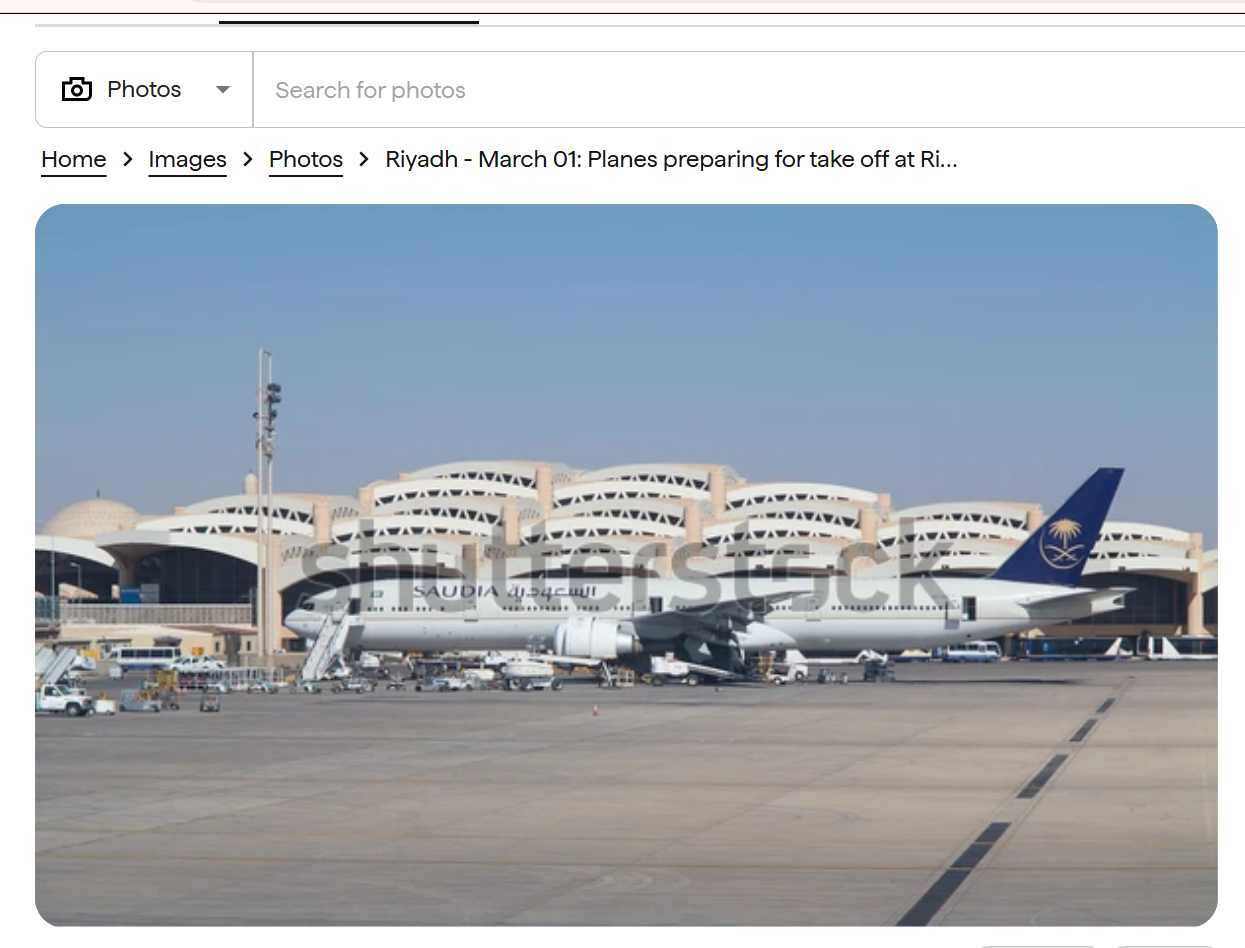
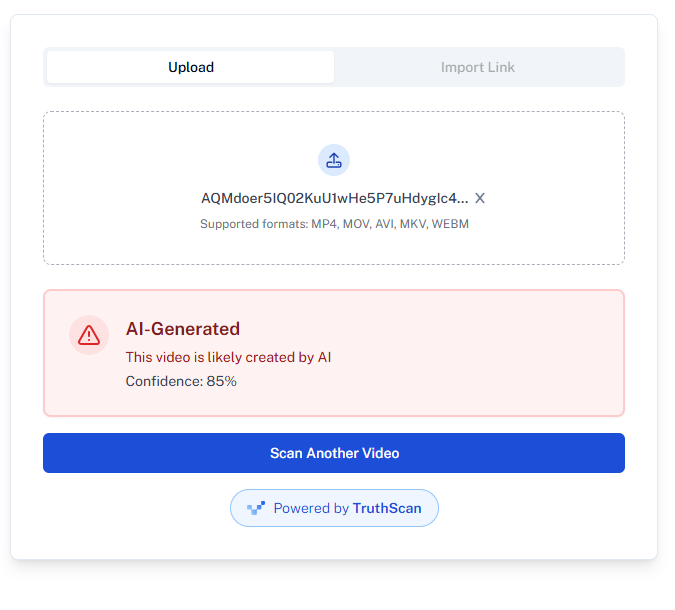
Upon closely examining the viral video, we suspected that it could be AI-generated. We then scanned the viral video using the AI detection tool Undetectable AI. According to the results, the video was found to be 85% AI-generated.
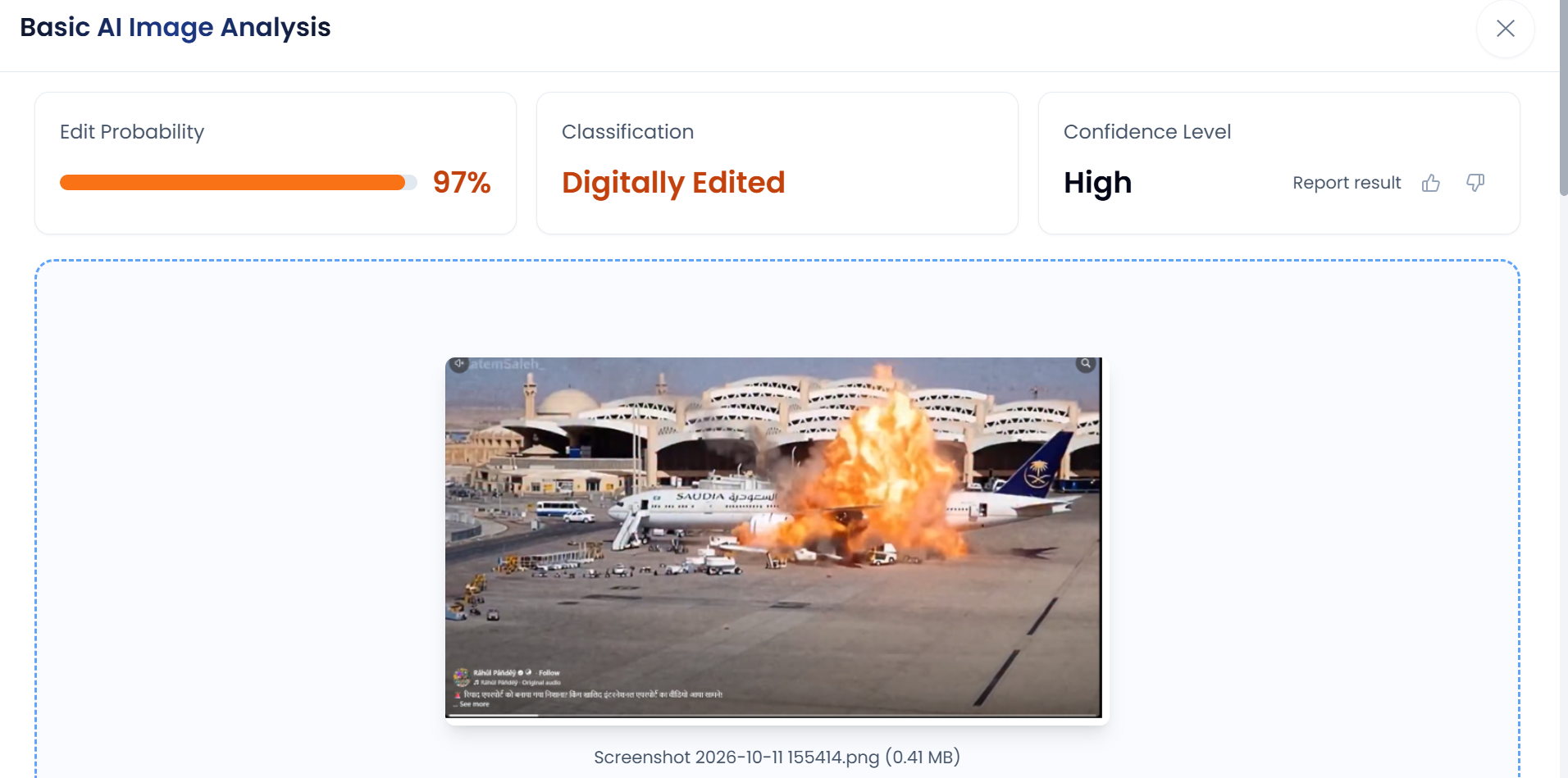
As part of our further research, we scanned the viral image using TruthScan. According to the results, the image was found to be 97% AI-generated.
Conclusion:
CyberPeace Research found the viral claim to be misleading. The video being shared as footage of the alleged Houthi missile attack on King Khalid International Airport in Riyadh is not authentic. Our research revealed that the video was AI-generated using a photograph taken at the airport on March 1, 2016. AI detection tools further indicated that the video and the image showed strong signs of being AI-generated.

Related Blogs

Introduction
Twitter Inc.’s appeal against barring orders for specific accounts issued by the Ministry of Electronics and Information Technology was denied by a single judge on the Karnataka High Court. Twitter Inc. was also given an Rs. 50 lakh fine by Justice Krishna Dixit, who claimed the social media corporation had approached the court defying government directives.
As a foreign corporation, Twitter’s locus standi had been called into doubt by the government, which said they were ineligible to apply Articles 19 and 21 to their situation. Additionally, the government claimed that because Twitter was only designed to serve as an intermediary, there was no “jural relationship” between Twitter and its users.
The Issue
In accordance with Section 69A of the Information Technology Act, the Ministry issued the directives. Nevertheless, Twitter had argued in its appeal that the orders “fall foul of Section 69A both substantially and procedurally.” Twitter argued that in accordance with 69A, account holders were to be notified before having their tweets and accounts deleted. However, the Ministry failed to provide these account holders with any notices.
On June 4, 2022, and again on June 6, 2022, the government sent letters to Twitter’s compliance officer requesting that they come before them and provide an explanation for why the Blocking Orders were not followed and why no action should be taken against them.
Twitter replied on June 9 that the content against which it had not followed the blocking orders does not seem to be a violation of Section 69A. On June 27, 2022, the Government issued another notice stating Twitter was violating its directions. On June 29, Twitter replied, asking the Government to reconsider the direction on the basis of the doctrine of proportionality. On June 30, 2022, the Government withdrew blocking orders on ten account-level URLs but gave an additional list of 27 URLs to be blocked. On July 10, more accounts were blocked. Compiling the orders “under protest,” Twitter approached the HC with the petition challenging the orders.
Legality
Additionally, the government claimed that because Twitter was only designed to serve as an intermediary, there was no “jural relationship” between Twitter and its users.
Government attorney Additional Solicitor General R Sankaranarayanan argued that tweets mentioning “Indian Occupied Kashmir” and the survival of LTTE commander Velupillai Prabhakaran were serious enough to undermine the integrity of the nation.
Twitter, on the other hand, claimed that its users have pushed for these rights. Additionally, Twitter maintained that under Article 14 of the Constitution, even as a foreign company, they were entitled to certain rights, such as the right to equality. They also argued that the reason for the account blocking in each case was not stated and that Section 69a’s provision for blocking a URL should only apply to the offending URL rather than the entire account because blocking the entire account would prevent the creation of information while blocking the offending tweet only applied to already-created information.
Conclusion
The evolution of cyberspace has been substantiated by big tech companies like Facebook, Google, Twitter, Amazon and many more. These companies have been instrumental in leading the spectrum of emerging technologies and creating a blanket of ease and accessibility for users. Compliance with laws and policies is of utmost priority for the government, and the new bills and policies are empowering the Indian cyberspace. Non Compliance will be taken very seriously, and the same is legalised under the Intermediary Guidelines 2021 and 2022 by Meity. Referring to Section 79 of the Information Technology Act, which pertains to an exemption from liability of intermediary in some instances, it was said, “Intermediary is bound to obey the orders which the designate authority/agency which the government fixes from time to time.”

The UN established its first permanent Global Mechanism for cybersecurity which will begin operations in March 2026. The policy framework for Western countries exists because their current strategies are being developed. The situation in India presents greater complexity and higher levels of interest than any other country.
The Fence That Became a Vantage Point
The United Nations cybersecurity talks have seen India actively participate since their start. India brought its proposal for an open and inclusive multilateral framework which was supported by Western states who wanted to establish universal norms and responsible state behaviour but India did not accept their geopolitical viewpoint.
India did not support the Russia-led bloc which wanted a permanent open-ended working group that would focus only on plenary meetings and the country also rejected the European Union's Program of Action. India maintained its previous stance by supporting multilateralism as a general principle while showing hesitation about backing specific power structures.
The fence now provides an advantage because it no longer serves as a point of vulnerability. India's non-alignment provides him with operational power because the body operates through decision-making which requires all members to agree.
Sovereignty First, Norms Second
The digital sovereignty framework which defines India's long-standing cybersecurity diplomatic activities serves as the country's fundamental cybersecurity diplomatic framework. New Delhi has been reluctant to endorse frameworks that could constrain how it manages its own cyberspace, whether through content regulation, surveillance architecture, or incident response. The Indian government establishes its control over internet governance through its implementation of VPN regulations and CERT-In reporting requirements and data localization discussions.
The new Global Mechanism creates a situation which India must handle because it creates an uncommon diplomatic situation. The framework's five pillars, threats, norms, international law, confidence-building measures, and capacity-building, each carry embedded assumptions that don't sit neatly with India's domestic policy posture. India supports the norm which prohibits countries from attacking each other's critical infrastructure while developing offensive cyber abilities and keeping its cyber response strategies secret.
The Capacity-Building Opening
The Indian government has a definite interest in dedicated thematic group 2 which focuses on building cybersecurity capacity. India exists in two opposing states because it operates as a developing nation which lacks basic national cybersecurity systems while also maintaining advanced cyber defense capabilities. The donor table exists as a platform which gives India both funding rights and complete rights to speak for developing nations. India should serve as a connecting force for DTG 2 by sharing its experience with CERT-In development and its sectoral frameworks for finance and telecom and its National Cyber Coordination Centre programs which train cybersecurity professionals while requesting capacity-building programs that follow demand-based needs assessment and local context understanding and which do not include the typical restrictions that accompany Western technical assistance.
India has done this before in other multilateral settings. The organization maintains its independence through its role as a credible Global South representative which it uses to speak for the Global South without aligning with any particular alliance.
The DTG 1 Question: Critical Infrastructure and Strategic Ambiguity
The DTG 1 study about ICT security challenges shows how resilience and cooperation and stability work together as different themes but creates complex challenges for India.
The 2020 Mumbai power grid incident which some researchers attribute to Chinese state-linked actors has become one of three major attacks against India's critical infrastructure together with AIIMS Delhi incidents in 2022 and ongoing cyber intrusions into defence and government networks. The international standards which govern critical infrastructure protection require actual implementation from India because the country possesses vital national assets.
India has not yet established formal processes for cyberattack attribution while its officials avoid the norm-enforcement diplomacy which Western countries practice through their coordinated attribution and sanction procedures.
India must either develop deeper transparency about its operations or create specialized operational plans which can keep its needed information undercover if it wants to participate in DTG 1 about cross-border interdependencies and incident response collaboration. India will likely engage selectively, supporting the idea of critical infrastructure norms while resisting mechanisms that operationalise accountability.
Geopolitical Triangulation
The new Global Mechanism needs countries to implement their national policies because states must stop merely restating their positions. Multilateral cybersecurity forums operate as Geopolitical triangulation platforms for India. India's security system must protect its interests against its two main cyber adversaries which include China and Pakistan-based groups.
The US and EU strategic partnership between India and these Western governments requires India to show closer ties with democratic nations through its participation in international forums. The new Global Mechanism will require India to pursue its current position by participating in capacity-building activities while developing common norms through its work on general norms language.
India will maintain its current position between Western liberal order enforcement and Russia-China sovereignty-maximalist counter-narrative through its capacity-building activities and general norms language work.
What India Should Actually Do
The document establishes core argument which states early DTG development needs to be established for proper assessment of future results which applies to Indian territory and European territory. India has the credibility and technical foundation and diplomatic ties which enable it to establish itself as an agenda-setter who takes proactive actions instead of following others. India should take the following actions to achieve its goals: lead or co-lead DTG 2 discussions which focus on the capacity requirements of the Global South while advancing DG 1 areas that protect developing nations from actual threats and establish South-South cybersecurity agreements through this system which will help them bypass Western capacity development restrictions. The Global Mechanism offers an essential multilateral platform which provides advantages to countries that take initial actions. India has the ability to make an impact because it possesses strategic advantages which will be activated through its choice between active participation and total disengagement.
References
- http://interface-eu.org/publications/the-new-united-nations-mechanism-on-cybersecurity#a-european-strategy-for-the-dtgs
- https://disarmament.unoda.org/en/our-work/emerging-challenges/developments-field-information-and-telecommunications-context
- https://www.recordedfuture.com/research/redecho-targeting-indian-power-sector
- https://www.saikrishnaassociates.com/cert-in-issues-directions-for-information-security-practices-procedure-prevention-response-and-reporting-of-cyber-incidents/
Executive Summary
A video widely circulated on social media claims to show a confrontation between a Zee News journalist and Chief of Army Staff (COAS) General Upendra Dwivedi during the Indian Army’s Annual Press Briefing 2026. The video alleges that General Dwivedi made sensitive remarks regarding ‘Operation Sindoor’, including claims that the operation was still ongoing and that diplomatic intervention by former US President Donald Trump had restricted India’s military response. Several social media users shared the clip while questioning the Indian Army’s operational decisions and demanding accountability over the alleged remarks. The CyberPeace concludes that the viral video claiming to show a discussion between a Zee News journalist and Chief of Army Staff General Upendra Dwivedi on ‘Operation Sindoor’ is misleading and digitally manipulated. Although the visuals were sourced from the Indian Army’s Annual Press Briefing 2026, the audio was artificially created and added later to misinform viewers. The Army Chief did not make any remarks regarding diplomatic interference or limitations on military action during the briefing.
Claim:
An X (formerly Twitter) user, Abbas Chandio (@AbbasChandio__), shared the video on January 14, asserting that it showed a Zee News journalist questioning the Army Chief about the status and outcomes of ‘Operation Sindoor’ during a recent press conference. In the clip, the journalist is purportedly heard challenging the Army Chief over his earlier statement that the operation was “still ongoing,” while the COAS is allegedly heard responding that diplomatic intervention during the conflict limited the Army’s ability to pursue further military action. Here is the link and archive link to the post, along with a screenshot.
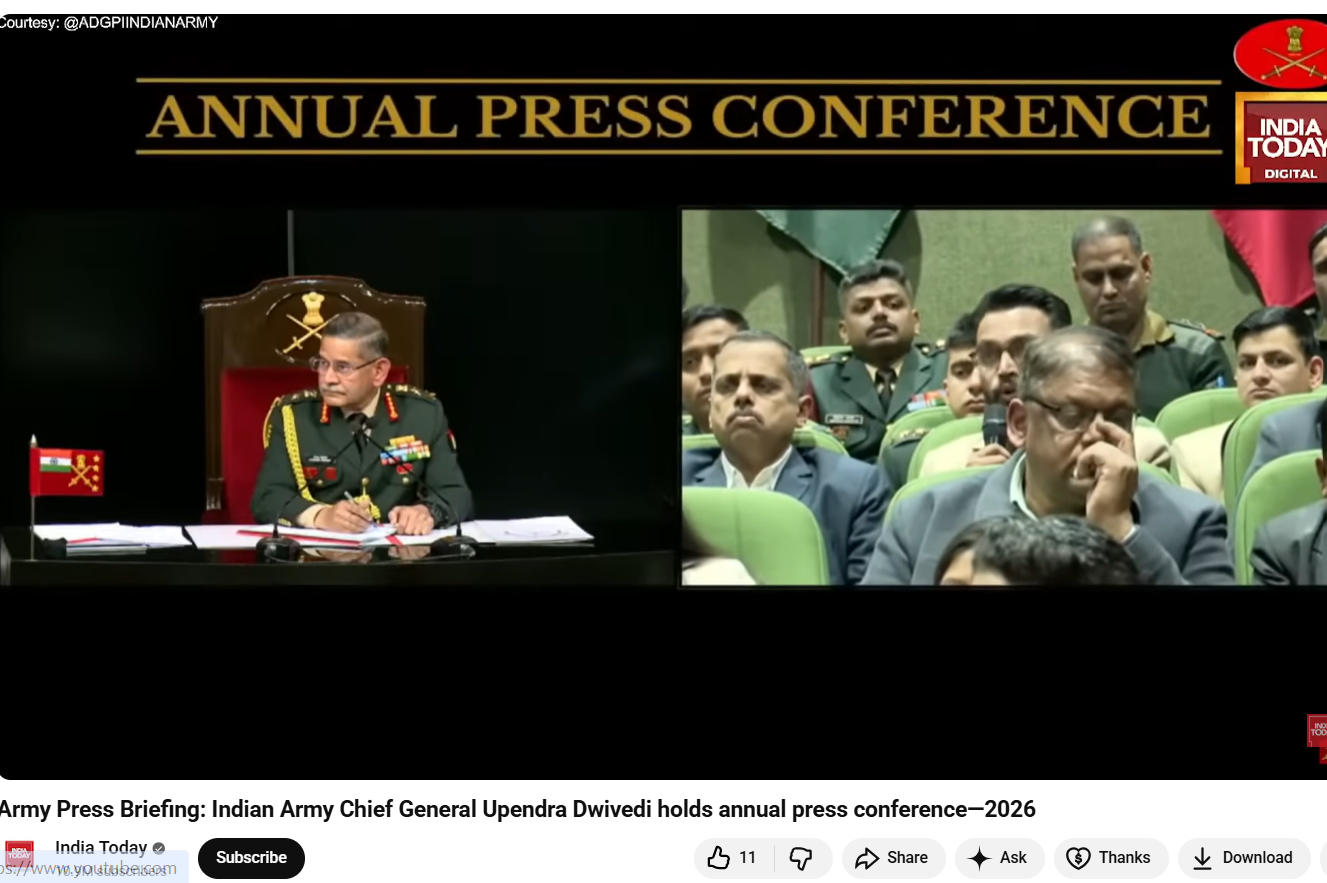
The reverse image search also directed to an extended version of the footage uploaded on the official YouTube channel of India Today. The original video was identified as coverage from the Indian Army’s Annual Press Conference 2026, held on January 13 in New Delhi and addressed by COAS General Upendra Dwivedi. Upon reviewing the original press briefing footage, CyberPeace found no instance where a Zee News journalist questioned the Army Chief about ‘Operation Sindoor’. There was also no mention of the statements attributed to General Dwivedi in the viral clip.
In the authentic footage, journalist Anuvesh Rath was seen raising questions related to defence procurement and modernization, not military operations or diplomatic interventions. Here is the link to the original video, along with a screenshot.
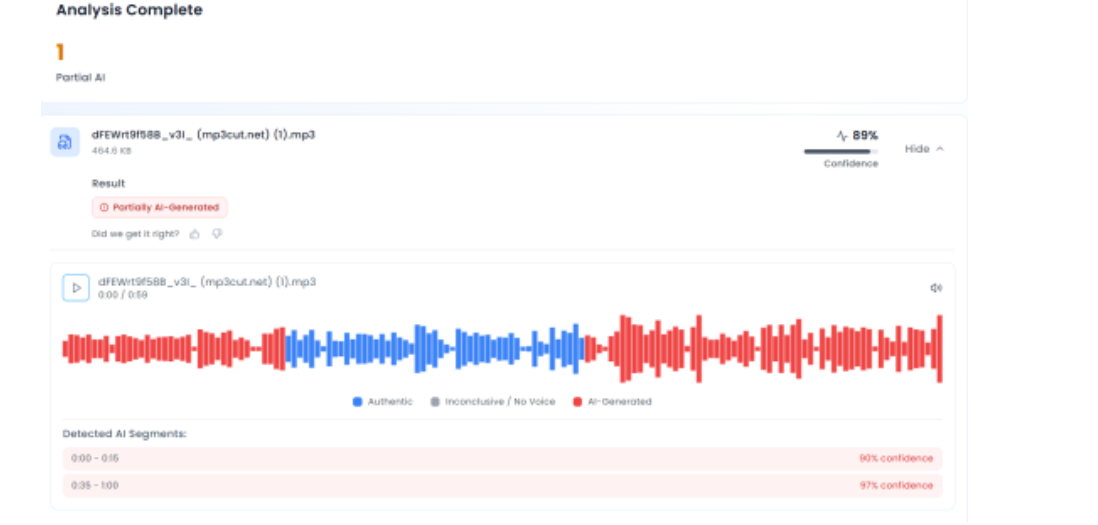
To further verify the claim, CyberPeace extracted the audio track from the viral video and analysed it using the AI-based voice detection tool Aurigin. The analysis revealed that the voice heard in the clip was artificially generated, indicating the use of synthetic or manipulated audio. This confirmed that while genuine visuals from the Army’s official press briefing were used, a fabricated audio track had been overlaid to falsely attribute controversial statements to the Army Chief and a Zee News journalist.
Conclusion
The CyberPeace concludes that the viral video claiming to show a discussion between a Zee News journalist and Chief of Army Staff General Upendra Dwivedi on ‘Operation Sindoor’ is misleading and digitally manipulated. Although the visuals were sourced from the Indian Army’s Annual Press Briefing 2026, the audio was artificially created and added later to misinform viewers. The Army Chief did not make any remarks regarding diplomatic interference or limitations on military action during the briefing. The video is a clear case of digital manipulation and misinformation, aimed at creating confusion and casting doubts over the Indian Army’s official position.
