
#FactCheck -Viral Video of Israeli Strike in Lebanon Misrepresented as Iranian Attack on US Base in Kuwait
Executive Summary
Amid heightened tensions in West Asia following the conflict involving the United States, Israel and Iran, a video showing a large explosion behind a building is being widely shared on social media.
Users claim that the footage shows an Iranian missile strike on a US military base in Kuwait. However, CyberPeace Research Wing research found the claim to be misleading. The viral video is actually from an Israeli airstrike in southern Lebanon. While Kuwait said its air defence systems intercepted missiles and drones during regional hostilities, the viral footage has no connection to any alleged attack on a US base in Kuwait.
Claim
An Instagram user, “indiscope24hr,” shared the video on May 28, 2026, with text overlaid on the clip stating:“Iran launches a deadly missile attack on a US base in Kuwait.”The caption claimed that Iran targeted a US airbase in retaliation for American military action and that Kuwait’s air defence systems were intercepting incoming missiles and drones.

Fact Check
To verify the claim, we extracted key frames from the viral video and conducted a reverse image search using Google Lens. This led us to a post shared on May 28, 2026, by the Instagram account “iltv_israel,” which identified the footage as an Israeli Air Force strike on a Hezbollah target in the southern Lebanese city of Tyre.

Further research found the same footage in a video report uploaded by the New York Post’s YouTube channel on May 28, 2026. According to the report, Israel carried out strikes targeting Hezbollah positions in Tyre, southern Lebanon.

We also found the clip in a video report published by NBC News. The report stated that Israel intensified strikes in southern Lebanon despite an existing ceasefire agreement.
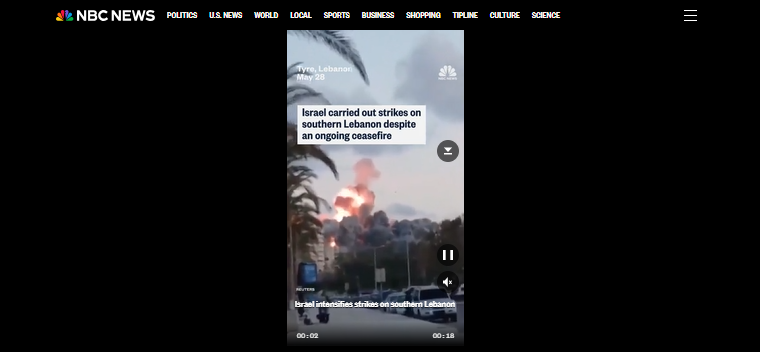
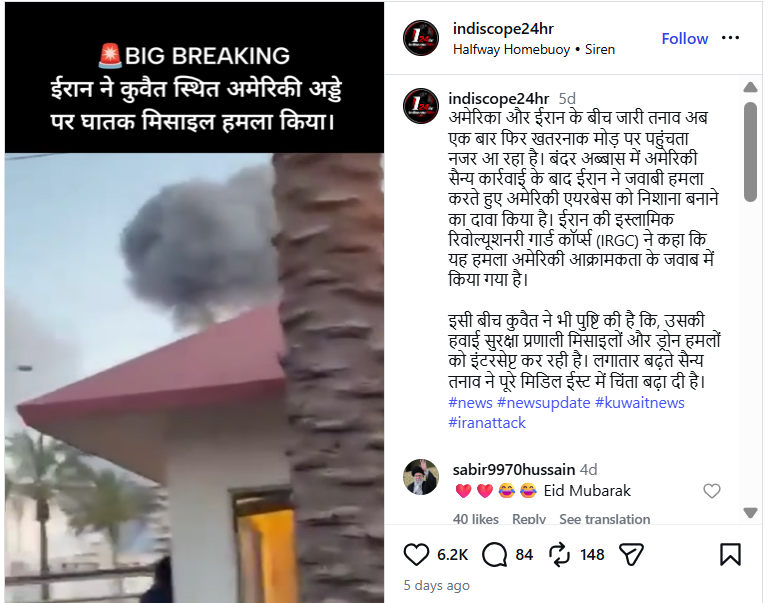
The matching visuals across these reports confirm that the viral footage originated from Lebanon and not from Kuwait.
Conclusion
The viral claim is misleading. The video does not show an Iranian missile strike on a US military base in Kuwait. It actually depicts an Israeli airstrike carried out in the Lebanese city of Tyre on May 28, 2026, and is being shared with a false context on social media.

Related Blogs

Introduction
CyberPeace Chronicles is a one-stop for the latest edition of news, updates, and findings in global cyberspace. As we step into the cyberage, it is pertinent that we need to incorporate cybersecurity practices in our day-to-day activities. From laptops to automated homes and cars, we are all surrounded by technology in some form or another. Thus, with the increased dependency, we need to eradicate the scope of vulnerabilities and threats around us and create robust and sustainable safety mechanisms for us and future generations.
What, When and How?
- WIN-RAR Update: CVE-2023-33831, a serious vulnerability, was identified in WinRAR versions prior to 6.23 in April 2023. When users attempted to access seemingly harmless files inside ZIP archives, this vulnerability allowed attackers to run arbitrary code. Cybercriminals transmitted malware families like DarkMe, GuLoader, and Remcos RAT by taking advantage of this vulnerability. It is essential to update WinRAR to version 6.23 or later in order to protect your computer and your data. Follow the following steps to secure your device -
- Checking Your Current WinRAR Version
- Downloading the Latest WinRAR Version
- Installing the Updated WinRAR
- Completing the Installation
- Verifying the Update
- Cleaning Up
- Indonesian Hacker Groups Target Indian Digital Infrastructure: As India geared up to host the G20 delegation as part of the Leadership Summit, various reports pointed towards different forms and intensity-based cyber attacks on Indian organisations and digital infrastructure. Tech firms in India have been successful in tracing the origination of the attacks to be from Indonesia. It is believed that hacker groups backed by anti-India elements have been trying to target the digital resources of India. Organisations and central agencies like Computer Emergency Response Team (CERT-In), National Critical Information Infrastructure Protection Centre (NCIIPC), I4C (Indian Cybercrime Coordination Centre), Delhi Police, Intelligence Bureau (IB), Research and Analysis Wing (R&AW), National Investigation Agency (NIA) and Central Bureau of Investigation (CBI) have constantly been working in keeping the Digital interests of India safe and secure, and with the ongoing G20 summit, it is very pertinent to be mindful of potential threats prevailing to prepare counter tactics for the same.
- CLOP Ransomware: The CL0P ransomware is thought to have initially surfaced in 2019 and was developed by a cybercriminal organisation that spoke Russian. The threat actor FIN11 (also known as TA505 and Snakefly), who is notorious for being financially driven, is frequently connected to the CL0P ransomware, which had its roots at the beginning of 2019. By utilising this technique, CL0P has targeted businesses utilising the "Accellion FTA" file transfer appliance's vulnerable version. Accordingly, it has been asserted that the following vulnerabilities have been used to access victim data and maybe switch to victim networks. Numerous well-publicized attacks carried out by CL0P have had an impact on organisations all across the world. Especially for Managed File Transfer (MFT) programmes, the CL0P performers are well known for their talent in developing zero-day vulnerabilities. The gang went after Accellion File Transfer Appliance (FTA) devices in both 2020 and 2021, then early in 2023, they went after Fortran/Linoma GoAnywhere MFT servers, and then later in June, they went after MOVEit transfer deployments. Up to 500 organisations are thought to have been harmed by this aggressive operation. Some of the ways to mitigate the risk are as follows:
- Regular Software Updates: Updating programmes and systems helps prevent known security flaws that fraudsters frequently exploit.
- Employee Training: Employee training can significantly lower the likelihood of successful penetration by educating staff members about phishing scams and safe internet conduct.
- Network Segmentation: By separating networks and restricting lateral movement, a ransomware attack's potential effects can be reduced.
- Regular Data backups: Data backups can lessen the effects of encryption and deter payment by regularly backing up data and storing it offsite.
- Security solutions: Putting in place effective cybersecurity measures like firewalls, intrusion detection systems, and cutting-edge endpoint protection can greatly improve an organisation's defences.
- Increased scrutiny for SIM card vendors: As phishing and smishing scams are on the rise in India, the Telecom Regulatory Authority of India (TRAI) has repeatedly issued notifications and consultation papers to address this growing concern. Earlier this year, TRAI notified that promotional calling will not be continued from 10-digit personal numbers. Instead, companies will now have to take authorised 9-digit numbers for promotional calls and SMSs. Similarly, to increase the efficiency of the same, TRAI has laid down that all the SIM card vendors will now have to be verified again, and any discrepancy found against any of the vendors will lead to blacklisting and penal actions against the vendor.
Conclusion
In conclusion, the digital landscape in 2023 is rife with both opportunities and challenges. The recent discovery of a critical vulnerability in WinRAR underscores the importance of regularly updating software to protect against malicious attacks. It is imperative for users to follow the provided steps to secure their devices and safeguard their data. Furthermore, the cyber threat landscape continues to evolve, with Indonesian hacker groups targeting Indian digital infrastructure, particularly during significant events like the G20 summit. Indian organisations and cybersecurity agencies are working diligently to defend against these threats and ensure the security of digital assets. The emergence of ransomware attacks, exemplified by the CL0P ransomware, serves as a stark reminder of the need for robust cybersecurity measures. Regular software updates, employee training, network segmentation, data backups, and advanced security solutions are crucial components of a comprehensive defence strategy against ransomware and other cyber threats. Additionally, the Telecom Regulatory Authority of India's efforts to enhance security in the telecommunications sector, such as stricter verification of SIM card vendors, demonstrate a proactive approach to addressing the rising threat of phishing and smishing scams. In this dynamic digital landscape, staying informed and implementing proactive cybersecurity measures is essential for individuals, organisations, and nations to protect their digital assets and maintain a secure online environment. Vigilance, collaboration, and ongoing adaptation are key to meeting the challenges posed by cyber threats in 2023 and beyond.

Introduction
In today's relentless current of information, where social media is oftentimes both the stage and the playwright, the line between reality and spectacle can become distressingly blurry. In such a virtual Pantheon, the conflation of truth and fiction has recently surfaced in a particularly contentious instance. The central figure is Poonam Pandey, an entertainment personality known for transgressing traditional contours of celebrity boldness. Pandey found herself ensnared in a narrative of her own orchestration—a grim hoax purporting she had succumbed to cervical cancer. This deceptive foray, rather than awakening public consciousness as intended, spiralled into an ominous fable about the malignant spread of misinformation and the profound moral dilemmas it engenders.
The Deception
The tapestry of this event was woven with threads of tragedy and deception, framing Pandey both as the tragic hero and the ill-fated architect of a spectacle that unfolded with a haunting familiarity evocative of ancient Greek dramas. The monumental pillar of social media, on what seemed to be an ordinary day, was shattered by the startling declaration of Pandey's untimely passing. The statement, as bereft of nuance as it was devastating, proclaimed: 'We are deeply grieved to announce the loss of our cherished Poonam to cervical cancer.' The emotional pulse of the Indian Film Industry was jolted; waves of homage inundated the digital space, each tribute a poignant echo of the shock that rippled through her fanbase. Yet the crux of the matter had yet to be unveiled.
As the world grappled with this news, the scenario took an unforeseen detour. Poonam Pandey made a re-entrance onto the world stage, alive, revealing her alleged demise to be nothing more than a macabre masquerade. The public's reaction to this revelation was a stratified symphony of emotions—indignation mingled with disbelief, with an underlying crescendo of betrayal. Pandey's defense postured her act as a last resort to draw attention to the silent yet pervasive threat of cervical cancer. In the ensuing mire of reactions, an inescapable quandary emerged: is it ever permissible to employ deceit for the sake of presumed publicity?
The Chaos
Satyajeet Tambe, an esteemed Maharashtra legislator, emerged amidst the churning chaos as a paragon of principled reason. Advocating that such mendacious stunts, playing the chords of public emotion and adulterating truth, should be met with legal repercussions, Tambe called for judicious action against Pandey. His imploration resonated with the necessity of integrity in the public domain, stating, 'The announcement of an influencer/model succumbing to cervical cancer should not be wielded as a tool for awareness.' His pronouncement sent reverberations through the collective conscience, echoing the need for accountability in the face of such transgressions.
Repercussion
The All Indian Cine Workers Association, a custodian of the film industry's values, also voiced its reproach. They urged for an FIR to be lodged against Poonam Pandey, underlining their sentiments with disappointment and a keen sense of betrayal. Within their condemnation lay a profound recognition of the elevated emotional investment inherent in their industry—an industry where the reverence for life and the abhorrence of deceit intertwine, making the cultivation of such lowly stunts anathema.
This spectacle, while unique in the temerity of its execution, mirrors the broader pathological wave of misinformation that corrodes the foundations of our digital era: the malady of fake news. When delineated, fake news finds its essence as information chiselled specifically to deceive, a form of communication that is not merely slanted but entirely devoid of authenticity, manufactured with nefarious intent. A protean adversary, fake news adeptly masquerades as trustworthy news, ensnaring the unsuspecting in its tendrils. Its purveyors span a spectrum—from shadowy figures to ostensibly benign social media accounts—all contributing to a dystopian fabric where truth is persistently imperilled.
The conjurers of these illusions are, in a sense, cunning illusionists ensconced behind curtains of anonymity or masquerading under a cloak of transparency. They craft elaborate illusions devoid of truth, but dripping with sufficient plausibility to ensnare those who yearn for simplicity in an increasingly complex world. Destabilizing forces, such as hyper partisan media outlets, regurgitate a concoction of concocted 'facts' and distortions, deliberately smudging the once-clear line between empirical truth and partisan fabrication.
The Aftermath
The Poonam Pandey episode stands as a harrowing beacon of the ethical abyss we face. It compels us to confront the irony of utilising falsity to raise awareness for laudable causes and considers the ramifications for public figures influencing the dissemination of information. The tempest around this event demonstrates the potent gravitational pull of information and the overarching need for the conscientious stewardship of its power.
Yet, as we sail through the murky waters of the digital expanse, where the allure of sensationalism and clickbait headlines is ever-present, our vigilance must not wane. The imperative of truth cannot come at the altar of awareness or sensationalism. The sanctity of fact anchors our understanding of reality; devoid of it, we are adrift in an ocean of confusion and misinformation.
In the dust settled after the Poonam Pandey debacle, the contours of a new discourse have emerged, harboring vital interrogations. How do we balance the drive for poignant awareness initiatives against the cardinal principle of truth? What mechanisms can ensure that health campaigns and their noble aspirations are not tainted by the allure of deception? Addressing these queries is not a solitary task for policymakers or influencers but, indeed, a collective societal responsibility that will define our cultural ethics and the legacy we wish to preserve.
Conclusion
As we contemplate the broader implications of this incident, let us not allow its sensational nature to eclipse the very real and pressing issue of cervical cancer—a condition that, beyond the glare of controversy, continues to shadow lives with its lethal silence. Instead, let our focus pivot towards tangible, truth-driven efforts aimed at education and empowerment. Truth, after all, is the beacon that dispels the murky shadows of ignorance and guides us toward enlightenment and healing.
References
- https://www.hindustantimes.com/india-news/poonam-pandey-in-trouble-as-maharashtra-politician-seeks-case-for-faking-her-death-101707005742992.html
- https://www.nagpurtoday.in/state-mlc-tambe-demands-police-action-against-poonam-pandey-for-faking-her-death/02051417
Executive Summary
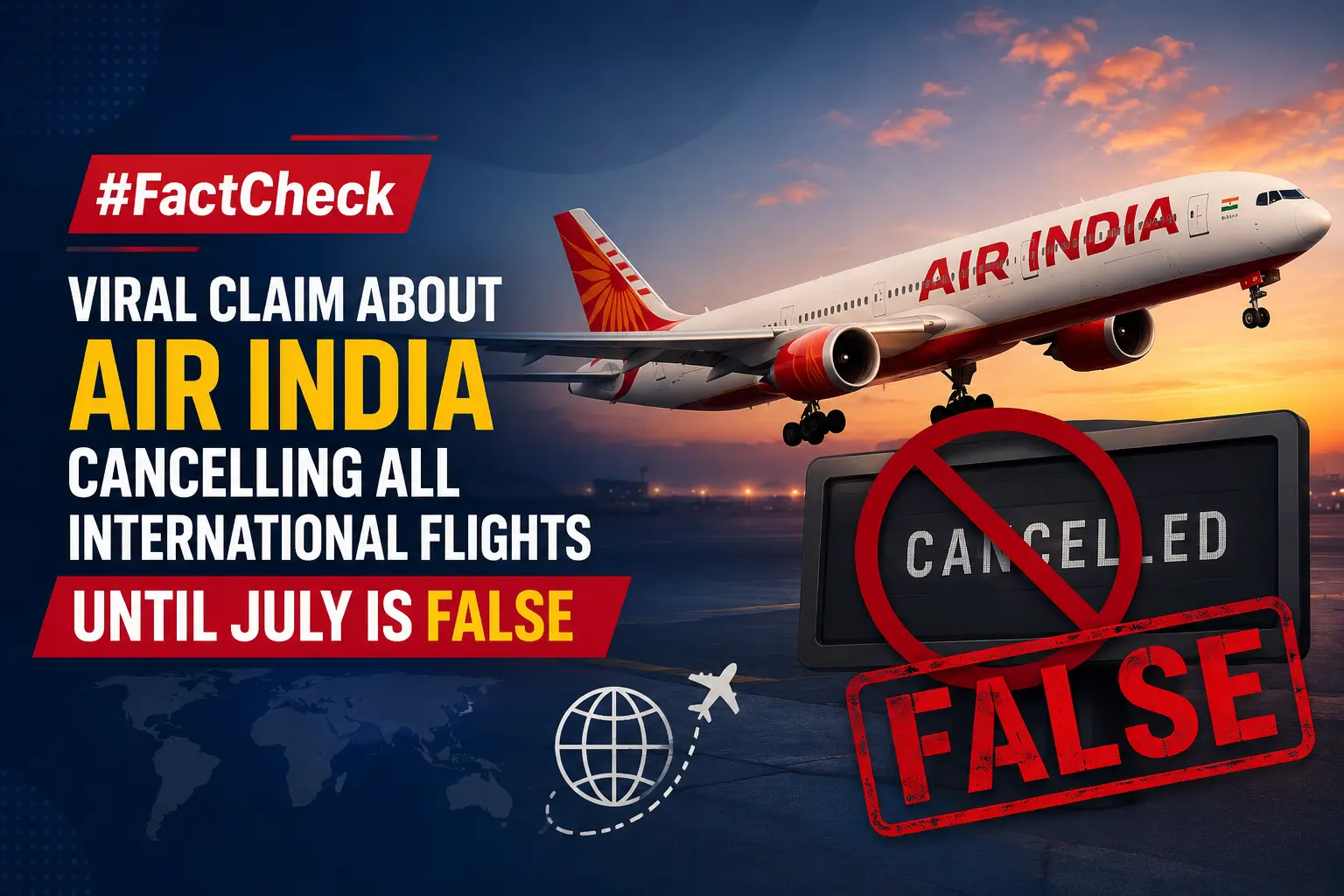
A video circulating on social media falsely claims that Air India has cancelled all of its international flights until July due to a fuel shortage. However, research conducted by CyberPeace Research Wing found the claim to be misleading and false. Our research revealed that Air India has made no announcement regarding the cancellation of all international flights. In reality, the airline has only made temporary reductions and adjustments on select international routes due to increasing operational pressure and the impact on profitability.
Claim
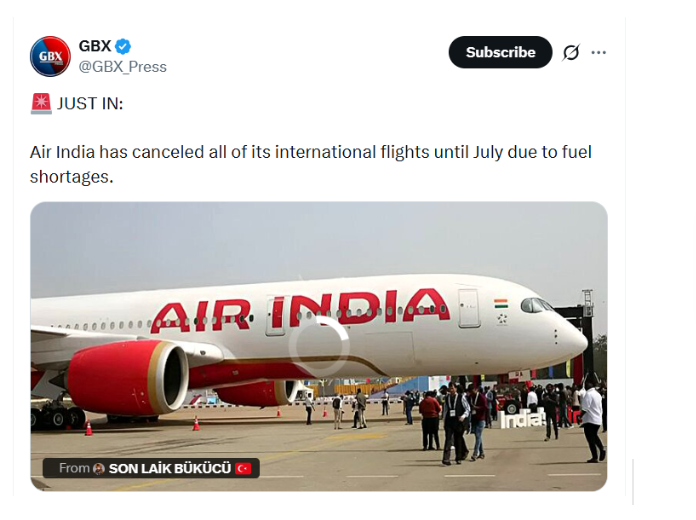
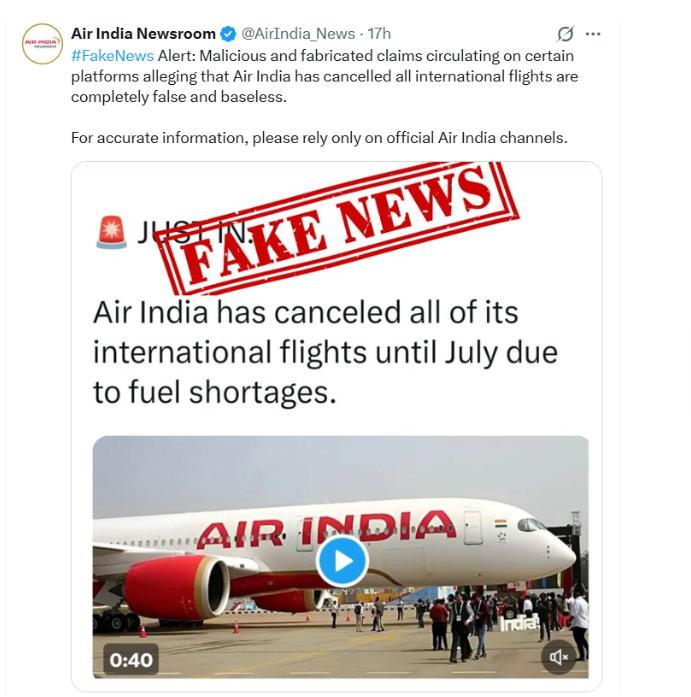
An X (formerly Twitter) user shared the viral video on May 3, 2026, claiming: “Due to a fuel shortage, Air India has cancelled all its international flights until July.”he post quickly gained attention and was widely shared on social media platforms.
Fact Check
To verify the claim, we examined the official social media accounts of Air India. During the research, we found a post on X in which the airline itself described the viral claim as fake and misleading.
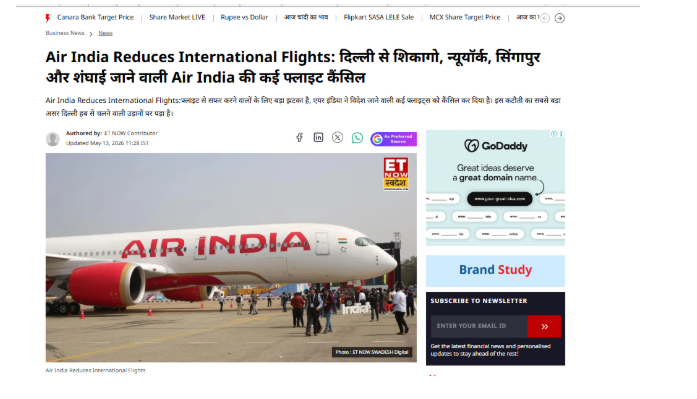
Taking the research further, we searched using relevant keywords and found a report published by ETNOW Swadesh on May 13, 2026. According to the report, Air India has not cancelled all international flights. Instead, due to mounting operational costs and pressure on profitability, the airline has temporarily reduced or modified services on a few select international routes.
Conclusion
Our research found that Air India has not announced the cancellation of all international flights until July. The viral claim circulating on social media is false and misleading. The airline has only implemented temporary adjustments and reductions on certain international routes, not a complete suspension of global operations.
