
From Deepfakes to Due Diligence - Decoding India’s IT Amendment Rules
Introduction
The digital ecosystem has undergone a profound transformation due to the rapid growth of artificial intelligence, especially through its generative applications. While this progress has introduced innovative technologies, it has also intensified the risks of deepfakes, misinformation, and identity theft. The Information Technology (Intermediary Guidelines and Digital Media Ethics Code) Amendment Rules, 2026, introduced by the Government of India, mark an important step toward stronger digital governance and greater oversight of online activities. These latest amendments establish new regulatory standards and represent India’s most comprehensive effort so far to address synthetically generated information, including AI created audio, video, and images that closely imitate reality.
Understanding the Core Shift: From Reactive to Proactive Regulation
The 2026 amendment establishes its main characteristic through its shift from a reactive compliance system to a proactive due diligence system. Intermediaries must now operate as active participants who take responsibility for detecting, marking and controlling dangerous material instead of functioning as neutral channels. The rules establish an official definition for stands for Synthetically Generated Information(SGI), which they protect through legal regulations, while they address issues such as impersonation scams, election manipulation and non-consensual deepfake content. The current transition represents a worldwide pattern that shows that governments are starting to make online platforms responsible for the material they display.
Key Provisions of the IT Amendment Rules, 2026
1. Mandatory Labelling of AI-Generated Content
Platforms must ensure that all AI-generated content is clearly labelled or watermarked to distinguish it from authentic media. Users must reveal their uploaded content's synthetic origin while platforms must confirm the information.
2. The 3-Hour Takedown Rule
The most contentious aspect of this regulation establishes new rules that require content removal to be processed within much shorter timeframes.:
- The government and courts grant three-hour time limits for removing unlawful content.
- The two-hour deadline applies to media that includes non-consensual intimate imagery.
The current time frame allows content removal within three hours, which represents a major decrease from the previous content removal time, which lasted between 24 and 36 hours, because online misinformation needs urgent attention.
3. Traceability and Metadata Requirements
The rules require AI-generated content to include both digital fingerprints and metadata, which enables traceability and accountability through their embedded digital fingerprints. The provision serves as an essential tool for law enforcement to investigate cases while it helps identify which parties generated harmful content.
4. Safe Harbour Conditionality
Intermediaries who do not meet the following three conditions risk losing their safe harbour protection through Section 79 of the IT Act:
- The first requirement demands that intermediaries must implement proper labelling.
- The second requirement demands that intermediaries must complete their takedown responsibilities within specific timeframes
- The third requirement demands that intermediaries must complete their due diligence tasks.
This development represents a major transition for digital platforms, which will face increased responsibility for their actions.
5. Strengthened Grievance Redressal
The amendment establishes two new requirements for platforms. The amendment requires platforms to create systems that operate at all times to monitor their compliance with regulations.
Significance: Why These Rules Matter
The 2026 amendments are significant for multiple reasons:
- The rules require labelling and rapid content removal, which helps to stop the viral dissemination of misleading information.
- The framework provides better identity protection, defamation defence and protection against non-consensual imagery.
- The new rules make intermediaries responsible for their own compliance failures.
- The regulation of AI-generated misinformation protects democratic processes during electoral periods and public discussions.
The rules demonstrate India's goal to establish international standards for AI governance and digital responsibility.
Challenges and Concerns
The amendments present key issues that exist despite their positive aspects:
- The process of removing content at high speed creates risks for legitimate expression because safeguards need to be established through careful planning.
- The technical and infrastructural requirements governing compliance create financial burdens for smaller platforms that operate as intermediaries.
The existing challenges demonstrate the necessity for a solution that protects both human rights and security needs.
Conclusion
The IT Amendment Rules, 2026, establish a critical turning point for India's progress toward digital governance. The framework aims to establish a more secure digital environment through its solution of AI-generated content and deepfake detection problems, which create transparency and accountability issues. The rules will achieve their goals through proper implementation, which requires creating quick enforcement methods that protect both legal processes and free speech rights. The ongoing development of AI technology requires regulatory systems to keep changing while including all citizens and upholding democratic principles.
References
- https://vajiramandravi.com/current-affairs/it-rules-amendment-2026
- https://indianexpress.com/article/legal-news/indias-new-3-hour-deepfake-removal-rule-experts-urge-strict-compliance-10528122
- https://timesofindia.indiatimes.com/technology/tech-news/governments-new-it-rules-make-ai-content-labelling-mandatory-give-google-youtube-instagram-and-other-platforms-3-hours-for-takedowns/articleshow/128157496.cms
- https://www.drishtiias.com/daily-updates/daily-news-analysis/information-technology-amendment-rules-2026
- https://visionias.in/current-affairs/news-today/2026-02-11/science-and-technology/government-notified-the-information-technology-intermediary-guidelines-and-digital-media-ethics-code-amendment-rules-2026

Related Blogs

Executive Summary
As India concluded its 77th Republic Day celebrations on January 26, 2026, with grandeur and patriotic enthusiasm along the iconic Kartavya Path, a video began circulating on social media claiming to show Indian security personnel failing to perform motorcycle stunts during the ceremonial parade. The short clip allegedly depicts soldiers attempting high-risk, synchronised motorcycle manoeuvres, only to lose balance and fall off their bikes. The visuals were widely shared online with mocking captions, suggesting incompetence during a nationally televised event. However, an research by the CyberPeace found that the video is not authentic and was digitally generated using artificial intelligence.
Claim
A Pakistan-based X user, Sadaf Baloch (@sadafzbaloch), shared the video on January 27, claiming it showed Indian security personnel failing to execute motorcycle stunts during the Republic Day parade held on January 26, 2026. While sharing the clip, the user wrote:“Every time the Indian Army tries a tactical stunt, it looks less like combat training and more like a low-budget circus trailer filmed in one take.”The post was widely circulated with similar narratives questioning the professionalism of Indian forces.
Here is the link and archive link to the post, along with a screenshot.

To verify the authenticity of the viral video, the Desk conducted a detailed frame-by-frame analysis. During the examination, a watermark linked to ‘Sora’—an AI text-to-video generation model was detected at the 00:05 timestamp. The presence of this watermark strongly indicated that the video was artificially generated and not recorded during a real-world event.

Fact Check:
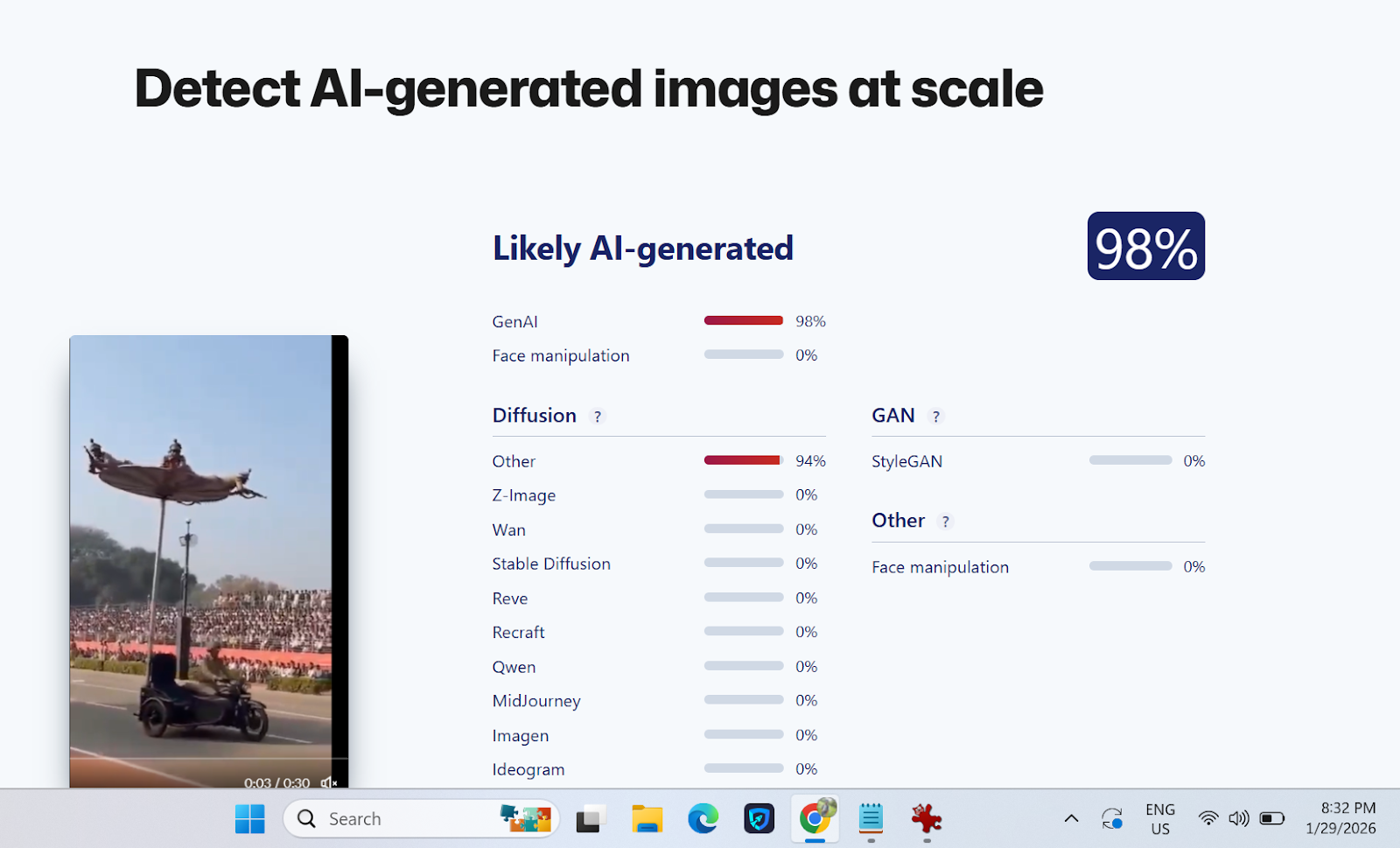
Further visual scrutiny revealed several inconsistencies commonly associated with AI-generated content. The background appeared unnatural and lacked realistic depth, while the movements and reactions of the security personnel looked mechanically exaggerated and inconsistent with real physics. Facial expressions and body motions during the alleged falls also appeared unrealistic. To strengthen the verification, the Desk analysed the clip using Sightengine, an AI-detection tool. The results showed a 98 per cent probability that the video contained AI-generated or deepfake elements.
Below is a screenshot of the result.
As part of the research , the Desk also conducted a customised keyword search and reviewed official coverage of the Republic Day parade. A full-length video broadcast by DD News on its official YouTube channel was examined. The footage showed joint CRPF and SSB motorcycle teams performing traditional daredevil stunts without any mishap. No incident resembling the viral claim was found in the official broadcast or in any credible media reports.
Here is the video link and a screenshot.

Conclusion
The CyberPeace research confirms that the viral video purportedly showing Indian security personnel failing to perform motorcycle stunts during the 77th Republic Day parade is AI-generated. The clip has been falsely circulated online as genuine content with the intent to mislead viewers and spread misinformation.

Executive Summary
Muslims offering prayers inside a crowded train in Japan is being widely shared on social media, amid ongoing discussions around the country’s alleged rise in anti-immigration sentiment. The clip is being presented as a recent and real incident. However, an research reveals that the video is not authentic. Experts noted that the prayer postures shown in the clip do not align with standard Islamic practices, raising doubts about its credibility. Further analysis indicates that the video has been generated using artificial intelligence (AI).
Claim
A user shared the viral video on YouTube, showing a group of men—mostly dressed in long tunics and skullcaps—appearing to offer prayers inside a moving subway train. Passengers can be seen seated on both sides of the carriage. In the clip, two men are kneeling on the floor and bowing their heads onto a small mat placed in front of them, with their heads coming very close to the knees of seated passengers. Another man is seen bending forward at the waist while standing, and a fourth appears to be standing upright with his eyes closed.
- Link: https://www.youtube.com/shorts/cZHMCUgbDIA

,
Fact Check
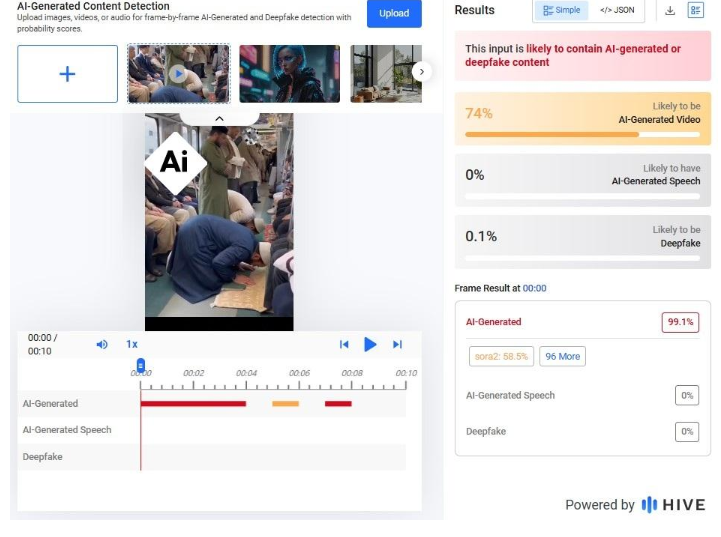
A closer examination of the video reveals several visual inconsistencies. One passenger appears to be fused with the seat rails, creating a distorted overlap. Others seem to be seated in areas where seats do not normally exist, such as directly in front of a door. Additionally, an advertisement visible in the background appears blurred and oddly shaped—another common indicator of AI-generated content. An analysis conducted using the Hive Moderation tool found that the video is “likely to contain AI-generated or deepfake content.”
Conclusion
The viral claim is misleading. The video does not depict a real incident in Japan. Instead, it is likely AI-generated content being circulated with a false narrative, misrepresenting both the context and religious practices shown in the clip.

Introduction
Cyber attacks are becoming increasingly common and most sophisticated around the world. India's Telecom operator BSNL has allegedly suffered a data breach. Reportedly, Hackers managed to steal sensitive information of BSNL customers and the same is now available for sale on the dark web. The leaked information includes names email addresses billing details contact numbers and outgoing call records of BSNL customers victims include both BSNL fibre and landline users. The threat actor using Querel has released a sample data set on a dark web forum and the data set contains 32,000 lines of leaked information the threat actor has claimed that the total number of lines across all databases amounts to approximately 2.9 Million.
The Persistent Threat to Digital Fortresses
As we plunge into the abyssal planes of the internet, where the shadowy tendrils of cyberspace stretch out like the countless arms of some digital leviathan, we find ourselves facing a stark and chilling revelation. At its murky depths lurks the dark web, a term that brings forth images of a clandestine digital netherworld where anonymity reigns supreme and the conventional rules of law struggle to cast their net. It is here, in this murky digital landscape, where the latest trophy of cyber larceny has been flagrantly displayed — the plundered data of Bharat Sanchar Nigam Ltd (BSNL), India's state-owned telecommunications colossus.
This latest breach serves not simply as a singular incident in the tapestry of cyber incursions but as a profound reminder of the enduring fragility of our digital bastions against the onslaught wielded by the ever-belligerent adversaries in cyberspace.
The Breach
Tracing the genesis of this worrisome event, we find a disconcerting story unfold. It began to surface when a threat actor, shrouded in the mystique of the digital shadows and brandishing the enigmatic alias 'Perell,' announced their triumph on the dark web. This self-styled cyber gladiator took to the encrypted recesses of this hidden domain with bravado, professing to have extracted 'critical information' from the inner sanctum of BSNL's voluminous databases. It is from these very vaults that the most sensitive details of the company's fibre network and landline customers originate.
A portion of the looted data, a mere fragment of a more extensive and damning corpus, was brandished like a nefariously obtained banner for all to see on the dark web. It was an ostentatious display, a teaser intended to tantalize and terrify — approximately 32,000 lines of data, a hint of the reportedly vast 2.9 million lines of data that 'Perell' claimed to have sequestered in their digital domain. The significance of this compromised information cannot be overstated; it is not mere bytes and bits strewn about in the cyber-wind. It constitutes the very essence of countless individuals, an amalgamation of email addresses, billing histories, contact numbers, and a myriad of other intimate details that, if weaponized, could set the stage for heinous acts of identity theft, insidious financial fraud, and precisely sculpted phishing schemes.
Ramifications
The ramifications of such a breach extend far beyond individual concerns of privacy invasion. This event signifies an alarming clarion call highlighting the susceptibility of our digital identities. In an era where the strands of our daily lives are ever more entwined with the World Wide Web, such penetrations are not merely an affront to corporate entities; they are a direct assault on the individual's inherent right to security and the implicit trust placed in the institutions that profess to shield their most private information.
Ripples of concern have emanated throughout the cybersecurity community, prompting urgent action from Cert-In, India's cyber security sentinel. Upon notification of this digital transgression, alarms were sounded, and yet, in a disconcerting turn, BSNL has remained enigmatic, adopting a silence that seems to belie the gravity of the situation. This reticence stands in contrast to the urgency for open dialogue and transparency — it is within the anvil of these principles that the foundations of trust are laid and sustained.
Conclusion
The narrative of the BSNL data breach transcends a singular tale of digital larceny or vulnerability; it unfolds as an insistent call to action, demanding a unified and proactive response to the perpetually morphing threat landscape that haunts our technologically dependent world. It is an uncomfortable reminder that in the intricately woven web of our online existence, we each stand as potential targets with our personal data held precariously as the coveted prize for those shadow-walkers and data marauders who dwell in the secretive realms of the internet's darkest corners.
