
#FactCheck- Brazil Explosion Video Falsely Linked to Attack on Israeli Defence Minister
Executive Summary
Amid reports of a two-week ceasefire announced on April 8, 2026, between the United States and Iran, a video showing a sudden explosion inside a building has gone viral on social media. The clip shows a fire brigade vehicle stationed outside a structure, with people entering the premises moments before a blast occurs. Social media users are sharing the video with claims that Iran carried out an attack on Israeli Defence Minister Yoav Gallant, alleging that the building shown is linked to Israel’s defence ministry.
However, a research by CyberPeace has found the claim to be false. The viral video is not recent and has no connection to Israel or any ongoing conflict.
Claim
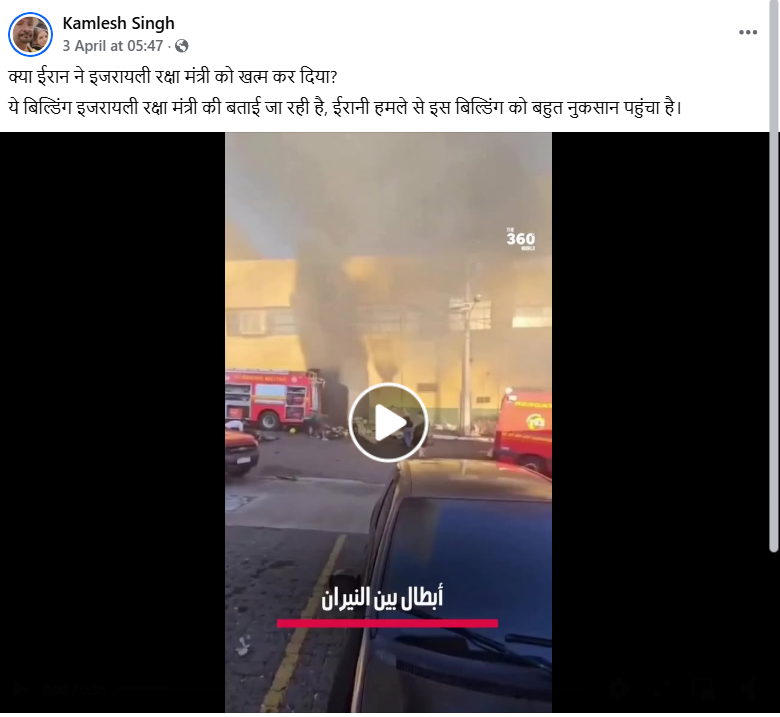
A Facebook user shared the video on April 3, 2026, claiming that Iran had attacked Israeli Defence Minister Yoav Gallant and severely damaged a building associated with him.
Fact Check
To verify the claim, we extracted keyframes from the viral video and conducted a reverse image search. This led us to the same video posted on an X account named Fernanda Melchionna on December 31, 2025.
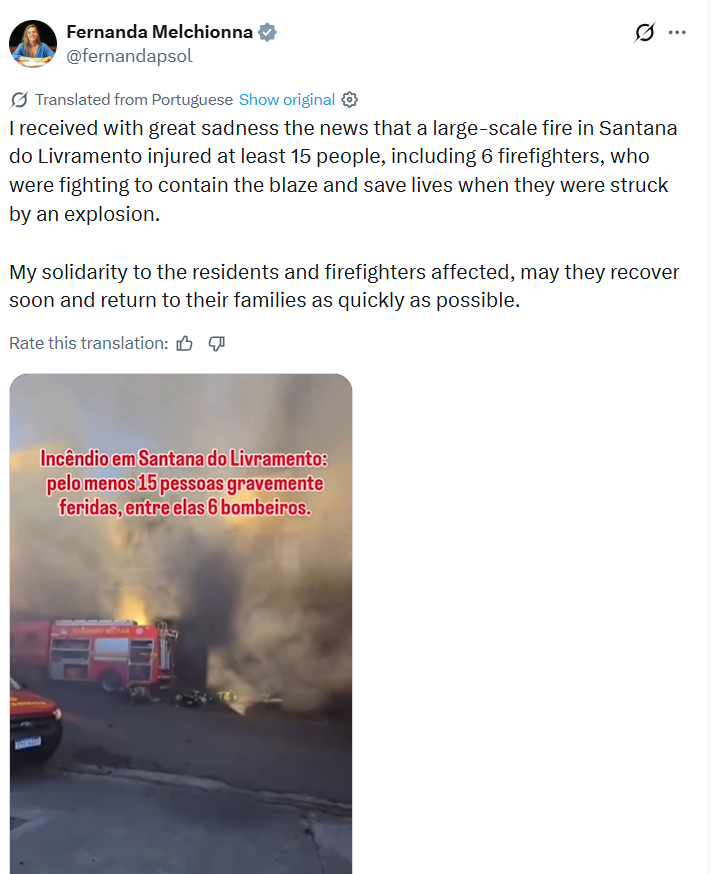
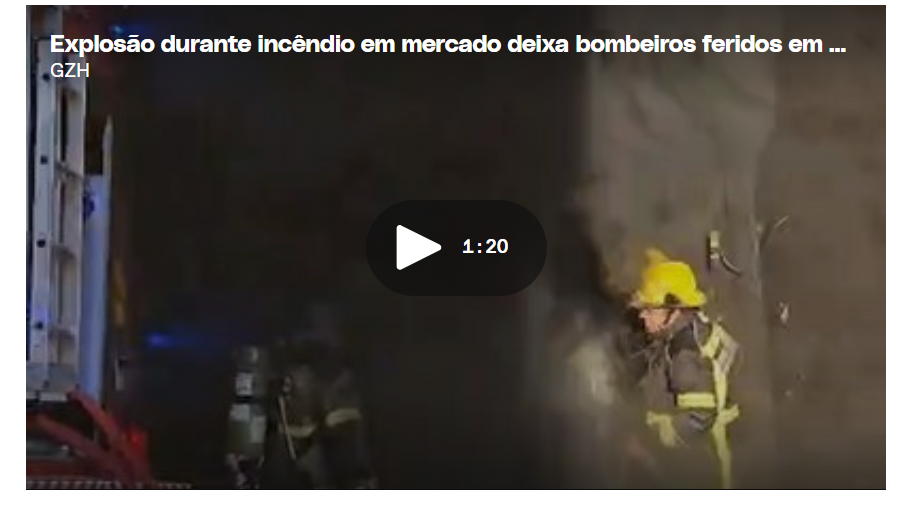
According to the available information, the video is from Santana do Livramento, where a major fire broke out in a supermarket. Further keyword searches led us to a report published on December 31, 2025, by the Brazilian news website GZH (gaúcha zh clicrbs). The report stated that a fire had erupted in a supermarket in Santana do Livramento, and firefighters had reached the spot to control the blaze. During the operation, an explosion occurred, leaving around 17 people injured. The injured were later taken to a hospital.
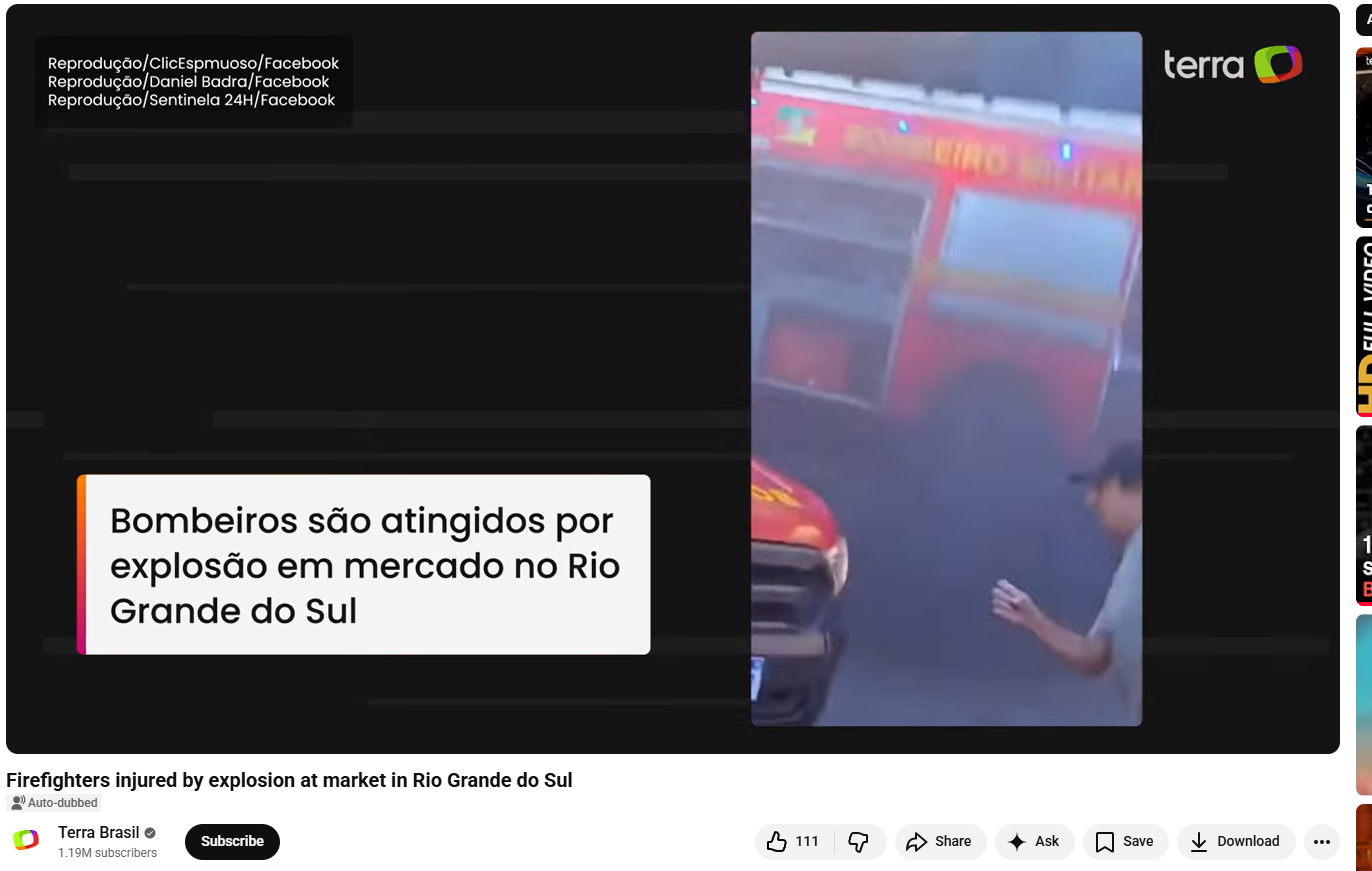
We also found the same video uploaded on the YouTube channel Terra Brasil on January 1, 2026, further confirming its origin and timeline.
Conclusion
The viral claim is false and misleading. The explosion video being shared as an attack on Israeli Defence Minister Yoav Gallant is unrelated to the ongoing Middle East situation. The footage is actually from December 2025 and shows an incident in Brazil, where a fire in a supermarket led to an explosion during firefighting operations. There is no evidence to suggest any such attack took place in Israel. The video has been taken out of context and circulated with a fabricated narrative to mislead users and exploit geopolitical tensions.

Related Blogs
Introduction
On 27 July 2026, Bank of Baroda admitted to experiencing a cybersecurity attack, officially confirming many hours of chatter and speculation amongst Bank of Baroda customers and information security professionals. According to a statement by the bank issued through regulatory filing, the breach came about due to unauthorised access into some of its data via compromise of an employee’s email account; however, not much beyond these details was disclosed. In the meantime, allegations of a major large-scale data leak flooded into various platforms and forums of the cybersecurity world along with mainstream news outlets and, eventually, mainstream social networks. It’s now critically important for us to attempt to differentiate factual from unverified details about Bank of Baroda’s recent cybersecurity incident.
We will analyse and list what the bank has released, what our community research has discovered and also what questions are still left unanswered.
The bank's version
Bank of Baroda said the breach traced back to a single compromised employee email account, which gave an unknown party unauthorised access to "certain data". Crucially, the bank maintains that its core banking systems, that is, the infrastructure that actually moves customer money, were never touched. It says the incident was detected and contained quickly and that it is working with law enforcement and regulators while a forensic investigation continues. That's a fairly narrow admission compared with what had already surfaced on the dark web.
What the hackers claim
Days before the bank's statement, a relatively new ransomware and data-extortion group calling itself ‘TripleX’ listed Bank of Baroda on its dark web leak site, dated July 24. The group claimed to have pulled roughly 1 terabyte of data and, unusually, released the entire cache for free rather than holding it for ransom, framing the move on its leak page as punishment for the bank's weak passwords and security lapses.
Independent researcher Srikanth Lakshmanan, founder of the digital-rights group 'CashlessConsumer', examined samples of the leaked material before alerting the bank and authorities. He told India Today Tech that what he reviewed included internal branch audit files, loan appraisal documents, vigilance investigation records, audit reports tied to the bank's bob World mobile app, and customer account-opening forms.
Several outlets also reported that sample files appeared to contain Aadhaar numbers, customer photographs, and NetBanking details, alongside corporate and NRI banking records. It's worth being precise here, though: Reuters and other outlets have emphasised that the exact contents and true scale of the leak haven't been independently verified, and Bank of Baroda itself hasn't confirmed which specific data categories were exposed. Estimates of the dataset's size have also varied anywhere from around 700 gigabytes to a full terabyte, depending on the source.
A repeat offender
TripleX isn't new to targeting state-owned banks. The gang first appeared in May 2026, and only weeks before targeting Bank of Baroda, it claimed responsibility for hacking PT Bank Negara Indonesia – the largest of Indonesia's state-owned banks, which stole nearly 2 terabytes of documents, including contracts, IDs and transaction histories. Both compromises follow a familiar pattern. Identify one point of entry, extract widely, and instead of working in the background to negotiate for a ransom, publish everything for the largest damage possible.
This represents a notable break from typical ransomware attacks. Groups such as TripleX forego encryption, simply relying solely on the public pressure of (or actuality of) imminent disclosure to extort victims. It is the extortion component of "double extortion" with little incentive to pursue payment.
The regulatory clock
India's banking sector doesn't get much slack when something like this happens. The Reserve Bank of India's Cyber Security Framework for Banks requires an initial incident report within two to six hours of detection, and India's Computer Emergency Response Team (CERT-In) mandates reporting of specified incidents within six hours. Bank of Baroda has also reportedly filed a preliminary notice under a cyber-insurance programme arranged through National Insurance, offering total coverage of roughly $78 million, though it's far too early to know whether it will actually be paid out or how much will actually be paid out.
Looking ahead, India's Digital Personal Data Protection Rules are due to take effect in May 2027, which will tighten breach-notification obligations further. This incident lands right at the edge of that regulatory transition, arguably a preview of what's at stake for the next bank that gets hit.
A History of Data Security Missteps
This is not the first time banks’ technology has raised a red flag. In 2023, an investigation by The Reporters’ Collective and Al Jazeera discovered that bank employees had inserted the mobile numbers of unauthorised agents (including those belonging to staff and security guards) and other businesses into their customers' profiles to drive enrolment on the bank’s app – BoB World. Several of the bank's customers were later victims of fraud due to the unauthorised association of mobile numbers, and the bank had its own internally reported data issues that later led to the RBI mandating an audit and then prohibiting the bank from onboarding new Bob World users temporarily. Even though the two issues are not related, it serves as context; in the case of banks handling more than $300 billion in their global operations through over 8,400 domestic locations, room for security errors is marginal, and the damage, both public and regulatory, escalates from there on.
What it means for customers
For those who bank with the Bank of Baroda, the common-sense approach is checking statements for any unfamiliar transactions; beware unsolicited calls/messages referencing account details (which typically follow after identity document leaks are being used as a basis for secondary scams); and as a security precaution, change your NetBanking password and app PIN while no core systems of the bank are reported to have been breached; even so, it is advisable to apply. Because Aadhaar, if it has been really compromised, cannot be reset like a password, which is why a compromised identity document is typically of longer-term risk than a stolen password.
Conclusion
The bigger story here isn't just one bank's bad week. It's a reminder that in a system where a single compromised employee inbox can cascade into hundreds of gigabytes of exposed customer data, "our core systems weren't affected" is true and reassuring and, for anyone whose loan documents or ID numbers may now be sitting on a dark web forum, somewhat beside the point.
Sources
- Bank of Baroda confirms cyber incident after hackers claim data theft — The Record (Recorded Future News): https://therecord.media/india-bank-of-baroda-reports-cybersecurity-incident
- Bank of Baroda Data Leak: What We Know So Far — Gulf News: https://gulfnews.com/business/banking/bank-of-baroda-data-leak-what-we-know-so-far-about-alleged-cyber-breach-1.500621898
- Bank of Baroda Breach Tests Disclosure Readiness — GovInfoSecurity (ISMG): https://www.govinfosecurity.com/bank-baroda-breach-tests-disclosure-readiness-a-32335
- India's Bank of Baroda Faces Alleged 1TB Data Leak on Dark Web — Yahoo Finance / India Today Tech: https://finance.yahoo.com/technology/ai/articles/india-bank-baroda-faces-alleged-113047992.html
- Bank of Baroda Data Breach Exposes Customer Records — The Asian Banker: https://www.theasianbanker.com/updates-and-articles/india-s-bank-of-baroda-data-breach-exposes-customer-records-after-employee-email-compromise
- India's Bank of Baroda Expose Worsens: Agents Steal Money From Accounts (2023 background) — Al Jazeera: https://www.aljazeera.com/economy/2023/10/12/indias-bank-of-baroda-expose-worsens-agents-steal-money-from-accounts
- 'Immediate Containment Measures Implemented': Bank of Baroda Issues Clarity on Alleged 1TB Data Leak — Republic World: https://www.republicworld.com/business/immediate-containment-measures-implemented-bank-of-baroda-issues-clarity-on-1tb-data-leak-2026-07-27-133590

Artificial Intelligence (AI) provides a varied range of services and continues to catch intrigue and experimentation. It has altered how we create and consume content. Specific prompts can now be used to create desired images enhancing experiences of storytelling and even education. However, as this content can influence public perception, its potential to cause misinformation must be noted as well. The realistic nature of the images can make it hard to discern as artificially generated by the untrained eye. As AI operates by analysing the data it was trained on previously to deliver, the lack of contextual knowledge and human biases (while framing prompts) also come into play. The stakes are higher whilst dabbling with subjects such as history, as there is a fine line between the creation of content with the intent of mere entertainment and the spread of misinformation owing to biases and lack of veracity left unchecked. AI-generated images enhance storytelling but can also spread misinformation, especially in historical contexts. For instance, an AI-generated image of London during the Black Death might include inaccurate details, misleading viewers about the past.
The Rise of AI-Generated Historical Images as Entertainment
Recently, generated images and videos of various historical instances along with the point of view of the people present have been floating all over the internet. Some of them include the streets of London during the Black Death in the 1300s in England, the eruption of Mount Vesuvius at Pompeii etc. Hogne and Dan, two creators who operate accounts named POV Lab and Time Traveller POV on TikTok state that they create such videos as they feel that seeing the past through a first-person perspective is an interesting way to bring history back to life while highlighting the cool parts, helping the audience learn something new. Mostly sensationalised for visual impact and storytelling, such content has been called out by historians for inconsistencies with respect to details particular of the time. Presently, artists admit to their creations being inaccurate, reasoning them to be more of an artistic interpretation than fact-checked documentaries.
It is important to note that AI models may inaccurately depict objects (issues with lateral inversion), people(anatomical implausibilities), or scenes due to "present-ist" bias. As noted by Lauren Tilton, an associate professor of digital humanities at the University of Richmond, many AI models primarily rely on data from the last 15 years, making them prone to modern-day distortions especially when analysing and creating historical content. The idea is to spark interest rather than replace genuine historical facts while it is assumed that engagement with these images and videos is partly a product of the fascination with upcoming AI tools. Apart from this, there are also chatbots like Hello History and Charater.ai which enable simulations of interacting with historical figures that have piqued curiosity.
Although it makes for an interesting perspective, one cannot ignore that our inherent biases play a role in how we perceive the information presented. Dangerous consequences include feeding into conspiracy theories and the erasure of facts as information is geared particularly toward garnering attention and providing entertainment. Furthermore, exposure of such content to an impressionable audience with a lesser attention span increases the gravity of the matter. In such cases, information regarding the sources used for creation becomes an important factor.
Acknowledging the risks posed by AI-generated images and their susceptibility to create misinformation, the Government of Spain has taken a step in regulating the AI content created. It has passed a bill (for regulating AI-Generated content) that mandates the labelling of AI-generated images and failure to do so would warrant massive fines (up to $38 million or 7% of turnover on companies). The idea is to ensure that content creators label their content which would help to spot images that are artificially created from those that are not.
The Way Forward: Navigating AI and Misinformation
While AI-generated images make for exciting possibilities for storytelling and enabling intrigue, their potential to spread misinformation should not be overlooked. To address these challenges, certain measures should be encouraged.
- Media Literacy and Awareness – In this day and age critical thinking and media literacy among consumers of content is imperative. Awareness, understanding, and access to tools that aid in detecting AI-generated content can prove to be helpful.
- AI Transparency and Labeling – Implementing regulations similar to Spain’s bill on labelling content could be a guiding crutch for people who have yet to learn to tell apart AI-generated content from others.
- Ethical AI Development – AI developers must prioritize ethical considerations in training using diverse and historically accurate datasets and sources which would minimise biases.
As AI continues to evolve, balancing innovation with responsibility is essential. By taking proactive measures in the early stages, we can harness AI's potential while safeguarding the integrity and trust of the sources while generating images.
References:
- https://www.npr.org/2023/06/07/1180768459/how-to-identify-ai-generated-deepfake-images
- https://www.nbcnews.com/tech/tech-news/ai-image-misinformation-surged-google-research-finds-rcna154333
- https://www.bbc.com/news/articles/cy87076pdw3o
- https://newskarnataka.com/technology/government-releases-guide-to-help-citizens-identify-ai-generated-images/21052024/
- https://www.technologyreview.com/2023/04/11/1071104/ai-helping-historians-analyze-past/
- https://www.psypost.org/ai-models-struggle-with-expert-level-global-history-knowledge/
- https://www.youtube.com/watch?v=M65IYIWlqes&t=2597s
- https://www.vice.com/en/article/people-are-creating-records-of-fake-historical-events-using-ai/?utm_source=chatgpt.com
- https://www.reuters.com/technology/artificial-intelligence/spain-impose-massive-fines-not-labelling-ai-generated-content-2025-03-11/?utm_source=chatgpt.com
- https://www.theguardian.com/film/2024/sep/13/documentary-ai-guidelines?utm_source=chatgpt.com

Introduction:
Welcome to the second edition of our blog on Digital forensics series. In our previous blog we discussed what digital forensics is, the process followed by the tools, and the subsequent challenges faced in the field. Further, we looked at how the future of Digital Forensics will hold in the current scenario. Today, we will explore differences between 3 particular similar sounding terms that vary significantly in functionality when implemented: Copying, Cloning and Imaging.
In Digital Forensics, the preservation and analysis of electronic evidence are important for investigations and legal proceedings. Replication of the data and devices is one of the fundamental tasks in this domain, without compromising the integrity of the original evidence.
Three primary techniques -- copying, cloning, and imaging -- are used for this purpose. Each technique has its own strengths and is applied according to the needs of the investigation.
In this blog, we will examine the differences between copying, cloning and imaging. We will talk about the importance of each technique, their applications and why imaging is considered the best for forensic investigations.
Copying
Copying means duplicating data or files from one location to another. When one does copying, it implies that one is using standard copy commands. However, when dealing with evidence, it might be hard to use copy only. It is because the standard copy can alter the metadata and change the hidden or deleted data .
The characteristics of copying include:
- Speed: copying is simpler and faster,compared to cloning or imaging.
- Risk: The risk involved in copying is that the metadata might be altered and all the data might be captured.
Cloning
It is the process where the transfer of the entire contents of a hard drive or a storage device is done on another storage device. This process is known as cloning . This way, the cloning process captures both the active data and the unallocated space and hidden partitions, thus containing the whole structure of the original device. Cloning is generally used at the sector level of the device. Clones can be used as the working copy of a device .
Characteristics of cloning:
- bit-for-bit replication: cloning keeps the exact content and the whole structure of the original device.
- Use cases: cloning is used when it is needed to keep the original device intact for further examination or a legal affair.
- Time consuming: Cloning is usually longer in comparison to simple copying since it involves the whole detailed replication. Though it depends on various factors like the size of the storage device, the speed of the devices involved, and the method of cloning.
Imaging:
It is the process of creating a forensic image of a storage device. A forensic image is a replica copy of every bit of data that was on the source device, this including the allocated, unallocated, and the available slack space .
The image is then used for analysis and investigation, and the original evidence is left untouched. Images can’t be used as the working copies of a device. Unlike cloning, which produces working copies, forensic images are typically used for analysis and investigation purposes and are not intended for regular use as working copies.
Characteristics of Imaging:
- Integrity: Imaging ensures the integrity and authenticity of the evidence produced
- Flexibility: Forensic image replicas can be mounted as a virtual drive to create image-specific mode for analysis of data without affecting the original evidence .
- Metadata: Imaging captures metadata associated with the data, thus promoting forensic analysis.
Key Differences
- Purpose: Copying is for everyday use but not good for forensic investigations requiring data integrity. Cloning and imaging are made for forensic preservation.
- Depth of Replication: Cloning and imaging captures the entire storage device including hidden, unallocated, and deleted data whereas copying may miss crucial forensic data.
- Data Integrity: Imaging and cloning keep the integrity of the original evidence thus making them suitable for legal and forensic use. Which is a critical aspect of forensic investigations.
- Forensic Soundness: Imaging is considered the best in digital forensics due to its comprehensive and non-invasive nature.
- Cloning is generally from one hard disk to another, where as imaging creates a compressed file that contains a snapshot of the entire hard drive or a specific partitions
Conclusion
Therefore, copying, cloning, and imaging all deal with duplication of data or storage devices with significant variations, especially in digital forensic. However, for forensic investigations, imaging is the most selected approach due to the correct preservation of the evidence state for any analysis or legal use . Therefore, it is essential for forensic investigators to understand these rigorous differences to avail of real and uncontaminated digital evidence for their investigation and legal argument.
