
#FactCheck-Old Saudi Arabia Fire Video Falsely Shared as Footage of Recent U.S. Attack on Iran
Executive Summary
As tensions between the United States and Iran continue to escalate in West Asia, a video showing a massive fire engulfing an industrial facility is being widely circulated on social media. Several users claim that the footage shows the aftermath of a recent U.S. strike on Iran. CyberPeace Research Wing’s research found the claim to be false. Our research revealed that the viral video is not related to the current U.S.-Iran conflict. It actually shows a 2022 attack on Saudi Arabia's Aramco petroleum distribution facility in Jeddah, carried out by Yemen's Houthi rebels.
Claim
An X user shared the viral video on July 16, 2026, claiming that it shows a recent American attack on Iran. https://x.com/SonOfBharat7/status/2077823734069826027 , https://perma.cc/RPA9-YZ3C

Fact Check
To verify the claim, we extracted keyframes from the viral video and conducted a reverse image search using Google Lens. During the research, we found that the same video had been uploaded by Reuters on March 26, 2022. According to Reuters, Yemen's Houthi rebels claimed responsibility for attacks on Saudi Arabia's energy facilities. Reuters reported that the Saudi-led coalition confirmed an attack on Saudi Aramco's petroleum products distribution station in Jeddah, where two storage tanks caught fire. The incident caused significant damage but no casualties were reported. https://www.youtube.com/watch?v=-CAxj5tgZ_w

For further verification, we found another video of the same incident uploaded by the Qatar Day Facebook page on March 25, 2022, showing the fire from a different angle. According to the post, a massive blaze broke out at an oil depot in Jeddah, Saudi Arabia, after Yemen's Houthi rebels launched multiple drone and missile attacks targeting Saudi infrastructure. Thick black smoke could be seen rising over the city.

Additionally, The Sun also uploaded the same footage on March 26, 2022, identifying it as the attack on Jeddah, Saudi Arabia. https://www.youtube.com/watch?v=bFj5nDL0y7o

Conclusion
Our research found that the viral video does not show a recent U.S. attack on Iran.Although the United States and Iran have recently exchanged military strikes and attacks on civilian infrastructure have been reported, the viral footage predates the current conflict by several years. It actually shows the March 2022 Houthi attack on Saudi Aramco's petroleum distribution facility in Jeddah, Saudi Arabia. Therefore, the claim linking the video to the ongoing U.S.-Iran conflict is false and misleading.

Related Blogs
Executive Summary
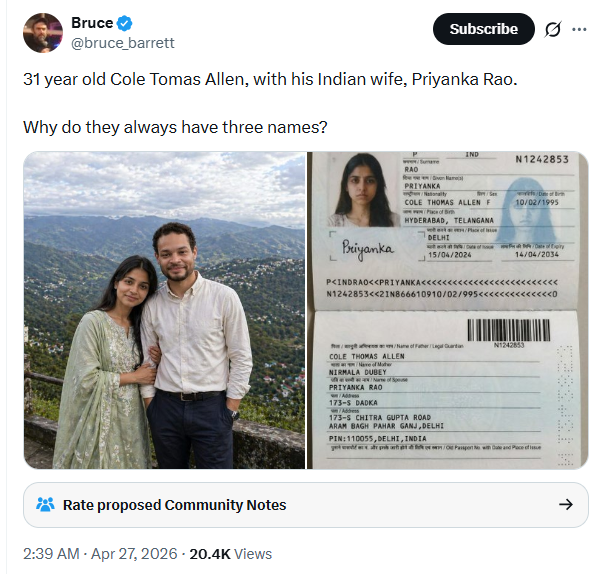
After reports identifying Cole Thomas Allen as the accused in the shooting incident at the White House Correspondents’ Association (WHCA) dinner, several Pakistani propaganda-linked social media accounts began circulating a new claim alleging that the suspect’s wife is an Indian woman named Priyanka Rao. Users shared a photo purportedly showing Cole Thomas Allen with Priyanka Rao, along with an alleged Indian passport in her name. One user posted the image with the caption: “31-year-old Cole Thomas Allen with his Indian wife Priyanka Rao. Why do they always have three names?”
However, research by the CyberPeace Research Wing found the claim to be fake. The viral passport and accompanying image appear to be AI-generated.
Claim:
Social media users claimed that Cole Thomas Allen, accused in the WHCA dinner shooting, is married to an Indian woman named Priyanka Rao.
Fact Check:
During the research, multiple inconsistencies were found in the viral passport image, strongly indicating it is fabricated. A close review of the document revealed several obvious errors commonly seen in AI-generated content. For instance, in the “Nationality” field, the name “Cole Thomas Allen” was written instead of a country name. Such a basic mistake would not appear in any genuine government-issued passport.
The Hindi text on the document was also highly inaccurate and unnatural. Examples included:
- “राष्ट्रीयता” misspelled as “राष्ट्रीयाय”
- “जन्मतिथि” replaced with meaningless text
- “जन्म स्थान” incorrectly written
- “Issue” mistranslated as unrelated wording
- “Date of Expiry” left untranslated in Hindi format
Further analysis using an AI detection tool indicated that the viral passport image had a 69 percent probability of being AI-generated.

Conclusion:
The claim that WHCA dinner shooting accused Cole Thomas Allen has an Indian wife named Priyanka Rao is fake. The viral passport and image being shared online are likely AI-generated and part of a misinformation campaign.
Introduction
There has been a recent surge of misinformation all over social media, claiming that every Indian ought to receive an allowance of ₹2,000 under some "Prime Minister's scheme." The message, which has been circulated far and wide on almost all platforms-WhatsApp, Facebook, Telegram, etc.-has urged users to click on an unfamiliar link to claim the allowance in their bank accounts.
It would seem like a very attractive offer, especially at a time when common citizens are coping with rising costs of living. But upon further examination, it turns out to be an outright online scam. NewsMobile fact-checked the claim and confirmed that no such scheme exists. Thus, the message circulating is a scam that aims to mislead common citizens.
Such an incident is not isolated. Over the years, fraudulent posts falsely offering benefits in the name of the government or well-known brands have been on the rise. These scams are not just about misinformation-they take advantage of trust, lure people into clicking, and sharing personal info that poses serious risks to financial and personal security.
Anatomy of the Viral PM Scheme Scam
The viral message received attention and was written in Hindi. It read:
“सभी नागरिकों को PM योजना के तहत दो हज़ार रुपए का भत्ता प्रदान किया गया है अपने bank खाते में प्राप्त करने के लिए click करें."
(English: “All citizens have been provided an allowance of ₹2000 under the PM scheme. Click to receive it in your bank account.”)
Beneath this was an odd link that, upon clicking through investigation, turned out to be not working and invalid. An examination of government sites, official handle accounts, and other such was done and no announcement for any such allowance was found.
This provides a neat explanation of a phishing attempt by which a scammer induces urgency and temptation in order to lure citizens into clicking a malicious link. While the link may no longer be active, it could very well have once redirected users to websites that harvest personal information such as Aadhaar numbers, bank details, or login credentials.
The Broader Problem: Fake Government Scheme Scams
Some scams have been exploiting the hoax gimmick of the ₹2,000 PM scheme into the wider trend. How do the con men work? They leverage the credibility of governmental initiatives to scam citizens. In the past, fake promises were made concerning free gas cylinders, cash allowances, subsidised rations, or even job opportunities.
During the COVID times, for instance, fake vaccination registration links and so-called relief scheme offers went viral, preying on the fears and vulnerabilities of ill-informed citizens. Likewise, false schemes associated with reputed companies such as Amazon, Flipkart, TATA Group, and Hermès have also gone viral, promising free gifts or allowances.
The one thing that makes scams associated with the government very dangerous is the exploitation of people's trust in authority. The common citizen is predisposed to believe the PM scheme or the Government Yojana because of the social credibility accorded to these announcements.
How These Scams Operate
These are scams where the creators intend deception and in the end, gain from defrauding a person. Fraudsters first create clickbait messages that are duly recorded to resemble official communications and often bear the government logos and bear a mix of Hindi-English text with the phrase "Pradhan Mantri Yojana" to make it sound legitimate. The messages then redirect users to bogus websites that really look very much like the government's portals, asking sick persons to enter personal information. Finally, as soon as they have obtained this data, the scammer uses it for identity theft, bank fraud, or sells it on the dark web. Social engineering does play a large role in these scams: here terms of urgency like limited time, last chance, and whatnot get created with the aim of pushing the targets to act on these without thinking. For maximum reach, victims are also asked to forward the message to their friends and family, causing the scammer to go viral across WhatsApp, Facebook, and Telegram.
Risks to Citizens
Risks are serious and manifold to falling prey to these scams. The immediate kind of risk is financial loss: divulging bank account details, an OTP, or credentials may constitute providing attackers the power to drain funds therefrom. Another prevalent kind of identity theft occurs through hijacked Aadhaar, PAN, or personal information that subsequently finds its way into fake loans or SIM activations. Apart from monetary losses, opening malicious links might also make devices infected with spyware or ransomware, thereby invading privacy and security. Victims tend to experience a form of psychological trauma due to feelings of betrayal or humiliation of being deceived, thus discouraging them from reporting, which in turn enables such scams to go undetected.
Best Practices for Prevention
It is prudent to exercise good cyber hygiene and be on the lookout for such scams. The citizens should verify each statement against government-authorised websites like https://www.mygov.in or through press statements of the ministries prior to believing it. One should not click on suspicious links offering money, gifts, or subsidies. Red flags like poor grammar, an unofficial domain name, or too-good-to-be-true offers can enable one to identify the scam in time. Two-factor authentication, antivirus software updates, and securing devices can drastically lower the threat from the technical angle. Equally important is the reporting of issues: always report any suspicious activities to cybercrime.gov.in or to the nearest cyber cell so that the authorities may trace some pattern and issue advisories accordingly. Finally, one can do some good by sharing verified fact checks within their circles to build added strength against misinformation and scams.
Policy and Community Role
While individual awareness is important, collective action must be taken against these fake government scheme scams. Platforms such as WhatsApp, Facebook, and X (Twitter) must tune up fraudsters' message detection mechanisms. In the meantime, Government Bodies must alert citizens periodically on new scams through their official handles/schemes and through community outreach.
Civil society and fact-checking agencies play an important role in dispelling frequently viral hoaxes. This work must be amplified to reach people's consciousness in regional languages for the very reason that in these terrain zones, forwarded messages are much more trusted.
Conclusion
The viral ₹2,000 PM scheme scam is a reminder that everything that is viral online cannot be trusted in toto. The scammers of the day are inventing newer scams to gain trust, spread misinformation, and extort innocent citizens.
The best defence will be awareness and alertness. Citizens must verify any claims through official channels before clicking on a link, sharing their data, or even acting upon it in any way. With proper cyber hygiene and avoiding suspicious messages, we can counterattack by reducing the percentage of impact that these scams may have and collaboratively build a secure digital environment.
As India pushes itself further into a digital ecosystem, both empowering and being resilient to cyber fraud is not a state of individual security, but a national agenda.
References
- https://www.newsmobile.in/nm-fact-checker/fact-check-viral-post-claiming-pm-scheme-offering-rs-2000-allowance-is-a-scam/
- https://timesofindia.indiatimes.com/business/financial-literacy/investing/beware-of-deepfake-scams-fraudsters-using-ai-videos-to-push-schemes-promising-unrealistic-returns-red-flags-to-watch-out-for/articleshow/124085155.cms
- https://www.business-standard.com/finance/personal-finance/invest-rs-21-000-to-earn-rs-20-lakh-monthly-viral-videos-of-fm-are-fake-125082000517_1.html
- https://www.pib.gov.in/PressReleasePage.aspx?PRID=2124728

Introduction
Digital Public Infrastructure (DPI) serves as the backbone of e-governance, enabling governments to deliver services more efficiently, transparently, and inclusively. By leveraging information and communication technology (ICT), digital governance systems reconfigure traditional administrative processes, making them more accessible and citizen-centric. However, the successful implementation of such systems hinges on overcoming several challenges, from ensuring data security to fostering digital literacy and addressing infrastructural gaps.
This article delves into the key enablers that drive effective DPI and outlines the measures already undertaken by the government to enhance its functionality. Furthermore, it outlines strategies for their enhancement, emphasizing the need for a collaborative, secure, and adaptive approach to building robust e-governance systems.
Key Enablers of DPI
Digital Public Infrastructure (DPI), the foundation for e-governance, relies on common design, robust governance, and private sector participation for efficiency and inclusivity. This requires common principles, frameworks for collaboration, capacity building, and the development of common standards. Some of the key measures undertaken by the government in this regard include:
- Data Protection Framework: The Digital Personal Data Protection (DPDP) Act of 2023 establishes a framework to ensure consent-based data sharing and regulate the processing of digital personal data. It delineates the responsibilities of data fiduciaries in safeguarding users' digital personal data.
- Increasing Public-Private Partnerships: Refining collaboration between the government and the private sector has accelerated the development, maintenance, expansion, and trust of the infrastructure of DPIs, such as the AADHAR, UPI, and Data Empowerment and Protection Architecture (DEPA). For example, the Asian Development Bank attributes the success of UPI to its “consortium ownership structure”, which enables the wide participation of major financial stakeholders in the country.
- Coordinated Planning: The PM-Gati Shakti establishes a clear coordination framework involving various inter-governmental stakeholders at the state and union levels. This aims to significantly reduce project duplications, delays, and cost escalations by streamlining communication, harmonizing project appraisal and approval processes, and providing a comprehensive database of major infrastructure projects in the country. This database called the National Master Plan, is jointly accessible by various government stakeholders through APIs.
- Capacity Building for Government Employees: The National e-Governance Division of the Ministry of Electronics and Information Technology routinely rolls out multiple training programs to build the technological and managerial skills required by government employees to manage Digital Public Goods (DPGs). For instance, it recently held a program on “Managing Large Digital Transformative Projects”. Additionally, the Ministry of Personnel, Public Grievances, and Pensions has launched the Integrated Government Online Training platform (iGOT) Karmayogi for the continuous learning of civil servants across various domains.
Digital Governance; Way Forward
E-governance utilizes information and communication technology (ICT) such as Wide Area Networks, the Internet, and mobile computing to implement existing government activities, reconfiguring the structures and processes of governance systems. This warrants addressing certain inter-related challenges such as :
- Data Security: The dynamic and ever-changing landscape of cyber threats necessitates regular advancements in data and information security technologies, policy frameworks, and legal provisions. Consequently, the digital public ecosystem must incorporate robust data cybersecurity measures, advanced encryption technologies, and stringent privacy compliance standards to safeguard against data breaches.
- Creating Feedback Loops: Regular feedback surveys will help government agencies improve the quality, efficiency, and accessibility of digital governance services by tailoring them to be more user-friendly and enhancing administrative design. This is necessary to build trust in government services and improve their uptake among beneficiaries. Conducting the decennial census is essential to gather updated data that can serve as a foundation for more informed and effective decision-making.
- Capacity Building for End-Users: The beneficiaries of key e-governance projects like Aadhar and UPI may have inadequate technological skills, especially in regions with weak internet network infrastructure like hilly or rural areas. This can present challenges in the access to and usage of technological solutions. Robust capacity-building campaigns for beneficiaries can provide an impetus to the digital inclusion efforts of the government.
- Increasing the Availability of Real-Time Data: By prioritizing the availability of up-to-date information, governments and third-party enterprises can enable quick and informed decision-making. They can effectively track service usage, assess quality, and monitor key metrics by leveraging real-time data. This approach is essential for enhancing operational efficiency and delivering improved user experience.
- Resistance to Change: Any resistance among beneficiaries or government employees to adopt digital governance goods may stem from a limited understanding of digital processes and a lack of experience with transitioning from legacy systems. Hand-holding employees during the transitionary phase can help create more trust in the process and strengthen the new systems.
Conclusion
Digital governance is crucial to transforming public services, ensuring transparency, and fostering inclusivity in a rapidly digitizing world. The successful implementation of such projects requires addressing challenges like data security, skill gaps, infrastructural limitations, feedback mechanisms, and resistance to change. Addressing these challenges with a strategic, multi-stakeholder approach can ensure the successful execution and long-term impact of large digital governance projects. By adopting robust cybersecurity frameworks, fostering public-private partnerships, and emphasizing capacity building, governments can create efficient and resilient systems that are user-centric, secure, and accessible to all.
References
- https://www.adb.org/sites/default/files/publication/865106/adbi-wp1363.pdf
- https://www.jotform.com/blog/government-digital-transformation-challenges/
- https://aapti.in/wp-content/uploads/2024/06/AaptixONI-DPIGovernancePlaybook_compressed.pdf
- https://community.nasscom.in/sites/default/files/publicreport/Digital%20Public%20Infrastructure%2022-2-2024_compressed.pdf
- https://proteantech.in/articles/Decoding-Digital-Public-Infrastructure-in-India/
