
#FactCheck - Digitally Altered Image Falsely Shows World Bank President Ajay Banga Holding Khalistani Flag
Executive Summary
A digitally manipulated image of World Bank President Ajay Banga has been circulating on social media, falsely portraying him as holding a Khalistani flag. The image was shared by a Pakistan-based X (formerly Twitter) user, who also incorrectly identified Banga as the President of the International Monetary Fund (IMF), thereby fuelling misleading speculation that he supports the Khalistani movement against India.
The Claim
On February 5, an X user with the handle @syedAnas0101010 posted an image allegedly showing Ajay Banga holding a Khalistani flag. The user misidentified him as the IMF President and captioned the post, “IMF president sending signals to INDIA.” The post quickly gained traction, amplifying false narratives and political speculation. Here is the link and archive link to the post, along with a screenshot:
Fact Check:
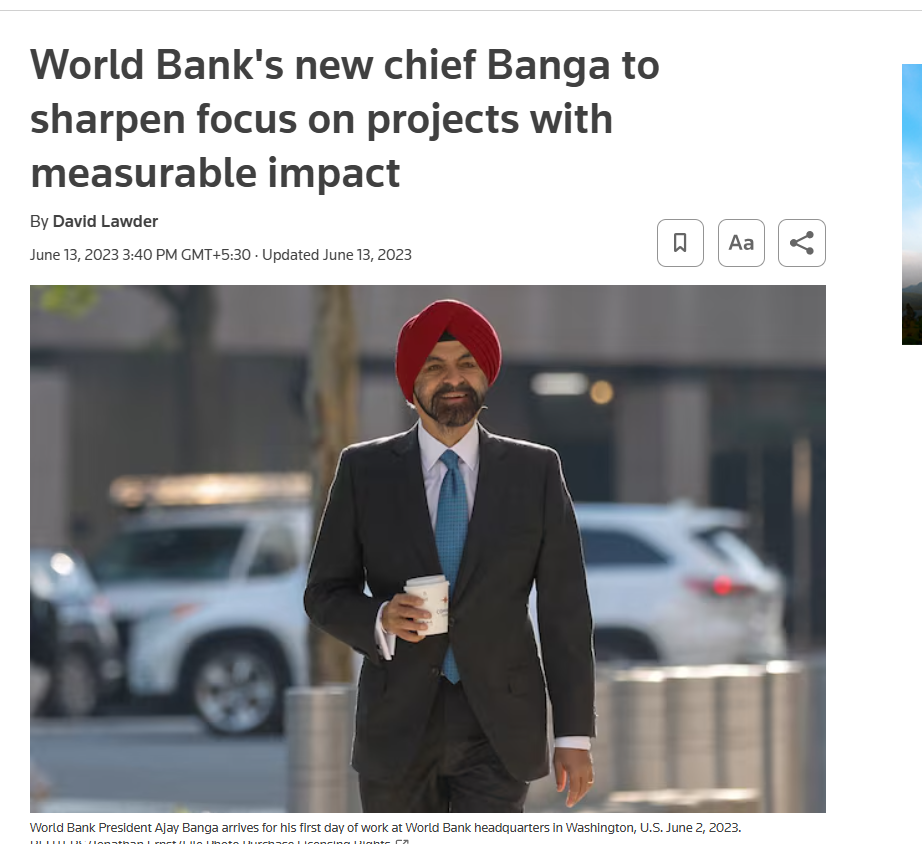
To verify the authenticity of the image, the CyberPeace Fact Check Desk conducted a detailed research . The image was first subjected to a reverse image search using Google Lens, which led to a Reuters news report published on June 13, 2023. The original photograph, captured by Reuters photojournalist Jonathan Ernst, showed Ajay Banga arriving at the World Bank headquarters in Washington, D.C., on June 2, 2023, marking his first day in office. In the authentic image, Banga is seen holding a coffee cup, not a flag.
Further analysis confirmed that the viral image had been digitally altered to replace the coffee cup with a Khalistani flag, thereby misrepresenting the context and intent of the original photograph. Here is the link to the report, along with a screenshot.
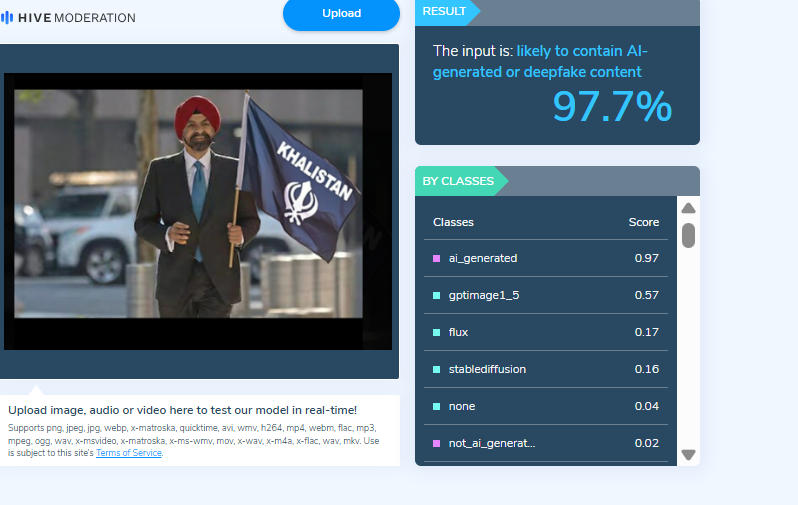
To strengthen the findings, the altered image was also analysed using the Hive Moderation AI detection tool. The tool’s assessment indicated a high likelihood that the image contained AI-generated or manipulated elements, reinforcing the conclusion that the image was not genuine. Below is a screenshot of the result.
Conclusion
The viral image claiming to show World Bank President Ajay Banga holding a Khalistani flag is fake. The photograph was digitally manipulated to spread misinformation and provoke political speculation. In reality, the original Reuters image from June 2023 shows Banga holding a coffee cup during his arrival at the World Bank headquarters. The claim that he supports the Khalistani movement is false and misleading.

Related Blogs
.webp)
The Equitable Growth Approach of AI and Digital Twins
Digital Twins can be simply described as virtual replicas of physical assets or systems, powered by real-time data and advanced simulations. When this technology is combined with AI, the impact it has on enabling real-time monitoring, predictive maintenance, optimised operations, and improved design processes through the creation of virtual replicas of physical assets becomes even greater. The greatest value of AI is its ability to make data actionable. And when combined with digital twins, these data can be collated, analysed, inefficiencies removed, and better decisions can be taken to improve efficiency and quality.
This intersection between AI and Digital Twins holds immense potential for addressing key challenges, particularly in countries like India, which is rapidly embracing digital adoption to achieve its economic ambitions and sustainability goals. According to Salesforce’s most recent survey on generative AI use among the general population within the U.S., UK, Australia and India, 75% of generative AI users are looking to automate repetitive tasks and use generative AI for work communications. India is particularly looking towards a rapid digital adoption, economic ambitions, and sustainable developments to be achieved through AI adoption. This blog discuss the intersection of equitable growth, sustainability, and AI-driven policies in India.
Sustainability and the Path Ahead: Digital Twin and AI-Driven Solutions
India faces sustainability challenges which are mainly associated with issues such as urban congestion, the rising demand for energy along with climate change and environmental degradation. AI and Digital Twins provide solutions for real-time simulations and predictive analysis. Some of the examples are its applications in sustainable urban planning such as smart cities like the Indore Smart City Initiative and traffic optimisation, energy efficiency/optimisation through AI-driven renewable energy projects and power grid optimisation and even water resource management through leak detection, equitable distribution and conservation.
The need is to balance innovation with regulation, particularly, underscoring the importance of ethical and sustainable deployment of AI and digital twins and addressing data privacy with AI ethics with recent developments such as the India’s evolving AI policy landscape, including the National Strategy for Artificial Intelligence and its focus on AI for All, regulatory frameworks such as DPDP Act and the manner in which they address AI ethics, data privacy, and digital governance.
The need is to initiate targeted policies that promote research and development in AI and digital twin technologies, skill development and partnerships with the private sector, think tanks, nonprofits and others. Also, collaborations at the global level would include aligning our domestic policies with global AI and sustainability initiatives and leveraging the international frameworks for climate tech and smart infrastructure.
Cyberpeace Outlook
As part of specific actions, policymakers need to engage in proactive governance to ensure the responsible use and development of AI. This includes enacting incentive schemes for sustainable AI projects and strengthening the enforcement of data privacy laws. Industry leaders must support equitable access to AI and digital twin technologies and develop tailored AI tools for resource-constrained settings, particularly in India. Finally, researchers need to drive innovation in alignment with sustainability goals, such as those related to agriculture and groundwater management.
References
- https://economictimes.indiatimes.com/tech/artificial-intelligence/technologies-like-ai-and-digital-twins-can-tackle-challenges-like-equitable-growth-to-sustainability-wef/articleshow/117121897.cms
- https://www.salesforce.com/news/stories/generative-ai-statistics/
- https://www.mdpi.com/2673-2688/4/3/38
- https://www.ibm.com/think/topics/generative-ai-for-digital-twin-energy-utilities
.webp)
Executive Summary
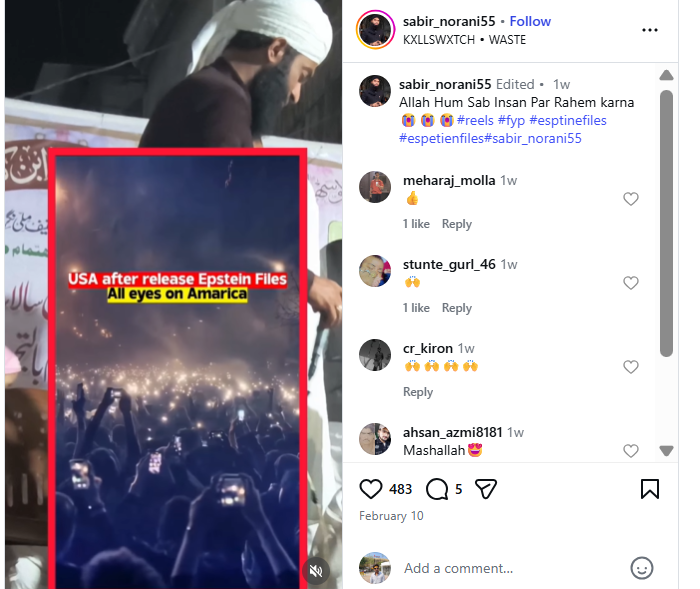
The U.S. Department of Justice recently released nearly three million pages of documents, along with thousands of videos and photographs, related to its research into convicted offender Jeffrey Epstein. Meanwhile, a video showing a massive crowd protesting on a street is going viral on social media The video, which had earlier circulated with false claims linking it to anti-government protests in Iran, is now being shared by several users who claim that the protest took place in the United States after the release of the Epstein files. Research by CyberPeace found the viral claim to be false. The video being linked to protests in the United States following the release of the Epstein files is not real and was generated using artificial intelligence (AI).
Claim:
An Instagram user uploaded the viral video on February 9, 2026, with the caption: “After Epstein files released in America. All eyes on America.”
- https://www.instagram.com/reel/DUjLe-XE5lA
- https://ghostarchive.org/archive/tkP6W
Fact Check:
To verify the claim, we first conducted a reverse search of the viral video using Google Lens. The same video was found posted on January 10, 2026, by an Instagram account named “elnaz555,” where it was shared in the context of recent protests in Iran. The post also mentioned that the video was created using AI.
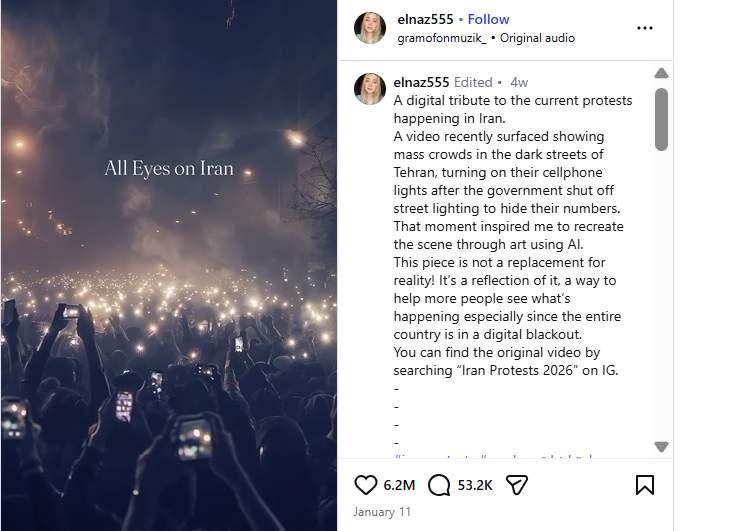
Based on this lead, we further analyzed a higher-quality version of the viral video using Hive Moderation, a tool used to detect AI-generated images and videos. The analysis indicated a 97.9% probability that the video was generated using artificial intelligence. The research clearly shows that the video is not authentic and has been falsely linked to protests in the United States after the release of the Epstein files.
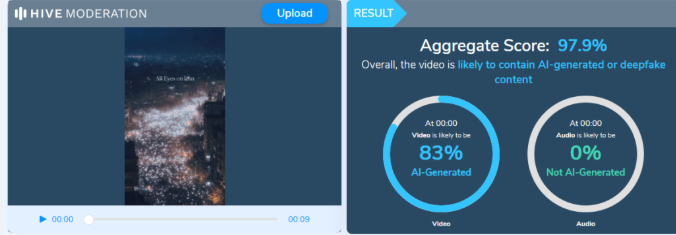
Conclusion:
The claim circulating on social media is false. The viral video allegedly showing protests in the United States following the release of the Epstein files is AI-generated and not related to any real event.
.webp)
Executive Summary
Amid heightened tensions following Israel and US actions against Iran, a video is being widely shared on social media. The footage shows thick black smoke rising into the sky from a location, suggesting a major explosion or attack. However, research conducted by the CyberPeace found the viral claim to be misleading. Our research revealed that the video is not recent and has no connection to the current Israel-Iran tensions. In fact, the footage is nearly a year old and shows a fire at a casino in Mexico, now being shared out of context.
Claim
Users circulating the video claim that it shows an attack on Tel Aviv, Israel. On March 1, 2026, a user on X shared the clip with the caption, “Iran has drained the oil out of Tel Aviv,” implying a devastating retaliatory strike. (Post and archive links provided above.)
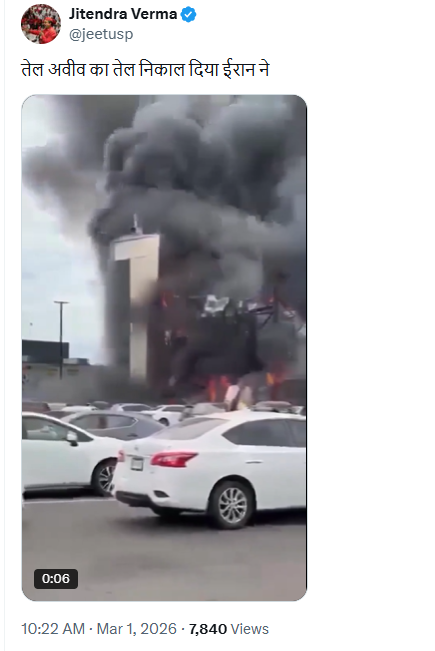
Fact Check:
To verify the authenticity of the video, we extracted key frames and performed a reverse image search using Google Lens. During the search, we found the same visuals in a Spanish media report published on January 16, 2025. This confirmed that the video predates the ongoing geopolitical developments.
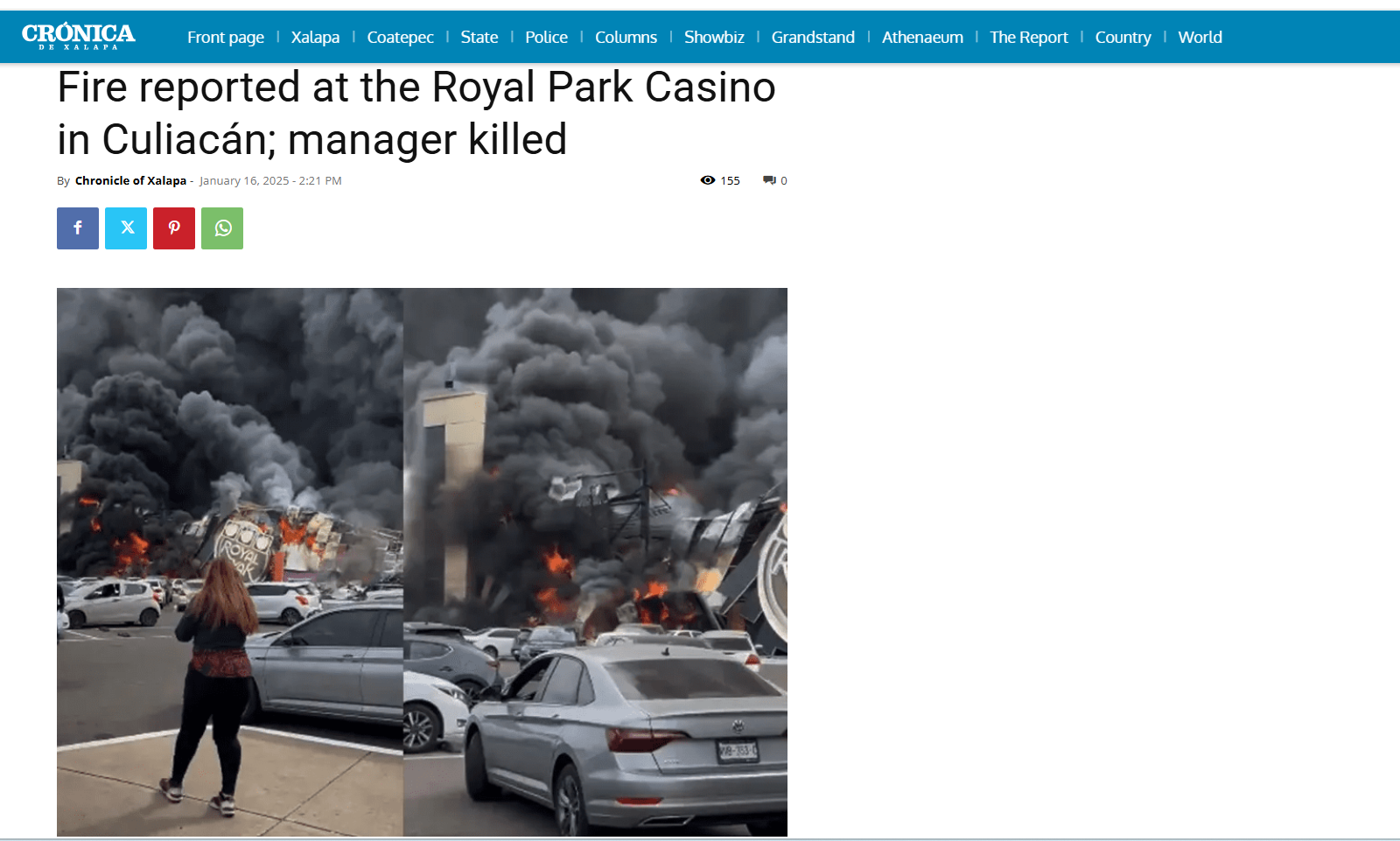
According to the report, the footage shows a fire at the Royal Park Casino located inside the Cinépolis plaza in Culiacán, Mexico. Local outlet Meganoticias Culiacán reported on X that the casino was “completely burned down.” The structure reportedly collapsed following the blaze, and emergency responders confirmed that several people were injured. Further keyword searches led us to the same footage on the official YouTube channel of Milenio, uploaded on January 17, 2025. The report clearly states that the fire occurred at the Royal Yacht Casino in Mexico and is unrelated to any recent military developments.
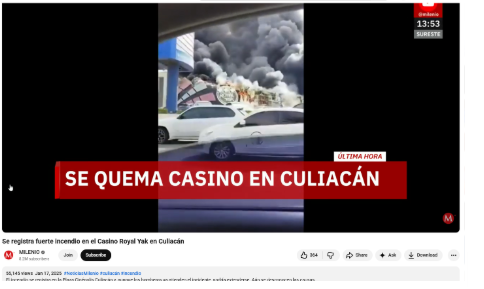
Conclusion
Evidence gathered during our research clearly establishes that the viral video is not related to any missile attack by Iran on Israel. The claim is false. The footage is from a fire incident at a casino in Mexico and is being misleadingly shared in the context of current international tensions, potentially creating unnecessary panic and confusion.
