
#FactCheck-AI-Generated Audio Falsely Added to Dharmendra Pradhan Video to Claim His Resignation as Education Minister
Executive Summary
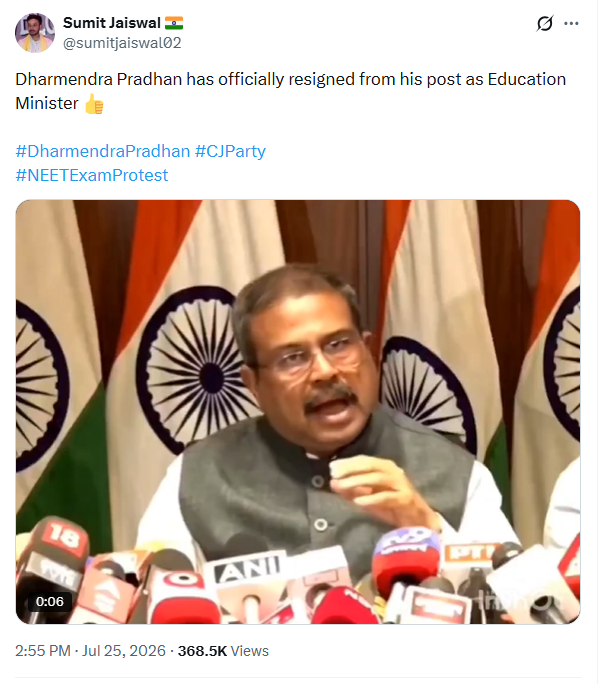
A video featuring Union Education Minister Dharmendra Pradhan is being widely shared on social media, claiming that he has resigned from his post. In the viral video, Pradhan can be seen addressing a press conference and is allegedly heard saying, “I am resigning from the post of Education Minister due to personal reasons. I thank everyone for this opportunity.” CyberPeace Research Wing’s research found that the claim is misleading. The research revealed that an AI-generated audio clip was added to an old video of Dharmendra Pradhan, falsely attributing a resignation statement to him. The video was digitally altered using a short segment from Pradhan’s press conference held in May 2026 regarding the NEET UG 2026 re-examination.
Claim:
A user on social media platform X, with the username @sumitjaiswal02, shared the viral video on July 25, 2026, claiming that “Dharmendra Pradhan has officially resigned from the post of Education Minister.” In the video, Pradhan is allegedly heard saying, “I am resigning from the post of Education Minister due to personal reasons. I thank everyone for this opportunity.”
The link, archive link and screenshot of the post are provided below
https://x.com/sumitjaiswal02/status/2080947511150448868?s=20
Fact Check:
To verify the viral claim, the Desk conducted an open-source search. During the research, several reports related to Dharmendra Pradhan’s resignation were found on credible news platforms and official sources. However, no authentic video was found on any official platform or verified news outlet showing Pradhan making the resignation statement heard in the viral clip.The research did find his resignation letter, which he shared through his official social media account. However, no official video statement announcing his resignation was available. Dharmendra Pradhan’s X post regarding his resignation can be accessed here:
https://x.com/dpradhanbjp/status/2080938216505667663?s=20

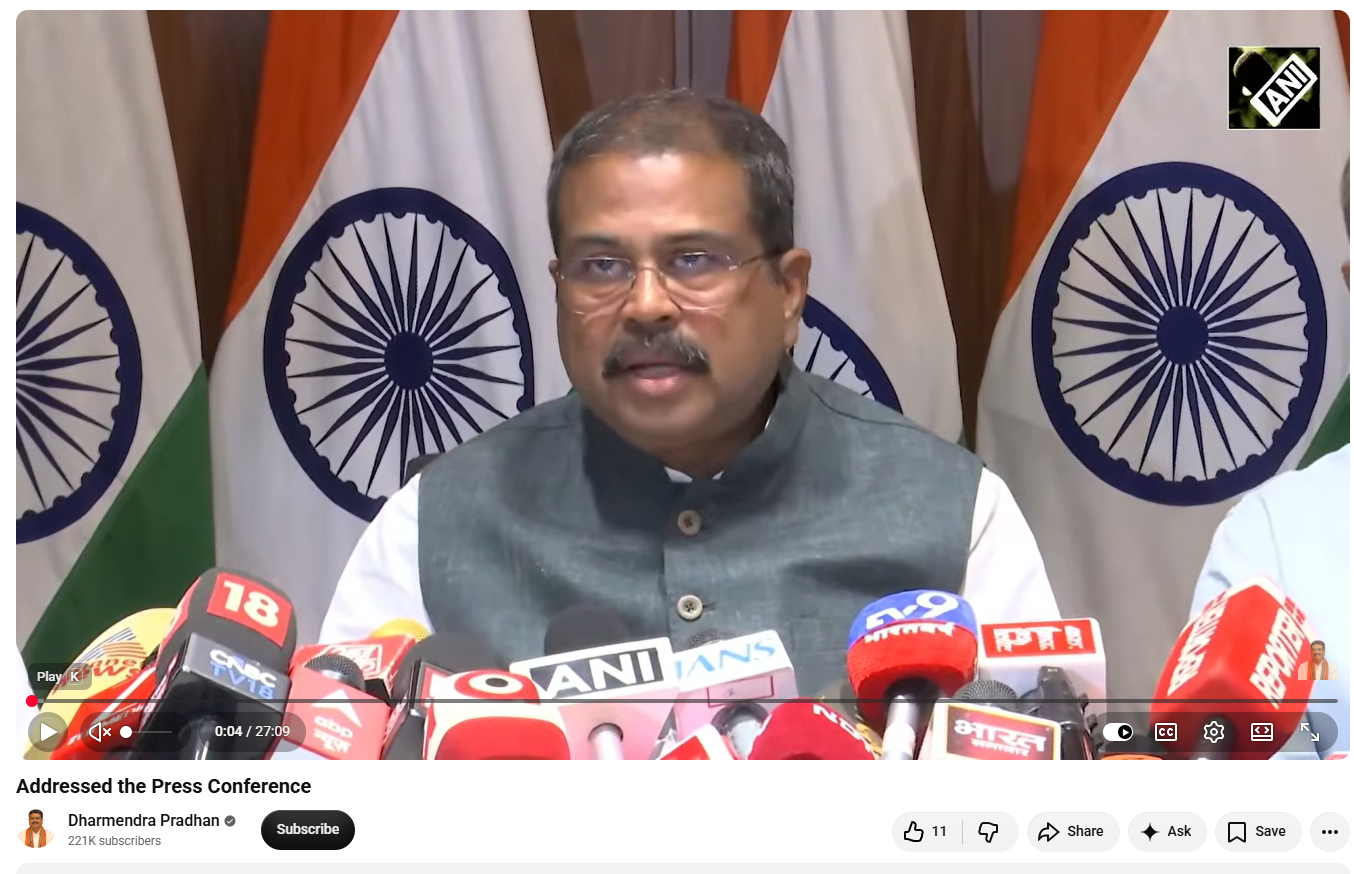
Further research involved extracting key frames from the viral video and conducting a reverse image search using Google Lens. This led the Desk to a video uploaded on Dharmendra Pradhan’s official YouTube channel on May 15, 2026. The video showed Pradhan addressing a press conference regarding the NEET UG 2026 re-examination. The video link and screenshot are provided below:
https://www.youtube.com/watch?v=XkcYnwOAj0M
After analysing the audio of the viral video, the PTI Fact Check Desk extracted the audio track and examined it using the AI audio detection tool Resemble AI. The analysis indicated that the audio used in the viral video was AI-generated and did not contain Dharmendra Pradhan’s original voice or any genuine statement made by him.

Conclusion:
Based on the research, the Desk concluded that the viral video has been digitally altered by adding AI-generated audio to falsely attribute a resignation statement to Union Education Minister Dharmendra Pradhan. The research found that the video uses a short segment from Pradhan’s May 2026 press conference on the NEET UG 2026 re-examination, which was modified by adding a fabricated AI-generated voice. The altered video is being circulated with a misleading claim about his resignation.

Related Blogs

Executive Summary:
One of the most complex threats that have appeared in the space of network security is focused on the packet rate attacks that tend to challenge traditional approaches to DDoS threats’ involvement. In this year, the British based biggest Internet cloud provider of Europe, OVHcloud was attacked by a record and unprecedented DDoS attack reaching the rate of 840 million packets per second. Targets over 1 Tbps have been observed more regularly starting from 2023, and becoming nearly a daily occurrence in 2024. The maximum attack on May 25, 2024, got to 2.5 Tbps, this points to a direction to even larger and more complex attacks of up to 5 Tbps. Many of these attacks target critical equipment such as Mikrotik models within the core network environment; detection and subsequent containment of these threats prove a test for cloud security measures.
Modus Operandi of a Packet Rate Attack:
A type of cyberattack where an attacker sends with a large volume of packets in a short period of time aimed at a network device is known as packet rate attack, or packet flood attack or network flood attack under volumetric DDoS attack. As opposed to the deliberately narrow bandwidth attacks, these raids target the computation time linked with package processing.
Key technical characteristics include:
- Packet Size: Usually compact, and in many cases is less than 100 bytes
- Protocol: Named UDP, although it can also involve TCP SYN or other protocol flood attacks
- Rate: Exceeding 100 million packets per second (Mpps), with recent attacks exceeding 840 Mpps
- Source IP Diversity: Usually originating from a small number of sources and with a large number of requests per IP, which testifies about the usage of amplification principles
- Attack on the Network Stack : To understand the impact, let's examine how these attacks affect different layers of the network stack:
1. Layer 3 (Network Layer):
- Each packet requires routing table lookups and hence routers and L3 switches have the problem of high CPU usage.
- These mechanisms can often be saturated so that network communication will be negatively impacted by the attacker.
2. Layer 4 (Transport Layer):
- Other stateful devices (e.g. firewalls, load balancers) have problems with tables of connections
- TCP SYN floods can also utilize all connection slots so that no incoming genuine connection can be made.
3. Layer 7 (Application Layer):
- Web servers and application firewalls may be triggered to deliver a better response in a large number of requests
- Session management systems can become saturated, and hence, the performance of future iterations will be a little lower than expected in terms of their perceived quality by the end-user.
Technical Analysis of Attack Vectors
Recent studies have identified several key vectors exploited in high-volume packet rate attacks:
1.MikroTik RouterOS Exploitation:
- Vulnerability: CVE-2023-4967
- Impact: Allows remote attackers to generate massive packet floods
- Technical detail: Exploits a flaw in the FastTrack implementation
2.DNS Amplification:
- Amplification factor: Up to 54x
- Technique: Exploits open DNS resolvers to generate large responses to small queries
- Challenge: Difficult to distinguish from legitimate DNS traffic
3.NTP Reflection:
- Command: monlist
- Amplification factor: Up to 556.9x
- Mitigation: Requires NTP server updates and network-level filtering
Mitigation Strategies: A Technical Perspective
1. Combating packet rate attacks requires a multi-layered approach:
- Hardware-based Mitigation:
- Implementation: FPGA-based packet processing
- Advantage: Can handle millions of packets per second with minimal latency
- Challenge: High cost and specialized programming requirements
2.Anycast Network Distribution:
- Technique: Distributing traffic across multiple global nodes
- Benefit: Dilutes attack traffic, preventing single-point failures
- Consideration: Requires careful BGP routing configuration
3.Stateless Packet Filtering:
- Method: Applying filtering rules without maintaining connection state
- Advantage: Lower computational overhead compared to stateful inspection
- Trade-off: Less granular control over traffic
4.Machine Learning-based Detection:
- Approach: Using ML models to identify attack patterns in real-time
- Key metrics: Packet size distribution, inter-arrival times, protocol anomalies
- Challenge: Requires continuous model training to adapt to new attack patterns
Performance Metrics and Benchmarking
When evaluating DDoS mitigation solutions for packet rate attacks, consider these key performance indicators:
- Flows per second (fps) or packet per second (pps) capability
- Dispersion and the latency that comes with it is inherent to mitigation systems.
- The false positive rate in the case of the attack detection
- Exposure time before beginning of mitigation from the moment of attack
Way Forward
The packet rate attacks are constantly evolving where the credible defenses have not stayed the same. The next step entails extension to edge computing and 5G networks for distributing mitigation closer to the attack origins. Further, AI-based proactive tools of analysis for prediction of such threats will help to strengthen the protection of critical infrastructure against them in advance.
In order to stay one step ahead in this, it is necessary to constantly conduct research, advance new technologies, and work together with other cybersecurity professionals. There is always a need to develop secure defenses that safeguard these networks.
Reference:
https://blog.ovhcloud.com/the-rise-of-packet-rate-attacks-when-core-routers-turn-evil/
https://cybersecuritynews.com/record-breaking-ddos-attack-840-mpps/
https://www.cloudflare.com/learning/ddos/famous-ddos-attacks/

Executive Summary
A video circulating on social media shows Dr. Vikas Divyakirti speaking during a podcast, where he is heard saying, “Those who cannot even memorise and speak four sentences are considered the greatest in India.” Several users are sharing the clip claiming that the remark was aimed at Narendra Modi. However, a research by CyberPeace found the claim to be misleading. The research revealed that the viral clip has been edited and shared out of context. In the original video, Divyakirti made the remarks in reference to film stars, not the Prime Minister.
Claim
On Facebook, a user shared the viral clip with an English caption alleging that Divyakirti criticised Modi, saying he cannot speak without a teleprompter or scripted interviews and has built a false image of greatness.

Similarly, another user shared the video on X, suggesting that people who cannot speak without a teleprompter are still considered great in India, indirectly linking the remark to Modi.

Fact Check
To verify the claim, we extracted keyframes from the viral video and conducted a reverse image search using Google Lens. This led us to the original video uploaded on the official YouTube channel of Raj Shamani.

At around the 3:55 mark, the same clip can be seen. During the conversation, Shamani asks whether building a larger-than-life perception actually benefits an individual. Responding to this, Dr. Vikas Divyakirti explains that film stars often have an exaggerated public image. He notes that many of the dialogues they are praised for are not written by them, but by others, and some even rely on teleprompters while speaking. He further adds that there are individuals who cannot even memorise and deliver four sentences or think independently, yet are regarded as great in India. He also mentions that many social media personalities use teleprompters, but audiences remain unaware and assume they possess exceptional knowledge.
Conclusion
The viral claim is misleading. The video has been edited and shared out of context. Dr. Vikas Divyakirti was referring to film stars and social media personalities, not Narendra Modi.
.webp)
Introduction
With the advent of cloud computing, new information and asset delivery avenues have become possible, including Infrastructure-as-a-Service, Platform-as-a-Service, and Software-as-a-Service. With this change, the conventional paradigm of "computer as a product" is replaced with "computing as a service," which is provided to customers via the internet by big data warehouses or the cloud. Additionally, it has brought about an essential shift in how organisations function, allowing them to access computer tools and services online instead of needing to construct and manage their IT systems. As a result, organizations are now more agile, scalable, and efficient and can react swiftly to shifting consumer demands and market situations.
The Growth of Remote and Hybrid Workspaces
Hybrid and remote workplaces are becoming more popular post-pandemic era. Many businesses have used regional workplace solutions to manage a more scattered workforce. IT departments are put in a difficult position since they have to make sure that branch office staff and remote workers can access the information they require safely and dependably. VPNs and Direct Internet Access links are becoming more and more popular, thus IT professionals are coming up with innovative ways for connecting distant locations to the main office while protecting the confidentiality of information.
User Portability
The widespread use of mobile devices for work, along with the growing Bring Your Own Device (BYOD) culture, has significantly contributed to the rise of remote work and flexible work environments. Employees can now connect to corporate systems using either personal or company-issued devices through secure methods such as Virtual Private Networks (VPNs) or cloud-based platforms. This has made teleworking, work-from-home setups, and flexible work hours increasingly common and practical, allowing for greater productivity and work-life balance.
Growing Volume of Traffic
Professionals in the modern workplace must have access to private apps stored in a data centre or a multi-cloud setup. Nevertheless, these programs might not always be easily accessible from branch offices or by remote workers and staff members might not have instant support for IT. Organizations must discover solutions to this problem so that remote workers may consistently and dependably access company resources while also making the most of their current assets. It is important to note that employees need reliable and secure ways to access their work tools from anywhere, just like they would in the office.
Battling Networking and Security Issues in a Post-Pandemic Setting
While many businesses have successfully adopted a cloud-first approach for new system implementations or have deployed specific Software-as-a-Service (SaaS) solutions, many are still struggling to fully reap the benefits of moving most or all of their business software to the cloud.
- Conventional IT frameworks allowed for the creation of the present company applications. Because of this, these applications are frequently inflexible and configured for fixed capacity across a limited number of data facilities. Certain organizations could lack the elements required to oversee an entire cloud migration. This could be the result of things like an affinity for on-premises systems, aversion to alteration, or a lack of experience with cloud systems.
- Although cloud computing might be a cost-effective solution for some workloads, it might not be the best choice overall. Running certain applications in a combination of cloud services or on-premises may be more cost-effective.
- Particularly if they are regionally distributed, workloads requiring high connection speeds or low latency may not be ideal for cloud computing.
- If a corporation lacks authority over the servers in the cloud, it may be concerned about the integrity of its data stored there. Consequently, they would rather keep it inside their data facilities.
- Firms may be restricted in their ability to migrate some types of information to the cloud by legal or compliance regulations.
Networking and Cybersecurity Consolidation: Handling Present Risks
In the past, protecting a network required establishing boundaries and keeping an eye on communication between recognized devices. However, it is now required for a network's components to work together as a cohesive system due to shifting expectations. To do this, flexible network pieces must be able to communicate with one another while also protecting workflows, apps, and payments that move across different devices. The current problem is to effortlessly combine security with network capabilities and connection so that data can flow between constantly moving devices while being inspected, encrypted, and subject to regulation.
Infrastructure and security personnel must update their methods and equipment to better meet these constraints to deliver reliable, efficient, and trustworthy access across users, apps, and regions within an enterprise. Inevitably, networking and safety will eventually merge for improved organizational alignment.
Businesses may stay ahead of the competition in attracting top people in an increasingly diverse and cost-effective workplace by integrating a virtual and physical workforce. The future of security solutions lies in consolidation and platformisation; a cloud-centric Secure Access Service Edge (SASE) the capacity offering paired with network edge capabilities like secured Software-Defined Wide Area Network (SD-WAN) can improve and automate the safety measures of the company while also cutting down on the complexity and expense of managing disparate point remedies.
Safe Networking: Moving Towards This Phenomenon and Concentration of Cybersecurity
Companies relying on conventional networking models often face challenges in securing modern elements, such as cloud-based applications, remote users, mobile devices, and distributed locations, because traditional networks were not designed with these factors in mind. A robust networking strategy integrates both safety and networking into one system to get around these problems. It enhances security posture and network performance. It improves the user's experience and lessens the complexities of management. It is important to combine point product providers into a risk management platform rather than implementing safety measures one at a time. Tighter cooperation, greater efficiency, and a quicker, better-coordinated reaction to network threats are made possible by this.
SASE: A Coordinated Method
Secure Access Service Edge (SASE) is a cloud-based architecture that offers security and networking solutions as needed and unites all edges into a single logical connection.
SASE drivers
Conventional safety measures are ill-suited to deal with the more dispersed and complicated IT environment brought about by the advent of the Internet of Things, edge computing, and telecommuting. Using SASE, security and network services may be accessed from the cloud, eliminating the need to backhaul traffic to a single data centre for safety assessment.
- Distant user traffic assessment and blind spots presented difficulties for companies.
- Full oversight over hybrid network operations is provided by SASE technology, which provides network services including FWaaS, SWG, DLP, and CASB.
- Issues around abnormal port usage and policy violations have arisen as more customers access SaaS apps from different gadgets and regions.
- SASE technology reduces the cost of hiring IT staff by combining safe access to resources from one supplier.
- SASE technology consolidates secure accessibility capabilities from one vendor, hence lowering the cost of hiring IT workers.
- One major benefit of SASE technology is its ease of administration. Even when overseeing multiple offices inside a corporate network, the IT department's job is minimized because a single cloud-based administrator manages the entire system.
Recommendations
- For high-risk use cases, consider utilizing Zero Trust Network Access to supplement or replace the outdated VPN for distant users.
- Take inventory of the gear and agreements in order to progressively replace the branch and perimeter hardware on-site over a few years in favour of delivering SASE functionalities via the cloud.
- Simplify and cut expenses by grouping suppliers when VPN, CASB, and encrypted web portal agreements are up for renewal. Profit from a market that has come together and integrated these security edge services.
- Limit SASE products to a couple of partnering companies.
- Irrespective of location, integrate Zero Trust Network Access (ZTNA) and methods of authorization (such as MFA) for every client, including those in the workplace or branch.
- To meet security and regulatory requirements, select SASE products that provide you control over where inspection takes place, how traffic is directed, what is recorded, and where records are kept.
Conclusion
The development of cloud technology, the rise of offsite and hybrid workplaces, and the increased challenges in communication and privacy following the pandemic highlight the necessity for a comprehensive and integrated strategy. By adopting SASE (Secure Access Service Edge), a cloud-centric framework that enables secure connectivity across diverse environments, businesses can enhance cybersecurity, streamline operations, and adapt to the evolving needs of modern workplaces. This approach ultimately contributes to a safer and more efficient future for information architecture.
References
- https://www.dsci.in/files/content/knowledge-centre/2023/DSCI-Fortinet%20POV%20Paper.pdf
- https://www.datacenterknowledge.com/cloud/cloud-trends-and-cybersecurity-challenges-navigating-future
- https://banagevikas.medium.com/cybersecurity-trends-2024-navigating-the-future-10383ec10efe
Authors:
Soumya Gangele (Intern - Tech & Policy), CyberPeace
Neeraj Soni (Sr. Researcher), CyberPeace
