
#FactCheck -AI-generated video falsely shows a monk walking among lions in a forest
Executive Summary
A video is being widely shared on social media showing a monk walking through a dense forest, with several lions seen around him. Users sharing the video claim that the monk is fearlessly walking among lions. CyberPeace Research Wing’s research found that the viral claim is false. The research revealed that the video is not real and was created using artificial intelligence (AI).
Claim
An Instagram user shared the viral video on July 27, 2026, claiming that a video of a monk fearlessly walking among several lions in a forest is going viral on social media. The caption accompanying the post reads:
"A video of a baba fearlessly passing through several lions in the jungle is rapidly going viral on social media. After watching the video, people are linking it with faith, courage and divine power. However, the authenticity of the video and the circumstances shown in it have not been independently verified.
Therefore, before considering it a miracle, viewers should exercise caution and verify the source and facts before believing any viral video. What do you think—faith, courage or something else?"
The post link, archive link and screenshot are provided below:
https://www.instagram.com/reel/DbTOIuRRYFe/

FactCheck
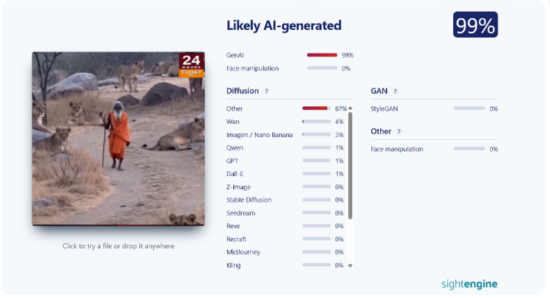
To verify the claim, we conducted a keyword search on Google. During the search, we did not find any credible media reports confirming the viral claim. Upon closely examining the viral video, we suspected that it could have been created using AI. We then analysed the video using the AI detection tool Sightengine. According to the tool’s analysis, the video has a 99 per cent probability of being AI-generated.
In the next step of our research , we scanned the viral video using another AI detection tool, WasIt AI. The results indicated that the video was generated using artificial intelligence.

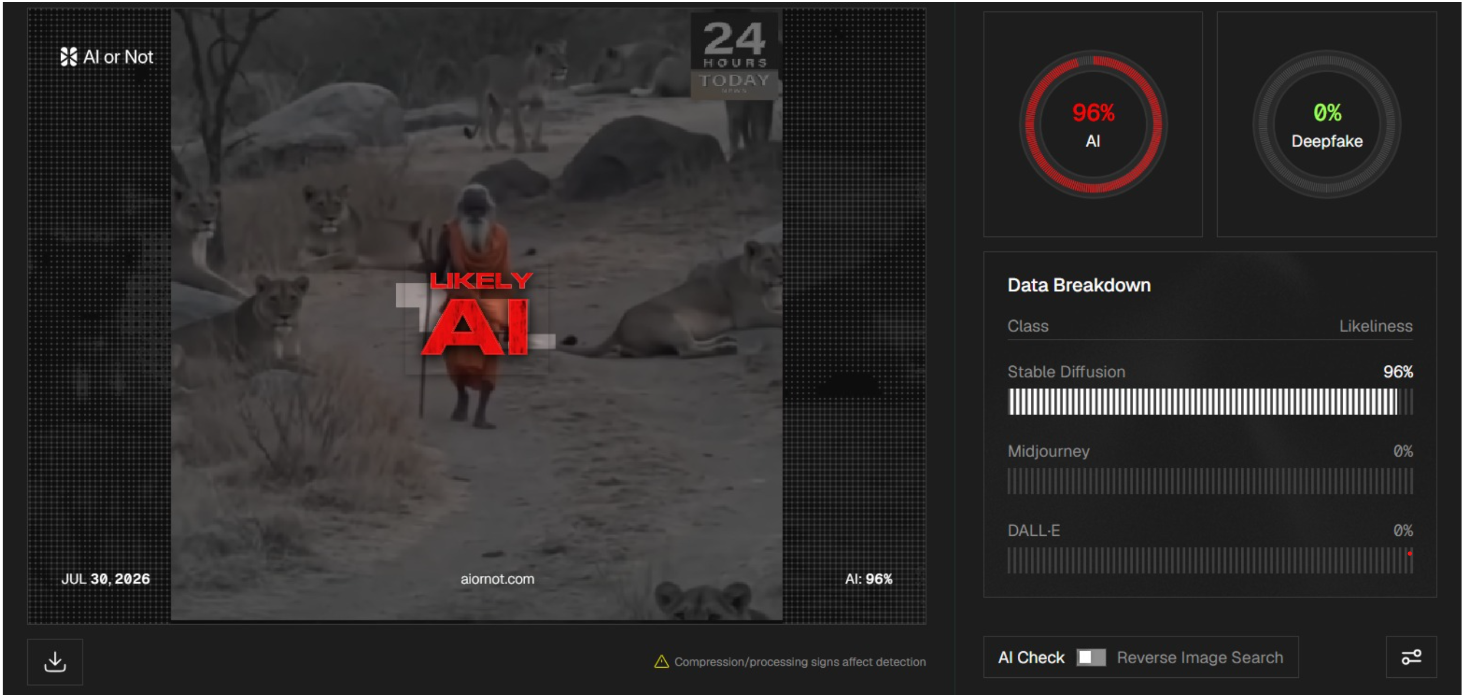
Finally, we analysed the video using the AI detection tool AI or Not, which also concluded that the viral video was created with the help of AI.
Conclusion
CyberPeace Research Wing’s research found that the viral claim is false. The video showing a monk walking among lions in a dense forest is not authentic but an AI-generated creation. The video is being shared with a misleading claim.

Related Blogs

Executive Summary
A video showing a massive blaze is going viral on social media with the claim that it captures an “attack” in Lucknow, Uttar Pradesh, suggesting that the city is witnessing a civil war-like situation. However, a fact-check by the CyberPeace Research Wing has found the claim to be false and misleading.
Claim
The viral post was shared by an X (formerly Twitter) user ‘@hitorisenshi142’ on April 15, 2026, with an English caption alleging unrest and violence in Lucknow.
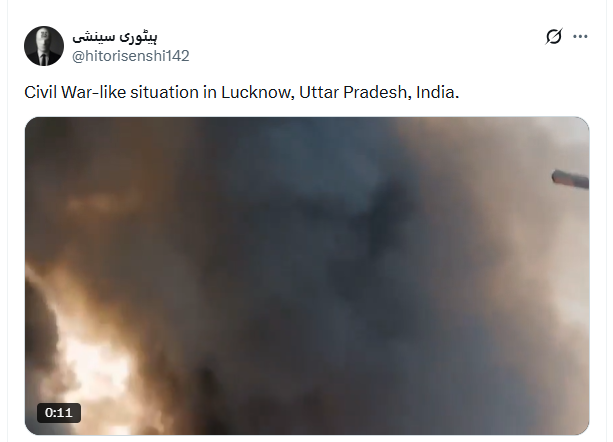
To verify the claim, keyframes from the video were extracted and subjected to a reverse image search. This led to a report published by News18 on April 16, 2026, which featured visuals matching the viral clip.

According to the report, the video actually shows a devastating fire that broke out in a slum settlement near Ring Road in Sector-12 of Vikas Nagar, Lucknow. The fire rapidly escalated, engulfing around 1,200 huts and leaving over 200 families affected in the nearly three-bigha area. Firefighting operations were extensive, with 22 fire tenders deployed to control the blaze. The situation was further aggravated as nearly 100 LPG cylinders stored in the huts exploded one after another, intensifying the fire and sending thick black smoke across the area.
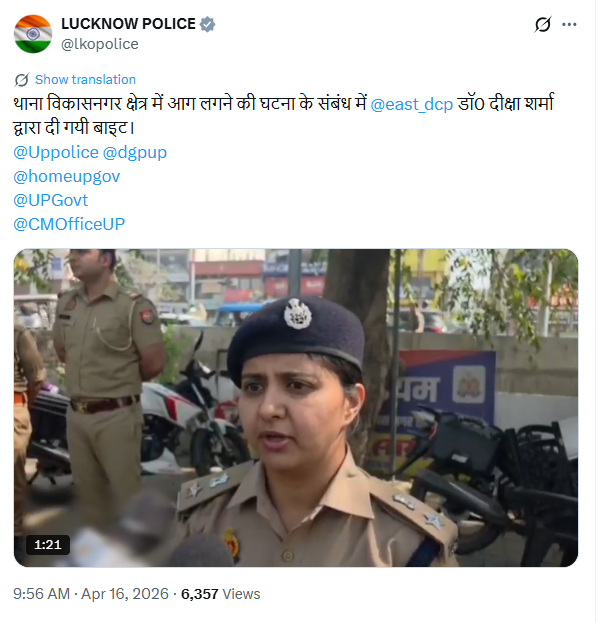
Further confirmation came from the official X account of Lucknow Police, which shared an update on April 16, 2026. The police clarified that the incident was a fire outbreak in the Vikas Nagar area and that the situation had been brought under control.
- https://x.com/lkopolice/status/2044633511584567415?s=20
Conclusion:
The viral claim suggesting that the video depicts an attack or civil war-like situation in Lucknow is false. The footage is from a fire incident in a slum area and is being circulated with misleading context to spread misinformation.

Executive Summary
Our research confirms that the viral image showing Iranian soldiers standing near a crashed helicopter is AI-generated and has no connection to any real-world event. It is being misleadingly shared online amid geopolitical tensions. Amid rising tensions between Iran, the United States, and Israel, a dramatic image is being widely shared on social media. The picture shows soldiers standing near the wreckage of a crashed helicopter in a desert, holding an Iranian flag. Users claim that Iranian forces shot down the aircraft. Research by CyberPeace Research Wing found that the viral image is fake and was created using AI tools.
Claim
A Facebook page named “Official Salman 09” shared the image on May 1, 2026, portraying it as a powerful symbol of victory in an ongoing conflict. The post suggested that the image reflected Iran’s military success and carried a broader political message amid regional tensions.
- https://www.facebook.com/photo/?fbid=909905332099201&set=a.522993370790401
- https://perma.cc/KCL8-7UDN

Fact Check
To verify the claim, we first conducted a reverse image search using Google Lens. The image did not appear on any credible news platforms, although it was widely circulating across social media—raising suspicion about its authenticity. We then analyzed the image using Google’s SynthID detector, which confirmed with high confidence that the image was generated using Google’s AI tools. SynthID is a technology designed to watermark and identify AI-generated content.

Further verification using AI detection tool Hive Moderation indicated a very high likelihood (up to 99.9%) that the image was AI-generated, with strong probability that it was created using Google’s Gemini.

Conclusion
Our research confirms that the viral image showing Iranian soldiers standing near a crashed helicopter is AI-generated and has no connection to any real-world event. It is being misleadingly shared online amid geopolitical tensions.

Introduction
In the labyrinthine expanse of the digital age, where the ethereal threads of our connections weave a tapestry of virtual existence, there lies a sinister phenomenon that preys upon the vulnerabilities of human emotion and trust. This phenomenon, known as cyber kidnapping, recently ensnared a 17-year-old Chinese exchange student, Kai Zhuang, in its deceptive grip, leading to an $80,000 extortion from his distraught parents. The chilling narrative of Zhuang found cold and scared in a tent in the Utah wilderness, serves as a stark reminder of the pernicious reach of cybercrime.
The Cyber Kidnapping
The term 'cyber kidnapping' typically denotes a form of cybercrime where malefactors gain unauthorised access to computer systems or data, holding it hostage for ransom. Yet, in the context of Zhuang's ordeal, it took on a more harrowing dimension—a psychological manipulation through online communication that convinced his family of his peril, despite his physical safety before the scam.
The Incident
The incident unfolded like a modern-day thriller, with Zhuang's parents in China alerting officials at his host high school in Riverdale, Utah, of his disappearance on 28 December 2023. A meticulous investigation ensued, tracing bank records, purchases, and phone data, leading authorities to Zhuang's isolated encampment, 25 miles north of Brigham City. In the frigid embrace of Utah's winter, Zhuang awaited rescue, armed only with a heat blanket, a sleeping bag, limited provisions, and the very phones used to orchestrate his cyber kidnapping.
Upon his rescue, Zhuang's first requests were poignantly human—a warm cheeseburger and a conversation with his family, who had been manipulated into paying the hefty ransom during the cyber-kidnapping scam. This incident not only highlights the emotional toll of such crimes but also the urgent need for awareness and preventative measures.
The Aftermath
To navigate the treacherous waters of cyber threats, one must adopt the scepticism of a seasoned detective when confronted with unsolicited messages that reek of urgency or threat. The verification of identities becomes a crucial shield, a bulwark against deception. Sharing sensitive information online is akin to casting pearls before swine, where once relinquished, control is lost forever. Privacy settings on social media are the ramparts that must be fortified, and the education of family and friends becomes a communal armour against the onslaught of cyber threats.
The Chinese embassy in Washington has sounded the alarm, warning its citizens in the U.S. about the risks of 'virtual kidnapping' and other online frauds. This scam fragments a larger criminal mosaic that threatens to ensnare parents worldwide.
Kai Zhuang's story, while unique in its details, is not an isolated event. Experts warn that technological advancements have made it easier for criminals to pursue cyber kidnapping schemes. The impersonation of loved ones' voices using artificial intelligence, the mining of social media for personal data, and the spoofing of phone numbers are all tools in the cyber kidnapper's arsenal.
The Way Forward
The crimes have evolved, targeting not just the vulnerable but also those who might seem beyond reach, demanding larger ransoms and leaving a trail of psychological devastation in their wake. Cybercrime, as one expert chillingly notes, may well be the most lucrative of crimes, transcending borders, languages, and identities.
In the face of such threats, awareness is the first line of defense. Reporting suspicious activity to the FBI's Internet Crime Complaint Center, verifying the whereabouts of loved ones, and establishing emergency protocols are all steps that can fortify one's digital fortress. Telecommunications companies and law enforcement agencies also have a role to play in authenticating and tracing the source of calls, adding another layer of protection.
Conclusion
The surreal experience of reading about cyber kidnapping belies the very real danger it poses. It is a crime that thrives in the shadows of our interconnected world, a reminder that our digital lives are as vulnerable as our physical ones. As we navigate this complex web, let us arm ourselves with knowledge, vigilance, and the resolve to protect not just our data, but the very essence of our human connections.
References
- https://www.bbc.com/news/world-us-canada-67869517
- https://www.ndtv.com/feature/what-is-cyber-kidnapping-and-how-it-can-be-avoided-4792135
