
#FactCheck: Old Jerusalem Clash Video Falsely Shared as Chaos at Tel Aviv Airport
Executive Summary
A video is being widely shared on social media showing a group of people clashing near a counter. The clip is being claimed to be from Ben Gurion Airport in Tel Aviv, Israel. Users allege that panic caused by Iranian missile threats has led people to try to flee the country, resulting in chaos and fights over flight tickets. However, a research by the CyberPeace found the claim to be false. Our findings reveal that the video is not related to the recent tensions and is actually from 2025.
Claim:
The viral video is being shared with the claim that chaos has erupted at Tel Aviv’s airport, with people trying to leave Israel due to Iranian attacks. An X user named “AjjuShane Experience (@AjjuShane)” shared the video with the caption: “We need tickets, we need flights, we want to leave Israel. We will not stay here until Iranian missiles crush us. Clashes are now happening at Tel Aviv’s Ben Gurion Airport.”
Post link:
- https://x.com/AjjuShane/status/2032584953112965238
- https://x.com/AjjuShane/status/2032584953112965238

Fact Check:
To verify the claim, we extracted keyframes from the video and conducted a reverse image search on Google. During the research , we found the same video on a Facebook page named Ynet, where it was shared on July 20, 2025.
- https://www.facebook.com/share/p/1NgTmpaZCs/
- https://www.facebook.com/share/p/1NgTmpaZCs/

The video carried a caption in Hebrew. Upon translation, it stated that the incident took place at “Cinema City” in Jerusalem, where dozens of Jewish youths clashed with Arab cafeteria workers. The visuals showed youths vandalizing property and throwing objects at staff members, while staff retaliated. Some individuals sustained minor injuries, but no serious harm was reported. We also found the same video on the YouTube channel of The Times of India, published on July 20, 2025. The caption mentioned that anti-Arab riots broke out inside a Cinema City theatre in Jerusalem on July 19, showing youths vandalizing the premises and clashing with Arab employees.

Conclusion:
Our research clearly shows that the viral video is from 2025 and unrelated to any recent Iran-Israel tensions. It is being misleadingly shared as a recent incident from Tel Aviv airport.

Related Blogs
Introduction
How Generative Artificial Intelligence, or GenAI, is changing the employee workday is no longer limited to writing emails or debugging code, but now also includes analysing contracts, generating reports, and much more. The use of AI tools in everyday work has become commonplace, but the speed at which companies have adopted these technologies has created a new kind of risk. Unlike threats that come from an outside attacker, Shadow AI is created inside an organisation by a legitimate employee who uses unapproved AI tools to make their work more efficient and productive. In many cases, the employee is unaware of the potential security, data privacy, and compliance risks involved in using such tools to perform their job duties.
What Is Shadow AI?
Shadow AI is when individuals use AI tools at work that aren’t provided by the company, like tools or other software programs, without the knowledge or permission of the employer. Examples of shadow AI include:
- Using personal ChatGPT or other chatbot accounts to complete tasks at the office
- Uploading business-related documents to online AI technologies for analysis or summarisation.
- Copying proprietary source code into an online AI model for debugging
- Installing browser extensions and add-ons that are not approved by IT or Security personnel.
How Shadow AI Is Harmful
1. Uncontrolled Data Exposure
When employees access or input information into their user-created AI, it becomes outside the controls of the company, such as both employee personal information and any third-party personal information, private company information (such as source code or contracts), and company internal strategies. After a user enters data into their user-created AIs, the company loses all ability to monitor how that data is stored, processed, or maintained. A data leak situation exists without a malicious cyberattack. The biggest risk of a data leak is not maliciousness but rather the loss of control and governance over sensitive data.
2. Regulatory and Legal Non-Compliance
Data protection laws like GDPR, India’s Digital Personal Data Protection (DPDP) Act, HIPAA, and other relevant sectoral laws require businesses to process data in accordance with the law, to minimise the amount of data they use, and to be accountable for their actions. Shadow AI often results in the unlawful use of personal data due to a lack of a legal basis for the processing, unauthorised cross-border data transfers, and not having appropriate contractual protections in place with their AI service providers. Regulators do not see the convenience of employees as an excuse for not complying with the law, and therefore, the organisation is ultimately responsible for any violations that occur.
3. Loss of Intellectual Property
Employees frequently use AI tools to speed up tasks involving proprietary information—debugging code, reviewing contracts, or summarising internal research. When done using unapproved AI platforms, this can expose trade secrets and intellectual property, eroding competitive advantage and creating long-term business risk.
Real-Life Example: Samsung’s ChatGPT Data Leak
In 2023, a case study exemplifying the Shadow AI risk occurred when Samsung Electronics placed a temporary ban on employee access to ChatGPT and other AI tools after reports from engineers revealed they were using ChatGPT to create debugging processes for internal source code and to summarise meeting notes. Consequently, confidential source code related to semiconductors was inadvertently uploaded onto a public AI platform. While there were no known incursions into the company’s system due to this incident, Samsung faced a significant challenge: once sensitive information is input into a public AI tool, it exists on external servers that are outside of the company’s purview or control.
As a result of this incident, Samsung restricted employee use of ChatGPT on corporate devices, issued a series of internal communications prohibiting the sharing of corporate data with public AI tools, and increased the urgency of their discussions regarding the adoption of secure, enterprise-level AI (artificial intelligence) solutions.
What Organisations Are Doing Today
Many organisations respond to Shadow AI risk by:
- Blocking access at the network level
- Circulating warning emails or policies
While these actions may reduce immediate exposure, they fail to address the root cause: employees still need AI to perform their jobs efficiently. As a result, bans often push AI usage underground, increasing Shadow AI rather than eliminating it.
Why Blocking AI Does Not Work—Governance Does
History has demonstrated that prohibition does not work - we see this when trying to block access to cloud storage, instant messaging and collaboration tools. Employees are forced to use personal devices and/or accounts when their employers block AI, which means employers do not have real-time visibility into how their employees are using these technologies, and creates friction with the security and compliance team as they try to enforce the types of tools their employees can use. Prohibiting AI adoption will not stop it from being adopted; it will just create a challenge for employers regarding how safe and responsible it is. The challenge for effective organisations is therefore to shift from denial and develop governance-first AI strategies aimed at controlling data usage, protection and security, rather than merely restricting access to a list of specific tools.
Shadow AI: A Silent Legal Liability Under the GDPR
Shadow AI isn't a problem for the Information Technology Department; it is a failure of Governance, Compliance and Law. By using AI tools that have not been approved as a result, the organisation processes personal data without a lawful basis (Article 6 of the General Data Protection Regulation (GDPR)), repurposes data for use beyond its original intent and in breach of the Purpose Limitation (Article 5(1)(b)), and routinely exceeds necessity and in breach of Data Minimisation (Article 5(1)(c)). The outcome of these actions is the use of tools that involve International Data Transfers Without Authorisation and are therefore in breach of Chapter V, and violate Article 32 because there are no enforceable safeguards in place. Most significantly, the failure to demonstrate Oversight, Logging and Control under Articles 5(2) and 24 constitutes a failure in Accountability. Therefore, from a Regulatory perspective, Shadow AI is not accidental and is not defensible.
The Right Solution: Secure and Governed AI Adoption
1. Provide Approved AI Tools
Employers have an obligation to supply business-approved AI technology for helping workers to be productive while maintaining maximum protections, like storing data separately and not using employees' data for training a model; defining how long data is kept, and the rules around deleting that data. When employees are provided with verified and secure AI options that align with their work processes, they will rely significantly less on Shadow AI.
2. Enforce Zero-Trust Data Access
The governance of AI systems must follow the principles of "zero trust," granting access to data only through the principle of "least privilege," which means that data access will only be allowed by the system user, and providing continuous verification of user-identity and context; this supports and helps establish context-aware controls to monitor and track all user activities, which will be especially important as agent-like AI systems become increasingly autonomous and are capable of operating at machine-speed where even small errors in configuration, will result in rapid and large expose to data.
3. Apply DLP and Audit Logging
It is important to have robust data loss prevention measures in place to protect sensitive data that is sent outside an organisation. The first end user or machine that accesses the data should be detailed in a comprehensive audit log that indicates when and how the data is accessed. In combination with other controls, these measures create accountability, comply with regulations, and assist with appropriately detecting and responding to incidents.
4. Maintain Visibility Across AI, Cloud, and SaaS
Security teams need unified visibility across AI tools, personal cloud applications, and SaaS platforms. Risks move across systems, and controls must follow the data wherever it flows.
Conclusion
This new threat exposes an organisation to the risk of data loss through leaks, regulatory fines, liability for the loss of intellectual property, and reputational damage, all of which can occur without any intent to cause harm. The way forward is not to block AI, but to adopt a clear framework built on governance, visibility, and secure enablement. This approach allows organisations to use AI with confidence, while ensuring trust, accountability, and effective oversight to protect data and support AI in reaching its full transformative potential. AI use is encouraged, but it must be done responsibly, ethically, and securely.
References
- https://bronson.ai/resources/shadow-ai/
- https://www.varonis.com/blog/shadow-ai
- https://www.waymakeros.com/learn/gdpr-hipaa-shadow-ai-compliance-nightmare
- https://www.forbes.com/sites/siladityaray/2023/05/02/samsung-bans-chatgpt-and-other-chatbots-for-employees-after-sensitive-code-leak/
- https://www.usatoday.com/story/special/contributor-content/2025/05/23/shadow-ai-the-hidden-risk-in-todays-workplace/83822081007

Executive Summary
A video is being widely shared on social media showing a delivery boy risking his life by jumping in front of a speeding truck to save a small child. The dramatic footage has drawn widespread praise, with many users calling the delivery worker a "real hero," "Superman," and even "an angel." Several social media users have claimed that the incident took place in Mumbai, alleging that the delivery boy's quick thinking prevented a fatal accident. CyberPeace Research Wing ’s research found the viral claim to be false. Our research revealed that the video is not real but AI-generated, and is being circulated with a misleading claim.
Claim
An X (formerly Twitter) user shared the viral video on July 12, 2026, with the caption: "This cannot be called a human, but an angel. Such an incredible feat by a delivery boy from Mumbai is hard to believe. At first glance, it seemed like he had sacrificed his life to save the child, but in the next moment, he saved not only himself but also the child's life. Watch this incredible video."
https://x.com/virjust18/status/2076270467569320072

Fact Check
To verify the viral claim, we conducted a keyword search on Google. However, we found no credible media reports or authentic sources confirming that such an incident had occurred in Mumbai or anywhere else. During the research, we found the same video uploaded on the Instagram account 'ai_nature_of_beauty_01' on July 12, 2026. Although the post's caption did not provide any details about the incident, a review of the account revealed that it regularly uploads AI-generated videos featuring fictional and digitally created scenarios. This strongly indicates that the viral clip is not footage of an actual event but content created using Artificial Intelligence.
https://www.instagram.com/reels/Das5IJ9FFF5/

We further analysed the video using the AI detection tool Hive Moderation, which indicated a 96.1% probability that the footage was AI-generated. The analysis strongly suggests that the video was created using artificial intelligence rather than recorded in the real world.

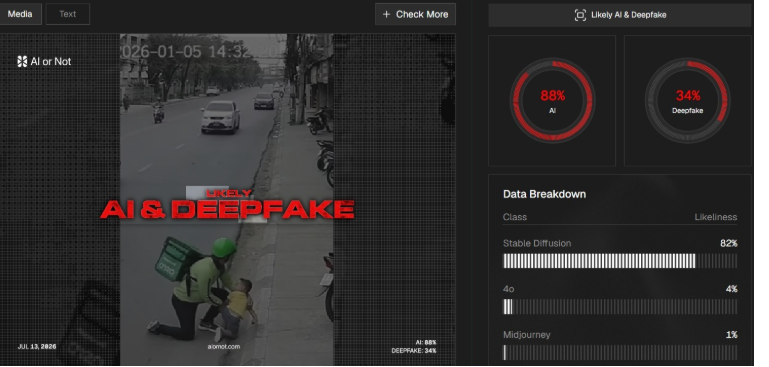
For additional verification, we also examined the video using another AI detection platform, AI or Not. The tool likewise identified the scenes in the viral clip as likely AI-generated, reinforcing our findings.
Conclusion
Our research found that the viral video does not depict a real rescue. It is AI-generated content that has been falsely circulated as footage of a delivery boy saving a child from a speeding truck in Mumbai. There is no credible evidence to support the claim that such an incident actually occurred.
Introduction
The rapid adoption of artificial intelligence (AI) tools and applications in companies has been largely presented as a groundbreaking development for enterprises. The potential for increased productivity and efficiently scaled companies eliminates repetitive tasks and builds a narrative that practically writes itself for executives. What has largely been ignored, however, is its effect on its users- the employees. Evidence from across the United States, United Kingdom, and continental Europe indicates an increase in psychological disengagement from work, along with an increase in the number of people who are actively sabotaging the very systems that companies have invested millions of dollars to implement, as a direct result of being forced to work with AI.
The Backdrop: Quiet Quitting
Quiet quitting is a form of employee disengagement wherein workers meet only the basic expectations of their job without. Gallup puts global employee engagement at just 21%. State of the Global Workplace 2026 report which analysed employee well-being across 160 countries reports that in India, employee and manager engagement has declined. Around 62% of workers describe themselves as not engaged, and another 17% are actively disengaged — not just drifting, but potentially pulling in the opposite direction. What does this mean for productivity? Gallup estimates this costs the global economy roughly $8.9 trillion in lost productivity each year, around 9% of world GDP. This is the workplace AI has entered into.
How AI Is Changing the Nature of Work
The promise was simpler work but employees report that the reality is often more of it. AI raises output expectations without necessarily reducing effort. Workers now lose the equivalent of 51 working days per year to technology friction, nearly two full months up 42% from 2025. Poorly integrated systems force employees to spend hours troubleshooting or correcting AI-generated outputs, adding cognitive load rather than removing it. Focus efficiency dropped to a three-year low of 60%, as collaboration time surged 34% and multitasking climbed 12%. AI is not eliminating work. It is transforming it into something more demanding and more fragmented. The psychological dimension is equally documented. TalentLMS research found that 54% of employees report persistent workplace unhappiness, with one in five experiencing it frequently or constantly. 29% report unmanageable workloads during this transition, and 15% do not clearly understand their role expectations in an AI-transformed workplace. When workers cannot see where they fit, withdrawal is a rational response.
Then there is the fear. IBM announced it would not replace roughly 7,800 back-office positions that could be handled by AI, framing it as natural attrition. Klarna said its AI assistant was doing the work of 700 full-time customer service agents. Dropbox laid off 16% of its workforce, with its CEO explicitly citing the need to “make room for AI.” AI was the leading cause of job cuts in March 2026 the first time that has happened since tracking began.
The Causal Link: AI Anxiety to Quiet Quitting
A peer-reviewed study published in March 2025 establishes the causal mechanism between forced AI adoption and employee disengagement. Conducted across 457 employees in Turkish SMEs, it found that AI anxiety does not directly compel people to resign. Instead, it triggers quiet quitting a form of progressive disengagement that functions as a precursor to departure. Drawing on Withdrawal Progression Theory, the study frames quiet quitting as a preliminary stage of turnover intention, where withdrawal progresses from mild detachment toward eventual exit. The integrated causal chain runs as follows: forced AI adoption creates work intensification and job anxiety, which produce burnout and loss of autonomy, which trigger psychological withdrawal, which precedes turnover. DHR Global’s Workforce Trends Report for 2026 found that overall employee engagement dropped from 88% to 64% in a single year. Crucially, 69% of C-suite leaders say their company has communicated clearly about AI’s impact on jobs but only 12% of entry-level staff agree. When the people most exposed to displacement are also the least informed about what is happening to their roles, disengagement is not a mystery. It is a response to a vacuum of information.
From Disengagement to Active Withdrawal
Quiet quitting is then a natural response. But what has emerged alongside it is something more active, and it is where the disengagement crisis tips into something organisations are unprepared for. The Writer and Workplace Intelligence survey of 2,400 knowledge workers found that 29% of employees admit to willfully withdrawing from their company’s AI strategy. Among Gen Z workers, that figure jumps to 44%. Active withdrawal takes several forms: entering proprietary data into public AI chatbots, using unapproved tools, outright refusing to engage with mandated platforms, and in some cases deliberately generating low-quality outputs to make the technology look ineffective. For Gen Z, the resistance has a structural logic. Junior roles in finance, law, and tech the traditional “learning by doing” rungs of the career ladder have declined by 32% since 2022. For a 22-year-old, AI is not a tool; it is a competitor that has already taken their first job. Workers who resist AI out of fear for their jobs are making themselves more vulnerable to the outcome they dread. 77% of executives say employees who refuse to become proficient in AI will not be considered for promotions or leadership roles, and 60% are considering cutting those who refuse to adopt it entirely.
Meanwhile, 75% of executives admit their company’s AI strategy is “more for show” than a meaningful guide to outcomes. Only 29% report significant ROI from generative AI, despite 97% claiming to have already deployed agents across their organisation. 39% of business leaders admit they made employees redundant as a result of deploying AI of whom 55% concede they made the wrong decisions about those redundancies. Organisations are moving fast, getting it wrong, and the cost is being absorbed by the workforce.
Conclusion
AI is not directly causing quiet quitting. However, AI is changing how we view working relationships; it will continue to result in predictable outcomes of poor execution of AI (i.e. passive to active disengagement) and radically change the way that we work, primarily by creating an increase in job demands, reducing autonomy, and raising worker anxiety without providing any transparency about future AI technology use. If AI continues to create a challenging work environment, it may lead to increased psychological detachment from work and ultimately result in productivity losses, possibly canceling out the very gains expected from AI integration. This globally rising disengagement from AI tools begets the question: is technology being deployed responsibly?
References
- https://www.gallup.com/workplace/349484/state-of-the-global-workplace.aspx
- https://www.walkme.com/news-releases/enterprises-lose-51-workdays-per-employee-to-technology-friction-annually-despite-record-ai-investment-walkme-global-study-of-3750-finds/.
- https://www.activtrak.com/resources/state-of-the-workplace/
- https://peoplemanagingpeople.com/employee-retention/quiet-cracking/
- https://www.webpronews.com/the-quiet-revolt-gen-z-workers-are-deliberately-undermining-ai-deployments-from-the-inside/
- https://www.uctoday.com/productivity-automation/44-of-gen-z-workers-are-sabotaging-your-enterprise-ai-rollout-the-problem-isnt-gen-z/
- https://pmc.ncbi.nlm.nih.gov/articles/PMC11939379/
- https://huntscanlon.com/workforce-trends-2026-leaders-confront-burnout-disengagement-and-ai-driven-change/
- https://fortune.com/2026/04/08/gen-z-workers-sabotage-ai-rollout-backlash/
- https://peoplemanagingpeople.com/employee-retention/quiet-cracking/
- https://www.hrgrapevine.com/us/content/article/2026-04-09-ai-adoption-is-tearing-companies-apart-says-new-report
- https://economictimes.indiatimes.com/news/new-updates/india-leads-in-workplace-disengagement-as-quiet-quitting-trend-rises-why-are-indians-mentally-checking-out-at-jobs/articleshow/130104773.cms?from=mdr
