
#FactCheck-Old Video From 2023 Palestine Protest Falsely Linked to Ongoing NEET Paper Leak Protest.
Executive Summary
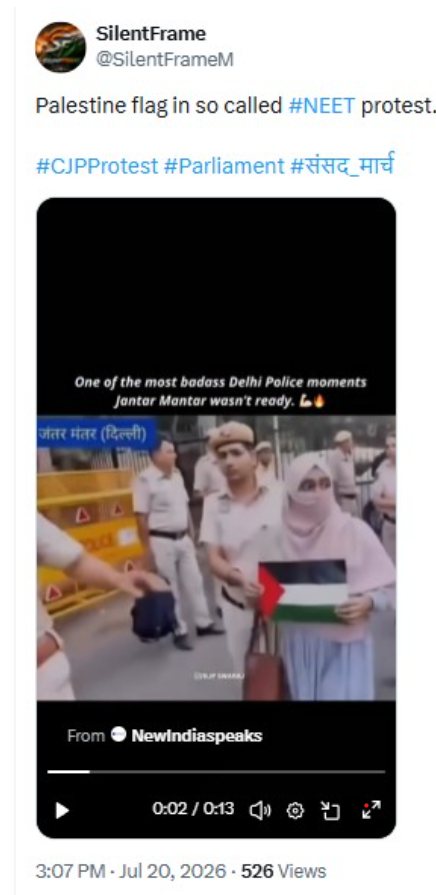
A video showing police personnel allegedly snatching and tearing a Palestine flag from a woman protester is being widely shared on social media. Users are claiming that the video was recorded during the ongoing CJP-led protest at Jantar Mantar demanding the resignation of the Union Education Minister over the NEET paper leak. CyberPeace Research Wing ’s research found that the viral claim is misleading. The video is not related to the ongoing CJP-led protest at Jantar Mantar over the NEET paper leak. The footage dates back to 2023 and is being falsely linked to a recent protest.
Claim:
A social media user shared the viral video claiming that a woman protester arrived at the NEET paper leak protest carrying a Palestine flag.
https://x.com/SilentFrameM/status/2079138742795939907
Fact Check:
A reverse image search of keyframes from the viral video led us to a YouTube video uploaded by Indian Observer on October 30, 2023, featuring the same visuals. The video description identified the footage as being from a pro-Palestine demonstration held at Jantar Mantar in solidarity with Palestinians.
https://www.youtube.com/shorts/_JhJyZ-Djyw

We also found an October 2023 report by Free Press Journal carrying the same visuals. According to the report, several students and civil society members had gathered at Jantar Mantar to protest Israel’s military actions in the Gaza Strip and express solidarity with Palestine. During the protest, Delhi Police briefly detained more than 50 demonstrators. As the detainees were being escorted away, a woman carrying a paper Palestine flag was seen confronting police personnel, who allegedly snatched and tore the flag.

Conclusion:
CyberPeace Research Wing ’s fact check found the viral claim to be misleading. The video is not from the ongoing CJP-led NEET paper leak protest at Jantar Mantar. The footage is from a pro-Palestine demonstration held in October 2023 and has been falsely shared as a recent video from the ongoing protests.

Related Blogs

In an exciting milestone achieved by CyberPeace, an ICANN APRALO At-Large organization, in collaboration with the Internet Corporation for Assigned Names and Numbers (ICANN), has successfully deployed and made operational an L-root server instance in Ranchi, Jharkhand. This initiative marks a significant step toward enhancing the resilience, speed, and security of internet connectivity in eastern India.
Understanding the DNS hierarchy – Starting from Root
Internet users access online information through different domain names and interactions with any web browser takes place through IP (Internet Protocol) addresses. Domain Name System (DNS) functions as the internet's equivalent of Yellow Pages or the phonebook of cyberspace. When a person uses a domain name like www.cyberpeace.org to access a website, their browser communicates with the internet protocol, and DNS converts the domain name to the corresponding IP address so that web browsers may load the web pages. The function of a DNS is to convert domain names to Internet Protocol addresses. It enables the respective browsers to load the resources from the Internet.
When a user types a domain name into your browser, a DNS query works behind the scenes to find the website’s IP address. First, your device asks a DNS resolver—often provided by your ISP or a third-party service—for the address. The resolver checks its cache for a match, and if none is found, it queries a root server to locate the top-level domain (TLD) server (like .com or .org). The resolver then asks the TLD server for the Authoritative nameserver responsible for the particular domain, which provides the specific IP address. Finally, the resolver sends this address back to your device, enabling it to connect to the website’s server and load the page. The entire process happens in milliseconds, ensuring seamless browsing.

Special focus on Root Server:
A root server is a name server that directly answers queries for records in the root zone and redirects requests for more specific domains to the appropriate top-level domain (TLD) servers. Root servers are an integral part of this system, acting as the first step in resolving a domain name into its corresponding IP address. They provide the initial direction needed to locate the authoritative servers for any domain.
The DNS root zone is served by 13 unique IP addresses, supported by hundreds of redundant root servers distributed worldwide connected through Anycast Routing to manage requests efficiently. As of January 8, 2025, the global root server system consists of 1921 instances operated by 12 independent root server operators. These servers ensure the smooth functioning of the internet by managing the backbone of DNS queries.

Type of Root Server Instances:
Well, in this regard, there are two types of root server instances that can be found– Global instance and Local instance.
Global root server instances are the primary root servers distributed strategically around the world. Local instances, on the other hand, are replicas of these global servers deployed in specific regions to handle local DNS traffic more efficiently. In each operator's list of sites, some instances are marked as global (globe icon) and some are marked as local (flag icon). The difference is in how widely available that instance will be, because of how routing for that instance is done. Recall that the routes for an instance are announced by BGP, the inter-domain routing protocol.
For global instances, the route advertisement is permitted to spread throughout the Internet, i.e., any router on the Internet could know the path to that instance. Of course, for a particular source, the route to that instance may not be the optimal route, so some other instance could be chosen as the destination.
With a local instance, however, the route advertisement is limited to only nearby networks. For example, the instance may be visible to just one ISP, or to ISPs that connect at a particular exchange point. Sources from farther away will not be able to see and query that local instance.
Deployment in Ranchi - The Journey & Significance:
CyberPeace in Collaboration with ICANN has successfully deployed an L-root server instance in Ranchi, marking a significant milestone in enhancing regional Internet infrastructure. This deployment, part of a global network of root servers, ensures faster and more reliable DNS query resolution for the region, reducing latency and enhancing cybersecurity.

The Journey of deploying the L-Root instance in Collaboration with ICANN followed the steps-
- Signing the Agreement: Finalized the L-SINGLE Hosting Agreement with ICANN to formalize the partnership.
- Procuring the Hardware: Acquired the required hardware appliance to meet technical standards for hosting the L-root server.
- Setup and Installation: Configured and installed the appliance to prepare it for seamless operation.
- Joining the Anycast Network: Integrated the server into ICANN's global Anycast network using BGP (Border Gateway Protocol) for efficient DNS traffic management.
The deployment of the L-root server in Ranchi marks a significant boost to the region’s digital ecosystem. It accelerates DNS query resolution, reducing latency and enhancing internet speed and reliability for users.
This instance strengthens cyber defenses by mitigating Distributed Denial of Service (DDoS) risks and managing local traffic efficiently. It also underscores Eastern India’s advanced digital infrastructure, aligning with initiatives like Digital India to meet evolving digital demands.
By handling local queries, the L-root server eases the load on global servers, contributing to a more stable and resilient global internet.
CyberPeace’s Commitment to a Secure and resilient Cyberspace
As an organization dedicated to promoting peace, security and resilience in cyberspace, CyberPeace views this collaboration with ICANN as a significant achievement in its mission. By strengthening the internet’s backbone in eastern India, this deployment underscores our commitment to enabling a secure, accessible, and resilient digital ecosystem.
Way forward and Roadmap for Strengthening India’s DNS Infrastructure:
The successful deployment of the L-root instance in Ranchi is a stepping stone toward bolstering India's digital ecosystem. CyberPeace aims to promote awareness about DNS infrastructure through workshops and seminars, emphasizing its critical role in a resilient digital future.
With plans to deploy more such root server instances across India, the focus is on expanding local DNS infrastructure to enhance efficiency and security. Collaborative efforts with government agencies, ISPs, and tech organizations will drive this vision forward. A robust monitoring framework will ensure optimal performance and long-term sustainability of these initiatives.
Conclusion
The deployment of the L-root server instance in Eastern India represents a monumental step toward strengthening the region’s digital foundation. As Ranchi joins the network of cities hosting root server instances, the benefits will extend not only to the local community but also to the global internet ecosystem. With this milestone, CyberPeace reaffirms its commitment to driving innovation and resilience in cyberspace, paving the way for a more connected and secure future.
.webp)
Introduction
The link between social media and misinformation is undeniable. Misinformation, particularly the kind that evokes emotion, spreads like wildfire on social media and has serious consequences, like undermining democratic processes, discrediting science, and promulgating hateful discourses which may incite physical violence. If left unchecked, misinformation propagated through social media has the potential to incite social disorder, as seen in countless ethnic clashes worldwide. This is why social media platforms have been under growing pressure to combat misinformation and have been developing models such as fact-checking services and community notes to check its spread. This article explores the pros and cons of the models and evaluates their broader implications for online information integrity.
How the Models Work
- Third-Party Fact-Checking Model (formerly used by Meta) Meta initiated this program in 2016 after claims of extraterritorial election tampering through dis/misinformation on its platforms. It entered partnerships with third-party organizations like AFP and specialist sites like Lead Stories and PolitiFact, which are certified by the International Fact-Checking Network (IFCN) for meeting neutrality, independence, and editorial quality standards. These fact-checkers identify misleading claims that go viral on platforms and publish verified articles on their websites, providing correct information. They also submit this to Meta through an interface, which may link the fact-checked article to the social media post that contains factually incorrect claims. The post then gets flagged for false or misleading content, and a link to the article appears under the post for users to refer to. This content will be demoted in the platform algorithm, though not removed entirely unless it violates Community Standards. However, in January 2025, Meta announced it was scrapping this program and beginning to test X’s Community Notes Model in the USA, before rolling it out in the rest of the world. It alleges that the independent fact-checking model is riddled with personal biases, lacks transparency in decision-making, and has evolved into a censoring tool.
- Community Notes Model ( Used by X and being tested by Meta): This model relies on crowdsourced contributors who can sign up for the program, write contextual notes on posts and rate the notes made by other users on X. The platform uses a bridging algorithm to display those notes publicly, which receive cross-ideological consensus from voters across the political spectrum. It does this by boosting those notes that receive support despite the political leaning of the voters, which it measures through their engagements with previous notes. The benefit of this system is that it is less likely for biases to creep into the flagging mechanism. Further, the process is relatively more transparent than an independent fact-checking mechanism since all Community Notes contributions are publicly available for inspection, and the ranking algorithm can be accessed by anyone, allowing for external evaluation of the system by anyone.
CyberPeace Insights
Meta’s uptake of a crowdsourced model signals social media’s shift toward decentralized content moderation, giving users more influence in what gets flagged and why. However, the model’s reliance on diverse agreements can be a time-consuming process. A study (by Wirtschafter & Majumder, 2023) shows that only about 12.5 per cent of all submitted notes are seen by the public, making most misleading content go unchecked. Further, many notes on divisive issues like politics and elections may not see the light of day since reaching a consensus on such topics is hard. This means that many misleading posts may not be publicly flagged at all, thereby hindering risk mitigation efforts. This casts aspersions on the model’s ability to check the virality of posts which can have adverse societal impacts, especially on vulnerable communities. On the other hand, the fact-checking model suffers from a lack of transparency, which has damaged user trust and led to allegations of bias.
Since both models have their advantages and disadvantages, the future of misinformation control will require a hybrid approach. Data accuracy and polarization through social media are issues bigger than an exclusive tool or model can effectively handle. Thus, platforms can combine expert validation with crowdsourced input to allow for accuracy, transparency, and scalability.
Conclusion
Meta’s shift to a crowdsourced model of fact-checking is likely to have bigger implications on public discourse since social media platforms hold immense power in terms of how their policies affect politics, the economy, and societal relations at large. This change comes against the background of sweeping cost-cutting in the tech industry, political changes in the USA and abroad, and increasing attempts to make Big Tech platforms more accountable in jurisdictions like the EU and Australia, which are known for their welfare-oriented policies. These co-occurring contestations are likely to inform the direction the development of misinformation-countering tactics will take. Until then, the crowdsourcing model is still in development, and its efficacy is yet to be seen, especially regarding polarizing topics.
References
- https://www.cyberpeace.org/resources/blogs/new-youtube-notes-feature-to-help-users-add-context-to-videos
- https://en-gb.facebook.com/business/help/315131736305613?id=673052479947730
- http://techxplore.com/news/2025-01-meta-fact.html
- https://about.fb.com/news/2025/01/meta-more-speech-fewer-mistakes/
- https://communitynotes.x.com/guide/en/about/introduction
- https://blogs.lse.ac.uk/impactofsocialsciences/2025/01/14/do-community-notes-work/?utm_source=chatgpt.com
- https://www.techpolicy.press/community-notes-and-its-narrow-understanding-of-disinformation/
- https://www.rstreet.org/commentary/metas-shift-to-community-notes-model-proves-that-we-can-fix-big-problems-without-big-government/
- https://tsjournal.org/index.php/jots/article/view/139/57

Executive Summary
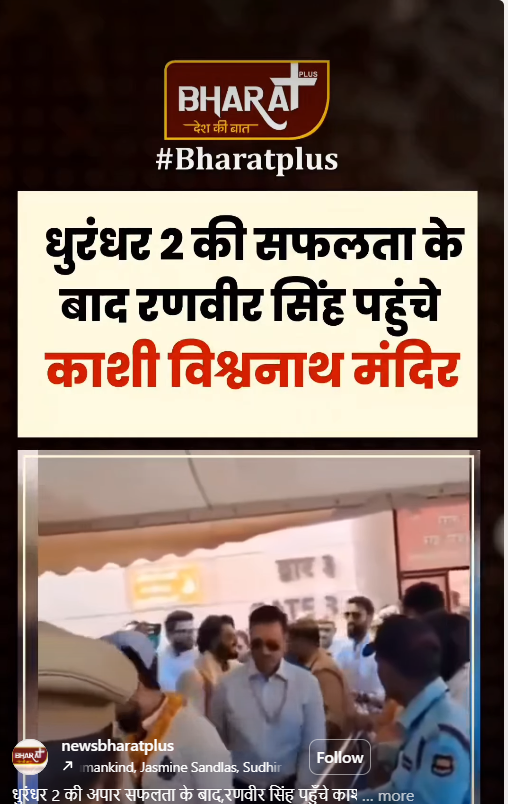
Following the reported box office success of ‘Dhurandhar 2: The Revenge’, released on March 19, 2026, a video of Ranveer Singh visiting a temple is being widely shared on social media. Users claim that the actor visited the Kashi Vishwanath Temple to offer prayers after the film’s success. Research by CyberPeace found that the viral claim is misleading. The video of Ranveer Singh visiting the Kashi Vishwanath Temple is not recent. It dates back to 2024, when he visited the temple with Kriti Sanon, and is unrelated to the release or success of ‘Dhurandhar 2: The Revenge’.
Claim
An Instagram user “newsbharatplus” shared the video on March 26, 2026, with a caption stating that after the massive success of Dhurandhar 2, Ranveer Singh visited the temple and performed rituals.
Fact Check
To verify the claim, we extracted keyframes from the viral video and conducted a reverse image search. This led us to a report published by Dainik Jagran on April 14, 2024. According to the report, Ranveer Singh had visited the Kashi Vishwanath Temple along with Kriti Sanon and noted fashion designer Manish Malhotra. During the visit, the trio was seen offering prayers, wearing traditional attire, and applying sandalwood tilak.
https://www.jagran.com/entertainment/bollywood-ranveer-singh-and-kriti-sanon-visits-kashi-vishwanath-temple-with-manish-malhotra-see-photos-here-23696781.html
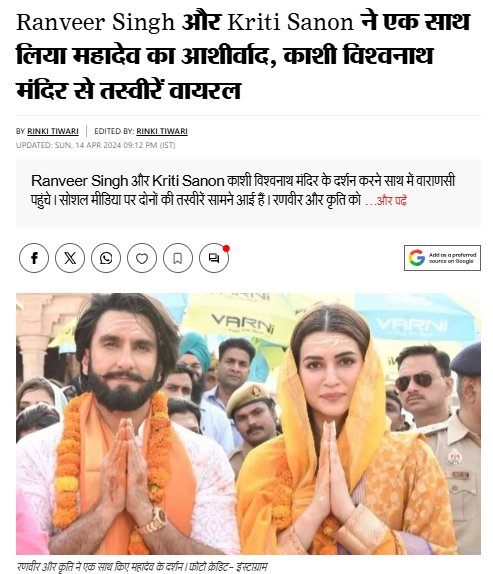
We also found a video report on the official YouTube channel of Times Now Navbharat, uploaded on April 15, 2024, showing Ranveer Singh and Kriti Sanon at the temple. The report also featured visuals from a fashion event held in Varanasi.
- https://www.youtube.com/watch?v=OMuW_SVbfb4

Conclusion
The viral claim is misleading. The video of Ranveer Singh visiting the Kashi Vishwanath Temple is not recent. It dates back to 2024, when he visited the temple with Kriti Sanon, and is unrelated to the release or success of ‘Dhurandhar 2: The Revenge’.
