
#FactCheck: Viral Video of Armless Woman Performing Gymnastics Is AI-Generated
Executive Summary
A video of a young woman without arms performing gymnastics has been widely shared on social media. In the video, the woman can be seen without both arms, yet she performs several difficult gymnastics moves with remarkable ease and confidence. Her impressive physical balance and practice have left viewers amazed. Users sharing the video are praising not only her talent but also her courage, confidence and determination. Many users are also describing it as an inspiring example of overcoming challenges and pursuing one's dreams with unwavering spirit.
However, a probe by the Research Wing of CyberPeace found that the video being shared on social media is not genuine but was generated using Artificial Intelligence (AI). The video shows the young woman performing difficult gymnastics moves with apparent ease, but a technical analysis revealed signs of AI-generated content. Therefore, sharing the video as a real incident or as the performance of an actual gymnast is misleading.
Claim:
A video circulating on social media shows a young woman without arms performing gymnastics, with users hailing her courage and determination.
https://www.facebook.com/reel/1793394471856936

Fact Check
During our research of the viral video, we first conducted a reverse image search of its different keyframes. We also searched Google using relevant keywords. However, we could not find the viral video in any credible media report.
During the reverse search, we found the same viral video on the Instagram account @arenaathletics1, where it was posted on September 13. The post also carries an “AI-generated content” label. The video has garnered more than 20 million views. Several users in the comment section have also identified the video as AI-generated.

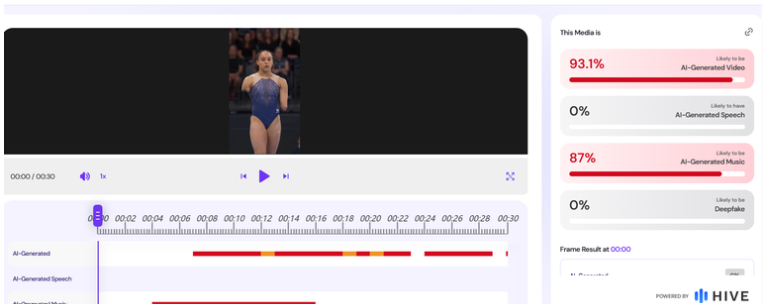
We then checked the viral video using the AI detection tool Hive Detect. In its analysis, the tool identified the video as likely AI-generated, assigning it a 93.1 percent score for AI-generated content.
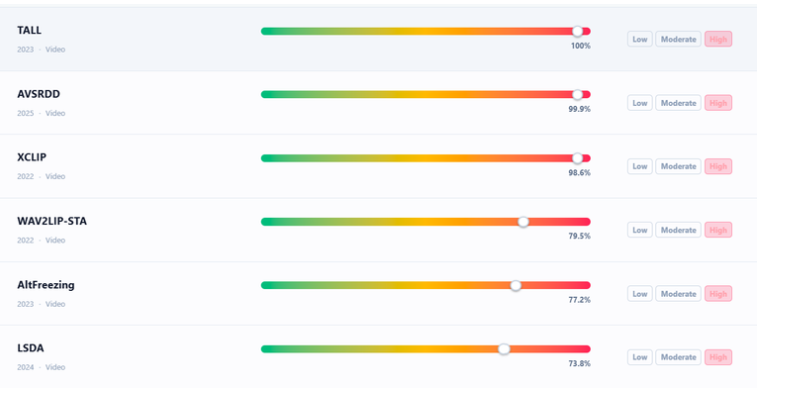
Additionally, six detectors on Deepfake-O-Meter identified the viral video as AI-generated with a high probability.
Conclusion
Our research found sufficient evidence to establish that the viral video showing a young woman without arms performing gymnastics is not genuine. The video was found on an Instagram account carrying an “AI-generated content” label, while analysis using AI detection tools, including Hive Detect and Deepfake-O-Meter, also indicated a high likelihood of AI-generated content. Therefore, the video is AI-generated and is being misleadingly shared as a real-life performance, rather than an authentic video of a gymnast.

Related Blogs

Introduction
Social media has emerged as a leading source of communication and information; its relevance cannot be ignored during natural disasters since it is relied upon by governments and disaster relief organisations as a tool for disseminating aid and relief-related resources and communications instantly. During disaster times, social media has emerged as a primary source for affected populations to access information on relief resources; community forums offering aid resources and official government channels for government aid have enabled efficient and timely administration of relief initiatives.
However, given the nature of social media, misinformation risks during natural disasters has also emerged as a primary concern that severely hampers aid administration during natural disasters. The disaster-disinformation network offers some sensationalised influential campaigns against communities at their most vulnerable. Victims who seek reliable resources during natural calamities often reach out to inhospitable campaigns and may experience delayed or lack of access to necessary healthcare, significantly impacting their recovery and survival. This delay can lead to worsening medical conditions and an increased death toll among those affected by the disaster. Victims may lack clear information on the appropriate agencies to seek assistance from, causing confusion and delays in receiving help.
Misinformation Threat Landscape during Natural Disaster
During the 2018 floods in Kerala, it was noted that a fake video on water leakage from the Mullaperyar Dam created panic among the citizens and negatively impacted the rescue operations. Similarly, in 2017, reports emerged claiming that Hurricane Irma had caused sharks to be displaced onto a Florida highway. Similar stories, accompanied by the same image, resurfaced following Hurricanes Harvey and Florence. The disaster-affected nation may face international criticism and fail to receive necessary support due to its perceived inability to manage the crisis effectively. This lack of confidence from the global community can further exacerbate the challenges faced by the nation, leaving it more vulnerable and isolated in its time of need.
The spread of misinformation through social media severely hinders the administration of aid and relief operations during natural disasters since it hinders first responders' efforts to counteract and reduce the spread of misinformation, rumours, and false information and declines public trust in government, media, and non-governmental organisations (NGOs), who are often the first point of contact for both victims and officials due to their familiarity with the region and the community. In Moldova, it was noted that foreign influence has exploited the ongoing drought to create divisions between the semi-autonomous regions of Transnistria and Gagauzia and the central government in Chisinau. News coverage critical of the government leverages economic and energy insecurities to incite civil unrest in this already unstable region. Additionally, First responders may struggle to locate victims and assist them to safety, complicating rescue operations. The inability to efficiently find and evacuate those in need can result in prolonged exposure to dangerous conditions and a higher risk of injury or death.
Further, international aid from other countries could be impeded, affecting the overall relief effort. Without timely and coordinated support from the global community, the disaster response may be insufficient, leaving many needs unmet. Further, misinformation also impedes military, reducing the effectiveness of rescue and relief operations. Military assistance often plays a crucial role in disaster response, and any delays can hinder efforts to provide immediate and large-scale aid.
Misinformation also creates problems of allocation of relief resources to unaffected areas which resultantly impacts aid processes for regions in actual need. Following the April 2015 earthquake in Nepal, a Facebook post claimed that 300 houses in Dhading needed aid. Shared over 1,000 times, it reached around 350,000 people within 48 hours. The originator aimed to seek help for Ward #4’s villagers via social media. Given the average Facebook user has 350 contacts, the message was widely viewed. However, the need had already been reported on quakemap.org, a crisis-mapping database managed by Kathmandu Living Labs, a week earlier. Helping Hands, a humanitarian group was notified on May 7, and by May 11, Ward #4 received essential food and shelter. The re-sharing and sensationalisation of outdated information could have wasted relief efforts since critical resources would have been redirected to a region that had already been secured.
Policy Recommendations
Perhaps the most important step in combating misinformation during natural disasters is the increasing public education and the rapid, widespread dissemination of early warnings. This was best witnessed in the November 1970 tropical cyclone in southeastern Bangladesh, combined with a high tide, struck southeastern Bangladesh, leaving more than 300,000 people dead and 1.3 million homeless. In May 1985, when a comparable cyclone and storm surge hit the same area, local dissemination of disaster warnings was much improved and the people were better prepared to respond to them. The loss of life, while still high (at about 10,000), the numbers were about 3% of that in 1970. On a similar note, when a devastating cyclone struck the same area of Bangladesh in May 1994, fewer than 1,000 people died. In India, the 1977 cyclone in Andra Pradesh killed 10,000 people, but a similar storm in the same area 13 years later killed only 910. The dramatic difference in mortalities was owed to a new early-warning system connected with radio stations to alert people in low-lying areas.
Additionally, location-based filtering for monitoring social media during disasters is considered as another best practice to curb misinformation. However, agencies should be aware that this method may miss local information from devices without geolocation enabled. A 2012 Georgia Tech study found that less than 1.4 percent of Twitter content is geolocated. Additionally, a study by Humanity Road and Arizona State University on Hurricane Sandy data indicated a significant decline in geolocation data during weather events.
Alternatively, Publish frequent updates to promote transparency and control the message. In emergency management and disaster recovery, digital volunteers—trusted agents who provide online support—can assist overwhelmed on-site personnel by managing the vast volume of social media data. Trained digital volunteers help direct affected individuals to critical resources and disseminate reliable information.
Enhancing the quality of communication requires double-verifying information to eliminate ambiguity and reduce the impact of misinformation, rumors, and false information must also be emphasised. This approach helps prevent alert fatigue and "cry wolf" scenarios by ensuring that only accurate, relevant information is disseminated. Prioritizing ground truth over assumptions and swiftly releasing verified information or acknowledging the situation can bolster an agency's credibility. This credibility allows the agency to collaborate effectively with truth amplifiers. Prebunking and Debunking methods are also effective way to counter misinformation and build cognitive defenses to recognise red flags. Additionally, evaluating the relevance of various social media information is crucial for maintaining clear and effective communication.
References
- https://www.nature.com/articles/s41598-023-40399-9#:~:text=Moreover%2C%20misinformation%20can%20create%20unnecessary,impacting%20the%20rescue%20operations29.
- https://www.redcross.ca/blog/2023/5/why-misinformation-is-dangerous-especially-during-disasters
- https://www.soas.ac.uk/about/blog/disinformation-during-natural-disasters-emerging-vulnerability
- https://www.dhs.gov/sites/default/files/publications/SMWG_Countering-False-Info-Social-M dia-Disasters-Emergencies_Mar2018-508.pdf

Introduction
Recently, in April 2025, security researchers at Oligo Security exposed a substantial and wide-ranging threat impacting Apple's AirPlay protocol and its use via third-party Software Development Kit (SDK). According to the research, the recently discovered set of vulnerabilities titled "AirBorne" had the potential to enable remote code execution, escape permissions, and leak private data across many different Apple and third-party AirPlay-compatible devices. With well over 2.35 billion active Apple devices globally and tens of millions of third-party products that incorporate the AirPlay SDK, the scope of the problem is enormous. Those wireless-based vulnerabilities pose not only a technical threat but also increasingly an enterprise- and consumer-level security concern.
Understanding AirBorne: What’s at Stake?
AirBorne is the title given to a set of 23 vulnerabilities identified in the AirPlay communication protocol and its related SDK utilised by third-party vendors. Seventeen have been given official CVE designations. The most severe among them permit Remote Code Execution (RCE) with zero or limited user interaction. This provides hackers the ability to penetrate home networks, business environments, and even cars with CarPlay technology onboard.
Types of Vulnerabilities Identified
AirBorne vulnerabilities support a range of attack types, including:
- Zero-Click and One-Click RCE
- Access Control List (ACL) bypass
- User interaction bypass
- Local arbitrary file read
- Sensitive data disclosure
- Man-in-the-middle (MITM) attacks
- Denial of Service (DoS)
Each vulnerability can be used individually or chained together to escalate access and broaden the attack surface.
Remote Code Execution (RCE): Key Attack Scenarios
- MacOS – Zero-Click RCE (CVE-2025-24252 & CVE-2025-24206) These weaknesses enable attackers to run code on a MacOS system without any user action, as long as the AirPlay receiver is enabled and configured to accept connections from anyone on the same network. The threat of wormable malware propagating via corporate or public Wi-Fi networks is especially concerning.
- MacOS – One-Click RCE (CVE-2025-24271 & CVE-2025-24137) If AirPlay is set to "Current User," attackers can exploit these CVEs to deploy malicious code with one click by the user. This raises the level of threat in shared office or home networks.
- AirPlay SDK Devices – Zero-Click RCE (CVE-2025-24132) Third-party speakers and receivers through the AirPlay SDK are particularly susceptible, where exploitation requires no user intervention. Upon compromise, the attackers have the potential to play unauthorised media, turn microphones on, or monitor intimate spaces.
- CarPlay Devices – RCE Over Wi-Fi, Bluetooth, or USB CVE-2025-24132 also affects CarPlay-enabled systems. Under certain circumstances, the perpetrators around can take advantage of predictable Wi-Fi credentials, intercept Bluetooth PINs, or utilise USB connections to take over dashboard features, which may distract drivers or listen in on in-car conversations.
Other Exploits Beyond RCE
AirBorne also opens the door for:
- Sensitive Information Disclosure: Exposing private logs or user metadata over local networks (CVE-2025-24270).
- Local Arbitrary File Access: Letting attackers read restricted files on a device (CVE-2025-24270 group).
- DoS Attacks: Exploiting NULL pointer dereferences or misformatted data to crash processes like the AirPlay receiver or WindowServer, forcing user logouts or system instability (CVE-2025-24129, CVE-2025-24177, etc.).
How the Attack Works: A Technical Breakdown
AirPlay sends on port 7000 via HTTP and RTSP, typically encoded in Apple's own plist (property list) form. Exploits result from incorrect treatment of these plists, especially when skipping type checking or assuming invalid data will be valid. For instance, CVE-2025-24129 illustrates how a broken plist can produce type confusion to crash or execute code based on configuration.
A hacker must be within the same Wi-Fi network as the targeted device. This connection might be through a hacked laptop, public wireless with shared access, or an insecure corporate connection. Once in proximity, the hacker has the ability to use AirBorne bugs to hijack AirPlay-enabled devices. There, bad code can be released to spy, gain long-term network access, or spread control to other devices on the network, perhaps creating a botnet or stealing critical data.
The Espionage Angle
Most third-party AirPlay-compatible devices, including smart speakers, contain built-in microphones. In theory, that leaves the door open for such devices to become eavesdropping tools. While Oligo did not show a functional exploit for the purposes of espionage, the risk suggests the gravity of the situation.
The CarPlay Risk Factor
Besides smart home appliances, vulnerabilities in AirBorne have also been found for Apple CarPlay by Oligo. Those vulnerabilities, when exploited, may enable attackers to take over an automobile's entertainment system. Fortunately, the attacks would need pairing directly through USB or Bluetooth and are much less practical. Even so, it illustrates how networks of connected components remain at risk in various situations, ranging from residences to automobiles.
How to Protect Yourself and Your Organisation
- Immediate Actions:
- Update Devices: Ensure all Apple devices and third-party gadgets are upgraded to the latest software version.
- Disable AirPlay Receiver: If AirPlay is not in use, disable it in system settings.
- Restrict AirPlay Access: Use firewalls to block port 7000 from untrusted IPs.
- Set AirPlay to “Current User” to limit network-based attack.
- Organisational Recommendations:
- Communicate the patch urgency to employees and stakeholders.
- Inventory all AirPlay-enabled hardware, including in meeting rooms and vehicles.
- Isolate vulnerable devices on segmented networks until updated.
Conclusion
The AirBorne vulnerabilities illustrate that even mature systems such as Apple's are not immune from foundational security weaknesses. The extensive deployment of AirPlay across devices, industries, and ecosystems makes these vulnerabilities a systemic threat. Oligo's discovery has served to catalyse immediate response from Apple, but since third-party devices remain vulnerable, responsibility falls to users and organisations to install patches, implement robust configurations, and compartmentalise possible attack surfaces. Effective proactive cybersecurity hygiene, network segmentation, and timely patches are the strongest defences to avoid these kinds of wormable, scalable attacks from becoming large-scale breaches.
References
- https://www.oligo.security/blog/airborne
- https://www.wired.com/story/airborne-airplay-flaws/
- https://thehackernews.com/2025/05/wormable-airplay-flaws-enable-zero.html
- https://www.securityweek.com/airplay-vulnerabilities-expose-apple-devices-to-zero-click-takeover/
- https://www.pcmag.com/news/airborne-flaw-exposes-airplay-devices-to-hacking-how-to-protect-yourself
- https://cyberguy.com/security/hackers-breaking-into-apple-devices-through-airplay/

Executive Summary
A video of an elderly woman performing a pole vault is being widely shared on social media. The video is being shared with the claim that the woman, who can be seen performing the astonishing feat, is 95 years old. Several people can also be seen around her in the video. She runs at full speed while carrying a pole and then leaps over a bar placed at a height. People present at the venue can be seen applauding her remarkable performance. A research done by the Research Wing of CyberPeace found that the video is not real but AI-generated.
Claim
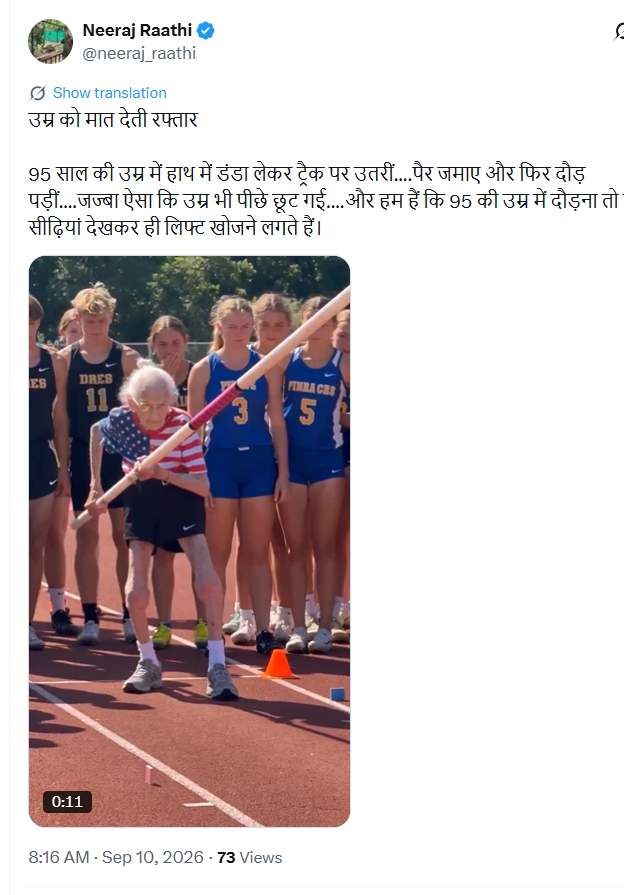
An X user shared the video with the caption: “Defying age with speed. At the age of 95, she stepped onto the track with a stick in her hand… planted her feet and started running… such determination that even age was left behind… and here we are, at 95, forget running, we start looking for a lift the moment we see the stairs.”
https://x.com/neeraj_raathi/status/2097879324573798613
https://archive.ph/8Invi
Fact Check
To verify the authenticity of the viral video showing the elderly woman performing a pole vault, we first conducted a Google search using relevant keywords. However, we did not find any credible media reports or other reliable sources identifying the video as footage of a real pole vault competition.
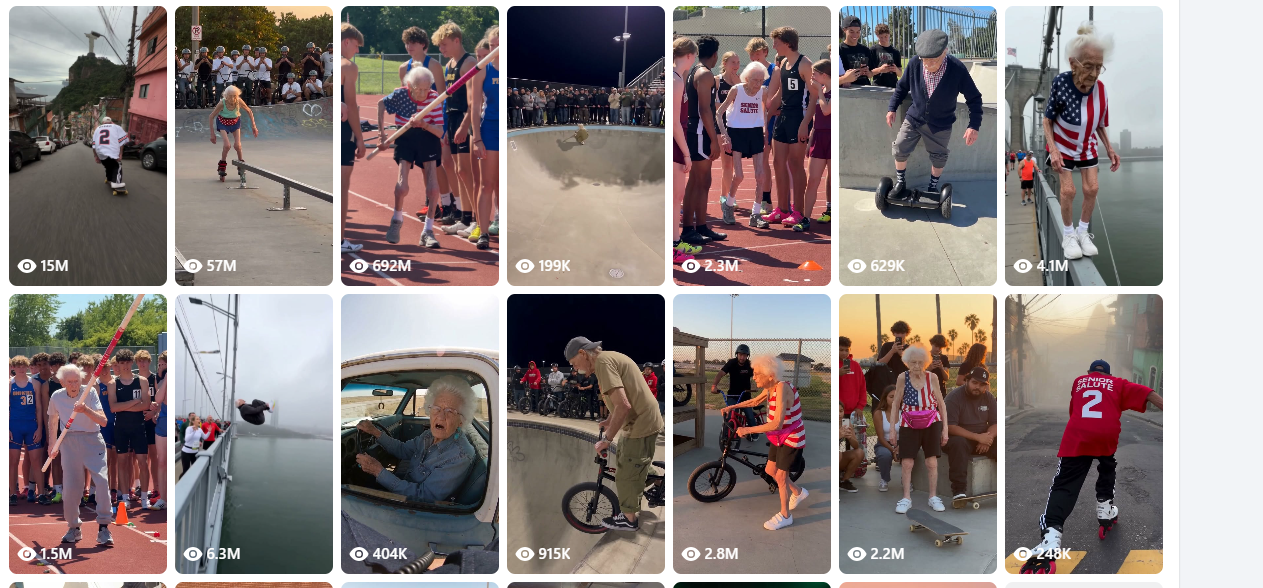
We then conducted a keyframe search and found the same video uploaded on September 8, 2026, on a Facebook page called ‘Senior Salute’, an AI content creator. The post also carries an AI-generated content label.
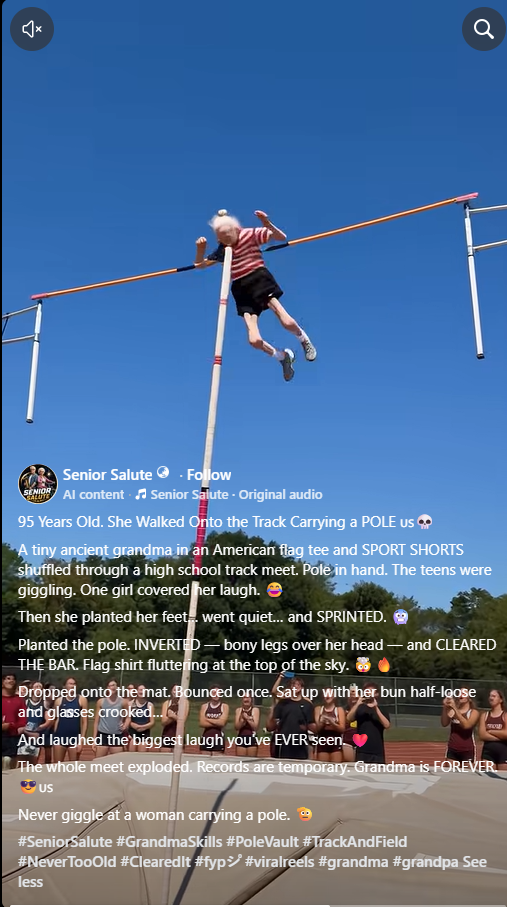
Upon reviewing the Facebook account, we found several similar videos showing elderly people performing various stunts. The account appears to exclusively create and share AI-generated videos.
We also checked the video using another AI detection tool, Truth Scan. In its analysis, the tool gave the viral video a 90 percent score, indicating that it was likely AI-generated.

In addition, we checked the visuals in the viral video using another AI detection platform, AIorNOT. In its analysis, the tool also indicated a high likelihood that the visuals in the video were AI-generated.

Conclusion
The evidence gathered during our research makes it clear that the viral video showing an elderly woman performing a pole vault is not genuine but AI-generated. The same video was found on a Facebook page that primarily shares AI-generated content and was posted with an AI-generated content label. Further, multiple AI detection tools also indicated a high likelihood that the video was created using AI. Therefore, the claim that the video shows a 95-year-old woman performing a real pole vault is false.
