
#FactCheck: Viral video claims BSF personnel thrashing a person selling Bangladesh National Flag in West Bengal
Executive Summary:
A video circulating online claims to show a man being assaulted by BSF personnel in India for selling Bangladesh flags at a football stadium. The footage has stirred strong reactions and cross border concerns. However, our research confirms that the video is neither recent nor related to the incident that occurred in India. The content has been wrongly framed and shared with misleading claims, misrepresenting the actual incident.
Claim:
It is being claimed through a viral post on social media that a Border Security Force (BSF) soldier physically attacked a man in India for allegedly selling the national flag of Bangladesh in West Bengal. The viral video further implies that the incident reflects political hostility towards Bangladesh within Indian territory.

Fact Check:
After conducting thorough research, including visual verification, reverse image searching, and confirming elements in the video background, we determined that the video was filmed outside of Bangabandhu National Stadium in Dhaka, Bangladesh, during the crowd buildup prior to the AFC Asian Cup. A match featuring Bangladesh against Singapore.

Second layer research confirmed that the man seen being assaulted is a local flag-seller named Hannan. There are eyewitness accounts and local news sources indicating that Bangladeshi Army officials were present to manage the crowd on the day under review. During the crowd control effort a soldier assaulted the vendor with excessive force. The incident created outrage to which the Army responded by identifying the officer responsible and taking disciplinary measures. The victim was reported to have been offered reparations for the misconduct.

Conclusion:
Our research confirms that the viral video does not depict any incident in India. The claim that a BSF officer assaulted a man for selling Bangladesh flags is completely false and misleading. The real incident occurred in Bangladesh, and involved a local army official during a football event crowd-control situation. This case highlights the importance of verifying viral content before sharing, as misinformation can lead to unnecessary panic, tension, and international misunderstanding.
- Claim: Viral video claims BSF personnel thrashing a person selling Bangladesh National Flag in West Bengal
- Claimed On: Social Media
- Fact Check: False and Misleading

Related Blogs

Executive Summary
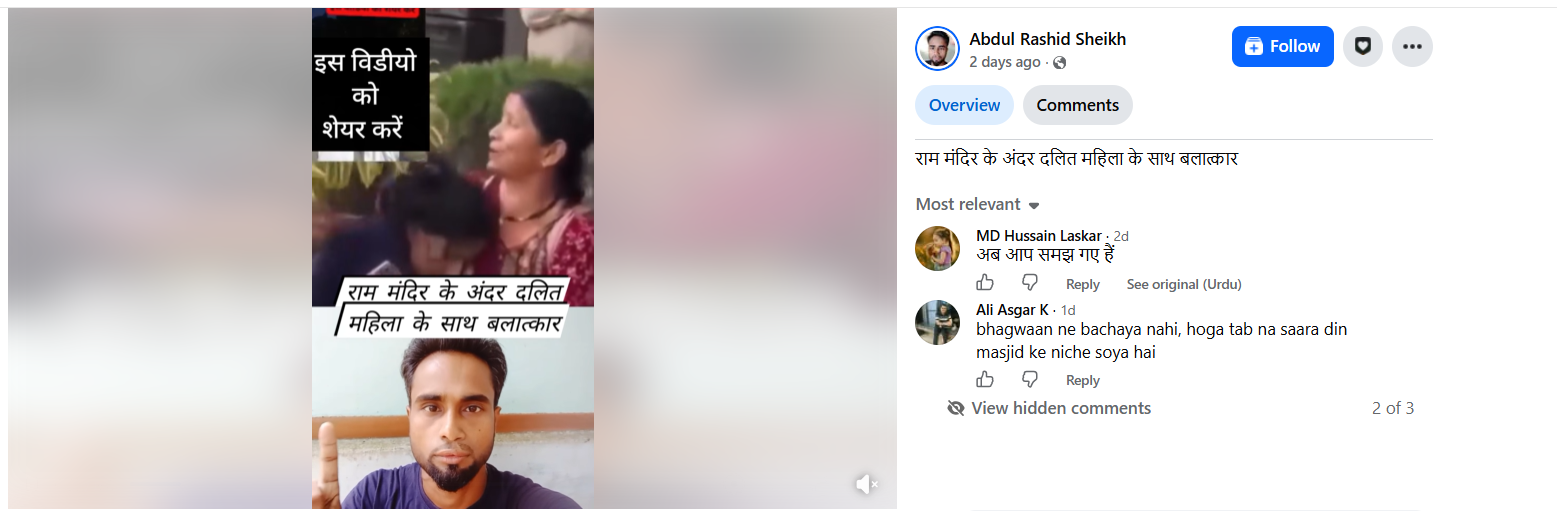
A video is being shared on social media with the claim that a Dalit woman was raped inside the Ram Temple in Ayodhya. In the video, two women can be seen crying, while some people around them appear to be consoling them. CyberPeace Research Wing’s research found the viral claim to be false. Our research found that the viral video has been created by combining two separate clips. In the first part of the video, a woman can be seen staging a protest at Buddha Park in Haldwani and raising issues related to her in-laws. The second part shows a girl expressing her anger. Our research found that this clip has been available on the internet since December 27, 2025. Neither of the two videos is related to the alleged rape of a Dalit woman inside the Ram Temple in Ayodhya.
Claim:
A Facebook user shared the viral video on September 21, 2026, with the caption, “Dalit woman raped inside the Ram Temple.”The post link, archive link and screenshot are provided below.
https://www.facebook.com/watch/?v=1420442086956519
Fact Check
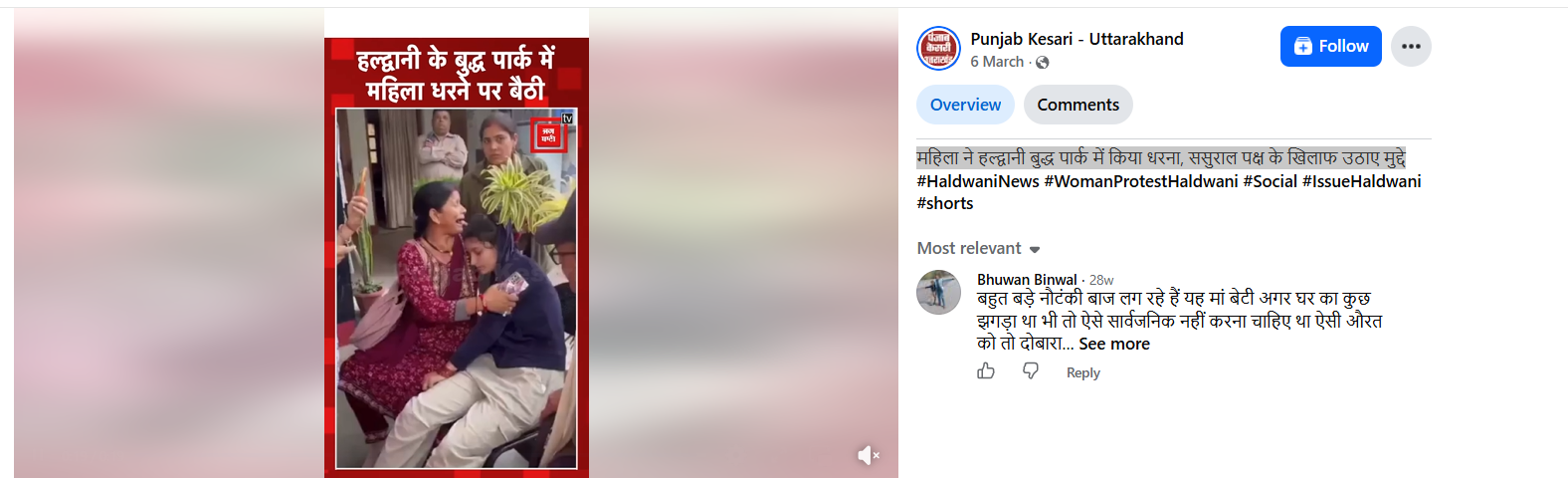
To verify the authenticity of the viral image, we conducted a Google search using relevant keywords. However, we did not find any credible media report related to the viral image during the search. To verify the claim, we conducted a reverse image search of the keyframes from the video. During the search, we found the same video on the Facebook page of Punjab Kesari - Uttarakhand, where it was published on March 6, 2026. According to the post, the woman staged a protest at Buddha Park in Haldwani and raised issues related to her in-laws. The link and screenshot of the relevant post are provided below.
https://www.facebook.com/watch/?v=897776589732940
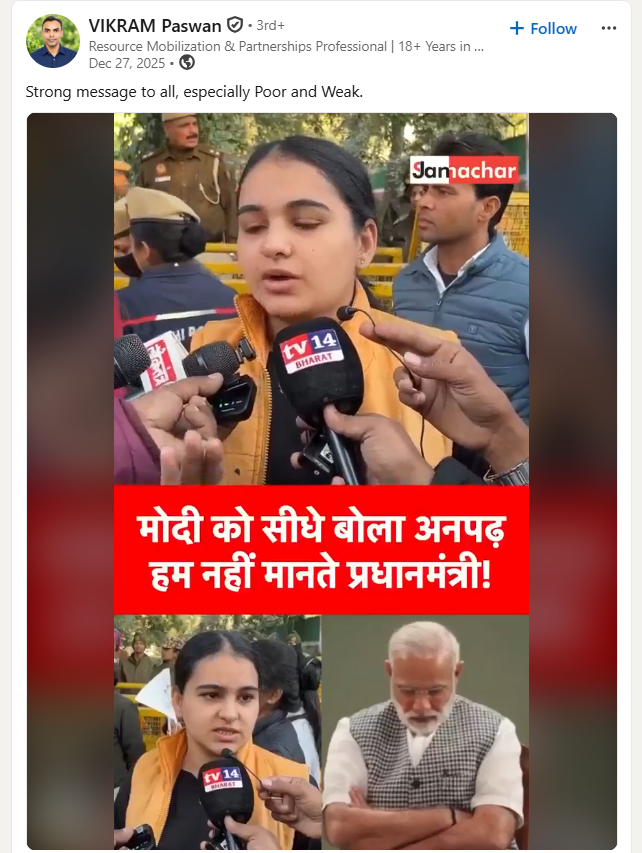
Meanwhile, we found the second part of the viral video on LinkedIn, where the video was published on December 27, 2025.
Our research makes it clear that two old and unrelated videos are being shared with a misleading claim linking them to the Ram Temple in Ayodhya. The videos have no connection with the alleged incident on the temple premises, and based on the available evidence, there is no confirmation of any such incident taking place at the Ram Temple. Our research found that the viral video was created by combining two separate clips. In the first part of the video, a woman can be seen staging a protest at Buddha Park in Haldwani and raising issues related to her in-laws. In the second part, a girl can be seen expressing her anger. Our research found that this clip has been available on the internet since December 27, 2025. Neither of the two videos is related to the alleged rape of a Dalit woman inside the Ram Temple in Ayodhya.
.webp)
Introduction
In an era where digital connectivity drives employment, investment, and communication, the most potent weapon of cybercriminals is ‘gaining trust’ with their sophisticated tactics. Prayagraj has been a recent battleground in India's cybercrime landscape. Within a one-year crackdown, over 10,400 SIM cards, 612 mobile device IMEIs, and 59 bank accounts were blocked, exposing a sprawling international fraud network. These activities primarily targeted unsuspecting individuals through Telegram job postings, fake investment tips, and mobile app scams, highlighting the darker side of convenience in cyberspace. With India now experiencing a wave of scams enabled by technology, this crackdown establishes a precedent for concerted cyber policing and awareness among citizens.
Digital Deceit: How the Scams Operated
SIM cards that have been issued through fake or stolen identities are increasingly being used by cybercriminals in Prayagraj and elsewhere. These SIMs were the initial weapon in a highly organised fraud system, allowing criminals to conduct themselves anonymously while abusing messaging services like WhatsApp and Telegram. The gangs involved in these scams, some of which have been linked by reports to nations like Nepal, Pakistan, China, Dubai, and Myanmar, enticed their victims with rich-yielding stock market advice, remote employment offers, and weekend employment promises. After getting a target engaged, victims were slowly manipulated into sending money in the name of application fees, verification fees, or investment contributions.
API Abuse and OTP Interception
What's more alarming about these scams is their tech-savviness. From Prayagraj's cybercrime squad, several syndicates are reported to have employed API-based mobile applications to intercept OTPs (One-Time Passwords) sent to Indian numbers. Such apps, cleverly disguised as genuine services or work-from-home software, collected personal details like bank account credentials and payment card data, allowing wrongdoers to carry out unauthorised transactions in a matter of minutes. The pilfered funds were then quickly transferred through several mule accounts, rendering the money trail almost untraceable.
The Human Impact: How Citizens Were Trapped
Victims tended to come from job-hunting groups, students, or housewives seeking to earn additional income. Often, the scammers persuaded users to join Telegram channels providing free investment advice or job-referral-based schemes, creating an illusion of authenticity. Once on board, victims were sometimes even paid small commissions initially, creating a false sense of success. This tactic, known as “advance-fee confidence building,” made victims more likely to invest larger sums later, ultimately leading to complete financial loss.
Digital Arrest Threats and Bitcoin Ransom Scams
Aside from investment and job scam complaints, the cybercrime cell also saw several "digital arrest" scams, where victims were forced to send money under the threat of engaging in criminal activities. Bitcoin extortion schemes were also used in some cases, with perpetrators threatening exposure of victims' personal information or browsing history on the internet unless they were paid in cryptocurrency.
Law Enforcement’s Cyber Shield: Local Action, Global Impact
Identifying the extent of the threat, Prayagraj authorities implemented strategic measures to enable local policing. Cyber Units have been formed in each of the 43 police stations in the district, each made up of a sub-inspector, head constable, constable, lady constable, and computer operator. This decentralised model enables response in real-time, improved victim support, and quicker forensic analysis of hacked devices. The nodal officer for cyber operations said that this multi-level action is not punitive but preventive, meant to break syndicates before more harm is caused.
CyberPeace Recommendations: Prevention is Power
As cybercrime gets advanced, citizens will also have to keep pace with it. Prayagraj's experience highlights the importance of public awareness, digital literacy, and instant response processes. To assist in preventing people from falling victim to such scams, CyberPeace advises the following:
- Don't click on dubious APK links sent on WhatsApp or Telegram.
- Do not share OTPs or confidential details, even if the source appears to be familiar.
- Never download unfamiliar apps that demand access to SMS or financial information.
- Block your SIM card, payment cards, and bank accounts at once if your phone is stolen.
- Report all cyber frauds to cybercrime.gov.in or your local Cyber Cell.
- Never join investment or job groups on social sites without verification.
- Refuse video calls from unknown numbers; some scammers use this method of recording or blackmailing victims.
Conclusion
Prayagraj crackdown uncovers both the magnitude and versatility of cybercrime in the present. From trans-border cartels to Telegram job scams, the cyber front is as intricate as ever. But this incident also illustrates what can be achieved when technology, law enforcement, and public awareness come together. To stay safe from cyber threats, a cyber-conscious citizenry is as important as an effective cyber cell for India. At CyberPeace, we know that defending cyberspace begins with cyber resilience, and the story of Prayagraj should encourage communities everywhere to take active digital precautions.
References
- https://www.hindustantimes.com/cities/lucknow-news/over-10k-sims-blocked-as-job-investment-frauds-rise-in-prayagraj-101753715061234.html
- https://consumer.ftc.gov/articles/how-recognize-and-avoid-phishing-scams
- https://faq.whatsapp.com/2286952358121083
- https://education.vikaspedia.in/viewcontent/education/digital-litercy/information-security/preventing-online-scams-cert-in-advisory?lgn=en
- https://cybercrime.gov.in/Accept.aspx
- https://www.linkedin.com/pulse/perils-advance-fee-fraud-protecting-yourself-from-scammers-sharma/
Overview of the Advisory
On 18 November 2025, the Ministry of Information and Broadcasting (I&B) published an Advisory that addresses all of the private satellite television channels in India. The advisory is one of the critical institutional interventions to the broadcast of sensitive content regarding recent security incidents concerning the blast at the Red Fort on November 10th, 2025. This advisory came after the Ministry noticed that some news channels have been broadcasting content related to alleged persons involved in Red Fort blasts, justifying their acts of violence, as well as information/video on explosive material. Broadcasting like this at this critical situation may inadvertently encourage or incite violence, disrupt public order, and pose risks to national security.
Key Instructions under the Advisory
The advisory provides certain guidelines to the TV channels to ensure strict compliance with the Programming and Advertising Code under the Cable Television Networks (Regulation) Act, 1995. The television channels are advised to exercise the highest level of discretion and sensitivity possible in reporting on issues involving alleged perpetrators of violence, and especially when reporting on matters involving the justification of acts of violence or providing instructional media on making explosive materials. The fundamental focus is to be very strict in following the Programme and Advertising Code as stipulated in the Cable Television Network Rules. In particular, broadcasters should not make programming that:
- Contain anything obscene, defamatory, deliberately false, or suggestive innuendos and half-truths.
- Likely to encourage or incite violence, contain anything against the maintenance of law and order, or promote an anti-national attitude.
- Contain anything that affects the integrity of the Nation.
- Could aid, abet or promote unlawful activities.
Responsible Reporting Framework
The advisory does not constitute outright censorship but instead a self-regulatory system that depends on the discretion and sensitivity of the TV channels focused on differentiating between broadcasting legitimate news and the content that crosses the threshold from information dissemination to incitement.
Why This Advisory is Important in a Digital Age
With the modern media systems, there has been an erosion of the line between the journalism of the traditional broadcasting medium and digital virality. The contents of television are no longer limited to the scheduled programs or cable channels of distribution. The contents of a single news piece, especially that of dramatic or contentious nature, can be ripped off, revised and repackaged on social media networks within minutes of airing- often without the context, editorial discretion or timing indicators.
This effect makes sensitive content have a multiplier effect. The short news item about a suspect justifying violence or containing bombs can be viewed by millions on YouTube, WhatsApp, Twitter/X, Facebook, by spreading organically and being amplified by an algorithm. Studies have shown that misinformation and sensational reporting are much faster to circulate compared to factual corrections- a fact that has been noticed in the recent past during conflicts and crisis cases in India and other parts of the world.
Vulnerabilities of Information Ecosystems
- The advisory is created in a definite information setting that is characterised by:
- Rapid Viral Mechanism: Content spreads faster than the process of verification.
- Algorithmic-driven amplification: Platform mechanism boosts emotionally charged content.
- Coordinated amplification networks: Organised groups are there to make these posts, videos viral, to set a narrative for the general public.
- Deepfake and synthetic media risks: Original broadcasts can be manipulated and reposted with false attribution.
Interconnection with Cybersecurity and National Security
Verified or sensationalised reporting of security incidents poses certain weaknesses:
- Trust Erosion: Trust is broken when the masses observe broadcasters in the air giving unverified claims or emotional accounts as facts. This is even to security agencies, law enforcement and government institutions themselves. The lack of trust towards the official information gives rise to information gaps, which are occupied by rumours, conspiracy theories, and enemy tales.
- Cognitive Fragmentation: Misinformation develops multiple versions of the truth among the people. The narratives given to citizens vary according to the sources of the media that they listen to or read. This disintegration complicates organising the collective response of the society an actual security threat because the populations can be organised around misguided stories and not the correct data.
- Radicalisation Pipeline: People who are interested in finding ideological backgrounds to violent action might get exposed to media-created materials that have been carefully distorted to evidence justifications of terrorism as a valid political or religious stand.
How Social Instability Is Exploited in Cyber Operations and Influence Campaigns
Misinformation causes exploitable vulnerability in three phases.
- First, conflicting unverified accounts disintegrate the information environment-populations are presented with conflicting versions of events by various media sources.
- Second, institutional trust in media and security agencies is shaken by exposure to subsequently rectified false information, resulting in an information vacuum.
- Third, in such a distrusted and puzzled setting, the population would be susceptible to organised manipulation by malicious agents.
- Sensationalised broadcasting gives opponents assets of content, narrative frameworks, and information gaps that they can use to promote destabilisation movements. These mechanisms of exploitation are directly opposed by responsible broadcasting.
Media Literacy and Audience Responsibility
Structural Information Vulnerabilities-
A major part of the Indian population is structurally disadvantaged in information access:
- Language barriers: Infrastructure in the field of fact-checking is still highly centralised in English and Hindi, as vernacular-language misinformation goes viral in Tamil, Telugu, Marathi, Punjabi, and others.
- Digital literacy gaps: It is estimated that there are about 40 million people in India who have been trained on digital literacy, but more than 900 million Indians access digital content with different degrees of ability to critically evaluate the content.
- Divides between rural and urban people: Rural citizens and less affluent people experience more difficulty with access to verification tools and media literacy resources.
- Algorithmic capture: social media works to maximise engagement over accuracy, and actively encourages content that is emotionally inflammatory or divisive to its users, according to their history of engagement.
Conclusion
The advisory of the Ministry of Information and Broadcasting is an acknowledgment of the fact that media accountability is a part of state security in the information era. It states the principles of responsible reporting without interference in editorial autonomy, a balance that various stakeholders should uphold. Implementation of the advisory needs to be done in concert with broadcasters, platforms, civil society, government and educational institutions. Information integrity cannot be handled by just a single player. Without media literacy resources, citizens are unable to be responsible in their evaluation of information. Without open and fast communication with the media stakeholders, government agencies are unable to combat misinformation.
The recommendations include collaborative governance, i.e., institutional forms in which media self-regulation, technological protection, user empowerment, and policy frameworks collaborate and do not compete. The successful deployment of measures will decide whether India can continue to have open and free media without compromising on information integrity that is sufficient to provide national security, democratic governance and social stability during the period of high-speed information flow, algorithmic amplification, and information warfare actions.
References
https://mib.gov.in/sites/default/files/2025-11/advisory-18.11.2025.pdf
