
#FactCheck: Viral Gambhir Video Predates T20 World Cup 2026, Claim Is Misleading
Executive Summary:
Following India’s heavy defeat to South Africa in the T20 World Cup 2026, the team has been facing intense trolling on social media. Amid this backdrop, a video of Indian cricket team head coach Gautam Gambhir has gone viral. In the clip, Gambhir can be heard saying,“Even people who have nothing to do with cricket have made comments. An IPL owner also wrote about split coaching. It’s surprising. People must stay in their own domain. If we don’t interfere in someone else’s domain, they have no right to interfere in ours.”The video is being shared with the claim that Gambhir made these remarks recently in response to trolling after India’s loss to South Africa in the T20 World Cup 2026. However, research by the CyberPeace found the claim to be misleading. The viral video is not related to the T20 World Cup 2026. It is from December 2025 and pertains to India’s Test series defeat against South Africa. An old video is being circulated with a misleading context.
Claim
An Instagram user, ‘rns_news200’, shared the viral video on February 23, 2026, claiming that after the loss to South Africa, head coach Gautam Gambhir issued a stern warning to Indian fans. The caption stated that Suryakumar Yadav was heavily trolled on social media after the match, and Gambhir responded strongly, saying players should not be unfairly targeted and the team deserves support, especially during difficult times.

Fact Check
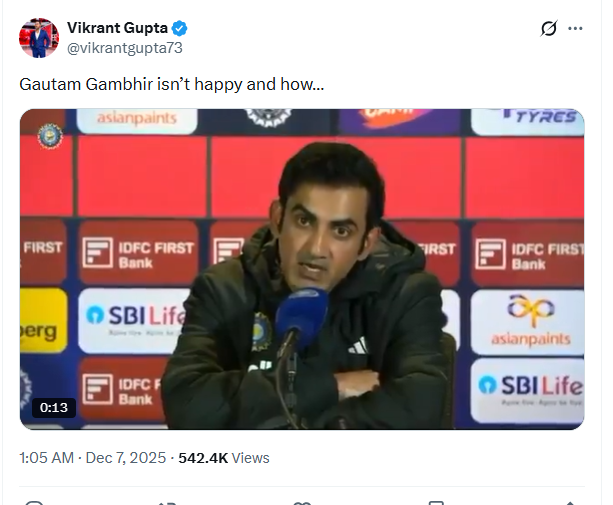
To verify the claim, we conducted a keyword search on Google. We found the same video on the official X (formerly Twitter) account of sports journalist Vikrant Gupta. The video was posted on December 7, 2025. According to the caption, Gambhir was expressing dissatisfaction following India’s performance.
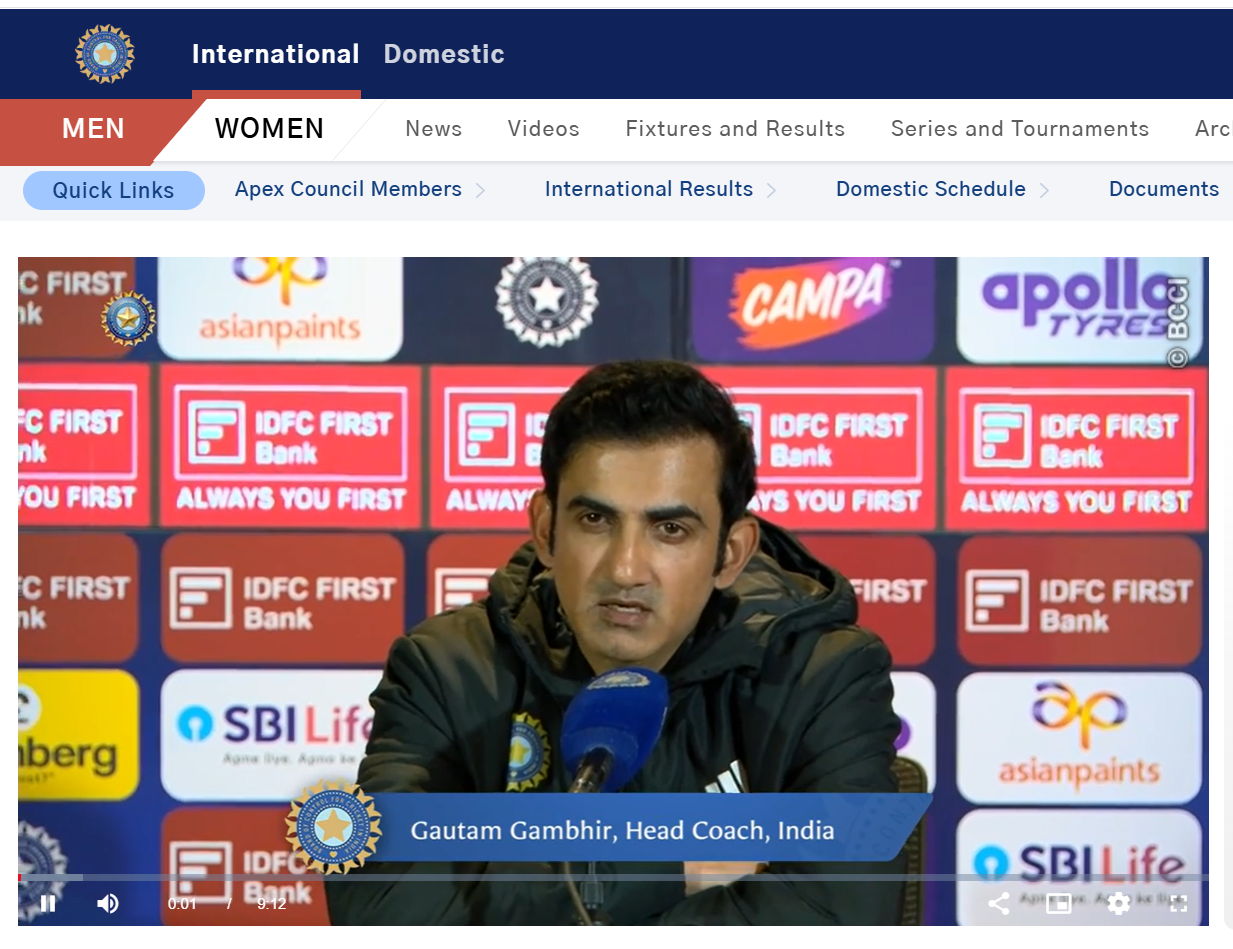
We also found the longer version of the video on the official website of the Board of Control for Cricket in India (BCCI), where it was published on December 6, 2025. In the full video, Gambhir is clearly seen speaking about India’s defeat to South Africa in a Test match. The specific segment that went viral appears around the 1 minute 58 second mark.
Conclusion
Our research found that the viral claim about Gautam Gambhir’s video being linked to trolling after the T20 World Cup 2026 is misleading. The clip is from December 2025 and relates to India’s Test series defeat against South Africa — not the T20 World Cup 2026.An old video is being reshared with a false and misleading context.

Related Blogs

Introduction
The Union Minister of Information and Broadcasting Ashwini Vaishnaw addressed the Press Council of India on the occasion of National Press Day regarding emergent concerns in the digital media and technology landscape. Union Minister of Information and Broadcasting Ashwini Vaishnaw has identified four major challenges facing news media in India, including fake news, algorithmic bias, artificial intelligence, and fair compensation. He emphasized the need for greater accountability and fairness from Big Tech to combat misinformation and protect democracy. Vaishnaw argued that platforms do not verify information posted online, leading to the spread of false and misleading information. He called on online platforms and Big Tech to combat misinformation and protect democracy.
Key Concerns Highlighted by Union Minister Ashwini Vaishnaw
- Misinformation: Due to India's unique sensitivities, digital platforms should adopt country-specific responsibilities and metrics. The Minister also questioned the safe harbour principle, which shields platforms from liability for user-generated content.
- Algorithmic Biases: The prioritisation of viral content, which is often divisive, by social media algorithms can have serious implications on societal peace.
- Impact of AI on intellectual Property: The training of AI on pre-existing datasets presents the ethical challenge of robbing original creators of their rights to their intellectual property
- Fair compensation: Traditional news media is increasingly facing financial strain since news consumption is shifting rapidly to social media platforms, creating uneven compensation dynamics.
Cyberpeace Insights
- Misinformation: Marked by routine upheavals and moral panics, Indian society is vulnerable to the severe impacts of fake news, including mob violence, political propaganda, health misinformation and more. Inspired by the EU's Digital Services Act, 2022, and other related legislation that addresses hate speech and misinformation, the Indian Minister has called for revisiting the safe harbour protection under Section 79 of the IT Act, 2000. However, any legislation on misinformation must strike a balance between protecting the fundamental rights to freedom of speech, and privacy while safeguarding citizens from its harmful effects.
- Algorithmic Biases: Social media algorithms are designed to boost user engagement since this increases advertisement revenue. This leads to the creation of filter bubbles- exposure to personalized information online and echo chambers interaction with other users with the same opinions that align with their worldview. These phenomena induce radicalization of views, increase intolerance fuel polarization in public discourse, and trigger the spread of more misinformation. Tackling this requires algorithmic design changes such as disincentivizing sensationalism, content labelling, funding fact-checking networks, etc. to improve transparency.
- Impact of AI on Intellectual Property: AI models are trained on data that may contain copyrighted material. It can lead to a loss of revenue for primary content creators, while tech companies owning AI models may financially benefit disproportionately by re-rendering their original works. Large-scale uptake of AI models will significantly impact fields such as advertising, journalism, entertainment, etc by disrupting their market. Managing this requires a push for Ethical AI regulations and the protection of original content creators.
Conclusion: Charting a Balanced Path
The socio-cultural and economic fabric of the Indian subcontinent is not only distinct from the rest of the world but has cross-cutting internal diversities, too. Its digital landscape stands at a crossroads as rapid global technological advancements present increasing opportunities and challenges. In light of growing incidents of misinformation on social media platforms, it is also crucial that regulators consider framing rules that encourage and mandate content verification mechanisms for online platforms, incentivizing them to adopt advanced AI-driven fact-checking tools and other relevant measures. Additionally, establishing public-private partnerships to monitor misinformation trends is crucial to rapidly debunking viral falsehoods. However ethical concerns and user privacy should be taken into consideration while taking such steps. Addressing misinformation requires a collaborative approach that balances platform accountability, technological innovation, and the protection of democratic values.
Sources
- https://www.indiatoday.in/india/story/news-media-4-challenges-ashwini-vaishnaw-national-press-day-speech-big-tech-fake-news-algorithm-ai-2634737-2024-11-17
- https://ec.europa.eu/commission/presscorner/detail/en/ip_24_881
- https://www.legaldive.com/news/digital-services-act-dsa-eu-misinformation-law-propaganda-compliance-facebook-gdpr/691657/
- https://www.fondationdescartes.org/en/2020/07/filter-bubbles-and-echo-chambers/
- https://www.google.com/searchq=News+Media+Bargaining+Code&oq=News+Media+Bargaining+Code&gs_lcrp=EgZjaHJvbWUyBggAEEUYOTIHCAEQABiABDIHCAIQABiABDIHCAMQABiABDIHCAQQABiABDIHCAUQABiABDIICAYQABgWGB4yCAgHEAAYFhgeMggICBAAGBYYHjIICAkQABgWGB7SAQcyMjVqMGo3qAIIsAIB&sourceid=chrome&ie=UTF-8

Executive Summary
Talks between the United States and Iran over a ceasefire reportedly held in Islamabad on Saturday ended without a resolution. Meanwhile, a video circulating on social media claims to show US troops returning home following a ceasefire in the Middle East conflict.
However, a research by the CyberPeace found the claim to be false. The viral video is not linked to any recent ceasefire. It actually dates back to March and shows the return of Iowa National Guard troops after months of deployment in the Middle East.
Claim
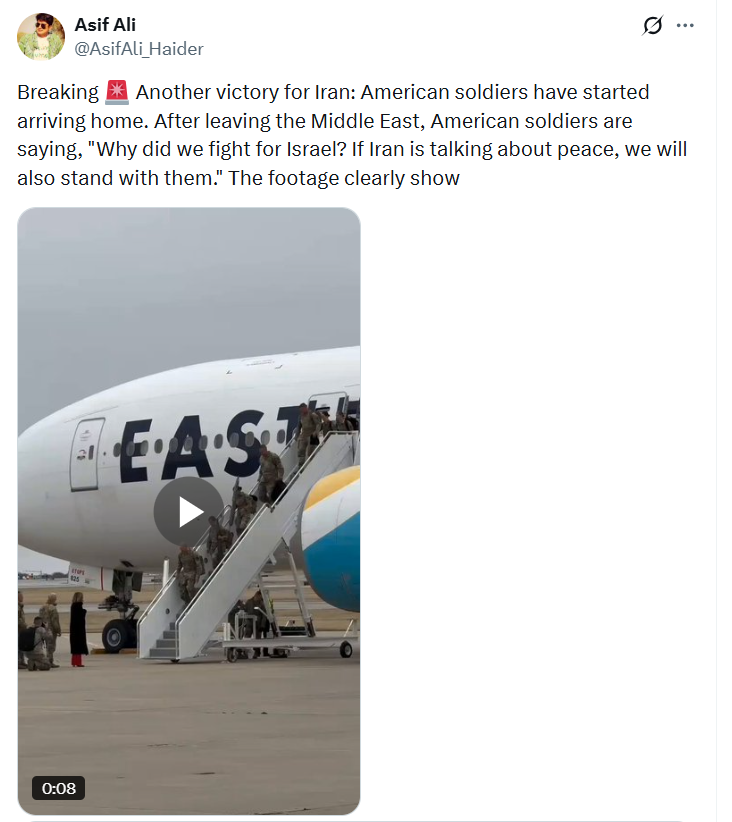
An X (formerly Twitter) user posted the video on April 7, 2026, claiming,“Another victory for Iran: American soldiers have started arriving home. After leaving the Middle East, American soldiers are saying, ‘Why did we fight for Israel? If Iran is talking about peace, we will also stand with them.’”
Fact Check
To verify the claim, we extracted keyframes from the viral video and conducted a reverse image search using Google Lens. This led us to posts by Newsradio 1040 WHO, which had shared the same footage on March 12 across Facebook and Instagram.

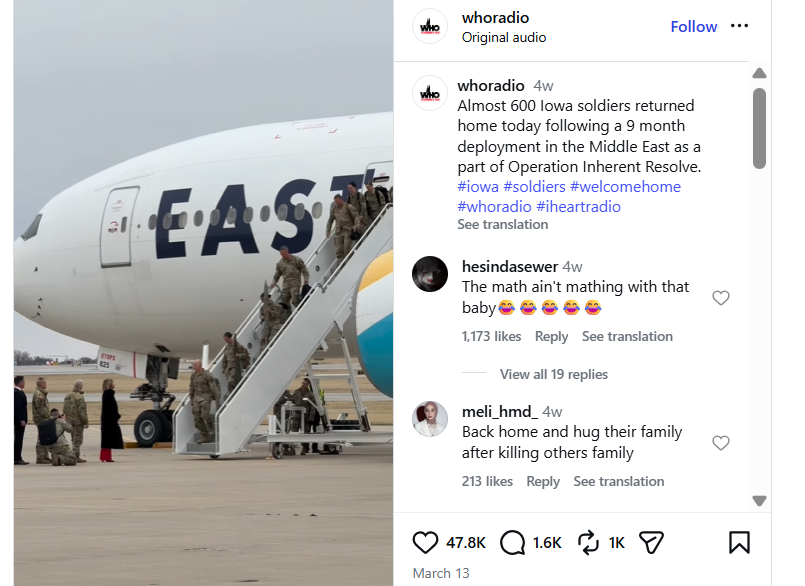
In its caption, the radio station stated that nearly 600 Iowa soldiers had returned home after a nine-month deployment in the Middle East as part of Operation Inherent Resolve. The segment, narrated by journalist Claire Burnett, explained that the soldiers belonged to the 2nd Brigade Combat Team, 34th Infantry Division, and had been deployed to Iraq and Syria. The footage was recorded at the 132nd Wing base of the Iowa Air National Guard in Des Moines.

For further confirmation, a March 12 report by KCCI 8 News also showed the same aircraft and troops, verifying the authenticity and timeline of the footage

Operation Inherent Resolve, launched in 2014, is a US-led campaign aimed at supporting local forces in the fight against the Islamic State (ISIS) and ensuring its lasting defeat.
https://www.kcci.com/article/iowans-welcome-national-guard-unit-home-from-deployment-in-middle-east/70729105

Conclusion
The viral claim is false and misleading. The video does not show US troops returning due to any recent ceasefire between the United States and Iran. Instead, it captures the routine homecoming of Iowa National Guard soldiers in March after completing a scheduled deployment in the Middle East.There is no evidence linking the footage to current geopolitical developments or any ceasefire agreement. The claim has been taken out of context and shared with a misleading narrative to create confusion around ongoing international events.

Introduction
Generative AI, particularly deepfake technology, poses significant risks to security in the financial sector. Deepfake technology can convincingly mimic voices, create lip-sync videos, execute face swaps, and carry out other types of impersonation through tools like DALL-E, Midjourney, Respeecher, Murf, etc, which are now widely accessible and have been misused for fraud. For example, in 2024, cybercriminals in Hong Kong used deepfake technology to impersonate the Chief Financial Officer of a company, defrauding it of $25 million. Surveys, including Regula’s Deepfake Trends 2024 and Sumsub reports, highlight financial services as the most targeted sector for deepfake-induced fraud.
Deepfake Technology and Its Risks to Financial Systems
India’s financial ecosystem, including banks, NBFCs, and fintech companies, is leveraging technology to enhance access to credit for households and MSMEs. The country is a leader in global real-time payments and its digital economy comprises 10% of its GDP. However, it faces unique cybersecurity challenges. According to the RBI’s 2023-24 Currency and Finance report, banks cite cybersecurity threats, legacy systems, and low customer digital literacy as major hurdles in digital adoption. Deepfake technology intensifies risks like:
- Social Engineering Attacks: Information security breaches through phishing, vishing, etc. become more convincing with deepfake imagery and audio.
- Bypassing Authentication Protocols: Deepfake audio or images may circumvent voice and image-based authentication systems, exposing sensitive data.
- Market Manipulation: Misleading deepfake content making false claims and endorsements can harm investor trust and damage stock market performance.
- Business Email Compromise Scams: Deepfake audio can mimic the voice of a real person with authority in the organization to falsely authorize payments.
- Evolving Deception Techniques: The usage of AI will allow cybercriminals to deploy malware that can adapt in real-time to carry out phishing attacks and inundate targets with increased speed and variations. Legacy security frameworks are not suited to countering automated attacks at such a scale.
Existing Frameworks and Gaps
In 2016, the RBI introduced cybersecurity guidelines for banks, neo-banking, lending, and non-banking financial institutions, focusing on resilience measures like Board-level policies, baseline security standards, data leak prevention, running penetration tests, and mandating Cybersecurity Operations Centres (C-SOCs). It also mandated incident reporting to the RBI for cyber events. Similarly, SEBI’s Cybersecurity and Cyber Resilience Framework (CSCRF) applies to regulated entities (REs) like stock brokers, mutual funds, KYC agencies, etc., requiring policies, risk management frameworks, and third-party assessments of cyber resilience measures. While both frameworks are comprehensive, they require updates addressing emerging threats from generative AI-driven cyber fraud.
Cyberpeace Recommendations
- AI Cybersecurity to Counter AI Cybercrime: AI-generated attacks can be designed to overwhelm with their speed and scale. Cybercriminals increasingly exploit platforms like LinkedIn, Microsoft Teams, and Messenger, to target people. More and more organizations of all sizes will have to use AI-based cybersecurity for detection and response since generative AI is becoming increasingly essential in combating hackers and breaches.
- Enhancing Multi-factor Authentication (MFA): With improving image and voice-generation/manipulation technologies, enhanced authentication measures such as token-based authentication or other hardware-based measures, abnormal behaviour detection, multi-device push notifications, geolocation verifications, etc. can be used to improve prevention strategies. New targeted technological solutions for content-driven authentication can also be implemented.
- Addressing Third-Party Vulnerabilities: Financial institutions often outsource operations to vendors that may not follow the same cybersecurity protocols, which can introduce vulnerabilities. Ensuring all parties follow standardized protocols can address these gaps.
- Protecting Senior Professionals: Senior-level and high-profile individuals at organizations are at a greater risk of being imitated or impersonated since they hold higher authority over decision-making and have greater access to sensitive information. Protecting their identity metrics through technological interventions is of utmost importance.
- Advanced Employee Training: To build organizational resilience, employees must be trained to understand how generative and emerging technologies work. A well-trained workforce can significantly lower the likelihood of successful human-focused human-focused cyberattacks like phishing and impersonation.
- Financial Support to Smaller Institutions: Smaller institutions may not have the resources to invest in robust long-term cybersecurity solutions and upgrades. They require financial and technological support from the government to meet requisite standards.
Conclusion
According to The India Cyber Threat Report 2025 by the Data Security Council of India (DSCI) and Seqrite, deepfake-enabled cyberattacks, especially in the finance and healthcare sectors, are set to increase in 2025. This has the potential to disrupt services, steal sensitive data, and exploit geopolitical tensions, presenting a significant risk to the critical infrastructure of India.
As the threat landscape changes, institutions will have to continue to embrace AI and Machine Learning (ML) for threat detection and response. The financial sector must prioritize robust cybersecurity strategies, participate in regulation-framing procedures, adopt AI-based solutions, and enhance workforce training, to safeguard against AI-enabled fraud. Collaborative efforts among policymakers, financial institutions, and technology providers will be essential to strengthen defenses.
Sources
- https://sumsub.com/newsroom/deepfake-cases-surge-in-countries-holding-2024-elections-sumsub-research-shows/
- https://www.globenewswire.com/news-release/2024/10/31/2972565/0/en/Deepfake-Fraud-Costs-the-Financial-Sector-an-Average-of-600-000-for-Each-Company-Regula-s-Survey-Shows.html
- https://www.sipa.columbia.edu/sites/default/files/2023-05/For%20Publication_BOfA_PollardCartier.pdf
- https://edition.cnn.com/2024/02/04/asia/deepfake-cfo-scam-hong-kong-intl-hnk/index.html
- https://www.rbi.org.in/Commonman/English/scripts/Notification.aspx?Id=1721
- https://elplaw.in/leadership/cybersecurity-and-cyber-resilience-framework-for-sebi-regulated-entities/
- https://economictimes.indiatimes.com/tech/artificial-intelligence/ai-driven-deepfake-enabled-cyberattacks-to-rise-in-2025-healthcarefinance-sectors-at-risk-report/articleshow/115976846.cms?from=mdr
