
#FactCheck-Old Yogi Adityanath video falsely linked to Bihar encounter case
Executive Summary
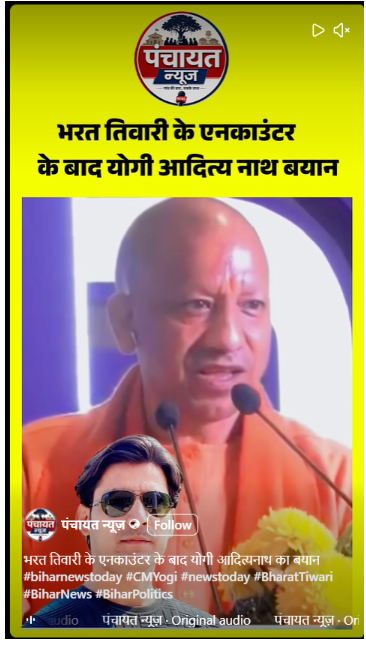
A video of Uttar Pradesh Chief Minister Yogi Adityanath is being widely circulated on social media with the claim that he supported the Bihar police and justified the encounter of Bharat Bhushan Tiwari in Bhojpur district’s Bilouti village on June 17, 2026. CyberPeace Research Wing research found the claim to be misleading. The viral video is not related to the Bihar encounter case. It is an old video from February 2026, in which the Chief Minister was speaking in the context of law and order and police action in Uttar Pradesh.
Claim:
A Facebook user shared the video claiming it shows CM Yogi Adityanath’s reaction supporting the Bihar encounter of Bharat Tiwari. https://www.facebook.com/reel/1712174420025092 ,https://archive.ph/wip/yUsou
Fact Check:
A keyword search led to the same video being found on the ‘ET Now Swadesh’ YouTube channel in the form of a short video, uploaded on February 4, 2026, indicating that it predates the Bihar incident. https://www.youtube.com/watch?v=Dj7ySFsnkqk

Further verification led to a Dainik Jagran report published on February 3, 2026, which carried visuals from the same statement. The report confirmed that the remarks were made in the context of Uttar Pradesh’s law and order situation and police response. https://www.jagran.com/uttar-pradesh/lucknow-city-cm-yogi-on-up-crime-zero-tolerance-and-police-action-justified-40129630.html
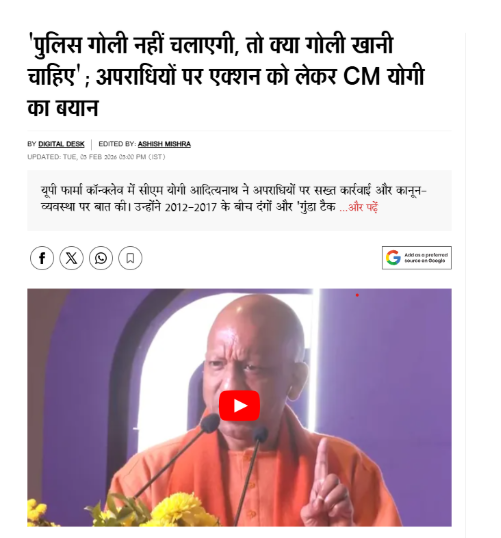
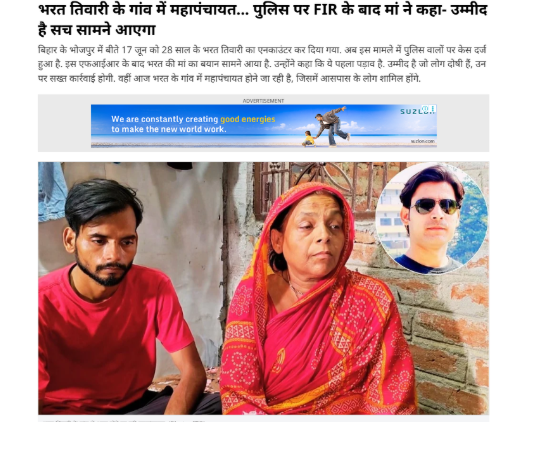
The report quoted CM Yogi Adityanath saying that if police do not act, criminals would dominate the situation, and that police are empowered to respond in the language criminals understand. He also emphasized that police training is designed to ensure effective response to crime. An Aaj Tak report on the Bihar encounter case stated that 28-year-old Bharat Tiwari was killed in an encounter on June 17, 2026, in Bhojpur district. Following the incident, an FIR was registered against police personnel, and the victim’s mother demanded strict action and justice.
Conclusion:
The research confirms that the viral video of CM Yogi Adityanath is old and unrelated to the Bihar encounter case. It is from February 2026 and pertains to a law-and-order statement in Uttar Pradesh. The video is being falsely shared by linking it to the Bihar encounter incident.

Related Blogs

Executive Summary
As tensions between the United States and Iran continue to escalate in West Asia, a video showing a massive fire engulfing an industrial facility is being widely circulated on social media. Several users claim that the footage shows the aftermath of a recent U.S. strike on Iran. CyberPeace Research Wing’s research found the claim to be false. Our research revealed that the viral video is not related to the current U.S.-Iran conflict. It actually shows a 2022 attack on Saudi Arabia's Aramco petroleum distribution facility in Jeddah, carried out by Yemen's Houthi rebels.
Claim
An X user shared the viral video on July 16, 2026, claiming that it shows a recent American attack on Iran. https://x.com/SonOfBharat7/status/2077823734069826027 , https://perma.cc/RPA9-YZ3C

Fact Check
To verify the claim, we extracted keyframes from the viral video and conducted a reverse image search using Google Lens. During the research, we found that the same video had been uploaded by Reuters on March 26, 2022. According to Reuters, Yemen's Houthi rebels claimed responsibility for attacks on Saudi Arabia's energy facilities. Reuters reported that the Saudi-led coalition confirmed an attack on Saudi Aramco's petroleum products distribution station in Jeddah, where two storage tanks caught fire. The incident caused significant damage but no casualties were reported. https://www.youtube.com/watch?v=-CAxj5tgZ_w

For further verification, we found another video of the same incident uploaded by the Qatar Day Facebook page on March 25, 2022, showing the fire from a different angle. According to the post, a massive blaze broke out at an oil depot in Jeddah, Saudi Arabia, after Yemen's Houthi rebels launched multiple drone and missile attacks targeting Saudi infrastructure. Thick black smoke could be seen rising over the city.

Additionally, The Sun also uploaded the same footage on March 26, 2022, identifying it as the attack on Jeddah, Saudi Arabia. https://www.youtube.com/watch?v=bFj5nDL0y7o

Conclusion
Our research found that the viral video does not show a recent U.S. attack on Iran.Although the United States and Iran have recently exchanged military strikes and attacks on civilian infrastructure have been reported, the viral footage predates the current conflict by several years. It actually shows the March 2022 Houthi attack on Saudi Aramco's petroleum distribution facility in Jeddah, Saudi Arabia. Therefore, the claim linking the video to the ongoing U.S.-Iran conflict is false and misleading.

In the vast, interconnected cosmos of the internet, where knowledge and connectivity are celebrated as the twin suns of enlightenment, there lurk shadows of a more sinister nature. Here, in these darker corners, the innocence of childhood is not only exploited but also scarred, indelibly and forever. The production, distribution, and consumption of Child Sexual Abuse Material (CSAM) have surged to alarming levels globally, casting a long, ominous shadow over the digital landscape.
In response to this pressing issue, the National Human Rights Commission (NHRC) has unfurled a comprehensive four-part advisory, a beacon of hope aimed at combating CSAM and safeguarding the rights of children in this digital age. This advisory dated 27/10/23 is not merely a reaction to the rising tide of CSAM, but a testament to the imperative need for constant vigilance in the realm of cyber peace.
The statistics paint a sobering picture. In 2021, more than 1,500 instances of publishing, storing, and transmitting CSAM were reported, shedding a harsh light on the scale of the problem. Even more alarming is the upward trend in cases reported in subsequent years. By 2023, a staggering 450,207 cases of CSAM had already been reported, marking a significant increase from the 204,056 and 163,633 cases reported in 2022 and 2021, respectively.
The Key Aspects of Advisory
The NHRC's advisory commences with a fundamental recommendation - a redefinition of terminology. It suggests replacing the term 'Child Pornography' with 'Child Sexual Abuse Material' (CSAM). This shift in language is not merely semantic; it underscores the gravity of the issue, emphasizing that this is not about pornography but child abuse.
Moreover, the advisory calls for the definition of 'sexually explicit' under Section 67B of the IT Act, 2000. This step is crucial for ensuring the prompt identification and removal of online CSAM. By giving a clear definition, law enforcement can act swiftly in removing such content from the internet.
The digital world knows no borders, and CSAM can easily cross jurisdictional lines. NHRC recognizes this challenge and proposes that laws be harmonized across jurisdictions through bilateral agreements. Moreover, it recommends pushing for the adoption of a UN draft Convention on 'Countering the Use of Information and Communications Technologies for Criminal Purposes' at the General Assembly.
One of the critical aspects of the advisory is the strengthening of law enforcement. NHRC advocates for the creation of Specialized State Police Units in every state and union territory to handle CSAM-related cases. The central government is expected to provide support, including grants, to set up and equip these units.
The NHRC further recommends establishing a Specialized Central Police Unit under the government of India's jurisdiction. This unit will focus on identifying and apprehending CSAM offenders and maintaining a repository of such content. Its role is not limited to law enforcement; it is expected to cooperate with investigative agencies, analyze patterns, and initiate the process for content takedown. This coordinated approach is designed to combat the problem effectively, both on the dark web and open web.
The role of internet intermediaries and social media platforms in controlling CSAM is undeniable. The NHRC advisory emphasizes that intermediaries must deploy technology, such as content moderation algorithms, to proactively detect and remove CSAM from their platforms. This places the onus on the platforms to be proactive in policing their content and ensuring the safety of their users.
New Developments
Platforms using end-to-end encryption services may be required to create additional protocols for monitoring the circulation of CSAM. Failure to do so may invite the withdrawal of the 'safe harbor' clause under Section 79 of the IT Act, 2000. This measure ensures that platforms using encryption technology are not inadvertently providing safe havens for those engaged in illegal activities.
NHRC's advisory extends beyond legal and law enforcement measures; it emphasizes the importance of awareness and sensitization at various levels. Schools, colleges, and institutions are called upon to educate students, parents, and teachers about the modus operandi of online child sexual abusers, the vulnerabilities of children on the internet, and the early signs of online child abuse.
To further enhance awareness, a cyber curriculum is proposed to be integrated into the education system. This curriculum will not only boost digital literacy but also educate students about relevant child care legislation, policies, and the legal consequences of violating them.
NHRC recognizes that survivors of CSAM need more than legal measures and prevention strategies. Survivors are recommended to receive support services and opportunities for rehabilitation through various means. Partnerships with civil society and other stakeholders play a vital role in this aspect. Moreover, psycho-social care centers are proposed to be established in every district to facilitate need-based support services and organization of stigma eradication programs.
NHRC's advisory is a resounding call to action, acknowledging the critical importance of protecting children from the perils of CSAM. By addressing legal gaps, strengthening law enforcement, regulating online platforms, and promoting awareness and support, the NHRC aims to create a safer digital environment for children.
Conclusion
In a world where the internet plays an increasingly central role in our lives, these recommendations are not just proactive but imperative. They underscore the collective responsibility of governments, law enforcement agencies, intermediaries, and society as a whole in safeguarding the rights and well-being of children in the digital age.
NHRC's advisory is a pivotal guide to a more secure and child-friendly digital world. By addressing the rising tide of CSAM and emphasizing the need for constant vigilance, NHRC reaffirms the critical role of organizations, governments, and individuals in ensuring cyber peace and child protection in the digital age. The active contribution from premier cyber resilience firms like Cyber Peace Foundation, amplifies the collective action forging a secure digital space, highlighting the pivotal role played by think tanks in ensuring cyber peace and resilience.
References:
- https://www.hindustantimes.com/india-news/nhrc-issues-advisory-regarding-child-sexual-abuse-material-on-internet-101698473197792.html
- https://ssrana.in/articles/nhrcs-advisory-proliferation-of-child-sexual-abuse-material-csam/
- https://theprint.in/india/specialised-central-police-unit-use-of-technology-to-proactively-detect-csam-nhrc-advisory/1822223/
.webp)
Introduction
Search engines have become indispensable in our daily lives, allowing us to find information instantly by entering keywords or phrases. Using the prompt "search Google or type a URL" reflects just how seamless this journey to knowledge has become. With millions of searches conducted every second, and Google handling over 6.3 million searches per minute as of 2023 (Statista), one critical question arises: do search engines prioritise results based on user preferences and past behaviours, or are they truly unbiased?
Understanding AI Bias in Search Algorithms
AI bias is also known as machine learning bias or algorithm bias. It refers to the occurrence of biased results due to human biases that deviate from the original training data or AI algorithm which leads to distortion of outputs and creation of potentially harmful outcomes. The sources of this bias are algorithmic bias, data bias and interpretation bias which emerge from user history, geographical data, and even broader societal biases in training data.
Common biases include excluding certain groups of people from opportunities because of AI bias. In healthcare, underrepresenting data of women or minority groups can skew predictive AI algorithms. While AI helps streamline the automation of resume scanning during a search to help identify ideal candidates, the information requested and answers screened out can result in biased outcomes due to a biased dataset or any other bias in the input data.
Case in Point: Google’s "Helpful" Results and Its Impact
Google optimises results by analysing user interactions to determine satisfaction with specific types of content. This data-driven approach forms ‘filter bubbles’ by repeatedly displaying content that aligns with a user’s preferences, regardless of factual accuracy. While this can create a more personalised experience, it risks confining users to a limited view, excluding diverse perspectives or alternative viewpoints.
The personal and societal impacts of such biases are significant. At an individual level, filter bubbles can influence decision-making, perceptions, and even mental health. On a societal level, these biases can reinforce stereotypes, polarise opinions, and shape collective narratives. There is also a growing concern that these biases may promote misinformation or limit users’ exposure to diverse perspectives, all stemming from the inherent bias in search algorithms.
Policy Challenges and Regulatory Measures
Regulating emerging technologies like AI, especially in search engine algorithms, presents significant challenges due to their intricate, proprietary nature. Traditional regulatory frameworks struggle to keep up with them as existing laws were not designed to address the nuances of algorithm-driven platforms. Regulatory bodies are pushing for transparency and accountability in AI-powered search algorithms to counter biases and ensure fairness globally. For example, the EU’s Artificial Intelligence Act aims to establish a regulatory framework that will categorise AI systems based on risk and enforces strict standards for transparency, accountability, and fairness, especially for high-risk AI applications, which may include search engines. India has proposed the Digital India Act in 2023 which will define and regulate High-risk AI.
Efforts include ethical guidelines emphasising fairness, accountability, and transparency in information prioritisation. However, a complex regulatory landscape could hinder market entrants, highlighting the need for adaptable, balanced frameworks that protect user interests without stifling innovation.
CyberPeace Insights
In a world where search engines are gateways to knowledge, ensuring unbiased, accurate, and diverse information access is crucial. True objectivity remains elusive as AI-driven algorithms tend to personalise results based on user preferences and past behaviour, often creating a biased view of the web. Filter bubbles, which reinforce individual perspectives, can obscure factual accuracy and limit exposure to diverse viewpoints. Addressing this bias requires efforts from both users and companies. Users should diversify sources and verify information, while companies should enhance transparency and regularly audit algorithms for biases. Together, these actions can promote a more equitable, accurate, and unbiased search experience for all users.
References
- https://www.bbc.com/future/article/20241101-how-online-photos-and-videos-alter-the-way-you-think
- https://www.bbc.com/future/article/20241031-how-google-tells-you-what-you-want-to-hear
- https://www.ibm.com/topics/ai-bias#:~:text=In%20healthcare%2C%20underrepresenting%20data%20of,can%20skew%20predictive%20AI%20algorithms
