
#FactCheck-Fake Frontline Cover Claiming ‘Vijay Wave’ Goes Viral During Tamil Nadu Polls
Executive Summary
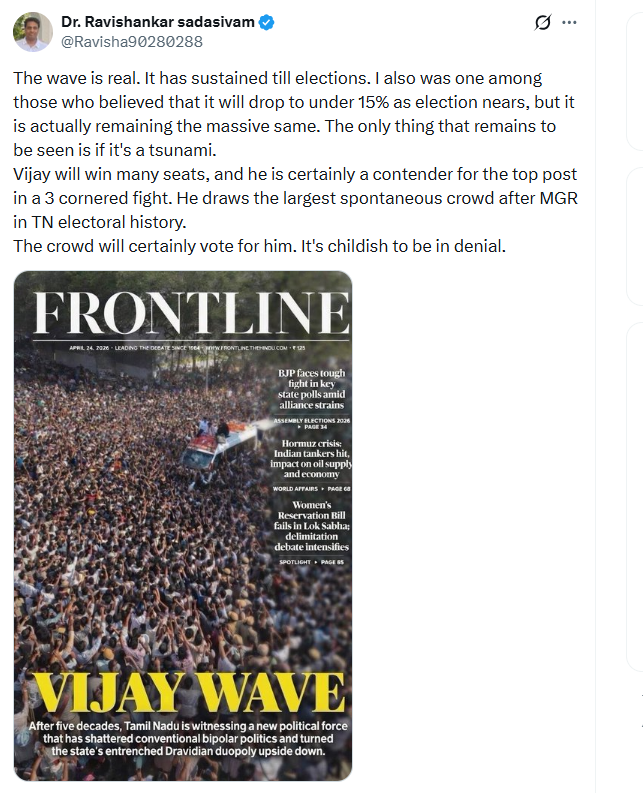
As Tamil Nadu voted in the 2026 Assembly elections, with 84.69 percent polling recorded on April 23, a purported cover page of Frontline magazine began circulating on social media. The viral image featured a massive rally crowd of South Indian actor and Tamilaga Vetri Kazhagam (TVK) chief Joseph Vijay, claiming that a “Vijay Wave” had emerged in the state. The alleged cover also stated that Tamil Nadu was witnessing a new political force after five decades, one that had challenged the dominance of Dravida Munnetra Kazhagam (DMK) and All India Anna Dravida Munnetra Kazhagam (AIADMK).
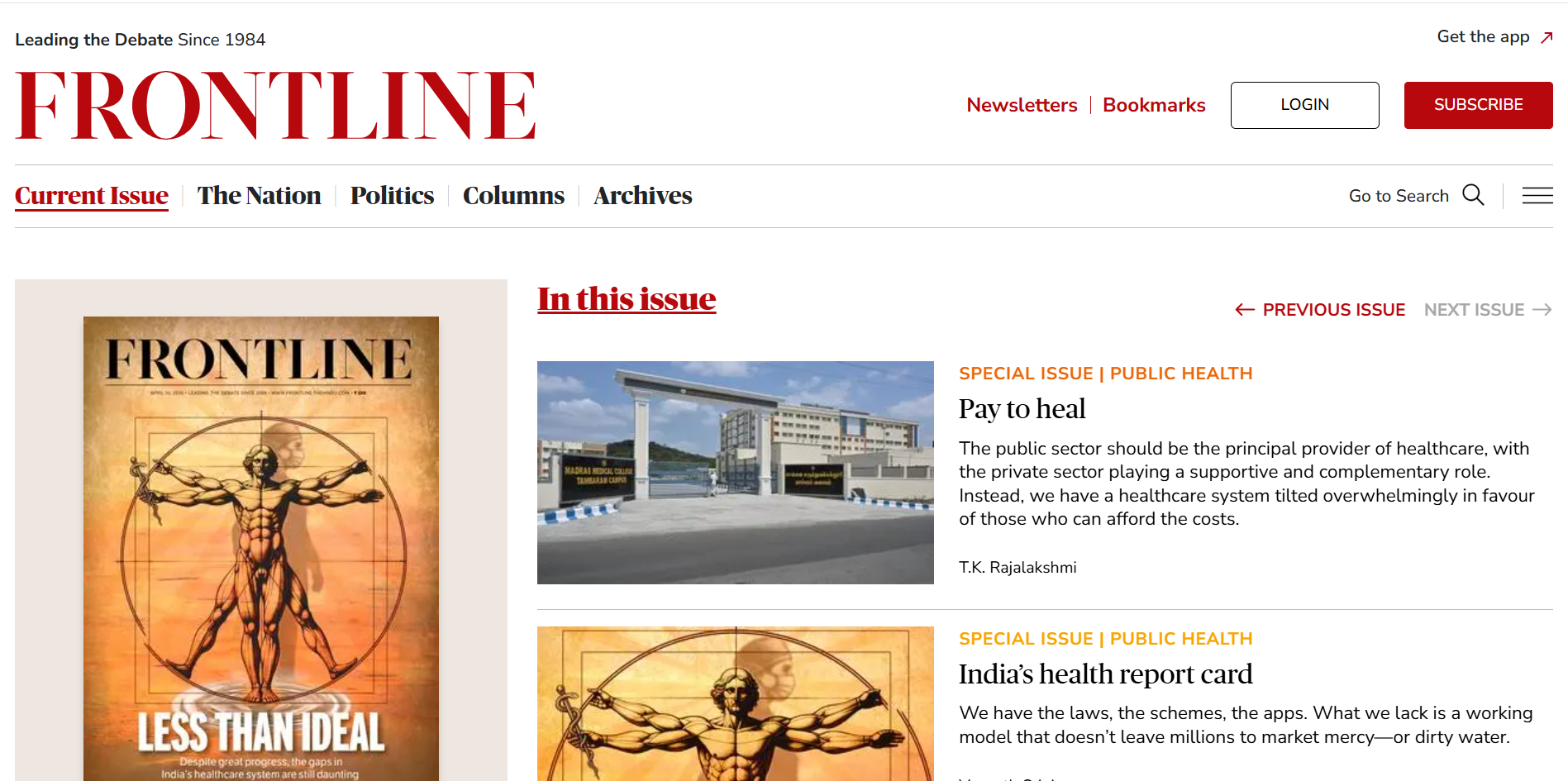
However, research by the CyberPeace Research Wing found that the viral cover page is fake. Frontline magazine has not published any such edition, and its latest issue is related to health.
Claim:
X user “Dr. Ravishankar Sadasivam” shared the viral image on April 22, 2026, claiming the “wave is real” and suggesting that Vijay could emerge as a top contender in a three-cornered contest. The post further claimed that after MGR, Vijay was drawing the largest spontaneous crowds in Tamil Nadu politics.
Fact Check:
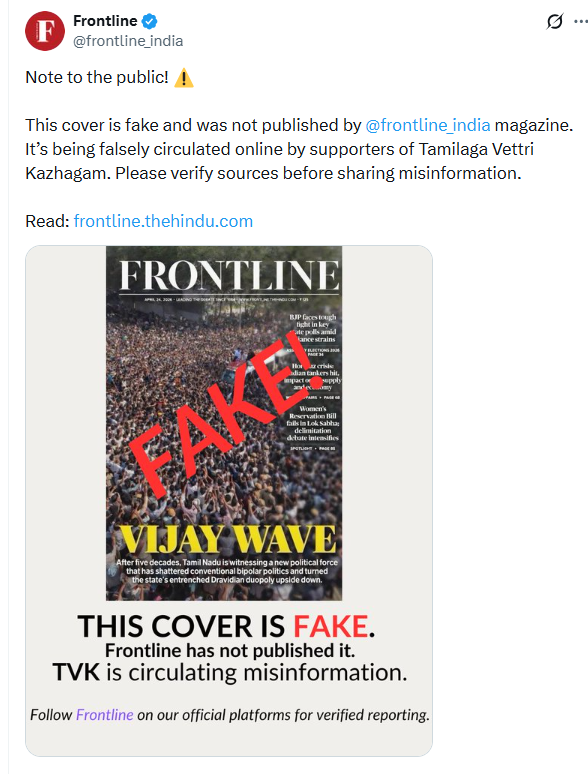
To verify the claim, relevant keyword searches were conducted online. During the research, a clarification post from Frontline magazine’s official X account, shared on April 22, 2026, was found. In the post, the publication clearly stated that the viral cover page was fake and had not been published by the magazine. It further said that the fabricated cover was being circulated online by supporters of TVK.
A review of the official Frontline website also found no edition carrying such a cover page.
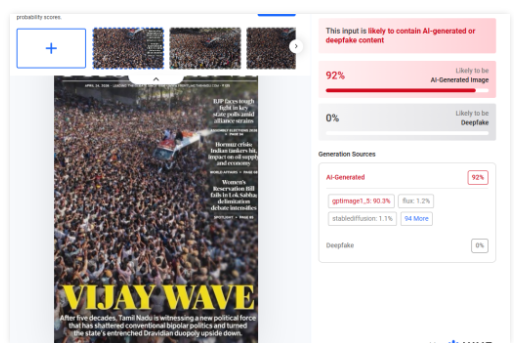
Additionally, the viral image was analyzed using the AI detection tool Hive Moderation, which rated it as 92 percent likely to be AI-generated.
Conclusion:
The claim that Frontline magazine published a cover story on a “Vijay Wave” during the Tamil Nadu Assembly elections is false. The viral cover page is fake and is being circulated online to mislead people.

Related Blogs

Introduction
Misinformation spreads differently with respect to different host environments, making localised cultural narratives and practices major factors in how an individual deals with it when presented in a certain place and to a certain group. In the digital age, with time-sensitive data, an overload of information creates a lot of noise which makes it harder to make informed decisions. There are also cases where customary beliefs, biases, and cultural narratives are presented in ways that are untrue. These instances often include misinformation related to health and superstitions, historical distortions, and natural disasters and myths. Such narratives, when shared on social media, can lead to widespread misconceptions and even harmful behaviours. For example, it may also include misinformation that goes against scientific consensus or misinformation that contradicts simple, objectively true facts. In such ambiguous situations, there is a higher probability of people falling back on patterns in determining what information is right or wrong. Here, cultural narratives and cognitive biases come into play.
Misinformation and Cultural Narratives
Cultural narratives include deep-seated cultural beliefs, folklore, and national myths. These narratives can also be used to manipulate public opinion as political and social groups often leverage them to proceed with their agenda. Lack of digital literacy and increasing information online along with social media platforms and their focus on generating algorithms for engagement aids this process. The consequences can even prove to be fatal.
During COVID-19, false claims targeted certain groups as being virus spreaders fueled stigmatisation and eroded trust. Similarly, vaccine misinformation, rooted in cultural fears, spurred hesitancy and outbreaks. Beyond health, manipulated narratives about parts of history are spread depending on the sentiments of the people. These instances exploit emotional and cultural sensitivities, emphasizing the urgent need for media literacy and awareness to counter their harmful effects.
CyberPeace Recommendations
As cultural narratives may lead to knowingly or unknowingly spreading misinformation on social media platforms, netizens must consider preventive measures that can help them build resilience against any biased misinformation they may encounter. The social media platforms must also develop strategies to counter such types of misinformation.
- Digital and Information Literacy: Netizens must encourage developing digital and information literacy in a time of information overload on social media platforms.
- The Role Of Media: The media outlets can play an active role, by strictly providing fact-based information and not feeding into narratives to garner eyeballs. Social media platforms also need to be careful while creating algorithms focused on consistent engagement.
- Community Fact-Checking: As localised information prevails in such cases, owing to the time-sensitive nature, immediate debunking of precarious information by authorities at the ground level is encouraged.
- Scientifically Correct Information: Starting early and addressing myths and biases through factual and scientifically correct information is also encouraged.
Conclusion
Cultural narratives are an ingrained part of society, and they might affect how misinformation spreads and what we end up believing. Acknowledging this process and taking counter measures will allow us to move further and take steps for intervention regarding tackling the spread of misinformation specifically aided by cultural narratives. Efforts to raise awareness and educate the public to seek sound information, practice verification checks, and visit official channels are of the utmost importance.
References
- https://www.icf.com/insights/cybersecurity/developing-effective-responses-to-fake-new
- https://www.dw.com/en/india-fake-news-problem-fueled-by-digital-illiteracy/a-56746776
- https://www.apa.org/topics/journalism-facts/how-why-misinformation-spreads
Introduction
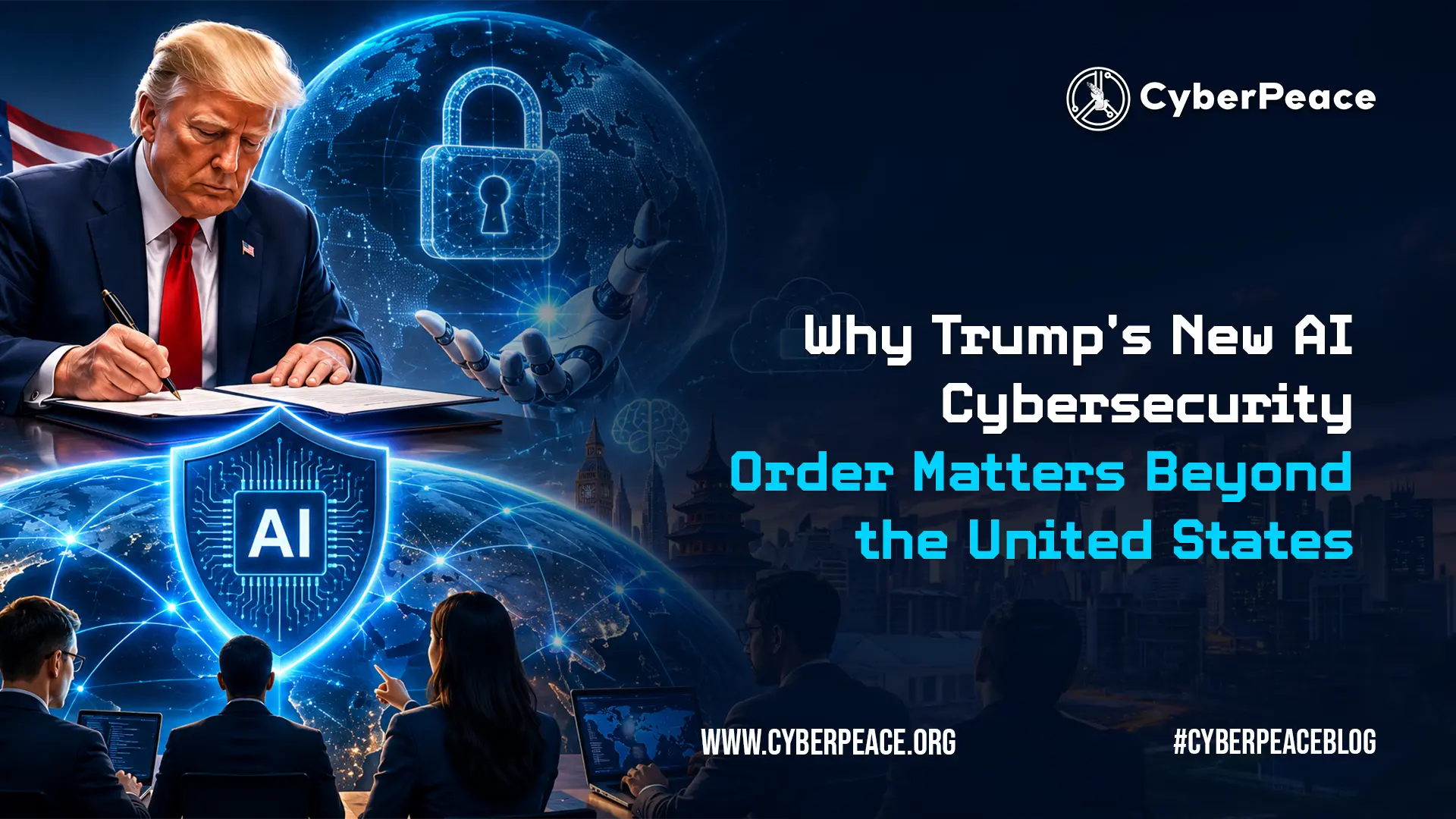
On June 2, 2026, U.S. President Donald Trump signed an executive order called "Promoting Artificial Intelligence Innovation and Security." The order tells federal agencies to improve cyber defences against AI-based threats and creates a system where AI companies can choose to let the government access powerful new models before they are released to the public. This happens as the U.S. and China are in a heated competition to lead the next generation of AI. While the order only affects the United States, its impact could reach the global AI industry, including India.
What Does the Executive Order Do?
The White House order focuses on three areas: First, it aims to upgrade government cyber security. Federal agencies must strengthen their information systems with AI-enabled defences within 30 days. Cyber Security and Infrastructure Agency (CISA) will issue new guidelines for civilian agencies, and an AI Cyber security Clearinghouse will be established for the government and private companies to share and resolve software vulnerabilities.
Second, the order introduces a voluntary pre-release review process for advanced AI models. Before a new model is publicly available, AI companies can give the government up to 30 days to evaluate it for cyber security risks. An earlier draft proposed a 90-day review period, but this was cut back due to feedback from the technology industry. The government will also create classified benchmarks to figure out which models qualify as a “covered frontier model” and are therefore subject to this review process.
Finally, the order emphasises criminal enforcement. It prioritises legal action against those who use AI tools to commit cybercrimes.
According to the White House, the aim is to promote AI innovation and security by collaborating with the private sector to modernise government and private information systems and protect them from external threats.
Why Does This Matter Globally?
- AI Is Now a National Security Issue Until recently, most governments viewed AI as an economic or scientific issue. This order officially changes that for the United States, placing advanced AI alongside other sensitive technologies that need government oversight before deployment. When the world's largest military makes this change, other governments pay attention. Countries allied with or partnering with the U.S. will likely revisit their own AI governance frameworks in the months ahead.
- Two Competing Models for the World The U.S. and EU represent two different approaches to AI governance. The EU AI Act lays down strict rules, is focused on ethics, and requires heavy compliance. The US approach is lighter on ethics, promoting voluntary cooperation, prioritising security, and encouraging innovation. Countries developing their own AI policies will either continue to align with one of these models or take ideas from both. The Atlantic Council has pointed out that if the U.S. model is successful, it could influence international security standards for AI development, even without formal global agreements.
- The China Factor Trump initially delayed signing the order, worried it would slow down American companies and give China an edge. The final version avoids mandatory licensing requirements but clearly indicates that the U.S. aims to lead, not only in building AI but also in securing it. China is likely to respond by speeding up its own evaluation systems, creating another global framework.
What Could This Mean for India?
India has taken a careful, non-mandatory approach to AI governance. MeitY's India AI Governance Guidelines, issued in November 2025, are based on principles and are not binding. India's AI Safety Institute has been announced but is not fully operational. Efforts to create binding regulation have been seen in actions like the Private Member's Bill, the AI Ethics and Accountability Bill, 2025, introduced in the Lok Sabha. This bill suggests mandatory reviews for high-risk AI systems but has not been passed yet. It's important to note that groups like the AI Governance Expert Group (AIGEG) and the Technology and Policy Expert Committee (TPEC) serve only in an advisory role; they do not have legislative power. As a result, nothing binding has been implemented so far. The Trump order puts additional pressure on India to pass measurable, binding AI-security-related measures. As AI use increases in banking, healthcare, telecommunications, and government services and frontier AI models continue to evolve without global oversight, stronger security evaluation methods are becoming necessary, especially in critical sectors.
Recent events prove this need. In June 2026, a Distributed Denial-of-Service (DDoS) attack hit the CBSE's On-Screen Marking portal. It saw 1.5 million requests in two minutes and over one lakh unauthorised file access attempts targeting a system used by millions of students. Similar attacks have impacted AIIMS Delhi and other public digital infrastructure. As AI tools make these attacks easier to carry out, security testing before deployment can no longer be seen as optional.
For Indian AI companies aiming at global markets, the U.S. framework is also important for business. Standards that are set voluntarily in Washington often become necessary for international partnerships and contracts.
Conclusion
Trump's AI cyber security order signals a shift. A government that resisted regulating AI has now recognised that powerful models need oversight before they reach the public. Its immediate impact affects U.S. agencies and developers. However, the broader message is that advanced AI is a national security concern. This will influence policy conversations around the world. For India, the priority is to develop its own security evaluation capacity now, rather than waiting to adopt frameworks created for other contexts.
References
- White House Executive Order, "Promoting Advanced Artificial Intelligence Innovation and Security," June 2, 2026
- Federal Register — Executive Order Publication, June 5, 2026
- Council on Foreign Relations — Assessing Trump's Executive Order on AI Oversight, June 4, 2026
- Atlantic Council — Reading Between the Lines of Trump's New Executive Order on AI, June 3, 2026
- Times of India — Donald Trump Passes AI Cyber security Order
- MeitY India AI Governance Guidelines, November 2025
- AI Ethics and Accountability Bill, 2025 — Explained
- NPR — Trump Signs EO Seeking Early Government Access to Powerful AI Models

Introduction
The Telecom Regulatory Authority of India (TRAI) has directed all telcos to set up detection systems based on Artificial Intelligence and Machine Learning (AI/ML) technologies in order to identify and control spam calls and text messages from unregistered telemarketers (UTMs).
The TRAI Directed telcos
The telecom regulator, TRAI, has directed all Access Providers to detect Unsolicited commercial communication (UCC)by systems, which is based on Artificial Intelligence and Machine Learning to detect, identify, and act against senders of Commercial Communication who are not registered in accordance with the provisions of the Telecom Commercial Communication Customer Preference Regulations, 2018 (TCCCPR-2018). Unregistered Telemarketers (UTMs) are entities that do not register with Access Providers and use 10-digit mobile numbers to send commercial communications via SMS or calls.
TRAI steps to curb Unsolicited commercial communication
TRAI has taken several initiatives to reduce Unsolicited Commercial Communication (UCC), which is a major source of annoyance for the public. It has resulted in fewer complaints filed against Registered Telemarketers (RTMs). Despite the TSPs’ efforts, UCC from Unregistered Telemarketers (UTMs) continues. Sometimes, these UTMs use messages with bogus URLs and phone numbers to trick clients into revealing crucial information, leading to financial loss.
To detect, identify, and prosecute all Unregistered Telemarketers (UTMs), the TRAI has mandated that Access Service Providers implement the UCC.
Detect the System with the necessary functionalities within the TRAI’s Telecom Commercial Communication Customer Preference Regulations, 2018 framework.
Access service providers have implemented such detection systems based on their applicability and practicality. However, because UTMs are constantly creating new strategies for sending unwanted communications, the present UCC detection systems provided by Access Service providers cannot detect such UCC.
TRAI also Directs Telecom Providers to Set Up Digital Platform for Customer Consent to Curb Promotional Calls and Messages.
Unregistered Telemarketers (UTMs) sometimes use messages with fake URLs and phone numbers to trick customers into revealing essential information, resulting in financial loss.
TRAI has urged businesses like banks, insurance companies, financial institutions, and others to re-verify their SMS content templates with telcos within two weeks. It also directed telecom companies to stop misusing commercial messaging templates within the next 45 days.
The telecom regulator has also instructed operators to limit the number of variables in a content template to three. However, if any business intends to utilise more than three variables in a content template for communicating with their users, this should be permitted only after examining the example message, as well as adequate justifications and justification.
In order to ensure consistency in UCC Detect System implementations, TRAI has directed all Access Providers to deploy UCC and detect systems based on artificial intelligence and Machine Learning that are capable of constantly evolving to deal with new signatures, patterns, and techniques used by UTMs.
Access Providers have also been directed to use the DLT platform to share intelligence with others. Access Providers have also been asked to ensure that such UCC Detect System detects senders that send unsolicited commercial communications in bulk and do not comply with the requirements. All Access Providers are directed to follow the instructions and provide an update on actions done within thirty days.
The move by TRAI is to curb the menacing calls as due to this, the number of scam cases is increasing, and now a new trend of scams started as recently, a Twitter user reported receiving an automated call from +91 96681 9555 with the message “This call is from Delhi Police.” It then asked her to stay in the queue since some of her documents needed to be picked up. Then he said he works as a sub-inspector at the Kirti Nagar police station in New Delhi. He then inquired whether she had recently misplaced her Aadhaar card, PAN card, or ATM card, to which she replied ‘no’. The scammer then poses as a cop and requests that she authenticate the last four digits of her card because they have found a card with her name on it. And a lot of other people tweeted about it.

Conclusion
TRAI directed the telcos to check the calls and messages from Unregistered numbers. This step of TRAI will curb the pesky calls and messages and catch the Frauds who are not registered with the regulation. Sometimes the unregistered sender sends fraudulent links, and through these fraudulent calls and messages, the sender tries to take the personal information of the customers, which results in financial losses.
