
Delhi Is Delhi-ing: A CyberPeace Advisory on Staying Sane Amid the Information Flood Around the CJP Protest
Introduction
Delhi is Delhi-ing these days — whether it's the protest, the monsoon weather, the ongoing Monsoon Session of Parliament, metro disruptions, or just the general chaos of it all. Amid everything else, it's been over 30 days, starting from late June 2026, since the large public march organised in part by the group known as the Cockroach Janta Party (CJP) converged near Parliament and on Jantar Mantar, and the city hasn't quite exhaled since. Like every large, fast-moving public event, it's come with a parallel flood online: photos, video clips, injury claims, and hot takes pouring in from participants, bystanders, and news outlets alike, all competing for your instagram scroll.
CyberPeace is a non-partisan digital trust and safety organisation, and what we do care about is the online information environment building up around the event — helping people spot misinformation and manipulated media, and encouraging a bit more caution before hitting "share" while rumours are moving faster than facts.
Delhi Police has already made a public appeal along similar lines, asking citizens against online spread of unverified rumours, noting that misinformation could make an already tense situation worse. This advisory builds on that, with some practical guidance for everyday citizens navigating the protest in light of social media.
Why This Matters Right Now
30 plus days in, the story has layers: the original hunger strike, the march itself, police action, viral clips, and now a second wave of commentary reacting to the reactions. Old footage resurfaces relabelled as "live." Numbers get inflated or deflated depending on who's sharing them. Screenshots go around stripped of context. The longer a protest runs, the murkier the timeline gets for anyone just scrolling past — which is exactly when misinformation finds the most room to spread.
The internet access was also restricted in parts of the city during the march, which has itself become a point of attention.
Given how much unverified information is already circulating, it's worth treating any single account of "what actually happened". The full picture will likely take time to emerge through credible reporting and scrutiny.
Why This Moment Is Especially Prone to Misinformation
A few things are working together here to make mis-information spread faster than usual: Emotions are running high. Clashes, injuries, and confrontations naturally provoke strong reactions, and content that makes people angry or afraid tends to get shared quickly, with far less scrutiny than a calm, verified report would get.
There are information gaps. Reports of internet restrictions in parts of the city leave holes that get filled with speculation or worse, old footage recycled and passed off as live updates.
The event is politically charged, which means competing narratives are synthetically being pushed from multiple directions, sometimes deliberately, making it harder to find neutral ground.
There's simply a huge volume of content. Thousands of clips and photos are being posted from one event, which makes it easy for unrelated or out-of-context material to slip in alongside the real thing. And then there's satire. Part of this movement has roots in political satire, so parody posts and meme accounts can easily be mistaken for genuine news if they're shared without context.
Common Types of Misleading Content to Watch For
A few patterns tend to show up again and again during events like this:
- Old footage getting relabelled - Photos or videos from a completely different protest, city, or even country, re-shared with a caption claiming it's from this event.
- Clips taken out of context - A short moment, like a scuffle, shown without what happened right before or after it, changing how it reads.
- Doctored images - Photos edited to add, remove, or exaggerate people, banners, injuries, or crowd size.
- Fake official statements - Screenshots or graphics designed to look like they came from Delhi Police or a government department, but never actually issued.
- Made-up casualty numbers - Figures shared with no real source, often vaguely attributed to "eyewitnesses."
- Impersonation accounts - Handles designed to look like an official police or organiser account, sometimes just one letter off from the real one.
- AI-generated visuals - Fully or partly synthetic images and videos showing scenes or crowds that never actually happened.
- Rumours about shutdowns - Unverified claims about internet blackouts, road closures, or metro shutdowns that may be old, exaggerated, or simply untrue.
What Citizens Should Do:
- Pause before you forward. If a clip or claim makes you feel an instant, strong reaction, that's often the moment to slow down, not speed up.
- Check the timestamp and source. A five-day-old protest generates a lot of recycled footage. Reverse image/video search before assuming something is "breaking."
- Cross-check with more than one outlet. If only one account or page is reporting something dramatic, wait for corroboration.
- Be wary of numbers without sources. Injury counts, crowd sizes, and arrest figures are easy to exaggerate in either direction.
- Don't share unverified visuals of injuries or violence. Beyond accuracy concerns, this can also cause real harm to the people shown.
- When in doubt, don't repost — verify first, or simply sit it out.
How to Check a Claim Before You Share It:
A checklist goes a long way here:
- Pause for a second. Content built to provoke a strong reaction is often designed to get past your defenses before you think twice. Just slowing down is itself protective.
- Ask where it actually came from. Is this from a named journalist or outlet you can verify, or an anonymous forward with no clear origin? Messages that have clearly been passed around many times deserve extra suspicion.
- Look for more than one source. If something significant is genuinely true, you'll usually find several independent, reputable outlets reporting it not just one channel or account.
- Check the date and place. A quick reverse image or video search can tell you if a photo or clip has shown up online before, and what it was originally about.
- Wait for official confirmation. For anything involving police action, injuries, or arrests, check verified accounts like Delhi Police, PIB, established news wires before treating a claim as settled fact.
- Be suspicious of absolute language. Words like "confirmed," "breaking," or "exposed," used without naming any actual source, are a classic misinformation tell.
- Look at the account, not just the post. New accounts with no history, or ones that only ever post about this one topic, deserve a second look.
- Notice when something feels too satisfying. If a claim perfectly confirms what you already believed, that's exactly when you should slow down and check it; it's the content you're least likely to question on your own.
Reliable Fact-Checking Platforms and AI Detection Tools:
These resources can help you check specific claims, images, or videos:
- For fact-checking: PIB Fact Check (factcheck.pib.gov.in) for anything involving government statements or orders; Alt News (altnews.in) and BOOM Live (boomlive.in), two independent Indian outlets that regularly cover protest- and politics-related claims.
- For reverse image and video searches: Google Images, Google Lens, and TinEye can show you where a photo first appeared and in what context. InVID-WeVerify is a free browser plugin built for journalists that breaks videos into keyframes and lets you reverse-search individual frames.
- For AI and synthetic media detection: Hive Moderation and Sensity AI offer public tools for checking images and video. Deepware Scanner focuses specifically on deepfake video. And most major platforms like Meta, YouTube, X are now labeling some AI-generated content automatically, though the absence of a label doesn't mean something's real.
- A few terms worth knowing: A cheapfake is misleading media made with simple editing, cropping, slowing down, re-captioning rather than AI. These are still far more common than actual AI deepfakes. A deepfake is synthetic audio, video, or image content made with AI to convincingly show someone saying or doing something they didn't. Synthetic media is the broader umbrella term for any AI-generated content, whether or not it's being used to deceive.
Reporting Mechanism ~ If You Come Across Suspected Misinformation
Don't share it further, even to mock or correct it any engagement can boost its reach. Check it against the fact-checking tools above before deciding what you think is true. Report it directly on the platform. If it falls under the category of ‘Unlawful Content’ as per IT Rules, you can reach out to the grievance officer of the platform for removal of such content.
If it involves a government statement or order, send it to PIB Fact Check. If it looks like incitement, impersonation, extortion, or another cybercrime, report it to the National Cyber Crime Reporting Portal (cybercrime.gov.in) or call 1930.
Further Steps & helplines
- To file a cybercrime complaint: National Cyber Crime Reporting Portal - 1930 or cybercrime.gov.in
- To flag a fake government-related claim: PIB Fact Check - factcheck.pib.gov.in
- For an on-ground emergency: dial 100 / 112
- CyberPeace Helpline: +91 9570000066 or helpline@cyberpeace.net
- For fact check and debunking of any suspicious viral information, you can reach out to cyberpeace at helpline@cyberpeace.net
- If this advisory feels useful, consider sharing it in family WhatsApp groups, community networks, or student and youth organisations as it helps slow the spread of unverified content when more people are thinking about it.
CyberPeace's Message to Citizens
Being first to share something isn't the same as being right. In moments like this, the most useful thing any of us can do is slow down, verify before sharing, be a little suspicious of content that confirms exactly what we already believed, and trust named, accountable sources over anonymous forwards. Misinformation during civic unrest doesn't just mislead people; it can raise tensions, put individuals at risk, and chip away at trust in both the media and the institutions meant to maintain public order.Our goal is simply to help people navigate the information around it a little more safely and critically.
Conclusion
Protests and public unrest always generate a flood of information, and not all of it will be accurate. What keeps that information environment healthy isn't any single authority or platform, it's the everyday habits of the people deciding, one post at a time, whether to check something or just pass it along. Delhi's news cycle will keep moving, and this advisory isn't asking anyone to disengage from it. It's just a nudge to stay a little more careful with what you believe and what you pass on in this social media age. Pause. Verify. Scroll healthy. Stay CyberPeaceful.
References
- https://rajkaran.in/delhi-police-urges-calm-amid-cjp-protest-warns-against-rumours-as-clashes-erupt-during-chalo-sansad-march
- https://www.youtube.com/shorts/0kkSCYrjRGc
- https://factcheck.pib.gov.in/
- https://www.altnews.in/
- https://www.boomlive.in/
- https://www.vishvasnews.com/
- https://www.factcrescendo.com/
- https://cybercrime.gov.in/
Contributors
- Neeraj Soni, Sr. Research Analyst, Policy & Advocacy, CyberPeace
- Ritika Goswami, Intern - Policy & Advocacy, CyberPeace

Related Blogs
India’s Rapid Digital Expansion
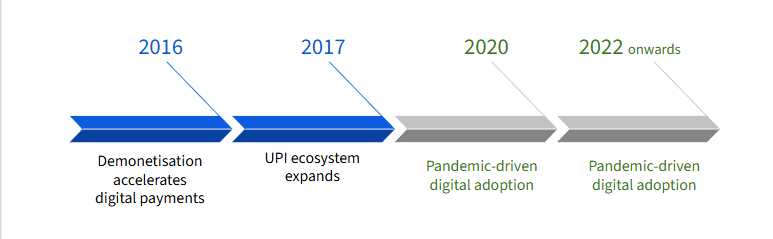
Over the past decade, India has experienced a rapid digitalisation process. The rise of digital financial services, affordable internet costs, and the penetration of smartphones have transformed the way people communicate, transact and do business online.
Online payment systems, including Unified Payments Interface (UPI), have enabled real-time transactions between banks and financial systems. As much as these systems have enhanced access to finance and efficiency, they have also created new opportunities for cybercriminals.
Cybercrime has evolved alongside the shift of financial and social interactions to digital platforms. The fraud attacks on online payments, online banking, and personal information have become common and increasingly costly.
To analyse the scale and trend of cybercrime in India, this analysis will use the datasets released by the National Crime Records Bureau (NCRB) and financial fraud data released by the Indian Cyber Crime Coordination Centre (I4C) under the Ministry of Home Affairs.
The Rise of Cybercrime in India
The Rise of Cybercrime in India
Source: National Crime Records Bureau – Crime in India Reports
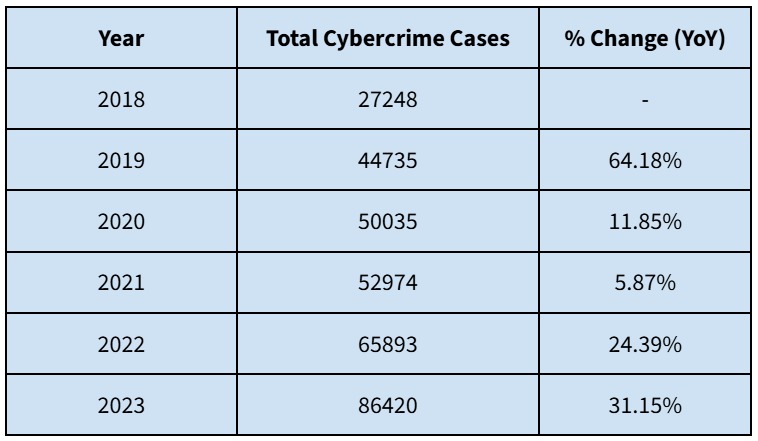
The data released by the NCRB documents cybercrime incidents registered by the police at the national level under the Information Technology Act, 2000 (IT Act) and criminal provisions covering offences such as cheating, impersonation, and digital fraud. In the past, the offences were listed in the provisions of the Indian Penal Code (IPC). Following criminal law reforms in India, on 1 July 2024, the Bharatiya Nyaya Sanhita (BNS), which replaced the IPC, came into force. Section 419 (cheating by impersonation), IPC, would be related to BNS Section 319 and Section 420 (cheating and dishonestly inducing delivery of property), which would be related to BNS Section 318(4). Similarly, crimes involving forgery and use of forged documents or electronic documents, which were previously contained in the IPC Sections 465-471, are dealt with in BNS Sections 335-340.
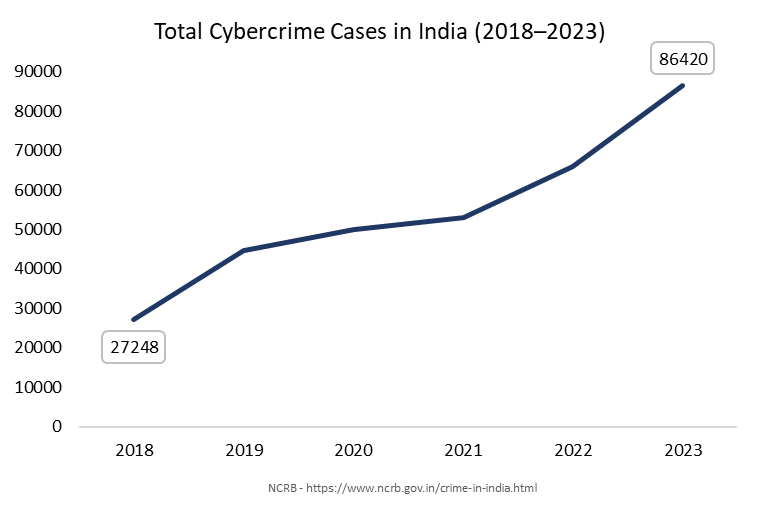
The data published by the NCRB represent the number of crimes that reached the point of the First Information Report (FIR) registration, meaning they reflect only cybercrime cases that were formally presented to the law enforcement system to investigate, rather than all complaints reported. The data shows that cybercrime cases increased from 27,248 in 2018 to 86,420 in 2023, a 3.17-fold increase in 5 years.
Two structural shifts are visible: the post-pandemic jump and subsequent acceleration.
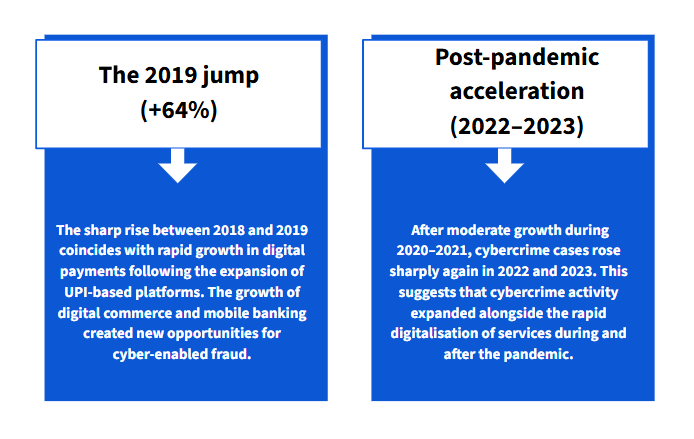
However, these figures likely underestimate the true scale of cybercrime because many incidents are reported only through online complaint portals and may not result in FIR registration.
The Financial Scale of Digital Fraud
The Financial Scale of Digital Fraud
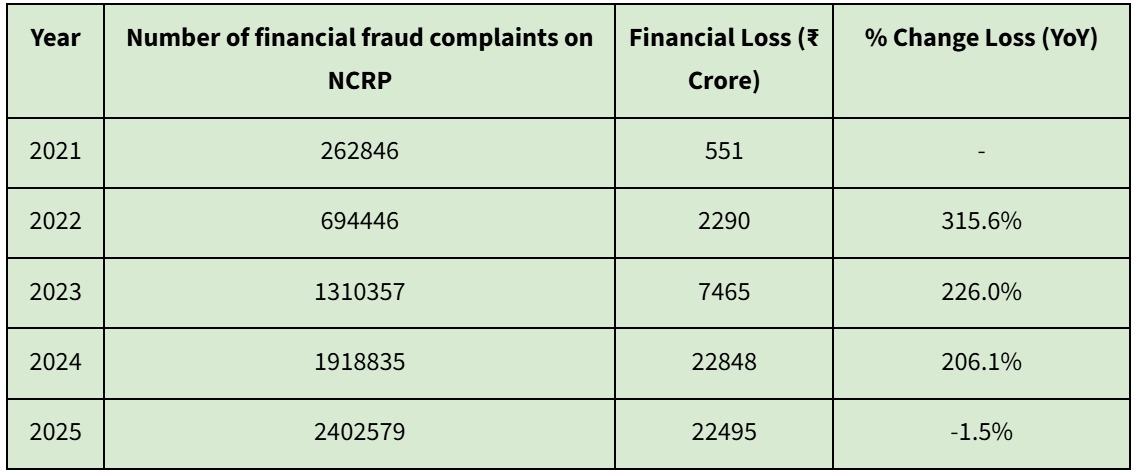
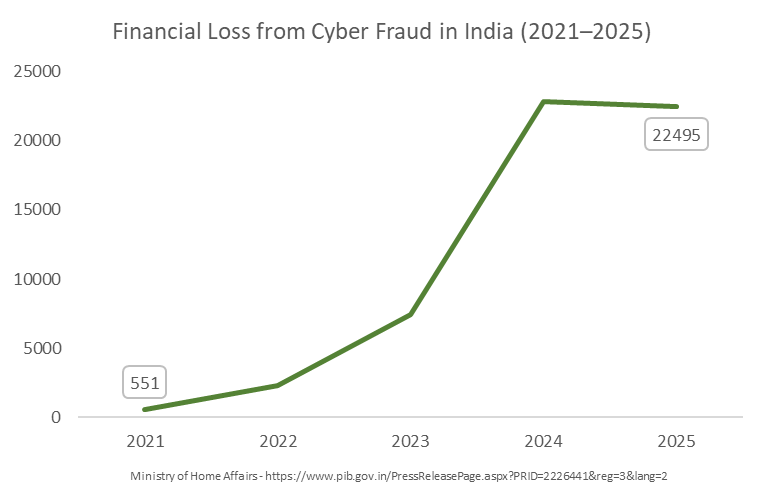
This dataset tracks financial fraud complaints reported through the National Cyber Crime Reporting Portal (NCRP) and the estimated financial losses associated with those complaints.
The financial losses reported between 2021 and 2024 increased by 41 times over four years, compared to 2021, from 551 crore to 22,848 crore. At the same time, the number of complaints rose from 262,846 to over 1.9 million, an increase of ~623%, indicating both rising victimisation and greater public awareness of reporting mechanisms.
The contrast between these two trends is striking:
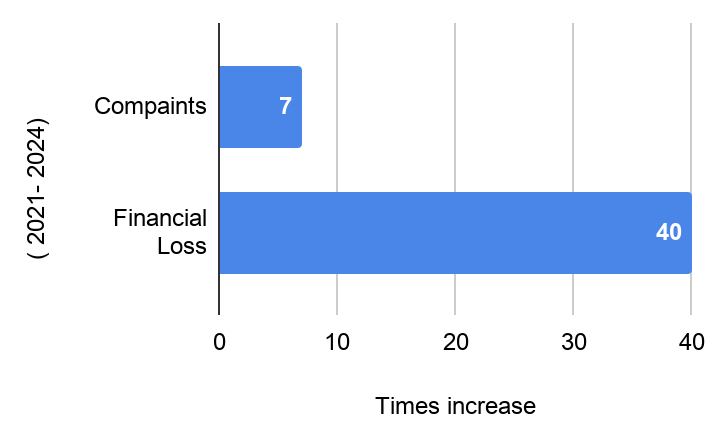
While complaints increased by around 7 times, financial losses increased by over 40 times.
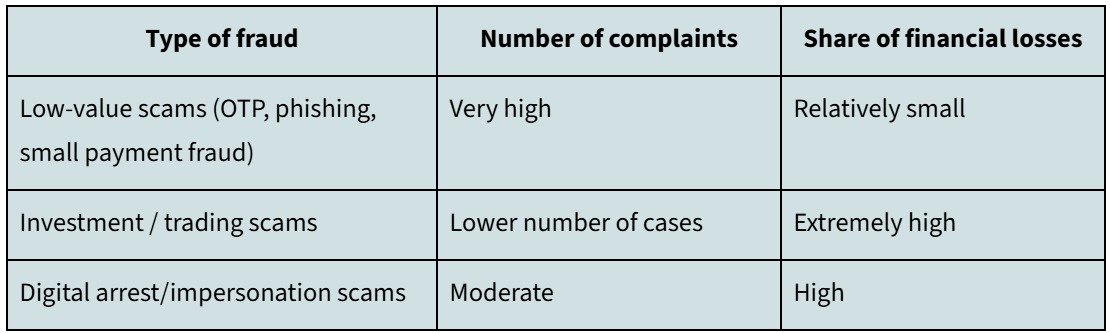
Distribution of Cyber-Fraud Complaints and Financial Losses by Fraud Type
This divergence implies an uneven relationship between the number of incidents and the financial damage that they inflict. Most cyber fraud incidents involve relatively small transaction values; however, a smaller group of fraud categories result in disproportionate numbers of financial losses.
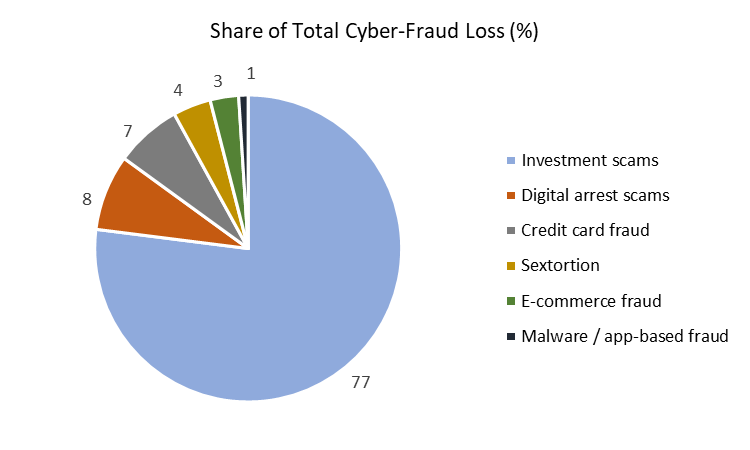
Distribution of Financial Losses Across Major Cyber-Fraud Categories in India
As reported by The Indian Express, based on the data compiled by the I4C, investment-related scams alone account for roughly 77% of reported cyber-fraud losses, followed by smaller shares from “digital arrest” scams (8%), credit card fraud (7%), sextortion (4%), e-commerce fraud (3%), and malware or app-based fraud (1%). This distribution means that even though scams with lower values, like phishing, OTP fraud, and small payment fraud, produce a high proportion of complaints, few categories of fraud produce most of the financial losses.
Analysis
1. Cybercrime is expanding faster than most traditional crimes: The fact that cybercrime cases have tripled in five years shows that cyber offences are presently becoming a significant element of Indian crime. Unlike conventional crimes that require physical proximity, cybercrime can be conducted remotely and at scale, enabling perpetrators to target large numbers of victims simultaneously.
2. Financial losses are concentrated in a small set of fraud categories: As cases of cybercrimes have been on the increase, the monetary losses of digital fraud cases have been increasing at a higher rate. The fact that the number of reported financial losses has increased 40 times in 4 years indicates that cybercrime has a very high economic impact.
3. Complaint volumes and financial damage follow different patterns: When comparing complaints and financial losses, it is evident that cyber fraud losses are unevenly distributed across types of incidents. Most of the prevalent scams reported, including phishing or OTP fraud, involve relatively small transaction values but yield a high portion of complaints. Conversely, fewer categories of fraud, especially investment-based schemes, contribute a significantly higher percentage of total financial losses.
4. Digital financial infrastructure has expanded the attack surface: India’s rapid adoption of digital payment systems, mobile banking and digital financial systems has dramatically increased the number of potential victims of cybercriminals. The scale of online transactions creates new vulnerabilities that organised cybercrime networks take advantage of.
5. Reporting improvements reveal previously hidden crime: The expansion of national reporting systems has enhanced the transparency in the trends of cybercrime. The increase in the number of complaints recorded is partially due to improved reporting systems and not necessarily to the increased criminal activity, meaning that previous data might have understated the magnitude of cyber fraud.
Recommendations
1. Move from reactive policing to proactive cyber-risk monitoring: The conventional models of policing focus on investigation of crimes that have already taken place. With such a magnitude and pace of cyber fraud, India should have systems that are designed to detect and prevent the fraud at its early stages, such as real-time observation of suspicious patterns in transactions by financial institutions.
2. Strengthen financial intelligence sharing across institutions: There are a lot of instances of cyber fraud that use more than one bank, payment system, and telecommunication provider. To detect new networks of fraud sooner, it can be suggested to establish more information-sharing measures between the financial institution and law enforcement agencies.
3. Target organised cyber fraud networks rather than individual incidents: Many digital scams operate through organised networks that coordinate phishing, mule accounts, and fake payment channels. The solution in regard to this involves dismantling these networks through investigative procedures instead of treating incidents on a case-by-case basis.
4. Improve recovery mechanisms for stolen funds: The recovery of the funds lost is one of the most difficult issues in cases of cyber fraud. Expanding systems such as the Citizen Financial Cyber Fraud Reporting and Management System (CFCFRMS) can improve the speed at which fraudulent transactions are frozen or reversed.
5. Strengthen digital financial literacy: A significant percentage of cyber frauds are based on social engineering methods that take advantage of user behaviour as opposed to technical weaknesses. Victimisation can be greatly reduced through specific public awareness efforts on typical scam schemes.
Conclusion
India’s experience illustrates a broader global trend: as economies digitise, crime increasingly follows the flow of digital money. While cybercrime incidents are rising steadily, the much faster growth in financial losses suggests that cybercriminals are becoming more organised, technologically sophisticated, and economically motivated.
References:
- https://indianexpress.com/article/india/indians-lost-rs-53000-crore-fraud-cheating-cases-six-years-maharashtra-2025-10452185/
- https://www.pib.gov.in/PressReleasePage.aspx?PRID=2226441®=3&lang=2 -
- https://www.ncrb.gov.in/crime-in-india.html
- https://i4c.mha.gov.in/index.aspx
- https://i4c.mha.gov.in/index.aspx

Executive Summary
A video is being shared on social media in which Prime Minister Narendra Modi can be heard saying that “a complete lockdown will be imposed from midnight to save the country.” Research by the CyberPeace found the viral claim to be misleading. Our probe revealed that the video is from March 2020, when PM Modi had announced a nationwide lockdown to curb the spread of COVID-19.
Claim:
An Instagram user shared the viral video on March 25, 2026. The link and archive link of the post are given below.

Fact Check:
To verify the claim, we conducted a keyword search on Google. However, we did not find any credible media reports confirming that such a lockdown announcement had been made recently. We then extracted keyframes from the viral video and performed a reverse image search using Google Lens. During this process, we found the same video on a YouTube channel, where it had been uploaded on March 24, 2020.
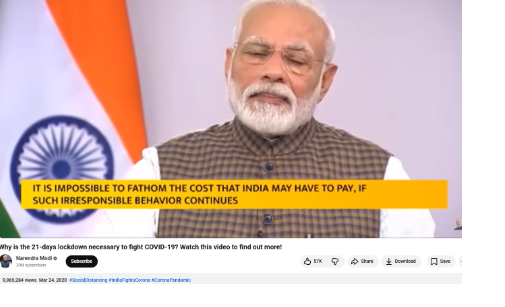
The viral portion of the clip appears around the 40-second mark in the original video.
Conclusion:
Our research found that the viral video is not recent. It dates back to March 24, 2020, when PM Modi announced a nationwide lockdown during the COVID-19 pandemic. The clip is being shared with a misleading claim.
India’s cities are rapidly embracing digital technologies, transforming the way essential urban services operate. From traffic management and water supply to online grievance redressal, connected systems are making city life more efficient. As the Prime Minister has emphasised, smart cities are not just a fancy concept; they aim to ensure basic services, including housing and infrastructure for the urban poor, are delivered comprehensively and equitably.
But improved cybersecurity has become essential with th increasing reliance on digital systems in daily life. A single breach in digital public systems could jeopardise citizen data and interrupt vital services. In light of this, MoHUA organised the National Conference on Making Cities Cyber Secure in collaboration with MHA and MeitY. This is in spirit with the goal of Digital India, which is to create a safer online environment for all. More than 300 representatives from Central Ministries, National Cybersecurity Agencies, State Governments, State IT and Urban Development Secretaries, Additional Director Generals, Municipal Commissioners, CEOs of Smart Cities, and representatives from organisations like CERT-In, NCIIPC, I4C, and STQC attended the conference.
Key Initiatives Presented
MoHUA showcased a series of city-level cybersecurity initiatives designed to create a common framework for all smart cities. These include:
- Mandatory appointment of Chief Information Security Officers (CISOs) at city level which maintain and oversee the security of digital infrastructure in smart cites
- Completion of regular cybersecurity audits to identify and address vulnerabilities in there seem
- Consistent Risk Management Across Services: A structured approach to risk management will be used so that critical areas like traffic systems, utilities and public services all follow the same high standards of protection.
CISOs and Cybersecurity Frameworks
At the conference, the Union Home Secretary underscored a clear message: every city needs its own Chief Information Security Officer (CISO) backed by a capable technical team. This isn’t just a box-ticking exercise. A dedicated CISO brings focus to meeting national security norms, coordinating quick responses to cyber incidents, and lifting the overall level of cyber hygiene in the city.
Naming a single officer also creates accountability and gradually builds local expertise instead of constant dependence on outside consultants. Over time, this leadership position can help cities develop their own in-house capacity to manage the increasingly complex digital systems that keep public services running.
The SPV Dimension: Beyond Implementation
An important theme of the conference was the future of Special Purpose Vehicles (SPVs)(SPVs means government-backed companies set up under the Companies Act, 2013 with joint shareholding between State/UT administrations and Urban Local Bodies to implement the Smart Cities Mission) which have been the implementing arms of the Smart Cities Mission. Drawing from Advisory No. 27 (June 2025), stakeholders discussed repositioning SPVs as dynamic, innovation-driven bodies capable of supporting long-term urban development beyond the initial project phase.
Key points included:
- Expanding SPVs’ role in consultancy, investment facilitation, technology integration, and policy research.
- Ensuring SPVs act as hubs of expertise and innovation, rather than just project managers.
- Aligning SPV functions with the evolving cybersecurity and technology needs of urban local bodies.
This expanded mandate could allow SPVs to become sustainable institutions that continuously support cities in managing digital risks and adopting new technologies responsibly.
Building a Culture of Cyber Preparedness
One clear takeaway from the conference was that cybersecurity can’t just be added on later — it needs to be part of every step in the digital planning process, from purchasing technology and designing systems to daily operations. Experts from the Intelligence Bureau (IB) pointed out that as more government services go online, the potential risks grow, and cities must always be ready to respond. They highlighted emerging cyber risks linked to the rapid digitisation of governance.
Some of the practical steps highlighted included regular security audits, penetration testing, staff training, and campaigns to raise awareness among citizens. Equally important to have CISO which lead cybersecurity and creating strong communication channels between city teams, state agencies, and national cybersecurity bodies, so that information is shared promptly and responses can be coordinated effectively
Conclusion
The Ministry of Home Affairs’ directive on strengthening cybersecurity in smart cities represents a major milestone in safeguarding India’s urban digital infrastructure and shows the government's proactive step in cybersecurity . By mandating the appointment of Chief Information Security Officers (CISOs), enforcing regular audits, and promoting structured risk management, the MHA has set clear expectations for city administration. The conference also highlighted the evolving role of Special Purpose Vehicles (SPVs) in supporting long-term technological resilience. Embedding cybersecurity at every stage of planning, from system design to daily operations, signals a shift toward a culture of proactive defence. As highlighted by the Intelligence Bureau, emerging cyber risks linked to the rapid digitisation of governance make robust cybersecurity measures the need of the hour for India’s smart cities.
- https://www.pib.gov.in/PressReleasePage.aspx?PRID=2146180
- https://www.pib.gov.in/PressReleasePage.aspx?PRID=2135474
- https://m.economictimes.com/news/economy/infrastructure/pm-narendra-modi-launches-smart-city-projects/articleshow/52916581.cms
- https://the420.in/mha-orders-stronger-cybersecurity-in-smart-cities/
- https://www.newindianexpress.com/nation/2025/Sep/20/tighten-cyber-security-measures-in-smart-cities-mha-to-housing-ministry
