
#FactCheck - Viral Postcard Attributing Fake UGC Statement to Keshav Prasad Maurya Is False
Executive Summary
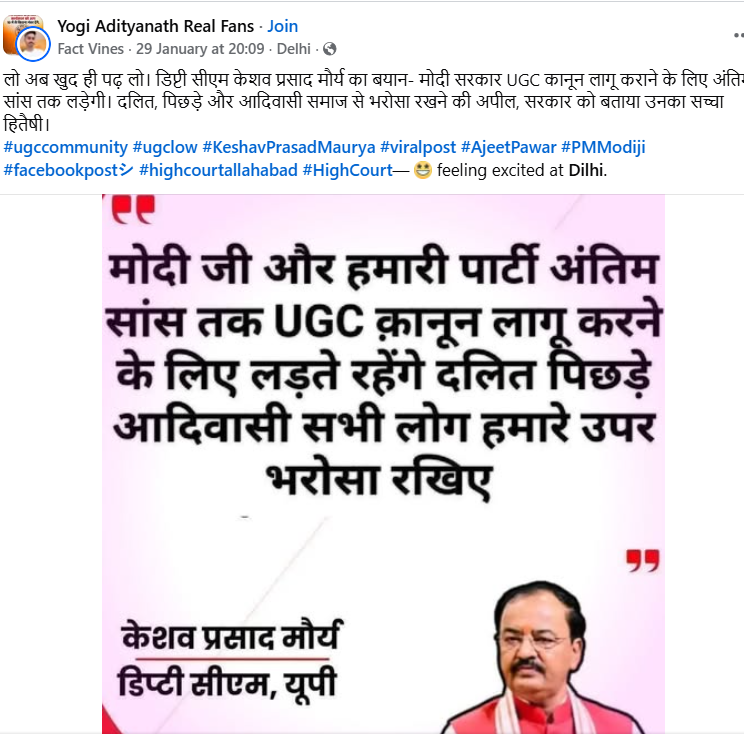
A postcard claiming that Uttar Pradesh Deputy Chief Minister Keshav Prasad Maurya commented on the Supreme Court’s stay on the new UGC regulations is being widely shared on social media. The viral postcard suggests that Maurya stated the Modi government would “fight till its last breath” to implement the UGC law and appealed to Dalit, backward and tribal communities to trust the government as their true well-wisher. However, an research by the CyberPeace has found that the viral postcard is fake. Keshav Prasad Maurya has not made any such statement.
Claim
A Facebook user shared the postcard with the caption:“Now read it yourself. Statement of Deputy CM Keshav Prasad Maurya — the Modi government will fight till its last breath to implement the UGC law. An appeal to Dalit, backward and tribal communities to trust the government, calling it their true well-wisher.”
(Archived version of the post available here.)
Fact Check:
During the research, we did not find any credible news reports mentioning such a statement by Deputy Chief Minister Keshav Prasad Maurya regarding the UGC regulations or the Supreme Court’s order. A closer examination of the viral postcard revealed several inconsistencies. Notably, the text on the postcard lacks proper punctuation, such as commas and full stops, which is unusual for professionally designed news graphics. The postcard carries the logo of Navbharat Times (NBT). However, when compared with genuine NBT postcards, the font style used in the viral image does not match NBT’s official design. We also traced the original NBT postcard that appears to have been edited to create the fake one. In the authentic postcard, shared by NBT on January 20, Keshav Prasad Maurya is quoted as saying: Where the lotus has bloomed, it will continue to bloom, and where it has not, under the guidance of PM Modi and the leadership of Nitin Nabin, the lotus will bloom.”
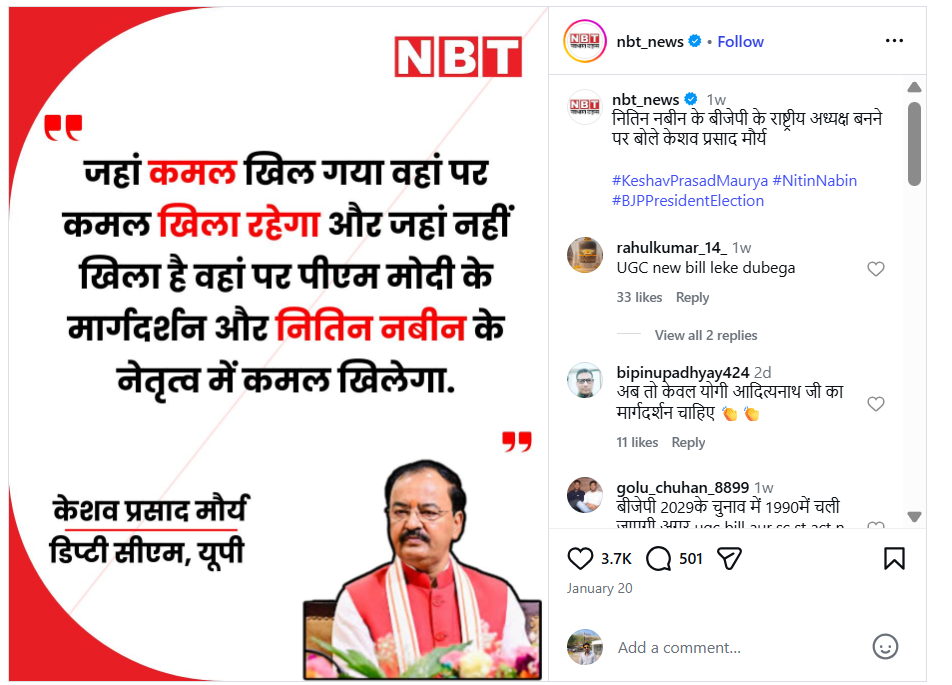
The original statement was digitally altered, and a fabricated quote was inserted to create the viral postcard.
Conclusion
CyberPeace research clearly establishes that the viral postcard is fake. The original Navbharat Times postcard has been tampered with, and Keshav Prasad Maurya’s actual statement has been replaced with a fabricated quote, which is now being circulated with a misleading claim.

Related Blogs
Introduction
India’s new Policy for Data Sharing from the National Transport Repository (NTR) released by the Ministry of Road Transport and Highways (MoRTH) in August, 2025, can be seen as a constitutional turning point and a milestone in administrative efficiency. The state has established an unprecedentedly large unified infrastructure by combining the records of 390 million vehicles, 220 million driver’s licenses, and the streams from the e-challan, e-DAR, and FASTag systems. Its supporters hail its promise of private-sector innovation, data-driven research, and smooth governance. However, there is a troubling paradox beneath this facade of advancement: the very structures intended to improve citizen mobility may simultaneously strengthen widespread surveillance. Without strict protections, the NTR runs the risk of violating the constitutional trifecta of need, proportionality, and legality as stated in Puttaswamy v. UOI, which brings to light important issues at the nexus of liberty, law, and data.
The other pertinent question to be addressed is as India unifies one of its comprehensive datasets on citizen mobility the question becomes more pressing: while motorised citizens are now in the spotlight for accountability, what about the millions of other datasets that are still dispersed, unregulated, and shared inconsistently in the areas of health, education, telecom, and welfare?
The Legal Backdrop
MoRTH grounds its new policy in Sections 25A and 62B of the Motor Vehicles Act, 1988. Data is consolidated into a single repository since states are required by Section 136A to electronically monitor road safety. According to the policy, it complies with the Digital Personal Data Protection Act, 2023.
The DPDP Act itself, however, is rife with state exclusions, particularly Sections 7 and 17, which give government organisations access to personal information for “any function under any law” or for law enforcement purposes. This is where the constitutional issue lies. Prior judicial supervision, warrants, or independent checks are not necessary. With legislative approval, MoRTH is essentially creating a national vehicle database without any constitutional protections.
Data, Domination and the New Privacy Paradigm
As an efficiency and governance reform, VAHAN, SARATHI, e-challan, eDAR, and FASTag are being consolidated into a single National Transport Repository (NTR). However, centralising extensive mobility and identity-linked records on a large scale is more than just a technical advancement; it also changes how the state and private life interact. The NTR must therefore be interpreted through a more comprehensive privacy paradigm, one that acknowledges that data aggregation is a means of enhancing administrative capacity and has the potential to develop into a long-lasting tool of social control and surveillance unless both technological and constitutional restrictions are placed at the same time.
Two recent doctrinal developments sharpen this concern. First, the Supreme Court’s foundational ruling that privacy is a fundamental right remains the constitutional lodestar, any state interference must satisfy legality, necessity and proportionality (KS Puttaswamy & Anr. vs UOI). Second, as seen by the court’s most recent refusals to normalise ongoing, warrantless location monitoring, such as the ruling overturning bail requirements that required accused individuals to provide a Google maps pin, as movement tracking necessitates closer examination (Frank Vitus v. Narcotics Control Bureau & Ors.,).When taken as a whole, these authorities maintain that unrestricted, ongoing access to mobility and toll-transaction records is a constitutional issue and cannot be handled as an administrative convenience.
Structural Fault Lines in the NTR Framework
Fundamentally, the NTR policy generates structural vulnerabilities by providing nearly unrestricted access through APIs and even mass transfers on physical media to a broad range of parties, including insurance companies, law enforcement, and intelligence services. This design undermines constitutional protections in three ways: first, it makes it possible to draw conclusions about private life patterns that the Supreme Court has identified as one of the most sensitive data categories by exposing rich mobility trails like FASTag logs and vehicle-linked identities; Second, it allows bulk datasets to circulate outside the ministry’s custodial boundary, which creates the possibility of function creep, secondary use, and monetisation risks reminiscent of the bulk sharing regime that the government itself once abandoned; and third, it introduces coercive exclusion by tying private sector access to Aadhaar-based OTP consent.
Reference
Executive Summary
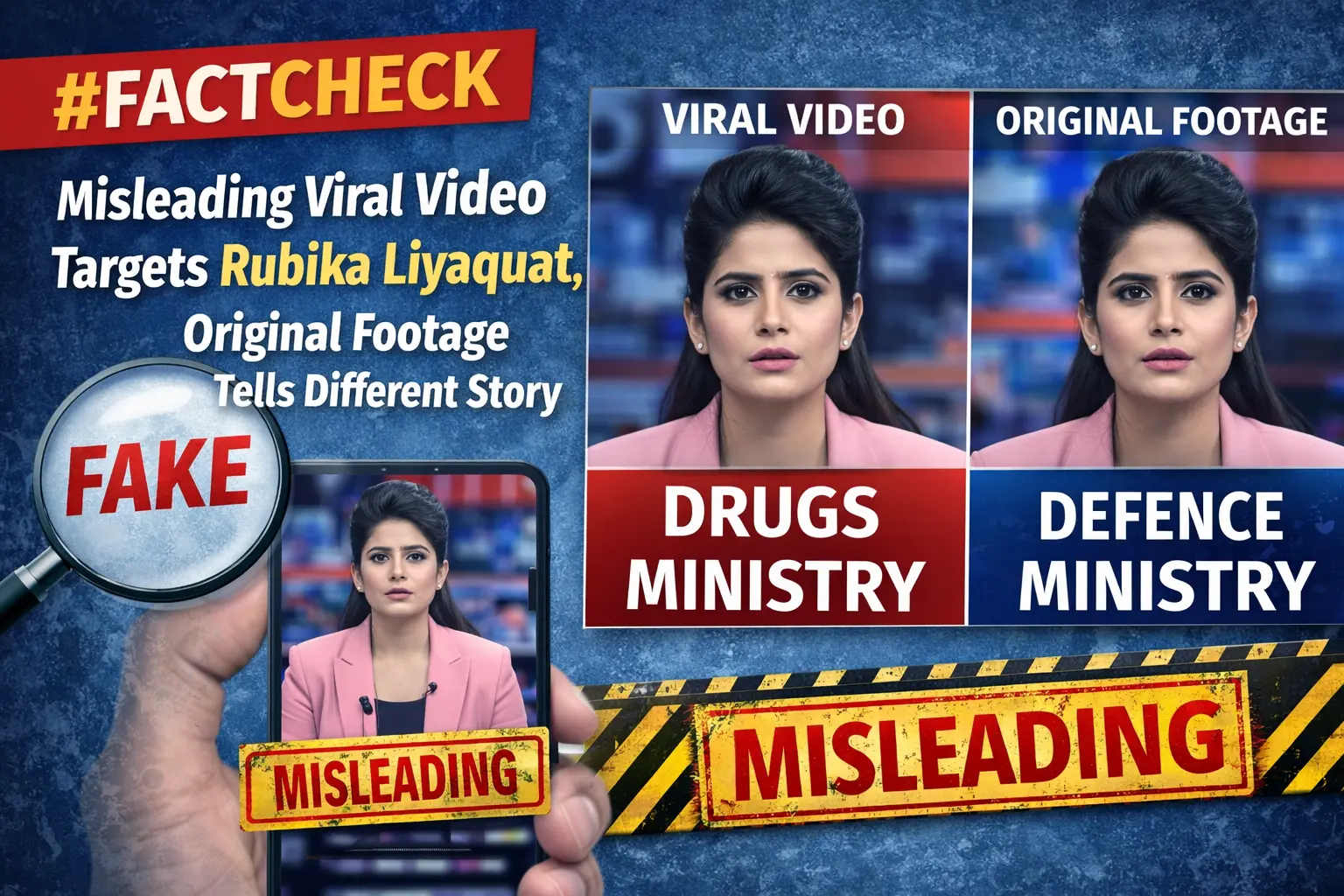
A video circulating on social media claims that a Pakistani man misbehaved with TV anchor Rubika Liyaquat during a live television debate. Users sharing the clip alleged that the Pakistani participant silenced the anchor on live TV.
However, research by CyberPeace found the viral claim to be false and revealed that the video being shared on social media is edited. In the original video, published on YouTube on November 26, 2025, the alleged Pakistani man was not present in the TV debate.
Claim
On February 13, 2026, a user shared the viral clip on X (formerly Twitter), claiming that the anchor was insulted during the debate and was left speechless. Another user on February 11, 2026, asked News18 India to verify the video and questioned who allowed such behaviour towards the journalist on air.
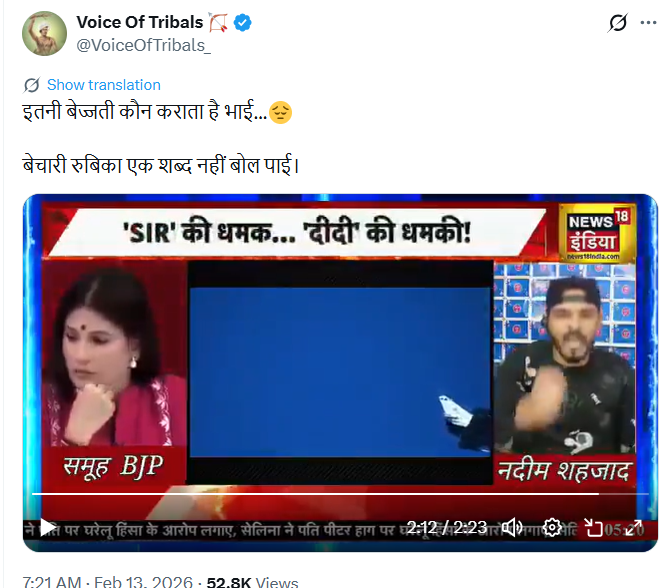
Fact Check:
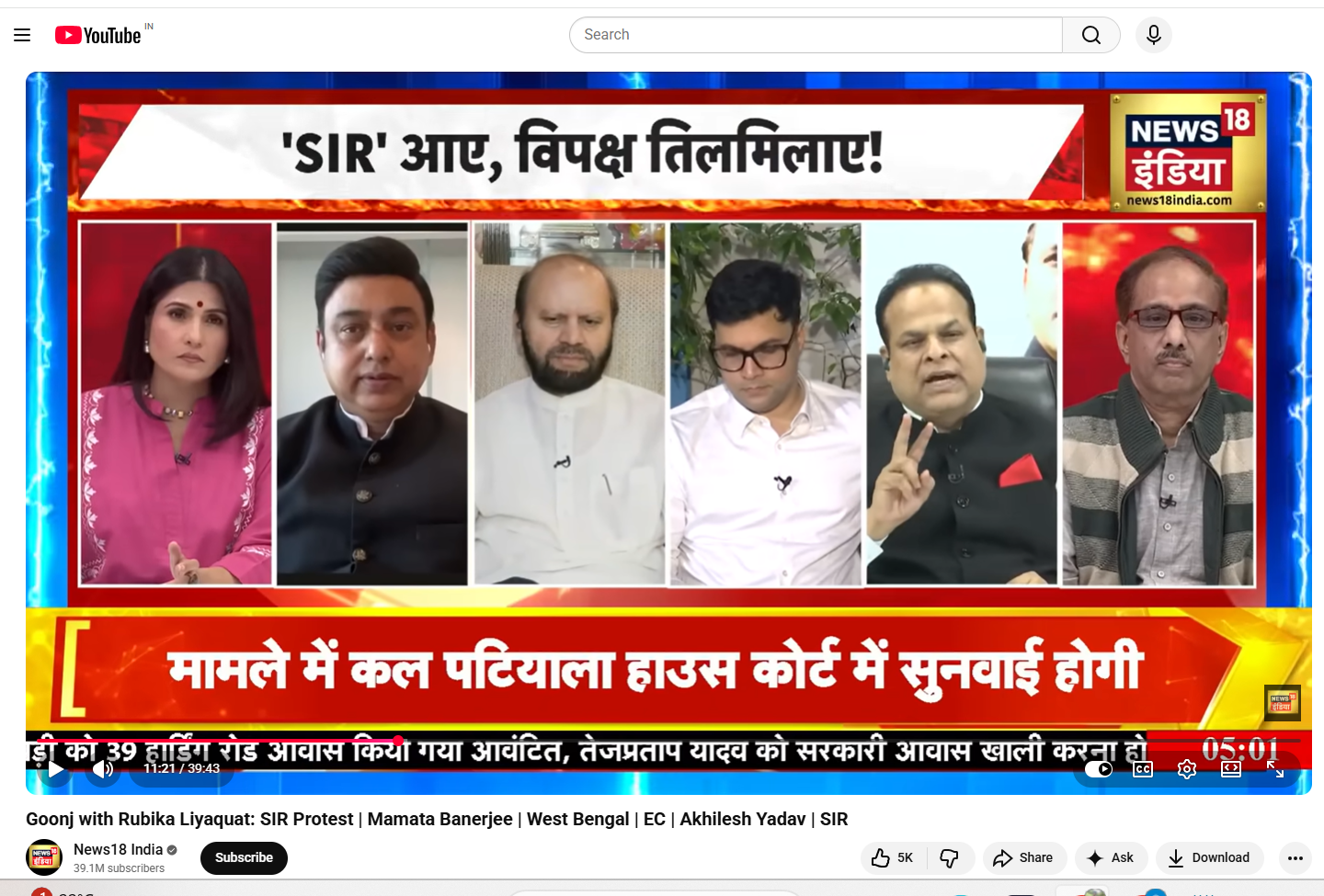
To verify the claim, we extracted key frames from the viral video and conducted a reverse image search using Google Lens. During the research, we found the full version of the debate uploaded on the official YouTube channel of News18 India on November 26, 2025. The nearly 40-minute original broadcast featured anchor Rubika Liyaquat along with panelists Zafar Islam, Varun Purohit, Prateek Kumar, Arvind Kumar Vajpayee, Tausif Ahmed Khan, and Aziz Khan. However, the person seen misbehaving with the anchor in the viral clip was not present in the original video.
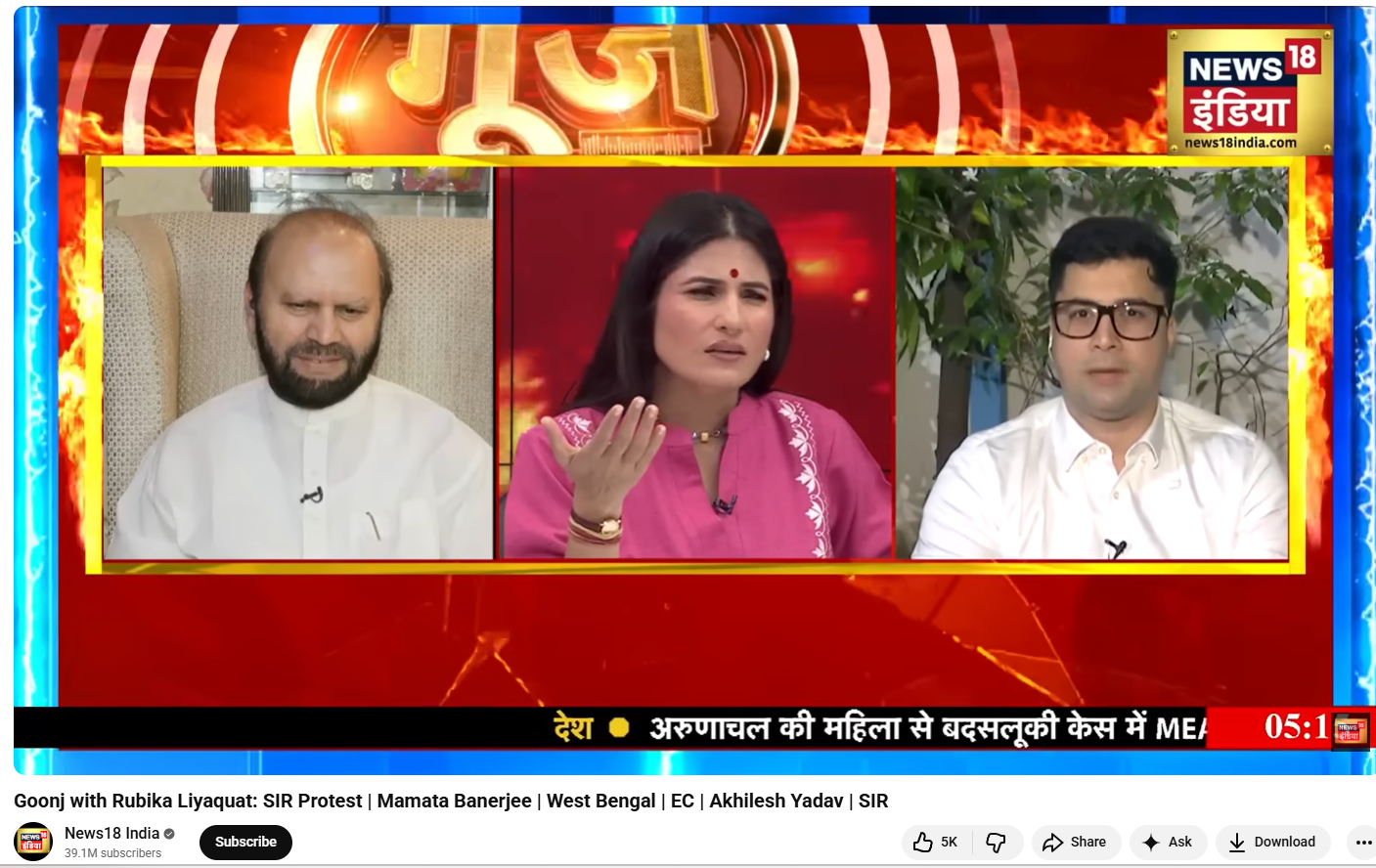
Upon carefully reviewing the footage, we located the actual segment around the 25-minute 40-second mark. In this portion, the anchor can be heard asking panelist Tausif Ahmed Khan to leave the show, using the same words heard in the viral clip. However, the original broadcast does not feature any Pakistani participant or any individual named “Nadeem Shahzad.”
Conclusion
Our research found that the viral claim is false. The circulating video has been edited, and the alleged Pakistani participant does not appear in the original debate uploaded on November 26, 2025.

Executive Summary:
A video clip being circulated on social media allegedly shows the Hon’ble President of India, Smt. Droupadi Murmu, the TV anchor Anjana Om Kashyap and the Hon’ble Chief Minister of Uttar Pradesh, Shri Yogi Adityanath promoting a medicine for diabetes. While The CyberPeace Research Team did a thorough investigation, the claim was found to be not true. The video was digitally edited, with original footage of the heavy weight persons being altered to falsely suggest their endorsement of the medication. Specific discrepancies were found in the lip movements and context of the clips which indicated AI Manipulation. Additionally, the distinguished persons featured in the video were actually discussing unrelated topics in their original footage. Therefore, the claim that the video shows endorsements of a diabetes drug by such heavy weights is debunked. The conclusion drawn from the analysis is that the video is an AI creation and does not reflect any genuine promotion. Furthermore, it's also detected by AI voice detection tools.

Claims:
A video making the rounds on social media purporting to show the Hon'ble President of India, Smt. Draupadi Murmu, TV anchor Anjana Om Kashyap, and Hon'ble Chief Minister of Uttar Pradesh Shri Yogi Adityanath giving their endorsement to a diabetes medicine.

Fact Check:
Upon receiving the post we carefully watched the video and certainly found some discrepancies between lip synchronization and the word that we can hear. Also the voice of Chief Minister of Uttar Pradesh Shri Yogi Adityanath seems to be suspicious which clearly indicates some sign of fabrication. In the video, we can hear Hon'ble President of India Smt. Droupadi Murmu endorses a medicine that cured her diabetes. We then divided the video into keyframes, and reverse-searched one of the frames of the video. We landed on a video uploaded by Aaj Tak on their official YouTube Channel.

We found something similar to the same viral video, we can see the courtesy written as Sansad TV. Taking a cue from this we did some keyword searches and found another video uploaded by the YouTube Channel Sansad TV. In this video, we found no mention of any diabetes medicine. It was actually the Swearing in Ceremony of the Hon’ble President of India, Smt. Droupadi Murmu.

In the second part, there was a man addressed as Dr. Abhinash Mishra who allegedly invented the medicine that cures diabetes. We reverse-searched the image of that person and landed at a CNBC news website where the same face was identified as Dr Atul Gawande who is a professor at Harvard School of Public Health. We watched the video and found no sign of endorsing or talking about any diabetes medicine he invented.

We also extracted the audio from the viral video and analyzed it using the AI audio detection tool named Eleven Labs, which found the audio very likely to be created using the AI Voice generation tool with the probability of 98%.

Hence, the Claim made in the viral video is false and misleading. The Video is digitally edited using different clips and the audio is generated using the AI Voice creation tool to mislead netizens. It is worth noting that we have previously debunked such voice-altered news with bogus claims.
Conclusion:
In conclusion, the viral video claiming that Hon'ble President of India, Smt. Droupadi Murmu and Chief Minister of Uttar Pradesh Shri Yogi Adityanath promoted a diabetes medicine that cured their diabetes, is found to be false. Upon thorough investigation it was found that the video is digitally edited from different clips, the clip of Hon'ble President of India, Smt. Droupadi Murmu is taken from the clip of Oath Taking Ceremony of 15th President of India and the claimed doctor Abhinash Mishra whose video was found in CNBC News Outlet. The real name of the person is Dr. Atul Gawande who is a professor at Harvard School of Public Health. Online users must be careful while receiving such posts and should verify before sharing them with others.
Claim: A video is being circulated on social media claiming to show distinguished individuals promoting a particular medicine for diabetes treatment.
Claimed on: Facebook
Fact Check: Fake & Misleading
