
#FactCheck-Old Bengal Panchayat Poll Video Falsely Linked to 2026 Assembly Elections
Executive Summary
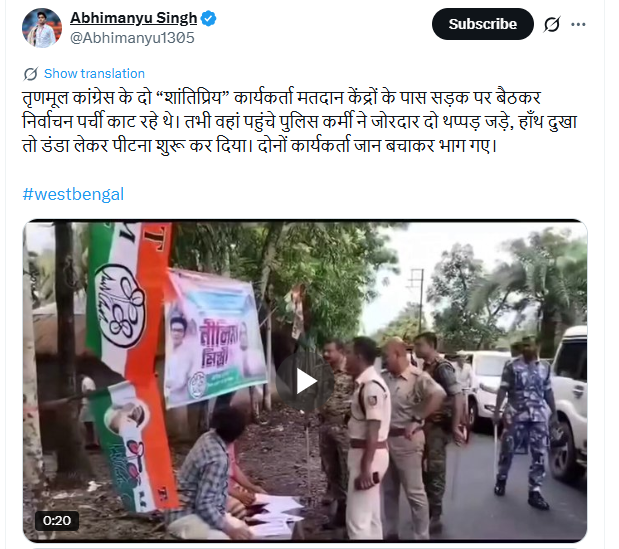
A video is being widely shared on social media showing two men seated on chairs when police personnel arrive and begin assaulting them. A flag of West Bengal Chief Minister Mamata Banerjee’s party, the Trinamool Congress (TMC), can also be seen in the footage. The video is being circulated with the claim that during the first phase of polling held on April 23, 2026, two TMC workers were issuing voter slips near a polling booth when security forces reached the spot and beat them. However, research by the CyberPeace Research Wing found the claim to be false. The footage is not recent and has no connection to the 2026 West Bengal Assembly elections.
Claim:
Social media users alleged that police assaulted TMC workers during the 2026 West Bengal Assembly elections. An X user, Abhimanyu Singh, shared the clip claiming that two “peaceful” TMC workers were sitting near polling stations issuing voter slips when a policeman slapped and beat them with a baton, forcing them to flee.
- https://x.com/Abhimanyu1305/status/2047317736825790549
- https://archive.ph/0ceXH
Fact Check:
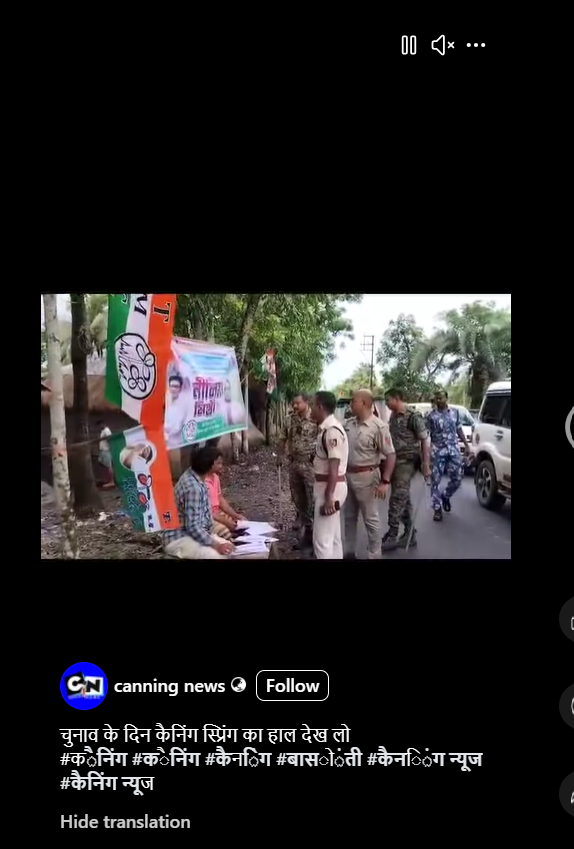
To verify the claim, keyframes from the viral video were subjected to a reverse image search. This led to the same video being found on a Facebook page named Canning News, where it had been uploaded in 2023. The caption stated: “Take a look at the situation in Basanti, Canning, on election day.”
Further searches found the clip published by News18 Bangla on July 6, 2023. The report described unrest during the 2023 Panchayat elections, stating that allegations of bomb throwing had surfaced in Basanti the previous night. On the morning of polling, a bomb was reportedly recovered from the roadside, creating panic in the area.

According to the report, police intervened to control the situation and took action wherever crowds had gathered. The footage showed police dispersing people with batons and, at times, physically confronting individuals.
Conclusion:
The viral claim is misleading. The video is from the 2023 Panchayat elections in West Bengal and is being falsely linked to the recent 2026 Assembly elections.

Related Blogs

Introduction
Since February 2020 the government has been taking keen steps to safeguard the Indian markets and the consumer, this could be seen in the forms of policies and exemptions for the market players and the consumers, however, due to the COVID-19 pandemic, the markets places became vulnerable to loss and various forms of new crimes and frauds. The Government recently tabled the Jan Vishwas bill which is an aftermath of the Vivad se Vishwas Bill, 2020 which was tabled in February 2020 for creating a safe and dynamic market, this bill is a clear example of how AtmaNirbhar Bharat plays a crucial role in nations development.
What is Jan Vishwas Bill, 2022
The Jan Vishwas (Amendment of Provisions) Bill, 2022 is a 108-page bill introduced in the Lok Sabha by the Union Minister of Commerce and Industry, Piyush Goyal. The statement of objects and reasons of the Bill states, “To amend certain enactments for decriminalizing and rationalizing minor offenses to further enhance trust-based governance for ease of living and doing business.” The bill aims to promote ease of doing business in India by decriminalizing minor offences and amending 183 provisions in 42 Acts administered by 19 ministries. The bill proposes to replace minor offences with monetary penalties and rationalize existing monetary penalties based on the gravity of the offences. The Acts to be amended by the bill include-
- Drugs and Cosmetics Act, 1940
- Public Debt Act, 1944
- Pharmacy Act, 1948
- Cinematograph Act, 1952
- Copyright Act, 1957
- Patents Act, 1970
- Environment (Protection) Act, 1986
- Motor Vehicles Act, 1988
- Trade Marks Act, 1999l Railways Act, 1989
- Information Technology Act, 2000
- Prevention of Money-laundering Act, 2002
- Food Safety and Standards Act, 2006
- Legal Metrology Act, 2009
- Factoring Regulation Act, 2011
The bill aims to decriminalize a large number of minor offences and replace them with monetary penalties. This step by the government is a clear indication of how important the market regulations are, in recent times Google was imposed with a penalty of 1300 crores and 900 crores for violating competitive market practices, these penalties, and criminalised actions will ensure proper compliance to laws of the land thus creating a blanket of safeguards for the Indian consumer and netizen.
What will the Ease of Business be?
The Government has been critical in pinpointing various parameters and factors to improve the ease of business in the country, this bill comes at the right time when we can see numerous start-ups and entrepreneurs emerging in our country. The parameters are as follows-
- Starting a Business of all
- Dealing with Construction Permits
- Getting Electricity
- Registering Property
- Getting Credit
- Protecting
- Minority Investors
- Paying Taxes
- Trading across Borders
- Enforcing Contracts and Resolving Insolvency
These parameters have been created with a sight on the future of the markets and how external factors like the Russia-Ukraine war can influence the markets. According to Minister Piyush Goyal, the fear of imprisonment for minor offences is a major factor hindering the growth of the business ecosystem and individual confidence in India. The Jan Vishwas Bill, 2022 aims to address this issue by replacing minor offences with monetary penalties. The bill also proposes an increase of 10% in the minimum amount of fine and penalty levied after every three years, once the bill becomes a law.
Conclusion
The bill will create a level playing field for the market players and the consumers with the backing of strong legislation and precedents thus maintaining transparency and accountability in the system. The amended provisions will allow various already existing legislation to come in tune with the current times and emerging technologies. The nation is at a critical juncture to fabricate policies and laws to address the issues and threats of the future and hence such a bill will be the strengthening pillar of the Indian markets and cyber-ecosystem. The Jan Vishwas Bill, 2022 has been referred to a 31-member joint parliamentary committee for scrutiny. The committee includes members from the Lok Sabha and the Rajya Sabha and will submit its report to parliament by the second part of the Budget session in 2023, The members from the Lok Sabha include PP Chaudhary, Sanjay Jaiswal, Queen Ojha, Rajendra Agrawal, Gaurav Gogoi, A Raja, Rajendra Agarwal, Poonam Pramod Mahajan, and Sougata Ray.

Introduction
On April 30, 2025, the Supreme Court of India delivered a landmark judgment that cast a sharp light on one of the most overlooked yet pressing issues in modern governance—digital inequity. In a country that has a staggering 900 million Internet users, the ruling highlights a disheartening reality, a paradox that brings the “digital divide” to centre stage. While India may be the world’s second-largest online market, a significant segment of its population remains digitally disenfranchised. The judgment, delivered in response to two interconnected petitions, underscored that access to the internet is no longer a luxury but a lifeline integral to exercising fundamental rights. The court pointed out in clear terms that the government must build a digital ecosystem that is inclusive and accessible to all and attributed the right to digital access as an intrinsic part of the right to life and liberty under Article 21 as enshrined under the Indian Constitution.
Understanding the Context: What Prompted the Petitions?
The judgment springs out of two writ petitions, which sought instructions or guidelines for people with blindness or limited vision and acid attack survivors, respectively, to conduct digital Know Your Customer (KYC)/e-KYC/video KYC mandated by RBI’s KYC Master Directions, 2016, which were reserved for judgment on January 28. The court delivered the judgment on April 30, 2025, emphasising the fact that true inclusion in this digital era is confounded in an inclusive digital infrastructure, and it must provide reasonable accommodation to those who face impediments due to any disability or disfigurement.
In consonance with its view, it laid down various guidelines that ensure that all persons with disabilities or acid attack survivors are treated even when digital processes are involved in accordance with the provisions of the Right of Persons with Disabilities Act, 2016 (hereinafter referred to as “RPwD Act”)
Another major observation made by the Honourable SC judges is that the mode of facilitation of government services is through digital platforms, i.e., e-governance, and access to all these welfare schemes is the right of every citizen, irrespective of the fact that they suffer from any disability. The failure of the provisioning of e-governance of these facilities to these individuals is a gross failure of the objectives of these schemes.
Key Observations and Directives
The court directed the government to release fresh guidelines that establish alternative methods to conduct digital KYC/e-KYC for all persons who suffer any impairment, low vision, or disfigurement with greater sensitivity, particularly for acid-attack survivors. The court made its intention very clear that the right to digital access is intrinsic to the right to life and liberty. All the tasks that are included within the ambit of digital KYC, such as pen-on-paper signatures, screen signatures, and the brief window for OTP entry, create an inaccessible and exclusionary framework, violating not just the dignity but the legal rights granted protection under the RPwD Act, 2016. The ruling directs a fundamental reimagining of digital governance through the lens of inclusion, equality, and dignity.
Conclusion
The court is not mincing its words when it declares digital accessibility as a constitutional imperative; it has made it clear that bridging the digital divide is no longer optional but a legal duty. The decision marks the new beginning and a propeller of digital transformation, and a delightful amalgamation of digital access and the rights of people. The effect of this judgment will not be restricted to one class of people. Still, it will cater to all those individuals who face these obstacles on a daily basis due to the exclusionary nature of digital platforms.
References

Introduction
The Telecom Regulatory Authority of India (TRAI), on March 13 2023, published a new rule to regulate telemarketing firms. Trai has demonstrated strictness when it comes to bombarding users with intrusive marketing pitches. In a report, TRAI stated that 10-digit mobile numbers could not be utilised for advertising. In reality, different phone numbers are given out for regular calls and telemarketing calls. Hence, it is an appropriate and much-required move in order to suppress and eradicate phishing scammers and secure the Indian Cyber-ecosystem at large.
What are the new rules?
The rules state that now 10-digit unregistered mobile numbers for promotional purposes would be shut down over the following five days. The rule claim that calling from unregistered mobile numbers had been banned was published on February 16. In this case, using 10-digit promotional messages for promotional calling will end within the following five days. This step by TRAI has been seen after nearly 6-8 months of releasing the Telecommunication Bill, 2022, which has focused towards creating a stable Indian Telecom market and reducing the phoney calls/messages by bad actors to reduce cyber crimes like phishing. This is done to distinguish between legitimate and promotional calls. According to certain reports, some telecom firms allegedly break the law by using 10-digit mobile numbers to make unwanted calls and send promotional messages. All telecom service providers must execute the requirements under the recent TRAI directive within five days.
How will the new rules help?
The promotional use of a cellphone number with 10 digits was allowed since the start, however, with the latest NCRB report on cyber crimes and the rising instances and reporting of cyber crimes primarily focused towards frauds related to monetary gains by the bad actors points to the issue of unregulated promotional messages. This move will act as a critical step towards eradicating scammers from the cyber-ecosystem, TRAI has been very critical in understanding the dynamics and shortcomings in the regulation of the telecom spectrum and network in India and has shown keen interest towards suppressing the modes of technology used by the scammers. It is a fact that the invention of the technology does not define its use, the policy of the technology does, hence it is important to draft ad enact policies which better regulate the existing and emerging technologies.
What to avoid?
In pursuance of the rules enacted by TRAI, the business owners involved in promotional services through 10-digit numbers will have to follow these steps-
- It is against the law to utilise a 10-digit cellphone number for promotional calls.
- You should stop doing so right now.
- Your mobile number will be blocked in the following five days if not.
- Users employed by telemarketing firms are encouraged to refrain from using the system in such circumstances.
- Those working for telemarketing firms are encouraged not to call from their mobile numbers.
- Users should phone the company’s registered mobile number for promotional purposes.
Conclusion
The Indian netizen has been exposed to the technology a little later than the western world. However, this changed drastically during the Covid-19 pandemic as the internet and technology penetration rates increased exponentially in just a couple of months. Although this has been used as an advantage by the bad actors, it was pertinent for the government and its institutions to take an effective and efficient step to safeguard the people from financial fraud. Although these frauds occur in high numbers due to a lack of knowledge and awareness, we need to work on preventive solutions rather than precautionary steps and the new rules by TRAI point towards a safe, secured and sustainable future of cyberspace in India.
