
#FactCheck-Viral Post Falsely Claims White House Dinner Shooter Was Muslim and Killed
Executive Summary
A social media post about the shooting incident during a dinner event for journalists covering the White House is going viral with the claim that the attacker was a Muslim man who was shot dead by security personnel. The accompanying video shows panic inside a hall and alert security officials responding to the situation. wHowever, research by the CyberPeace Research Wing found that the claim is false and misleading. The video is being shared with incorrect information about the identity and fate of the suspect.
Claim:
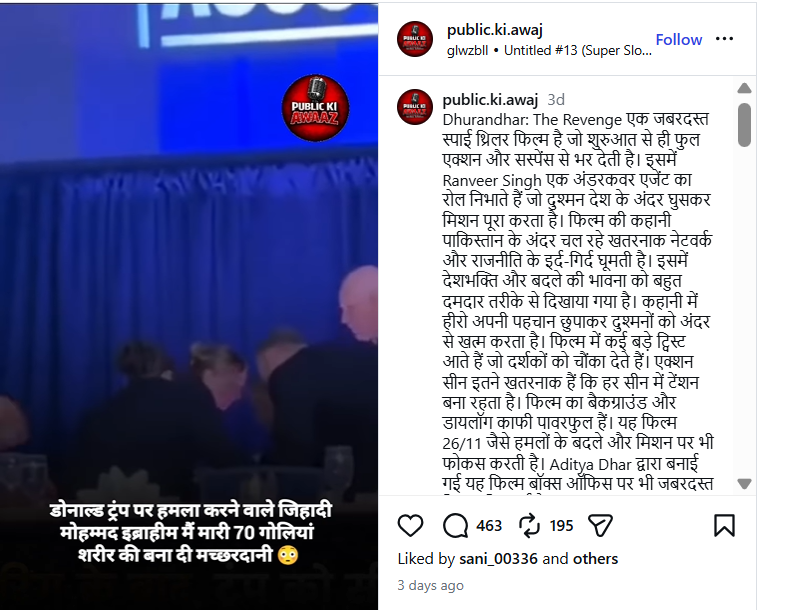
An Instagram user shared the video on April 26, 2026, claiming that the attacker who targeted Donald Trump was a “jihadi” named Mohammad Ibrahim and that he was killed after being shot multiple times.
Fact Check:
To verify the claim, relevant keyword searches were conducted online.
A report published by BBC on April 28, 2026, stated that the suspect accused of attempting to assassinate President Donald Trump during the Washington dinner event was identified as Cole Thomas Allen. The report said Allen lived with his parents in Los Angeles and was produced in court on April 28.

According to court documents cited in the report, Allen rushed past a security checkpoint carrying a semi-automatic handgun, a pump-action shotgun, and three knives. Authorities said one Secret Service agent was injured during the incident before Allen was subdued and taken into custody. A separate report published by NBC News on April 26, 2026, also identified the accused as Cole Thomas Allen and included visuals from the incident, showing the suspect after his arrest.

Conclusion:
The claim that the White House dinner party attacker was a Muslim man named Mohammad Ibrahim is false. The accused has been identified as Cole Thomas Allen, and he was arrested after the incident. Claims that he was killed are also incorrect.

Related Blogs

EXECUTIVE SUMMARY:
A viral video is surfacing claiming to capture an aerial view of Mount Kailash that has breathtaking scenery apparently providing a rare real-life shot of Tibet's sacred mountain. Its authenticity was investigated, and authenticity versus digitally manipulative features were analyzed.
CLAIMS:
The viral video claims to reveal the real aerial shot of Mount Kailash, as if exposing us to the natural beauty of such a hallowed mountain. The video was circulated widely in social media, with users crediting it to be the actual footage of Mount Kailash.


FACTS:
The viral video that was circulated through social media was not real footage of Mount Kailash. The reverse image search revealed that it is an AI-generated video created by Sonam and Namgyal, two Tibet based graphic artists on Midjourney. The advanced digital techniques used helped to provide a realistic lifelike scene in the video.
No media or geographical source has reported or published the video as authentic footage of Mount Kailash. Besides, several visual aspects, including lighting and environmental features, indicate that it is computer-generated.
For further verification, we used Hive Moderation, a deep fake detection tool to conclude whether the video is AI-Generated or Real. It was found to be AI generated.

CONCLUSION:
The viral video claiming to show an aerial view of Mount Kailash is an AI-manipulated creation, not authentic footage of the sacred mountain. This incident highlights the growing influence of AI and CGI in creating realistic but misleading content, emphasizing the need for viewers to verify such visuals through trusted sources before sharing.
- Claim: Digitally Morphed Video of Mt. Kailash, Showcasing Stunning White Clouds
- Claimed On: X (Formerly Known As Twitter), Instagram
- Fact Check: AI-Generated (Checked using Hive Moderation).
Introduction
Cyberwarfare has evolved into one of the most decisive instruments of statecraft and conflict. The increasing digitisation of critical infrastructure like power grids, water systems, transportation systems, healthcare networks, and energy sources has made these systems new targets in the war of algorithms. Military logic is evolving to paralyse the nation’s critical infrastructure to keep its resources engaged in repairing them and thereby break the nation’s ability to deter and counter attacks, all without firing a single bullet.
From Ransomware to an Invisible Sabotage: The changing nature of warfare
The operational technology (OT) landscape has become the epicentre of cyber operations, all around the world. Once, which was insulated, related to industrial systems that controlled turbines, pipelines, or dams, they now stand connected to the Internet through supervisory control and data acquisition (SCADA) and the Internet of Things. These connections have also become gateways for attackers, besides enhancing the efficiency of the infrastructural lifelines of the nation.
Groups like Volt Typhoon, Sandworm, Laurionite, and Cyberavengers have transformed the art of digital infiltration into a strategic shift. Volt Typhoon, which is linked to China, has used “living-off-the-land” techniques to exploit the legitimate administrative tools to remain invisible while scanning the critical infrastructures in the US. Sandworm, which is aligned with Russia’s GRU (Glavnoye Razvedyvatelnoye Upravlenie) or Main Intelligence Directorate (in English), has demonstrated the power of cyber sabotage in real time, as its attacks on Ukraine’s power grids in 2015 and 2021 had left millions in darkness, coinciding with kinetic missile strikes. Meanwhile, the Iranian-affiliated Cyberavengers group, which has weaponised the AI-assisted malware, such as IOCONTROL, that are capable of hijacking water and energy control systems. Each of these systems used in these operations reflects a shift from direct espionage activities to a state of strategic paralysis.
In comparison to the traditional cybercrime activities that are aimed at stealing data and extortion of money, these campaigns repeatedly target the physical systems, which consist of the machinery that sustains civilian life and military preparedness.
The Military Logic behind Cyber Targeting: A Web of Vulnerabilities
A critical infrastructure is a complex ecosystem that covers power generation, transportation, communication, and manufacturing are all interconnected, which means a single compromised node can cascade into a national paralysis. For instance, a breach in the systems of the dam can flood an entire city, a grid shutdown can halt water supply to hospitals, and even affect air traffic. The 2015 Black Energy Malware attack in Ukraine has proved this possibility when three utilities were hacked, plunging thousands of homes into darkness. The Iranian hackers once again gained access to the Bowman Avenue Dam of New York and controlled its floodgates, which gave a chilling demonstration of the destructive reality of digital manipulation.
The systems remain vulnerable mainly for 3 reasons such as-
- Legacy Architectures: Many of these industrial systems were designed decades ago with no built-in cybersecurity mechanisms.
- Slow Patching and Segmentation Gaps: All updates and segmentation between IT and TO networks often lag, providing open entry points for attackers.
- Converging with IoT: The integration of smart sensors and cloud-based management tools has expanded the attack surface exponentially.
This interconnected fragility has turned our critical infrastructures into both a weapon and a target or a tool for coercion in modern hybrid warfare. Between 2023 and 2024, over 420 cyberattacks were witnessed in several critical global infrastructures, which averaged to 13 attacks per second, according to a news report. These were not just random acts of digital vandalism; they were deliberate and coordinated operational attempts by state-led actors from China, Russia, and Iran.
Developing a new Resilience as the new tool of Deterrence
Cyber deterrence no longer rests on the fear of retaliation, it relies on the need for resilience. Nations that can absorb attacks, maintain continuity, and recover rapidly would be the true superpowers of this digital age. Segmentation, real-time threat detection, and AI-assisted recovery models are vital pillars of this model of resilience. The logic of modern cyberwarfare is clear, which means that the more a nation digitizes, the more it will need to defend itself.
However, as the line between war and peace blurs, safeguarding critical infrastructure is no longer just an IT priority; rather, it is a national security doctrine. In this silent theatre of cyberwarfare, survival will depend not only on firepower, but on firewalls.
References
- https://rmcglobal.com/critical-infrastructure-under-siege-the-top-ot-threats-of-2025/
- https://ccdcoe.org/uploads/2018/10/Geers2009_The-Cyber-Threat-to-National-Critical-Infrastructures.pdf
- https://www.researchgate.net/publication/335752979_Cybersecurity_of_Critical_Infrastructure
- https://arxiv.org/html/2510.04118v1
- https://www.anapaya.net/blog/top-5-critical-infrastructure-cyberattacks
.webp)
Introduction
Big Tech has been pushing back against regulatory measures, particularly regarding data handling practices. X Corp (formerly Twitter) has taken a prominent stance in India. The platform has filed a petition against the Central and State governments, challenging content-blocking orders and opposing the Center’s newly launched Sahyog portal. The X Corp has furthermore labelled the Sahyog Portal as a 'censorship portal' that enables government agencies to issue blocking orders using a standardized template.
The key regulations governing the tech space in India include the IT Act of 2000, IT Rules 2021 and 2023 (which stress platform accountability and content moderation), and the DPDP Act 2023, which intersects with personal data governance. This petition by the X Corp raises concerns for digital freedom, platform accountability, and the evolving regulatory frameworks in India.
Elon Musk vs Indian Government: Key Issues at Stake
The 2021 IT Rules, particularly Rule 3(1)(d) of Part II, outline intermediaries' obligations regarding ‘Content Takedowns’. Intermediaries must remove or disable access to unlawful content within 36 hours of receiving a court order or government notification. Notably, the rules do not require government takedown requests to be explicitly in writing, raising concerns about potential misuse.
X’s petition also focuses on the Sahyog Portal, a government-run platform that allows various agencies and state police to request content removal directly. They contend that the failure to comply with such orders can expose intermediaries' officers to prosecution. This has sparked controversy, with platforms like Elon Musk’s X arguing that such provisions grant the government excessive control, potentially undermining free speech and fostering undue censorship.
The broader implications include geopolitical tensions, potential business risks for big tech companies, and significant effects on India's digital economy, user engagement, and platform governance. Balancing regulatory compliance with digital rights remains a crucial challenge in this evolving landscape.
The Global Context: Lessons from Other Jurisdictions
The ‘EU's Digital Services Act’ establishes a baseline 'notice and takedown' system. According to the Act, hosting providers, including online platforms, must enable third parties to notify them of illegal content, which they must promptly remove to retain their hosting defence. The DSA also mandates expedited removal processes for notifications from trusted flaggers, user suspension for those with frequent violations, and enhanced protections for minors. Additionally, hosting providers have to adhere to specific content removal obligations, including the elimination of terrorist content within one hour and deploying technology to detect known or new CSAM material and remove it.
In contrast to the EU, the US First Amendment protects speech from state interference but does not extend to private entities. Dominant digital platforms, however, significantly influence discourse by moderating content, shaping narratives, and controlling advertising markets. This dual role creates tension as these platforms balance free speech, platform safety, and profitability.
India has adopted a model closer to the EU's approach, emphasizing content moderation to curb misinformation, false narratives, and harmful content. Drawing from the EU's framework, India could establish third-party notification mechanisms, enforce clear content takedown guidelines, and implement detection measures for harmful content like terrorist material and CSAM within defined timelines. This would balance content regulation with platform accountability while aligning with global best practices.
Key Concerns and Policy Debates
As the issue stands, the main concerns that arise are:
- The need for transparency in government orders for takedowns, the reasons and a clear framework for why they are needed and the guidelines for doing so.
- The need for balancing digital freedom with national security and the concerns that arise out of it for tech companies. Essentially, the role platforms play in safeguarding the democratic values enshrined in the Constitution of India.
- This court ruling by the Karnataka HC will have the potential to redefine the principles upon which the intermediary guidelines function under the Indian laws.
Potential Outcomes and the Way Forward
While we wait for the Hon’ble Court’s directives and orders in response to the filed suit, while the court's decision could favour either side or lead to a negotiated resolution, the broader takeaway is the necessity of collaborative policymaking that balances governmental oversight with platform accountability. This debate underscores the pressing need for a structured and transparent regulatory framework for content moderation. Additionally, this case also highlights the importance of due process in content regulation and the need for legal clarity for tech companies operating in India. Ultimately, a consultative and principles-based approach will be key to ensuring a fair and open digital ecosystem.
References
- https://www.thehindu.com/sci-tech/technology/elon-musks-x-sues-union-government-over-alleged-censorship-and-it-act-violations/article69352961.ece
- https://www.hindustantimes.com/india-news/elon-musk-s-x-sues-union-government-over-alleged-censorship-and-it-act-violations-101742463516588.html
- https://www.financialexpress.com/life/technology-explainer-why-has-x-accused-govt-of-censorship-3788648/
- https://thelawreporters.com/elon-musk-s-x-sues-indian-government-over-alleged-censorship-and-it-act-violations
- https://www.linklaters.com/en/insights/blogs/digilinks/2023/february/the-eu-digital-services-act---a-new-era-for-online-harms-and-intermediary-liability
