
#FactCheck-AI-Generated Video Falsely Shared as Venezuela Earthquake Footage
Executive Summary
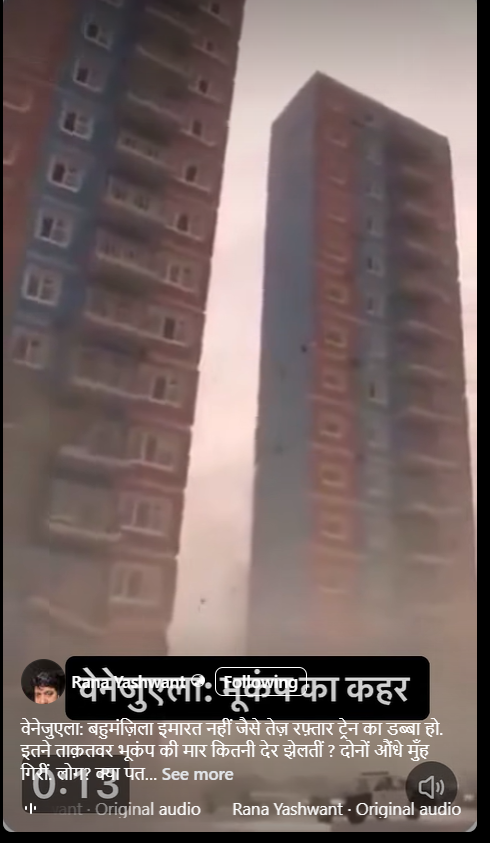
Two powerful earthquakes measuring 7.2 and 7.5 in magnitude struck Venezuela on June 24, 2026, within a span of one minute, causing widespread destruction. Hundreds of buildings were reportedly reduced to rubble. Against this backdrop, a video is being widely shared on social media showing two high-rise buildings colliding with each other before collapsing. Several users have claimed that the footage shows the aftermath of the recent earthquake in Venezuela. CyberPeace Research Wing team conducted a detailed research and found that the viral video is not authentic. The footage was generated using artificial intelligence and is being falsely shared as real visuals from the Venezuela earthquake.
Claim
A Facebook user, “Rana Yashwant,” shared the video on June 26, 2026, with the caption: "Venezuela: The high-rise buildings fell as if they were fast-moving train coaches. How long could they withstand such a powerful earthquake? Both collapsed face-first. What happened to the people? Who knows." https://www.facebook.com/reel/1036186612182534 ,https://perma.cc/98PE-DFKB
Fact Check
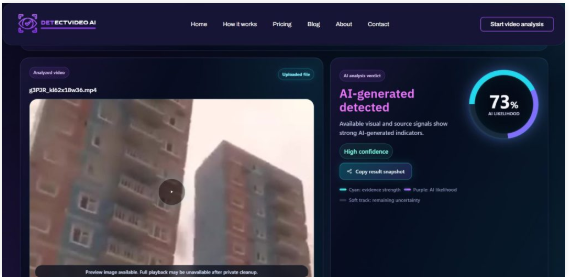
We first extracted several keyframes from the viral video and conducted reverse image searches using Google Lens. However, we found no credible news reports or evidence linking the footage to the recent earthquakes in Venezuela. A closer examination of the video revealed several anomalies. Despite the intense shaking and collision of the buildings, the windows and structural features remained unchanged throughout the footage. No visible deformation or damage appeared in the buildings before they collapsed, which is highly unrealistic and raised suspicions that the video had been generated using AI. To verify this, we analyzed the video using the AI detection tool detectvideo.ai. The results indicated a 73 percent probability that the footage was AI-generated.
Similarly, analysis conducted using Sightengine found a 99 percent probability that the video had been created using artificial intelligence.

Conclusion
Our research found the viral claim to be false. The video showing two buildings colliding and collapsing is not related to the recent earthquakes in Venezuela. The footage was generated using artificial intelligence and is being misleadingly shared as real disaster footage.

Related Blogs

Introduction
For more than 10 years, WhatsApp has been designed around one seemingly trivial but impactful idea: your phone number is your digital identity. This concept offered simplicity in terms of contact discovery and onboard- ing but inevitably exposed users to fraud, spam and the everyday necessity of sharing personal phone numbers with complete strangers in group chats and conversations. On June 29th Meta finally revealed a major move: you’ll now be able to choose and reservate a WhatsApp username and communicate without sharing your phone number.
This shift to a username based identity marks the company catching up to platforms like Telegram and Signal, which have utilized this functionality for years.
However, while presented as a push towards greater privacy for the millions using its platform, this new change has already created some alarm around impersonation, cybersquatting, and identity theft. The issues became amplified when, according to reports, the Indian Ministry of Electronics and Information Technology advised WhatsApp to halt the implementation of the new features while it clarifies details, shifting a mundane app update into a high-stakes discussion on digital privacy, platform responsibility, and government regulation.
How does the mechanism work?
“WhatsApp’s username is an added pseudonym layer on its current phone number architecture, not a replacement,” Meta said in a statement on Thursday, as reported by TechCrunch. A WhatsApp username is a three to 35-character name containing lower case letters, numbers, periods and underscores that must contain at least one letter and “should not look like a website address.” The feature will allow you to “reserve a unique identifier that you can share as an alternative to your phone number in WhatsApp Settings - Accounts - Username.”
It said the usernames will work in parallel with a username key which can serve as a passphrase to initiate conversation “with a recipient before sending a message for the first time.”
“The change - which will have some additional, protective measures like reserving usernames for people of public interest or those that would cause impersonation, and rate limits on claiming names - can help maintain phone number protection, while offering people more choices,” Meta said. WhatsApp said usernames will replace phone numbers as the primary way to initiate new chats, but will not be publicly searchable: “Anyone you message would need your exact username, and would still need you to respond.”
The Genuine Privacy Case
The upside is real. Phone numbers double as keys to two-factor authentication, banking apps and SIM-swap fraud, so handing one to a new acquaintance, a group chat of strangers or a customer-support bot has always carried quiet risk. Numbers harvested from public groups already fuel spam and scam campaigns, and a username-first model narrows that exposure considerably.
For journalists, small business owners and anyone who fields messages from people they've never met, decoupling identity from a number that also unlocks their bank account is a meaningful, overdue shift – and one that WhatsApp's closest competitors adopted years ago without major incident.
The Scammer's Paradise Scenario
The trouble lies in what a username removes. A phone number was never just an identifier; it was also a rough verification signal and, for law enforcement, a traceable data point. Security reporters testing the reservation system found that lookalike handles mimicking prominent Indian politicians, film stars and the Reserve Bank of India remained available to claim. Crypto executive Changpeng Zhao's own failed bid to capture his desired handle highlighted the first-come, first-served danger of the rollout and led researchers to advise people to manually activate the optional username key that Meta leaves disabled by default.
The Mozilla Foundation was unvarnished about the tradeoff, noting that impersonation from fake accounts and scams are an “inevitable consequence” of a design that abandons the “implicit signal of authenticity” that comes from owning a phone number.
Indian entrepreneur Ankur Warikoo called the rollout a potential “disaster” if robust enforcement against fraud isn’t immediately applied because scammers could register handles a few characters removed from a popular brand or public figure to launch investment and payment schemes, a concern mirrored by cyber security researchers who observed that many users neglect to check verification badges before trusting an account.
India's Regulatory Scrutiny of WhatsApp's Username Feature
So far the strongest reaction comes from New Delhi. The Ministry of Electronics and Information Technology (MeitY) issued an official notice to Meta's compliance office that it should “temporarily suspend the feature” in the country pending further consultations and “provided an explanation in three days”. The cited concerns involve “digital arrest” fraud, a rapid boom category that involves crooks impersonating investigators like those with India's CBI, judges or customs agents to extort victims, in addition to standard concerns around phishing and bank or government impersonation.
A subtler concern, for India’s government anyway, is “traceability.”
At present, say officials, an Indian mobile number is a launching pad to determine whether a given suspect is a domestic or international actor, while a username and foreign SIM would leave authorities nowhere to begin. The Department of Telecommunications independently voiced concerns over how the change intersects with its SIM-binding regulations and over WhatsApp's lag time for such requests. The MeitY notice, the legal basis for which, incidentally, is in contention with some digital rights groups, specifically invokes Section 79 of the IT Act and various IT Rules from 2021 and provisions on identity theft and impersonation that target individual criminals rather than the tech tools. Not everyone, however, shares MeitY’s reading of the legal ground: the Internet Freedom Foundation says that Section 79 “deal with liability of intermediary” and “does not confer on the government power to license the features of a product,” while arguing the relevant criminal statutes were designed to criminalize impersonators, not tech platforms whose services are misused, echoing concerns that killed a similar government advisement about AI models last spring.
In the meantime, Meta says usernames are unavailable in the country for now and the multilayered safeguards it designed were always intended for exactly this level of risk.
Conclusion
WhatsApp's username feature is neither a total privacy upgrade nor a major security problem; instead, it reallocates risk, reducing phone number exposure while adding a risk of identity spoofing and misuse. Whether it pays off will hinge on the strength of Meta's crackdown on fraudulent usernames, the uptake of extra security features like the username key and whether the company can adequately satisfy regulatory concerns about traceability and user safety. Until all those questions are fully settled, users may want to use the feature tentatively, secure a desired username, enable any other protections and be watchful about new contacts.
References
- https://blog.whatsapp.com/its-time-to-reserve-your-whatsapp-username
- https://www.businesstoday.in/technology/news/story/whatsapp-usernames-why-indias-top-creators-fear-scams-impersonation-and-identity-theft-540359-2026-07-02
- https://www.outlookindia.com/national/outlook-explains-why-is-the-indian-government-worried-about-whatsapp-usernames
- https://techcrunch.com/2026/06/29/whatsapp-now-lets-you-reserve-usernames/
- https://bestmediainfo.com/mediainfo/mediainfo-digital/whatsapp-says-username-feature-not-live-yet-after-meity-asks-meta-to-pause-rollout-12124813

Executive Summary
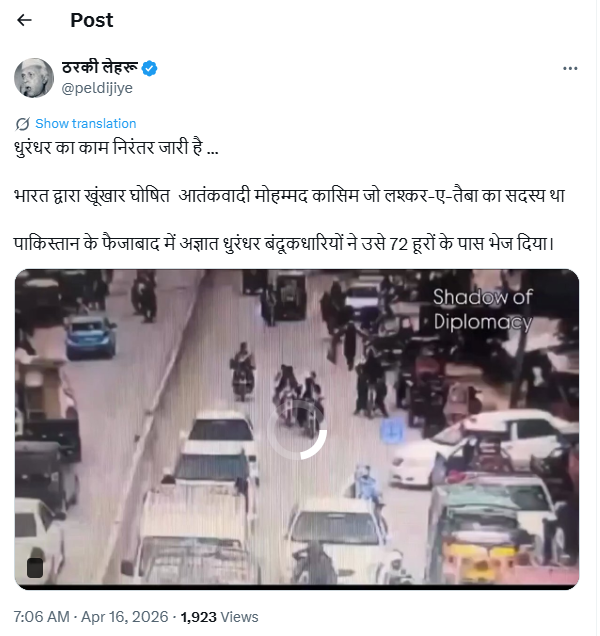
A CCTV video showing a man being shot is being widely circulated on social media with the claim that it depicts the killing of Lashkar-e-Taiba terrorist Amir Hamza in Pakistan. However, research by the CyberPeace Research Wing found that the claim is misleading. The viral video existed online even before the reported attack on Amir Hamza.
Claim
Social media users are sharing a CCTV clip claiming that Lashkar-e-Taiba terrorist Amir Hamza was shot dead in Pakistan.
Fact Check
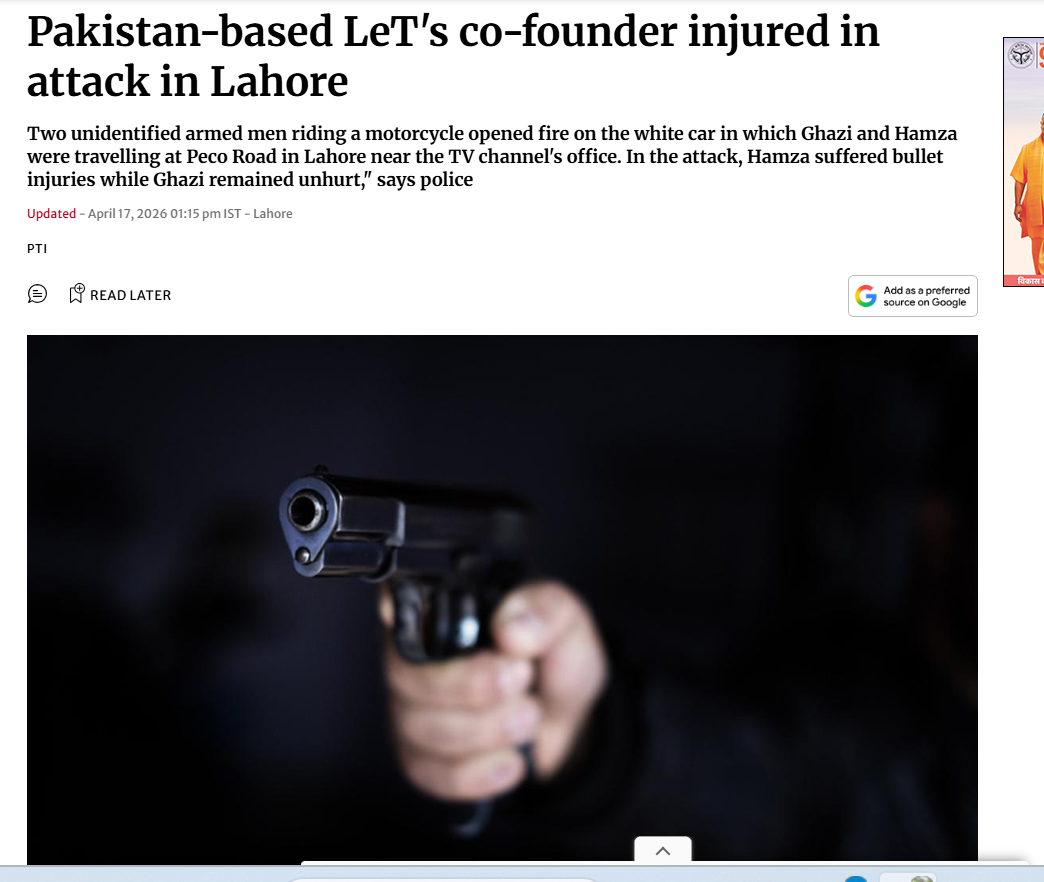
To verify the claim, we first searched relevant keywords such as “Maulana Amir Hamza firing Lahore.” This led us to a report published on April 17, 2026, by The Hindu. Citing Pakistani channel 24 News HD TV, the report stated that unidentified attackers opened fire on the car of TV host Justice Nazir Ahmed Ghazi. Amir Hamza was injured in the incident, not killed.
We also reviewed the official social media accounts of 24 News HD TV. A post on its X handle (@24NewsHD) confirmed that Justice Ghazi was safe, while Amir Hamza sustained injuries in the firing incident in Lahore.

For further verification, we extracted keyframes from the viral video and performed a reverse image search. The same clip was found uploaded on March 28, 2026, on a Pakistani Facebook page. According to the post, the CCTV footage was linked to the killing of an individual named Saifullah Malakhel.
Although we could not independently verify the exact origin of the video, our findings clearly indicate that the footage predates the recent attack on Amir Hamza and is unrelated to the incident.
Conclusion
The viral claim is false. Amir Hamza was not killed but reportedly injured in the firing incident, as per credible media reports. The CCTV video being shared in this context is old and unrelated, and has been circulated with a misleading narrative.

Executive Summary:
A viral online video claims Canadian Prime Minister Justin Trudeau promotes an investment project. However, the CyberPeace Research Team has confirmed that the video is a deepfake, created using AI technology to manipulate Trudeau's facial expressions and voice. The original footage has no connection to any investment project. The claim that Justin Trudeau endorses this project is false and misleading.

Claims:
A viral video falsely claims that Canadian Prime Minister Justin Trudeau is endorsing an investment project.

Fact Check:
Upon receiving the viral posts, we conducted a Google Lens search on the keyframes of the video. The search led us to various legitimate sources featuring Prime Minister Justin Trudeau, none of which included promotion of any investment projects. The viral video exhibited signs of digital manipulation, prompting a deeper investigation.

We used AI detection tools, such as TrueMedia, to analyze the video. The analysis confirmed with 99.8% confidence that the video was a deepfake. The tools identified "substantial evidence of manipulation," particularly in the facial movements and voice, which were found to be artificially generated.


Additionally, an extensive review of official statements and interviews with Prime Minister Trudeau revealed no mention of any such investment project. No credible reports were found linking Trudeau to this promotion, further confirming the video’s inauthenticity.
Conclusion:
The viral video claiming that Justin Trudeau promotes an investment project is a deepfake. The research using various tools such as Google Lens, AI detection tool confirms that the video is manipulated using AI technology. Additionally, there is no information in any official sources. Thus, the CyberPeace Research Team confirms that the video was manipulated using AI technology, making the claim false and misleading.
- Claim: Justin Trudeau promotes an investment project viral on social media.
- Claimed on: Facebook
- Fact Check: False & Misleading
