
#FactCheck:Old 9/11 Videos Falsely Linked to Iran’s Attack on Israel Amid Ongoing Conflict
Executive Summary
Amid the ongoing war between the United States–Israel alliance and Iran since February 28, 2026, two videos are going viral across social media platforms. The clips show people running in panic, with visuals suggesting a large-scale attack. Users are sharing these videos with the claim that they depict Iran’s recent strikes on Israel. However, a research by the CyberPeace has found both claims to be false. The viral posts are misleading, as the videos are actually from the 9/11 terrorist attacks on the World Trade Center in New York, United States. They have no connection to the current conflict involving Iran or Israel.
Claim
A Facebook page titled ‘Bihar Ko Nihar’ shared one of the videos on March 25, 2026, with the caption: “Iran has launched its most powerful attack on Israel so far. Thousands of soldiers are reported dead, triggering massive protests within the country, and Israel appears completely helpless.” Similarly, another video is being circulated with the false claim that Iran has launched a missile attack on the United States.
The above claims are being widely shared by multiple users across different social media platforms. Archived versions of these posts are also available.
- https://www.facebook.com/reel/4317571078525937
- https://www.facebook.com/reel/1485000739860984
- https://perma.cc/E98R-A4CT

Fact Check
To verify the authenticity of the videos, keyframes were extracted and analyzed using Google Lens. The first viral clip was traced back to a YouTube video uploaded on September 11, 2007, by a channel named ‘Jumperwtc’, which clearly identifies the footage as being from the World Trade Center attacks in the United States. This confirms that the viral video is a segment from that older footage.

For the second video, reverse image searches led to a report published on CBS8.com on September 10, 2021, where the same visuals were found. Further reesearch revealed that the footage also appears in a video uploaded on September 11, 2021, by the YouTube channel ‘CBS 8 San Diego’. The viral segment can be seen around the 1:11 timestamp in that video.
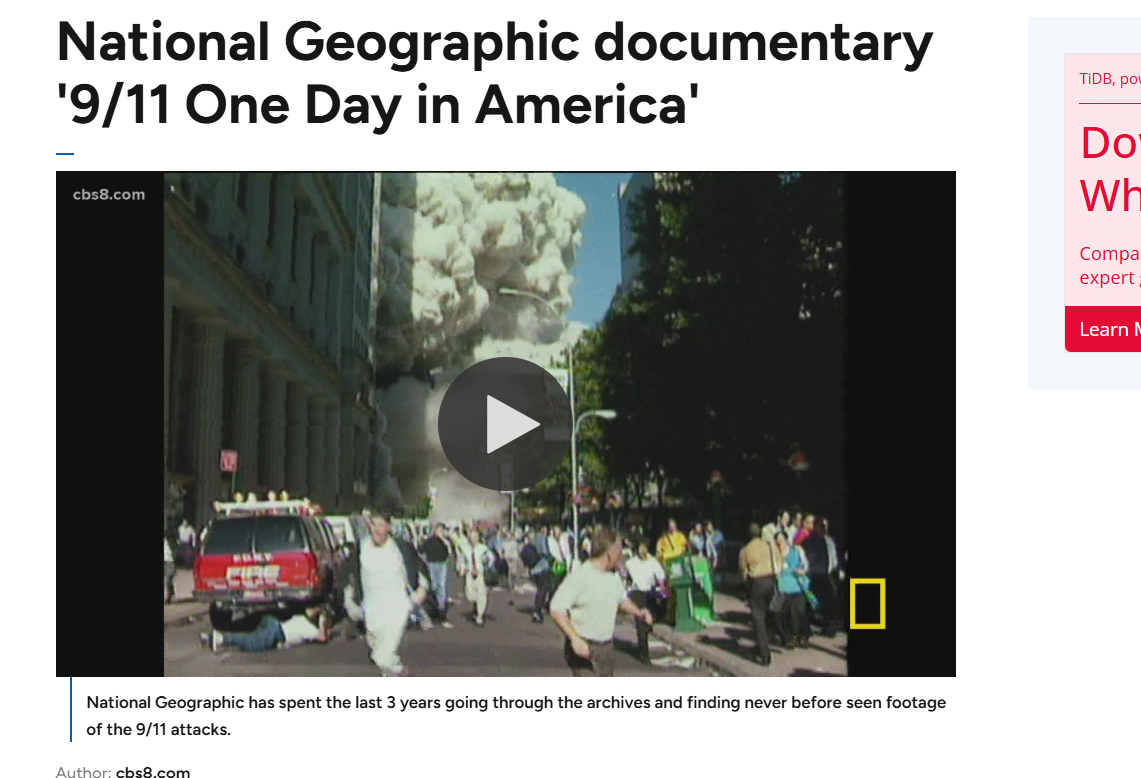
Conclusion
Both viral videos being shared as recent attacks by Iran on Israel or the United States are actually old clips from the 9/11 attacks on the World Trade Center in New York. The claims are false, and the videos are unrelated to the ongoing conflict in West Asia.

Related Blogs

Executive Summary:
A misleading video claiming to show fireworks at Dubai International Cricket Stadium following India’s 2025 ICC Champions Trophy win has gone viral, causing confusion among viewers. Our investigation confirms that the video is unrelated to the cricket tournament. It actually depicts the fireworks display from the December 2024 Arabian Gulf Cup opening ceremony at Kuwait’s Jaber Al-Ahmad Stadium. This incident underscores the rapid spread of outdated or misattributed content, particularly in relation to significant sports events, and highlights the need for vigilance in verifying such claims.

Claim:
The circulated video claims fireworks and a drone display at Dubai International Cricket Stadium after India's win in the ICC Champions Trophy 2025.

Fact Check:
A reverse image search of the most prominent keyframes in the viral video led it back to the opening ceremony of the 26th Arabian Gulf Cup, which was hosted by Jaber Al-Ahmad International Stadium in Kuwait on December 21, 2024. The fireworks seen in the video correspond to the imagery in this event. A second look at the architecture of the stadium also affirms that the venue is not Dubai International Cricket Stadium, as asserted. Additional confirmation from official sources and media outlets verifies that there was no such fireworks celebration in Dubai after India's ICC Champions Trophy 2025 win. The video has therefore been misattributed and shared with incorrect context.

Fig: Claimed Stadium Picture

Conclusion:
A viral video claiming to show fireworks at Dubai International Cricket Stadium after India's 2025 ICC Champions Trophy win is misleading. Our research confirms the video is from the December 2024 Arabian Gulf Cup opening ceremony at Kuwait’s Jaber Al-Ahmad Stadium. A reverse image search and architectural analysis of the stadium debunk the claim, with official sources verifying no such celebration took place in Dubai. The video has been misattributed and shared out of context.
- Claim: Fireworks in Dubai celebrate India’s Champions Trophy win.
- Claimed On: Social Media
- Fact Check: False and Misleading

Introduction:
Technology has become a vital part of everyone’s life nowadays, it occupies essential activities of a person’s life whether we are working or playing and studying. I would say from education to corporate, technology makes everything easier and simpler to achieve the goals for a particular thing. Corporate companies are using technology for their day-to-day work and there are many law-based foundations that are publishing blogs and papers for legal awareness, many lawyers use internet technology for promoting themselves which amounts to growth in their work. Some legal work can now be done by machines, which was previously unthinkable. Large disputes frequently have many documents to review. Armies of young lawyers and paralegals are typically assigned to review these documents. This work can be done by a properly trained machine. Machine drafting of documents is also gaining popularity. We’ve also seen systems that can forecast the outcome of a dispute. We are starting to see machines take on many tasks that we once thought was solely the domain of lawyers.
How to expand law firms and the corporate world with the help of technology?
If we talk about how lawyers’ lives will be impacted by technology then I would explain about law students first. Students are the one who is utilizing the technology at its best for their work, tech could be helpful in students’ lives. as law students use SCC online and manupatra, which are used for case laws. And during their law internships, they use it to help their seniors to find appropriate cases for them. and use it as well for their college research work. SCC and manupatra are very big platforms by which we can say if students use technology for their careers, it will impact their law career in the best ways.
A lawyer running a law firm is not a small task, and there are plenty of obstacles to that, such as a lack of tech solutions, failure to fulfil demands, and inability to innovate, these obstacles prevent the growth of some firms. The right legal tech can grow an organization or a law firm and there will be fewer obstacles.
Technology can be proven as a good mechanism to grow the law firm, as everything depends on tech, from court work to corporate. If we talk about covid during 2020, everything shifted towards the virtual world, court hearings switched to online mode due to covid which proved as a bone to the legal system as the case hearings were speedy and there was no physical contact due to that.
Legal automation is also helping law firms to grow in a competitive world. And it has other benefits also like shifting tedious tasks from humans to machines, allowing the lawyer to work on more valuable work. I would say that small firms should also need to embrace automation for competition in the corporate sector. Today, artificial intelligence offers a solution to solve or at least make the access-to-justice issue better and completely transform our traditional legal system.
There was a world-cited author, Richard Susskind, OBE, who talked about the future of law and lawyers and he wrote a book, Online Courts and the Future of Justice. Richard argues that technology is going to bring about a fascinating decade of change in the legal sector and transform our court system. Although automating our old ways of working plays a part in this, even more, critical is that artificial intelligence and technology will help give more individuals access to justice.
The rise of big data has also resulted in rapid identification systems, which allow police officers to quickly see an individual’s criminal history through a simple search.The FBI’s Next Generation Identification (NGI) system matches individuals with their criminal history information using biometrics such as fingerprints, palm prints, iris recognition, and facial recognition. The NGI’s current technologies are constantly being updated, and new ones are being added, to make the NGI the most comprehensive way to gather up-to-date information on the person being examined
During covid, there were e-courts services in courts, and lawyers and judges were taking cases online. After the covid, the use of technology increased in the law field also from litigation to corporate. As technology can also safeguard confidential information between parties and lawyers. There was ODR, (online dispute resolution) happening meetings that were taking place online mode.
File sharing is inevitable in the practice of law. Yet sometimes the most common ways of sharing (think email) are not always the most secure. With the remote office, the boom has come an increased need for alternate file-sharing solutions. There is data encryption to protect data as it is a reliable method to protect confidential data and information.
Conclusion-
Technology has been playing a vital role in the legal industry and has increased the efficiency of legal offices and the productivity of clerical workers. With the advent of legal tech, there is greater transparency between legal firms and clients. Clients know how many fees they must pay and can keep track of the day-to-day progress of the lawyer on their case. Also, there is no doubt that technology, if used correctly, is fast and efficient – more than any human individual. This can prove to be of great assistance to any law firm. Lawyers of the future will be the ones who create the systems that will solve their client’s problems. These legal professionals will include legal knowledge engineers, legal risk managers, system developers, design thinking experts, and others. These people will use technology to create new ways of solving legal problems. In many ways, the legal sector is experiencing the same digitization that other industries have, and because it is so document-intensive, it is actually an industry that stands to benefit greatly from what technology has to offer.

Executive Summary:
A video that circulated on social media to show Iranian President Ebrahim Raisi inside a helicopter moments before the tragic crash on May 20, 2024, has equally been proven to be fake. The validation of information leaves no doubt, that the video was shot in January 2024, which showed Raisi’s visiting Nemroud Reservoir Dam project. As a means of verifying the origin of the video, the CyberPeace Research Team conducted reverse image search and analyzed the information obtained from the Islamic Republic News Agency, Mehran News, and the Iranian Students’ News Agency. Further, the associated press pointed out inconsistencies between the part in the video that went viral and the segment that was shown by Iranian state television. The original video is old and it is not related to the tragic crash as there is incongruence between the snowy background and the green landscape with a river presented in the clip.

Claims:
A video circulating on social media claims to show Iranian President Ebrahim Raisi inside a helicopter an hour before his fatal crash.


Fact Check:
Upon receiving the posts, in some of the social media posts we found some similar watermarks of the IRNA News agency and Nouk-e-Qalam News.

Taking a cue from this, we performed a keyword search to find any credible source of the shared video, but we found no such video uploaded by the IRNA News agency on their website. Recently, they haven’t uploaded any video regarding the viral news.
We closely analyzed the video, it can be seen that President Ebrahim Raisi was watching outside the snow-covered mountain, but in the internet-available footage regarding the accident, there were no such snow-covered mountains that could be seen but green forest.
We then checked for any social media posts uploaded by IRNA News Agency and found that they had uploaded the same video on X on January 18, 2024. The post clearly indicates the President’s aerial visit to Nemroud Dam.

The viral video is old and does not contain scenes that appear before the tragic chopper crash involving President Raisi.
Conclusion:
The viral clip is not related to the fatal crash of Iranian President Ebrahim Raisi's helicopter and is actually from a January 2024 visit to the Nemroud Reservoir Dam project. The claim that the video shows visuals before the crash is false and misleading.
- Claim: Viral Video of Iranian President Raisi was shot before fatal chopper crash.
- Claimed on: X (Formerly known as Twitter), YouTube, Instagram
- Fact Check: Fake & Misleading
