
#FactCheck-Has PM Modi Responded To Viral Claim Of Resignation? No, Social Media Post Is Fabricated
Executive Summary
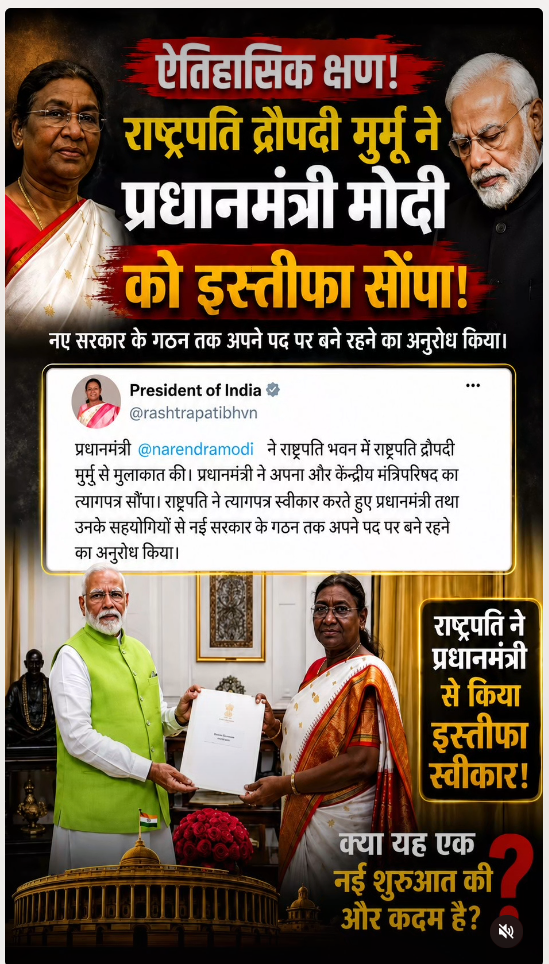
A poster is being shared on social media claiming that Prime Minister Narendra Modi has submitted his resignation to President Droupadi Murmu. The post also includes a screenshot of an X (formerly Twitter) account allegedly belonging to President Droupadi Murmu, stating that the Prime Minister has tendered his resignation, along with his Union Council of Ministers, to the President. Research by the CyberPeace Research Wing proved the viral claim to be fake. The research revealed that the poster being shared on social media is fabricated.
Claim:
Sharing the viral poster on the social media platform Instagram, a user wrote, “President Droupadi Murmu accepted the resignation of Prime Minister Narendra Modi and requested him to continue in office until the formation of the new government. This is part of the constitutional process of Indian democracy. What is your opinion? Is this just a formality or a step towards a new beginning?” The archive link and screenshot of the post are given below:
https://www.instagram.com/reels/DcA0HqhN3Fr/
FactCheck
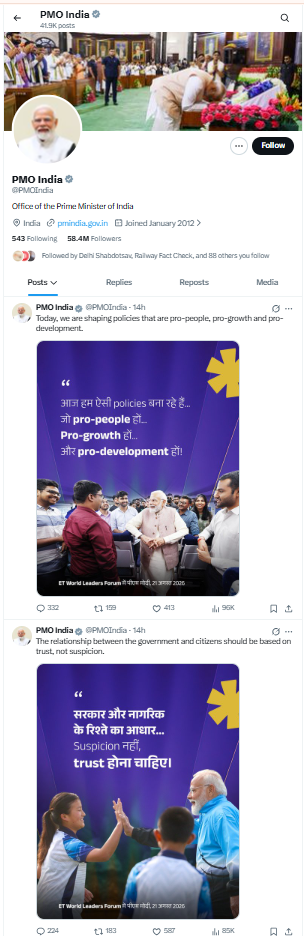
To ascertain the truth behind the viral claim, we conducted a search on Google using relevant keywords. During this, we did not find any credible media reports confirming the viral claim. In the next step of the research, we scanned the X account of the Prime Minister’s Office (PMO). We did not find any such post there either. The link and screenshot of the relevant post are given below:
Proceeding further with the research, we scanned the X account of the President. We did not find any post confirming the viral claim there as well. The link and screenshot of the relevant post are given below:

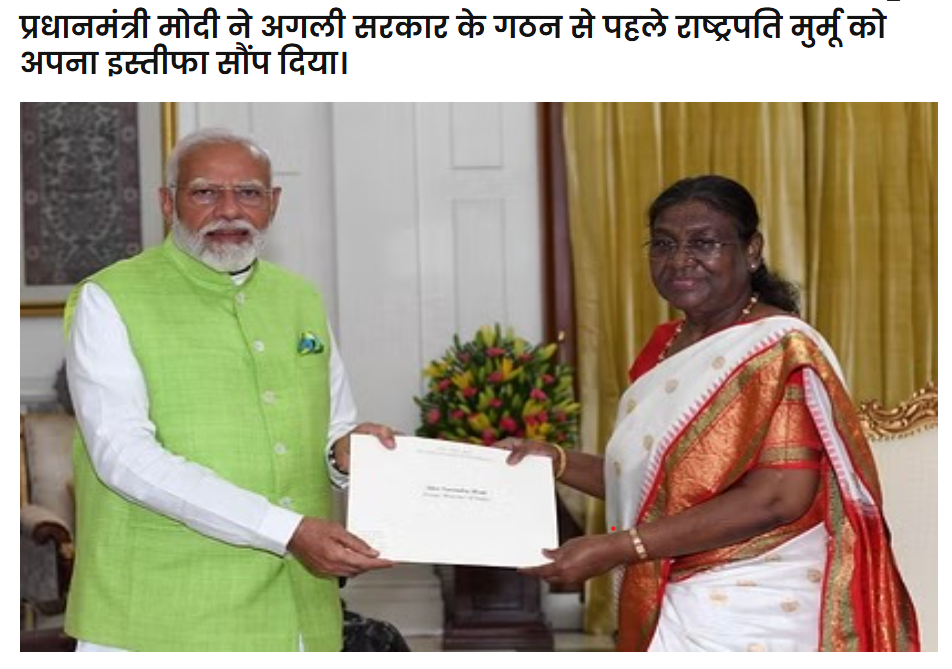
In the next stage of our research, we found a report published on the DD News website on June 5, 2024. According to the report, ahead of the formation of the next Bharatiya Janata Party (BJP)-led NDA government, Prime Minister Narendra Modi, along with his Council of Ministers, had tendered his resignation to President Droupadi Murmu. This paved the way for the dissolution of the 17th Lok Sabha, which ran from 2019 to 2024. President Droupadi Murmu accepted the resignation of Prime Minister Modi and his Council of Ministers, and requested them to continue in office until the new government assumed charge. The link and screenshot of the post are given below:
Conclusion:
In our research, the viral claim turned out to be fake. The research revealed that the poster being shared on social media is fake.

Related Blogs

Executive Summary
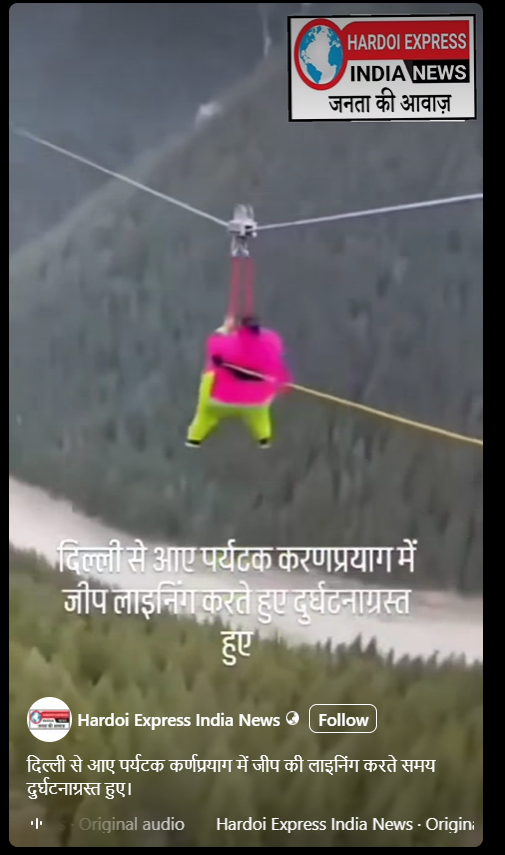
A video is being shared on social media claiming that a female tourist from Delhi fell into a deep gorge during ziplining in Karnaprayag. In the viral video, a woman dressed in bright pink and yellow clothes is seen ziplining amidst high mountains, when suddenly the zipline wire breaks and she falls from a significant height into a deep gorge. Social media users are sharing this video, presenting it as a real incident. Research by the CyberPeace Research Wing revealed that the claim of a Delhi woman tourist's death during a zipline accident in Karnaprayag is baseless. The viral video is AI-generated.
Claim
According to the claim, this accident took place in Karnaprayag, Uttarakhand, where a female tourist from Delhi became a victim of this horrific mishap. Several social media users are claiming that the woman died in this accident.
https://www.facebook.com/reel/26108544868822432
Fact Check
To investigate the video viral as a zipline accident in Karnaprayag, we conducted a reverse search of its keyframes. During this, we found the video uploaded as a Short on a Pakistani YouTube channel, @Zoyaqueen-w2t, on June 2, 2026. Hashtags like '#funnyshorts' were used in the caption of this video. Scanning this account revealed that several other fictional videos related to similar zipline accidents have also been uploaded here. Apart from this, the video was also shared with funny hashtags in some social media posts from May 2026.
https://www.youtube.com/shorts/Gzha_J7Fqv0
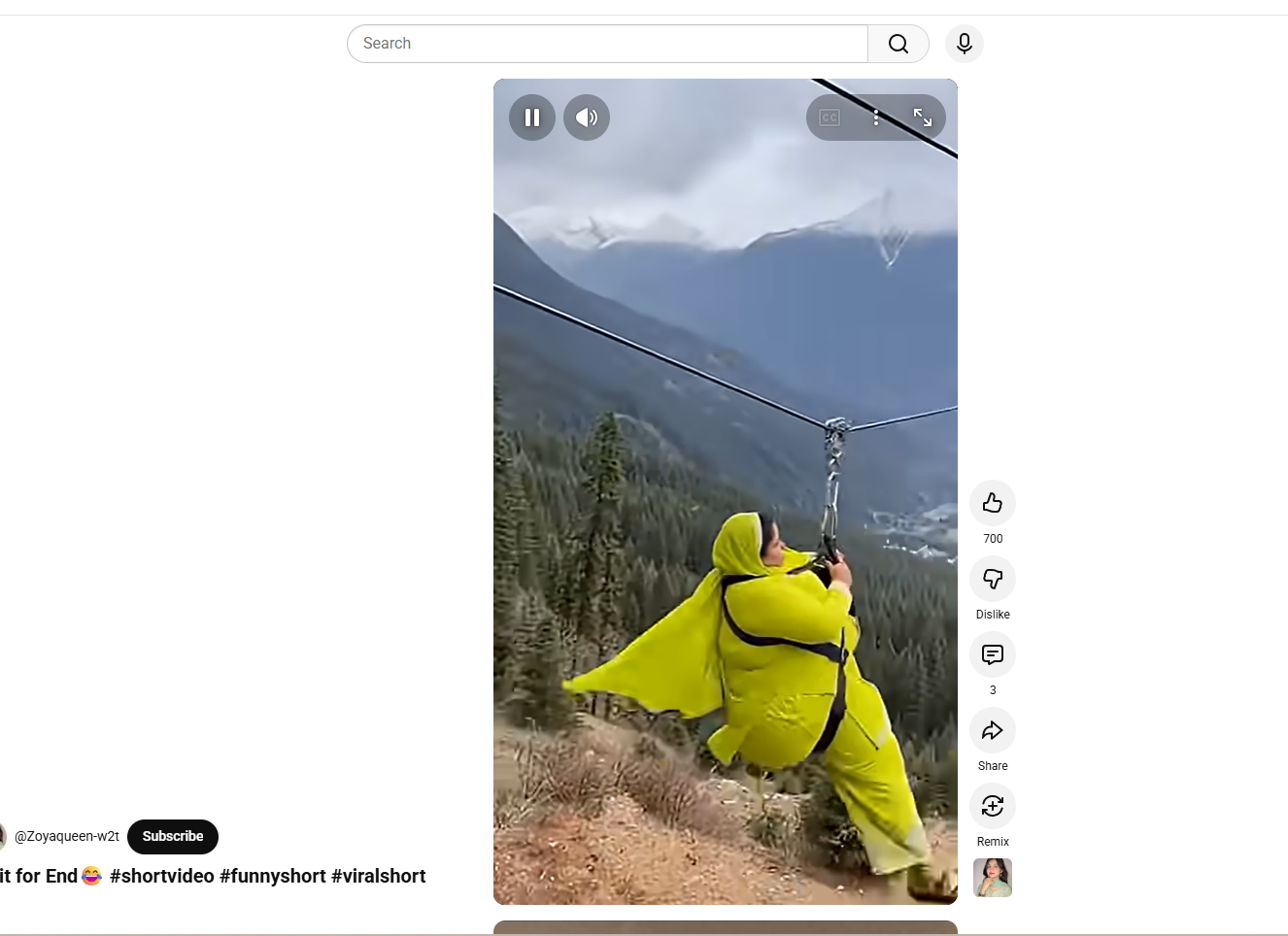
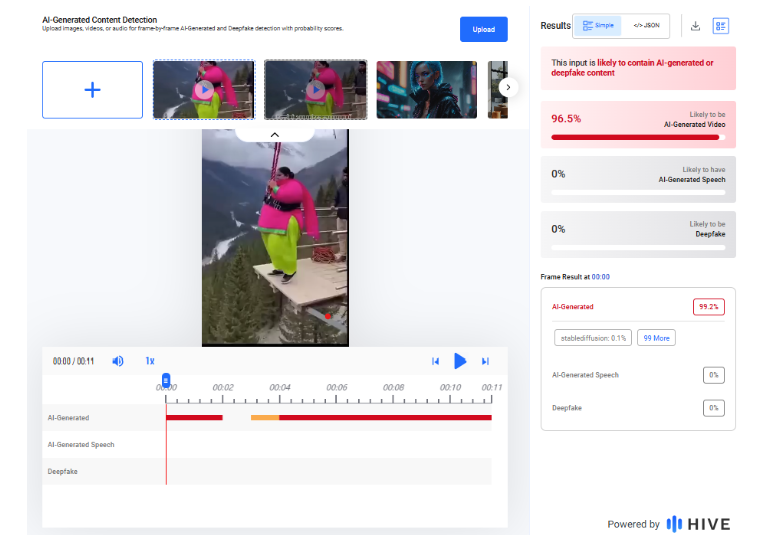
Following this, searching with relevant keywords yielded no credible media reports regarding any such zipline accident in Karnaprayag, Uttarakhand, in recent times. Subsequently, we scanned the viral video of the alleged zipline accident using the AI detection tool 'Hive Moderation'. During the analysis, the tool classified the video as highly likely to be AI-generated, with a score of 99.2%.
Conclusion
From the evidence gathered in our research , it is clear that the claim regarding the death of a female tourist from Delhi during a zipline accident in Karnaprayag is baseless. The viral video is not of a real incident, but is AI-generated.

Introduction
In September 2024, the Australian government announced the Communications Legislation Amendment (Combatting Misinformation and Disinformation) Bill 2024 ( CLA Bill 2024 hereon), to provide new powers to the Australian Communications and Media Authority (ACMA), the statutory regulatory body for Australia's communications and media infrastructure, to combat online misinformation and disinformation. It proposed allowing the ACMA to hold digital platforms accountable for the “seriously harmful mis- and disinformation” being spread on their platforms and their response to it, while also balancing freedom of expression. However, the Bill was subsequently withdrawn, primarily over concerns regarding the possibility of censorship by the government. This development is reflective of the global contention on the balance between misinformation regulation and freedom of speech.
Background and Key Features of the Bill
According to the BBC’s Global Minds Survey of 2023, nearly 73% of Australians struggled to identify fake news and AI-generated misinformation. There has been a substantial rise in misinformation on platforms like Facebook, Twitter, and TikTok since the COVID-19 pandemic, especially during major events like the bushfires of 2020 and the 2022 federal elections. The government’s campaign against misinformation was launched against this background, with the launch of The Australian Code of Practice on Disinformation and Misinformation in 2021. The main provisions of the CLA Bill, 2024 were:
- Core Transparency Obligations of Digital Media Platforms: Publishing current media literacy plans, risk assessment reports, and policies or information on their approach to addressing mis- and disinformation. The ACMA would also be allowed to make additional rules regarding complaints and dispute-handling processes.
- Information Gathering and Record-Keeping Powers: The ACMA would form rules allowing it to gather consistent information across platforms and publish it. However, it would not have been empowered to gather and publish user information except in limited circumstances.
- Approving Codes and Making Standards: The ACMA would have powers to approve codes developed by the industry and make standards regarding reporting tools, links to authoritative information, support for fact-checking, and demonetisation of disinformation. This would make compliance mandatory for relevant sections of the industry.
- Parliamentary Oversight: The transparency obligations, codes approved and standards set by ACMA under the Bill would be subject to parliamentary scrutiny and disallowance. ACMA would be required to report to the Parliament annually.
- Freedom of Speech Protections: End-users would not be required to produce information for ACMA unless they are a person providing services to the platform, such as its employees or fact-checkers. Further, it would not be allowed to call for removing content from platforms unless it involved inauthentic behavior such as bots.
- Penalties for Non-Compliance: ACMA would be required to employ a “graduated, proportionate and risk-based approach” to non-compliance and enforcement in the form of formal warnings, remedial directions, injunctions, or significant civil penalties as decided by the courts, subject to review by the Administrative Review Tribunal (ART). No criminal penalties would be imposed.
Key Concerns
- Inadequacy of Freedom of Speech Protections: The biggest contention on this Bill has been regarding the issue of possible censorship, particularly of alternative opinions that are crucial to the health of a democratic system. To protect the freedom of speech, the Bill defined mis- and disinformation, what constitutes “serious harm” (election interference, harming public health, etc.), and what would be excluded from its scope. However, reservations among the Opposition persisted due to the lack of a clear mechanism to protect divergent opinions from the purview of this Bill.
- Efficacy of Regulatory Measures: Many argue that by allowing the digital platform industry to make its codes, this law lets it self-police. Big Tech companies have no incentive to curb misinformation effectively since their business models allow them to reap financial benefits from the rampant spread of misinformation. Unless there are financial non- or dis- incentives to curb misinformation, Big Tech is not likely to address the situation at war footing. Thus, this law would run the risk of being toothless. Secondly, the Bill did not require platforms to report on the “prevalence of” false content which, along with other metrics, is crucial for researchers and legislators to track the efficacy of the current misinformation-curbing practices employed by platforms.
- Threat of Government Overreach: The Bill sought to expand the ACMA’s compliance and enforcement powers concerning misinformation and disinformation on online communication platforms by giving it powers to form rules on information gathering, code registration, standard-making powers, and core transparency obligations. However, even though the ACMA as a regulatory authority is answerable to the Parliament, the Bill was unclear in defining limits to these powers. This raised concerns from civil society about potential government overreach in a domain filled with contextual ambiguities regarding information.
Conclusion
While the Communications Legislation Amendment (Combatting Misinformation and Disinformation) Bill sought to equip the ACMA with tools to hold digital platforms accountable and mitigate the harm caused by false information, its critique highlights the complexities of regulating such content without infringing on freedom of speech. Legislations and proposals regarding the matter all over the world are having to contend with this challenge. Globally, legislation and proposals addressing this issue face similar challenges, emphasizing the need for a continuous discourse at the intersection of platform accountability, regulatory restraint, and the protection of diverse viewpoints.
To regulate Big Tech effectively, governments can benefit from adopting a consultative, incremental, and cooperative approach, as exemplified by the European Union’s Digital Services Act 2023. Such a framework provides for a balanced response, fostering accountability while safeguarding democratic freedoms.
Resources
- https://www.infrastructure.gov.au/sites/default/files/documents/factsheet-misinformation-disinformation-bill.pdf
- https://www.infrastructure.gov.au/have-your-say/new-acma-powers-combat-misinformation-and-disinformation
- https://www.mi-3.com.au/07-02-2024/over-80-australians-feel-they-may-have-fallen-fake-news-says-bbc
- https://www.hrlc.org.au/news/misinformation-inquiry
- https://humanrights.gov.au/our-work/legal/submission/combatting-misinformation-and-disinformation-bill-2024
- https://www.sbs.com.au/news/article/what-is-the-misinformation-bill-and-why-has-it-triggered-worries-about-freedom-of-speech/4n3ijebde
- https://www.hrw.org/report/2023/06/14/no-internet-means-no-work-no-pay-no-food/internet-shutdowns-deny-access-basic#:~:text=The%20Telegraph%20Act%20allows%20authorities,preventing%20incitement%20to%20the%20commission
- https://www.hrlc.org.au/submissions/2024/11/8/submission-combatting-misinformation?utm_medium=email&utm_campaign=Media%20Release%20Senate%20Committee%20to%20hear%20evidence%20calling%20for%20Albanese%20Government%20to%20regulate%20and%20hold%20big%20tech%20accountable%20for%20misinformation&utm_content=Media%20Release%20Senate%20Committee%20to%20hear%20evidence%20calling%20for%20Albanese%20Government%20to%20regulate%20and%20hold%20big%20tech%20accountable%20for%20misinformation+Preview+CID_31c6d7200ed9bd2f7f6f596ba2a8b1fb&utm_source=Email%20campaign&utm_term=Read%20the%20Human%20Rights%20Law%20Centres%20submission%20to%20the%20inquiry

Executive Summary:
A viral post on X (formerly Twitter) gained much attention, creating a false narrative of recent damage caused by the earthquake in Tibet. Our findings confirmed that the clip was not filmed in Tibet, instead it came from an earthquake that occurred in Japan in the past. The origin of the claim is traced in this report. More to this, analysis and verified findings regarding the evidence have been put in place for further clarification of the misinformation around the video.

Claim:
The viral video shows collapsed infrastructure and significant destruction, with the caption or claims suggesting it is evidence of a recent earthquake in Tibet. Similar claims can be found here and here

Fact Check:
The widely circulated clip, initially claimed to depict the aftermath of the most recent earthquake in Tibet, has been rigorously analyzed and proven to be misattributed. A reverse image search based on the Keyframes of the claimed video revealed that the footage originated from a devastating earthquake in Japan in the past. According to an article published by a Japanese news website, the incident occurred in February 2024. The video was authenticated by news agencies, as it accurately depicted the scenes of destruction reported during that event.

Moreover, the same video was already uploaded on a YouTube channel, which proves that the video was not recent. The architecture, the signboards written in Japanese script, and the vehicles appearing in the video also prove that the footage belongs to Japan, not Tibet. The video shows news from Japan that occurred in the past, proving the video was shared with different context to spread false information.

The video was uploaded on February 2nd, 2024.
Snap from viral video

Snap from Youtube video

Conclusion:
The video viral about the earthquake recently experienced by Tibet is, therefore, wrong as it appears to be old footage from Japan, a previous earthquake experienced by this nation. Thus, the need for information verification, such that doing this helps the spreading of true information to avoid giving false data.
- Claim: A viral video claims to show recent earthquake destruction in Tibet.
- Claimed On: X (Formerly Known As Twitter)
- Fact Check: False and Misleading
