
#FactCheck: Fake AI-Edited Video Falsely Attributes LPU Case Remark to Punjab Police Officer
Executive Summary:
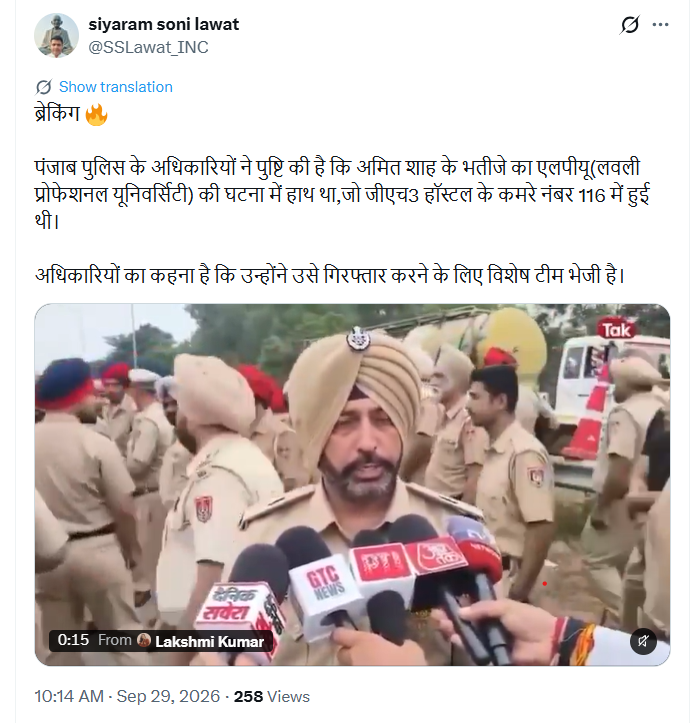
A video is going viral on social media with the claim that the protests and unrest at Lovely Professional University (LPU) over the alleged rape of a female student were linked to the nephew of Union Home Minister Amit Shah. The viral video purportedly shows a police officer telling the media that the involvement of an alleged relative of Amit Shah had surfaced in the case and that a police team had been sent to Delhi to arrest him. However, CyberPeace Research found that the original video has been digitally manipulated using AI and is being circulated with a misleading claim.
Claim:
The post caption reads: “Breaking Punjab Police officials have confirmed that Amit Shah’s nephew was involved in the LPU (Lovely Professional University) incident, which took place in Room No. 116 of GH3 Hostel. Officials say they have sent a special team to arrest him.” In the viral video, a police officer is purportedly heard telling the media: “We are receiving information that the person who committed this crime was a BJP worker and a relative of the Home Minister. This incident took place in Room 116 of GH3 Hostel. But now the Punjab Police is fully alert and an FIR has been registered. We will take action. The boy is currently in Delhi, but our teams have been sent there.
https://x.com/SSLawat_INC/status/2104794508311540147
Fact Check:
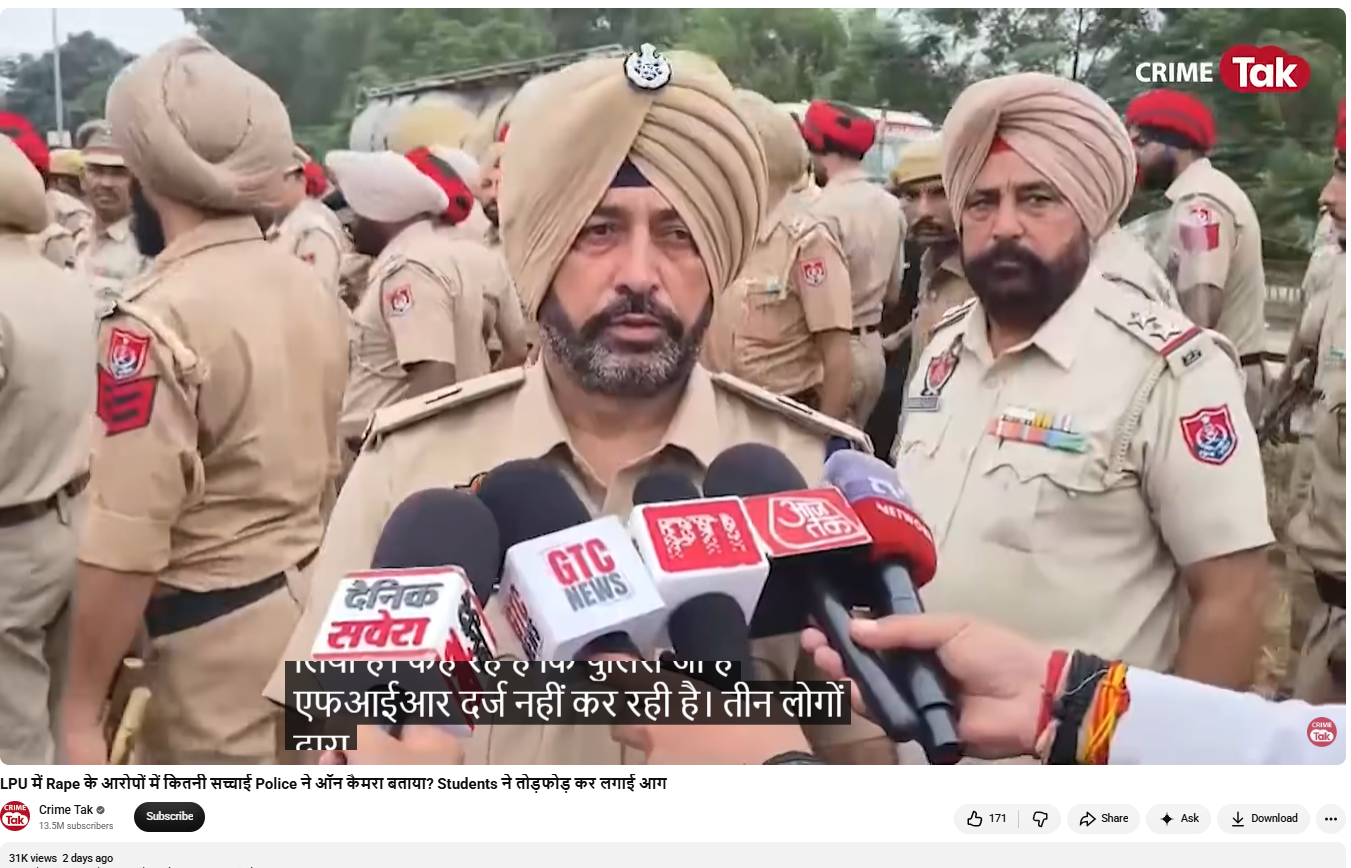
To verify the viral video claiming that the nephew of Union Home Minister Amit Shah was named as an accused in the LPU case in Punjab, we conducted a Google search using relevant keywords. During the search, we did not find any credible media reports in which the Punjab Police had made such a statement. Since the video carries the ‘Crime Tak’ logo, we checked the channel’s YouTube account. During our research, we found the original version of the viral video uploaded on the ‘Crime Tak’ YouTube channel on September 27. We found that the police officer seen in the video is Phagwara SP Major Singh. In the original video available on the ‘Crime Tak’ YouTube channel, SP Major Singh does not mention any involvement of Amit Shah’s relative. Instead, while speaking about the protests at LPU and rumours surrounding an alleged rape and suicide, he says that the police have not received any concrete information or complaint regarding the matter. He further states that if students provide any complaint or credible information, the police will take appropriate action as per the medical examination and investigation process.
https://www.youtube.com/watch?v=UY7cE0S65-k
Since the police officer in the original video did not make any statement about Amit Shah’s nephew, it became clear that the viral video had been manipulated. To further verify this, we analyzed the audio in the video using the AI detection tool Resemble AI. The tool identified the voice of the police officer in the video as fake.

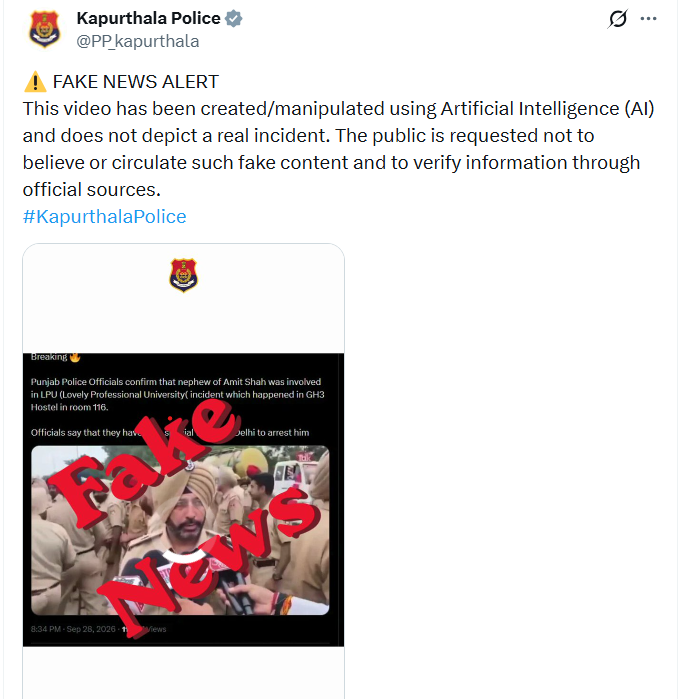
The Kapurthala Police posted on its official X handle on September 29, 2026, describing the video as fake.
Conclusion:
The evidence gathered during our research confirms that the video of a Punjab Police officer allegedly accusing Amit Shah’s relative has been digitally manipulated using AI. In the original video, the Punjab Police officer did not make any such statement while responding to questions from the media.

Related Blogs

CyberPeace | Automotive Cybersecurity & Digital Forensics
Introduction
After a crash, the story usually comes from the driver, a witness or a police report. But a modern vehicle can leave another version behind - a digital one. An Event Data Recorder (EDR), commonly called a car's black box, can preserve selected information from the seconds around a crash. NHTSA describes EDRs as recording vehicle dynamics, driver inputs, crash characteristics, restraint status and some post-crash information.[1] The exact fields depend on the vehicle. A black box is not a magical device that records everything; it is one evidence source inside a much larger vehicle.
A modern vehicle can also contain safety controllers, diagnostic interfaces, ADAS, telematics and software-update systems. For an investigator, the question is what evidence can be linked to the EDR and what that combined record can actually support.
What Is Actually in the Black Box?
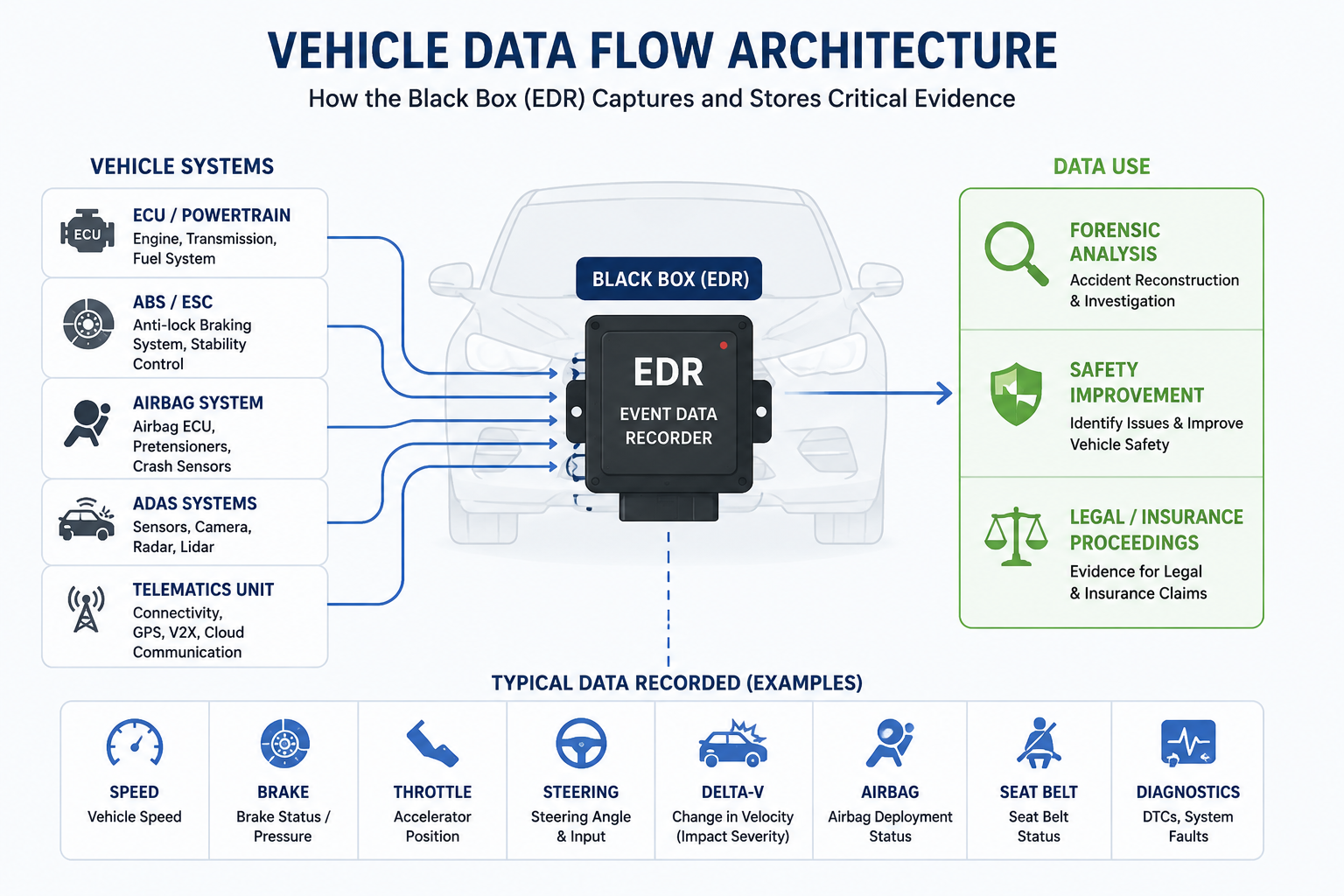
An EDR is best understood as a short event record, not a continuous driving diary. Depending on the vehicle and its configuration, forensic extraction may reveal items such as speed, acceleration, delta-V, engine RPM, throttle position, brake status, steering input, ABS or stability-control activity, seat-belt status and airbag or restraint events. NHTSA's published EDR material shows that data elements can include longitudinal and lateral acceleration, delta-V, vehicle speed, engine speed, throttle, service-brake status, roll/pitch/yaw information and steering input.[2] Do not overread the data: A field that exists in one model should not automatically be assumed to exist in another. A forensic report must identify exactly which module and fields were available and actually recovered.
What Can a Forensic Examination Recover?
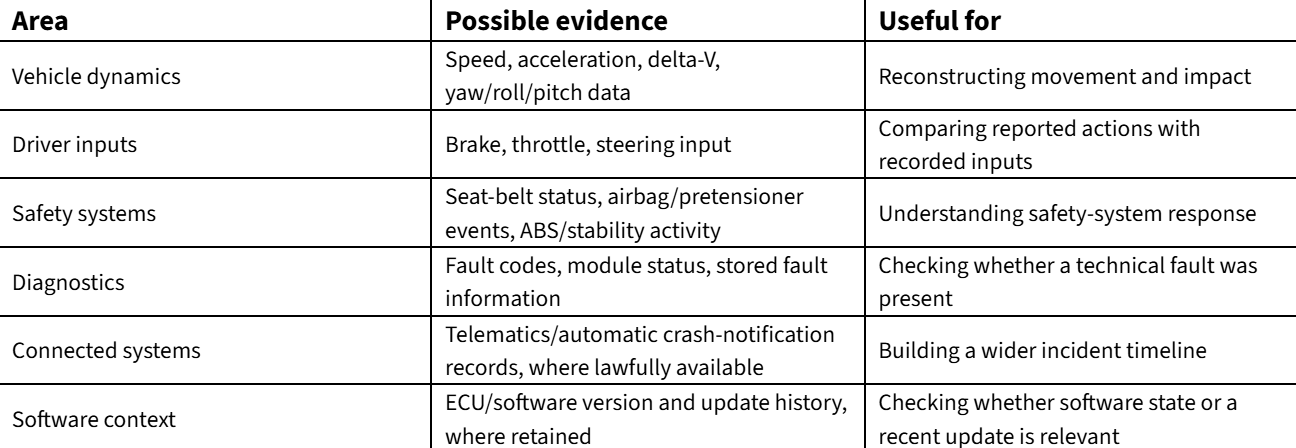
A Brake Failure Example
Consider a driver who reports: “I pressed the brake, but nothing happened.” The statement should be preserved, but a forensic investigation should test it. Was brake status captured? What was the speed before the event? Did ABS activate? What were the acceleration and delta-V patterns? Were there relevant fault codes? Was the vehicle recently repaired or updated? Suppose the recovered records show a brake input, ABS activity and a change in vehicle speed before impact. That does not prove the brakes were mechanically perfect. It does, however, make the sentence “nothing happened” too simple. Conversely, a relevant fault appearing just before the event may give investigators a stronger lead. The important part is the comparison: human account, vehicle record, physical evidence and technical history should be examined together.
Smart Vehicles, Digital Evidence and Cybersecurity Investigation
A connected vehicle can communicate through cellular networks, Bluetooth, Wi-Fi, mobile applications, workshop tools and cloud services. If unusual activity appears around a safety-critical incident, investigators may need to look beyond the EDR. Useful questions include:
• Was there unusual diagnostic or service activity before the incident?
• Was a software update or configuration change recently applied?
• Do timestamps from different modules line up, or is there clock drift?
• Can the extracted record be tied back to the original vehicle and module?
• Is there a non-cyber explanation - such as a hardware fault or software defect - that fits the evidence better?
The mindset matters: A cyberattack should be a conclusion supported by evidence, not the default explanation for strange vehicle behaviour.
The Forensic View: From Data to Evidence
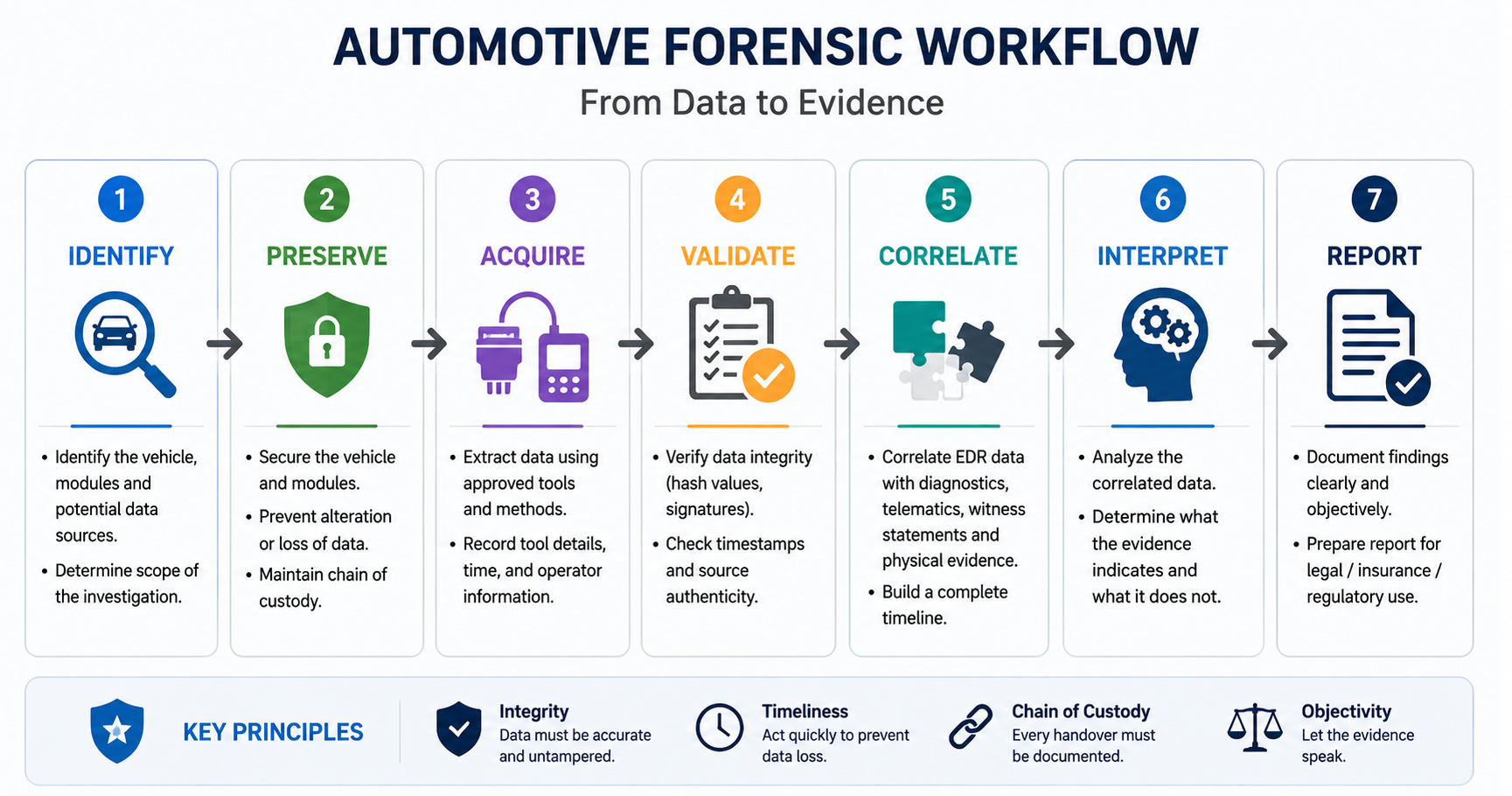
Automotive forensics is not simply plugging in a tool and exporting a report. The investigator should document the vehicle identity, module involved, extraction method, tool version, acquisition time and evidence-preservation steps. The goal is to make the work repeatable and defensible.
• Identify the relevant modules and evidence sources.
• Preserve the vehicle and extracted data against unnecessary alteration.
• Acquire data using a documented and appropriate method.
• Validate provenance, integrity, timestamps and completeness.
• Correlate EDR, diagnostics, software history, connected records and physical evidence.
• Report both findings and uncertainty.
A useful forensic rule: “Recorded” does not mean “proven.” Evidence becomes persuasive when its source, integrity and context are clear.
What the Law and Standards Are Changing
India is moving toward a more formal automotive cybersecurity lifecycle. IS-189 focuses on vehicle cybersecurity and the Cyber Security Management System (CSMS), while AIS-190 deals with software updates and the Software Update Management System (SUMS).[4][5] The wider statutory and type-approval framework is provided by the Motor Vehicles Act, 1988 and the Central Motor Vehicles Rules, 1989. For vehicle prototypes, Rule 126 provides for testing and approval by authorized testing agencies.[6][7]
In June 2026, the Ministry of Road Transport and Highways (MoRTH) came out with draft G.S.R. 503(E). The draft proposes new CMVR Rules 125-T and 125-U covering cybersecurity and software-update requirements. Since G.S.R. 503(E) is still a draft notification, its proposed requirements and the dates from which they may apply should be verified with the latest final notification before treating them as applicable law.[8]
At the international level, UN Regulation No. 155 addresses vehicle cybersecurity, while UN Regulation No. 156 covers software updates and their management.[9][10] This matters to forensics because lifecycle cybersecurity creates an expectation that manufacturers should be able to understand and manage security risks over time. In other words, logs, software-state information, vulnerability records and incident evidence can become part of the security story, not merely post-incident paperwork.
The Real Takeaway
The black box is valuable because it can reduce guesswork. It may tell us how fast the vehicle was moving, whether the driver applied the brake, how the vehicle responded, and what certain safety systems were doing around the event. But it rarely answers the whole case on its own. The strongest investigation is built by joining several pieces: EDR data, diagnostics, software context, connected-system evidence and what was found at the crash scene.
For cybersecurity professionals, the lesson is simple: a secure vehicle should not only resist attacks. It should also leave trustworthy evidence when something goes wrong. Good access controls, reliable timestamps and careful evidence handling help turn “something failed” into a defensible explanation.
Conclusion
The phrase “car black box” sounds simple, but the evidence behind it is not. An EDR can preserve a small but valuable window into a crash. During forensic examination, investigators may also be able to recover diagnostic, safety-system, software and connected-vehicle information, depending on the vehicle and what has been retained. The job is not to collect the largest possible amount of data. It is to collect the right data, preserve it properly and understand what each record can - and cannot - prove.
That is where automotive cybersecurity and digital forensics meet. As vehicles become more connected and software-driven, the ability to reconstruct an incident becomes part of security itself.
References
1. National Highway Traffic Safety Administration (NHTSA), Event Data Recorder (EDR) overview and research resources.
2. NHTSA, Use of Event Data Recorder (EDR) Technology for Highway Crash Data Analysis.
3. NHTSA, Light-Vehicle Event Data Recorder Technologies Update.
4. Automotive Research Association of India (ARAI), AIS-189, Approval of Vehicles with Regards to Cyber Security and Cyber Security Management System, April 2024.
5. Automotive Research Association of India (ARAI), AIS-190, Approval of Vehicles with Regards to Software Update and Software Update Management System, April 2024.
6. Government of India, Motor Vehicles Act, 1988.
7. Government of India, Central Motor Vehicles Rules, 1989, Rule 126.
8. Ministry of Road Transport and Highways, G.S.R. 503(E), 17 June 2026, draft Central Motor Vehicles (Amendment) Rules concerning cybersecurity and software updates.
9. UNECE, UN Regulation No. 155, Cyber Security and Cyber Security Management System.
10. UNECE, UN Regulation No. 156, Software Update and Software Update Management System.
11. NIST, SP 800-86, Guide to Integrating Forensic Techniques into Incident Response.

Introduction
Social media has emerged as a leading source of communication and information; its relevance cannot be ignored during natural disasters since it is relied upon by governments and disaster relief organisations as a tool for disseminating aid and relief-related resources and communications instantly. During disaster times, social media has emerged as a primary source for affected populations to access information on relief resources; community forums offering aid resources and official government channels for government aid have enabled efficient and timely administration of relief initiatives.
However, given the nature of social media, misinformation risks during natural disasters has also emerged as a primary concern that severely hampers aid administration during natural disasters. The disaster-disinformation network offers some sensationalised influential campaigns against communities at their most vulnerable. Victims who seek reliable resources during natural calamities often reach out to inhospitable campaigns and may experience delayed or lack of access to necessary healthcare, significantly impacting their recovery and survival. This delay can lead to worsening medical conditions and an increased death toll among those affected by the disaster. Victims may lack clear information on the appropriate agencies to seek assistance from, causing confusion and delays in receiving help.
Misinformation Threat Landscape during Natural Disaster
During the 2018 floods in Kerala, it was noted that a fake video on water leakage from the Mullaperyar Dam created panic among the citizens and negatively impacted the rescue operations. Similarly, in 2017, reports emerged claiming that Hurricane Irma had caused sharks to be displaced onto a Florida highway. Similar stories, accompanied by the same image, resurfaced following Hurricanes Harvey and Florence. The disaster-affected nation may face international criticism and fail to receive necessary support due to its perceived inability to manage the crisis effectively. This lack of confidence from the global community can further exacerbate the challenges faced by the nation, leaving it more vulnerable and isolated in its time of need.
The spread of misinformation through social media severely hinders the administration of aid and relief operations during natural disasters since it hinders first responders' efforts to counteract and reduce the spread of misinformation, rumours, and false information and declines public trust in government, media, and non-governmental organisations (NGOs), who are often the first point of contact for both victims and officials due to their familiarity with the region and the community. In Moldova, it was noted that foreign influence has exploited the ongoing drought to create divisions between the semi-autonomous regions of Transnistria and Gagauzia and the central government in Chisinau. News coverage critical of the government leverages economic and energy insecurities to incite civil unrest in this already unstable region. Additionally, First responders may struggle to locate victims and assist them to safety, complicating rescue operations. The inability to efficiently find and evacuate those in need can result in prolonged exposure to dangerous conditions and a higher risk of injury or death.
Further, international aid from other countries could be impeded, affecting the overall relief effort. Without timely and coordinated support from the global community, the disaster response may be insufficient, leaving many needs unmet. Further, misinformation also impedes military, reducing the effectiveness of rescue and relief operations. Military assistance often plays a crucial role in disaster response, and any delays can hinder efforts to provide immediate and large-scale aid.
Misinformation also creates problems of allocation of relief resources to unaffected areas which resultantly impacts aid processes for regions in actual need. Following the April 2015 earthquake in Nepal, a Facebook post claimed that 300 houses in Dhading needed aid. Shared over 1,000 times, it reached around 350,000 people within 48 hours. The originator aimed to seek help for Ward #4’s villagers via social media. Given the average Facebook user has 350 contacts, the message was widely viewed. However, the need had already been reported on quakemap.org, a crisis-mapping database managed by Kathmandu Living Labs, a week earlier. Helping Hands, a humanitarian group was notified on May 7, and by May 11, Ward #4 received essential food and shelter. The re-sharing and sensationalisation of outdated information could have wasted relief efforts since critical resources would have been redirected to a region that had already been secured.
Policy Recommendations
Perhaps the most important step in combating misinformation during natural disasters is the increasing public education and the rapid, widespread dissemination of early warnings. This was best witnessed in the November 1970 tropical cyclone in southeastern Bangladesh, combined with a high tide, struck southeastern Bangladesh, leaving more than 300,000 people dead and 1.3 million homeless. In May 1985, when a comparable cyclone and storm surge hit the same area, local dissemination of disaster warnings was much improved and the people were better prepared to respond to them. The loss of life, while still high (at about 10,000), the numbers were about 3% of that in 1970. On a similar note, when a devastating cyclone struck the same area of Bangladesh in May 1994, fewer than 1,000 people died. In India, the 1977 cyclone in Andra Pradesh killed 10,000 people, but a similar storm in the same area 13 years later killed only 910. The dramatic difference in mortalities was owed to a new early-warning system connected with radio stations to alert people in low-lying areas.
Additionally, location-based filtering for monitoring social media during disasters is considered as another best practice to curb misinformation. However, agencies should be aware that this method may miss local information from devices without geolocation enabled. A 2012 Georgia Tech study found that less than 1.4 percent of Twitter content is geolocated. Additionally, a study by Humanity Road and Arizona State University on Hurricane Sandy data indicated a significant decline in geolocation data during weather events.
Alternatively, Publish frequent updates to promote transparency and control the message. In emergency management and disaster recovery, digital volunteers—trusted agents who provide online support—can assist overwhelmed on-site personnel by managing the vast volume of social media data. Trained digital volunteers help direct affected individuals to critical resources and disseminate reliable information.
Enhancing the quality of communication requires double-verifying information to eliminate ambiguity and reduce the impact of misinformation, rumors, and false information must also be emphasised. This approach helps prevent alert fatigue and "cry wolf" scenarios by ensuring that only accurate, relevant information is disseminated. Prioritizing ground truth over assumptions and swiftly releasing verified information or acknowledging the situation can bolster an agency's credibility. This credibility allows the agency to collaborate effectively with truth amplifiers. Prebunking and Debunking methods are also effective way to counter misinformation and build cognitive defenses to recognise red flags. Additionally, evaluating the relevance of various social media information is crucial for maintaining clear and effective communication.
References
- https://www.nature.com/articles/s41598-023-40399-9#:~:text=Moreover%2C%20misinformation%20can%20create%20unnecessary,impacting%20the%20rescue%20operations29.
- https://www.redcross.ca/blog/2023/5/why-misinformation-is-dangerous-especially-during-disasters
- https://www.soas.ac.uk/about/blog/disinformation-during-natural-disasters-emerging-vulnerability
- https://www.dhs.gov/sites/default/files/publications/SMWG_Countering-False-Info-Social-M dia-Disasters-Emergencies_Mar2018-508.pdf

Introduction
In order to effectively deal with growing cyber crime and threats the Telangana police has taken initiative by launching Law Enforcement Chief Information Security Officers (CISO) Council, an innovative project launched in Telangana, India, which is a significant response to the growing cyber threat landscape. With cyber incidents increasing in the recent years and concerning statistics such as a tenfold rise in password-based attacks and an increase in ransomware attacks, the Council aims to strengthen the region's digital defenses. It primarily focuses on reducing vulnerability, improving resilience, and providing real-time threat intelligence. By promoting partnerships between the public and private sectors, offering legal and regulatory guidance, and facilitating networking and learning opportunities, this collaborative effort involving industry, academia, and law enforcement is a crucial move towards protecting critical infrastructure and businesses from cyber threats, the Telangana police in partnership with industry and academia, has launched the Law Enforcement CISO (Chief Information Security Officers) Council of India on 7th October 2023. Chief of the Central Crime Station Stephen Ravindra said that the forum is a path-breaking initiative and the Council represents an open platform for all the enforcement agencies in the country. The upcoming inititiative inculcate close association with different stakeholders, which includes government departments, startups, centers of excellence and international collaborations, carving a nieche for a sturdy cybersecurity envirnoment.
Enhancing Cybersecurity is the Need of the Hour:
The recent launch of the Law Enforcement CISO Council in Hyderabad, India emphasized the need for government organizations and industries to prioritize the protection of their digital space. Cyber incidents, ransomware attacks, and threats to critical infrastructure have been on the rise, making it essential to take proactive cybersecurity measures. Disturbing statistics regarding cyber threats, such as password-based attacks, BEC (Business Email Compromise) attempts, and vulnerabilities in the supply chain, highlight the importance of addressing these issues urgently. This initiative aims to provide real-time threat intelligence, legal guidance, and encourages collaboration between public and private organizations in order to combat cybercrime. Given that every cyber attack has criminal elements, the establishment of these councils is a crucial step towards minimizing vulnerabilities, enhancing resilience, and ensuring the security of our digital world.
International Issue & Domestic Issue:
The announcement by the Telangana State Police, is a proactive step to form a first-of-its-kind Law Enforcement CISO Council (LECC), as part of an initiative from the State government to give a further impetus to cyber security. Jointly with its law enforcement partners, the Telangana Police has decided to make cyber cops more efficient and shape them on par with the technology advancements. The Telangana police have proved its commitment for a secure cyber environment by recovering INR 2.2 crore and INR 6.8 crore lost by people in cyber frauds which is industry’s highest rate of helping the victims.
The Police department complemented efforts by corporate executives for their personal interest in the subject and mentioned police officers’ expertise and inputs from professionals from the industry need to work cohesively to prevent further increase in the number of cyber crime cases. Data indicates that the exponential increase in cyber threats in recent times necessitates an informed and prudent action with the cooperation and collaboration of the IT Department of Telangana, centers of excellence, start-ups, white hats or ethical hackers, and international associations.
A report from Telangana commissioner states the trend of a surge in the number of cyber incidents and vulnerabilities of Government organizations, Critical Infrastructure and MSMEs and stressed that every cyber security breaches have an element of criminality in it. The Law Enforcement CISO Council is a progressive step in this direction which ensures a reduced cyber attacks, enhanced resilience, actionable strategic and tactical real-time threat intelligence, legal guidance, opportunities for public private partnerships, networking, learning and much more.
The Secretary of SCSC, shared some alarming statistics on the threats that are currently rampant across the digital world. To combat it in today’s era of widespread digital dependence, the program launched by the Telangana Police stands as a commendable step or an initiative that offers a glimmer of aspiration. It brings together all the heroes who want to protect the digital spaces and counter the growing number of threats.
Contribution of Telangana Police for carving a niche to be followed:
The launch of the Law Enforcement CISO Council in Telangana represents a pivotal step in addressing the pressing challenges posed by escalating cyber threats. As highlighted by the Director General of Police, the initiative recognizes the critical need to combat cybercrime, which is growing at an alarming rate. The Council not only acknowledges the casual approach often taken towards cybersecurity but also aims to rectify it by fostering collaboration between law enforcement, industry, and academia.
One of the most significant positive aspects of this initiative is its commitment to sharing intelligence, ensuring that the hard-earned lessons from cyber fraud victims are translated into protective measures for others. By collaborating with the IT Department of Telangana, centers of excellence, startups, and ethical hackers, the Council is poised to develop robust Standard Operating Protocols (SOPs) and innovative tools to counter cyber threats effectively.
Moreover, the Council's emphasis on Public-Private Partnerships (PPPs) underscores its proactive approach in dealing with the evolving landscape of cyber threats. It offers a platform for networking and learning, enabling information sharing, and will contribute to reducing the attack surface, enhancing resilience, and providing real-time threat intelligence. Additionally, the Council will provide legal and regulatory guidance, which is crucial in navigating the complex realm of cybercrime. This collective effort represents a promising way forward in safeguarding digital spaces, critical infrastructure, and industries against cyber threats and ensuring a safer digital future for all.
Conclusion:
The Law Enforcement CISO Council in Telangana is an innovative effort to strengthen cybersecurity in the state. With the rise in cybercrimes and vulnerabilities, the council brings together expertise from various sectors to establish a strong defense against digital threats. Its goals include reducing vulnerabilities, improving resilience, and ensuring timely threat intelligence. Additionally, the council provides guidance on legal and regulatory matters, promotes collaborations between the public and private sectors, and creates opportunities for networking and knowledge-sharing. Through these important initiatives, the CISO Council will play a crucial role in establishing digital security and protecting the state from cyber threats.
References:
- http://www.uniindia.com/telangana-police-launches-india-s-first-law-enforcement-ciso-council/south/news/3065497.html
- https://indtoday.com/telangana-police-launched-indias-first-law-enforcement-ciso-council/
- https://www.technologyforyou.org/telangana-police-launched-indias-first-law-enforcement-ciso-council/
- https://timesofindia.indiatimes.com/city/hyderabad/victims-of-cyber-fraud-get-back-rs-2-2-cr-lost-money-in-bank-a/cs/articleshow/104226477.cms?from=mdr
