
#FactCheck: Digitally Manipulated Video of Salman Khan, Rahul Gandhi, and Vijay
Executive Summary
A video is being widely shared on social media, allegedly showing Bollywood superstar Salman Khan alongside Congress leader Rahul Gandhi and Tamil Nadu Chief Minister Vijay, also known simply as Vijay. CyberPeace Research Wing Research Wing researched the viral picture/image and found that it was AI-generated and digitally manipulated. ClaimA user on social media shared a picture featuring Rahul Gandhi, Salman Khan, and CM Vijay together. The link and screenshot of the post are given below:
https://www.facebook.com/reel/2460733931107405
https://archive.is/0ji8e

Factcheck
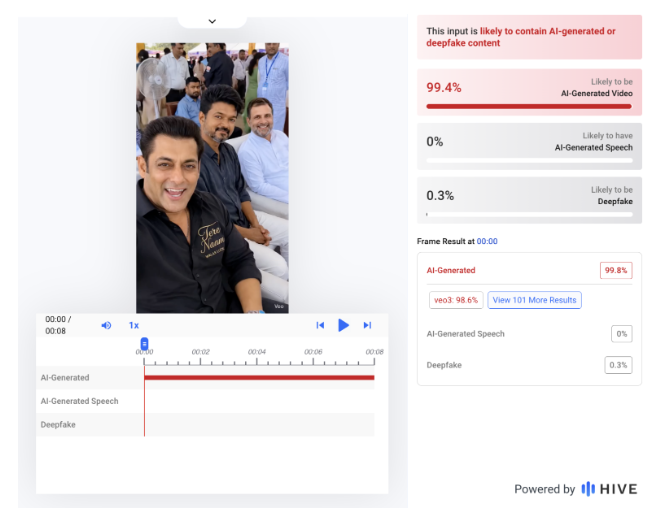
A reverse image search of several key frames of the video, along with searches using relevant keywords, yielded no reliable evidence supporting this claim. We found no verified video, official social media post, or credible media report showing Congress leader Rahul Gandhi, Salman Khan, and Vijay together as depicted in the viral clip. None of the individuals seen in the video have shared this clip on their verified social media accounts. A frame-by-frame analysis also revealed several clear signs of AI manipulation. These include unnatural facial expressions, improper lip-syncing, unnatural body movements, inconsistencies in body proportions, and irregularities in lighting and shadows. The background of the video also appears excessively smooth and lacks realistic depth and texture. To further verify the claim, we analyzed the video using the AI detection tool Hive Moderation. The tool categorized the video as AI-generated with a high probability score, providing additional proof that the viral footage has been digitally created.
Conclusion
We researched the viral picture/image and found that it was AI-generated and digitally manipulated.

Related Blogs

Executive Summary:
A viral picture on social media showing UK police officers bowing to a group of social media leads to debates and discussions. The investigation by CyberPeace Research team found that the image is AI generated. The viral claim is false and misleading.

Claims:
A viral image on social media depicting that UK police officers bowing to a group of Muslim people on the street.


Fact Check:
The reverse image search was conducted on the viral image. It did not lead to any credible news resource or original posts that acknowledged the authenticity of the image. In the image analysis, we have found the number of anomalies that are usually found in AI generated images such as the uniform and facial expressions of the police officers image. The other anomalies such as the shadows and reflections on the officers' uniforms did not match the lighting of the scene and the facial features of the individuals in the image appeared unnaturally smooth and lacked the detail expected in real photographs.

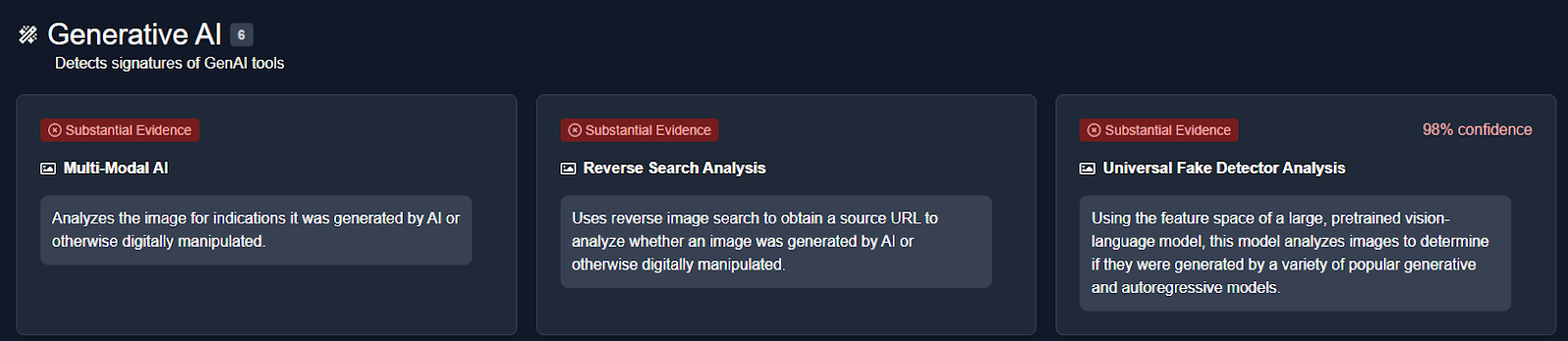
We then analysed the image using an AI detection tool named True Media. The tools indicated that the image was highly likely to have been generated by AI.


We also checked official UK police channels and news outlets for any records or reports of such an event. No credible sources reported or documented any instance of UK police officers bowing to a group of Muslims, further confirming that the image is not based on a real event.
Conclusion:
The viral image of UK police officers bowing to a group of Muslims is AI-generated. CyberPeace Research Team confirms that the picture was artificially created, and the viral claim is misleading and false.
- Claim: UK police officers were photographed bowing to a group of Muslims.
- Claimed on: X, Website
- Fact Check: Fake & Misleading

Introduction
The mysteries of the universe have been a subject of curiosity for humans over thousands of years. To solve these unfolding mysteries of the universe, astrophysicists are always busy, and with the growing technology this seems to be achievable. Recently, with the help of Artificial Intelligence (AI), scientists have discovered the depths of the cosmos. AI has revealed the secret equation that properly “weighs” galaxy clusters. This groundbreaking discovery not only sheds light on the formation and behavior of these clusters but also marks a turning point in the investigation and discoveries of new cosmos. Scientists and AI have collaborated to uncover an astounding 430,000 galaxies strewn throughout the cosmos. The large haul includes 30,000 ring galaxies, which are considered the most unusual of all galaxy forms. The discoveries are the first outcomes of the "GALAXY CRUISE" citizen science initiative. They were given by 10,000 volunteers who sifted through data from the Subaru Telescope. After training the AI on 20,000 human-classified galaxies, scientists released it loose on 700,000 galaxies from the Subaru data.
Brief Analysis
A group of astronomers from the National Astronomical Observatory of Japan (NAOJ) have successfully applied AI to ultra-wide field-of-view images captured by the Subaru Telescope. The researchers achieved a high accuracy rate in finding and classifying spiral galaxies, with the technique being used alongside citizen science for future discoveries.
Astronomers are increasingly using AI to analyse and clean raw astronomical images for scientific research. This involves feeding photos of galaxies into neural network algorithms, which can identify patterns in real data more quickly and less prone to error than manual classification. These networks have numerous interconnected nodes and can recognise patterns, with algorithms now 98% accurate in categorising galaxies.
Another application of AI is to explore the nature of the universe, particularly dark matter and dark energy, which make up over 95% energy of the universe. The quantity and changes in these elements have significant implications for everything from galaxy arrangement.
AI is capable of analysing massive amounts of data, as training data for dark matter and energy comes from complex computer simulations. The neural network is fed these findings to learn about the changing parameters of the universe, allowing cosmologists to target the network towards actual data.
These methods are becoming increasingly important as astronomical observatories generate enormous amounts of data. High-resolution photographs of the sky will be produced from over 60 petabytes of raw data by the Vera C. AI-assisted computers are being utilized for this.
Data annotation techniques for training neural networks include simple tagging and more advanced types like image classification, which classify an image to understand it as a whole. More advanced data annotation methods, such as semantic segmentation, involve grouping an image into clusters and giving each cluster a label.
This way, AI is being used for space exploration and is becoming a crucial tool. It also enables the processing and analysis of vast amounts of data. This advanced technology is fostering the understanding of the universe. However, clear policy guidelines and ethical use of technology should be prioritized while harnessing the true potential of contemporary technology.
Policy Recommendation
- Real-Time Data Sharing and Collaboration - Effective policies and frameworks should be established to promote real-time data sharing among astronomers, AI developers and research institutes. Open access to astronomical data should be encouraged to facilitate better innovation and bolster the application of AI in space exploration.
- Ethical AI Use - Proper guidelines and a well-structured ethical framework can facilitate judicious AI use in space exploration. The framework can play a critical role in addressing AI issues pertaining to data privacy, AI Algorithm bias and transparent decision-making processes involving AI-based tech.
- Investing in Research and Development (R&D) in the AI sector - Government and corporate giants should prioritise this opportunity to capitalise on the avenue of AI R&D in the field of space tech and exploration. Such as funding initiatives focusing on developing AI algorithms coded for processing astronomical data, optimising telescope operations and detecting celestial bodies.
- Citizen Science and Public Engagement - Promotion of citizen science initiatives can allow better leverage of AI tools to involve the public in astronomical research. Prominent examples include the SETI @ Home program (Search for Extraterrestrial Intelligence), encouraging better outreach to educate and engage citizens in AI-enabled discovery programs such as the identification of exoplanets, classification of galaxies and discovery of life beyond earth through detecting anomalies in radio waves.
- Education and Training - Training programs should be implemented to educate astronomers in AI techniques and the intricacies of data science. There is a need to foster collaboration between AI experts, data scientists and astronomers to harness the full potential of AI in space exploration.
- Bolster Computing Infrastructure - Authorities should ensure proper computing infrastructure should be implemented to facilitate better application of AI in astronomy. This further calls for greater investment in high-performance computing devices and structures to process large amounts of data and AI modelling to analyze astronomical data.
Conclusion
AI has seen an expansive growth in the field of space exploration. As seen, its multifaceted use cases include discovering new galaxies and classifying celestial objects by analyzing the changing parameters of outer space. Nevertheless, to fully harness its potential, robust policy and regulatory initiatives are required to bolster real-time data sharing not just within the scientific community but also between nations. Policy considerations such as investment in research, promoting citizen scientific initiatives and ensuring education and funding for astronomers. A critical aspect is improving key computing infrastructure, which is crucial for processing the vast amount of data generated by astronomical observatories.
References
- https://mindy-support.com/news-post/astronomers-are-using-ai-to-make-discoveries/
- https://www.space.com/citizen-scientists-artificial-intelligence-galaxy-discovery
- https://www.sciencedaily.com/releases/2024/03/240325114118.htm
- https://phys.org/news/2023-03-artificial-intelligence-secret-equation-galaxy.html
- https://www.space.com/astronomy-research-ai-future

Executive Summary
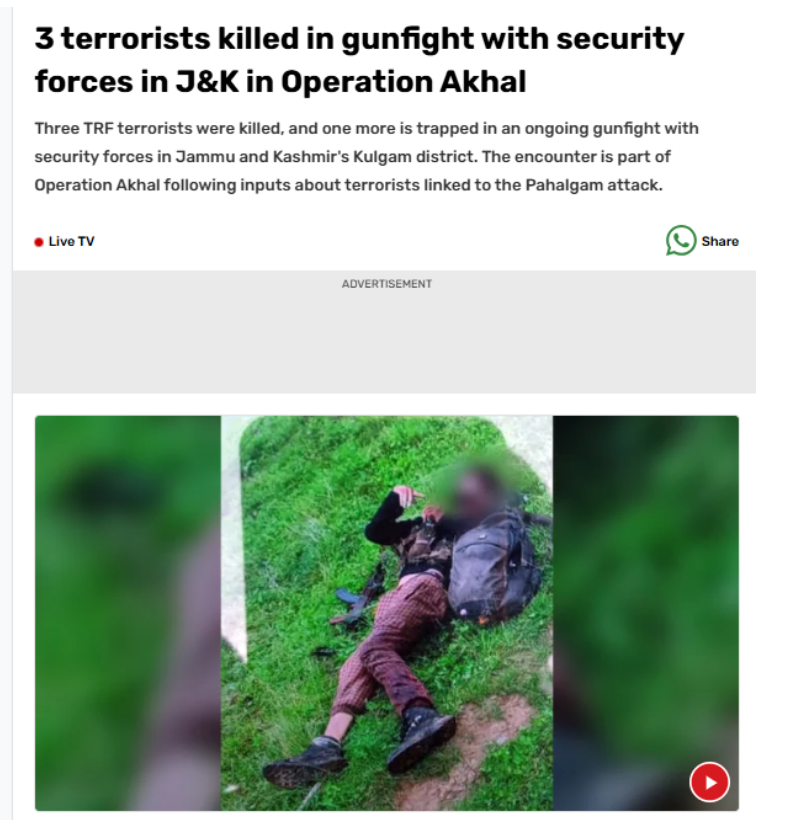
A video circulating on social media is being shared with the claim that the Border Security Force (BSF) shot dead a Bangladeshi national who was attempting to infiltrate India through the Tripura border. CyberPeace Research Wing research found the claim to be misleading. The viral video is not related to any recent incident on the Tripura border. It actually shows Haris Nazir Dar, a militant who was killed during an encounter in Jammu and Kashmir’s Kulgam district last year.
Claim:
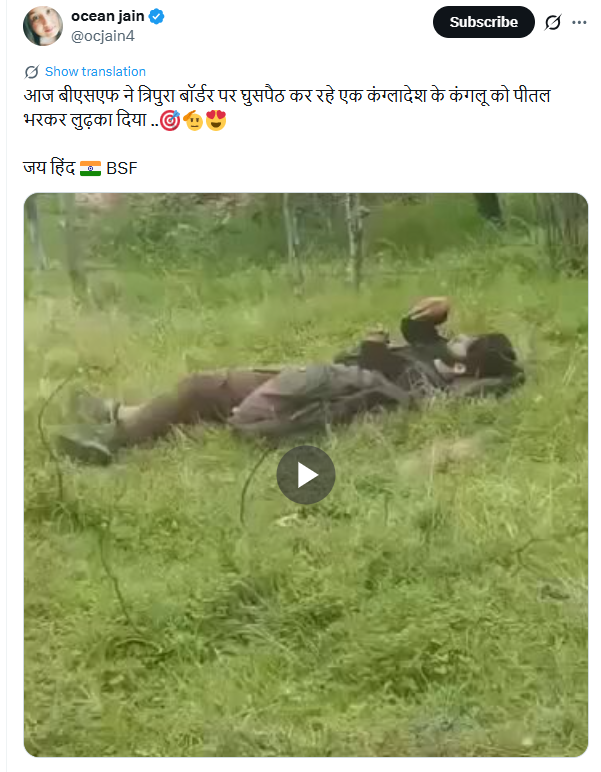
The viral clip, which is around eight seconds long, shows a body lying on the ground. It is being shared on X with captions suggesting that the deceased was a Bangladeshi infiltrator who was killed while attempting to cross the India-Bangladesh border in Tripura.
https://x.com/ocjain4/status/2066210317265457298
Fact Check:
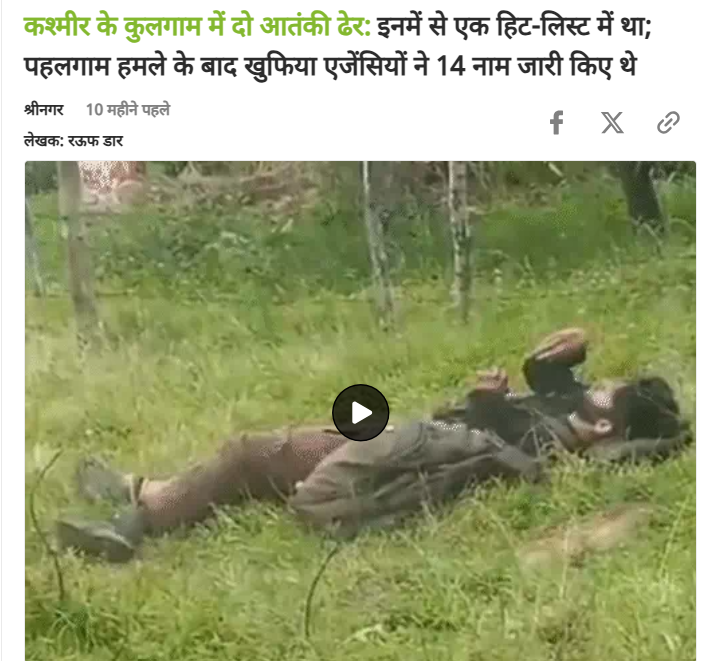
To verify the claim, we extracted keyframes from the viral video and conducted a reverse image search. During the research, we found matching visuals in a report published by Dainik Bhaskar on August 2, 2025. The report was related to an encounter between security forces and militants in the Akhal forest area of Kulgam district in Jammu and Kashmir. Visuals in the report matched those seen in the viral video.
We also found a report published by India Today on August 2, 2025, which carried photographs of slain militant Haris Nazir Dar taken from a different angle. The report stated that security forces had killed three militants during the operation in the Akhal forest area of Kulgam. https://www.indiatoday.in/india/story/gunfight-underway-with-3-lashkar-terrorists-in-jks-kulgam-2764971-2025-08-01
Conclusion:
The evidence gathered during our research makes it clear that the viral video does not show a Bangladeshi infiltrator killed at the Tripura border. The footage is actually from a security operation in Jammu and Kashmir and shows Haris Nazir Dar, a militant who was killed in an encounter in Kulgam last year.

