
#FactCheck: AI-generated audio falsely shows Bangladeshi journalist Mahfuz Anam making remarks on India’s RAW, Mecca Pact
Executive Summary
Several social media users shared an India Today news clipping showing an exclusive interaction between senior journalist Rajdeep Sardesai and Bangladeshi journalist Mahfuz Anam. In the purported conversation, Anam was heard claiming that India’s intelligence agency RAW was trying to prevent Bangladesh from joining the Mecca Pact. He was also allegedly heard saying that New Delhi was promoting an alternative defence pact with Bangladesh involving a Middle Eastern country and Israel. However, the CyberPeace Research Wing found that the viral video had been digitally manipulated using AI-generated audio. The original video, uploaded by India Today, showed Anam in conversation with Sardesai in 2024, discussing Bangladesh’s July uprising and the developments that followed.
Claim
A Facebook page, ‘MatriX MojtabA’, shared an India Today news clipping on August 12 showing senior journalist Rajdeep Sardesai interviewing Bangladeshi journalist Mahfuz Anam. In the purported conversation, Anam was heard saying that RAW was trying to prevent Bangladesh from joining the Mecca Pact. He was also allegedly heard claiming that New Delhi was promoting an alternative defence pact with Bangladesh involving a Middle Eastern country and Israel.
https://www.facebook.com/reel/1804199927691664/

Fact Check
Based on the clue that the viral clip was taken from an exclusive conversation between Mahfuz Anam and India Today, the Desk conducted a customised keyword search on Google. The search led to an extended version of the same interaction uploaded on India Today’s official YouTube channel. The Desk identified the original footage by comparing the background setting and the clothes worn by both Sardesai and Anam, which appeared identical in the viral and original clips. However, an analysis of the original video established that it was an old recording from August 2024. The video showed Anam and Sardesai discussing Bangladesh’s July 2024 uprising and the developments that followed. The Desk analysed the complete 14-minute-and-three-second video and found that Anam did not mention RAW or the Mecca Pact anywhere in the interaction. The Mecca Pact was signed by Pakistan, Saudi Arabia and Turkey on August 7, 2026. This established that the statement attributed to Anam in the viral video was not part of the original conversation and had been digitally manipulated.
https://www.youtube.com/watch?v=gEoyTkOZ8xE

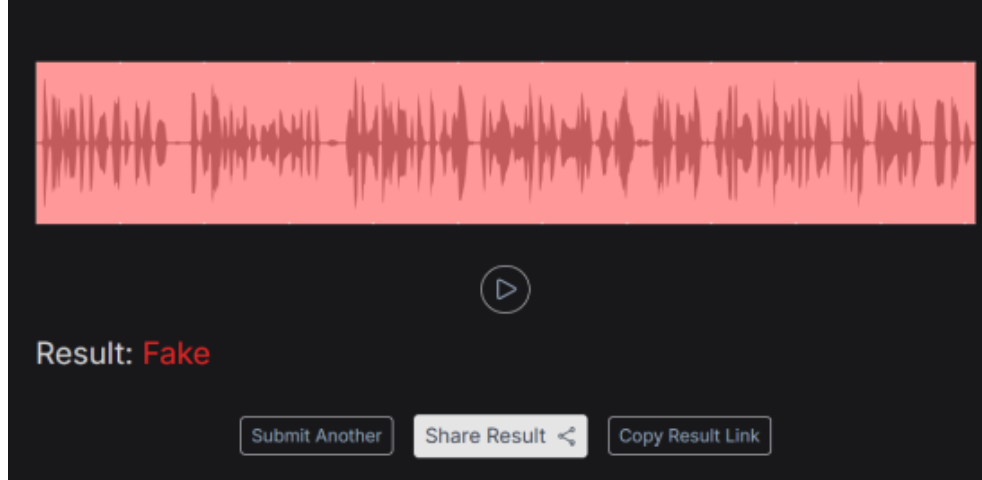
Further, after finding indications that the audio in the viral clip may have been AI-generated, the Desk extracted the audio from the video and analysed it using Resemble AI, an AI audio detection tool. The analysis indicated that the audio was AI-generated and did not contain Mahfuz Anam’s original statement.
Conclusion
The viral video showing Bangladeshi journalist Mahfuz Anam purportedly claiming that India’s RAW was trying to prevent Bangladesh from joining the Mecca Pact is digitally manipulated. The audio in the viral clip was replaced with AI-generated audio to attribute a false statement to Anam. The original India Today video, recorded in 2024, shows Anam speaking with Rajdeep Sardesai about Bangladesh’s July uprising and the developments that followed. He does not make any remarks about RAW, the Mecca Pact or an alternative defence pact involving India, a Middle Eastern country and Israel.

Related Blogs

Executive Summary
A video is being widely shared on social media showing a delivery boy risking his life by jumping in front of a speeding truck to save a small child. The dramatic footage has drawn widespread praise, with many users calling the delivery worker a "real hero," "Superman," and even "an angel." Several social media users have claimed that the incident took place in Mumbai, alleging that the delivery boy's quick thinking prevented a fatal accident. CyberPeace Research Wing ’s research found the viral claim to be false. Our research revealed that the video is not real but AI-generated, and is being circulated with a misleading claim.
Claim
An X (formerly Twitter) user shared the viral video on July 12, 2026, with the caption: "This cannot be called a human, but an angel. Such an incredible feat by a delivery boy from Mumbai is hard to believe. At first glance, it seemed like he had sacrificed his life to save the child, but in the next moment, he saved not only himself but also the child's life. Watch this incredible video."
https://x.com/virjust18/status/2076270467569320072

Fact Check
To verify the viral claim, we conducted a keyword search on Google. However, we found no credible media reports or authentic sources confirming that such an incident had occurred in Mumbai or anywhere else. During the research, we found the same video uploaded on the Instagram account 'ai_nature_of_beauty_01' on July 12, 2026. Although the post's caption did not provide any details about the incident, a review of the account revealed that it regularly uploads AI-generated videos featuring fictional and digitally created scenarios. This strongly indicates that the viral clip is not footage of an actual event but content created using Artificial Intelligence.
https://www.instagram.com/reels/Das5IJ9FFF5/

We further analysed the video using the AI detection tool Hive Moderation, which indicated a 96.1% probability that the footage was AI-generated. The analysis strongly suggests that the video was created using artificial intelligence rather than recorded in the real world.

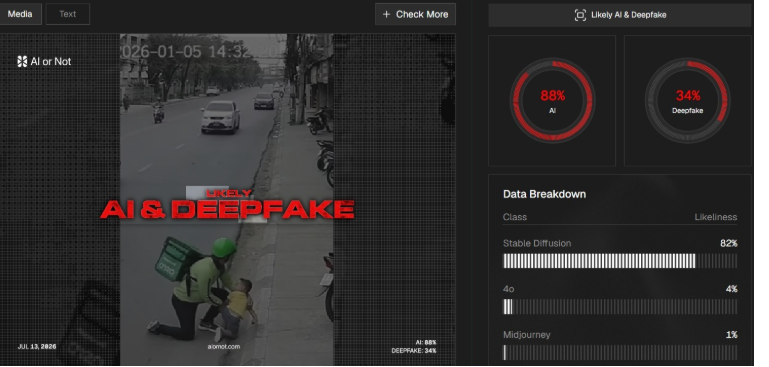
For additional verification, we also examined the video using another AI detection platform, AI or Not. The tool likewise identified the scenes in the viral clip as likely AI-generated, reinforcing our findings.
Conclusion
Our research found that the viral video does not depict a real rescue. It is AI-generated content that has been falsely circulated as footage of a delivery boy saving a child from a speeding truck in Mumbai. There is no credible evidence to support the claim that such an incident actually occurred.
.webp)
Introduction
The Senate bill introduced on 19 March 2024 in the United States would require online platforms to obtain consumer consent before using their data for Artificial Intelligence (AI) model training. If a company fails to obtain this consent, it would be considered a deceptive or unfair practice and result in enforcement action from the Federal Trade Commission (FTC) under the AI consumer opt-in, notification standards, and ethical norms for training (AI Consent) bill. The legislation aims to strengthen consumer protection and give Americans the power to determine how their data is used by online platforms.
The proposed bill also seeks to create standards for disclosures, including requiring platforms to provide instructions to consumers on how they can affirm or rescind their consent. The option to grant or revoke consent should be made available at any time through an accessible and easily navigable mechanism, and the selection to withhold or reverse consent must be at least as prominent as the option to accept while taking the same number of steps or fewer as the option to accept.
The AI Consent bill directs the FTC to implement regulations to improve transparency by requiring companies to disclose when the data of individuals will be used to train AI and receive consumer opt-in to this use. The bill also commissions an FTC report on the technical feasibility of de-identifying data, given the rapid advancements in AI technologies, evaluating potential measures companies could take to effectively de-identify user data.
The definition of ‘Artificial Intelligence System’ under the proposed bill
ARTIFICIALINTELLIGENCE SYSTEM- The term artificial intelligence system“ means a machine-based system that—
- Is capable of influencing the environment by producing an output, including predictions, recommendations or decisions, for a given set of objectives; and
- 2. Uses machine or human-based data and inputs to
(i) Perceive real or virtual environments;
(ii) Abstract these perceptions into models through analysis in an automated manner (such as by using machine learning) or manually; and
(iii) Use model inference to formulate options for outcomes.
Importance of the proposed AI Consent Bill USA
1. Consumer Data Protection: The AI Consent bill primarily upholds the privacy rights of an individual. Consent is necessitated from the consumer before data is used for AI Training; the bill aims to empower individuals with unhinged autonomy over the use of personal information. The scope of the bill aligns with the greater objective of data protection laws globally, stressing the criticality of privacy rights and autonomy.
2. Prohibition Measures: The proposed bill intends to prohibit covered entities from exploiting the data of consumers for training purposes without their consent. This prohibition extends to the sale of data, transfer to third parties and usage. Such measures aim to prevent data misuse and exploitation of personal information. The bill aims to ensure companies are leveraged by consumer information for the development of AI without a transparent process of consent.
3. Transparent Consent Procedures: The bill calls for clear and conspicuous disclosures to be provided by the companies for the intended use of consumer data for AI training. The entities must provide a comprehensive explanation of data processing and its implications for consumers. The transparency fostered by the proposed bill allows consumers to make sound decisions about their data and its management, hence nurturing a sense of accountability and trust in data-driven practices.
4. Regulatory Compliance: The bill's guidelines call for strict requirements for procuring the consent of an individual. The entities must follow a prescribed mechanism for content solicitation, making the process streamlined and accessible for consumers. Moreover, the acquisition of content must be independent, i.e. without terms of service and other contractual obligations. These provisions underscore the importance of active and informed consent in data processing activities, reinforcing the principles of data protection and privacy.
5. Enforcement and Oversight: To enforce compliance with the provisions of the bill, robust mechanisms for oversight and enforcement are established. Violations of the prescribed regulations are treated as unfair or deceptive acts under its provisions. Empowering regulatory bodies like the FTC to ensure adherence to data privacy standards. By holding covered entities accountable for compliance, the bill fosters a culture of accountability and responsibility in data handling practices, thereby enhancing consumer trust and confidence in the digital ecosystem.
Importance of Data Anonymization
Data Anonymization is the process of concealing or removing personal or private information from the data set to safeguard the privacy of the individual associated with it. Anonymised data is a sort of information sanitisation in which data anonymisation techniques encrypt or delete personally identifying information from datasets to protect data privacy of the subject. This reduces the danger of unintentional exposure during information transfer across borders and allows for easier assessment and analytics after anonymisation. When personal information is compromised, the organisation suffers not just a security breach but also a breach of confidence from the client or consumer. Such assaults can result in a wide range of privacy infractions, including breach of contract, discrimination, and identity theft.
The AI consent bill asks the FTC to study data de-identification methods. Data anonymisation is critical to improving privacy protection since it reduces the danger of re-identification and unauthorised access to personal information. Regulatory bodies can increase privacy safeguards and reduce privacy risks connected with data processing operations by investigating and perhaps implementing anonymisation procedures.
The AI consent bill emphasises de-identification methods, as well as the DPDP Act 2023 in India, while not specifically talking about data de-identification, but it emphasises the data minimisation principles, which highlights the potential future focus on data anonymisation processes or techniques in India.
Conclusion
The proposed AI Consent bill in the US represents a significant step towards enhancing consumer privacy rights and data protection in the context of AI development. Through its stringent prohibitions, transparent consent procedures, regulatory compliance measures, and robust enforcement mechanisms, the bill strives to strike a balance between fostering innovation in AI technologies while safeguarding the privacy and autonomy of individuals.
References:
- https://fedscoop.com/consumer-data-consent-training-ai-models-senate-bill/#:~:text=%E2%80%9CThe%20AI%20CONSENT%20Act%20gives,Welch%20said%20in%20a%20statement
- https://www.dataguidance.com/news/usa-bill-ai-consent-act-introduced-house#:~:text=USA%3A%20Bill%20for%20the%20AI%20Consent%20Act%20introduced%20to%20House%20of%20Representatives,-ConsentPrivacy%20Law&text=On%20March%2019%2C%202024%2C%20US,the%20U.S.%20House%20of%20Representatives
- https://datenrecht.ch/en/usa-ai-consent-act-vorgeschlagen/
- https://www.lujan.senate.gov/newsroom/press-releases/lujan-welch-introduce-billto-require-online-platforms-receive-consumers-consent-before-using-their-personal-data-to-train-ai-models/

Executive Summary
A video showing flames and thick smoke rising over a densely populated city at night is being widely circulated on social media. The video is being shared with the claim that it shows the actual visuals of explosions and destruction caused by an attack on Iran. CyberPeace Research Wing ’s research found the viral claim to be false. Our research revealed that the video is not real footage but an AI-generated video, which is being circulated with a false claim.
Claim
A user on social media platform Instagram shared the viral video on July 17, 2026, claiming that it shows the real visuals of an attack on Iran and the massive explosions caused by it.
https://www.instagram.com/reel/Da1_gaXyyoP/?utm_source=ig_web_copy_link&igsh=NTc4MTIwNjQ2YQ==

Fact Check
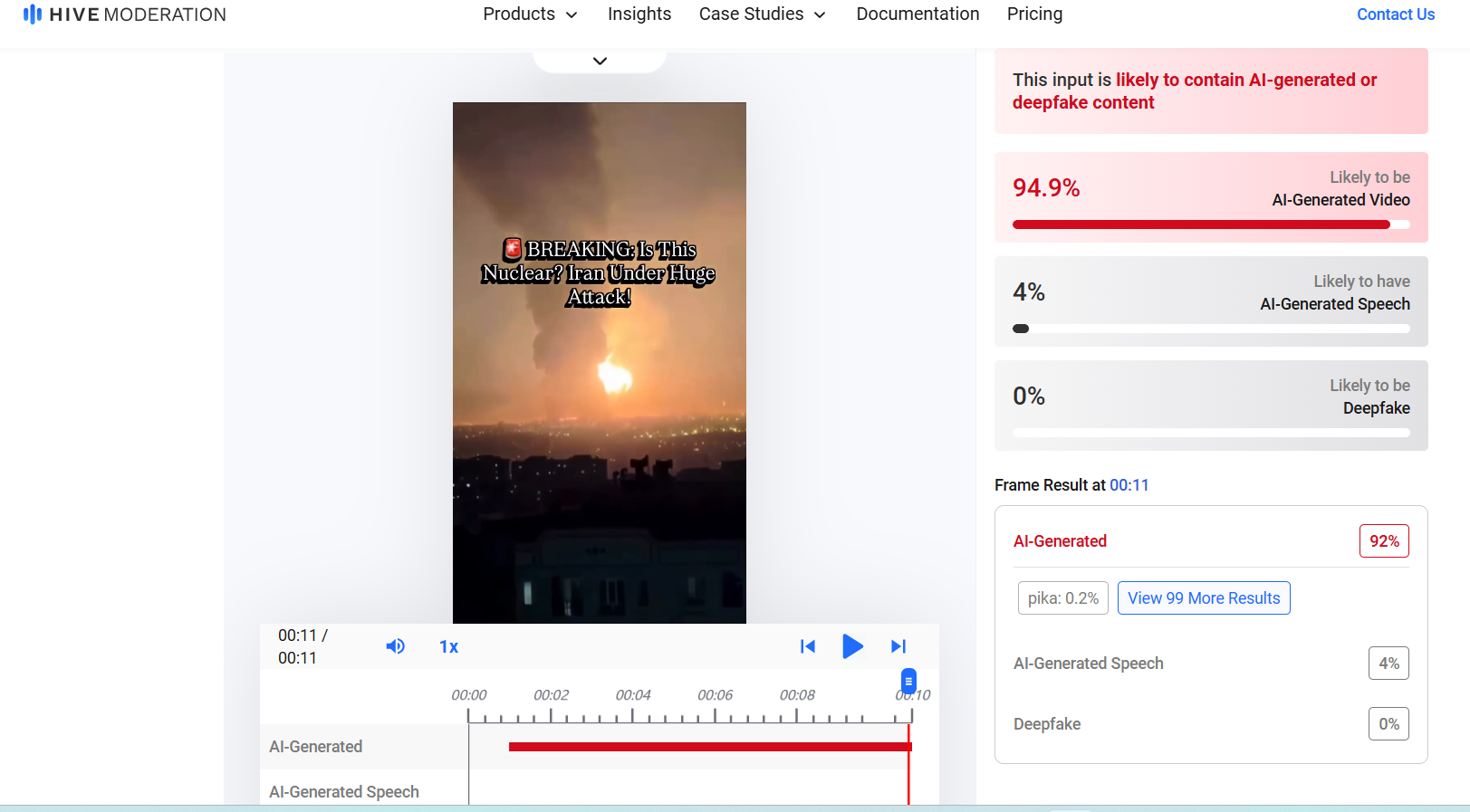
To verify the authenticity of the viral claim, we extracted multiple keyframes from the video and conducted a reverse image search using Google Lens. During the research, we did not find any credible news report, verified video, or authentic source confirming that the footage was related to any attack on Iran. To further examine the authenticity of the video, we analysed it using multiple AI detection tools. First, we scanned the video using Hive Moderation. The tool’s analysis indicated that the video had a 94.9% probability of being AI-generated, suggesting that the footage may have been created using Artificial Intelligence.
For additional verification, we analysed the video using DetectVideo AI. The tool also indicated that the video was likely AI-generated, with an estimated 80% probability.

We further checked the video using another AI detection tool, AI or Not, which suggested that the footage had a 64% probability of being AI-generated.

At the final stage of verification, we used WasIt.AI, which also indicated that the video was likely AI-generated, with an 88% probability.

Conclusion
CyberPeace Research Wing ’s research found that the viral video does not show real footage of an attack on Iran.The video was created using Artificial Intelligence (AI) and is being falsely shared as authentic visuals of explosions and destruction caused by an attack on Iran. Users are advised to verify such sensational claims before sharing them online.
