
#FactCheck: AI-Generated Image Falsely Shared as Sushant Singh Rajput’s Last Moments
Executive Summary
A picture of late actor Sushant Singh Rajput is being shared on social media. In the picture, a woman can be seen holding him, while another person is standing beside him. The social media post claims that the picture is from the last days of Sushant Singh Rajput’s life.CyberPeace Research found the viral claim to be false. Our research found that the viral picture is not authentic, but was created using Artificial Intelligence (AI). The AI-generated image is being shared on social media with a misleading claim.
Claim:
On September 18, 2026, a Facebook user shared the viral picture with the caption, “How was Sushant Singh murdered? The photo is going viral.” The post link, archived link and screenshot are provided below.
https://www.facebook.com/reel/1591592259073828

Fact Check
To verify the authenticity of the viral image, we conducted a Google search using relevant keywords. However, we did not find any credible media report related to the viral image. In the next step of our research, we examined the viral image closely and noticed several inconsistencies that raised suspicion that it had been AI-generated. We then scanned the image using AI or Not. According to the results, the viral image was identified as AI-generated.
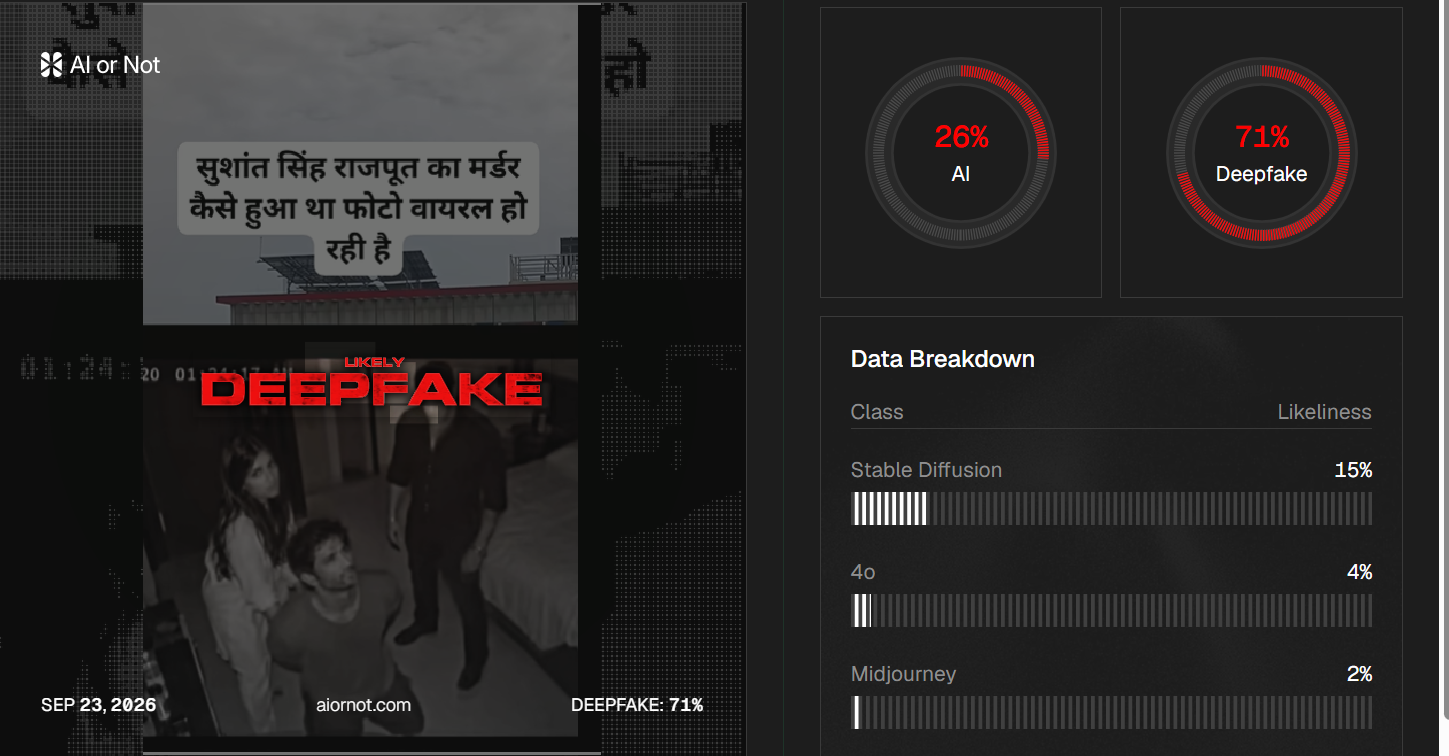
We also scanned the viral image using another AI detection tool, DeepAI. According to the results, the image was found to have a 96 percent likelihood of being AI-generated.

Conclusion
Our research found that the viral image is not authentic, but was created using Artificial Intelligence (AI). The AI-generated image is being shared on social media with a misleading claim.

Related Blogs

Executive Summary
A video featuring former Indian cricketer Sachin Tendulkar is being widely circulated on social media with the date “12-5-2026” displayed on the screen. In the viral clip, Tendulkar appears to promote an investment scheme, allegedly saying that people investing in the scheme today could earn Rs 80 lakh by the end of the day. Throughout the video, he is seen speaking about investment opportunities and financial returns. However, research conducted by CyberPeace Research Wing found that the video is AI-generated and misleading. The original footage was actually from an event marking the centenary celebrations of Sri Sathya Sai Baba.
Claim
A Facebook user shared the viral video on May 12, 2026, claiming that Sachin Tendulkar was endorsing a high-return investment scheme. The post quickly gained traction on social media platforms.

Fact Check
To verify the claim, we searched the internet using relevant keywords but found no credible media reports suggesting that Tendulkar had endorsed any such investment scheme. As part of our research, we extracted key frames from the viral clip and conducted a reverse image search. During the search, we found the original video uploaded on November 19, 2025, on the YouTube channel of IANS. According to the video description, Tendulkar was attending an event organized to mark the centenary year celebrations of Sri Sathya Sai Baba.

We further found a similar version of the same video uploaded on November 19, 2025, on the official Facebook page of Times Now, confirming that the footage was unrelated to any investment or financial scheme.

Conclusion
Our research found that the viral video has been manipulated using AI-generated audio or editing techniques to falsely portray Sachin Tendulkar promoting an investment scheme. The original video was from a public event related to Sri Sathya Sai Baba’s centenary celebrations and had no connection to any financial investment platform.

Introduction
The Chairman of Vardhman Group, Mr SP Oswal, an India-based textile manufacturer, fell victim to a cyber fraud scheme that cost him ₹7 crore. The scam unfolded on August 28 and 29, conning Mr Oswal into transferring Rs 7 crore into multiple bank accounts. As per the recent reports, the Police have managed to freeze these accounts and recover over Rs 5 crore as of now. The fraudsters convinced Mr SP Oswal that he was a suspect in a money laundering investigation and held on a “Digital Arrest”. These are sophisticated cyber frauds where cyber-criminals impersonate law enforcement officials or other authorities and target innocent individuals with manipulative tactics. The scam targets are often contacted out of the blue, on Instant messaging apps like WhatsApp and informed that their bank accounts, digital identities, or other online assets have been compromised. Criminals play into the victims' fear by threatening them with imminent arrest, legal consequences, or public humiliation if they don't cooperate with a series of urgent demands.
Posing as Officials, Fraudsters Orchestrate ₹7 Crore Scam
The investigation revealed that the fraudsters posed as members of the Central Bureau of Investigation (CBI). They had contacted Mr Oswal and claimed that his Aadhaar had been misused in a case involving fake passports and financial fraud. The imposter conducted a video call in a police uniform using a background with the CBI logo. The fraud escalated further, Mr Oswal got a fake "arrest warrant" on WhatsApp allegedly authorised by the Supreme Court. Fraudsters convinced Mr Oswal to transfer ₹7 crores to facilitate bail proceedings, claiming he was under "digital arrest". The meticulously planned scam involved fake documents, a virtual courtroom, and relentless intimidation tactics leaving Mr Oswal effectively under "digital arrest" for two days. While the police have successfully recovered over Rs 5 crore so far, this case highlights the alarming threat of digital impersonation of law enforcement authorities.
Legal Outlook on the Validity of Digital Arrests
In India, the main laws governing cyber crimes are the Information Technology Act, of 2000 and the rules made under therein, and the newly enacted Bhartiya Nyaya Sanhita, 2023. Recently enacted new criminal laws do not provide for any provision for law enforcement agencies conducting a digital arrest. The law only provides for service of the summons and the proceedings in an electronic mode. Hence, there are no provisions for conducting 'digital arrests' as per the laws of the country.
Further, It should be noted that the Indian Cyber Crime Coordination Centre (I4C), under the Ministry of Home Affairs, coordinates the activities related to combating cybercrime in the country. MHA works closely with other ministries to counter these frauds. The I4C also provides technical support to the police authorities of states/UTs for the identification and investigation of these cases.
Best Practices to Avoid Digital Arrest Scams
- To protect yourself from scams, it is crucial to verify the identity of individuals claiming to be law enforcement or government officials and use official contact channels to confirm their credentials.
- Be cautious of pressure tactics used by fraudsters, especially demands for quick payment over unverified communication platforms like WhatsApp.
- Cross-check official documents with legal advisors or relevant authorities.
- Never share sensitive personal information, such as your Aadhaar number, over phone calls, emails, or messages without verifying the request's authenticity.
- Avoid untraceable payments, such as cryptocurrency or prepaid cards, without validating the transaction's legitimacy, especially under duress.
- Stay informed on scam techniques, particularly those involving impersonation and digital threats.
- Enable Two-Factor Authentication (2FA) for sensitive online accounts to prevent misuse.
- Consult advice from legal professionals if you receive threatening communication involving digital arrest or legal actions and do not take any action on the asks of persons posing as legitimate authorities.
- In case of any cybercrime, you can file a complaint at cybercrime.gov.in or helpline number 1930. You can also seek assistance from the CyberPeace helpline at +91 9570000066.
Conclusion
The digital arrest of Vardhman Group's CEO underscores the increasing sophistication of cyber fraud schemes, which exploit fear and urgency, leading to severe financial and reputational harm. No one is immune from cybercrime, vigilance is essential at all leadership levels. While laws like the IT Act and initiatives taken by the I4C help combat cybercrime, rapidly evolving threats demand proactive safety measures. Beyond the possibility of financial loss, incidents like this jeopardise brand reputation, investor confidence, and operational stability. Be cautious of such threats and exercise due care and caution while navigating the digital landscape. Be aware of such kinds of scams and the manipulative tactics used by fraudsters to avoid them. By staying vigilant and aware we can avoid the growing scam of digital arrests.
References
- https://www.business-standard.com/companies/news/digital-arrest-and-rs-7-crore-heist-how-vardhman-group-head-was-tricked-124100100832_1.html
- https://www.hindustantimes.com/business/vardhman-group-chairman-sp-oswal-duped-of-rs-7-crore-fraudsters-posed-as-cbi-101727666912738.html
- https://www.msspalert.com/native/digital-arrests-the-new-frontier-of-cybercrime

About Global Commission on Internet Governance
The Global Commission on Internet Governance was established in January 2014 with the goal of formulating and advancing a strategic vision for Internet governance going forward. Independent research on Internet-related issues of international public policy is carried out and supported over the two-year initiative. An official commission report with particular policy recommendations for the future of Internet governance will be made available as a result of this initiative.
There are two goals for the Global Commission on Internet Governance. First, it will encourage a broad and inclusive public discussion on how Internet governance will develop globally. Second, through its comprehensive policy-oriented report and the subsequent marketing of this final report, the Global Commission on Internet Governance will present its findings to key stakeholders at major Internet governance events.
The Internet: exploring the world wide web and the deep web
The Internet can be thought of as a vast networking infrastructure, or network of networks. By linking millions of computers worldwide, it creates a network that allows any two computers, provided they are both online, to speak with one another.
The Hypertext Transfer Protocol is the only language spoken over the Internet and is used by the Web to transfer data. Email, which depends on File Transfer Protocol, Usenet newsgroups, Simple Mail Transfer Protocol, and instant messaging, is also used on the Internet—not the Web. Thus, even though it's a sizable chunk, the Web is only a part of the Internet [1]. In summary, the deep Web is the portion of the Internet that is not visible to the naked eye. It is stuff from the World Wide Web that isn't available on the main Web. Standard search engines cannot reach it. More than 500 times larger than the visible Web is this enormous subset of the Internet [1-2].
The Global Commission on Internet Governance will concentrate on four principal themes:
• Improving the legitimacy of government, including standards and methods for regulation;
• Promoting economic innovation and expansion, including the development of infrastructure, competition laws, and vital Internet resources;
• Safeguarding online human rights, including establishing the idea of technological neutrality for rights to privacy, human rights, and freedom of expression;
• Preventing systemic risk includes setting standards for state behaviour, cooperating with law enforcement to combat cybercrime, preventing its spread, fostering confidence, and addressing disarmament-related issues.
Dark Web
The part of the deep Web that has been purposefully concealed and is unreachable using conventional Web browsers is known as the "dark Web." Dark Web sites are a platform for Internet users who value their anonymity since they shield users from prying eyes and typically utilize encryption to thwart monitoring. The Tor network is a well-known source for content that may be discovered on the dark web. Only a unique Web browser known as the Tor browser is required to access the anonymous Tor network (Tor 2014). It was a technique for anonymous online communication that the US Naval Research Laboratory first introduced as The Onion Routing (Tor) project in 2002. Many of the functionality offered by Tor are also available on I2P, another network. On the other hand, I2P was intended to function as a network inside the Internet, with traffic contained within its boundaries. Better anonymous access to the open Internet is offered by Tor, while a more dependable and stable "network within the network" is provided by I2P [3].
Cybersecurity in the dark web
Cyber crime is not any different than crime in the real world — it is just executed in a new medium: “Virtual criminality’ is basically the same as the terrestrial crime with which we are familiar. To be sure, some of the manifestations are new. But a great deal of crime committed with or against computers differs only in terms of the medium. While the technology of implementation, and particularly its efficiency, may be without precedent, the crime is fundamentally familiar. It is less a question of something completely different than a recognizable crime committed in a completely different way [4].”
Dark web monitoring
The dark Web, in general, and the Tor network, in particular, offer a secure platform for cybercriminals to support a vast amount of illegal activities — from anonymous marketplaces to secure means of communication, to an untraceable and difficult to shut down infrastructure for deploying malware and botnets.
As such, it has become increasingly important for security agencies to track and monitor the activities in the dark Web, focusing today on Tor networks, but possibly extending to other technologies in the near future. Due to its intricate webbing and design, monitoring the dark Web will continue to pose significant challenges. Efforts to address it should be focused on the areas discussed below [5].
Hidden service directory of dark web
A domain database used by both Tor and I2P is based on a distributed system called a "distributed hash table," or DHT. In order for a DHT to function, its nodes must cooperate to store and manage a portion of the database, which takes the shape of a key-value store. Owing to the distributed character of the domain resolution process for hidden services, nodes inside the DHT can be positioned to track requests originating from a certain domain [6].
Conclusion
The deep Web, and especially dark Web networks like Tor (2004), offer bad actors a practical means of transacting in products anonymously and lawfully.
The absence of discernible activity in non-traditional dark web networks is not evidence of their nonexistence. As per the guiding philosophy of the dark web, the actions are actually harder to identify and monitor. Critical mass is one of the market's driving forces. It seems unlikely that operators on the black Web will require a great degree of stealth until the repercussions are severe enough, should they be caught. It is possible that certain websites might go down, have a short trading window, and then reappear, which would make it harder to look into them.
References
- Ciancaglini, Vincenzo, Marco Balduzzi, Max Goncharov and Robert McArdle. 2013. “Deepweb and Cybercrime: It’s Not All About TOR.” Trend Micro Research Paper. October.
- Coughlin, Con. 2014. “How Social Media Is Helping Islamic State to Spread Its Poison.” The Telegraph, November 5.
- Dahl, Julia. 2014. “Identity Theft Ensnares Millions while the Law Plays Catch Up.” CBS News, July 14.
- Dean, Matt. 2014. “Digital Currencies Fueling Crime on the Dark Side of the Internet.” Fox Business, December 18.
- Falconer, Joel. 2012. “A Journey into the Dark Corners of the Deep Web.” The Next Web, October 8.
- Gehl, Robert W. 2014. “Power/Freedom on the Dark Web: A Digital Ethnography of the Dark Web Social Network.” New Media & Society, October 15. http://nms.sagepub.com/content/early/2014/ 10/16/1461444814554900.full#ref-38.
