
#FactCheck - AI-Generated Video Falsely Claims Salman Khan Is Joining AIMIM
A video of Bollywood actor Salman Khan is being widely circulated on social media, in which he can allegedly be heard saying that he will soon join Asaduddin Owaisi’s party, the All India Majlis-e-Ittehadul Muslimeen (AIMIM). Along with the video, a purported image of Salman Khan with Asaduddin Owaisi is also being shared. Social media users are claiming that Salman Khan is set to join the AIMIM party.
CyberPeace research found the viral claim to be false. Our research revealed that Salman Khan has not made any such statement, and that both the viral video and the accompanying image are AI-generated.
Claim
Social media users claim that Salman Khan has announced his decision to join AIMIM.On 19 January 2026, a Facebook user shared the viral video with the caption, “What did Salman say about Owaisi?” In the video, Salman Khan can allegedly be heard saying that he is going to join Owaisi’s party. (The link to the post, its archived version, and screenshots are available.)

Fact Check:
To verify the claim, we first searched Google using relevant keywords. However, no credible or reliable media reports were found supporting the claim that Salman Khan is joining AIMIM.

In the next step of verification, we extracted key frames from the viral video and conducted a reverse image search using Google Lens. This led us to a video posted on Salman Khan’s official Instagram account on 21 April 2023. In the original video, Salman Khan is seen talking about an event scheduled to take place in Dubai. A careful review of the full video confirmed that no statement related to AIMIM or Asaduddin Owaisi is made.

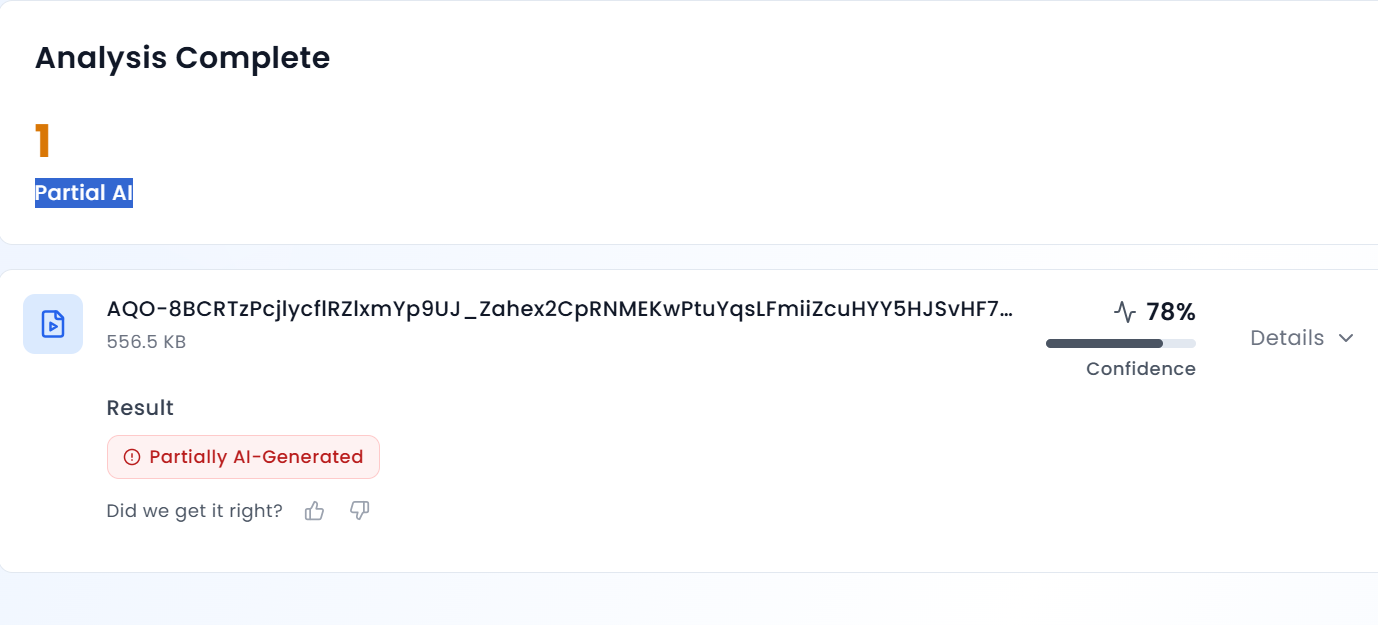
Further analysis of the viral clip revealed that Salman Khan’s voice sounds unnatural and robotic. To verify this, we scanned the video using AURGIN AI, an AI-generated content detection tool. According to the tool’s analysis, the viral video was generated using artificial intelligence.
Conclusion
Salman Khan has not announced that he is joining the AIMIM party. The viral video and the image circulating on social media are AI-generated and manipulated.

Related Blogs
Introduction
On September 1–2, 2026, the G20 Innovation Ministerial was held at the Carolina Inn in Chapel Hill, North Carolina. This gathering of ministers, senior officials, and high-profile technology executives marked the first sectoral ministerial of the G20 presidency held by the U.S. government this year. The two consensus documents that resulted from the meeting, the G20 Innovation Ministerial Statement and the Carolina Principles, are expected to dictate how the largest world economies regulate AI for many years. In this post, the content of the two documents will be discussed along with their role in the larger context of the U.S. G20 presidency that will culminate in the leaders’ summit in Miami scheduled for December and the response of the tech community, allied governments, and civil society to the framework.
The U.S. Presidency and the Road to Chapel Hill
The United States assumed the rotating G20 presidency on December 1, 2025, and immediately signalled a departure from the priorities pursued by South Africa, the previous chair, whose 2025 Johannesburg summit had emphasised climate finance and debt sustainability for developing economies, a summit the U.S. ultimately boycotted. In its opening statement, the State Department announced that the American presidency would organise the year around three themes: reducing regulatory burdens on economic growth, securing affordable and reliable energy supply chains, and "pioneering new technologies and innovations". The Innovation Ministerial in Chapel Hill was the clearest single expression of that third pillar, and it was scheduled ahead of the finance ministers' meetings in Asheville and the foreign ministers' meetings in Atlanta, with the full cycle set to close at the Leaders' Summit at Trump National Doral in Miami on December 14–15, 2026.
Symbolism was deliberately built into the choice of venue. White House science and technology advisor Michael Kratsios, who chaired the ministerial, argued that North Carolina's Research Triangle and its status as home to the nation's first public university made Chapel Hill an apt backdrop for a statement about translating research into commercial and public benefit. The venue also produced the framework's name: the Carolina Principles.
The Innovation Ministerial Statement: Six Pillars
The Innovation Ministerial Statement is organised around six pillars:
pro-innovation policy frameworks; technology for opportunity and prosperity (chiefly AI adoption in public services);
- skilled technical workforce development;
- intellectual property policy for AI;
- standards that support both AI-enabled standards development and standards for AI systems; and
- industrial innovation and supply-chain resilience.
All six ideas run together in one concept: "Old-fashioned or too rigid regulatory systems can limit innovation in an unintended way," and successful policymaking, short of restricting entrepreneurial initiatives, consists of creating the type of regulatory framework which is effective and flexible. The language is also marked by sensitivity to sovereignty, stating repeatedly that countries have the right "to formulate their policies and express their sovereignty on issues of emerging technology governance" and thus make it possible for twenty countries with different legislative customs to agree upon one text.
On IP, the statement treats the copyright-AI interface as unresolved by design, noting that questions about how doctrines such as prior consent and fair-use-style exceptions apply to AI training "remain appropriately resolved through each member's established legal processes" rather than through a harmonised international rule. On standards, it frames AI itself as a tool for regulatory efficiency for comparing safety and performance data across jurisdictions and reducing duplicative testing while affirming that market competition, not government selection, should determine which AI models succeed.
The Carolina Principles: Structuring the Technology Lifecycle
Where the Ministerial Statement sets out aspirations, the Carolina Principles operationalise them across the "science and technology development lifecycle". The document is structured in three parts. The first, Advancing Discovery and Strengthening Technology Development, calls for sustained public investment in foundational research, blended public-private financing across technology readiness levels, and streamlined administrative processes for R&D funding. The second, Accelerating Validation and Commercialisation, is the most operationally specific section, endorsing regulatory sandboxes, results-based funding mechanisms, and innovation-orientated public procurement to help technologies cross the gap from laboratory to market. The third, Enabling Technology Adoption, is the section that has drawn the most political attention: it commits members to apply existing sector-specific regulatory frameworks to AI wherever possible and to reserve new rulemaking only for "novel considerations that existing legal frameworks cannot adequately address" as defined in The Carolina Principles for Emerging Technologies, 2026, Section III.
That last commitment is the crux of what commentary has called the U.S.'s "light-touch" pitch to the world. Rather than proposing a new international AI regulator, the Carolina Principles ask governments to extend the jurisdiction of existing sector regulators and financial supervisors handling AI in finance and health authorities handling AI in medical devices and to treat novel, cross-cutting AI regulation as an exception rather than a default. Commerce Secretary Howard Lutnick announced that all twenty G20 members, including China, endorsed the framework, calling it a product of "an enormous amount of work" given the divergent starting positions in the room. The timing was pointed: the framework was finalised roughly a month after the European Union's AI Act reached its most consequential enforcement milestone, with binding obligations for high-risk AI systems taking effect on August 2, 2026, a contrast Elon Musk, participating in the ministerial, invoked directly in criticising EU-style regulation.
Reception: Consensus Inside, Scepticism Outside
Inside the Carolina Inn, the mood among industry leaders was buoyant. In a fireside conversation with Secretary Lutnick, OpenAI's Sam Altman described AI as "incredible magic of intelligence in a bottle" while warning that continued infrastructure build-out, more data centres, and more compute would be necessary to keep costs manageable. Nvidia's Jensen Huang and Palantir's Alex Karp offered similarly optimistic assessments, and Anthropic's participation in a voluntary model-testing arrangement with the U.S. government's safety and security institute was cited by OSTP Director Kratsios as evidence that industry-government cooperation, rather than statutory mandate, could deliver trustworthy AI.
Outside the security perimeter, several hundred demonstrators, like students, faculty, and local organisers, gathered to protest what they characterised as an unaccountable alliance between government and AI capital, chanting slogans against both the technology's labour-market effects and the data centre buildout it requires. The juxtaposition captured a tension that runs beneath the consensus text itself: a framework designed to secure the broadest possible international agreement necessarily says less about how risks Labour displacement, energy demand, and algorithmic harm will be managed than it does about how innovation will be accelerated.
Conclusion
The Carolina Principles represent a coherent and, by G20 standards, unusually specific attempt to answer a question that has vexed multilateral technology governance for a decade: how do twenty economies with incompatible regulatory philosophies agree on anything regarding AI? The answer Chapel Hill produced was to agree on process rather than on substantive limits. Whether that process-based consensus proves durable will depend on what happens between now and the Miami Leaders' Summit in December, when heads of state, rather than ministers, will decide whether to elevate the Carolina Principles into the G20's broader economic agenda or treat them as a single ministerial's contribution to a much longer conversation.
References
- https://assets.publishing.service.gov.uk/media/6a996786f5b35599aec19180/g20-innovation-ministerial
- https://www.commerce.gov/sites/default/files/2026-09/THE-CAROLINA-PRINCIPLES-FOR-EMERGING-TE
- https://www.commerce.gov/news/press-releases/2026/09/g20-innovation-ministerial-concludes-conseNSUS statement
- https://www.whitehouse.gov/releases/2026/09/g20-innovation-ministerial-concludes-with-consensus-sstatement/
- https://www.state.gov/policy-issues/g20/feed/
- https://g20.org/g20-united-states/
- https://dailytarheel.com/480187/university/university-g20-event-1/
- https://qz.com/g20-us-light-touch-ai-framework-chapel-hill-090326
- https://explainx.ai/blog/g20-carolina-principles-ai-regulation-chapel-hill-2026
- https://enterprisedna.co/resources/news/us-g20-carolina-principles-ai-regulation-enterprise-september-2026/
- https://www.cnbc.com/2026/09/02/g20-innovation-ministerial-live-updates.html
- https://fortune.com/2026/09/05/tech-ceos-ai-data-centers-g20-protests-sam-altman-nvidia-jensen-huang-palantir-alex-karp-chapel-hill-north-carolina-ai-backlash/
- https://www.wunc.org/education/2026-09-02/protest-chapel-hill-unc-g20-innovation-technology-sam-a
- https://www.cfr.org/articles/us-g20-presidency-narrow-agenda-2026

Executive Summary
A video is being widely shared on social media with the claim that a youth was killed in police firing in Bihar’s Siwan. The viral 1-minute-22-second video shows a young man standing with a stick in his hand. Moments later, gunfire is heard, after which he appears to be injured and collapses. His associates are then seen carrying him away from the spot. CyberPeace Research Wing’s research found that the claim is false. The research revealed that the viral video is not from Bihar’s Siwan but dates back to the student protests in Bangladesh in July 2024.
Claim:
The video was shared on X with a caption claiming that it shows a police firing incident in Bihar’s Siwan, where a student was allegedly killed after police opened fire with AK-47 rifles.
The caption stated, “This video is going viral on social media. It is being claimed that this video is from Siwan, Bihar, where police fired AK-47s at students. During the firing, a youth was hit by two bullets and died.”
https://x.com/Deshmukh_0/status/2082053481993740701

Fact Check:
To verify the authenticity of the viral claim, we extracted keyframes from the video and conducted a reverse image search. During the research, we found a longer version of the same video uploaded on the YouTube channel of a Bangladeshi news portal on July 16, 2024.
According to the video description, the footage shows the death of student Abu Sayed during protests in Rangpur, Bangladesh, on July 16, 2024.
https://www.youtube.com/watch?v=iuf7H0MNIaI

Further research led us to a report published by bdnews24, which also carried visuals matching those seen in the viral video. The report stated that on July 16, 2024, Abu Sayed, an English Department student at Begum Rokeya University in Rangpur, Bangladesh, died after being shot during the protests.
https://bdnews24.com/bangladesh/87ef7e69c496#google_vignette

Conclusion:
The evidence gathered during the research confirms that the viral video claiming to show a youth being killed in police firing in Bihar’s Siwan is misleading. The video is actually from Bangladesh and shows the death of student Abu Sayed during the July 2024 protests in Rangpur. The old footage is being shared with a false claim linking it to a recent incident in Bihar.
Introduction
In January 2026, the Basic Act on the Development of Artificial Intelligence and the Establishment of a Foundation for Trustworthiness came into effect in South Korea, establishing one of the first national AI laws in the world. The bill, enacted by the National Assembly of Korea in December 2024 and implemented from January 22, 2026, aims to strike a balance between the rapid advancement of technology and clear safeguards against risks, as well as transparency, accountability, and responsible AI use. It puts Seoul and the European Union on the frontline of developing legal systems for artificial intelligence and indicates a long-term goal of becoming an AI power on the global stage.
What the AI Basic Act Covers
The AI Basic Act consists of 19 separate AI bills that are merged into a single piece of legislation that covers the lifecycle of AI, including research and development, deployment, and utilisation. It is very wide in its coverage: it refers to any AI system that influences the Korean market or users inside the country, irrespective of the country in which it is created. The law does not apply to national defence and security applications.
The law defines key concepts like artificial intelligence, generative AI, and high-impact AI and establishes the principles of ethical AI, safety, user rights, industry support, and national policy coordination. It also offers a legal foundation for the activities of the government to promote AI innovation without jeopardising the common good.
Fundamentally, the AI Basic Act is designed to establish a culture of trust between businesses and the government/citizens. It does not prohibit AI technologies and does not excessively limit innovation. Instead, it creates the framework of responsible development and economic growth.
Guardrails for Safety and Accountability
One of the defining features of the AI Basic Act is its risk-based approach. Rather than considering all AI systems as similar, it makes a distinction between ordinary and high-impact AI systems, the ones applied in sectors where the wrong or unsafe decision can have a major impact on the safety, rights, or critical infrastructure of the population. Some of them can be seen in healthcare, transportation, financial services, education, and public services.
The high-impact AI operators must integrate risk management plans, human controls, and surveillance systems. In critical decision-making situations, human control should be available at all times; that is, machines can help but not override human control where human safety or other human rights are involved.
The law enables the regulators to perform on-site checks, demand documentation, and conduct compliance investigations. Fines for breaches may go up to 30 million Korean won (approximately 21,000 US dollars). It has a one-year period of transition that is based on guidance but not enforcement, thus allowing companies time to implement compliance measures before imposing fines.
These requirements contribute to enhancing accountability by defining who is accountable for the safety outcomes. The law in South Korea is placed in the ecosystem, as opposed to the methods in which industry self-governance alone is utilised.
Transparency and Labelling Requirements
The AI Basic Act is based on transparency. The legislation ensures that users are notified before an AI system is operating, particularly with the generation of AI outputs that could be confused with human-created material. As an example, AI-generated text, images, video, or audio that may be difficult to distinguish between reality and fake must have obvious labels or watermarks to allow users to understand the source of the content.
The necessity to label is meant to fight misinformation, misleading activities, and unintended influence on the perception of the people. It is based on international anxiety regarding AI-generated content, such as deepfakes, manipulated media, and misleading online advertisements that have already been addressed separately in policy by South Korea, as well as discussions of data governance.
The transparency is also applied to the process of decision-making in AI systems. Developers and operators should be able to give explicit information about the way in which high-impact systems make their conclusions so that those who are victims of automated decisions can seek meaningful explanations. Although specific explainability criteria are in the process of being developed, the law grounds the principle that AI cannot act behind the scenes in situations where crucial decisions are being made.
Data Privacy and User Protection
The AI governance practice in South Korea is complementary to its current data protection laws, the Personal Information Protection Act (PIPA), which is broadly regarded as equivalent to major international data protection regulations like the GDPR in regard to personal data laws. The AI Basic Act provides an explanation as to how the data can be gathered, processed, and utilised within AI systems with regard to privacy rights, particularly in areas of high impact.
The law does not supersede the personal data protection policies, but it sets certain conditions on how AI developers must address the data to be utilised in training, testing, and running AIs. Operators will be required to document their data workflows and demonstrate how they guard the privacy of their users, including by transparency and consent mechanisms where necessary. This can assist in ensuring that the information that is utilised in AI functions is regulated by definite norms, and it is more difficult to avoid privacy requirements in the name of innovation.
Accountability and Governance Infrastructure
The AI Basic Act establishes a national policy framework of AI governance. The National Artificial Intelligence Strategy Committee, chaired by the President, is at the top and proposes the overall AI policy and aligns it with national objectives. The organisations that would support this are the specialised organisations that deal with safety, risk assessment, and research and the policy centre that would analyse the effects of AI on society and assist in its adoption by the industry.
This institutional structure facilitates strategic guidance as well as operational control. It is through incorporating AI governance in the administration of the people, but not into the market forces, that South Korea wishes to have the ethical and societal concerns become part of the sectors and agencies.
Promoting Innovation and Industrial Support
Although the AI Basic Act does not disregard regulation, it is not a law of restrictions. It also offers legal justification for research and development, human capital, and the growth of the AI industry, with special consideration for startups and small and medium-sized businesses. The legislation promotes AI clusters, long-term funding programmes, and policies to bring foreign talent to the Korean AI ecosystem.
This bidimensional approach of compliance and support is indicative of the broader desire of Korea to become one of the leading AI powers in the world, along with the US and China. The government has pointed out that it will encourage trust by having clear and predictable rules that will attract investment and maintain innovation and not stifle it.
What This Means Globally
The AI Basic Act of South Korea is not only interesting in its contents but also in its timing. It is also among the first thorough AI legislations to come into force in the world, and it beats the gradual regulatory implementations in other parts of the globe, like the European Union. Its system incorporates a principle-based framework, transparency requirements, accountability regulations, and industrial support, which reflects a contrasting model to either pure prescriptive risk regulation or lax self-regulation models elsewhere.
Other critics, such as industry groups and civil society organisations, have suggested that some of the protections may be more explicit, in particular to those who are harmed by AI systems, or to establish high-impact categories. Nonetheless, the framework sets a benchmark upon which most nations will pay close attention when they establish their own AI regimes.
Conclusion
The AI Basic Act puts South Korea at the forefront of national AI regulation, including very well-developed guardrails that enforce transparency, ethical control, accountability, and data protection in addition to fostering innovation. It recognises that AI could lead to economic and social advantages, yet also actual risks, particularly when systems are opaque, autonomous, or widely implemented. South Korea has gone holistically in responsible AI governance by integrating human oversight, labelling requirements, risk management planning, and governance infrastructure into law to be emulated by other countries in the years to come.
Sources
- https://www.theguardian.com/world/2026/jan/29/south-korea-world-first-ai-regulation-laws
- https://www.oecd.org/content/dam/oecd/en/publications/reports/2025/10/artificial-intelligence-and-the-labour-market-in-korea_af668423/68ab1a5a-en.pdf
- https://asianintelligence.ai/south-korea
- https://aibasicact.kr/
- https://aibusinessweekly.net/p/south-korea-ai-basic-act-takes-effect-jan22-2026
- https://asiadaily.org/news/12112/
