
#FactCheck:AI-Created Video Falsely Shows Car Catching Fire During Celebration
Executive Summary:
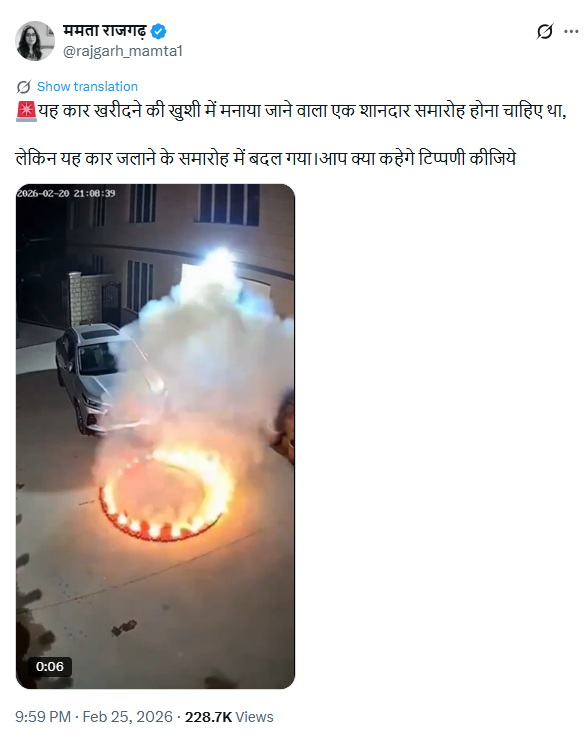
A video showing a car catching fire is rapidly going viral on social media. In the clip, a family can be seen bursting firecrackers in front of a newly purchased car. Moments later, the vehicle also appears to catch fire. The video is being shared with the claim that the family was celebrating the purchase of a new car with fireworks, which accidentally led to the vehicle going up in flames. Many users are circulating the clip as footage of a real incident. However, an research by the CyberPeace found that the video is not from a real-life event but has been created using Artificial Intelligence (AI).
Claim
On February 25, 2026, an X user named “Mamta Rajgarh” shared the viral video with the caption:“This was supposed to be a grand celebration for buying a new car, but it turned into a ceremony of burning the car. What do you say? Comment below.”
- Post link: https://x.com/rajgarh_mamta1/status/2026696175311786408?s=20
- Archived link: https://perma.cc/22AA-KBS4
Fact Check:
To verify the claim, we conducted a keyword search on Google but found no credible news reports supporting the alleged incident. Upon closely examining the video, we noticed several technical inconsistencies. The car’s number plate is unclear, a common flaw often seen in AI-generated content. Additionally, the sequence of events appears unnatural — the firecrackers seem to extinguish first, and only after a delay does the car suddenly catch fire. These irregularities raised suspicion that the video may have been artificially generated. To further verify, we analyzed the clip using AI detection tools. Hive Moderation indicated a 98.7 percent likelihood that the video was generated using Artificial Intelligence.
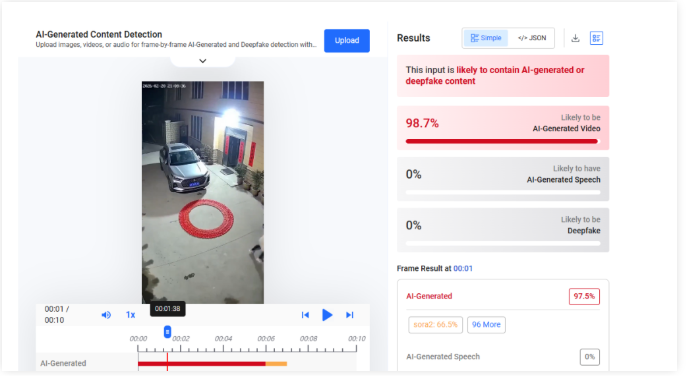
Another AI detection tool, Undetectable.ai, suggested a 77 percent probability that the video was AI-generated.
Conclusion
Our research confirms that the viral video does not depict a real incident. It has been created using Artificial Intelligence and is being misleadingly shared as genuine footage.

Related Blogs
Introduction
We inhabit an era where digital connectivity, while empowering, has also unleashed a relentless tide of cyber vulnerabilities, where personal privacy is constantly threatened, and crimes like sextortion are the perfect example of the sinister side of our hyperconnected world. Social media platforms, instant messaging apps, and digital content-sharing tools have all grown rapidly, changing how people communicate with one another and making it harder to distinguish between the private and public domains. The rise of sophisticated cybercrimes that use the very tools meant to connect us is the price paid for this unparalleled convenience. Sextortion, a portmanteau of “sex’ and “extortion”, stands out among them as a particularly pernicious kind of internet exploitation. Under the threat of disclosing their private information, photos, or videos, people are forced to engage in sexual behaviours or provide intimate content. Sextortion’s psychological component is what makes it particularly harmful, it feeds on social stigma, shame, and fear, which discourage victims from reporting the crime and feed the cycle of victimisation and silence. This cybercrime targets vulnerable people from all socioeconomic backgrounds and is not limited by age, gender, or location.
The Economy of Shame: Sextortion as a Cybercrime Industry
A news report from June 03, 2025, reveals a sextortion racket busted in Delhi, where a money trail of over Rs. 5 crore was identified by different teams of the Crime branch. From synthetic financial identities to sextortion and other cyber frauds, a recipe for a sophisticated cybercrime chain was found. To believe this is an aberration is to overlook the reality that it is symptomatic of a much wider and largely uncharted criminal framework. According to the FBI’s 2024 IC3 report, “extortion (including sextortion)” has skyrocketed to 86,415 complaints with losses of $143 million reported in the United States (US) alone. This indicates that coercive image-based threats are no longer an isolated cybercrime but an everyday occurrence. Sextortion is no longer an isolated cybercrime; it has metamorphosed into a systematic, industrialised criminal enterprise. Another news report dated 19th July, 2025, where Delhi Police has detained four people suspected of participating in a sextortion scheme that targeted a resident of the Bhagwanpur Khera neighbourhood of Shahdara. The suspected people were allegedly arrested on a complaint wherein the victim was manipulated and fell prey to a dating site.
The threat is amplified by the usage of deepfake technology, which allows offenders to create obscene content that looks believable. The approach, which relies on the stigma attached to sexual imagery in conservative societies like India, is that victims frequently give in to requests out of fear of damaging their reputations. The combination of cybercrime and cutting-edge technology highlights the lopsided power that criminals possess, leaving victims defenceless and law enforcement unable to keep up.
Legal Remedies and the Evolving Battle Against Sextortion
Given the complexity of these crimes, India has recognised sextortion and similar cyber-enabled financial crimes under a number of legal frameworks. A change to recognising cyber-enabled sexual exploitation as an organised criminal business is shown by the introduction of specific provisions like Section 111 in the Bhartiya Nyaya Sanhita (BNS), 2023, which classifies organised cybercrimes including extortion and frauds which fall under its expansive interpretation, as a serious offence. Similarly, Section 318 (2) criminalises cheating with a maximum sentence of three years in prison or a fine, whereas Section 336 (2) makes digital forgery a crime with a maximum sentence with a maximum sentence of two years in prison or a fine. In addition to these regulations, cheating by personation through computer resources is punishable by the Information Technology Act, 2000, specifically Section 66D, which carries a maximum sentence of three years in prison and a maximum fine of Rs. 1 lakh. Due to issues with attribution, cross-border jurisdiction, and the discreet nature of digital evidence, enforcement is still inconsistent even with current statutory restrictions.
The government and its agencies recognise that laws achieve real impact only when backed by awareness initiatives and accessible, localised mechanisms for redressal. Several Indian states and the Department of Telecommunications launched numerous campaigns to educate the public about and safeguard their mobile communication assets against identity theft, financial fraud, and cyberscams. Initiatives like Cyber Saathi Initiative and Cyber Dost by MHA, with the goal of improving forensic and victim reporting skills.
Conclusion
At CyberPeace, we understand that the best defence against online abuse is prevention. Our goal is to provide people with the information and resources to identify, avoid and report sextortion attempts like CyberPeace Helpline and organise awareness campaigns on safe digital habits. In order to remain updated with the constantly looming danger, our research and policy advocacy also focus on developing more robust legal and technological safeguards.
To every reader: think before you share, secure your accounts, and never let shame silence you. If you or someone you know becomes a victim, report it immediately, help is available, and justice is possible. Together we can reclaim the internet as a space of trust, not terror.
References
- https://www.hindustantimes.com/india-news/delhi-police-busts-sextortion-cyberfraud-rackets-6-held-101748959601825.html
- https://timesofindia.indiatimes.com/city/delhi/delhi-police-arrests-four-for-sextortion-and-blackmail-in-shahdara/articleshow/122767656.cms
- https://cdn.ncw.gov.in/wp-content/uploads/2025/05/CyberSaheli.pdf

Executive Summary:
A misleading video has been widely shared online, falsely portraying Pandit Jawaharlal Nehru stating that he was not involved in the Indian independence struggle and he even opposed it. The video is a manipulated excerpt from Pandit Nehru’s final major interview in 1964 with American TV host Arnold Mich. The original footage available on India’s state broadcaster Prasar Bharati’s YouTube channel shows Pandit Nehru discussing about Muhammad Ali Jinnah, stating that Jinnah did not participate in the independence movement and opposed it. The viral video falsely edits Pandit Nehru’s comments to create a false narrative, which has been debunked upon reviewing the full, unedited interview.

Claims:
In the viral video, Pandit Jawaharlal Nehru states that he was not involved in the fight for Indian independence and even opposed it.


Fact check:
Upon receiving the posts, we thoroughly checked the video and then we divided the video into keyframes using the inVid tool. We reverse-searched one of the frames of the video. We found a video uploaded by Prasar Bharati Archives official YouTube channel on 14 May 2019.

The description of the video reads, “Full video recording of what was perhaps Pandit Jawaharlal Nehru's last significant interview to American TV Host Arnold Mich Jawaharlal Nehru's last TV Interview - May 1964e his death. Another book by Chandrika Prasad provides a date of 18th May 1964 when the interview was aired in New York, this is barely a few days before the death of Pandit Nehru on 27th May 1964.”
On reviewing the full video, we found that the viral clip of Pandit Nehru runs from 14:50 to 15:45. In this portion, Pandit Nehru is speaking about Muhammad Ali Jinnah, a key leader of the Muslim League.
At the timestamp 14:34, the American TV interviewer Arnold Mich says, “You and Mr. Gandhi and Mr. Jinnah, you were all involved at that point of Independence and then partition in the fight for Independence of India from the British domination.” Pandit Nehru replied, “Mr. Jinnah was not involved in the fight for independence at all. In fact, he opposed it. Muslim League was started in about 1911 I think. It was started really by the British encouraged by them so as to create factions, they did succeed to some extent. And ultimately there came the partition.”
Upon thoroughly analyzing we found that the viral video is an edited version of the real video to misrepresent the actual context of the video.
We also found the same interview uploaded on a Facebook page named Nehru Centre for Social Research on 1 December 2021.

Hence, the viral claim video is misleading and fake.
Hence, the viral video is fake and misleading and netizens must be careful while believing in such an edited video.
Conclusion:
In conclusion, the viral video claiming that Pandit Jawaharlal Nehru stated that he was not involved in the Indian independence struggle is found to be falsely edited. The original footage reveals that Pandit Nehru was referring to Muhammad Ali Jinnah's participation in the struggle, not his own. This explanation debunks the false story conveyed by the manipulated video.
- Claim: Pandit Jawaharlal Nehru stated that he was not involved in the struggle for Indian independence and even he opposed it.
- Claimed on: YouTube, LinkedIn, Facebook, X (Formerly known as Twitter)
- Fact Check: Fake & Misleading

Executive Summary
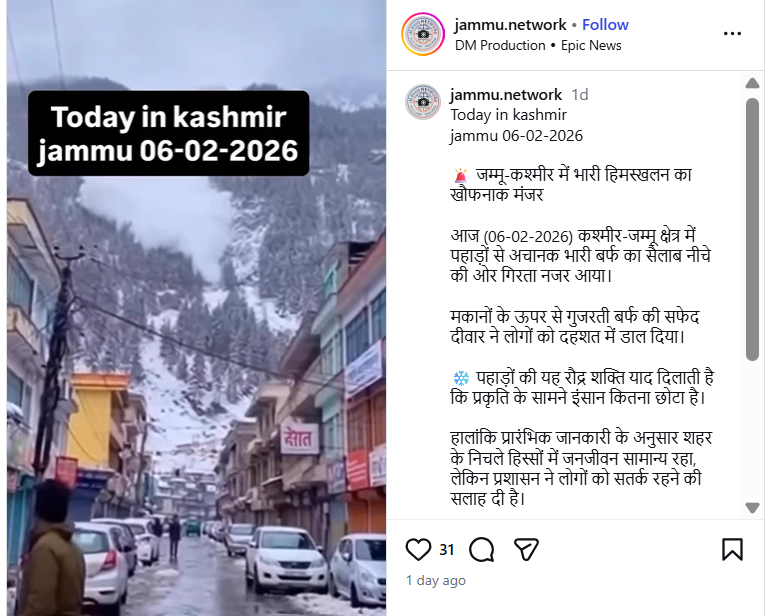
A video is being shared on social media claiming to show an avalanche in Kashmir. The caption of the post alleges that the incident occurred on February 6. Several users sharing the video are also urging people to avoid unnecessary travel to hilly regions. CyberPeace’s research found that the video being shared as footage of a Kashmir avalanche is not real. The research revealed that the viral video is AI-generated.
Claim
The video is circulating widely on social media platforms, particularly Instagram, with users claiming it shows an avalanche in Kashmir on February 6. The archived version of the post can be accessed here. Similar posts were also found online. (Links and archived links provided)
Fact Check:
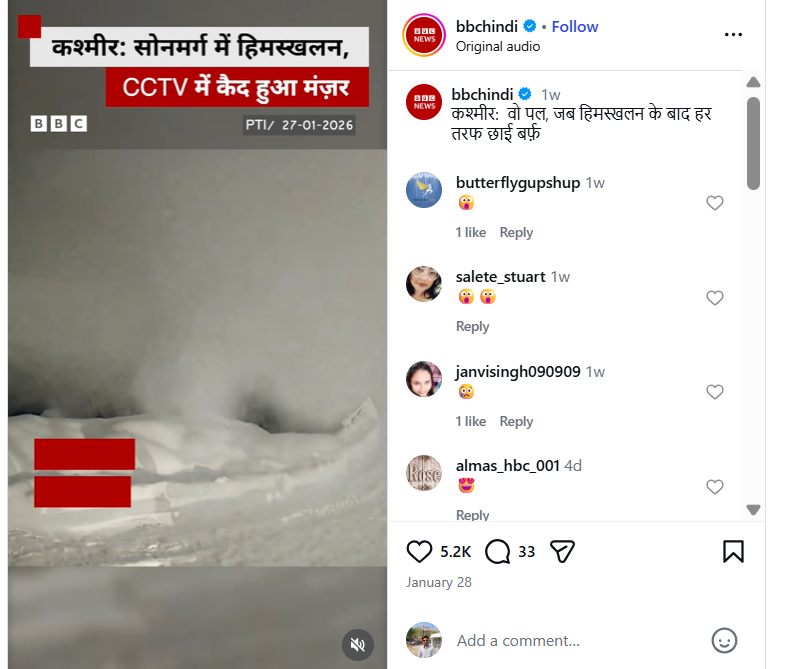
To verify the claim, we searched relevant keywords on Google. During this process, we found a video posted on the official Instagram account of the BBC. The BBC post reported that an avalanche occurred near a resort in Sonamarg, Kashmir, on January 27. However, the BBC post does not contain the viral video that is being shared on social media, indicating that the circulating clip is unrelated to the real incident.
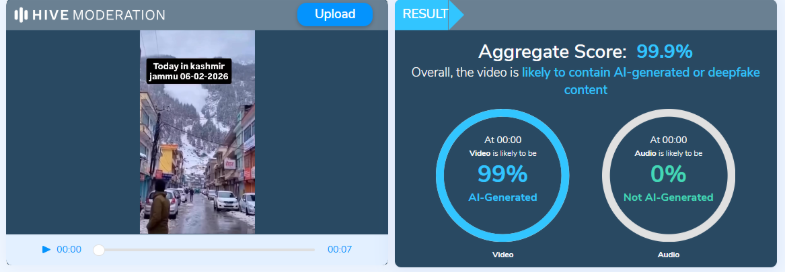
A close examination of the viral video revealed several inconsistencies. For instance, during the alleged avalanche, people present at the site are not seen panicking, running for cover, or moving toward safer locations. Additionally, the movement and flow of the falling snow appear unnatural. Such visual anomalies are commonly observed in videos generated using artificial intelligence. As part of the research , the video was analyzed using the AI detection tool Hive Moderation. The tool indicated a 99.9% probability that the video was AI-generated.
Conclusion
Based on the evidence gathered during our research , it is clear that the video being shared as footage of a Kashmir avalanche is not genuine. The clip is AI-generated and misleading. The viral claim is therefore false.
