
#FactCheck- Old Georgia, Bulgaria Videos Falsely Linked to Attacks in Israel
Executive Summary
Amid uncertainty over the future of the two-week ceasefire following 21 hours of inconclusive talks between the United States and Iran, two videos linked to Israel are going viral on social media.In one clip, a man speaking at a microphone is suddenly attacked by another person. Some users claim the video shows an incident inside Israel’s parliament, the Knesset.
In another video, a similar scene is being shared with the claim that a Member of Parliament assaulted Israeli Prime Minister Benjamin Netanyahu. However, a research by the CyberPeace found both claims to be false. The videos are old and unrelated to Israel.
Claim
An Instagram user shared one of the videos claiming it shows an attack inside the Israeli parliament.Another user shared a similar clip alleging that an MP assaulted Prime Minister Netanyahu.


Fact Check
First Video
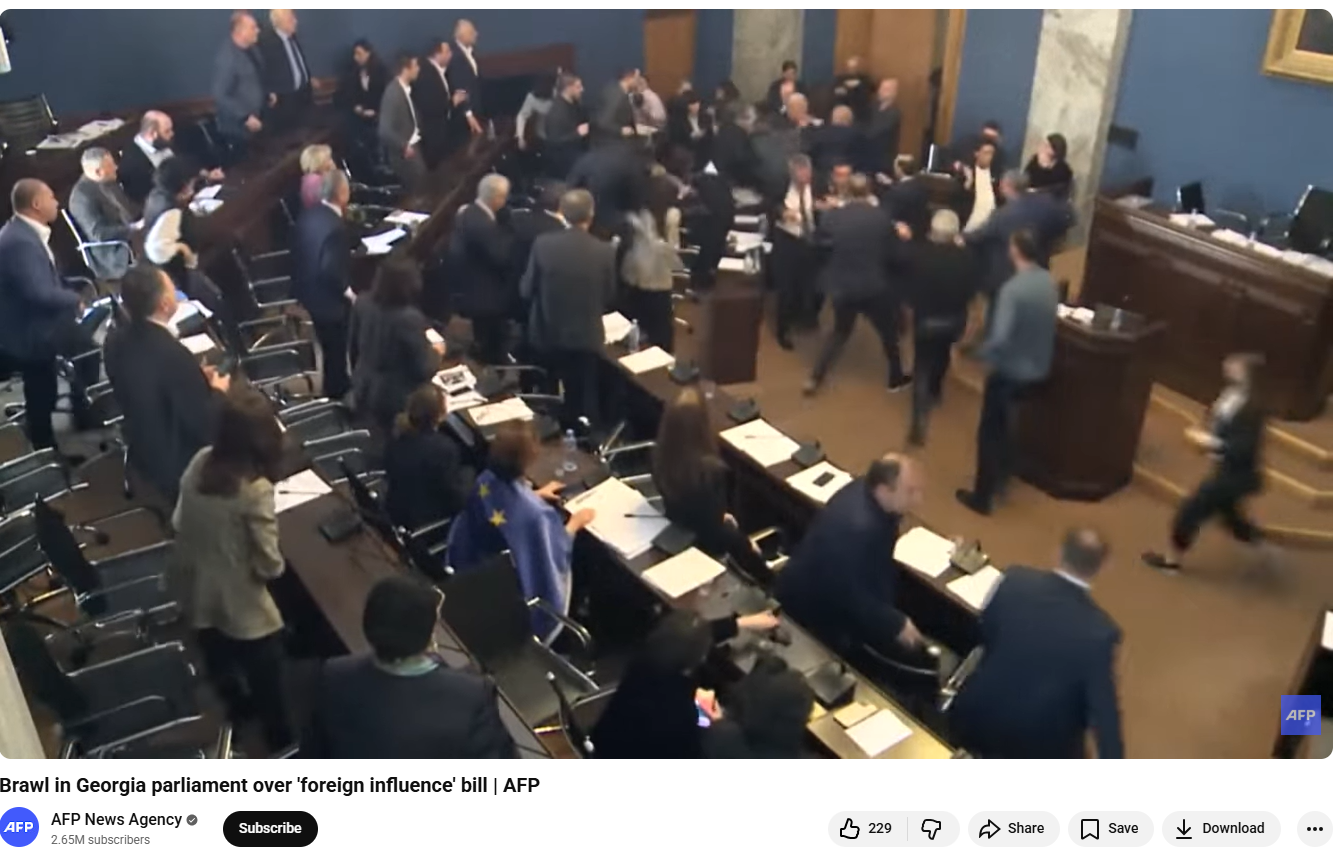
We extracted keyframes from the first viral clip and conducted a reverse image search. The footage was found on the YouTube channel of AFP News Agency, uploaded on April 15, 2024. According to the report, the video shows a scuffle inside the parliament of Georgia. The clash broke out after the government reintroduced a controversial bill, during which an opposition leader punched a ruling party MP, triggering chaos in the chamber.
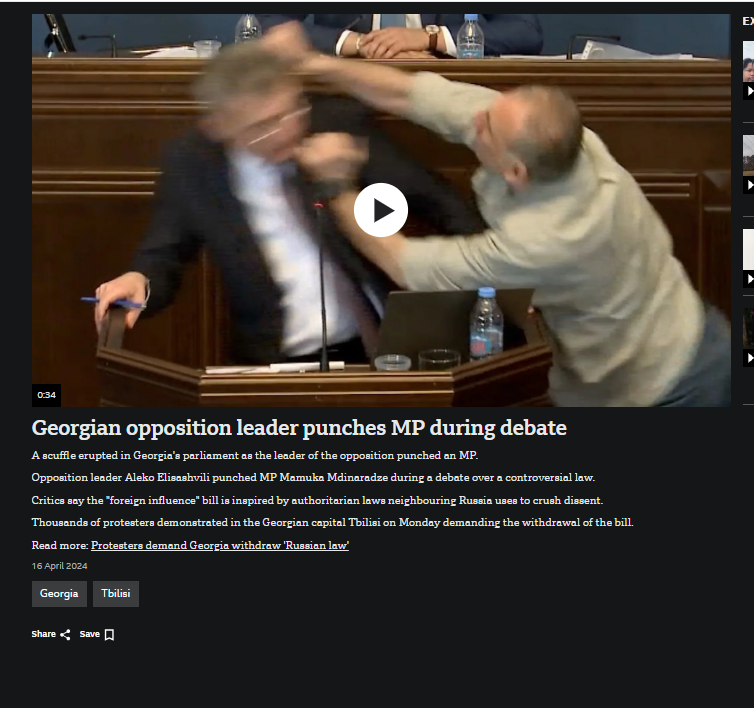
The same incident was also reported by BBC on April 16, 2024, confirming that the video is from Georgia and not Israel.
Second Video
The second video has also circulated earlier with similar claims. Verification shows that it dates back to January 2013 and is from Bulgaria. Footage uploaded by the YouTube channel “On Demand News” on January 19, 2013 shows an attack on Bulgarian political leader Ahmed Dogan, when a man pointed a gun at him before being overpowered by security personnel.

Conclusion
The viral claims are false and misleading. Neither of the videos is related to Israel. The first clip is from Georgia’s parliament in April 2024, while the second dates back to a 2013 incident in Bulgaria. Both videos have been taken out of context and falsely linked to Israel and Prime Minister Benjamin Netanyahu to mislead viewers.
There is no evidence of any such attack in Israel’s parliament or on its prime minister as claimed. Users are advised to verify information before sharing such content, especially during sensitive geopolitical situations.

Related Blogs
Introduction
In today’s digital world, data has emerged as the new currency that influences global politics, markets, and societies. Companies, governments, and tech behemoths aim to control data because it accords them influence and power. However, a fundamental challenge brought about by this increased reliance on data is how to strike a balance between privacy protection and innovation and utility.
In recognition of these dangers, more than 200 Nobel laureates, scientists, and world leaders have recently signed the Global Call for AI Red Lines. Governments are urged by this initiative to create legally binding international regulations on artificial intelligence by 2026. Its goal is to stop AI from going beyond moral and security bounds, particularly in areas like political manipulation, mass surveillance, cyberattacks, and dangers to democratic institutions.
One way to address the threat to privacy is through pseudonymization, which makes it possible to use data valuable for research and innovation by substituting personal identifiers for artificial ones. Pseudonymization thus directly advances the AI Red Lines initiative's mission of facilitating technological advancement while lowering the risks of data misuse and privacy violations.
The Red Lines of AI: Why do they matter?
The Global Call for AI Red Lines initiative represents a collective attempt to impose precaution before catastrophe, which was done with the objective of recognising the Red Lines in the use of AI tools. Thus, anything that unites the risks of using AI is due to the absence of global safeguards. Some of these Red Lines can be understood as;
- Cybersecurity breaches in the form of exposure of financial and personal data due to AI-driven hacking and surveillance.
- Occurrence of privacy invasions due to endless tracking.
- Generative AI can also help to create realistic fake content, undermining the trust of public discourses, leading to misinformation.
- Algorithmic amplification of polarising content can also threaten civic stability, leading to a demographic disruption.
Legal Frameworks and Regulatory Landscape
The regulations of Artificial Intelligence stand fragmented across jurisdictions, leaving significant loopholes aside. Some of the frameworks already provide partial guidance. The European Union’s Artificial Intelligence Act 2024 bans “unacceptable” AI practices, whereas the US-China Agreement also ensures that nuclear weapons remain under human, not machine-controlled. The UN General Assembly has adopted resolutions urging safe and ethical AI usage, with a binding and elusive global treaty.
On the front of data protection, the General Data Protection Regulations (GDPR) of EU offers a clear definition of Pseudonymisation under Article 4(5). It also describes a process where personal data is altered in a way that it cannot be attributed to an individual without additional information, which must be stored securely and separately. Importantly, pseudonymised data still qualifies as “personal data” under GDPR. However, India’s Digital Personal Data Protection Act (DPDP) 2023 adopts a similar stance. It does not explicitly define pseudonymisation in broad terms, such as “personal data” by including potentially reversible identifiers. According to Section 8(4) of the Act, companies are meant to adopt appropriate technical or organisational measures. International bodies and conventions like the OECD Principles on AI or the Council of Europe Convention 108+ emphasize accountability, transparency, and data minimisation. Collectively, these instruments point towards pseudonymization as a best practice, though interpretations of its scope differ.
Strategies for Corporate Implementation
For a company, pseudonymisation is not just about compliance, it is also a practical solution that offers measurable benefits. By pseudonymising data, businesses can get benefits, such as;
- Enhancing Privacy protection by masking identifiers like names or IDs by reducing the impact of data breaches.
- Preserving Data Utility, unlike having a full anonymisation, pseudonymisation also retains patterns that are essential for analytical innovation.
- Facilitating data sharing can allow organizations to collaborate with their partners and researchers while maintaining proper trust.
According to these benefits, competitive advantages get translated to clauses where customers find it more likely to trust organizations that prioritise data protection, while pseudonymisation further enables the firms to engage in cross-border collaboration without violating local data laws.
Balancing Privacy Rights and Data Utility
Balancing is a central dilemma; on one side lies the case of necessity over data utility, where companies, researchers and governments rely on large datasets to enhance the scale of AI innovation. On the other hand lies the question of the right to privacy, which is a non-negotiable principle protected under the international human rights law.
Pseudonymisation offers a practical compromise by enabling the use of sensitive data while reducing the privacy risks. Taking examples of different domains, such as healthcare, it allows the researchers to work with patient information without exposing identities, whereas in finance, it supports fraud detection without revealing the customer details.
Conclusion
The rapid rise of artificial intelligence has led to the outpacing of regulations, raising urgent questions related to safety, fairness and accountability. The global call for recognising the AI red lines is a bold step that looks in the direction of setting universal boundaries. Yet, alongside the remaining global treaties, practical safeguards are also needed. Pseudonymisation exemplifies such a safeguard, which is legally recognised under the GDPR and increasingly relevant in India’s DPDP Act. It balances the twin imperatives of privacy, protection, and data utility. For organizations, adopting pseudonymisation is not only about ensuring regulatory compliance, rather, it is also about building trust, ensuring resilience, and aligning with the broader ethical responsibilities in this digital age. As the future of AI is debatable, the guiding principles also need to be clear. By embedding techniques for preserving privacy, like pseudonymisation, into AI systems, we can take a significant step towards developing a sustainable, ethical and innovation-driven digital ecosystem.
References
https://www.techaheadcorp.com/blog/shadow-ai-the-risks-of-unregulated-ai-usage-in-enterprises/
https://planetmainframe.com/2024/11/the-risks-of-unregulated-ai-what-to-know/
https://cepr.org/voxeu/columns/dangers-unregulated-artificial-intelligence
https://www.forbes.com/sites/bernardmarr/2023/06/02/the-15-biggest-risks-of-artificial-intelligence/

Executive Summary:
A video showing a peacock allegedly trapped in ice has been going viral on social media. In the clip, the peacock appears to be frozen in a snow-covered area. Moments later, a man is seen approaching with a hammer and breaking the ice to rescue the bird. Social media users are sharing the video as a real-life incident, praising the peacock’s resilience and describing the scene as inspiring. However, CyberPeace research found the viral claim to be misleading. Our research revealed that the video was created using Artificial Intelligence (AI) and is being falsely circulated as a real incident.
Claim:
Facebook user ‘Ras Bihari Pathak’ shared the viral video on January 25, 2026, with the caption: “This peacock is not standing on ice, but on courage. It reminds us that no matter how harsh the circumstances are, hope always returns in colours.” The archived version of the post can be accessed here.

Fact Check:
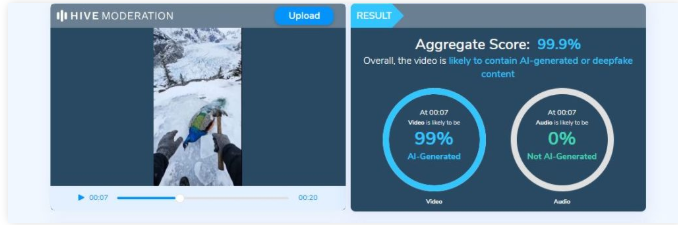
To verify the claim, we first conducted a keyword search on Google to check whether any such real incident involving a peacock trapped in ice had been reported. However, no credible or verified media reports were found. Next, we closely examined the viral video. Upon observation, the peacock’s movements and reactions appeared unnatural and artificial. The motion lacked realistic physical behaviour, raising suspicion that the video might have been digitally generated. To confirm this, we analysed the clip using the AI video detection tool Hive Moderation, which indicated a 99 per cent or higher likelihood that the video was AI-generated.
Conclusion:
CyberPeace research confirms that the viral video showing a peacock allegedly trapped in ice is not real. The clip has been created using Artificial Intelligence and is being shared on social media with a false and misleading claim.
.webp)
Introduction
The rise of misinformation, disinformation, and synthetic media content on the internet and social media platforms has raised serious concerns, emphasizing the need for responsible use of social media to maintain information accuracy and combat misinformation incidents. With online misinformation rampant all over the world, the World Economic Forum's 2024 Global Risk Report, notably ranks India amongst the highest in terms of risk of mis/disinformation.
The widespread online misinformation on social media platforms necessitates a joint effort between tech/social media platforms and the government to counter such incidents. The Indian government is actively seeking to collaborate with tech/social media platforms to foster a safe and trustworthy digital environment and to also ensure compliance with intermediary rules and regulations. The Ministry of Information and Broadcasting has used ‘extraordinary powers’ to block certain YouTube channels, X (Twitter) & Facebook accounts, allegedly used to spread harmful misinformation. The government has issued advisories regulating deepfake and misinformation, and social media platforms initiated efforts to implement algorithmic and technical improvements to counter misinformation and secure the information landscape.
Efforts by the Government and Social Media Platforms to Combat Misinformation
- Advisory regulating AI, deepfake and misinformation
The Ministry of Electronics and Information Technology (MeitY) issued a modified advisory on 15th March 2024, in suppression of the advisory issued on 1st March 2024. The latest advisory specifies that the platforms should inform all users about the consequences of dealing with unlawful information on platforms, including disabling access, removing non-compliant information, suspension or termination of access or usage rights of the user to their user account and imposing punishment under applicable law. The advisory necessitates identifying synthetically created content across various formats, and instructs platforms to employ labels, unique identifiers, or metadata to ensure transparency.
- Rules related to content regulation
The Information Technology (Intermediary Guidelines and Digital Media Ethics Code) Rules, 2021 (Updated as on 6.4.2023) have been enacted under the IT Act, 2000. These rules assign specific obligations on intermediaries as to what kind of information is to be hosted, displayed, uploaded, published, transmitted, stored or shared. The rules also specify provisions to establish a grievance redressal mechanism by platforms and remove unlawful content within stipulated time frames.
- Counteracting misinformation during Indian elections 2024
To counter misinformation during the Indian elections the government and social media platforms made their best efforts to ensure the electoral integrity was saved from any threat of mis/disinformation. The Election Commission of India (ECI) further launched the 'Myth vs Reality Register' to combat misinformation and to ensure the integrity of the electoral process during the general elections in 2024. The ECI collaborated with Google to empower the citizenry by making it easy to find critical voting information on Google Search and YouTube. In this way, Google has supported the 2024 Indian General Election by providing high-quality information to voters and helping people navigate AI-generated content. Google connected voters to helpful information through product features that show data from trusted institutions across its portfolio. YouTube showcased election information panels, featuring content from authoritative sources.
- YouTube and X (Twitter) new ‘Notes Feature’
- Notes Feature on YouTube: YouTube is testing an experimental feature that allows users to add notes to provide relevant, timely, and easy-to-understand context for videos. This initiative builds on previous products that display helpful information alongside videos, such as information panels and disclosure requirements when content is altered or synthetic. YouTube clarified that the pilot will be available on mobiles in the U.S. and in the English language, to start with. During this test phase, viewers, participants, and creators are invited to give feedback on the quality of the notes.
- Community Notes feature on X: Community Notes on X aims to enhance the understanding of potentially misleading posts by allowing users to add context to them. Contributors can leave notes on any post, and if enough people rate the note as helpful, it will be publicly displayed. The algorithm is open source and publicly available on GitHub, allowing anyone to audit, analyze, or suggest improvements. However, Community Notes do not represent X's viewpoint and cannot be edited or modified by their teams. A post with a Community Note will not be labelled, removed, or addressed by X unless it violates the X Rules, Terms of Service, or Privacy Policy. Failure to abide by these rules can result in removal from accessing Community Notes and/or other remediations. Users can report notes that do not comply with the rules by selecting the menu on a note and selecting ‘Report’ or using the provided form.
CyberPeace Policy Recommendations
Countering widespread online misinformation on social media platforms requires a multipronged approach that involves joint efforts from different stakeholders. Platforms should invest in state-of-the-art algorithms and technology to detect and flag suspected misleading information. They should also establish trustworthy fact-checking protocols and collaborate with expert fact-checking groups. Campaigns, seminars, and other educational materials must be encouraged by the government to increase public awareness and digital literacy about the mis/disinformation risks and impacts. Netizens should be empowered with the necessary skills and ability to discern fact and misleading information to successfully browse true information in the digital information age. The joint efforts by Government authorities, tech companies, and expert cyber security organisations are vital in promoting a secure and honest online information landscape and countering the spread of mis/disinformation. Platforms must encourage netizens/users to foster appropriate online conduct while using platforms and abiding by the terms & conditions and community guidelines of the platforms. Encouraging a culture of truth and integrity on the internet, honouring differing points of view, and confirming facts all help to create a more reliable and information-resilient environment.
References:
- https://www.meity.gov.in/writereaddata/files/Advisory%2015March%202024.pdf
- https://blog.google/intl/en-in/company-news/outreach-initiatives/supporting-the-2024-indian-general-election/
- https://blog.youtube/news-and-events/new-ways-to-offer-viewers-more-context/
- https://help.x.com/en/using-x/community-notes
