
From Principles to Practice: Implementing Digital Trust Standards through ISO/IEC 25389
Introduction
In July 2025, the Digital Trust & Safety Partnership (DTSP) achieved a significant milestone with the formal acceptance of its Safe Framework Specification as an international standard, ISO/IEC 25389. This is the first globally recognised standard that is exclusively concerned with guaranteeing a secure online experience for the general public's use of digital goods and services.
Significance of the New Framework
Fundamentally, ISO/IEC 25389 provides organisations with an organised framework for recognising, controlling, and reducing risks associated with conduct or content. This standard, which was created under the direction of ISO/IEC's Joint Technical Committee 1 (JTC 1), integrates the best practices of DTSP and offers a precise way to evaluate organisational maturity in terms of safety and trust. Crucially, it offers the first unified international benchmark, allowing organisations globally to coordinate on common safety pledges and regularly assess progress.
Other Noteworthy Standards and Frameworks
While ISO/IEC 25389 is pioneering, it’s not the only framework shaping digital trust and safety:
- One of the main outcomes of the United Nations’ 2024 Summit for the Future was the UN's Global Digital Compact, which describes cross-border cooperation on secure and reliable digital environments with an emphasis on countering harmful content, upholding online human rights, and creating accountability standards.
- The World Economic Forum’s Digital Trust Framework defines the goals and values, such as cybersecurity, privacy, transparency, redressability, auditability, fairness, interoperability and safety, implicit to the concept of digital trust. It also provides a roadmap to digital trustworthiness that imbibes these dimensions.
- The Framework for Integrity, Security and Trust (FIST) launched at the Cybereace Summit 2023 at USI of India in New Delhi, calls for a multistakeholder approach to co-create solutions and best practices for digital trust and safety.
- While still in the finalisation stage for implementation rollout, India's Digital Personal Data Protection Act, 2023 (DPDP Act) and its Rules (2025) aim to strike a balance between individual rights and data processing needs by establishing a groundwork for data security and privacy.
- India is developing frameworks in cutting-edge technologies like artificial intelligence. Using a hub-and-spoke model under the IndiaAI Mission, the AI Safety Institute was established in early 2025 with the goal of creating standards for trustworthy, moral, and safe AI systems. Furthermore, AI standards with an emphasis on safety and dependability are being drafted by the Bureau of Indian Standards (BIS).
- Google's DigiKavach program (2023) and Google Safety Engineering Centre (GSEC) in Hyderabad are concrete efforts to support digital safety and fraud prevention in India's tech sector.
What It Means for India
India is already claiming its place in discussions about safety and trust around the world. Google's June 2025 safety charter for India, for example, highlights how India's distinct digital scale, diversity, and vast threat landscape provide insights that inform global cybersecurity strategies.
For India's digital ecosystem, ISO/IEC 25389 comes at a critical juncture. Global best practices in safety and trust are desperately needed as a result of the rapid adoption of digital technologies, including the growth of digital payments, e-governance, and artificial intelligence and a concomitant rise in instances of digital harms. Through its guidelines, ISO/IEC 25389 provides a reference benchmark that Indian startups, government agencies, and tech companies can use to improve their safety standards.
Conclusion
A global trust-and-safety standard like ISO/IEC 25389 is essential for making technology safer for people, even as we discuss the broader adoption of security and safety-by-design principles integrated into the processes of technological product development. India can improve user protection, build its reputation globally, and solidify its position as a key player in the creation of a safer, more resilient digital future by implementing this framework in tandem with its growing domestic regulatory framework (such as the DPDP Act and AI Safety policies).
References
- https://dtspartnership.org/the-safe-framework-specification/
- https://dtspartnership.org/press-releases/dtsps-safe-framework-published-as-an-international-standard/?
- https://www.weforum.org/stories/2024/04/united-nations-global-digital-compact-trust-security/?
- https://economictimes.indiatimes.com/tech/technology/google-releases-safety-charter-for-india-senior-exec-details-top-cyber-threat-actors-in-the-country/articleshow/121903651.cms?
- https://initiatives.weforum.org/digital-trust/framework
- https://government.economictimes.indiatimes.com/news/secure-india/the-launch-of-fist-framework-for-integrity-security-and-trust/103302090

Related Blogs

Introduction
India's Computer Emergency Response Team (CERT-In) has unfurled its banner of digital hygiene, heralding the initiative 'Cyber Swachhta Pakhwada,' a clarion call to the nation's citizens to fortify their devices against the insidious botnet scourge. The government's Cyber Swachhta Kendra (CSK)—a Botnet Cleaning and Malware Analysis Centre—stands as a bulwark in this ongoing struggle. It is a digital fortress, conceived under the aegis of the National Cyber Security Policy, with a singular vision: to engender a secure cyber ecosystem within India's borders. The CSK's mandate is clear and compelling—to detect botnet infections within the subcontinent and to notify, enable cleaning, and secure systems of end users to stymie further infections.
What are Bots?
Bots are automated rogue software programs crafted with malevolent intent, lurking in the shadows of the internet. They are the harbingers of harm, capable of data theft, disseminating malware, and orchestrating cyberattacks, among other digital depredations.
A botnet infection is like a parasitic infestation within the electronic sinews of our devices—smartphones, computers, tablets—transforming them into unwitting soldiers in a hacker's malevolent legion. Once ensnared within the botnet's web, these devices become conduits for a plethora of malicious activities: the dissemination of spam, the obstruction of communications, and the pilfering of sensitive information such as banking details and personal credentials.
How, then, does one's device fall prey to such a fate? The vectors are manifold: an infected email attachment opened in a moment of incaution, a malicious link clicked in haste, a file downloaded from the murky depths of an untrusted source, or the use of an unsecured public Wi-Fi network. Each action can be the key that unlocks the door to digital perdition.
In an era where malware attacks and scams proliferate like a plague, the security of our personal devices has ascended to a paramount concern. To address this exigency and to aid individuals in the fortification of their smartphones, the Department of Telecommunications(DoT) has unfurled a suite of free bot removal tools. The government's outreach extends into the ether, dispatching SMS notifications to the populace and disseminating awareness of these digital prophylactics.
Stay Cyber Safe
To protect your device from botnet infections and malware, the Government of India, through CERT-In, recommends downloading the 'Free Bot Removal Tool' at csk.gov.in.' This SMS is not merely a reminder but a beacon guiding users to a safe harbor in the tumultuous seas of cyberspace.
Cyber Swachhta Kendra
The Cyber Swachhta Kendra portal emerges as an oasis in the desert of digital threats, offering free malware detection tools to the vigilant netizen. This portal, also known as the Botnet Cleaning and Malware Analysis Centre, operates in concert with Internet Service Providers (ISPs) and antivirus companies, under the stewardship ofCERT-In. It is a repository of knowledge and tools, a digital armoury where users can arm themselves against the specters of botnet infection.
To extricate your device from the clutches of a botnet or to purge the bots and malware that may lurk within, one must embark on a journey to the CSK website. There, under the 'Security Tools' tab, lies the arsenal of antivirus companies, each offering their own bot removal tool. For Windows users, the choice includes stalwarts such as eScan Antivirus, K7 Security, and Quick Heal. Android users, meanwhile, can venture to the Google Play Store and seek out the 'eScan CERT-IN Bot Removal ' tool or 'M-Kavach2,' a digital shield forged by C-DAC Hyderabad.
Once the chosen app is ensconced within your device, it will commence its silent vigil, scanning the digital sinews for any trace of malware, excising any infections with surgical precision. But the CSK portal's offerings extend beyond mere bot removal tools; it also proffers other security applications such as 'USB Pratirodh' and 'AppSamvid.' These tools are not mere utilities but sentinels standing guard over the sanctity of our digital lives.
USB Pratirodh
'USB Pratirodh' is a desktop guardian, regulating the ingress and egress of removable storage media. It demands authentication with each new connection, scanning for malware, encrypting data, and allowing changes to read/write permissions. 'AppSamvid,' on the other hand, is a gatekeeper for Windows users, permitting only trusted executables and Java files to run, safeguarding the system from the myriad threats that lurk in the digital shadows.
Conclusion
In this odyssey through the digital safety frontier, the Cyber Swachhta Kendra stands as a testament to the power of collective vigilance. It is a reminder that in the vast, interconnected web of the internet, the security of one is the security of all. As we navigate the dark corners of the internet, let us equip ourselves with knowledge and tools, and may our devices remain steadfast sentinels in the ceaseless battle against the unseen adversaries of the digital age.
References
- https://timesofindia.indiatimes.com/gadgets-news/five-government-provided-botnet-and-malware-cleaning-tools/articleshow/107951686.cms
- https://indianexpress.com/article/technology/tech-news-technology/cyber-swachhta-kendra-free-botnet-detection-removal-tools-digital-india-8650425/

Introduction
In June 2026, Eros Innovation launched Eros Music Worlds, describing itself as the world's first "large cultural music platform". Its first two acts, Jordan and Tanu, are not singers in any conventional sense; they are AI-native personas built from Eros's own film characters, powered by models trained on a licensed corpus of roughly 1.5 trillion cultural tokens drawn from 11,000 films. Alongside them sits a strategic partnership with the family of Mohammed Rafi, the late playback legend, to produce new recordings, a live concert franchise, and a music academy in his name. It's a tidy preview of where AI in music is actually headed: not a novelty generator bolted onto the old industry, but a new kind of media company built around owned IP, licensed data, and characters designed to outlive any single song.
Beyond the demo
The last eighteen months have produced a stream of "firsts". Xania Monet, an AI-voiced R&B act built by Mississippi poet Telisha Jones using Suno, became the first AI artist to chart on a Billboard airplay ranking and was signed by Hallwood Media after a bidding war that reportedly reached $3 million. Breaking Rust, Enlly Blue and Juno Skye followed onto country, rock and Christian charts within weeks. None of this happened in a vacuum: Suno and Udio, the two dominant AI music generators, went from being sued by every major label in mid-2024 to signing licensing settlements with Universal and Warner by late 2025. Voice cloning has run a parallel track from the viral 2023 track "Heart on My Sleeve", which mimicked Drake and The Weeknd without consent, to a wave of Indian cases where AI tools recreated a specific singer's timbre for commercial use. Composition and production tools are now routine studio infrastructure rather than curiosities; the interesting frontier has shifted to multilingual adaptation and catalogue reanimation. Eros has promised 34-language localisation for its AI artists, a scale no dubbing studio could match manually. A related, if less music-specific, signal came from Collective Artists Network's AI-powered Mahabharat: Ek Dharmayudh, produced with Prasar Bharati. AI tools handled pre-visualisation, multi-language dubbing sync and sound design, while composers and voice directors retained control of tone and emotion, a template other Indian studios are likely to copy for scoring and localising large-scale cultural content cheaply.
Where the money actually is?
The commercial case for labels isn't "AI makes music at scale", because scale alone isn't value. Deezer, the only major platform publishing detection data, reported in July 2026 that AI-generated tracks had crossed 50% of daily uploads, around 90,000 tracks a day, up from 10,000 in January 2025. Yet those tracks account for only 1–3% of actual streams, and Deezer flags 85% of that listening as fraudulent bot activity. Generating music has become nearly free; getting anyone to listen hasn't. The real opportunity for rights holders lies elsewhere: licensing catalogues into controlled ecosystems (Universal's 2026 platform with Udio, Warner's deals with both Udio and Suno), reviving legacy artists for new audiences (Eros-Rafi), and using AI for the unglamorous, high-volume work of localisation, sync placement and short-form content that never justified full production budgets before. AI-native performers also travel well into gaming, virtual concerts and brand collaboration formats built for characters rather than people, where a synthetic act never ages, never cancels a tour and can be licensed into a dozen campaigns simultaneously. That is a genuinely new revenue line, but it's a narrow one; it monetises IP ownership, not music generation itself. IFPI's Global Music Report 2026 shows the underlying business is healthy: revenues reached $31.7 billion, up 6.4% — but that growth is still driven overwhelmingly by human catalogues and paid subscriptions, not AI-generated volumes.
The legal fault lines
This is where India's position is genuinely instructive and unresolved. The Copyright Act, 1957, defines the author of a "computer-generated" work as the person who causes it to be created (language added in 1994 for a world of human-directed software, not autonomous generative models), and Indian courts haven't yet settled how far it stretches. What's clearer is the industry's stance on training data: The Indian music industry body, alongside T-Series, Saregama and Sony Music, has sought to join the ANI Media suit against OpenAI in the Delhi High Court, arguing that scraping sound recordings to train models without a licence breaches copyright, a case they say is "crucial for the entire music industry in India, and even worldwide".
Personality rights have moved faster than legislation. In the absence of a dedicated statute, Indian courts have built protection case by case: the Delhi High Court's 2023 order shielding Anil Kapoor's voice and likeness from AI misuse and the Bombay High Court's 2024 ruling in Arijit Singh v Codible Ventures, India's first AI voice-cloning judgement, which granted an injunction spanning every medium, explicitly including the metaverse and generative-AI tools, and rejected fair-use and parody defences outright. Similar orders have since followed for Amitabh Bachchan, Aishwarya Rai Bachchan and others. The pattern mirrors, but predates, statutory responses abroad: Tennessee's 2024 ELVIS Act was the first US law to protect voice explicitly as property, and the federal NO FAKES Act remains pending. The US Copyright Office's January 2025 report reaffirmed that human authorship is the bedrock of copyrightability, denying protection to fully AI-generated output while leaving substantially human-directed hybrid works to case-by-case review. Two regimes are converging on the same instinct that consent and human contribution must anchor ownership through different legal tools: India via judge-made personality rights and the US via statute and Copyright Office guidance.
Who bears the risk?
The disruption isn't evenly spread. Session singers, jingle artists, dubbing performers and early-career composers, the layer of the industry that supplies craft rather than fame, are most exposed since their work is precisely what generative tools now approximate cheaply. A PRS for Music survey of over 2,600 creators found 79% worried about AI competing directly with their output and 76% expecting it to hurt their livelihoods. CISAC has projected AI could erode musicians' incomes by nearly a quarter by 2028. Separately, roughly a fifth of professional voice actors surveyed say they've already lost work to a synthetic voice. For streaming platforms, the risk is structural: as AI supply floods catalogues, royalty pools shared across all streams get diluted, discoverability worsens, and fraud bot streams on AI tracks are designed purely to harvest royalties, which becomes a live threat to the economics everyone else depends on.
Recommendations
None of this points to AI simply replacing musicians, nor to it staying a background production tool. A third category is emerging AI-native "characters" with continuity, backstory and owned IP, closer to franchise properties than bands, which is exactly the model Eros and Hallwood Media are betting on. The deeper shift underneath it is economic: once the marginal cost of producing a new track approaches zero, the constraint on the industry stops being supplied and becomes attention. Whether AI-native artists become a durable category depends on questions still unresolved, training data legality chief among them, and on whether audiences keep listening once the novelty fades. Deezer's own research found 97% of listeners can't reliably distinguish AI from human music, yet 52% still believe fully AI-generated songs shouldn't sit on the same charts as human ones. Provenance matters even when perception can't detect it.
Conclusion
Scarcity in the age of AI will not be creative output but genuine human connection. As AI makes music production abundant and inexpensive, the qualities it cannot replicate authenticity, lived experience, artistic identity, and trust – become increasingly valuable. Audiences will continue to seek creators with compelling stories and meaningful live experiences. In an era of infinite synthetic content, originality is no longer the premium; credibility, human presence, and emotional connection are.
Sources
- https://www.livemint.com/industry/media/ai-music-ai-native-artists-eros-music-worlds-eros-innovation-copyright-intellectual-property-music-industry-11785053693997.html
- https://www.facebook.com/KJSIMofficial/posts/the-mint-featured-insights-from-dr-alka-agarwal-assistant-professor-general-mana/1375301184595168/
- https://www.linkedin.com/posts/livemint_how-ai-brought-the-mahabharat-to-life-collective-activity-7389643662193999873-6BKG
- https://musically.com/2026/07/02/ai-powered-platform-eros-music-worlds-is-turning-film-characters-into-virtual-singers/
- https://www.business-standard.com/companies/news/bollywood-t-series-saregama-sony-music-copyright-lawsuit-openai-delhi-hc-125021400876_1.html
Executive Summary
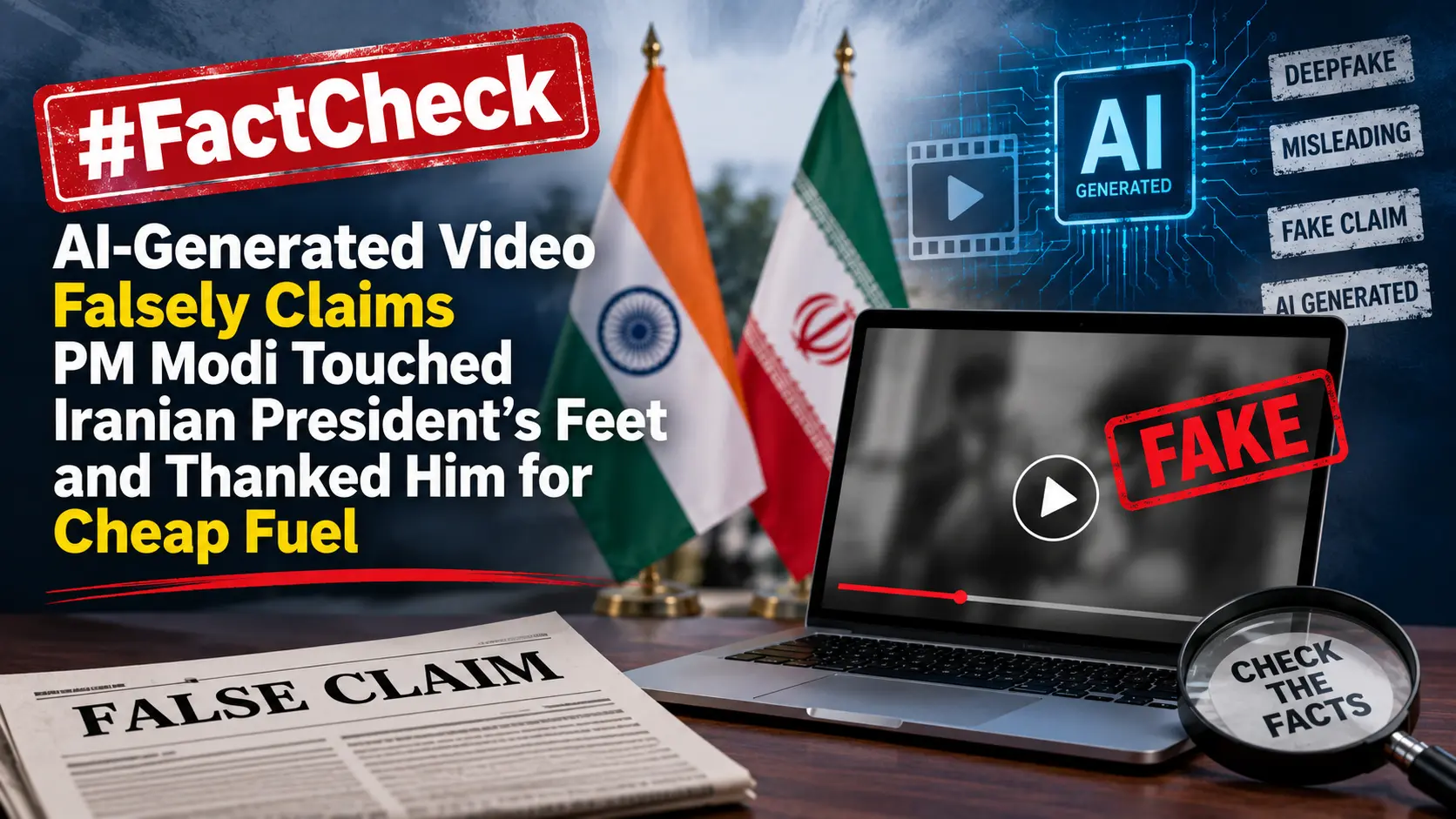
A video of Prime Minister Narendra Modi and Iranian President Masoud Pezeshkian is being shared on social media with the claim that the Prime Minister touched the Iranian President’s feet and thanked him for providing gas, petrol and diesel to India at cheap prices. The post links the video to the 2026 BRICS Summit and claims that the two leaders had this conversation during the summit. CyberPeace Research Wing’s research found that the viral video is not authentic and is AI-generated.It is worth noting that Prime Minister Narendra Modi and Iranian President Masoud Pezeshkian held a bilateral meeting on September 11, 2026, on the sidelines of the BRICS Summit in New Delhi. According to the Prime Minister’s Office, the two leaders discussed various aspects of bilateral relations, the situation in West Asia, the safety of maritime routes, and the need to ensure peace and stability in the region.
During the meeting, Prime Minister Modi thanked Iran for its regular and high-level participation in BRICS-related meetings. He also thanked President Pezeshkian for participating in the Leaders’ Session of the BRICS Business Forum. However, the official statement issued by the Prime Minister’s Office makes no mention of Modi thanking the Iranian President for providing gas, petrol, diesel or oil at cheap prices.
Claim:
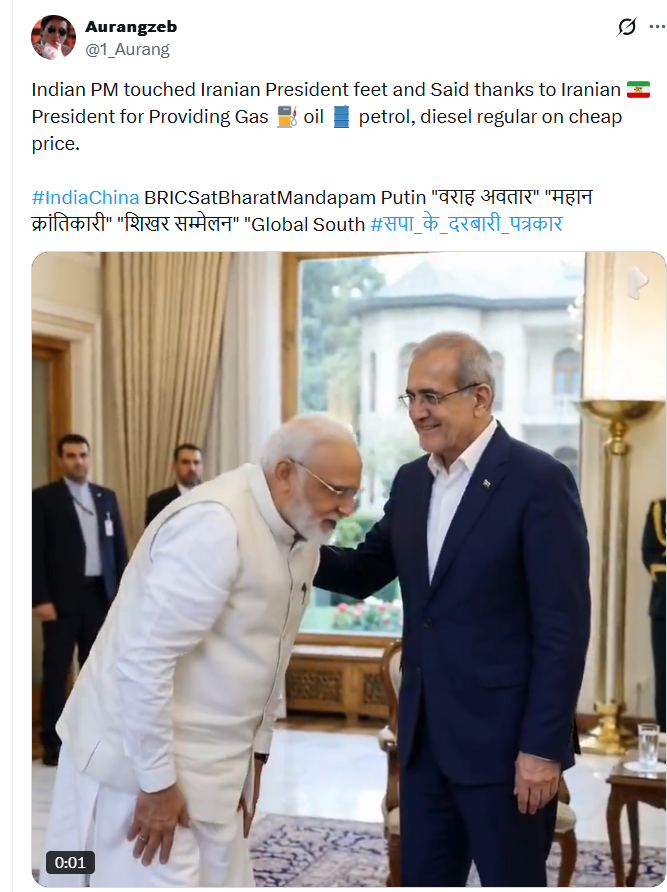
Prime Minister Narendra Modi touched the feet of Iranian President Masoud Pezeshkian and thanked him for providing gas, oil, petrol and diesel to India at cheap prices.
https://x.com/1_Aurang/status/2099001779719749833
Fact Check:
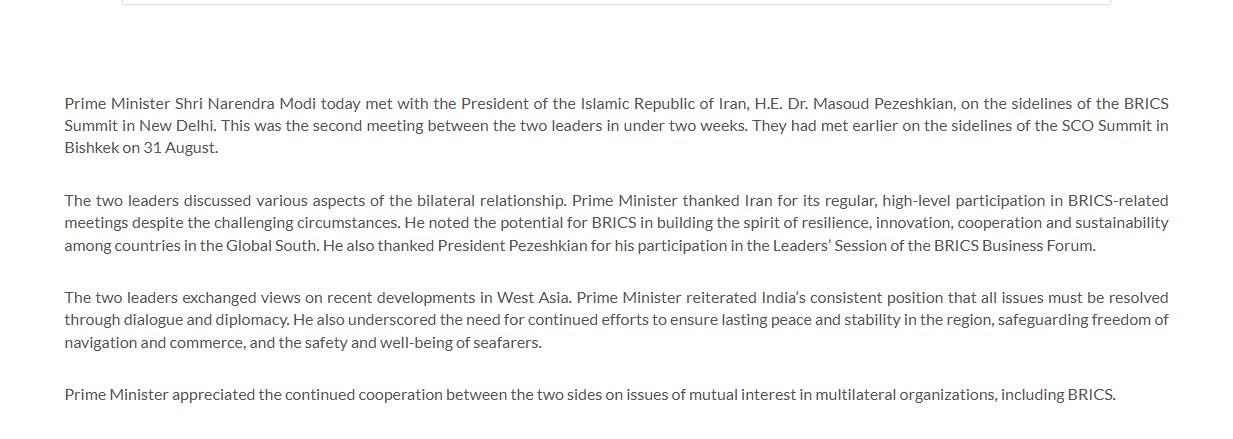
To verify the authenticity of the viral claim, we conducted a Google search using relevant keywords. However, we did not find any credible media report supporting the claim.As part of our research, we found a press release published on the Prime Minister’s Office (PMO) website on September 11, 2026. The release provides details of the meeting between Prime Minister Narendra Modi and Iranian President Masoud Pezeshkian on the sidelines of the BRICS Summit. According to the press release, Prime Minister Modi thanked President Pezeshkian for Iran’s regular and high-level participation in BRICS-related meetings. He also thanked Pezeshkian for participating in the Leaders’ Session of the BRICS Business Forum.The two leaders also discussed bilateral relations and recent developments in West Asia. Prime Minister Modi reiterated India’s position that all issues should be resolved through dialogue and diplomacy and stressed the need to ensure peace and stability in the region. However, the press release makes no mention of Prime Minister Modi thanking the Iranian President for providing gas, oil, petrol or diesel at cheap prices.
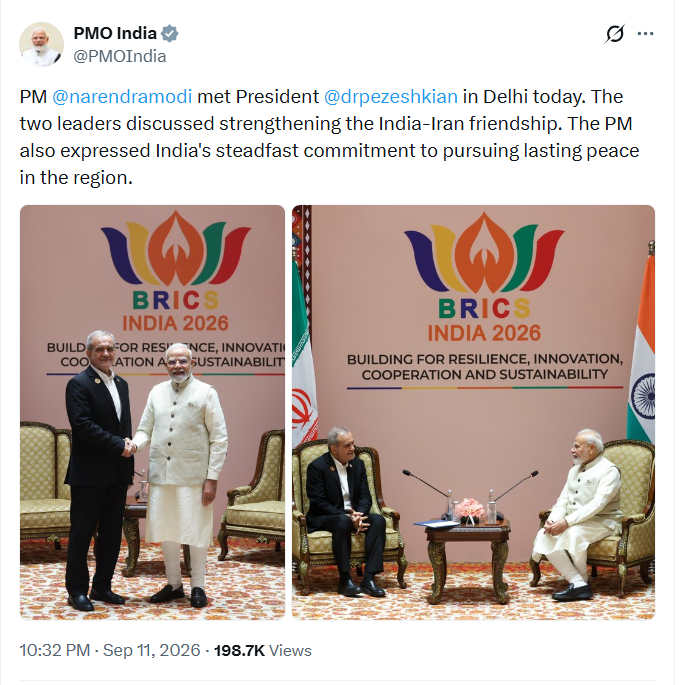
As part of our further research, we found the original photograph of the two leaders on the official X handle of the Prime Minister’s Office (PMO). The photograph shows Prime Minister Narendra Modi and Iranian President Masoud Pezeshkian shaking hands with each other.
https://x.com/PMOIndia/status/2098457126842851492?s=20
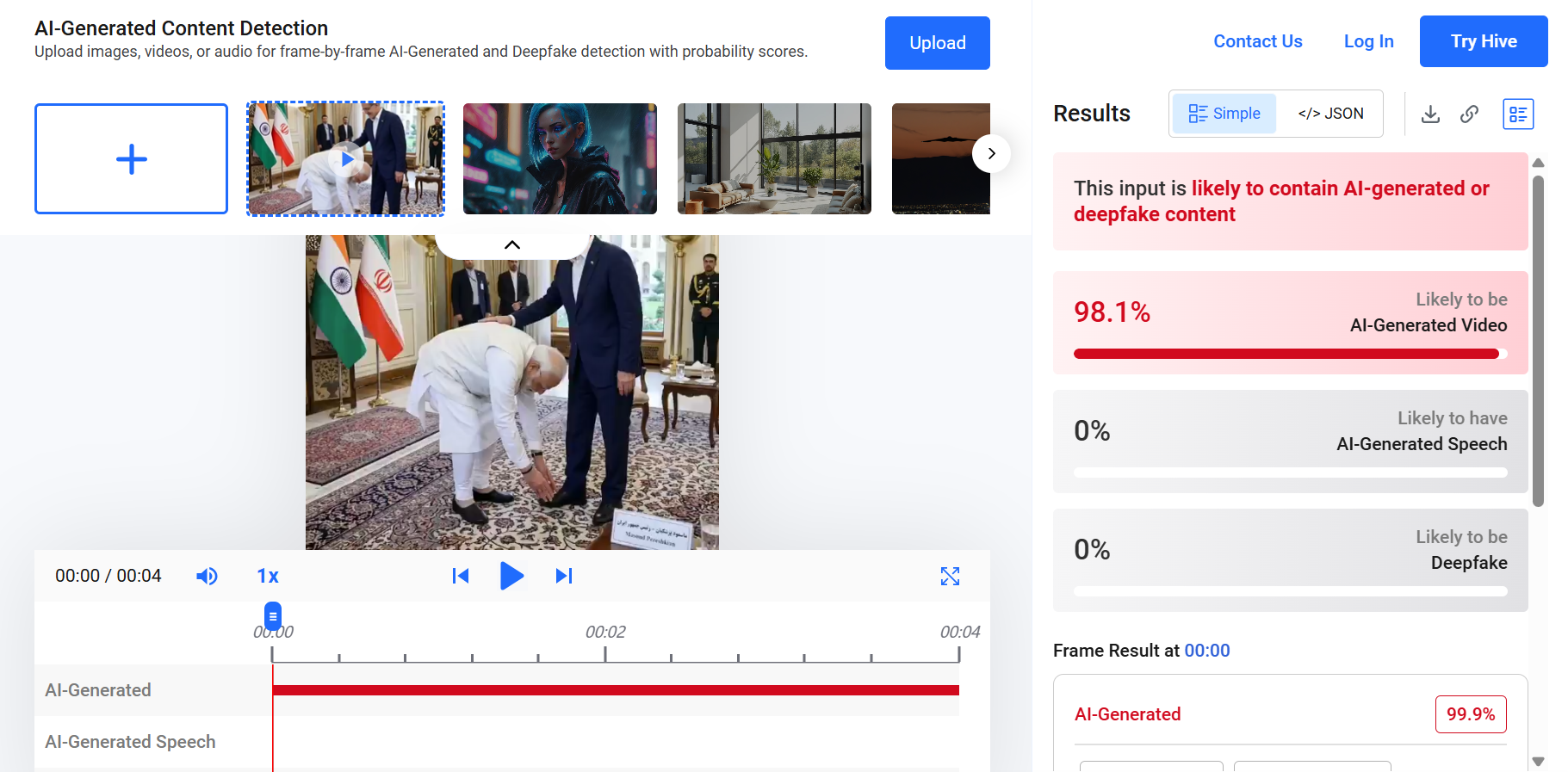
We then examined the video closely and noticed several visual inconsistencies. We subsequently scanned the video using the AI detection tool Hive Moderation. According to the results, the viral video has a 98% probability of being AI-generated.
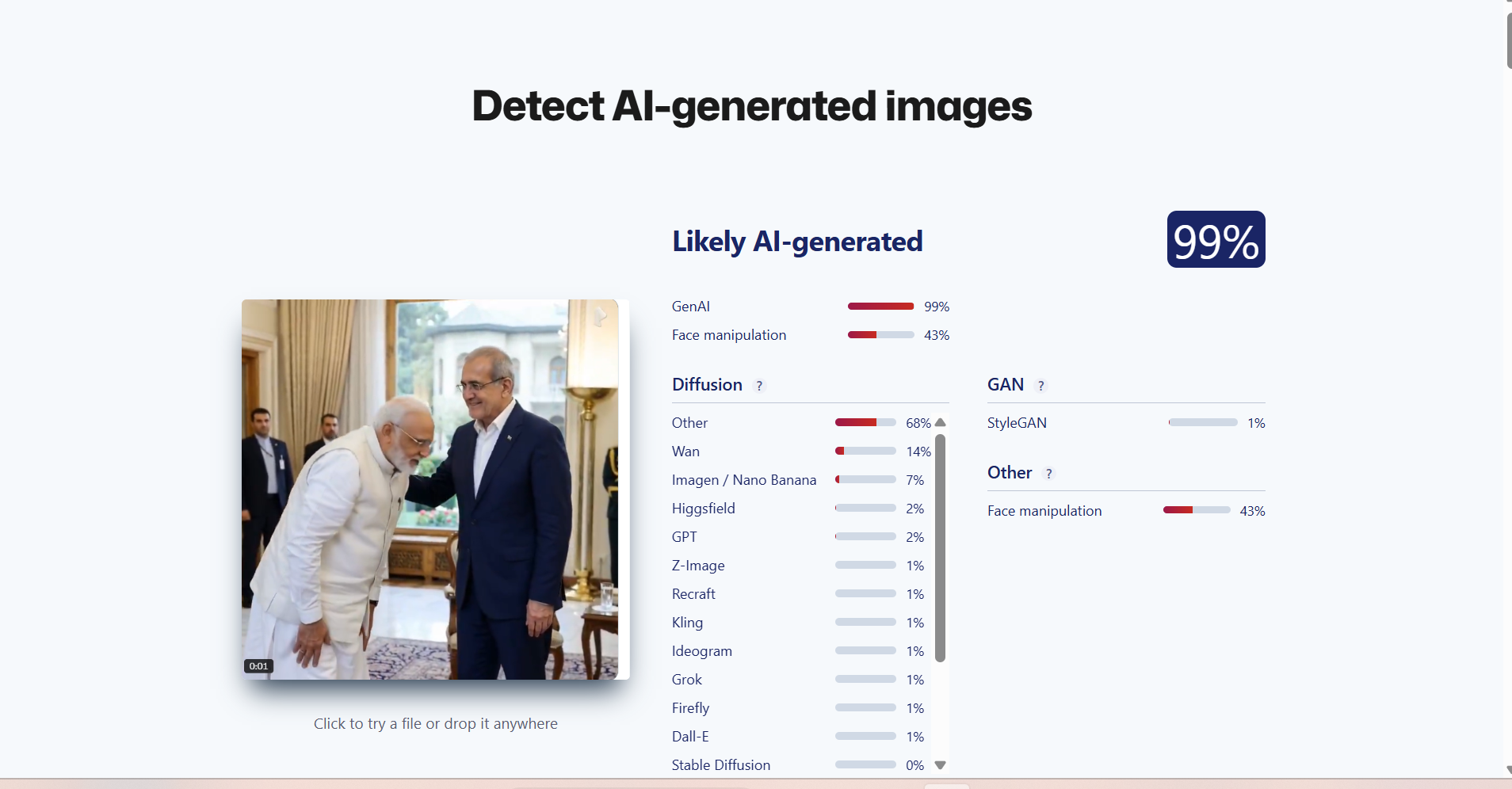
We also scanned the video using another AI detection tool, Sightengine. According to the results, the viral video has a 99% probability of being AI-generated.
Conclusion
Our research found that the viral claim is false. The video claiming that Prime Minister Narendra Modi touched Iranian President Masoud Pezeshkian’s feet and thanked him for providing cheap gas, oil, petrol and diesel to India is AI-generated and does not show a genuine interaction between the two leaders. Our research found several visual inconsistencies in the video. The findings were further supported by AI detection tools, with Hive Moderation identifying a 98% probability of AI generation, while Sightengine indicated a 99% probability. Furthermore, the official information released by the Prime Minister’s Office regarding Modi’s meeting with Pezeshkian contains no reference to the Prime Minister thanking Iran for providing fuel at cheap prices. Therefore, the video is being circulated on social media with a false and misleading claim.
