
#FactCheck -Viral Video of General Manoj Pande Misleading, Audio Found to Be AI-Generated
Executive Summary:
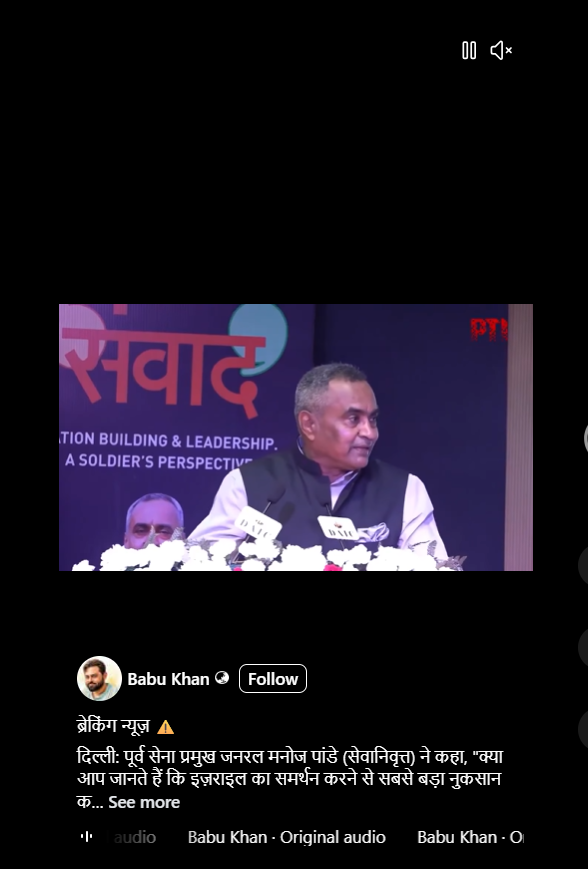
A video of former Army Chief General Manoj Pande is going viral on social media with the claim that he attacked the Modi government, saying that supporting Israel is causing significant harm to the Indian Army. The research by CyberPeace revealed that the audio present in the viral video is AI-generated. No such statement was made in the original video.
Claim:
On social media platform X, while sharing the viral video, users wrote, “Delhi: Former Army Chief General Manoj Pande (Retd.) said, ‘Do you know what the biggest loss of supporting Israel is? Our Indian Army was always trained as a moral force, but the current situation is turning it into an ethnic force. Remember my words, this situation is moving towards a complete rebellion. We have all seen what is happening in Assam.’ ‘The Israeli army stands against humanity, and brutality has become its identity. Our army is becoming like them due to its association. The Modi government and the Sangh Parivar are responsible for this. For both, Israel is an ideal country, and they are running an agenda to turn India into Israel.’”
Fact Check:
In the research of the viral video claiming that former Army Chief General Manoj Pande attacked the Modi government, we conducted a reverse image search with the help of keyframes. During this process, we found a video uploaded on March 14 on the X account of the news agency Press Trust of India (PTI).
The visuals present in the video matched those in the viral video.
In this video, former Army Chief General Manoj Pande was seen delivering a speech in Marathi and English. However, during this, he was talking about increasing new kinds of capabilities in view of the current situation and not mentioning Israel, as claimed in the viral video. In the approximately 1 minute 15 seconds long video, he did not give any such statement as present in the viral video.

While taking the research forward, we found a report published on March 15, 2026, on the website of ThePrint. This report mentioned the speech delivered by former Army Chief General Manoj Pande, but no report mentioned the statement shown in the viral video.
Conclusion:
Our research found that the audio present in the viral video is AI-generated. In the original video, he did not make any such statement.

Related Blogs

Executive Summary
Iran’s official news agencies have denied claims that senior officials, including Foreign Minister Abbas Araghchi and Parliament Speaker Mohammad Bagher Ghalibaf, have arrived in Pakistan for talks. A senior official told Iran’s Tasnim News Agency that Tehran is considering Pakistan’s proposal for peace talks, but any dialogue would depend on the United States fulfilling its commitment to halt military actions on all fronts.
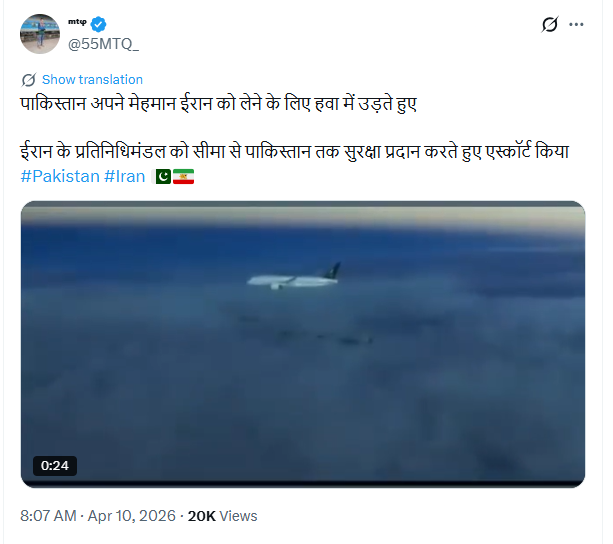
Notably, the United States and Iran had agreed to a two-week ceasefire on April 8, 2026, with discussions reportedly scheduled for April 11 in Islamabad. Amid this backdrop, a video showing fighter jets escorting a large aircraft is being widely circulated on social media. Users claim that Pakistan deployed these jets to escort an Iranian delegation into the country.
However, an research by the CyberPeace found the claim to be false. The viral video is not recent and dates back to 2019.
Claim
An X (formerly Twitter) user shared the video claiming that Pakistan Air Force jets were escorting an Iranian delegation into Pakistan.
Fact Check
Reverse image search of keyframes from the viral video led us to a February 18, 2019 report by Radio Free Europe/Radio Liberty. The report stated that the fighter jets were deployed by Pakistan to escort the aircraft of Saudi Crown Prince Mohammed bin Salman during his visit to Pakistan on February 17, 2019.

Further verification led us to the same footage uploaded on YouTube by the channel “SCMP Archive” on July 6, 2020. At the time, Pakistan’s Air Force had described the escort as part of a ceremonial welcome tradition for visiting dignitaries.

Conclusion
The viral claim is misleading. The video does not show Pakistani fighter jets escorting an Iranian delegation amid ongoing ceasefire talks. Instead, it is an old clip from 2019, when Pakistan deployed JF-17 fighter jets to welcome Saudi Crown Prince Mohammed bin Salman during his official visit. There is no evidence linking the video to current geopolitical developments involving Iran and Pakistan. The footage has been taken out of context and reshared with a false narrative to mislead viewers.
.webp)
Introduction
Meta Platforms is experiencing a long-term surge of lawsuits that not only question particular practices, but also the very design and governance of its platforms, across the United States and beyond. This range of privacy breaches to youth mental health damages and antitrust issues are all indicative of a new era of judicial, regulatory, and civil society scrutiny of the duties of big tech firms. The main question is no longer whether harmful content is placed on platforms, but to what extent they are actively creating harm-producing environments.
From Content to Conduct: A Turning Point in Legal Strategy
Over the years, Meta and other sites have depended on legal safeguards like the US Communications Decency Act, Section 230, which protects companies against liability due to user-created content. New ways of testing that protection are now being tried.
Recent incidents have shifted off the blame of particular content and has placed the emphasis on the design of the platform. Courts are becoming more receptive to consider whether the characteristics of infinite scroll, algorithmic amplification, and engagement-based ranking systems are contributing to quantifiable harm.
In March 2026, a California jury declared that Meta and Google were negligent in creating platforms that led to youth addiction and mental health problems. The jury decided that Meta and Google were to pay off a joint sum of 6 million dollars in damages, with 70 percent of the sum being charged on Meta. It is a bellwether case, which means that it is related to about 2,000 other pending cases by parents and school districts. This change is important as it avoids legal barriers. When the liability is linked to the design decisions instead of user-created content, accountability begins to shift.
The Youth Harm Cases: A Big Tobacco Moment
Social media are becoming the subject of increased scrutiny by courts and regulators as products that have quantifiable psychological impacts. The most impactful group of lawsuits against Meta is, perhaps, the one concerning youth mental health.
A day prior to the California verdict, a New Mexico jury ordered Meta to pay $375 million in damages due to failure to safeguard young users against child predators on Instagram and Facebook, and found that the company had lied to consumers about the safety of its products and violated state consumer protection laws.
Similar arguments have been presented in other lawsuits filed by attorneys general in over 30 states, and the cases reflect previous regulatory turning points in other industries such as tobacco. The question that courts are not merely asking is whether there is harm or not. They are questioning whether businesses were aware of creating systems that capitalize on behavioral weaknesses. It has been reported in internal documents and accounts of former employees that Meta made a profit by intentionally turning its platforms into addictions to children, with algorithmic functions tailored to drive users into engagement loops, maximising time on platform to the detriment of wellbeing.
Meta has refuted these characterisations, claiming that teen mental health is multifaceted and cannot be blamed on an individual app. The companies have indicated that they will appeal the verdicts.
Privacy and Data Misuse: An Ongoing Fault Line
Platform design is not the only issue that Meta faces in legal matters. Cases centered on privacy have been a recurrent problem in the last ten years, and previous cases have claimed that Facebook monitored users even after they have logged out, scanned personal messages, and utilized personal data in a manner that was beyond user expectations. In more recent times, in April 2026, a class action suit was filed claiming that WhatsApp messages were accessed by Meta employees and third-party contractors, despite the long-standing end-to-end encryption guarantees of the platform.
These instances indicate a structural problem that is consistent. Consent mechanisms and privacy policies tend to be out of date with the reality of data use, and the gap between legal compliance and what users actually know or expect.
Antitrust: A Win, But Not a Clean One
One of the legal fronts was Meta all the way. In November 2025, a judge in the US District Court, James Boasberg, declared that Meta was not a social networking monopoly, finding that the FTC did not demonstrate that the acquisitions of Instagram and WhatsApp by the company were against the antitrust law. The decision has since been appealed by the FTC, which continues to argue that "Meta broke our antitrust laws by acquiring Instagram and WhatsApp, and that American consumers have been harmed by it.
The case also demonstrates a significant drawback of the antitrust law as a form of regulation of tech companies. By the time the trial occurred five years after the lawsuit was initiated, the social media market had evolved such that Tik Tok was a major competitor, undermining the market definition claims of the FTC. The structural issue of whether a few platforms are too powerful in the communication of the masses is not answered, although the legal claim in this instance might have been unsuccessful.
Policy Takeaways: What This Means Going Forward
The accumulating number of lawsuits against Meta provides a number of valuable lessons to policymakers.
- Platform design has become a regulatory topic. Laws should go beyond content regulation and deal with the construction of systems. Engagement maximising features can also increase harm, and this trade-off must be governed explicitly.
- Transparency should be mandatory and not discretionary. Privacy policies and disclosures on platforms are usually too complicated or ambiguous. Regulators might be required to make more transparent and standardised disclosures regarding the use of data and the operation of recommendation systems.
- Section 230 safeguards are under reinterpretation. Courts are becoming open to restrict immunity in cases where the harm is associated with the conduct of the platform and not the content of the user. This would redefine the law of all digital platforms, and not only Meta.
- Cross-border coordination is needed. Meta is an international company, yet the regulatory reaction is still divided. This will require more coordination among jurisdictions to guarantee uniform enforcement and to eliminate regulatory arbitrage.
Conclusion
The lawsuits of Meta are not single cases. They are a more general reconsideration of the regulation of digital platforms and the accountability of those responsible when design decisions have harm at scale. In the wider context of the technology ecosystem, the implications are structural. Courts are starting to question not only what is hosted on them, but how they work and why they are constructed in the manner they are.
The age of minimal responsibility is being supplanted by a more challenging requirement: that platforms should foresee, quantify, and alleviate the harms they produce. The result of these cases will not only decide the future of Meta in terms of legal matters. They will influence the regulations of the digital economy in the years to come.
References
- https://www.npr.org/2026/03/25/nx-s1-5746125/meta-youtube-social-media-trial-verdict
- https://www.pbs.org/newshour/show/jury-finds-meta-and-youtube-liable-in-landmark-youth-addiction-case
- https://www.cbsnews.com/news/meta-ftc-whatsapp-instagram/
- https://www.cnbc.com/2026/01/20/ftc-appeals-metaruling-antitrust-instagram-whatsapp.html
- https://www.bbc.com/news/articles/czjw0zgz9zyo
.jpg)
Introduction
The Indian Cabinet has approved a comprehensive national-level IndiaAI Mission with a budget outlay ofRs.10,371.92 crore. The mission aims to strengthen the Indian AI innovation ecosystem by democratizing computing access, improving data quality, developing indigenous AI capabilities, attracting top AI talent, enabling industry collaboration, providing startup risk capital, ensuring socially-impactful A projects, and bolstering ethical AI. The mission will be implemented by the'IndiaAI' Independent Business Division (IBD) under the Digital India Corporation (DIC) and consists of several components such as IndiaAI Compute Capacity, IndiaAI Innovation Centre (IAIC), IndiaAI Datasets Platform, India AI Application Development Initiative, IndiaAI Future Skills, IndiaAI Startup Financing, and Safe & Trusted AI over the next 5 years.
This financial outlay is intended to befulfilled through a public-private partnership model, to ensure a structured implementation of the IndiaAI Mission. The main objective is to create and nurture an ecosystem for India’s AI innovation. This mission is intended to act as a catalyst for shaping the future of AI for India and the world. AI has the potential to become an active enabler of the digital economy and the Indian government aims to harness its full potential to benefit its citizens and drive the growth of its economy.
Key Objectives of India's AI Mission
● With the advancements in data collection, processing and computational power, intelligent systems can be deployed in varied tasks and decision-making to enable better connectivity and enhance productivity.
● India’s AI Mission will concentrate on benefiting India and addressing societal needs in primary areas of healthcare, education, agriculture, smart cities and infrastructure, including smart mobility and transportation.
● This mission will work with extensive academia-industry interactions to ensure the development of core research capability at the national level. This initiative will involve international collaborations and efforts to advance technological frontiers by generating new knowledge and developing and implementing innovative applications.
The strategies developed for implementing the IndiaAI Mission are via Public-Private Partnerships, Skilling initiatives and AI Policy and Regulation. An example of the work towards the public-private partnership is the pre-bid meeting that the IT Ministry hosted on 29th August2024, which saw industrial participation from Nvidia, Intel, AMD, Qualcomm, Microsoft Azure, AWS, Google Cloud and Palo Alto Networks.
Components of IndiaAI Mission
The IndiaAI Compute Capacity: The IndiaAI Compute pillar will build a high-end scalable AI computing ecosystem to cater to India's rapidly expanding AI start-ups and research ecosystem. The ecosystem will comprise AI compute infrastructure of 10,000 or more GPUs, built through public-private partnerships. An AI marketplace will offer AI as a service and pre-trained models to AI innovators.
The IndiaAI Innovation Centre will undertake the development and deployment of indigenous Large Multimodal Models (LMMs) and domain-specific foundational models in critical sectors. The IndiaAI Datasets Platform will streamline access to quality on-personal datasets for AI innovation.
The IndiaAI Future Skills pillar will mitigate barriers to entry into AI programs and increase AI courses in undergraduate, master-level, and Ph.D. programs. Data and AI Labs will be set up in Tier 2 and Tier 3 cities across India to impart foundational-level courses.
The IndiaAI Startup Financing pillar will support and accelerate deep-tech AI startups, providing streamlined access to funding for futuristic AI projects.
The Safe & Trusted AI pillar will enable the implementation of responsible AI projects and the development of indigenous tools and frameworks, self-assessment check lists for innovators, and other guidelines and governance frameworks by recognising the need for adequate guardrails to advance the responsible development, deployment, and adoption of AI.
CyberPeace Considerations for the IndiaAI Mission
● Data privacy and security are paramount as emerging privacy instruments aim to ensure ethical AI use. Addressing bias and fairness in AI remains a significant challenge, especially with poor-quality or tampered datasets that can lead to flawed decision-making, posing risks to fairness, privacy, and security.
● Geopolitical tensions and export control regulations restrict access to cutting-edge AI technologies and critical hardware, delaying progress and impacting data security. In India, where multilingualism and regional diversity are key characteristics, the unavailability of large, clean, and labeled datasets in Indic languages hampers the development of fair and robust AI models suited to the local context.
● Infrastructure and accessibility pose additional hurdles in India’s AI development. The country faces challenges in building computing capacity, with delays in procuring essential hardware, such as GPUs like Nvidia’s A100 chip, hindering businesses, particularly smaller firms. AI development relies heavily on robust cloud computing infrastructure, which remains in its infancy in India. While initiatives like AIRAWAT signal progress, significant gaps persist in scaling AI infrastructure. Furthermore, the scarcity of skilled AI professionals is a pressing concern, alongside the high costs of implementing AI in industries like manufacturing. Finally, the growing computational demands of AI lead to increased energy consumption and environmental impact, raising concerns about balancing AI growth with sustainable practices.
Conclusion
We advocate for ethical and responsible AI development adoption to ensure ethical usage, safeguard privacy, and promote transparency. By setting clear guidelines and standards, the nation would be able to harness AI's potential while mitigating risks and fostering trust. The IndiaAI Mission will propel innovation, build domestic capacities, create highly-skilled employment opportunities, and demonstrate how transformative technology can be used for social good and enhance global competitiveness.
References
● https://pib.gov.in/PressReleasePage.aspx?PRID=2012375
