
#FactCheck -Viral Humanoid Robot Video Actually Filmed at the Museum of the Future
Executive Summary
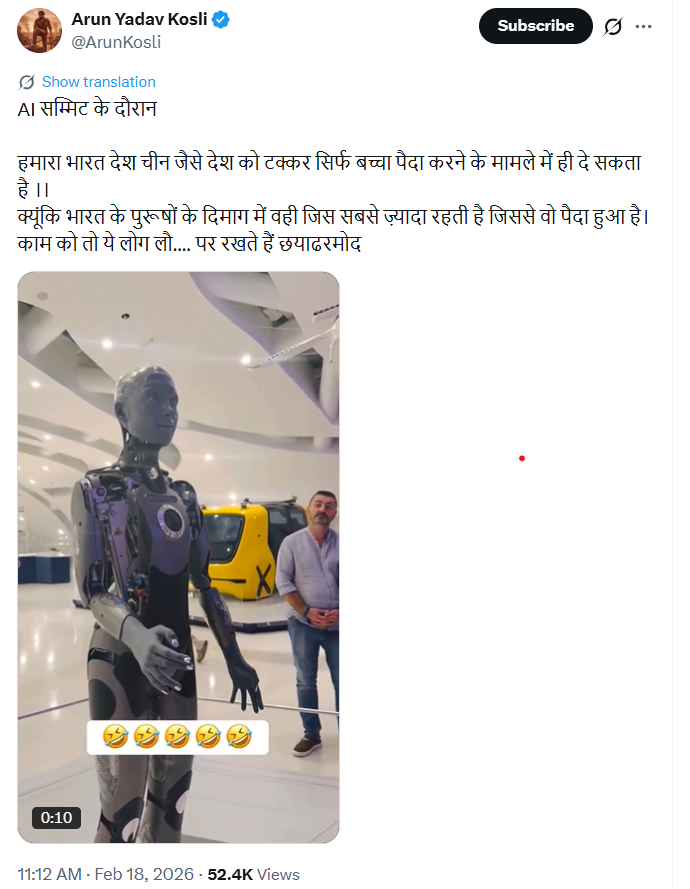
A video circulating widely on social media shows a man interacting with a humanoid robot and using abusive language, after which the robot asks him to maintain politeness. Several users shared the clip claiming that the incident took place during a recent AI summit in New Delhi. The video triggered strong reactions online, with some users demanding legal action against the individual. However, research by CyberPeace found the claim to be misleading.
Claim
Social media users claimed that the viral video showing a man abusing a robot was recorded during an AI summit in New Delhi, India.
Fact Check
To verify the claim, we conducted a reverse image search of the individual seen in the video. The search led us to an Instagram post uploaded by a Pakistani account identifying the individual as Kashif Zameer.

Further keyword searches helped us locate his Instagram profile, where the same video had been uploaded on February 17, 2026. The post included hashtags such as “Dubai,” indicating the actual location of the incident. The profile also lists Lahore, Pakistan, as the user’s location and describes him as a businessman and social media personality.

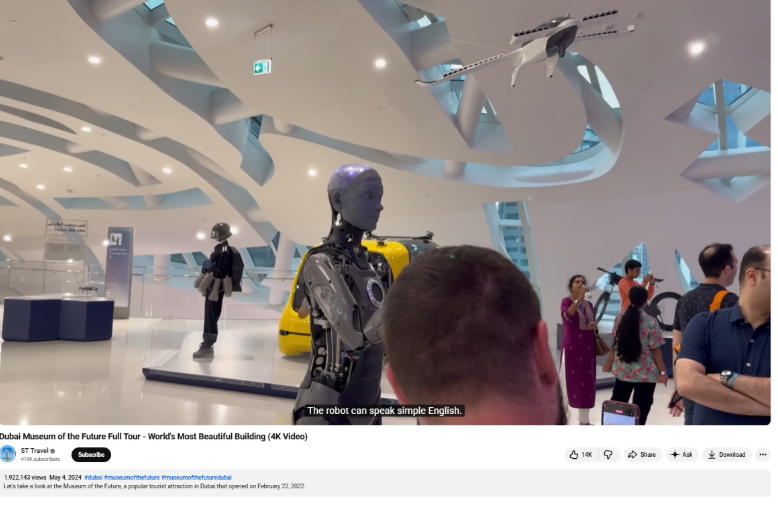
To confirm the location shown in the video, we conducted additional searches using keywords such as “Dubai” and “humanoid robot.” The research revealed that the robot featured in the clip is “Ameca,” located at the Museum of the Future in Dubai.
Conclusion
The viral claim is false. The video is not related to any AI summit held in New Delhi. The incident occurred in Dubai, and the person seen in the video is not an Indian citizen.

Related Blogs

Introduction
In an era where digitalization is transforming every facet of life, ensuring that personal data is protected becomes crucial. The enactment of the Digital Personal Data Protection Act, 2023 (DPDP Act) is a significant step that has been taken by the Indian Parliament which sets forth a comprehensive framework for Digital Personal Data. The Draft Digital Personal Data Protection Rules, 2025 has recently been released for public consultation to supplement the Act and ensure its smooth implementation once finalised. Though noting certain positive aspects, there is still room for addressing certain gaps and multiple aspects under the draft rules that require attention. The DPDP Act, 2023 recognises the individual’s right to protect their personal data providing control over the processing of personal data for lawful purposes. This Act applies to data which is available in digital form as well as data which is not in digital form but is digitalised subsequently. While the Act is intended to offer wide control to the individuals (Data Principal) over their personal information, its impact on vulnerable groups such as ‘Persons with Disabilities’ requires closer scrutiny.
Person with Disabilities as data principal
The term ‘data principal’ has been defined under the DPDP Act under Section 2(j) as a person to whom the personal data is related to, which also includes a person with a disability. A lawful guardian acting on behalf of such person with disability has also been included under the ambit of this definition of Data Principal. As a result, a lawful guardian acting on behalf of a person with disability will have the same rights and responsibilities as a data principal under the Act.
- Section 9 of the DPDP Act, 2023 states that before processing the personal data of a person with a disability who has a lawful guardian, the data fiduciary must obtain verifiable consent from that guardian, ensuring proper protection of the person with disability's data privacy.
- The data principal has the right to access information about personal data under Section 11 which is being processed by the data fiduciary.
- Section 12 provides the right to correction and erasure of personal data by making a request in a manner prescribed by the data fiduciary.
- A right to grievance redressal must be provided to the data principal in respect of any act or omission of performance of obligations by the data fiduciary or the consent manager.
- Under Section 14, the data principal has the right to nominate any other person to exercise the rights provided under the Act in case of death or incapacity.
Provision of consent and its implication
The three key components of Consent that can be identified under the DPDP Act, are:
- Explicit and Informed Consent: Consent given for the processing of data by the data principal or a lawful guardian in case of persons with disabilities must be clear, free and informed as per section 6 of the Act. The data fiduciary must specify the itemised description of the personal data required along with the specified purpose and description of the goods or services that would be provided by such processing of data. (Rule 3 under Draft Digital Personal Data Protection Rules)
- Verifiable Consent: Section 9 of the DPDP Act provides that the data fiduciary needs to obtain verifiable consent of the lawful guardian before processing any personal data of such a person with a disability. Rule 10 of the Draft Rules obligates the data fiduciary to adopt measures to ensure that the consent given by the lawful guardian is verifiable before the is processed.
- Withdrawal of Consent: Data principal or such lawful guardian has the option to withdraw consent for the processing of data at any point by making a request to the data fiduciary.
Although the Act includes certain provisions that focus on the inclusivity of persons with disability, the interpretation of such sections says otherwise.
Concerns related to provisions for Persons with Disabilities under the DPDP Act:
- Lack of definition of ‘person with disabilities’: The DPDP Act or the Draft Rules does not define the term ‘persons with disabilities’. This will create confusion as to which categories of disability are included and up to what percentage. The Rights of Persons with Disabilities Act, 2016 clearly defines ‘person with benchmark disability’, ‘person with disability’ and ‘person with disability having high support needs’. This categorisation is essential to determine up to what extent a person with disability needs a lawful guardian which is missing under the DPDP Act.
- Lack of autonomy: Though the definition of data principal includes persons with disabilities however the decision-making authority has been given to the lawful guardian of such individuals. The section creates ambiguity for people who have a lower percentage of disability and are capable of making their own decisions and have no autonomy in making decisions related to the processing of their personal data because of the lack of clarity in the definition of ‘persons with disabilities’.
- Safeguards for abuse of power by lawful guardian: The lawful guardian once verified by the data fiduciary can make decisions for the persons with disabilities. This raises concerns regarding the potential abuse of power by lawful guardians in relation to the handling of personal data. The DPDP Act does not provide any specific protection against such abuse.
- Difficulty in verification of consent: The consent obtained by the Data Fiduciary must be verified. The process that will be adopted for verification is at the discretion of the data fiduciary according to Rule 10 of the Draft Data Protection Rules. The authenticity of consent is difficult to determine as it is a complex process which lacks a standard format. Also, with the technological advancements, it would be challenging to identify whether the information given to verify the consent is actually true.
CyberPeace Recommendations
The DPDP Act, 2023 is a major step towards making the data protection framework more comprehensive, however, the provisions related to persons with disabilities and powers given to lawful guardians acting on their behalf still need certain clarity and refinement within the DPDP Act framework.
- Consonance of DPDP with Rights of Persons with Disabilities (RPWD) Act, 2016: The RPWD and DPDP Act should supplement each other and can be used to clear the existing ambiguities. Such as the definition of ‘persons with disabilities’ under the RPWD Act can be used in the context of the DPDP Act, 2023.
- Also, there must be certain mechanisms and safeguards within the Act to prevent abuse of power by the lawful guardian. The affected individual in case of suspected abuse of power should have an option to file a complaint with the Data Protection Board and the Board can further take necessary actions to determine whether there is abuse of power or not.
- Regulatory oversight and additional safeguards are required to ensure that consent is obtained in a manner that respects the rights of all individuals, including those with disabilities.
References:
- https://www.meity.gov.in/writereaddata/files/Digital%20Personal%20Data%20Protection%20Act%202023.pdf
- https://www.meity.gov.in/writereaddata/files/259889.pdf
- https://www.indiacode.nic.in/bitstream/123456789/15939/1/the_rights_of_persons_with_disabilities_act%2C_2016.pdf
- https://www.deccanherald.com/opinion/consent-disability-rights-and-data-protection-3143441
- https://www.pacta.in/digital-data-protection-consent-protocols-for-disability.pdf
- https://www.snrlaw.in/indias-new-data-protection-regime-tracking-updates-and-preparing-for-compliance/
.webp)
Executive Summary:
A viral video claims to show a massive cumulonimbus cloud over Gurugram, Haryana, and Delhi NCR on 3rd September 2025. However, our research reveals the claim is misleading. A reverse image search traced the visuals to Lviv, Ukraine, dating back to August 2021. The footage matches earlier reports and was even covered by the Ukrainian news outlet 24 Kanal, which published the story under the headline “Lviv Covered by Unique Thundercloud: Amazing Video”. Thus, the viral claim linking the phenomenon to a recent event in India is false.
Claim:
A viral video circulating on social media claims to show a massive cloud formation over Gurugram, Haryana, and the Delhi NCR region on 3rd September 2025. The cloud appears to be a cumulonimbus formation, which is typically associated with heavy rainfall, thunderstorms, and severe weather conditions.

Fact Check:
After conducting a reverse image search on key frames of the viral video, we found matching visuals from videos that attribute the phenomenon to Lviv, a city in Ukraine. These videos date back to August 2021, thereby debunking the claim that the footage depicts a recent weather event over Gurugram, Haryana, or the Delhi NCR region.


Further research revealed that a Ukrainian news channel named 24 Kanal, had reported on the Lviv thundercloud phenomenon in August 2021. The report was published under the headline “Lviv Covered by Unique Thundercloud: Amazing Video” ( original in Russian, translated into English).

Conclusion:
The viral video does not depict a recent weather event in Gurugram or Delhi NCR, but rather an old incident from Lviv, Ukraine, recorded in August 2021. Verified sources, including Ukrainian media coverage, confirm this. Hence, the circulating claim is misleading and false.
- Claim: Old Thundercloud Video from Lviv city in Ukraine Ukraine (2021) Falsely Linked to Delhi NCR, Gurugram and Haryana.
- Claimed On: Social Media
- Fact Check: False and Misleading.

Introduction
Since February 2020 the government has been taking keen steps to safeguard the Indian markets and the consumer, this could be seen in the forms of policies and exemptions for the market players and the consumers, however, due to the COVID-19 pandemic, the markets places became vulnerable to loss and various forms of new crimes and frauds. The Government recently tabled the Jan Vishwas bill which is an aftermath of the Vivad se Vishwas Bill, 2020 which was tabled in February 2020 for creating a safe and dynamic market, this bill is a clear example of how AtmaNirbhar Bharat plays a crucial role in nations development.
What is Jan Vishwas Bill, 2022
The Jan Vishwas (Amendment of Provisions) Bill, 2022 is a 108-page bill introduced in the Lok Sabha by the Union Minister of Commerce and Industry, Piyush Goyal. The statement of objects and reasons of the Bill states, “To amend certain enactments for decriminalizing and rationalizing minor offenses to further enhance trust-based governance for ease of living and doing business.” The bill aims to promote ease of doing business in India by decriminalizing minor offences and amending 183 provisions in 42 Acts administered by 19 ministries. The bill proposes to replace minor offences with monetary penalties and rationalize existing monetary penalties based on the gravity of the offences. The Acts to be amended by the bill include-
- Drugs and Cosmetics Act, 1940
- Public Debt Act, 1944
- Pharmacy Act, 1948
- Cinematograph Act, 1952
- Copyright Act, 1957
- Patents Act, 1970
- Environment (Protection) Act, 1986
- Motor Vehicles Act, 1988
- Trade Marks Act, 1999l Railways Act, 1989
- Information Technology Act, 2000
- Prevention of Money-laundering Act, 2002
- Food Safety and Standards Act, 2006
- Legal Metrology Act, 2009
- Factoring Regulation Act, 2011
The bill aims to decriminalize a large number of minor offences and replace them with monetary penalties. This step by the government is a clear indication of how important the market regulations are, in recent times Google was imposed with a penalty of 1300 crores and 900 crores for violating competitive market practices, these penalties, and criminalised actions will ensure proper compliance to laws of the land thus creating a blanket of safeguards for the Indian consumer and netizen.
What will the Ease of Business be?
The Government has been critical in pinpointing various parameters and factors to improve the ease of business in the country, this bill comes at the right time when we can see numerous start-ups and entrepreneurs emerging in our country. The parameters are as follows-
- Starting a Business of all
- Dealing with Construction Permits
- Getting Electricity
- Registering Property
- Getting Credit
- Protecting
- Minority Investors
- Paying Taxes
- Trading across Borders
- Enforcing Contracts and Resolving Insolvency
These parameters have been created with a sight on the future of the markets and how external factors like the Russia-Ukraine war can influence the markets. According to Minister Piyush Goyal, the fear of imprisonment for minor offences is a major factor hindering the growth of the business ecosystem and individual confidence in India. The Jan Vishwas Bill, 2022 aims to address this issue by replacing minor offences with monetary penalties. The bill also proposes an increase of 10% in the minimum amount of fine and penalty levied after every three years, once the bill becomes a law.
Conclusion
The bill will create a level playing field for the market players and the consumers with the backing of strong legislation and precedents thus maintaining transparency and accountability in the system. The amended provisions will allow various already existing legislation to come in tune with the current times and emerging technologies. The nation is at a critical juncture to fabricate policies and laws to address the issues and threats of the future and hence such a bill will be the strengthening pillar of the Indian markets and cyber-ecosystem. The Jan Vishwas Bill, 2022 has been referred to a 31-member joint parliamentary committee for scrutiny. The committee includes members from the Lok Sabha and the Rajya Sabha and will submit its report to parliament by the second part of the Budget session in 2023, The members from the Lok Sabha include PP Chaudhary, Sanjay Jaiswal, Queen Ojha, Rajendra Agrawal, Gaurav Gogoi, A Raja, Rajendra Agarwal, Poonam Pramod Mahajan, and Sougata Ray.
