
#FactCheck-Viral Video Falsely Claims ‘Civil War-Like Situation’ in Lucknow; Actually Shows Slum Fire
Executive Summary
A video showing a massive blaze is going viral on social media with the claim that it captures an “attack” in Lucknow, Uttar Pradesh, suggesting that the city is witnessing a civil war-like situation. However, a fact-check by the CyberPeace Research Wing has found the claim to be false and misleading.
Claim
The viral post was shared by an X (formerly Twitter) user ‘@hitorisenshi142’ on April 15, 2026, with an English caption alleging unrest and violence in Lucknow.

To verify the claim, keyframes from the video were extracted and subjected to a reverse image search. This led to a report published by News18 on April 16, 2026, which featured visuals matching the viral clip.

According to the report, the video actually shows a devastating fire that broke out in a slum settlement near Ring Road in Sector-12 of Vikas Nagar, Lucknow. The fire rapidly escalated, engulfing around 1,200 huts and leaving over 200 families affected in the nearly three-bigha area. Firefighting operations were extensive, with 22 fire tenders deployed to control the blaze. The situation was further aggravated as nearly 100 LPG cylinders stored in the huts exploded one after another, intensifying the fire and sending thick black smoke across the area.
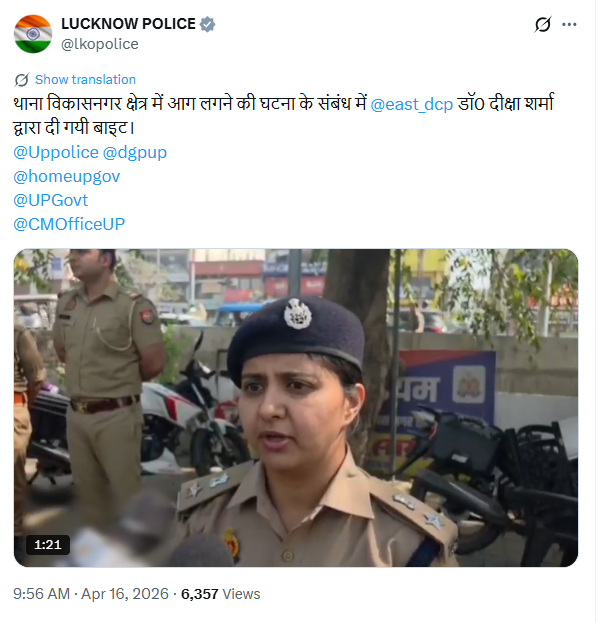
Further confirmation came from the official X account of Lucknow Police, which shared an update on April 16, 2026. The police clarified that the incident was a fire outbreak in the Vikas Nagar area and that the situation had been brought under control.
- https://x.com/lkopolice/status/2044633511584567415?s=20
Conclusion:
The viral claim suggesting that the video depicts an attack or civil war-like situation in Lucknow is false. The footage is from a fire incident in a slum area and is being circulated with misleading context to spread misinformation.

Related Blogs

Introduction
A 33-year-old MBA graduate and 36-year-old software engineer set up the cybercrime hub in one bedroom. They formed the nameless private enterprise two years ago and hired the two youngsters as employees. The police revealed that the fraudsters moved Rs 854 crore rapidly through 84 bank accounts in the last two years. They were using eight mobile phones active during the day and night for their malicious operations. This bad actors group came in the eyes of the police when a 26-year-old woman filed a complaint, she was lured and cheated for Rs 8.5 lakh on the pretext of making small investments for high returns. It led to cyber crime police on their doorstep. The police discovered that they were operating a massive cyber fraud network from that single room, targeting a large number of people for committing cyber fraud through offering investment schemes and luring innocent people.
How cybercrime fraudsters lured the victims?
The Bangalore police have busted a cyber fraud scam worth 854 Crore rupees. And police have arrested 6 accused. These bad actors illegally deceived numerous victims on the pretext of investment schemes. The gang used to lure them through WhatsApp and Telegram. Initially, the people were asked to invest small amounts, promising daily profits ranging from 1 thousand to 5 thousand rupees. As the trust grew, thousands of victims indulged in investments ranging from 1 lack to 10 lack rupees. This Money luring modus operandi was used by the fraudsters to attract them and get the victims to invest more and more. The amount invested by the victims was deposited into various bank accounts by the fraudsters. When the victims tried to withdraw their amount after depositing they were unable to do so. Soon after the amount was received, the accused gang would launder the money and divert it to other accounts.
Be cautious of online investment fraud
It concerns all of us who used to invest online. The Bangalore police have busted cyber crime or cyber investment fraud of 854 crore rupees. The 6 members of the gang that the police have arrested used to approach victims through WhatsApp and telegram to convince them to invest small amounts, from 1 thousand to 10 thousand at the bare minimum and promising them returns or profit amount per day and later lock this amount and diverting it into different bank accounts, ensuring that those get invested never get access to it again. Now, this went on in the country receiving a large number of cases that have been registered from various states in the country.
Advisory and best practices
- It is important to mention that there could be several other cybercrime investment frauds like this that you may not even be aware of. Hence, this incident of massive online investment fraud operated from the IT capital of the country definitely acts as an eye-opener for all of us. We urge people to be cautious and raise the alarm about any such cyber crime or investment fraud that they see in the cyber world today.
- In the age of the internet, where there is a large number of mobile users in the country, and users look for a source of income on the internet and use it to invest their money, it is important to be aware of such fraud and be cautious and take proper precautions before investing in any such online scheme. It is always advisable to invest only in legitimate sources and after conducting due diligence.
- Be cautious and do your research: Whenever you are investing in any scheme or in digital currency, make sure to verify the authenticity or legitimacy of the person or company who is offering such service. Check the reviews, official website, and feedback from authentic sources. Find out whether the agents or brokers who contact you are licensed to operate in your state and are compliant with regulators or other investors.
- Verify the credentials: Check the genuineness by checking the licenses, registration and certification of the person or company offering such services, whether he is authorised or not.
- Be Skeptical of offers which seem to be too good: If it sounds too good, be cautious and inquire about its authenticity, such as unsolicited offers. Be especially careful if you receive an unsolicited pitch to invest in a particular company or see it praised online but if you could not find current financial information about it from independent sources. It could be a fraudulent scheme. It is advisable to compare promised yields with current returns on well-known stock indexes.
- Seek Expert Advice: If you are a beginner in online investment, you may seek advice from reliable resources such as financial advisors who can provide more clarity on aspects of investment and guidance to help you make informed decisions.
- Avoid Unreliable Platforms: Be cautious and stick to authorised established agencies. Be cautious when dealing with a person or company lacking sufficient user reviews and credible security measures.
- Protect yourself online: Protect yourself online. Fraudsters target users on online and social marketing sites and commit various online frauds; hence, it's important to be cautious and protect yourself online. So be cautious and make your own sound decision after all analysis while investing in any such services.
- Report Suspicious Accounts: If you encounter any social media accounts, social media groups or profiles which seem suspicious and engaged in fraudulent services, you must report such profiles to the respective platform immediately.
- Report cyber crimes to law enforcement agencies: A powerful resource available to victims of cybercrime is the National Cyber Crime Reporting Portal, equipped with a 24x7 helpline number, 1930. This portal serves as a centralised platform for reporting cybercrimes, including financial fraud.
Conclusion:
This recent cyber investment fraud worth Rs 854 Crore, orchestrated by a group of fraudsters operating from a single room, serves as a stark reminder of the risks posed by bad actors. This incident underscores the importance of being vigilant when it comes to online investments and financial transactions. As we navigate the vast and interconnected landscape of the internet, it is imperative that we exercise due diligence and employ best practices to protect ourselves. We need to be cautious and protected from falling victim to these fraudulent schemes, actively reporting suspicious accounts and cybercrimes to relevant authorities through resources like the National Cyber Crime Reporting Portal will contribute to helping stop these types of cyber crimes. Knowledge and awareness are some of the biggest factors we have in fighting back against such cyber frauds in this digital age and making a safer digital environment for everyone.
References
- https://www.news18.com/india/bengaluru-cyber-crime-rs-854-crore-84-banks-accounts-fraud-network-one-bedroom-house-yelahanka-karnataka-8618426.html
- https://indianexpress.com/article/cities/bangalore/cyber-crime-bengaluru-links-over-5000-cases-india-8982753/lite/

Introduction
The term ‘super spreader’ is used to refer to social media and digital platform accounts that are able to quickly transmit information to a significantly large audience base in a short duration. The analogy references the medical term, where a small group of individuals is able to rapidly amplify the spread of an infection across a huge population. The fact that a few handful accounts are able to impact and influence many is attributed to a number of factors like large follower bases, high engagement rates, content attractiveness or virality and perceived credibility.
Super spreader accounts have become a considerable threat on social media because they are responsible for generating a large amount of low-credibility material online. These individuals or groups may create or disseminate low-credibility content for a number of reasons, running from social media fame to garnering political influence, from intentionally spreading propaganda to seeking financial gains. Given the exponential reach of these accounts, identifying, tracing and categorising such accounts as the sources of misinformation can be tricky. It can be equally difficult to actually recognise the content they spread for the misinformation that it actually is.
How Do A Few Accounts Spark Widespread Misinformation?
Recent research suggests that misinformation superspreaders, who consistently distribute low-credibility content, may be the primary cause of the issue of widespread misinformation about different topics. A study[1] by a team of social media analysts at Indiana University has found that a significant portion of tweets spreading misinformation are sent by a small percentage of a given user base. The researchers conducted a review of 2,397,388 tweets posted on Twitter (now X) that were flagged as having low credibility and details on who was sending them. The study found that it does not take a lot of influencers to sway the beliefs and opinions of large numbers. This is attributed to the impact of what they describe as superspreaders. The researchers collected 10 months of data, which added up to 2,397,388 tweets sent by 448,103 users, and then reviewed it, looking for tweets that were flagged as containing low-credibility information. They found that approximately a third of the low-credibility tweets had been posted by people using just 10 accounts, and that just 1,000 accounts were responsible for posting approximately 70% of such tweets.[2]
Case Study
- How Misinformation ‘Superspreaders’ Seed False Election Theories
During the 2020 U.S. presidential election, a small group of "repeat spreaders" aggressively pushed false election claims across various social media platforms for political gain, and this even led to rallies and radicalisation in the U.S.[3] Superspreaders accounts were responsible for disseminating a disproportionately large amount of misinformation related to the election, influencing public opinion and potentially undermining the electoral process.
In the domestic context, India was ranked highest for the risk of misinformation and disinformation according to experts surveyed for the World Economic Forum’s 2024 Global Risk Report. In today's digital age, misinformation, deep fakes, and AI-generated fakes pose a significant threat to the integrity of elections and democratic processes worldwide. With 64 countries conducting elections in 2024, the dissemination of false information carries grave implications that could influence outcomes and shape long-term socio-political landscapes. During the 2024 Indian elections, we witnessed a notable surge in deepfake videos of political personalities, raising concerns about the influence of misinformation on election outcomes.
- Role of Superspreaders During Covid-19
Clarity in public health communication is important when any grey areas or gaps in information can be manipulated so quickly. During the COVID-19 pandemic, misinformation related to the virus, vaccines, and public health measures spread rapidly on social media platforms, including Twitter (Now X). Some prominent accounts or popular pages on platforms like Facebook and Twitter(now X) were identified as superspreaders of COVID-19 misinformation, contributing to public confusion and potentially hindering efforts to combat the pandemic.
As per the Center for Countering Digital Hate Inc (US), The "disinformation dozen," a group of 12 prominent anti-vaccine accounts[4], were found to be responsible for a large amount of anti-vaccine content circulating on social media platforms, highlighting the significant role of superspreaders in influencing public perceptions and behaviours during a health crisis.
There are also incidents where users are unknowingly engaged in spreading misinformation by forwarding information or content which are not always shared by the original source but often just propagated by amplifiers, using other sources, websites, or YouTube videos that help in dissemination. The intermediary sharers amplify these messages on their pages, which is where it takes off. Hence such users do not always have to be the ones creating or deliberately popularising the misinformation, but they are the ones who expose more people to it because of their broad reach. This was observed during the pandemic when a handful of people were able to create a heavy digital impact sharing vaccine/virus-related misinformation.
- Role of Superspreaders in Influencing Investments and Finance
Misinformation and rumours in finance may have a considerable influence on stock markets, investor behaviour, and national financial stability. Individuals or accounts with huge followings or influence in the financial niche can operate as superspreaders of erroneous information, potentially leading to market manipulation, panic selling, or incorrect impressions about individual firms or investments.
Superspreaders in the finance domain can cause volatility in markets, affect investor confidence, and even trigger regulatory responses to address the spread of false information that may harm market integrity. In fact, there has been a rise in deepfake videos, and fake endorsements, with multiple social media profiles providing unsanctioned investing advice and directing followers to particular channels. This leads investors into dangerous financial decisions. The issue intensifies when scammers employ deepfake videos of notable personalities to boost their reputation and can actually shape people’s financial decisions.
Bots and Misinformation Spread on Social Media
Bots are automated accounts that are designed to execute certain activities, such as liking, sharing, or retweeting material, and they can broaden the reach of misinformation by swiftly spreading false narratives and adding to the virality of a certain piece of content. They can also artificially boost the popularity of disinformation by posting phony likes, shares, and comments, making it look more genuine and trustworthy to unsuspecting users. Bots can exploit social network algorithms by establishing false identities that interact with one another and with real users, increasing the spread of disinformation and pushing it to the top of users' feeds and search results.
Bots can use current topics or hashtags to introduce misinformation into popular conversations, allowing misleading information to acquire traction and reach a broader audience. They can lead to the construction of echo chambers, in which users are exposed to a narrow variety of perspectives and information, exacerbating the spread of disinformation inside restricted online groups. There are incidents reported where bot's were found as the sharers of content from low-credibility sources.
Bots are frequently employed as part of planned misinformation campaigns designed to propagate false information for political, ideological, or commercial gain. Bots, by automating the distribution of misleading information, can make it impossible to trace the misinformation back to its source. Understanding how bots work and their influence on information ecosystems is critical for combatting disinformation and increasing digital literacy among social media users.
CyberPeace Policy Recommendations
- Recommendations/Advisory for Netizens:
- Educating oneself: Netizens need to stay informed about current events, reliable fact-checking sources, misinformation counter-strategies, and common misinformation tactics, so that they can verify potentially problematic content before sharing.
- Recognising the threats and vulnerabilities: It is important for netizens to understand the consequences of spreading or consuming inaccurate information, fake news, or misinformation. Netizens must be cautious of sensationalised content spreading on social media as it might attempt to provoke strong reactions or to mold public opinions. Netizens must consider questioning the credibility of information, verifying its sources, and developing cognitive skills to identify low-credibility content and counter misinformation.
- Practice caution and skepticism: Netizens are advised to develop a healthy skepticism towards online information, and critically analyse the veracity of all information sources. Before spreading any strong opinions or claims, one must seek supporting evidence, factual data, and expert opinions, and verify and validate claims with reliable sources or fact-checking entities.
- Good netiquette on the Internet, thinking before forwarding any information: It is important for netizens to practice good netiquette in the online information landscape. One must exercise caution while sharing any information, especially if the information seems incorrect, unverified or controversial. It's important to critically examine facts and recognise and understand the implications of sharing false, manipulative, misleading or fake information/content. Netizens must also promote critical thinking and encourage their loved ones to think critically, verify information, seek reliable sources and counter misinformation.
- Adopting and promoting Prebunking and Debunking strategies: Prebunking and debunking are two effective strategies to counter misinformation. Netizens are advised to engage in sharing only accurate information and do fact-checking to debunk any misinformation. They can rely on reputable fact-checking experts/entities who are regularly engaged in producing prebunking and debunking reports and material. Netizens are further advised to familiarise themselves with fact-checking websites, and resources and verify the information.
- Recommendations for tech/social media platforms
- Detect, report and block malicious accounts: Tech/social media platforms must implement strict user authentication mechanisms to verify account holders' identities to minimise the formation of fraudulent or malicious accounts. This is imperative to weed out suspicious social media accounts, misinformation superspreader accounts and bots accounts. Platforms must be capable of analysing public content, especially viral or suspicious content to ascertain whether it is misleading, AI-generated, fake or deliberately misleading. Upon detection, platform operators must block malicious/ superspreader accounts. The same approach must apply to other community guidelines’ violations as well.
- Algorithm Improvements: Tech/social media platform operators must develop and deploy advanced algorithm mechanisms to detect suspicious accounts and recognise repetitive posting of misinformation. They can utilise advanced algorithms to identify such patterns and flag any misleading, inaccurate, or fake information.
- Dedicated Reporting Tools: It is important for the tech/social media platforms to adopt robust policies to take action against social media accounts engaged in malicious activities such as spreading misinformation, disinformation, and propaganda. They must empower users on the platforms to flag/report suspicious accounts, and misleading content or misinformation through user-friendly reporting tools.
- Holistic Approach: The battle against online mis/disinformation necessitates a thorough examination of the processes through which it spreads. This involves investing in information literacy education, modifying algorithms to provide exposure to varied viewpoints, and working on detecting malevolent bots that spread misleading information. Social media sites can employ similar algorithms internally to eliminate accounts that appear to be bots. All stakeholders must encourage digital literacy efforts that enable consumers to critically analyse information, verify sources, and report suspect content. Implementing prebunking and debunking strategies. These efforts can be further supported by collaboration with relevant entities such as cybersecurity experts, fact-checking entities, researchers, policy analysts and the government to combat the misinformation warfare on the Internet.
References:
- https://journals.plos.org/plosone/article?id=10.1371/journal.pone.0302201 {1}
- https://phys.org/news/2024-05-superspreaders-responsible-large-portion-misinformation.html#google_vignette {2}
- https://phys.org/news/2024-05-superspreaders-responsible-large-portion-misinformation.html#google_vignette {3}
- https://counterhate.com/research/the-disinformation-dozen/ {4}
- https://phys.org/news/2024-05-superspreaders-responsible-large-portion-misinformation.html#google_vignette
- https://journals.plos.org/plosone/article?id=10.1371/journal.pone.0302201
- https://www.nytimes.com/2020/11/23/technology/election-misinformation-facebook-twitter.html
- https://www.wbur.org/onpoint/2021/08/06/vaccine-misinformation-and-a-look-inside-the-disinformation-dozen
- https://healthfeedback.org/misinformation-superspreaders-thriving-on-musk-owned-twitter/
- https://www.ncbi.nlm.nih.gov/pmc/articles/PMC8139392/
- https://www.jmir.org/2021/5/e26933/
- https://www.yahoo.com/news/7-ways-avoid-becoming-misinformation-121939834.html
Executive Summary
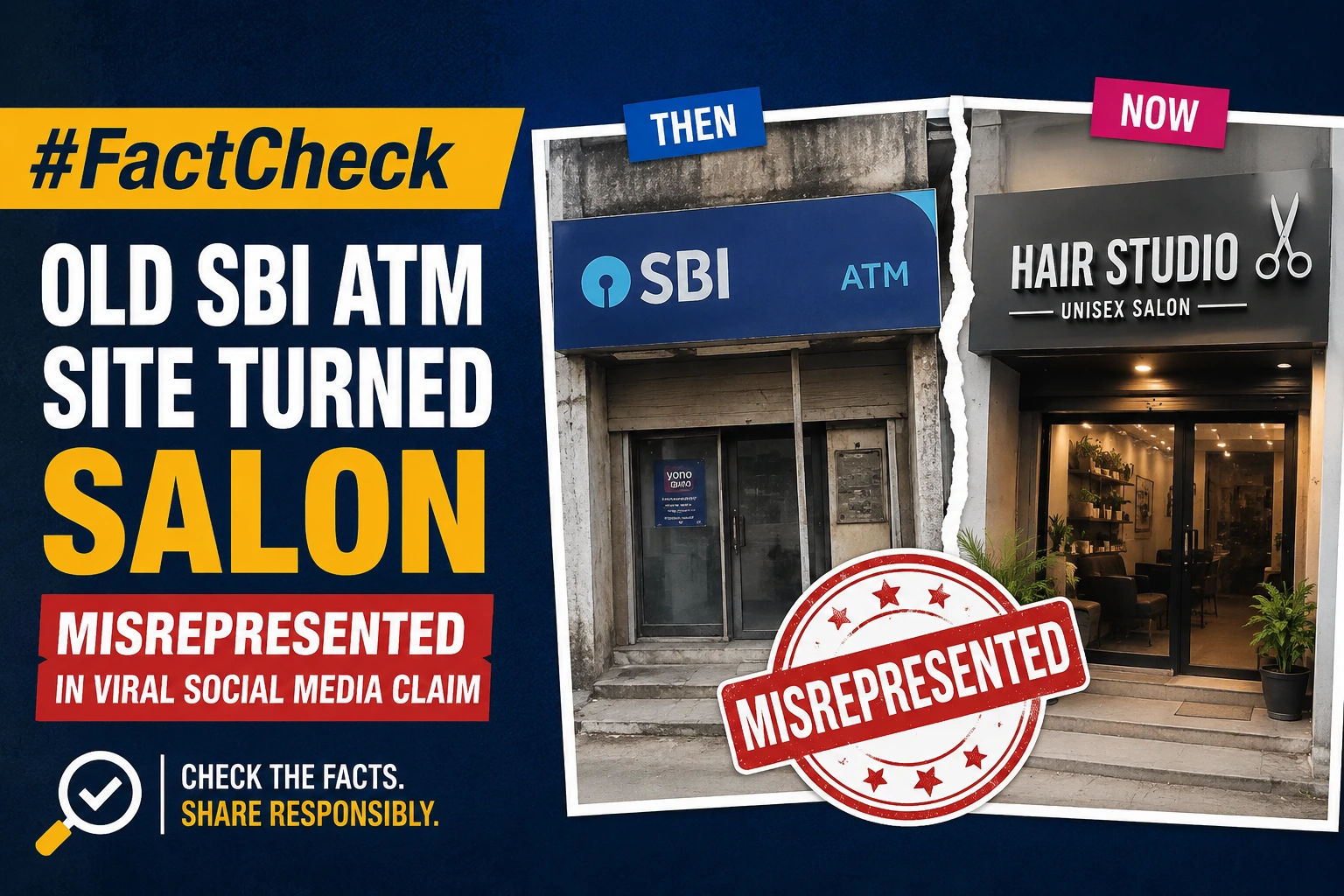
A video is going viral on social media claiming that a salon has been opened inside a State Bank of India (SBI) ATM in Bihar. The video is also being used by some users to take political jibes at the central and state governments led by the Bharatiya Janata Party (BJP). However, the CyberPeace Research Wing’s research has found that this claim is misleading. The location shown in the viral video was earlier an SBI ATM, which had been shut down around six months ago. After the bank discontinued its operations at the site, the ATM machine and other equipment were removed. However, the external structure of the ATM cabin and the SBI signage were not removed at that time. After the premises were vacated, the property owner rented out the space to a salon operator. Since the SBI board and branding were still visible on the structure, the video created confusion and went viral with misleading claims.
Following the circulation of the video, the bank later removed its signage from the location and also cleared all remaining SBI branding from the structure. Our research also found that the bank had removed the ATM machine and equipment months earlier, but the cabin structure and SBI board were left behind. After that, the space was rented out for commercial use as a salon. In this context, it would be incorrect to claim that a salon was opened inside an active SBI ATM.
Claim
A Facebook user ‘Soumitra Roy’ shared a video on 11 May 2026 claiming:
“Someone has opened a barber shop inside an SBI ATM in Bihar. The BJP’s double-engine government has developed Bihar so much that loan EMIs can now be deducted directly inside ATMs. This is Modi’s masterstroke.”
- https://www.facebook.com/reel/980962511535926
- https://perma.cc/WTY2-WEQQ

Fact Check
To verify the viral claim, a keyword search based on the video was conducted. Several media reports were found, which clarified the full context of the incident. A report uploaded on the YouTube channel ‘Live Cities’ on 12 May 2026 stated that a salon was running at a former ATM location in Danapur, Bihar. The bank had already vacated the premises about six months earlier, but its signage had not been removed. The report also includes an interview with the property owner, who confirmed that the bank had removed its ATM machine and equipment six months ago and later the space was rented out to a salon operator.

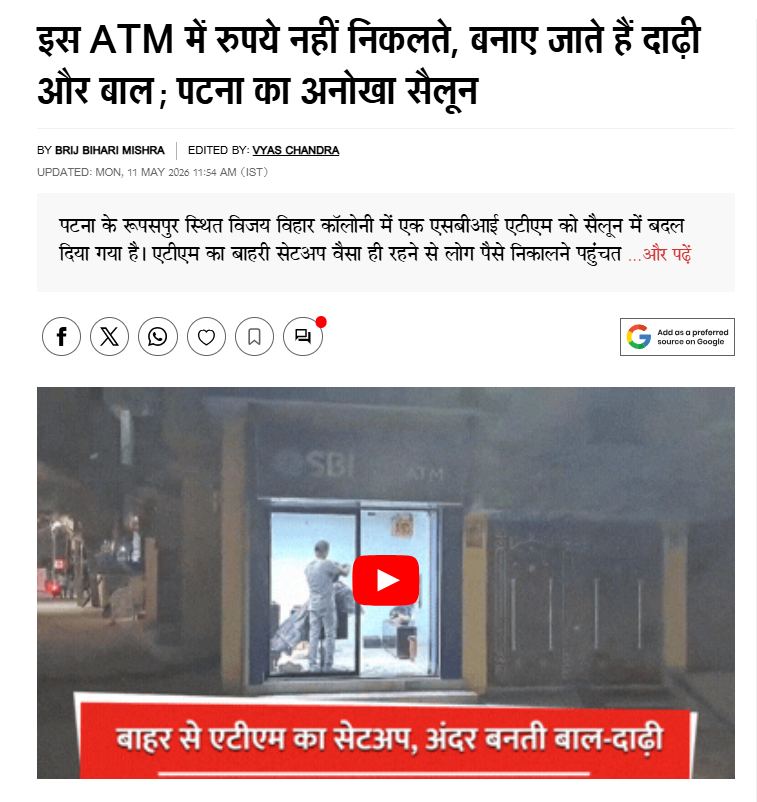
The viral video was also found on the Jagran website in a news report dated 11 May 2026. The report states that an SBI ATM previously existed at the location. The bank had removed the ATM machine due to operational reasons but left behind the external structure and signage. Later, the space was rented out to a salon operator, who began running his business from the same setup.
Conclusion
Our research found that the viral post is misleading. It is incorrect to claim that a salon was opened inside an SBI ATM. The truth is that the bank had shut down the ATM at this location around six months ago and removed all machines and equipment. After that, the premises were rented out to a salon operator, which led to confusion due to the presence of old SBI signage.
