
Passkeys - New Security
Introduction
Apple launched Passkeys with iOS 16 as a more authentic and secure mechanism. It is safer than passwords, and it is more efficient in comparison to passwords. Apple users using iOS 16 passkeys features should enable two-factor authentication. The passkeys are an unchallenging mechanism than the passwords for the passkeys. The user just has to open the apps and websites, and then the biometric sensor automatically recognises the face and fingerprints. There can be a PIN and pattern used to log instead of passwords. The passkeys add an extra coating of protection to the user’s systems against cyber threats like phishing attacks by SMS and one-time password-based. In a report 9 to 5mac, there is confirmation that 95% of users are using passkeys. Also, with the passkeys, users’ experience will be better, and it is a more security-proof mechanism. The passwords were weak, reused credentials and credentials leaked, and the chances of phishing attacks were real.
What are passkeys?
Passkey is a digital key linked to users’ accounts and websites or applications. Passkeys allow the user to log into any application and website without entering passwords, usernames, or other details. The aim of this new feature is to replace the old long pattern of entering passwords for going through any websites and applications.
The passkeys are developed by Microsoft, Apple, and Google together, and it is also called FIDO Authentication (Fast identity online). It eliminates the need to remember passwords and the need for typing. So, the passkeys work as they replace the password with a unique digital key, which is tied to the account then, the key is stored in the device itself, and it is end-to-end encrypted. The passkeys will always be on the sites on which users specifically created them. the passkeys use the technology of cryptography for more security purposes. And the passkeys guarantee against the phish.
And since the passkeys follow FIDO standards so, this also can be used for third-party nonapple devices as the third-party device generate a QR code that enables the iOS user to scan that to log in. It will recognise the face of the person for authentication and then asks for permission on another device to deny or allow.
How are passkeys more secure than passwords?
The passkeys follow the public key cryptographic protocols that support the security keys, and they work against phishing and other cyber threats. It is more secure than SMS and apps based on one-time passwords. And another type of multi-factor authentication.
Why are passwords insecure?
The users create passwords easily, and it is wondering if they are secure. The very important passwords are short and easy to crack as they generally relate to the user’s personal information or popular words. One password is reused by the user to the different accounts, and then, in this case, hacking one account gives access to all accounts to the hackers. The problem is that passwords have inherent flaws, like they could be easily stolen.
Are passkeys about to become obligatory?
Many websites restrict the type of passwords, as some websites ask for mixtures of numbers and symbols, and many websites ask for two-factor authentication. There is no surety about the obligation of passkeys widespread as it is still a new concept and it will take time, so it is going to be optional for a while.
- There was a case of a Heartland payment system data breach, and Heartland was handling over 100 million monthly credit card transactions for 175,000 retailers at the time of the incident. Visa and MasterCard detected the hack in January 2009 when they notified Heartland of suspicious transactions. And this happened due to a password breach. The corporation paid an estimated $145 million in settlement for illegal payments. Today, data-driven breaches affect millions of people’s personal information.
- GoDaddy reported a security attack in November that affected the accounts of over a million of its WordPress customers. The attacker acquired unauthorised access to GoDaddy’s Managed WordPress hosting environment by hacking into the provisioning system in the company’s legacy Managed WordPress code.
Conclusion
The use of strong and unique passwords is an essential requirement to safeguard information and data from cyberattacks, but still, passwords have its own disadvantages. And by the replacement of passwords, a passkey, a digital key that ensures proper safety and there is security against cyberattacks and cybercrimes through passkey. There are cases above-mentioned that happened due to the password’s weaker security. And in this technology world, there is a need for something for protection and prevention from cybercrimes, and the world dumps passwords and adopts passkeys.
References
- https://www.cnet.com/tech/mobile/switch-to-passkeys-more-secure-than-passwords-on-ios-16-iphone-14/
- https://economictimes.indiatimes.com/magazines/panache/google-is-ending-passwords-rolls-out-passkeys-for-easy-log-in-how-to-set-it/articleshow/99988444.cms?from=mdr
- https://security.googleblog.com/2023/05/making-authentication-faster-than-ever.html#:~:text=Because%20they%20are%20based%20on,%2Dfactor%20authentication%20(MFA).

Related Blogs

Introduction
February marks the beginning of Valentine’s Week, the time when we transcend from the season of smog to the season of love. This is a time when young people are more active on social media and dating apps with the hope of finding a partner to celebrate the occasion. Dating Apps, in order to capitalise on this occasion, launch special offers and campaigns to attract new users and string on the current users with the aspiration of finding their ideal partner. However, with the growing popularity of online dating, the tactics of cybercriminals have also penetrated this sphere. Scammers are now becoming increasingly sophisticated in manipulating individuals on digital platforms, often engaging in scams, identity theft, and financial fraud under the guise of romance. As love fills the air, netizens must stay vigilant and cautious while searching for a connection online and not fall into a scammer’s trap.
Here Are Some CyberPeace Tips To Avoid Romance Scams
- Recognize Red Flags of Romance Scams:- Online dating has made it easier to connect with people, but it has also become a tool for scammers to exploit the emotions of netizens for financial gain. They create fake profiles, build trust quickly, and then manipulate victims into sending money. Understanding their tactics can help you stay safe.
- Warning Signs of a Romance Scam:- If someone expresses strong feelings too soon, it’s a red flag. Scammers often claim to have fallen in love within days or weeks, despite never meeting in person. They use emotional pressure to create a false sense of connection. Their messages might seem off. Scammers often copy-paste scripted responses, making conversations feel unnatural. Poor grammar, inconsistencies in their stories, or vague answers are warning signs. Asking for money is the biggest red flag. They might have an emergency, a visa issue, or an investment opportunity they want you to help with. No legitimate relationship starts with financial requests.
- Manipulative Tactics Used by Scammers:- Scammers use love bombing to gain trust. They flood you with compliments, calling you their soulmate or destiny. This is meant to make you emotionally attached. They often share fake sob stories. It could be anything ranging from losing a loved one, facing a medical emergency, or even being stuck in a foreign country. These are designed to make you feel sorry for them and more willing to help. Some of these scammers might even pretend to be wealthy, being investors or successful business owners, showing off their fabricated luxury lifestyle in order to appear credible. Eventually, they’ll try to lure you into a fake investment. They create a sense of urgency. Whether it’s sending money, investing, or sharing personal details, scammers will push you to act fast. This prevents you from thinking critically or verifying your claims.
- Financial Frauds Linked to Romance Scams:- Romance scams have often led to financial fraud. Victims may be tricked into sending money directly or get roped into elaborate schemes. One common scam is the disappearing date, where someone insists on dining at an expensive restaurant, only to vanish before the bill arrives. Crypto scams are another major concern. Scammers convince victims to invest in fake cryptocurrency platforms, promising huge returns. Once the money is sent, the scammer disappears, leaving the victim with nothing.
- AI & Deepfake Risks in Online Dating:- Advancements in AI have made scams even more convincing. Scammers use AI-generated photos to create flawless, yet fake, profile pictures. These images often lack natural imperfections, making them hard to spot. Deepfake technology is also being used for video calls. Some scammers use pre-recorded AI-generated videos to fake live interactions. If a person’s expressions don’t match their words or their screen glitches oddly, it could be a deepfake.
- How to Stay Safe:-
- Always verify the identities of those who contact you on these sites. A simple reverse image search can reveal if someone’s profile picture is stolen.
- Avoid clicking suspicious links or downloading unknown apps sent by strangers. These can be used to steal your personal information.
- Trust your instincts. If something feels off, it probably is. Stay alert and protect yourself from online romance scams.
Best Online Safety Practices
- Prioritize Social Media Privacy:- Review and update your privacy settings regularly. Think before you share and be mindful of who can see your posts/stories. Avoid oversharing personal details.
- Report Suspicious Activities:- Even if a scam attempt doesn’t succeed, report it. Indian Cyber Crime Coordination Centre (I4C) 'Report Suspect' feature allow users to flag potential threats, helping prevent cybercrimes.
- Think Before You Click or Download:- Avoid clicking on unknown links or downloading attachments from unverified sources. These can be traps leading to phishing scams or malware attacks.
- Protect Your Personal Information:- Be cautious with whom and how you share your sensitive details online. Cybercriminals exploit even the smallest data points to orchestrate fraud.

Executive Summary
A ‘deep depression’ formed over the Bay of Bengal made landfall along the Andhra Pradesh and Odisha coasts in late September 2026, affecting several districts. A video is going viral on social media in connection with the weather system, purportedly showing its impact. Some users are sharing the video claiming that it shows the effects of the storm in Odisha. CyberPeace Research fact-checked the viral claim and found that the impact of the storm was reported in Andhra Pradesh, Odisha, Telangana and Chhattisgarh. However, the viral video showing the destruction caused by the storm is actually from Bhadradri Kothagudem in Telangana.
Claim
Instagram user ‘deepak_.pandey900’ posted a video on September 24, 2026, along with an archive link, claiming that “Cyclone Arnab, which formed over the Bay of Bengal, made landfall along the north Andhra Pradesh and south Odisha coasts between 11 pm and 1 am. Heavy rainfall is occurring in the coastal districts of both states due to its impact. Schools have been closed in 10 districts of southern Odisha, and around 5,000 people have been shifted to safer locations. Traffic was disrupted after four bridges in Malkangiri were submerged, and the National Highway was also closed as a precautionary measure. Strong winds caused 10 fishing boats to sink and dozens of others to be damaged in Bhadrak.”
https://www.instagram.com/deepak_.pandey900/reel/DdrZwOaBYjd

Fact Check
To verify the viral claim, we first conducted a Google Lens search using keyframes extracted from the video. X user ‘Telangana365’ shared the video on September 23, 2026, with the caption: “The ‘Arnab cyclone’ has caused massive destruction in Morampalli Banjara of Burgampadu mandal in Bhadradri Kothagudem district. The situation is such that it is difficult to understand what is happening. It is completely dark, with heavy dust and dark clouds all around. According to the victims, they witnessed a terrifying scene. Strong winds uprooted trees and blew away thatched roofs... people were even thrown some distance by the gusts of wind. Fortunately, they suffered only minor injuries.”
https://x.com/Telangana365/status/2102743504715907406?s=20

The video was also posted on the YouTube channel ‘TV2_NEWS’ on September 23, 2026, identifying it as footage from Burgampadu mandal in Telangana.

A report published on the website of Telangana-based news portal ‘Big TV’ on September 24, 2026, used a keyframe from the video. According to the report, “Cyclone Arnab, which formed over the Bay of Bengal, has caused widespread destruction. Its impact has been felt not only in Odisha and Andhra Pradesh but also significantly in Telangana. The cyclone caused destruction in Bhadradri Kothagudem district soon after crossing the coast. It suddenly wreaked havoc in Morampalli Banjara of Burgampadu mandal. Heavy rainfall and strong winds engulfed the area. Several people were injured during the incident.”

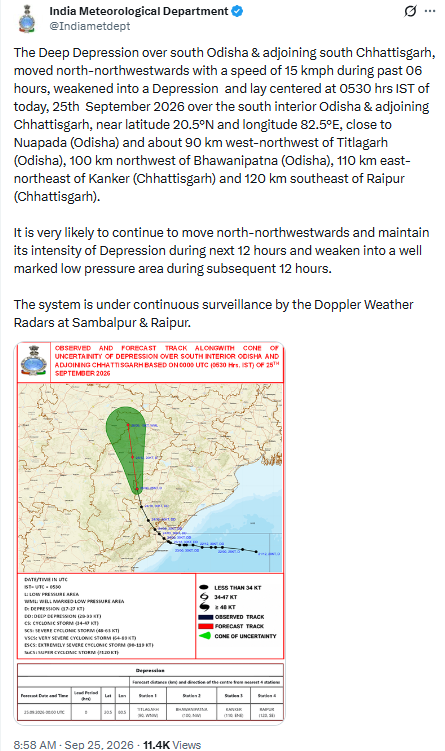
According to information shared by the India Meteorological Department (IMD) on its X handle at around 9 am on September 25, 2026, “The Deep Depression over south Odisha and adjoining south Chhattisgarh moved north-northwestwards at a speed of 15 kmph during the past six hours. It weakened into a Depression and lay centred at 5:30 am on September 25, 2026, over interior south Odisha and adjoining Chhattisgarh. It is very likely to continue moving north-northwestwards and maintain its intensity as a Depression for the next 12 hours. Thereafter, it is expected to weaken into a Well-Marked Low Pressure Area during the subsequent 12 hours.”
Conclusion:
The Deep Depression that formed over the Bay of Bengal caused heavy rainfall in Andhra Pradesh, Telangana and Odisha. However, the viral video showing the destruction caused by the storm is actually from Telangana.

Executive Summary:
A new threat being uncovered in today’s threat landscape is that while threat actors took an average of one hour and seven minutes to leverage Proof-of-Concept(PoC) exploits after they went public, now the time is at a record low of 22 minutes. This incredibly fast exploitation means that there is very limited time for organizations’ IT departments to address these issues and close the leaks before they are exploited. Cloudflare released the Application Security report which shows that the attack percentage is more often higher than the rate at which individuals invent and develop security countermeasures like the WAF rules and software patches. In one case, Cloudflare noted an attacker using a PoC-based attack within a mere 22 minutes from the moment it was released, leaving almost no time for a remediation window.
Despite the constant growth of vulnerabilities in various applications and systems, the share of exploited vulnerabilities, which are accompanied by some level of public exploit or PoC code, has remained relatively stable over the past several years and fluctuates around 50%. These vulnerabilities with publicly known exploit code, 41% was initially attacked in the zero-day mode while of those with no known code, 84% was first attacked in the same mode.
Modus Operandi:
The modus operandi of the attack involving the rapid weaponization of proof-of-concept (PoC) exploits is characterized by the following steps:
- Vulnerability Identification: Threat actors bring together the exploitation of a system vulnerability that may be in the software or hardware of the system; this may be a code error, design failure, or a configuration error. This is normally achieved using vulnerability scanners and test procedures that have to be performed manually.
- Vulnerability Analysis: After the vulnerability is identified, the attackers study how it operates to determine when and how it can be triggered and what consequences that action will have. This means that one needs to analyze the details of the PoC code or system to find out the connection sequence that leads to vulnerability exploitation.
- Exploit Code Development: Being aware of the weakness, the attackers develop a small program or script denoted as the PoC that addresses exclusively the identified vulnerability and manipulates it in a moderated manner. This particular code is meant to be utilized in showing a particular penalty, which could be unauthorized access or alteration of data.
- Public Disclosure and Weaponization: The PoC exploit is released which is frequently done shortly after the vulnerability has been announced to the public. This makes it easier for the attackers to exploit it while waiting for the software developer to release the patch. To illustrate, Cloudflare has spotted an attacker using the PoC-based exploit 22 minutes after the publication only.
- Attack Execution: The attackers then use the weaponized PoC exploit to attack systems which are known to be vulnerable to it. Some of the actions that are tried in this context are attempts at running remote code, unauthorized access and so on. The pace at which it happens is often much faster than the pace at which humans put in place proper security defense mechanisms, such as the WAF rules or software application fixes.
- Targeted Operations: Sometimes, they act as if it’s a planned operation, where the attackers are selective in the system or organization to attack. For example, exploitation of CVE-2022-47966 in ManageEngine software was used during the espionage subprocess, where to perform such activity, the attackers used the mentioned vulnerability to install tools and malware connected with espionage.
Precautions: Mitigation
Following are the mitigating measures against the PoC Exploits:
1. Fast Patching and New Vulnerability Handling
- Introduce proper patching procedures to address quickly the security released updates and disclosed vulnerabilities.
- Focus should be made on the patching of those vulnerabilities that are observed to be having available PoC exploits, which often risks being exploited almost immediately.
- It is necessary to frequently check for the new vulnerability disclosures and PoC releases and have a prepared incident response plan for this purpose.
2. Leverage AI-Powered Security Tools
- Employ intelligent security applications which can easily generate desirable protection rules and signatures as attackers ramp up the weaponization of PoC exploits.
- Step up use of artificial intelligence (AI) - fueled endpoint detection and response (EDR) applications to quickly detect and mitigate the attempts.
- Integrate Artificial Intelligence based SIEM tools to Detect & analyze Indicators of compromise to form faster reaction.
3. Network Segmentation and Hardening
- Use strong networking segregation to prevent the attacker’s movement across the network and also restrict the effects of successful attacks.
- Secure any that are accessible from the internet, and service or protocols such as RDP, CIFS, or Active directory.
- Limit the usage of native scripting applications as much as possible because cyber attackers may exploit them.
4. Vulnerability Disclosure and PoC Management
- Inform the vendors of the bugs and PoC exploits and make sure there is a common understanding of when they are reported, to ensure fast response and mitigation.
- It is suggested to incorporate mechanisms like digital signing and encryption for managing and distributing PoC exploits to prevent them from being accessed by unauthorized persons.
- Exploits used in PoC should be simple and independent with clear and meaningful variable and function names that help reduce time spent on triage and remediation.
5. Risk Assessment and Response to Incidents
- Maintain constant supervision of the environment with an intention of identifying signs of a compromise, as well as, attempts of exploitation.
- Support a frequent detection, analysis and fighting of threats, which use PoC exploits into the system and its components.
- Regularly communicate with security researchers and vendors to understand the existing threats and how to prevent them.
Conclusion:
The rapid process of monetization of Proof of Concept (POC) exploits is one of the most innovative and constantly expanding global threats to cybersecurity at the present moment. Cyber security experts must react quickly while applying a patch, incorporate AI to their security tools, efficiently subdivide their networks and always heed their vulnerability announcements. Stronger incident response plan would aid in handling these kinds of menaces. Hence, applying measures mentioned above, the organizations will be able to prevent the acceleration of turning PoC exploits into weapons and the probability of neutral affecting cyber attacks.
Reference:
https://www.mayrhofer.eu.org/post/vulnerability-disclosure-is-positive/
https://www.uptycs.com/blog/new-poc-exploit-backdoor-malware
https://www.balbix.com/insights/attack-vectors-and-breach-methods/
https://blog.cloudflare.com/application-security-report-2024-update
